10 AI Prospecting Tools Operators Actually Use in 2026
Most advice on AI prospecting tools starts with a vendor ranking. That's the wrong starting point. The central question is which layer of the prospecting motion is broken: account discovery, enrichment, outreach execution, or the handoffs between them.
In 2026, an AI prospecting tool can find accounts, research contacts, detect buying signals, score leads, generate outreach, manage replies, and write activity back to the CRM. Some tools handle one job well. Others combine several jobs but leave operators responsible for the gaps.
The market falls into four practical buying categories:
- Agent canvas: flexible systems for composing research and prospecting workflows.
- Workflow OS: systems that coordinate data, agents, playbooks, approvals, and reporting.
- Data led: platforms whose main advantage is contact, company, phone, intent, or enrichment data.
- Engagement led: tools built around sequences, inboxes, calling, conversation intelligence, and sales execution.
This list judges each tool by an operator test. Can it produce useful prospects, preserve data quality, fit the team's existing motion, and make human accountability clearer rather than less clear?
AI adoption is no longer an edge case. Salesforce's 2026 State of Sales research found that 87% of sales organizations use AI somewhere across the sales cycle, while 54% of sellers had already used AI agents. The practical implication is simple: buyers should compare workflow fit and control, not just ask whether a tool has an AI feature.
Teams comparing vendors should also compare sales intelligence platforms by the job each one owns. That exposes the difference between buying a useful layer and buying another disconnected tab.
Table of Contents
- 1. Yalc
- 2. Clay
- 3. Apollo.io
- 4. Cognism
- 5. 6sense Revenue AI
- 6. Outreach
- 7. Salesloft
- 8. Amplemarket
- 9. Reply.io with Jason AI
- 10. LeadIQ
- Top 10 AI Prospecting Tools, Feature Comparison
- Choosing an AI Prospecting Tool Without Buying the Wrong Layer
1. Yalc
Category: Workflow OS
Best for: B2B startups, scaleups, RevOps teams, growth teams, agencies, and operators who want an owned GTM system
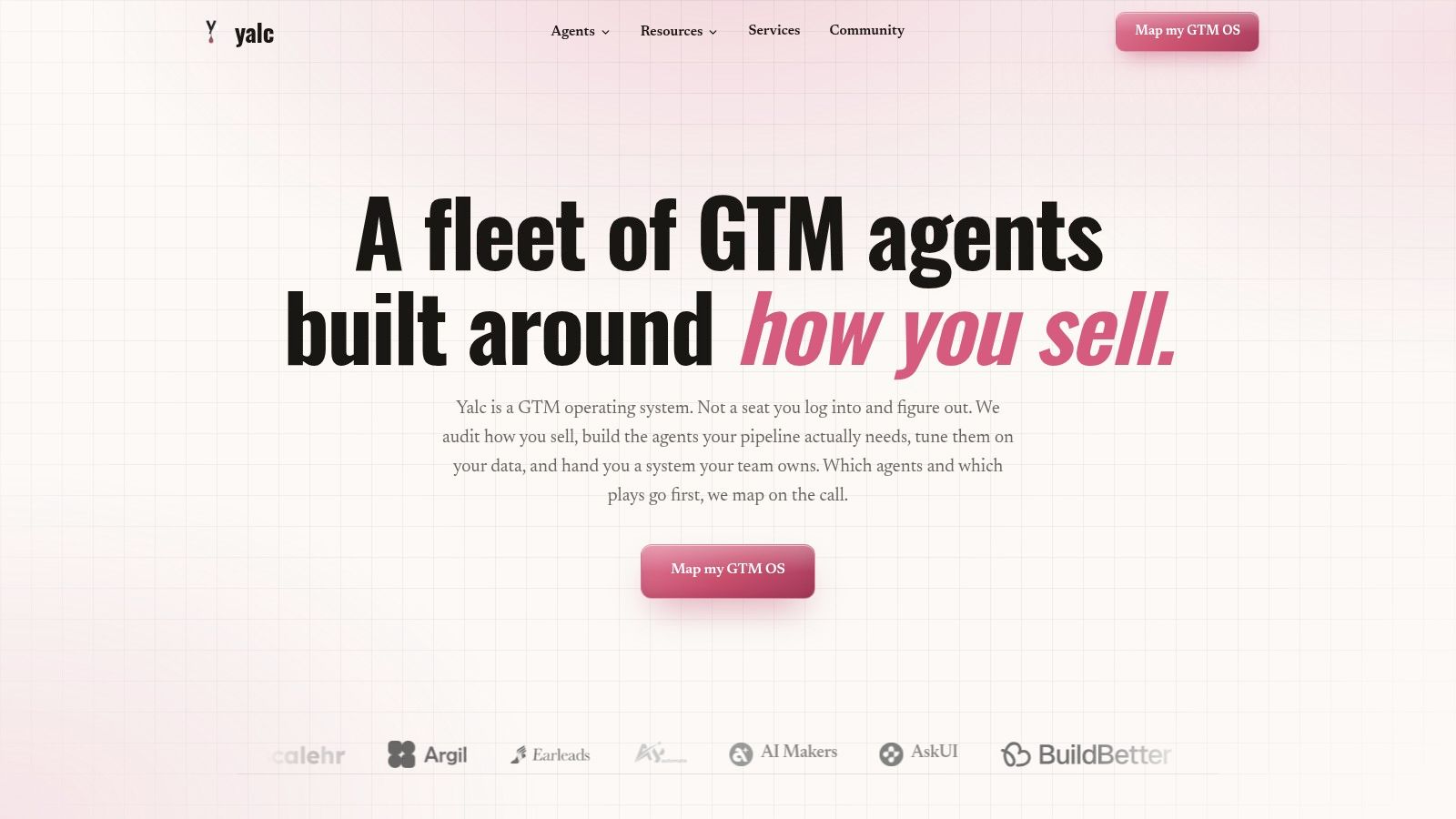
Yalc fits teams that need prospecting to connect with a broader revenue motion. In practice, one team can run research, enrichment, sequencing, reply handling, CRM actions, and reporting without exporting work between several disconnected tools. The underlying GTM API, AI agents, reusable playbooks, and integrations keep those steps in the same operating layer.
The main advantage is control. Operators can run configured playbooks from Slack or the UI. Technical users can compose custom plays and atomic skills through the Yalc MCP in Claude Code. Both interfaces use the same data, GTM knowledge, and accumulated campaign intelligence, which reduces the risk of building separate logic for each channel.
Its play library covers prospecting, lead qualification, LinkedIn scraping, visitor pipelines, enrichment, ICP scoring, campaign building, sequence execution, reply handling, CRM cleanup, competitive intelligence, and SEO auditing. Each campaign begins with a hypothesis and defined success metrics. Yalc records the outcome, promotes stronger plays from hypothesis to validated to proven, and retires weak ones.
Where Yalc earns its place
Yalc is a poor fit for a solo operator who only needs a contact list and an email sequence. Setup requires implementation work, usable integrations, and a team willing to let engineers configure the system around its actual GTM motion.
That work pays off when a team is tired of manually connecting data providers, sequencers, CRM actions, chat tools, and reporting. Yalc runs on infrastructure the customer controls, applies scoped permissions, records step by step telemetry, and pauses sensitive actions for approval.
Practical rule: Treat prospecting automation as a controlled operating process, not an unlimited sending button.
Yalc is delivered as a product and service. The engagement includes an audit of the existing motion, forward deployed engineering support, installation on controlled infrastructure, data and integration wiring, playbook configuration, team walkthroughs, and ongoing tuning. This suits teams that want operational IP they can own, rather than another rented point tool.
Pros
- Workflow ownership: Teams can compose and version plays instead of accepting fixed vendor steps.
- Tool interoperability: Data providers, CRMs, channels, and models can sit behind one interface.
- Auditability: Scoped access, approval gates, and telemetry make agent activity reviewable.
- Compounding intelligence: Campaign outcomes inform later play selection and quality control.
Cons
- Higher implementation burden: A custom build takes more time than activating an off-the-shelf sequencer.
- Data readiness matters: Fragmented CRM records and weak integrations reduce orchestration value.
- Potentially too broad: Very small teams may only need a data or engagement layer.
2. Clay
Category: Agent canvas
Best for: GTM engineering and RevOps teams that need flexible enrichment workflows
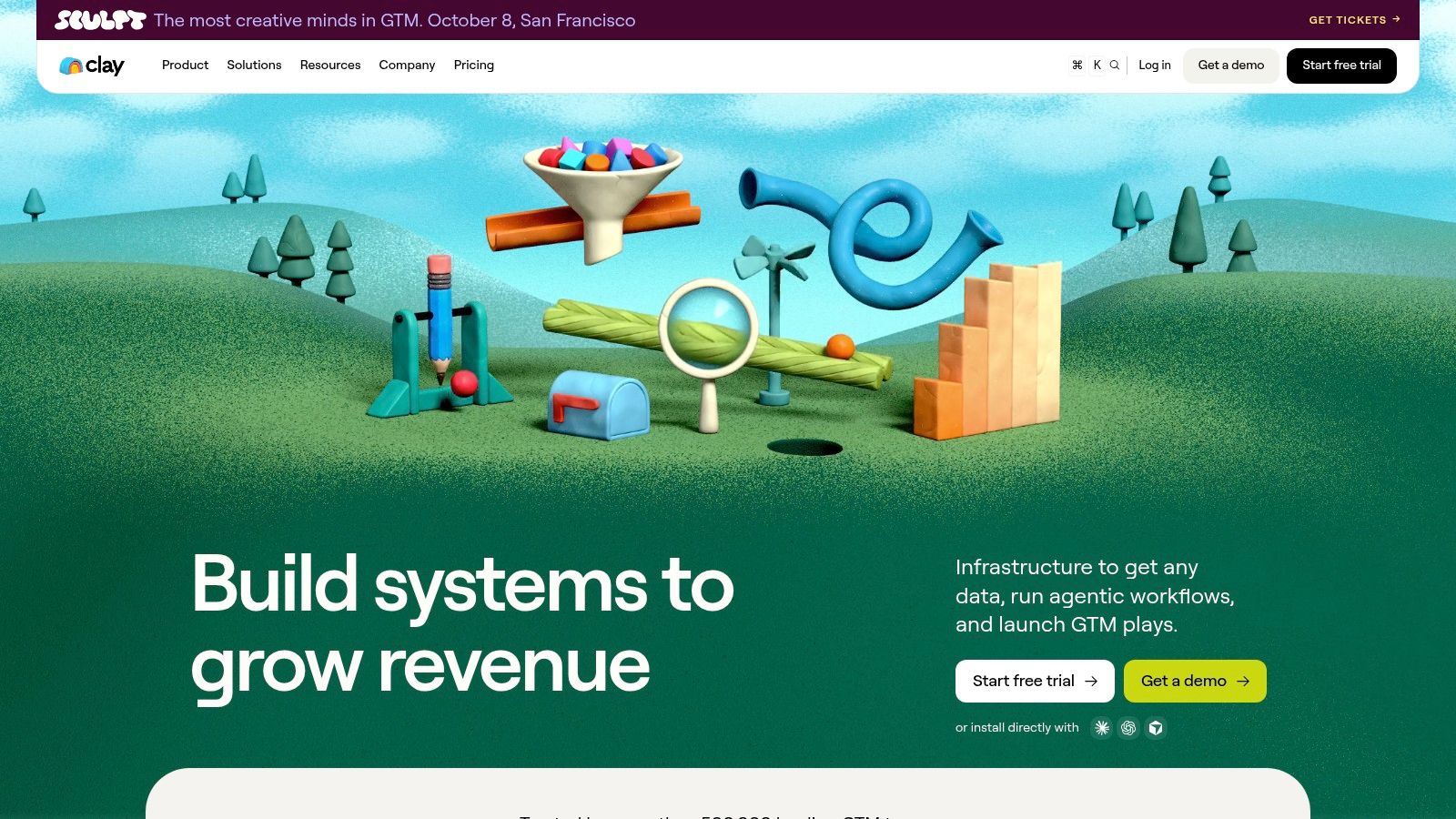
Clay is a programmable prospecting canvas. It finds and enriches accounts, researches contacts, applies scoring logic, and triggers downstream actions without forcing the operator into a fixed workflow.
Claygent performs live web research, while the platform connects to more than 100 enrichment sources and supports bring your own API keys. That combination gives operators control over the data supply chain. A team can decide which provider handles email, phone, firmographics, technographics, or company research instead of accepting one database as the answer to every problem.
The trade off is operational. Clay gives a capable operator a canvas, not a finished prospecting department. Someone still needs to design flows, manage credits, inspect enrichment quality, handle duplicate logic, and maintain downstream integrations. Its action and credit model gives useful cost control, but forecasting spend requires understanding how each workflow consumes resources.
Clay works best when the team's problem is unusual data logic. For example, a RevOps operator can combine firmographic filters, web research, hiring signals, enrichment waterfalls, and custom scoring before passing a selected list to an engagement tool.
Teams comparing it with a broader operating layer can review Clay alternatives for GTM workflows.
Pros
- Flexible composition: Operators can build workflows around a specific ICP and data problem.
- Broad enrichment access: Multiple providers reduce dependence on a single database.
- Developer friendly control: API keys and governed connections support custom infrastructure.
Cons
- Requires maintenance: DIY workflows need an owner after launch.
- Execution is secondary: Teams usually need another platform for serious multichannel engagement.
- Cost needs monitoring: Credits and actions can make poorly designed workflows expensive.
3. Apollo.io
Category: Data led and engagement led
Best for: Small and mid market teams that want data and outreach in one platform
Apollo.io is the practical choice for teams that want to move from an empty CRM to a live campaign quickly. It combines a B2B lead database with filters, recommendations, a Chrome assistant, multichannel sequences, a dialer, inbox tools, tasks, and basic pipeline functions.
Its appeal is not architectural sophistication. It's the short distance between finding a contact and enrolling that contact in a sequence. A small sales team can search by company, role, geography, or other attributes, inspect a record, draft outreach, and launch without assembling several separate products.
That convenience creates governance work at scale. Operators need rules for duplicate records, credit consumption, bounced contacts, suppression lists, and regional compliance. Apollo is useful when speed to first campaign matters, but it shouldn't become the source of truth without a clear CRM and data ownership policy.
The platform's AI can help with writing, recommendations, and campaign workflows. It still needs a precise ICP and human review. A generic database plus generic copy will produce generic outreach.
For teams considering a broader operating model, see Apollo alternatives for prospecting operations.
Pros
- Fast activation: Teams can move from discovery to outreach in one environment.
- Broad functionality: Database, sequences, dialer, inbox, and basic pipeline tools sit together.
- Good starting point: It suits teams that don't yet need a custom data architecture.
Cons
- Data governance is essential: Credit use and record quality need active oversight.
- Advanced regional needs: Teams with demanding EMEA compliance requirements may need a specialist data provider.
- Limited orchestration depth: Complex cross system playbooks can outgrow the native workflow.
4. Cognism
Category: Data led
Best for: EMEA teams and phone heavy outbound motions
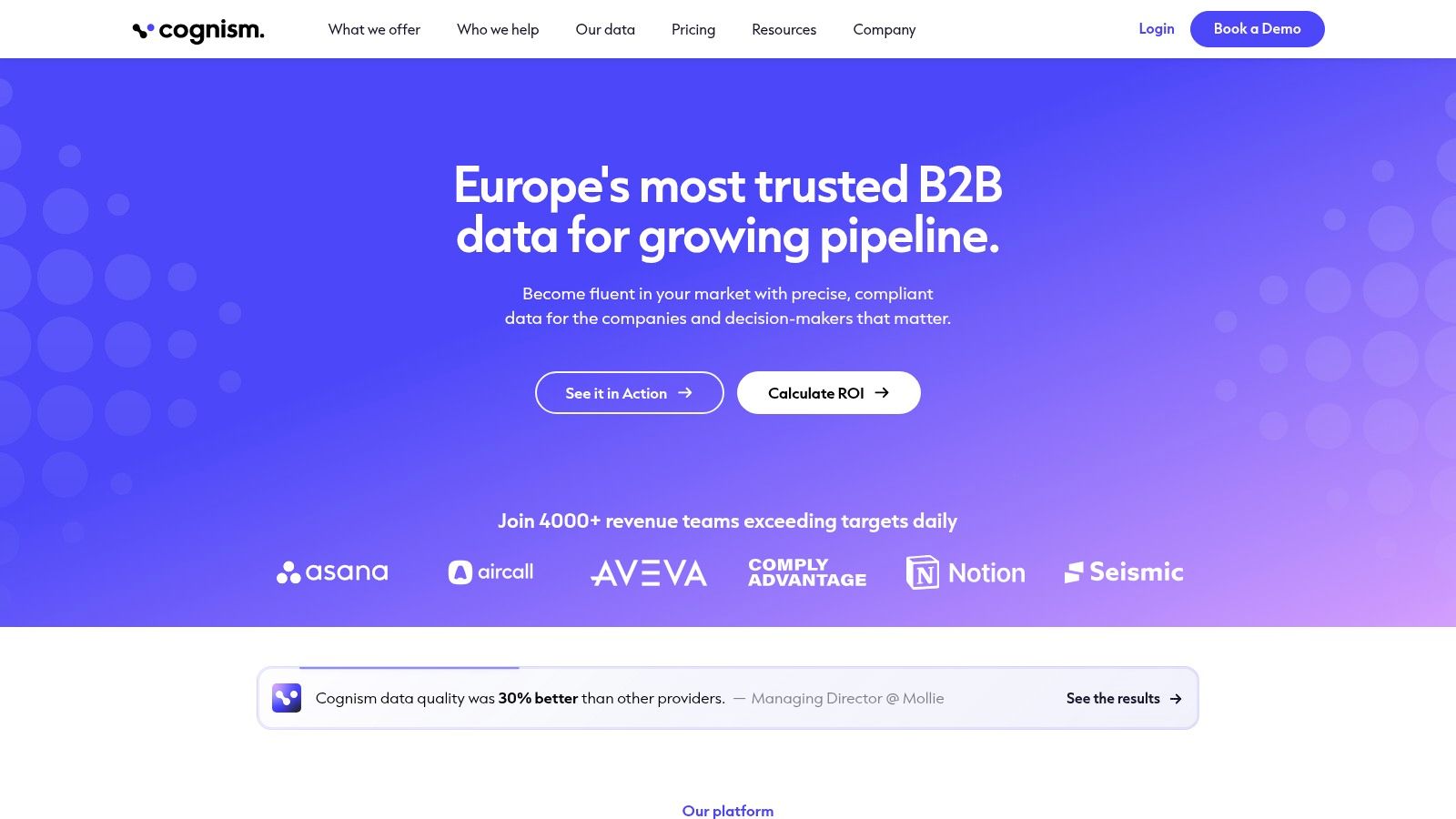
Cognism is a premium data provider built around validated contact information, phone coverage, and compliance focused workflows. Its Diamond Data combines AI assisted verification with human research to support teams that care about reaching real mobile numbers rather than just collecting more records.
The platform is particularly relevant for European outbound. GDPR and CCPA focused controls, a data processing agreement, APIs, and integrations help teams embed contact data into their existing CRM, enrichment, and engagement systems instead of treating Cognism as a standalone workspace.
Cognism makes the most sense when a sales team calls. A company running email only may not capture the full value of validated mobile data. The buyer should test coverage in the exact countries, industries, and roles that matter, because data performance varies by market.
The platform won't replace the engagement layer. Teams still need sequencing, call workflows, reply management, and CRM automation elsewhere. That's a strength for buyers who want a dependable data component, but a drawback for anyone trying to consolidate the entire motion.
Pros
- Phone focused data: Useful for teams where mobile connect rates matter.
- European relevance: Compliance controls and regional coverage support EMEA operations.
- Embedding options: APIs and integrations make it suitable for an existing stack.
Cons
- Quote based buying: Smaller teams may find the commercial process heavier.
- Limited native execution: Cognism supplies data more than it runs outreach.
- Best value requires calling discipline: Email first teams may not use its strongest capability.
5. 6sense Revenue AI
Category: Data led
Best for: Enterprise and account based marketing teams
6sense Revenue AI is designed for teams that start with accounts, buying stages, and intent signals rather than an undifferentiated contact list. Its predictive models help sales and marketing teams prioritize accounts by fit and apparent buying activity.
The platform combines first party and third party intent with orchestration, predictive account insights, AI email, and agentic workflows. That makes it useful for an enterprise team trying to focus SDR effort on accounts that deserve attention now, rather than asking representatives to work every account in a territory equally.
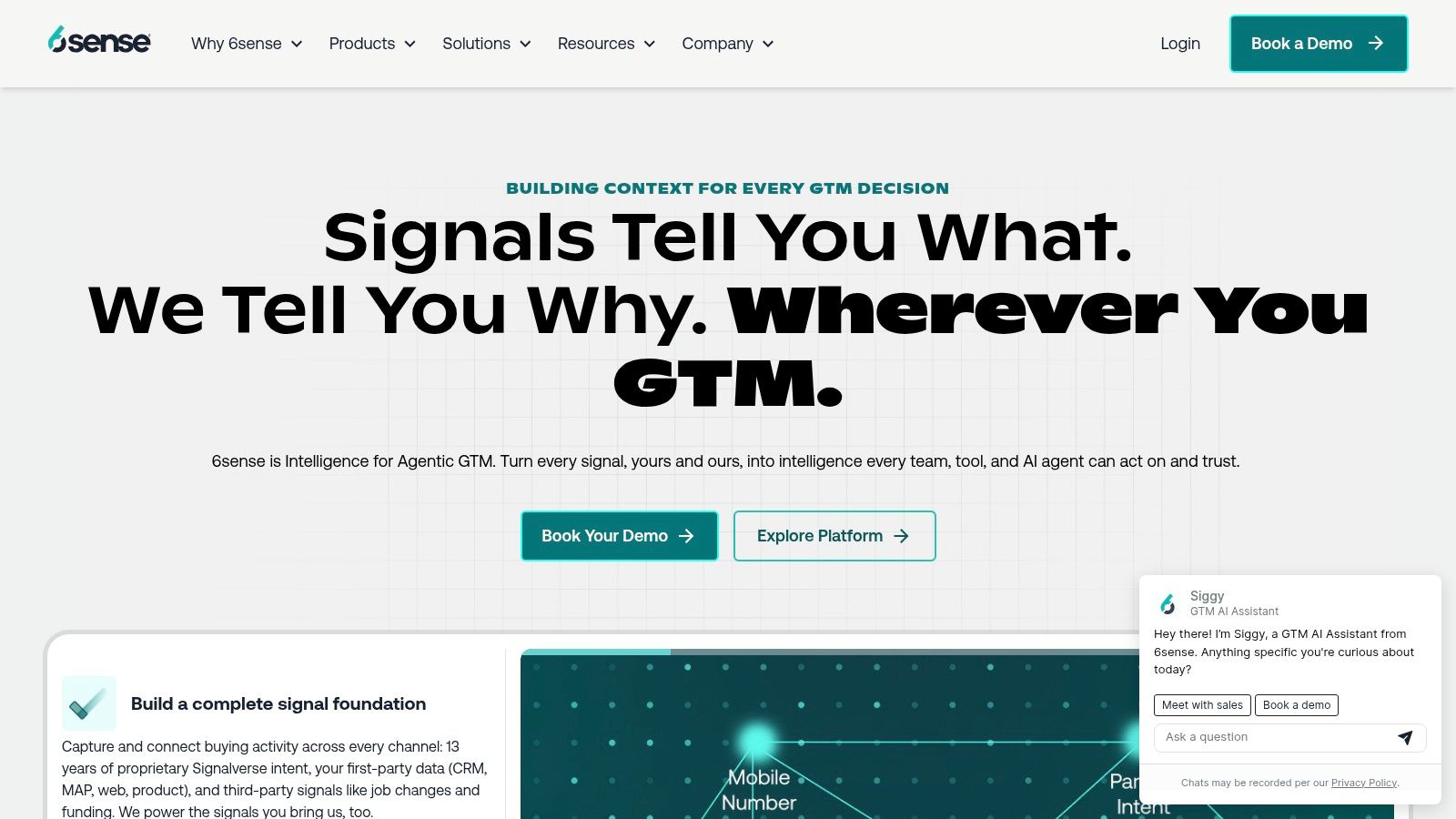
The limitation is signal coverage. Predictive systems are only useful when the market generates enough observable activity and the team has defined what a qualified account looks like. A narrow category, small market, or weak first party tracking can leave sellers with impressive scores and little actionable context.
6sense is rarely the right first purchase for a small team with basic list building problems. It becomes more defensible when marketing and sales share an account based motion, the CRM is mature, and leadership needs a common prioritization layer.
Pros
- Account prioritization: Helps large teams decide where seller time should go.
- Intent orchestration: First party and third party signals can inform coordinated action.
- Enterprise controls: It fits complex governance and integration environments.
Cons
- High complexity: Smaller teams may pay for capabilities they won't use.
- Signal dependence: Results vary with market coverage and tracking quality.
- Account first orientation: It may not solve detailed contact research on its own.
6. Outreach
Category: Engagement led
Best for: Complex organizations that need mature sales execution controls
Outreach is an enterprise sales engagement platform with AI embedded into sequences, account work, deal support, and next best action guidance. Smart Email Assist drafts first touch messages and replies, while account and deal assistants help sellers identify risks, opportunities, and useful next steps.
Its advantage is operational maturity. Administrators can standardize multichannel sequences, tasks, approvals, reporting, and CRM behavior across a large sales organization. The AI sits inside the workflow rather than asking sellers to copy prompts into a separate tool.
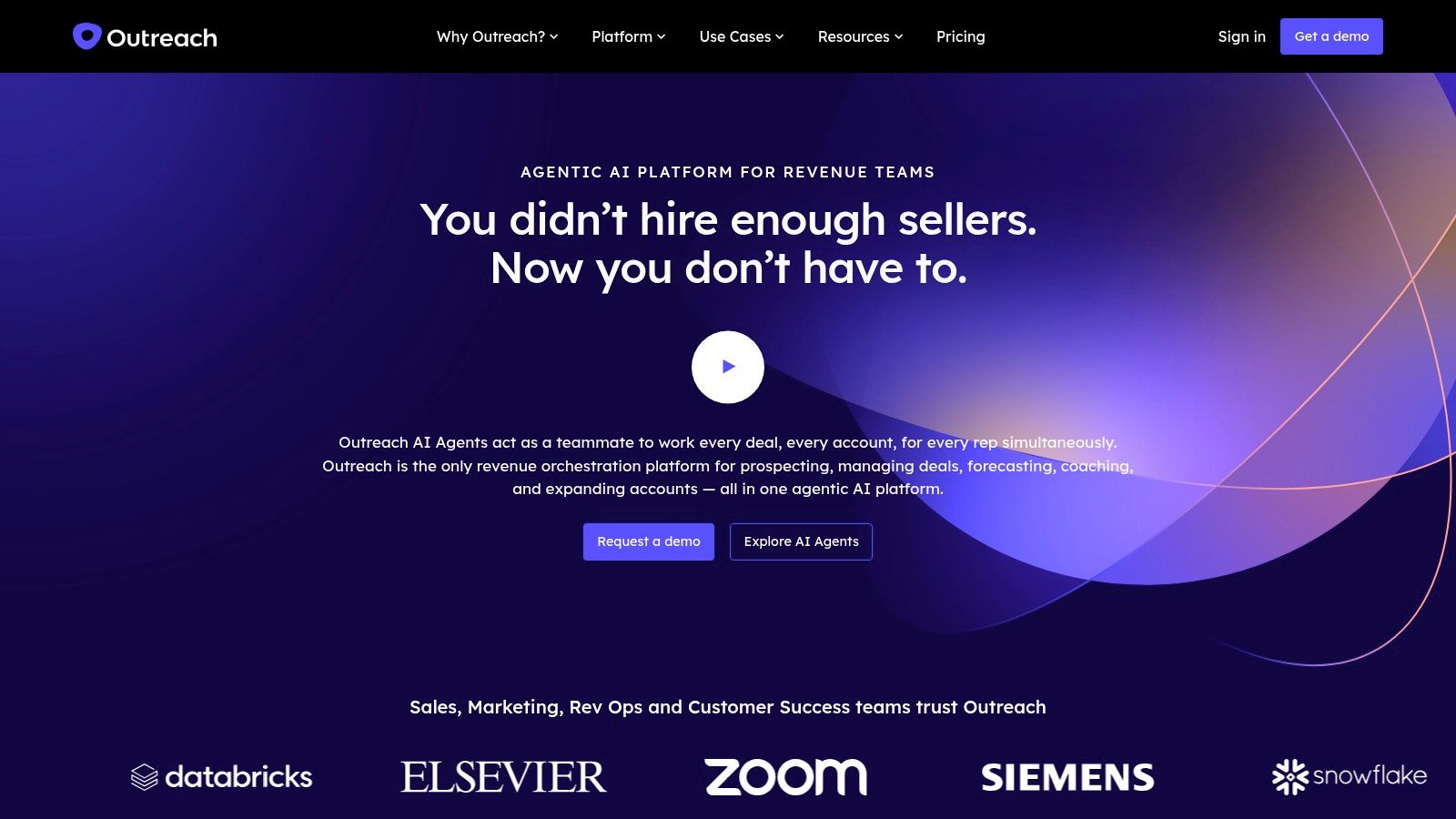
Outreach isn't a native data provider. Teams need to connect a source such as ZoomInfo or LeadIQ, then decide which system owns enrichment, suppression, field updates, and account routing. That makes implementation more involved, but it also gives enterprise buyers freedom to keep their preferred data contracts.
The cost is usually more than a small team needs, and change management can become a project of its own. Outreach is a strong execution layer, not a cheap way to discover whether outbound works.
Teams assessing the category can read about Outreach alternatives for sales workflows.
Pros
- Mature administration: Useful for permissions, standards, and complex workflows.
- Contextual AI: Drafting and recommendations use selling context inside the platform.
- Deep engagement: Sequences and task automation support structured execution.
Cons
- Data is external: Buyers need another source for contact and company records.
- Implementation effort: Smaller teams may struggle to justify the learning curve.
- Specific commercial model: Budgeting requires a detailed conversation with sales.
7. Salesloft
Category: Engagement led
Best for: Teams that want daily prioritization, coaching, and standardized cadences
Salesloft combines sales engagement with revenue orchestration and conversation intelligence. Its Rhythm engine turns buyer and account signals into prioritized actions, helping SDRs decide whom to contact and what work deserves attention during the day.
That focus on daily execution is the product's defining strength. Salesloft supports cadence building, call recording, transcription, conversation analysis, coaching, and deal management. A manager can use the same platform to guide rep activity and inspect the quality of conversations.
The operator should test reporting against the actual GTM motion before signing. Nonstandard routing, custom stages, unusual ownership rules, or complex channel mixes can create dashboard mismatches. A platform that looks complete in a demonstration may need substantial configuration to reflect how the team really sells.
Salesloft fits a sales organization that wants consistency and coaching more than a flexible research canvas. It's less attractive when the main bottleneck is enrichment or when the team wants to compose custom agents outside the native workflow.
Pros
- Rep prioritization: Rhythm gives sellers a daily action layer.
- Coaching depth: Conversation intelligence connects activity with manager feedback.
- Broad execution: Cadences, deals, and coaching share a platform.
Cons
- Reporting needs testing: Custom GTM processes may not map neatly to defaults.
- No public price: Budget planning requires vendor engagement.
- Less flexible for builders: Teams wanting an open agent canvas may prefer another layer.
8. Amplemarket
Category: Data led and engagement led
Best for: Teams that want signals, research, and multichannel execution in one place
Amplemarket combines account and contact discovery, research, buying signals, multichannel engagement, and an AI assistant called Duo Copilot. Operators can describe an ICP in natural language, surface leads and signals, research accounts, draft messages, and manage outreach from a unified workspace.
Duo Copilot supports signal, research, and sequence work while keeping the representative involved in approval. The platform also offers prebuilt AI skills for market mapping, competitor displacement, and ICP scoring. Its MCP connectivity lets users run prospecting actions from compatible AI and developer tools instead of leaving their existing workspace.
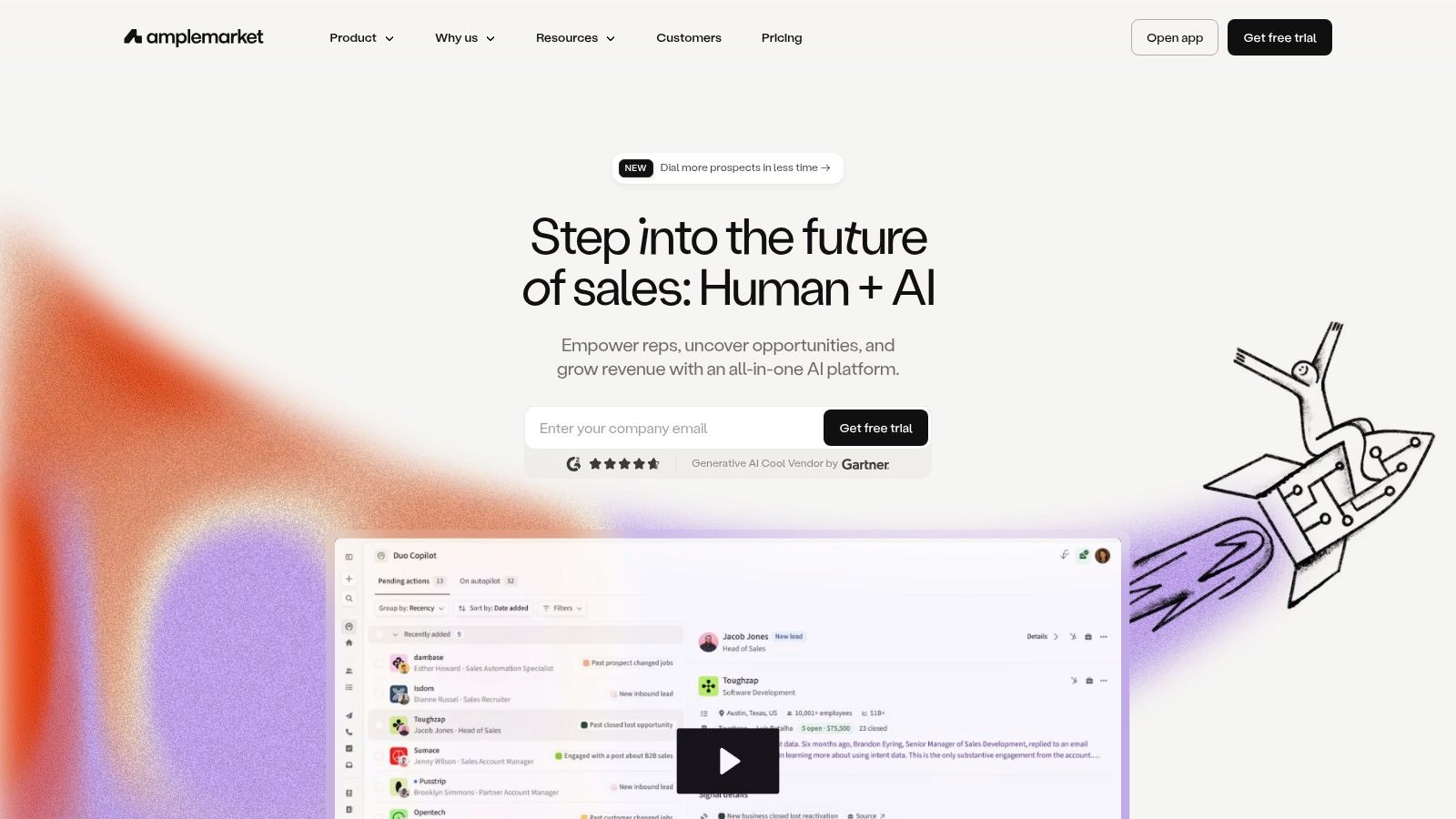
The appeal is the connection between knowing whom to contact and contacting them. Teams don't need to export a signal list, enrich it elsewhere, and then rebuild the sequence in another system. That reduces handoff risk, although buyers still need to define approval rules, channel policies, and data ownership.
Amplemarket is a better fit for a coordinated outbound team than for a company that only wants a browser extension. Smaller teams should validate whether they need the breadth before committing to a full platform.
Pros
- Signal to action: Research and engagement sit in the same motion.
- Human approval: Teams can control how much autonomy Duo receives.
- Natural language workflows: ICP definition and prospecting setup are accessible to operators.
Cons
- Configuration matters: Weak signal definitions produce weak prioritization.
- Smaller ecosystem: It has less market familiarity than larger engagement vendors.
- Platform breadth: Buyers with one narrow requirement may not need the full system.
9. Reply.io with Jason AI
Category: Engagement led
Best for: Teams that need to launch multichannel campaigns quickly
Reply.io is a multichannel outreach platform with an embedded AI SDR called Jason AI. Jason can source leads, generate sequences, personalize messages, draft replies, and support meeting booking, while the underlying platform manages campaigns across email, calls, and social channels.
The product is useful when the team already has a clean data source and wants faster campaign production. AI sequence generation and copy refinement reduce the mechanical work involved in preparing outreach, and reply drafting helps operators handle routine responses without writing every message from scratch.
Jason AI should not be mistaken for a complete data foundation. Teams still need to verify contact records, define suppression rules, and inspect the quality of the generated messages. The AI SDR pricing is separate from the basic outreach plans, so buyers should model the combined cost rather than comparing only the entry plan.
Reply is a sensible execution layer for teams that want rapid campaign setup and frequent AI feature updates. It's less suitable when the core problem is data quality or complicated cross system orchestration.
Pros
- Fast campaign creation: AI handles much of the sequence and copy preparation.
- Reply support: Routine response drafting can reduce SDR administration.
- Multichannel delivery: Email, calls, and social are managed within campaign workflows.
Cons
- Data dependency: It works better when the input list is already clean.
- Separate AI pricing: Jason AI adds another commercial layer.
- Limited operating system depth: Complex GTM learning loops need external systems.
10. LeadIQ
Category: Data led
Best for: LinkedIn centered SDR research and contact enrichment
LeadIQ is built around the browser workflow many SDRs already use. Its Chrome experience supports LinkedIn research, contact capture, enrichment, champion tracking, job change alerts, and synchronization with CRMs and engagement platforms.
LeadIQ's AI Account Prospecting and Scribe features add account context and messaging support. The practical benefit is speed at the moment of research. A representative can identify a person, capture relevant information, enrich the record, and push it into Outreach, Salesloft, or a CRM without rebuilding the record manually.
LeadIQ is not the best choice for a team seeking a complete prospecting operating layer. It's a focused bridge between browser research, contact data, and downstream engagement. Phone coverage can vary by region and plan, so a trial should use the actual roles and markets the team targets.
Its clear plan structure and enterprise controls make it easier to evaluate than some quote only tools, but large deployments may still require a commercial conversation. LeadIQ works well as a component in a deliberate stack, especially when SDRs live in LinkedIn.
Pros
- Browser first workflow: Efficient for LinkedIn based prospecting.
- Useful handoffs: Contacts can move into CRMs and engagement tools quickly.
- Account context: Champion tracking and job change alerts add useful timing signals.
Cons
- Regional variation: Phone coverage needs validation before rollout.
- Not a full engagement platform: Outreach still happens elsewhere.
- Stack dependency: Its value depends on reliable CRM and sequencing integrations.
Top 10 AI Prospecting Tools, Feature Comparison
| Product | Core features | Quality (★) | Price / Value (💰) | Target audience (👥) | Unique selling points (✨) |
|---|---|---|---|---|---|
| Yalc 🏆 | Unified GTM API, playbook library, GTM knowledge orchestration, two surfaces (Claude MCP + Slack/UI) | ★★★★★ | 💰 Custom (build + service), higher up‑front, faster ROI vs hiring | 👥 B2B startups, scaleups, sales/revops, growth teams, founders, agencies | ✨ Self‑grading campaigns, infra & keys you control, forward‑deployed GTM engineers, portable Markdown/YAML plays |
| Clay | Programmable canvas, Claygent live research, 100+ sources, MCP connector | ★★★★☆ | 💰 Usage/credit model, flexible but variable | 👥 Ops-driven teams, data engineers, custom workflow builders | ✨ Live web research, BYO API keys, extreme workflow flexibility |
| Apollo.io | Lead DB + filters, multichannel sequences, Chrome assistant, AI copy | ★★★★☆ | 💰 Mid, strong value for DB + outreach combo | 👥 SMB & mid‑market GTM teams | ✨ All‑in‑one data + outreach, fast time‑to‑first‑campaign |
| Cognism | AI+human-validated phones/emails, GDPR/CCPA focus, APIs | ★★★★☆ | 💰 Premium (quote), enterprise pricing | 👥 Teams needing high‑quality EMEA data & phone coverage | ✨ Diamond Data validation, strong EMEA compliance posture |
| 6sense Revenue AI | Predictive account models, intent signals, AI email & workflows | ★★★★☆ | 💰 High / enterprise | 👥 ABM-focused enterprises, large account teams | ✨ Intent‑led account prioritization, deep enterprise integrations |
| Outreach | Smart Email Assist, account/deal assistants, multichannel sequencing | ★★★★☆ | 💰 Enterprise / tailored | 👥 Complex organizations, mature sales ops | ✨ Mature workflows, native context‑aware Sales AI, admin controls |
| Salesloft | Rhythm prioritization engine, conversation intelligence, coaching tools | ★★★★☆ | 💰 Enterprise‑mid (quote) | 👥 SDR teams, revenue ops focused on coaching & scale | ✨ Signal→action Rhythm, strong coaching & conversation insights |
| Amplemarket | AI Searcher (natural language ICP), Duo Copilot, multichannel inbox | ★★★★☆ | 💰 Mid | 👥 Signal‑oriented teams, AI tool users | ✨ Natural‑language ICP search, MCP connectivity for conversational flows |
| Reply.io (Jason AI) | AI sequence generation, web sourcing, multichannel campaigns, inbox | ★★★★☆ | 💰 Mid (Jason AI add‑on extra) | 👥 Teams seeking an AI SDR to accelerate campaigns | ✨ End‑to‑end AI SDR (Jason), rapid campaign launches |
| LeadIQ | AI account prospecting, enrichment, Chrome-first LinkedIn workflow, CRM sync | ★★★★☆ | 💰 Mid | 👥 LinkedIn-centric SDRs and prospectors | ✨ Chrome workflow for fast prospect capture and CRM push |
Choosing an AI Prospecting Tool Without Buying the Wrong Layer
Buy the missing layer, not the most impressive demo. A team with weak contact data doesn't need another sequence editor. A team with accurate records and poor rep follow through doesn't need a larger database. A team losing hours to exports, imports, and manual reporting may need a workflow OS rather than another specialist tool.
Team size and lead volume provide a useful first filter. A founder or very small team with a narrow market can usually start with an engagement led tool or a simple data and outreach combination. Apollo suits teams that want broad functionality without assembling a complicated stack. LeadIQ works when representatives research primarily in LinkedIn, while Reply.io fits a team that needs to launch multichannel campaigns quickly.
A growing RevOps team should consider Clay when custom enrichment and data logic are the main bottlenecks. Clay gives operators room to build a data supply chain around the company's ICP. The team needs to budget for maintenance, documentation, duplicate handling, and credit governance.
Larger organizations usually need stronger administration and clearer ownership. Outreach and Salesloft are suited to standardized execution, coaching, and sales management. Cognism makes more sense when EMEA coverage, phone data, and compliance are central. 6sense fits an account based motion where marketing and sales can act on shared intent and prioritization.
Yalc belongs in a different buying conversation. It is the option for a team that wants to coordinate prospecting with qualification, CRM hygiene, reporting, competitive intelligence, content, and other GTM plays. The implementation is heavier, but the team can own the playbooks, data connections, permissions, telemetry, and learning loop.
Use the same operator checks for every shortlisted tool:
- Data check: Can the team inspect, correct, merge, suppress, and roll back records without losing manually entered CRM data? Practical AI sales tooling guidance from HubSpot specifically recommends editable fields, duplicate detection, merge logic, and rollback procedures.
- Workflow check: What happens between discovery, enrichment, scoring, outreach, reply handling, and CRM updates? Count the manual handoffs.
- Approval check: Which actions require a human before they affect a prospect, customer, CRM record, or sending domain?
- Audit check: Can an operator reconstruct what the agent saw, decided, changed, and sent? Independent governance guidance for AI sales automation recommends scoped permissions, explicit approval for sensitive actions, and step by step agent logs.
- Security check: Ask for GDPR and CCPA controls, SOC 2 status, admin access controls, and confirmation about whether customer data trains external models. Vendor evaluation guidance for generative AI sales tools identifies these as practical checks for enterprise buyers.
- Outcome check: Define success around qualified pipeline, useful conversations, data accuracy, and operator time, not message volume alone.
The market is growing because buyers want more than drafted emails. The sales prospecting AI market is projected to grow from $4.8 billion in 2025 to $21.6 billion by 2034, with an 18.2% projected CAGR, according to Sales Prospecting AI Market research from Dataintelo. Lead generation represents the largest use case in that estimate, followed by lead scoring. That direction reinforces the buying lesson: prioritization and workflow quality matter as much as copy generation.
The strongest adoption pattern is hybrid. G2's analysis of AI sales intelligence in prospecting reports that teams use AI for personalized outbound email and account research, while human and AI roles remain mixed rather than fully replaced. AI should handle research, enrichment, first touch preparation, prioritization, and routine triage. Humans should own positioning, exceptions, sensitive actions, relationship development, and complex qualification.
A final test separates useful automation from expensive noise. Run the same defined ICP through each shortlisted tool. Inspect the records manually. Review the suggested messages. Trace every CRM update. Ask who approves the send, who owns the data, and what the system learns after a campaign fails. The tool that survives that test is more valuable than the tool with the longest feature page.
If the team's main issue is one narrow gap, buy the narrow layer. If the issue is fragmented execution across the whole GTM motion, evaluate a workflow OS. That is the difference between adding AI to prospecting and building a prospecting system that operators can govern.
Yalc combines AI prospecting, enrichment, qualification, sequencing, reply handling, CRM work, and campaign measurement behind a unified GTM API. Visit Yalc to see how its governed playbooks and forward deployed engineering can turn a fragmented sales stack into an owned, auditable operating system.