Audit Trail Software in 2026: A Practical Buyer's Guide
Audit trail software has moved out of the compliance back office and into the revenue engine. The market estimate puts the category at $4.2 billion in 2025, with a projection of $10.8 billion by 2034, implying a 13.1% compound annual growth rate (market estimate). That growth reflects a practical change in ownership. Security and legal still care about the controls, but revenue operations, sales enablement, and deal desk leaders increasingly have to prove what happened inside the systems that create pipeline and revenue.
A CRM history panel isn't enough when an AI agent changes a lead, a rep edits a forecast, or a pricing exception moves through approval. The record needs to show who acted, what changed, when it happened, and whether anyone could alter the evidence later.
Table of Contents
- Why Audit Trail Software Is Now a GTM Stack Problem
- What Audit Trail Software Actually Does
- Core Features and the Compliance Requirements They Serve
- How to Evaluate and Select the Right Software
- Implementation and Integration Best Practices
- GTM and RevOps Use Cases Including How Yalc Fits
- The Cost of Logging Everything and What to Do Instead
- The One Decision That Matters Most for 2026 Buyers
Why Audit Trail Software Is Now a GTM Stack Problem
The counterintuitive point is simple: audit trail software is now a GTM stack decision, not only a compliance purchase. The software component accounts for 58.3% of revenue in the cited market estimate, which suggests buyers are prioritizing systems that capture and preserve activity records rather than passive log storage (market estimate).
A generic security log sent to GRC once a quarter can't answer the questions revenue leaders face during a live deal. Who approved the discount? Which customer cohort received the changed price? Did an automated workflow update the opportunity before or after the forecast review? Which version of the policy governed the approval?
Three pressures are pushing this issue into GTM operations:
- AI driven outreach creates evidentiary risk. Automated agents can research prospects, draft messages, classify replies, update records, and trigger follow up. Human review still matters, but it only helps when the system records the agent's action and the approval context.
- Procurement questionnaires reach deeper into the stack. Buyers and InfoSec teams increasingly ask how every tool touching pipeline data records access, changes, approvals, and retention.
- Privacy obligations require reconstruction. State privacy regimes such as CCPA and CPRA, Virginia CDPA, and Texas TDPSA widen the practical need to identify what happened to personal data inside revenue workflows. The applicable obligations vary, so teams need a documented mapping rather than a generic claim of compliance.
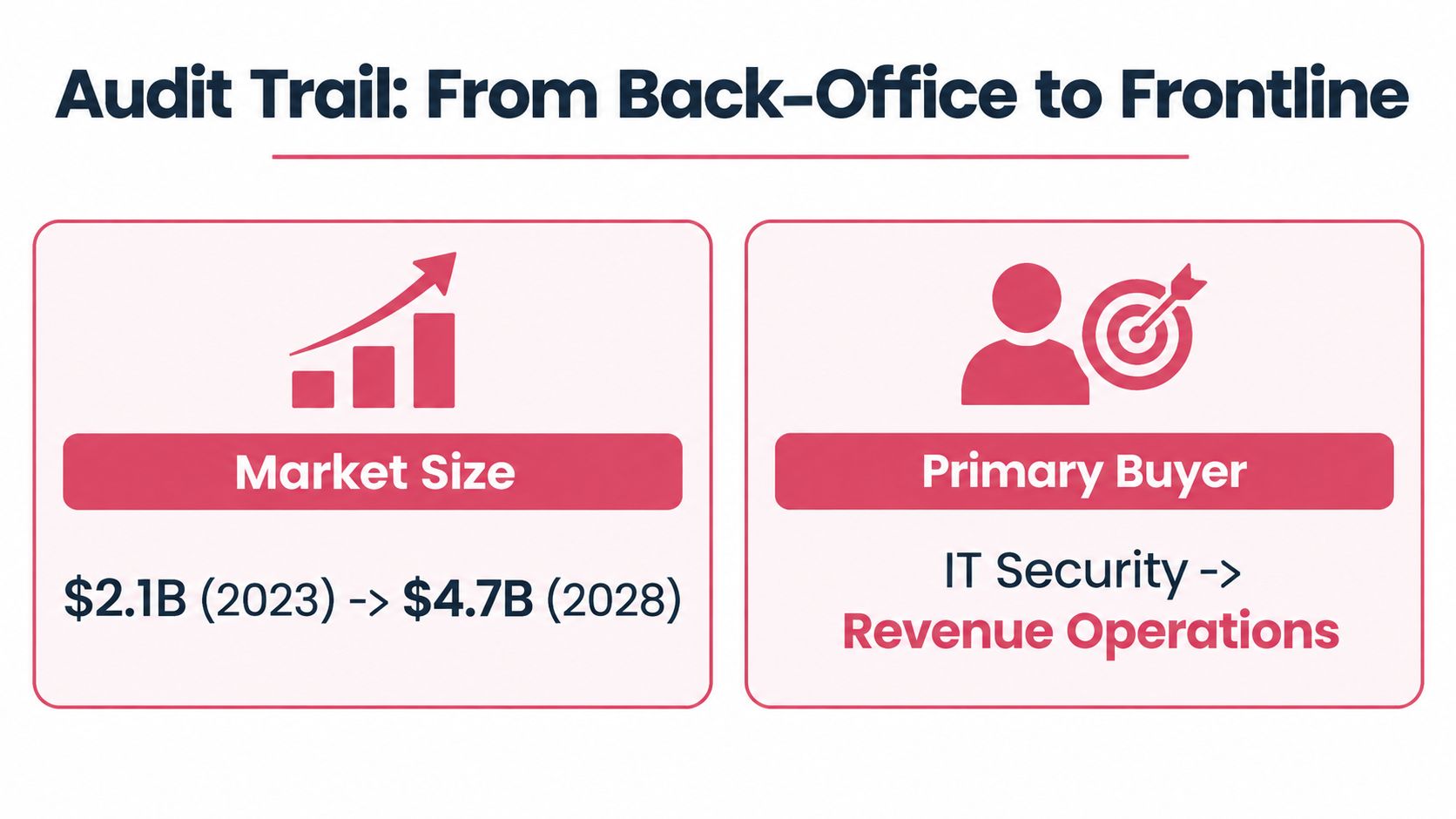
Operator view: If a revenue system can change customer data, pricing, eligibility, or outreach, its audit posture belongs in the GTM operating model.
That means the buying group changes too. Revenue operations owns workflow context, sales leaders own approvals, deal desk owns exceptions, and security and legal validate evidence standards. The stack needs to support all four without turning every action into a manual review.
Teams evaluating their broader GTM stack should treat auditability as an architectural requirement. The useful question isn't whether a tool produces logs. It's whether the business can query a trustworthy account of a revenue decision while the context still exists.
What Audit Trail Software Actually Does
Audit trail software creates an append only evidence layer around business activity. It records meaningful events, attaches identity and context, preserves the chronology, and makes later manipulation detectable. NIST says audit trails can help detect security violations, performance problems, and application flaws, so the value comes from preserving a chronology investigators can replay, not from collecting random system messages (NIST guidance).
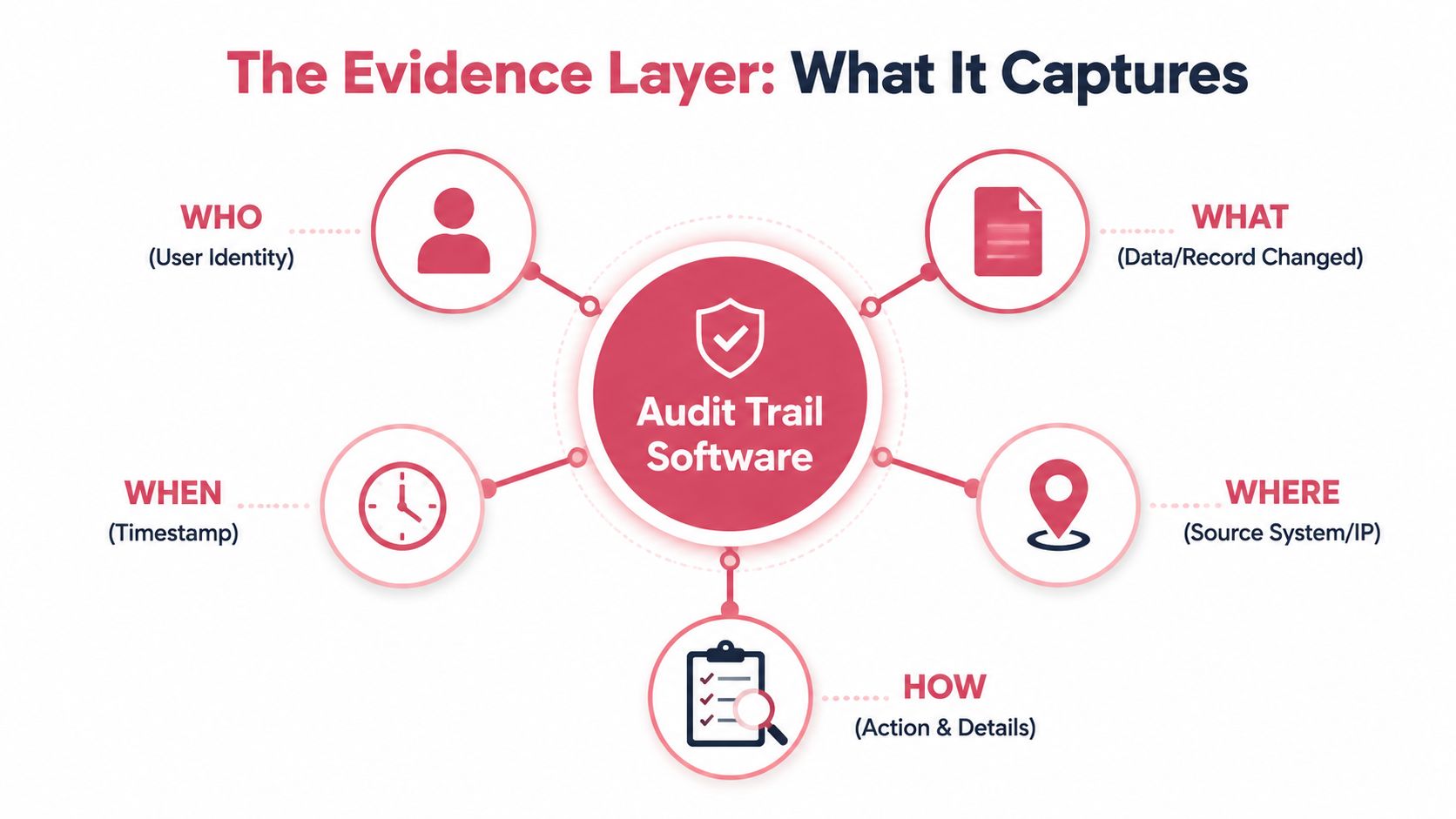
A useful event should answer five questions:
- Who performed the action, including the verified human or service identity.
- What record, field, message, approval, or configuration changed.
- When the event occurred, with a trustworthy timestamp.
- Where the action originated, such as the source system or session context.
- How it happened, including the action type, result, before and after values, and relevant workflow details.
The four jobs that matter
First, the system must capture meaningful state changes. That includes creates, edits, deletes, approvals, exports, sends, permission changes, and automated decisions. A timestamp without the affected record is weak evidence. A record change without the prior value makes investigation slower.
Second, it must bind each event to an identity that the business trusts. Shared accounts and vague service labels undermine accountability. An AI agent needs its own identity, while the system should also preserve the human who approved or initiated the action.
Third, the evidence layer must resist tampering. Hash chaining can expose an edit because each entry depends on the previous hash. WORM storage provides another append only pattern. Independent technical guidance also recommends canonicalizing events, retaining hashes and signatures, and anchoring batch Merkle roots externally (tamper proof audit trail guidance).
Fourth, the records must be searchable, filterable, and exportable. A technically immutable store that takes days to query fails operationally. In 2026, audit trails increasingly need to cover AI agent actions as well as human actions, because automated execution now changes the provenance of revenue data.
Generic logging tells the team that a service ran. An audit trail tells the team that a named identity changed a specific record, under a particular workflow, and preserves proof for later review.
Core Features and the Compliance Requirements They Serve
Buyers should map every feature to an evidence requirement. A security badge or compliance page isn't a substitute for proving that the product can preserve, restrict, retrieve, and dispose of records in the required way.
Immutable storage comes first
Hash chains, signed entries, and WORM backed storage address the central integrity question, whether an administrator can rewrite the past. This matters for controls associated with SOC 2 CC7.2, ISO 27001 A.12.4, and FDA 21 CFR Part 11. NIST SP 800 209 also says audit data should be protected from tampering with immutable methods such as WORM and monitored so storage destinations don't fill up and break visibility (NIST SP 800 209).
Retention must be configurable by event class and data sensitivity. Public guidance summarized by industry sources identifies one year for PCI DSS audit logs, with the most recent three months immediately available, six years for certain HIPAA records, and seven years for SOX related records (retention guidance). Those targets aren't universal defaults. They demonstrate why one global retention switch is inadequate.
Role based access should limit both the records people can view and the actions they can take. Finance may need pricing approvals, while a regional operations administrator may need only records from that region. Scoped permissions support least privilege and controls associated with SOX ITGC.
Real time alerts add operational value. A mass export, privilege change, or approval override should generate a review signal rather than wait for an audit. Automated discovery and classification can help identify regulated fields and close gaps in privacy workflows, including searches needed for CCPA and CPRA data subject requests.
Finally, the system should produce auditor ready evidence packages through a UI, API, and machine readable export. A reviewer should be able to trace a decision without asking the operations team to stitch together screenshots, tickets, and emails. Teams building a control catalog may also find a focused resource for legal teams useful when aligning evidence ownership with legal review.
| Core Feature | Compliance Regime Served | Typical Retention Window |
|---|---|---|
| Tamper evident storage | SOC 2 CC7.2, ISO 27001 A.12.4, FDA 21 CFR Part 11 | Based on the applicable policy |
| Configurable event retention | PCI DSS, HIPAA, SOX, privacy programs | One year for PCI DSS, six years for certain HIPAA records, seven years for SOX related records |
| Scoped access controls | SOX ITGC, least privilege controls | For the active policy period and required evidence period |
| Alerts and monitoring | Security monitoring, breach readiness, internal controls | Based on event risk and investigation needs |
| Exportable evidence and APIs | SOC 2, ISO 27001, regulatory reviews | Long enough to support the relevant audit cycle |
Features without enforcement are promises. The vendor must demonstrate the controls under pressure.
How to Evaluate and Select the Right Software
A vendor demo should be a controlled test, not a parade of attractive dashboards. The buyer should bring representative GTM events, a proposed retention policy, and a list of actions that must be impossible to erase.
Run the demo as a failure test
- Test append only behavior. Ask the vendor to show cryptographic hashing or signed entries, then attempt to delete or edit an event. The response should expose the change or block it. A statement that logs are “secure” isn't evidence.
- Separate retention by event class. Configure different policies for pricing overrides, ordinary record edits, exports, and access events. Verify that legal hold can freeze records without corrupting normal reporting.
- Probe permissions. Create regional roles and test record and field visibility. An administrator with broad platform access shouldn't automatically read every sensitive event.
- Demand faithful exports. Request an immutable human readable package and machine readable JSON for a SOX, HIPAA, or GDPR review. Check whether the export preserves timestamps, identities, before and after values, signatures, and event relationships.
- Test realistic search conditions. Load synthetic data that reflects projected volume and run queries across a full retention period. Slow investigation is a cost, even when storage is affordable.
- Inspect integration paths. Confirm documented APIs and webhooks for identity, SIEM, and ticketing systems. Ask whether failures create alerts and whether events can be replayed safely.
Walk away rule: If the product can't prove tamper evidence, scoped access, retention control, and complete export fidelity, pricing shouldn't rescue the deal.
The evaluation should also include the operating team. Sales operations needs usable filters, security needs trustworthy forwarding, legal needs hold and discovery controls, and auditors need evidence that can stand alone. A practical analyst enablement tools guide can help teams compare governance capabilities, but the final decision should come from hands on workflow tests.
Implementation and Integration Best Practices
Audit trail rollouts fail when teams install a repository before deciding what evidence they need. A phased program works better because it exposes gaps, reduces alert noise, and gives operators time to establish ownership.
Use four deliberate phases
Phase one maps the estate. Inventory every system that touches customer or revenue data, including CRM, CPQ, billing, support, conversational GTM tools, enrichment platforms, and reporting layers. For each workflow, identify mutable records, untracked handoffs, shared identities, and actions that can change revenue outcomes.
Phase two defines the evidence policy. Classify events by risk, specify required fields, assign retention, and document who may review them. Instrument the append only evidence layer before enabling broad alerting. Otherwise, the team will spend its first weeks tuning alerts against incomplete or poorly contextualized data.
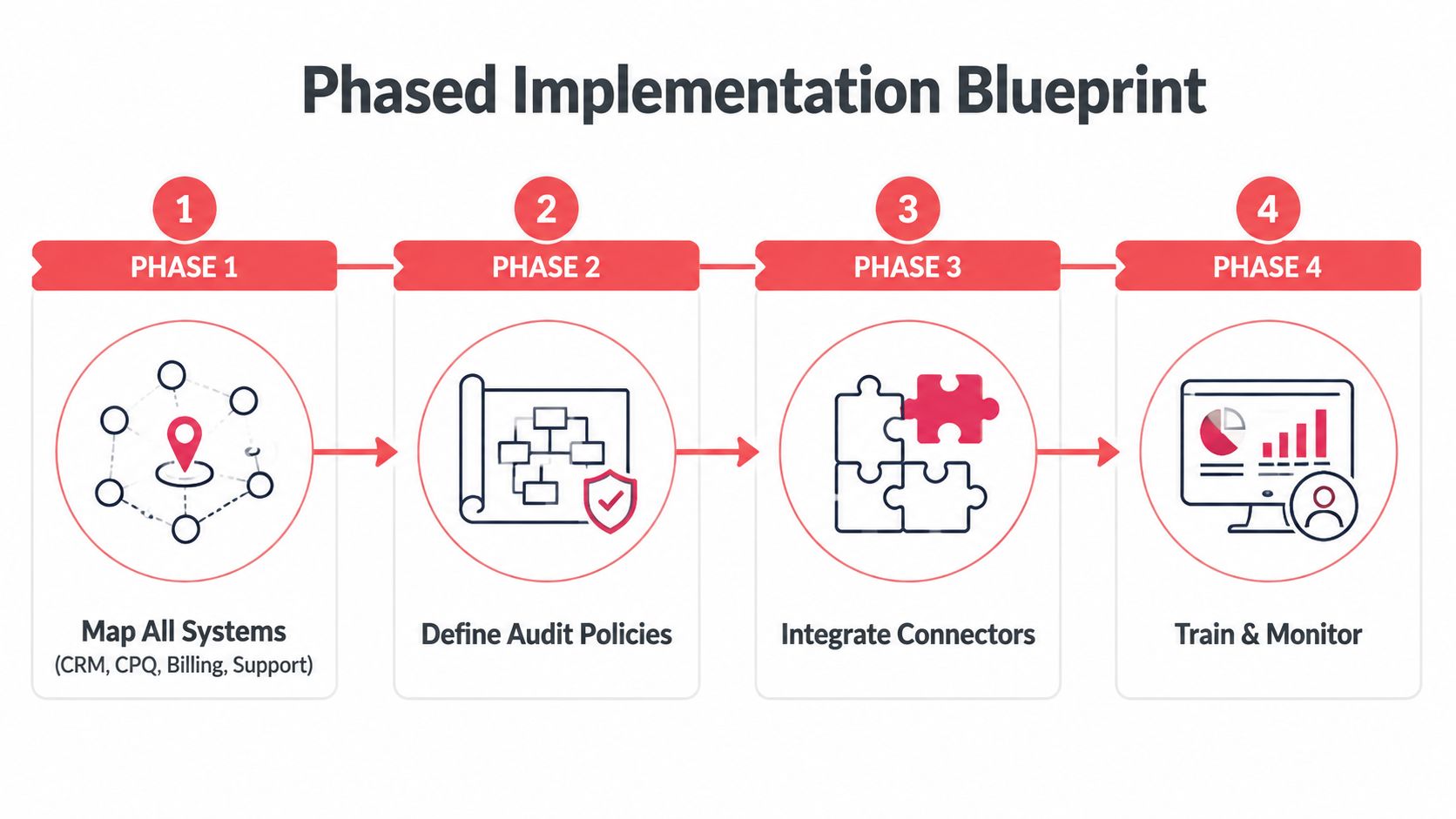
Phase three integrates trusted sources. Prefer server side event submission from services that users can't disable. Federate identity through SSO, forward relevant events to the SIEM, and preserve correlation IDs across systems. Client side logging, synchronous writes that block source systems, and missing correlation IDs are recurring failure points.
Phase four operationalizes the control. Write an incident evidence runbook, schedule access reviews, document retention changes, and define escalation ownership. The team should practice retrieving a complete decision history, not just confirm that events exist.
For email heavy workflows, a practical guide for email centric teams can help identify where manual handoffs create missing context. Teams also need to document how their automation connects with the wider MCP layer when agents can initiate or modify GTM actions.
Success shouldn't be declared after installation. Run the program through at least one full audit cycle, including a retention review, access review, incident simulation, and evidence export.
GTM and RevOps Use Cases Including How Yalc Fits
Audit trail software earns its place in the GTM stack when it protects decisions that affect revenue. A generic login record won't explain why a forecast changed or whether an exception followed the approved pricing policy.
Start with the workflows that change money
Pricing changes need an append only history of the old value, new value, approver, reason, and affected customer cohort. Without that context, finance can see the outcome but not reconstruct the decision.
Deal desk approvals should preserve approver identity, timestamp, policy version, and any override. A signed approval is more useful than a message in a chat channel that may lose its relationship to the quote.
Pipeline edits require before and after values and reviewer attribution. This matters when a rep changes close timing, stage, amount, or forecast category.
Partner commissions need calculations traceable to source events. If a reseller disputes a payment, operations should be able to follow the originating opportunity, terms, adjustments, and approval history.
Renewal terms and discount exceptions should remain reproducible months later. Teams shouldn't depend on the memory of the account executive or a spreadsheet stored in a personal folder.
AI sales conversations add a separate evidence problem. Objection handling, consent, transcript storage, retention, and agent decisions need controls that match the sensitivity of the data and the applicable privacy policy.
Yalc treats GTM telemetry as part of the system of record for these actions. Its operating model records agent steps, human approvals, and scoped data access, while the conversation itself provides context for the action. Buyers should still validate the exact retention, export, and deployment controls against their own requirements. The platform can be reviewed at Yalc as one option for teams that want GTM execution and audit context connected.
| GTM Use Case | Compliance Requirement | Yalc Capability |
|---|---|---|
| Pricing override | Tamper evident approval and change history | Step by step telemetry with approval context |
| Deal desk exception | Verified approver, timestamp, and policy context | Human approval for sensitive actions |
| Pipeline edit | Before and after values with attribution | Logged agent and human actions |
| Partner commission | Traceable calculation inputs and outputs | Event history connected to GTM workflows |
| Renewal exception | Reproducible decision record | Searchable workflow context and exports |
| AI conversation | Consent, transcript, retention, and access control | Scoped permissions and recorded agent activity |
The practical standard is whether compliance review becomes a query instead of a reconstruction project.
The Cost of Logging Everything and What to Do Instead
More logging doesn't automatically produce stronger compliance. High event volumes can strain storage, slow searches, increase ingestion and review costs, and make cross system correlation harder (audit trail compliance guidance).
The right target is meaningful events per reviewer hour. If reviewers spend their time sorting harmless reads, duplicated system messages, and low context notifications, the business has created evidence volume without useful evidence quality.
A retention tier should reflect business risk:
| Event Category | Risk Level | Retention Window | Storage Tier |
|---|---|---|---|
| Pricing overrides and approval overrides | High | Multi year, based on policy | Immutable, immediately searchable |
| Quote edits and renewal exceptions | High | Multi year, based on policy | Immutable, searchable archive |
| Mass exports and sensitive data access | High | Based on the applicable privacy or health data rule | Immutable, restricted access |
| Routine record reads | Lower | Shorter period, based on policy | Lower cost searchable storage |
| Health checks and routine system events | Lower | Operational period | Aggregated or lower cost storage |
High risk actions deserve full fidelity. Routine reads may need a shorter window or aggregation where the applicable rule allows it. The policy must still preserve enough information for monitoring, analysis, investigation, and reporting, as required by NIST SP 800 171, which also calls for access controls, tamper resistance, and managed disposal of audit information (NIST SP 800 171 guidance).
Storage design should also prevent a full destination from ending visibility. NIST SP 800 209 specifically emphasizes monitoring log destinations so collection failures are detected.
The contrarian recommendation is to log selectively, classify aggressively, and retain according to risk. A smaller trail that reviewers can understand is more defensible than an enormous archive nobody can investigate.
The One Decision That Matters Most for 2026 Buyers
The most important decision is whether the business needs a standalone log repository or an evidence layer embedded in the GTM operating system where audited actions originate.
A repository receives events after the fact. An embedded layer can preserve provenance, workflow context, policy version, approval state, and before and after values at write time. That distinction matters because reconstruction loses context. A later SIEM record may show that a CRM update occurred, but it may not show which pricing rule applied or which human approved the exception.
The embedded approach is especially important for discount governance, lead routing integrity, deal desk approvals, partner calculations, and AI initiated changes. Those workflows need evidence tied to the decision, not just evidence that a system processed a request.
The buyer question for every demo should be:
Can this product prove the complete business decision at the moment it happens, and preserve that proof under the required access and retention policy?
If the answer depends on manual exports, scattered application logs, or an administrator's explanation, the architecture is already too weak for revenue critical workflows.
Yalc connects GTM execution with step by step telemetry, human approval controls, scoped permissions, and evidence that stays tied to the originating workflow. Visit Yalc to evaluate how its AI native GTM operating system can help teams make revenue actions traceable without turning every operator into a compliance administrator.