B2B Sales Enablement Strategy That Scales Revenue
Marketing has shipped the battlecards, case studies, and email sequences. Sales has saved some in a shared folder, copied others into personal documents, and improvised the rest during calls. Managers ask for consistent execution, yet every rep follows a slightly different process, buyers receive mixed messages, and revenue remains difficult to forecast.
That pattern doesn't mean the team lacks effort. It means the operating layer between strategy and execution is missing. B2B sales enablement turns positioning, process, coaching, technology, and feedback into a repeatable system. It helps a rep know what to say, gives a buyer enough proof to move forward independently, and gives leaders evidence about which plays deserve more investment.
Sales enablement has moved from an occasional training function to a mainstream operating model. A widely cited industry summary reports that fewer than 20% of organizations used sales enablement in 2013, compared with more than 60% by 2019. The same summary says 90% of revenue professionals use enablement technology at work, while 82% of a global sample of 1,200 people reported daily usage (Cirrus Insight sales enablement statistics).
The practical implication is straightforward. Enablement shouldn't be treated as a content library or a quarterly training event. It should function as a self correcting GTM operating system, one that supports reps, managers, marketers, and increasingly independent buyers.
Table of Contents
- Introduction Why B2B Sales Enablement Decides Revenue Consistency
- What B2B Sales Enablement Really Means Today
- The Core Pillars of a High Performing Enablement Strategy
- Designing a Sales Process for the Self Serve Buyer
- Building Your Enablement Tech Stack and Playbooks
- Measuring What Matters KPIs That Prove Enablement Works
- Putting It All Together An Enablement System That Learns
Introduction Why B2B Sales Enablement Decides Revenue Consistency
A revenue leader can usually find the symptoms within a few hours. One rep sends a product overview before understanding the account. Another sends a detailed technical guide to a business stakeholder. A third creates a custom deck from an old template. Marketing sees high asset production, sales sees low usability, and operations sees incomplete activity data.
The team doesn't need more documents. It needs a controlled way to connect a buyer question to a useful response, a defined sales action, and a measurable outcome.
That connection is the job of enablement. A strong system gives each role practical support inside the workflow. Marketing creates and maintains messages that reflect buyer problems. Sales leaders define the behaviors and stages that matter. Managers reinforce those behaviors through coaching. Operations connects activity data to pipeline and retention signals.
Practical rule: If a rep has to search several systems, ask another team, or rewrite an asset before using it, the enablement system is adding friction instead of removing it.
The shift toward digital buying makes this operating layer more important. Some buyers want a self guided path through research, evaluation, internal alignment, and approval. Others need a rep at specific moments to validate risk, answer a complex question, or help a committee reach agreement. The system must support both without forcing every opportunity into the same meeting heavy motion.
A useful strategy therefore has four parts:
- Strategy: Define the ideal customer profile, positioning, buyer problems, and desired behaviors.
- Process: Map those elements to stages, qualification rules, plays, and handoffs.
- Technology: Connect content, CRM records, enrichment, sequencing, coaching, and reporting.
- Measurement: Track adoption and revenue signals, then promote effective plays and retire weak ones.
The rest of the operating model follows this logic. Enablement earns its place in revenue operations when it makes execution more consistent, buyer progress easier, and improvement continuous.
What B2B Sales Enablement Really Means Today
A simple analogy helps. Think of a restaurant during a busy service. The menu defines the offer, the kitchen prepares the ingredients, the order system routes requests, and the manager watches quality and timing. A recipe stored in a drawer isn't an operating model. The restaurant needs the right recipe, available ingredients, clear preparation steps, trained staff, and feedback from every service.
B2B sales enablement works the same way. It connects four questions:
- What should the team say? Positioning, narratives, battlecards, and proof.
- What should the team do? Stages, qualification, sequences, and next steps.
- What should the team learn? Product knowledge, discovery skills, objection handling, and manager coaching.
- What should the organization improve? Usage, adoption, conversion, cycle time, retention, and quota outcomes.
Enablement isn't the same as training
Training helps people learn a skill or concept. Enablement makes that skill usable during work. A discovery workshop may teach a questioning framework, while enablement puts that framework into the CRM, adds a call preparation checklist, gives the manager a coaching rubric, and tracks whether reps use it.
Sales operations owns much of the process and data infrastructure. Marketing owns important parts of messaging and content. Enablement connects those functions to seller behavior and buyer progress. It doesn't replace them.
The modern system also serves the buyer directly. A rep may send an interactive demo, a proof document, a pricing explanation, or a shared workspace that lets stakeholders review information asynchronously. The rep remains available, but the buyer doesn't need a live meeting for every step.
Why the operating model changed
The adoption curve explains why buyers now expect more than isolated tools. Enablement technology has become part of daily revenue work, so teams expect content, automation, coaching, and analytics to operate together rather than sit in separate applications.
The best plain language definition is this: B2B sales enablement is the system that helps revenue teams deliver the right message, proof, behavior, and next step at the right moment, then learn from the result.
That definition includes the buyer's experience. It also creates a useful test. If a program only stores files or schedules training, it may support enablement, but it isn't yet an enablement operating system.
The Core Pillars of a High Performing Enablement Strategy
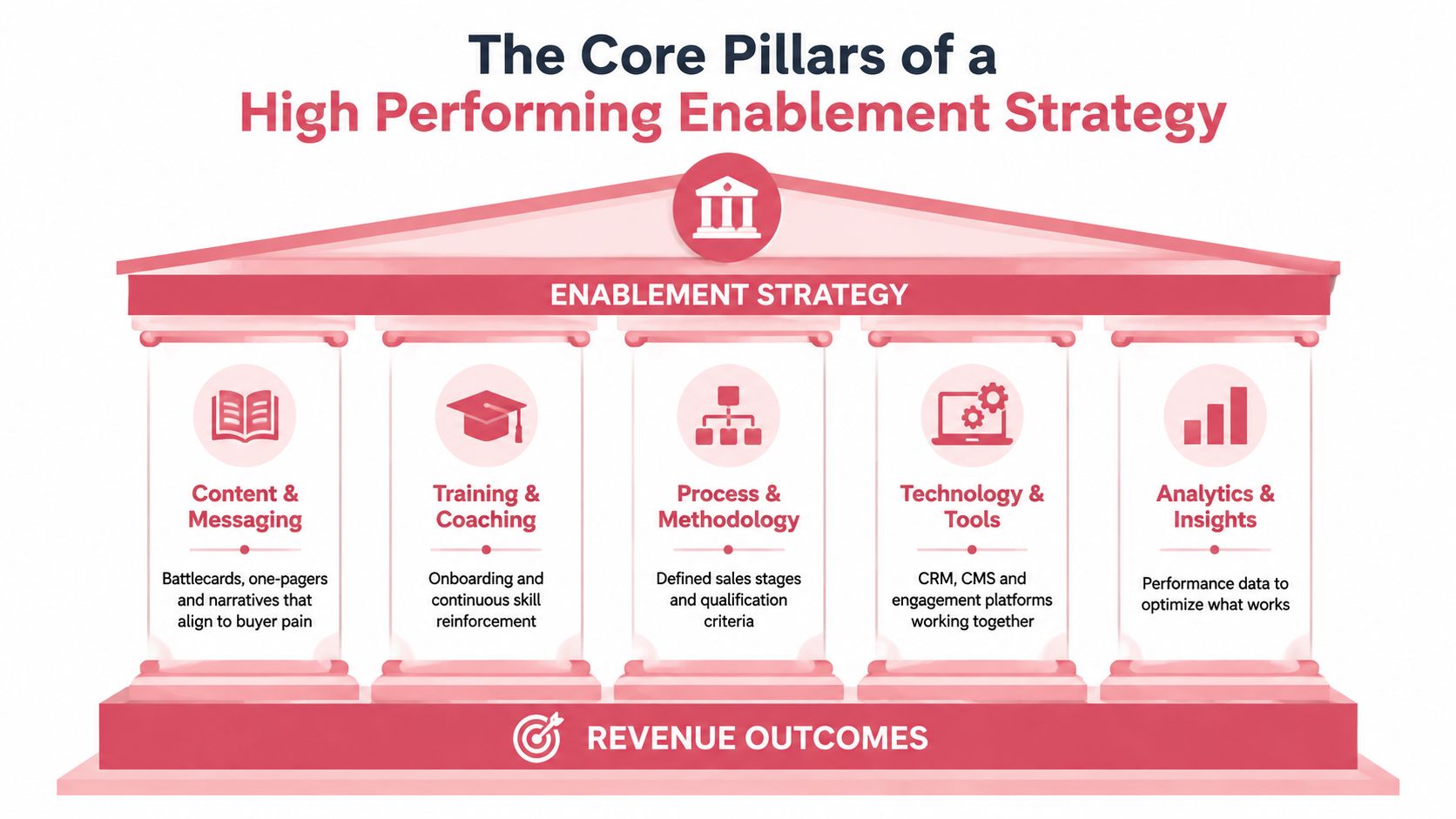
A high performing strategy has distinct pillars, but the pillars only create value when they work as one workflow. Content without process becomes random. Training without manager reinforcement fades. Technology without governance multiplies clutter. Analytics without action becomes another dashboard.
The first pillar is content and messaging. Teams need a small set of approved narratives tied to buyer pain, not an endless catalogue of assets. A useful system might include an industry problem brief, a discovery guide, a competitive response, an ROI worksheet, and proof for each major stakeholder. Each item needs an owner, an intended use, and a review rule.
Teams building this layer can use practical guidance on content creation for sales reps, especially when marketing needs to turn positioning into assets that reps can use during live opportunities.
The second pillar is training and coaching. Onboarding introduces the motion, but coaching makes it stick. Managers should observe calls, review opportunity plans, and reinforce one behavior at a time. A seller who knows the discovery framework but never uses it hasn't become ready.
The process must carry the message
The third pillar is process and methodology. Define what each stage means, what evidence is required to advance, and which buyer question the rep must answer next. A stage shouldn't change because a calendar event occurred. It should change because the opportunity contains evidence of buyer progress.
The fourth pillar is technology and tools. A CRM, content system, engagement platform, call recorder, and analytics layer should pass useful context between them. The right design reduces duplicate entry and brings guidance into the place where the rep already works.
The fifth pillar is analytics and governance. Leaders need to know which content gets used, which training gets completed, which plays produce quality conversations, and which actions correlate with stronger outcomes. Governance decides when to update, approve, test, or retire a play.
Audit the weakest connection
A practical audit follows one opportunity from first touch to close. Check whether the buyer received a consistent narrative, whether the rep had a clear next action, whether the manager could inspect execution, and whether the data captured what happened.
Use the Yalc sales playbook examples as a reference point for making plays concrete. A play should specify its trigger, inputs, actions, approval points, buyer facing output, and success measure.
The pillars are connected through feedback. If a content asset gets used often but doesn't help opportunities progress, the message may be attractive but weak. If a play works only when a particular manager supervises it, the process lacks sufficient guidance. Enablement improves when leaders diagnose the connection rather than celebrating activity in isolation.
Designing a Sales Process for the Self Serve Buyer
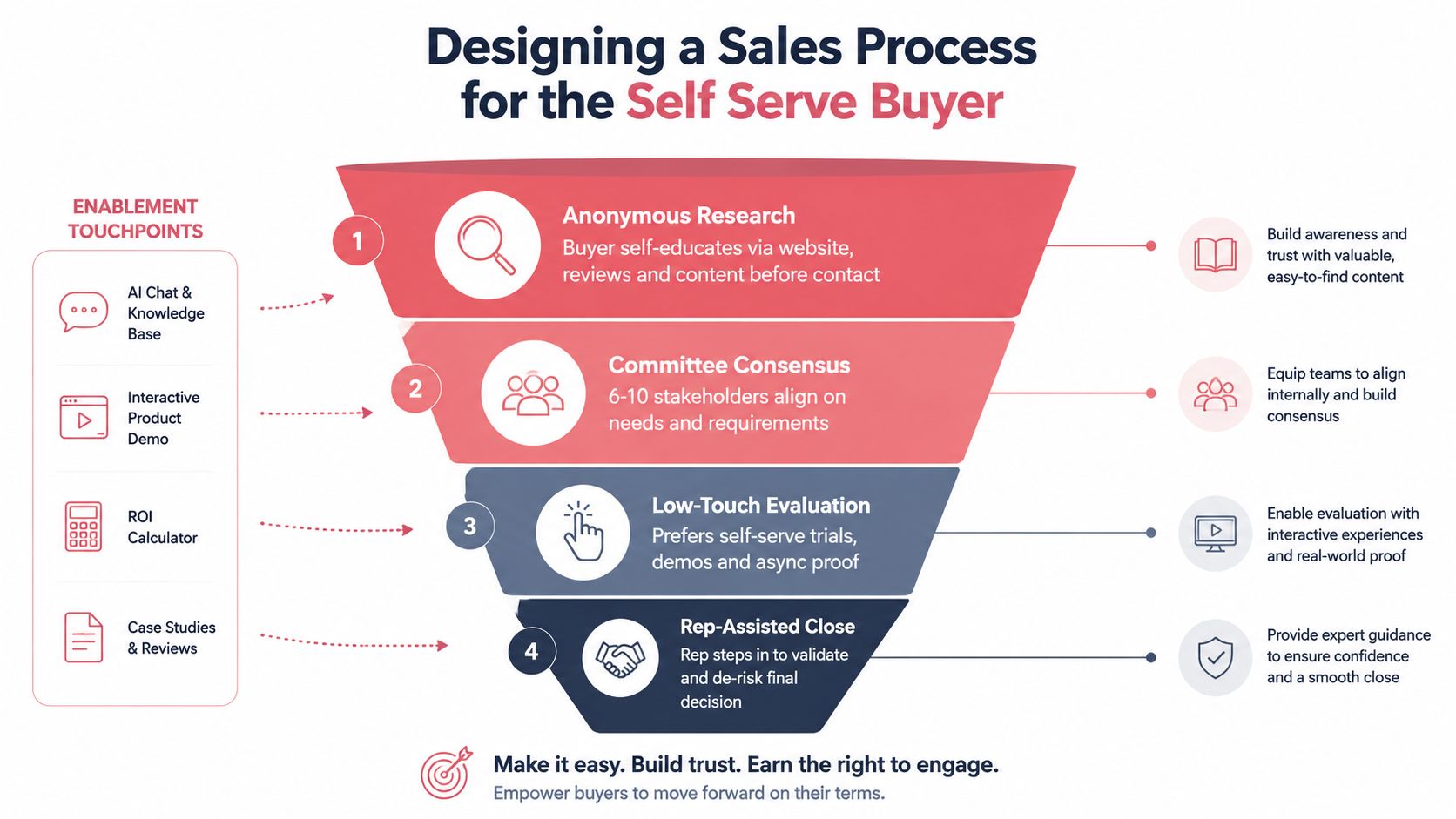
A self serve buyer still needs confidence. The buyer may prefer to research without a rep, compare options independently, and share material internally before accepting a conversation. The sales process should make that behavior easy while preserving a clear path to human help when the decision becomes complex.
Recent research reports that 67% of B2B buyers prefer a rep free experience (Gartner survey coverage). A separate 2025 benchmark says 78% of respondents report that buyers prefer self service journeys, and that deals require 12.4 touchpoints, compared with 9.2 in 2023 (Allego State of Sales Enablement report).
Those touchpoints don't need to become a stream of meetings. They can include a website explanation, a comparison page, an interactive demo, a useful email, a chat response, a shared buyer workspace, and a focused validation call. The important question is whether every interaction answers a buyer question and creates a sensible next step.
Map content to questions
Build the journey around buyer uncertainty rather than seller activity. Ask what each stakeholder must believe before moving forward.
- Problem recognition: Can the buyer explain the operational cost of the current situation?
- Solution fit: Can the buyer see how the approach addresses the problem?
- Risk reduction: Can technical, financial, legal, and security stakeholders find credible proof?
- Internal consensus: Can a champion share the case without rebuilding it?
- Decision readiness: Are the remaining objections visible and assigned to an owner?
A digital sales room can hold the current recommendation, relevant proof, implementation information, security material, and a short list of next steps. The rep doesn't need to push every asset at once. Sequencing matters. Early content should create clarity, while later content should reduce specific risk.
The larger the committee, the more carefully the system should coordinate channels and roles. Email, LinkedIn, chat, and shared workspaces should carry the same positioning, but each can serve a different purpose. A rep can use live time for judgment and relationship work while the buyer handles routine education independently.
Buyer centered test: Remove every asset that doesn't answer a current question, prove a material point, or make the next decision easier.
The process should also include a human escalation path. A buyer who asks for a custom evaluation, complex integration review, or commercial discussion shouldn't be forced back into generic self service content. Rep assisted self service works because autonomy and expertise reinforce each other.
Building Your Enablement Tech Stack and Playbooks
A useful stack should make the sales motion easier to run, inspect, and improve. Start with the team's motion, data maturity, and need for control. A small team may need only a few focused tools with clear handoffs. A larger organization may require integrations, permissions, governance, and reporting. The wrong stack is the one that adds administrative work or hides how plays perform.
Compare the stack patterns
Point tools handle focused jobs such as enrichment, sequencing, content management, or call analysis. They suit teams with clear ownership and dependable data handoffs. Without those handoffs, disconnected reporting creates manual work and weakens feedback.
An integrated suite brings more functions around the CRM. Administration becomes simpler, and managers gain a shared view of execution. The tradeoff is less flexibility if the suite does not fit the team's motion.
A unified GTM API connects specialized providers through a common interface. It suits teams that may change enrichment, messaging, or channel providers without rebuilding every play. Technical ownership is higher, but the operating model becomes easier to move between providers.
Before choosing sales enablement tools, map the work the stack must support:
- Data: Enrichment, firmographics, contacts, account history, and intent signals.
- Execution: Email, LinkedIn, calling, chat, and task management.
- Knowledge: Positioning, proof, objection handling, and buyer resources.
- Learning: Onboarding, practice, coaching, and just in time guidance.
- Measurement: Activity, adoption, conversion, pipeline quality, and retention.
The playbook converts those capabilities into repeatable behavior. A prospecting play can specify the target account, research fields, personalization rules, approval conditions, channels, and stop criteria. A reply handler can classify intent, identify risk, draft a response, and route sensitive messages to a person for review.
Make playbooks portable
Treat each play as operating IP, not as a document buried in a folder. Record its trigger, inputs, steps, outputs, permissions, and success criteria in a format the team can inspect and update. That structure lets the team replace a provider without redesigning the sales motion.
Teams connecting content, coaching, and execution can review guidance on how to improve sales team performance with enablement.
Yalc illustrates the unified approach. It connects GTM tools through a unified interface, stores ICP, voice, positioning, and prior play outcomes in a knowledge layer, and lets teams run preconfigured plays from Slack or its interface, or compose plays through its MCP in Claude Code. It logs agent activity, supports human approval for sensitive actions, and records verdicts. Validated plays can become defaults, while weak plays can be retired automatically through that governance loop.
The stack should operate like a self-correcting system, not a static content library. A play runs, produces an outcome, receives a verdict, and either stays in service or leaves the operating set. That feedback supports rep-assisted self-serve buying, where buyers get useful guidance independently and reps step in when judgment or approval is required.
Choose from the motion outward. Map channels, stakeholders, approval points, and reporting needs first, then select the smallest stack that can execute, learn, and reduce administrative work.
Measuring What Matters KPIs That Prove Enablement Works
A new playbook launches on Monday. By Friday, reps have opened it, managers have discussed it, and pipeline has barely changed. That gap is why enablement measurement must examine behavior before revenue. A revenue total shows the result, not whether reps used the qualification method, buyers received relevant proof, or managers reinforced the intended motion.
Harvard Business Review KPI research emphasizes balancing leading and lagging indicators across 800 or more sales groups. Leading indicators show adoption and execution. Lagging indicators show commercial consequences. Both are needed to diagnose the system.
Track measures at the rep and opportunity level:
- Content usage: Which assets reps use, share, and attach to active opportunities.
- Training completion: Whether assigned learning is completed and followed by observed application.
- Ramp time: How quickly a new rep performs required behaviors consistently.
- Quota attainment: Whether execution reaches the commercial standard.
- Customer retention: Whether the motion supports durable customer outcomes.
Each metric should trigger a decision. Low usage points to a discovery or access problem before a content production problem. High training completion with unchanged behavior points to manager coaching or workflow prompts. Rising adoption without better conversion calls for testing the message or qualification rule.
Revenue signals need context
Organizations without sales enablement reported an average forecast win rate of 42.5%, compared with 49.0% for organizations with sales enablement. That represents a 6.5 point absolute lift, or about a 15.3% relative improvement, according to the Sales Enablement Maturity Index.
| Metric | Without Enablement | With Enablement |
|---|---|---|
| Forecast win rate | 42.5% | 49.0% |
| Best in class quota attainment | 60% | 84% |
The quota comparison comes from the same source family, as reported by Exec's sales enablement statistics. These figures do not establish that a content library caused the difference. They support a narrower conclusion: structured enablement can influence conversion and quota performance when teams adopt the process behind the assets.
Measure method adoption, not document activity alone. The maturity research connects process and methodology adoption above 75% with above average gains in revenue plan attainment, quota attainment, and win rates, with the strongest boost appearing above 90% adoption. That distinction matters for rep-assisted self-serve buying, where buyers may progress independently and reps must apply judgment at specific points.
A useful dashboard ties activity to execution and outcomes. These sales dashboard examples show how to organize those views without reducing enablement to one revenue number.
The operating loop should also grade each play against its intended outcome. A play that fails repeatedly is revised or retired. A play that works under defined conditions is promoted, documented, and easier to run. AI can support that review by flagging weak plays for governance, while approved criteria keep retirement decisions inspectable.
Putting It All Together An Enablement System That Learns
A scalable enablement system starts with a clear ICP, voice, positioning, and definition of a qualified outcome. It then connects the data sources that describe accounts, contacts, activity, conversations, content use, and opportunity status. Playbooks execute against that context, while approvals protect sensitive actions.
AI should automate preparation, routing, summarization, scoring, and repetitive follow through. Human leaders should retain control over strategy, claims, permissions, and high consequence communication. The system earns trust when every run has an audit trail and a measurable success condition.
The learning loop is simple:
- Form a hypothesis: Define the buyer, trigger, message, action, and expected outcome.
- Run the play: Execute through the approved channels and tools.
- Score the result: Compare activity and buyer response with the success criteria.
- Record the verdict: Mark the play as a hypothesis, validated, or proven.
- Promote or retire: Make reliable plays easier to run and remove weak ones.
This model also applies to the information leaders use to understand their market. A curated startup funding feed can help teams identify relevant company events, but the feed only becomes useful when the system turns those events into qualified accounts, timely plays, and measured outcomes.
The operating principle is clear. Proven behavior should become the default. Weak behavior should become harder to repeat. That is how a lean GTM team increases consistency without adding a new layer of manual coordination.
Yalc connects sales research, enrichment, qualification, outreach, reporting, and GTM knowledge through one operating layer, with playbooks that can be composed or run with minimal setup. Visit Yalc to see how a self correcting enablement system can help the team execute, measure, and improve its revenue motion.