B2B Sales Processes: Stages, Roles, and Automation
A complex B2B sales process stages through account research, qualification, multi stakeholder engagement, selling, and handoff, while automation handles repeatable work and humans handle diagnosis and consensus. The median B2B buying group includes six to ten decision makers, so a pipeline built around one contact will routinely miss the people who can block or approve the purchase.
A demo can go well and still lead nowhere. An SDR may secure enthusiastic agreement from a champion, only for procurement, security, finance, or operations to reject the solution before the next meeting. Effective B2B sales processes therefore need more than stage names and handoff rules. They need a living map of the decision group, clear evidence for stage progression, fast response to buying signals, and deliberate boundaries between automation and human judgment.
Table of Contents
- Why B2B Deals Stall Before the First Meeting
- The Core B2B Sales Process Stages
- Roles and Motions That Fit the Process
- Metrics That Predict Real Outcomes
- Where GTM Automation Belongs
- Qualification as a Multi Stakeholder Graph
- Closing the Loop with Graded Playbooks
Why B2B Deals Stall Before the First Meeting
Gartner research found that the median B2B buying group includes six to ten decision makers, with each person bringing four or five pieces of independent information before consensus forms. The published buyer enablement document makes the operational problem clear. The first contact isn't the opportunity. The opportunity is the network of people who must reach a decision.
Consider a common stall. An SDR identifies a strong account, finds a relevant operations leader, and books a polished product demonstration. The champion confirms the problem and asks for a proposal. Then the process goes quiet. Later, the seller learns that procurement won't add another vendor category and security has already rejected the required integration model. The pitch wasn't weak. The seller never reached the people shaping the decision.

Engagement isn't the same as coverage
A reply, meeting, or completed demo proves contact activity. It doesn't prove buying group alignment. The account plan should distinguish the internal champion, economic buyer, daily users, technical evaluators, procurement, legal, security, and possible internal opponents.
Each role has a different reason to support or resist the purchase:
- Users need confidence that the workflow will work in practice.
- Technical evaluators need integration, security, and implementation evidence.
- Finance needs a credible business case and ownership of the investment.
- Procurement and legal need a workable paper process.
- Executives need a concise explanation of why the change matters now.
Practical rule: A meeting with one enthusiastic contact is a signal to map the account, not permission to forecast the deal.
A flat lead list encourages sellers to optimize for message volume. A stakeholder graph encourages them to ask better questions. Who can veto the project? Who owns the business change? Which person will have to defend the decision internally? What evidence can the champion carry into those conversations?
The process should record those answers before the seller treats activity as progress. If the account remains single threaded, the next action isn't another generic follow up. It's a role specific plan that helps the champion create internal consensus without forcing every stakeholder into an unnecessary sales call.
The Core B2B Sales Process Stages
A strong process works as a sequence of evidence based gates, not a checklist of seller tasks. Each stage defines what enters, what must be learned, and what buyer action permits progression.
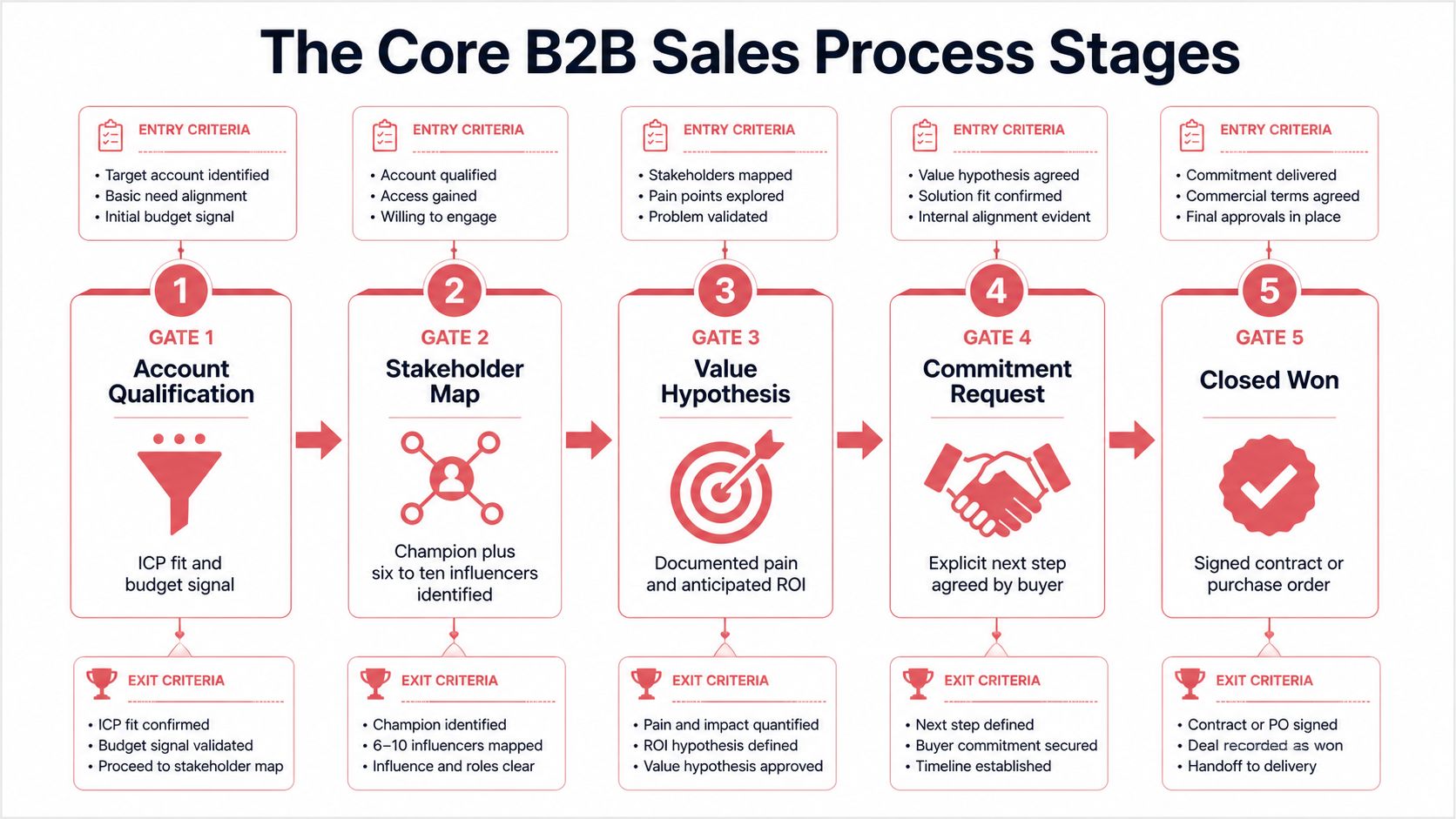
Gate one starts with account qualification
The account enters when it shows credible ICP fit and a relevant business signal. Research should capture firmographic context, current technology, likely business change, and the reason the account may act. The exit condition is a documented fit hypothesis, not merely a populated contact record.
Gate two builds the stakeholder map
Qualification becomes an opportunity only after the seller identifies the champion and the roles that influence approval. The map should include known objections, decision criteria, required evidence, and missing access. If the economic buyer or technical evaluator remains unknown, the opportunity carries an explicit coverage risk.
Gate three tests the value hypothesis
Discovery should connect a defined business problem to an operational consequence and a measurable decision criterion. The seller and buyer should agree on what success means, who owns it, and what validation is required. A demo without that agreement is activity, not validation.
Gate four requests commitment
A commitment request asks the buyer to take a specific next step, such as scheduling security review, confirming a pilot scope, introducing procurement, or approving a commercial review. “We'll follow up” isn't a commitment. The buyer must accept an action, owner, and timing.
Gate five closes and hands off context
Closed won requires a signed contract or purchase order, followed by a handoff containing the business case, stakeholder map, commitments, risks, and success criteria. Customer success shouldn't have to reconstruct the deal from scattered notes.
Teams often benefit from documenting these rules alongside practical sales pipeline templates. The important design choice is to make every stage exit verifiable. A proposal sent by the seller isn't evidence that the buyer is ready to negotiate. A scheduled technical review is.
Roles and Motions That Fit the Process
SDR, AE, inbound, and outbound aren't separate processes. They're different ways to feed and operate the same gates. The right motion depends on the quality of the signal, the complexity of the buying group, and the amount of diagnosis required.
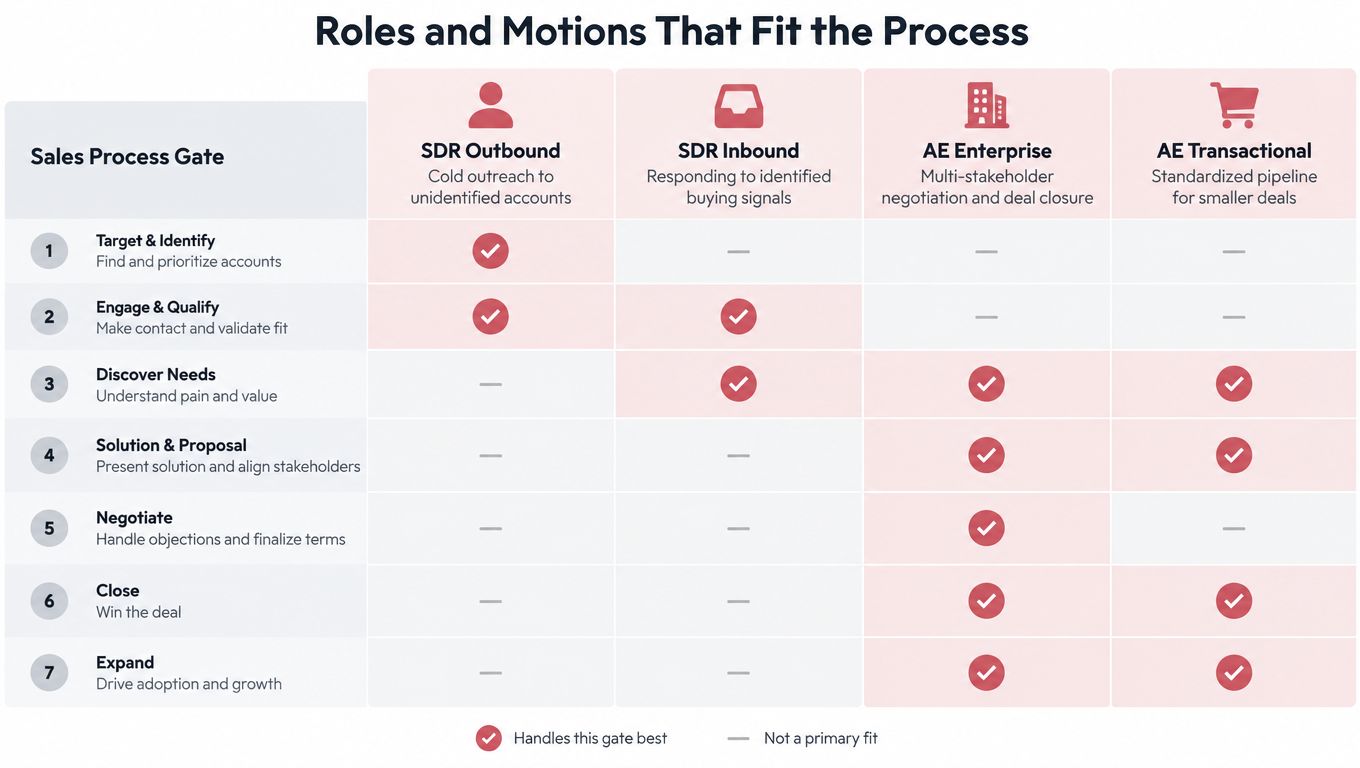
Match the motion to the signal
SDR outbound works best at account qualification and initial stakeholder discovery when the account hasn't raised a hand. The SDR researches fit, forms a relevant hypothesis, and earns access to a person who can validate the problem. It shouldn't force a complex enterprise deal through a generic sequence.
SDR inbound owns speed and routing. A form submission, content interaction, or direct inquiry gives the team an identified signal. The job is to confirm context quickly, enrich the record, and connect the buyer with the right human or resource.
AE enterprise takes over when the buying group, business case, and technical consequences require diagnosis. The AE coordinates discovery, solution validation, executive alignment, procurement, legal, and negotiation. The role isn't just to deliver a larger demo. It's to orchestrate agreement.
AE transactional fits repeatable opportunities with limited decision complexity. Standardized qualification, pricing, and implementation information can move the buyer forward with less seller involvement.
| Buyer situation | Best starting motion | Human work that matters |
|---|---|---|
| Unidentified account with plausible fit | SDR outbound | Form a relevant hypothesis and find the right role |
| Clear inbound signal | SDR inbound | Respond, enrich, route, and qualify quickly |
| Several functions affected | AE enterprise | Diagnose risk and build consensus |
| Standard purchase path | AE transactional | Make information and next steps easy |
Buyers increasingly want independent research, but independence doesn't eliminate the need for expert help. Gartner research reported that 61% of B2B buyers prefer a rep free buying experience overall, while 73% actively avoid suppliers that send irrelevant outreach. Gartner's 2025 survey release supports a hybrid design. Let buyers self serve for routine education, then bring in a seller when the question becomes specific to their systems, risks, or internal decision.
Teams refining discovery, objection handling, and role based selling can also use PreSales Unleashed GmbH coaching as a practical skills resource. The useful test is simple. If a motion creates more activity but doesn't improve access, diagnosis, or commitment, it isn't scaling the process. It's scaling noise.
Metrics That Predict Real Outcomes
Activity counts are easy to report and weak at diagnosing risk. A healthy scorecard measures whether the buyer moved through a gate, whether the right stakeholders are covered, and whether the team responded while intent was still active.
Response latency deserves its own service level
An audit of 2,241 U.S. companies found that contacting an inbound lead within one hour made organizations nearly seven times more likely to qualify it, while companies waiting at least twenty four hours were about sixty times less likely to qualify than those responding within the first hour. The audit summary supports a clear operating rule. New inbound inquiries should enter a monitored queue, receive an owner, and trigger an approved first attempt immediately.
The workflow should preserve the exact response timestamp and separate an attempted contact from a completed conversation. Managers should inspect:
- Median response time: How quickly the team usually acts.
- Worst case response time: Where routing or ownership breaks.
- Qualification by latency bucket: Whether speed changes downstream quality.
- Meeting and opportunity creation: Whether fast action creates real progression.
The result should be segmented by source, geography, company size, intent, and channel. A fast inbound workflow shouldn't be treated as proof that cold outbound will behave the same way.
Coverage measures decision risk
A deal with one active champion and no economic buyer access may show impressive email and meeting activity. It still has a structural weakness. Track stakeholder coverage, single threaded and multi threaded opportunities, stage aging, loss reasons, and win outcomes by coverage level.
The purpose isn't to turn relationship building into a crude score. It is to make invisible risk visible early enough to act. A missing technical evaluator should create a task. An untested procurement path should prevent late stage forecasting.
Quality matters after digital engagement
Digital self service improves convenience, but complex purchases still benefit from targeted assistance. Gartner research found that buyers who completed a digital self service purchase were 1.65 times more likely to regret it than buyers following traditional rep led paths. Rep assisted digital purchasing reduced buyer regret by half compared with self service digital commerce, and buyers were 1.8 times more likely to complete a high quality deal when they used supplier provided digital tools with a sales representative. The cited B2B sales research points to a useful division of labor.
Self service should answer routine questions. Sellers should intervene when the buyer needs diagnosis, consensus building, risk reduction, or decision support. Measure whether that intervention resolves uncertainty, not just whether it produces another logged activity.
Where GTM Automation Belongs
Automation works best when it reinforces a known gate. It shouldn't decide that a deal is healthy merely because a sequence ran or a field was filled.
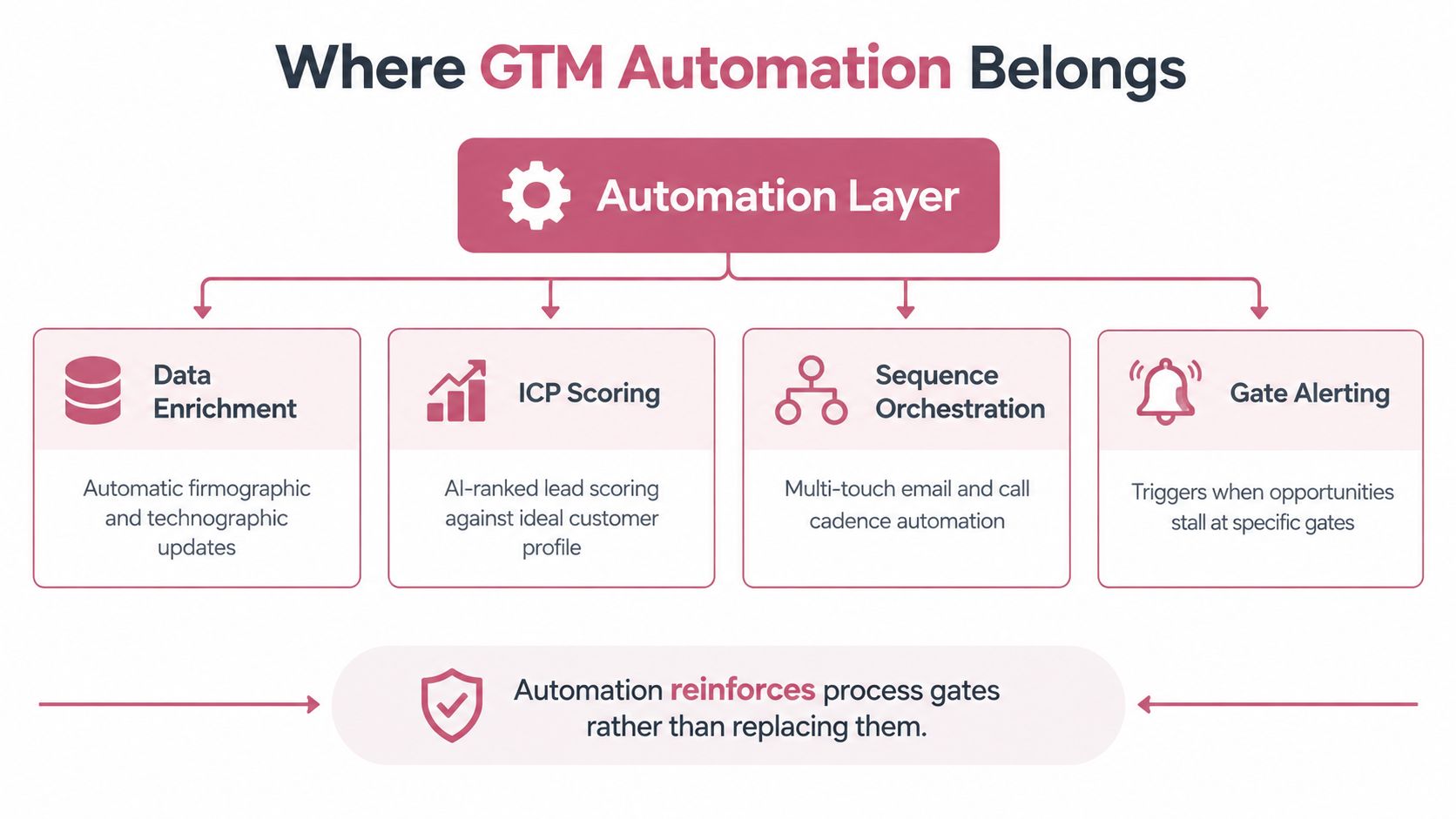
Automate preparation and repetition
A practical automation layer can handle:
- Data enrichment: Update company, role, technology, and account context before a seller reviews the record.
- ICP scoring: Rank accounts against agreed fit and buying signals, while exposing the reasons behind the score.
- Sequence orchestration: Run approved email, call, and social steps with suppression rules for replies, opt outs, and changed context.
- Reply triage: Classify positive replies, objections, referrals, unsubscribe requests, and requests for human contact.
- CRM synchronization: Write structured stakeholder, risk, next step, and response fields into the system of record.
- Reporting: Show latency, stage aging, coverage gaps, and campaign outcomes without forcing managers to assemble reports manually.
Yalc provides one example of this operating model. Its GTM system can research and enrich accounts, score ICP fit, synchronize CRM records, orchestrate approved outreach, handle replies, and record campaign telemetry, while human approvals remain available for sensitive actions. Teams that want to evaluate a controlled introduction can use this guide to pilot AI in sales teams alongside clear approval and measurement rules.
Pause when context becomes consequential
Human judgment should take over when the buyer describes an ambiguous use case, cross functional disagreement, security or legal risk, unusual commercial terms, or a claim that requires evidence. The system can prepare the account brief and draft the response. A seller or subject matter expert should decide whether the answer is accurate and appropriate.
Gartner's finding that 73% of buyers avoid suppliers sending irrelevant outreach makes indiscriminate automation especially costly. A sequence should stop when the buyer changes direction, introduces a new stakeholder, raises a risk, or asks a question outside the approved knowledge base.
A useful implementation assigns every automation step an escalation condition. It also logs the trigger, the proposed action, the approval, and the result. The sales process automation framework should therefore describe both what runs automatically and what must pause.
Automation should remove preparation and repetition. It shouldn't remove accountability for a consequential buyer answer.
Qualification as a Multi Stakeholder Graph
Qualification becomes more accurate when the account is modeled as a network of roles, influence, objections, and evidence. The champion is one node in that graph, not a substitute for the graph itself.
A 2025 Edelman and LinkedIn report found that more than 40% of B2B deals stall because of internal misalignment, while 71% of hidden buyers report little or no interaction with sales teams. The report on hidden buyers shows why visible engagement can create false confidence. A person who never joins a seller call may still shape the internal decision.
Build the graph during discovery
Start with the business change, then identify who experiences its consequences. For each stakeholder, capture:
- Role in the decision: User, champion, economic buyer, technical reviewer, procurement, legal, security, or executive sponsor.
- Influence and position: Supportive, neutral, opposed, or unknown.
- Decision criteria: What must be true for that person to approve.
- Required evidence: Business case, workflow proof, integration detail, risk documentation, or executive narrative.
- Relationship to the champion: Direct access, indirect access, or no known path.
- Next action: Introduction, role specific content, validation session, or internal enablement.
The seller shouldn't spam every stakeholder with the same message. The champion may need a concise internal business case. A technical evaluator may need architecture and security material. Finance may need a clear explanation of cost ownership and expected operational impact.
Turn coverage into a stage exit
A scheduled demo doesn't resolve a buying group risk. Stage progression should require evidence that the relevant roles have been identified, their decision criteria are understood, and the champion can reach people who can approve or block the purchase.
The CRM can store these fields, while a reply handler can detect new personas, objections, and decision criteria. A buying committee mapping workflow can help teams identify and coordinate the buying group without reducing qualification to a single score.
Managers should inspect the graph during forecast reviews. If the opportunity has strong user enthusiasm but no financial owner, the next action is not another product presentation. If procurement appears late, the seller should surface the paper process before commercial negotiation.
Teams that need a faster operating approach can review methods for qualifying B2B leads faster, then adapt the useful parts to their own approval paths. The goal isn't speed at the expense of judgment. It's earlier discovery of the people and evidence that determine whether speed will matter.
Closing the Loop with Graded Playbooks
A sales process without telemetry depends on memory and optimism. A graded playbook treats every campaign, routing rule, and stakeholder action as a hypothesis with a measurable outcome, a verdict, and a change to the next run.
Start with a narrow question. For example, does role specific enablement help a champion secure access to procurement, or does a faster inbound response improve qualification for a particular lead source? Define the signal before launch, then record the result without changing the criteria after seeing the outcome.
Measure the gate, not just the campaign
A useful review includes:
- Stage aging: Where opportunities wait longer than expected.
- Loss reasons: Whether the failure came from fit, timing, competition, risk, budget, or internal alignment.
- Coverage level: How outcomes differ between single threaded and multi threaded opportunities.
- Response latency: Whether speed changes contact and qualification results.
- Human approval rate: Which automated actions require frequent correction.
- Play verdict: Whether the motion should be promoted, revised, or retired.
Gartner research indicates that enterprise buying groups commonly contain five to eleven stakeholders spanning roughly five business functions, including finance, IT, operations, procurement, legal, and executive leadership. The account mapping guidance supports treating coverage as an operating requirement, not an optional research field.
Make feedback operational
Suppose the stalled deal from the opening scene reaches a second cycle. The team responds quickly to the inbound signal, identifies the operations champion, asks for the technical evaluator, and surfaces procurement before the proposal. The seller gives each role the evidence it needs, while automation records the missing coverage and pauses outreach when a sensitive question appears.
The playbook then grades itself. If technical validation happened earlier and the opportunity advanced with fewer unresolved risks, that sequence becomes a stronger candidate for reuse. If a generic message produced replies but no stakeholder access, the team retires it rather than celebrating activity.
The final handoff should preserve the same context. Delivery receives the agreed business outcome, stakeholder commitments, implementation concerns, and success criteria. The account then generates better intelligence for the next cycle, because the process captured what occurred instead of only recording that the deal was won or lost.
Yalc connects account research, enrichment, qualification, outreach, reply handling, CRM updates, and campaign reporting through a unified GTM operating system, with human approvals for sensitive actions and telemetry for every play. Visit Yalc to evaluate a controlled automation layer for your B2B sales process and turn stakeholder coverage, response speed, and play performance into measurable operating data.