The B2B Lead Qualification Process That Actually Works
Stop treating BANT as a qualification process. It is a short interview script, and it tells a team very little about whether an account can buy. A contact can name a problem, claim a timeline, and still lack influence, sponsorship, and agreement from the people who own the outcome.
A useful B2B lead qualification process works differently. It treats every score as a hypothesis about account readiness, updates that hypothesis as evidence arrives, and grades itself against real outcomes. Speed matters. Fit matters. Neither replaces proof that a buying group has formed around a problem worth solving.
Table of Contents
- Why Most B2B Lead Qualification Processes Fail Before They Start
- Defining Your ICP as a Tiered Fit Model
- Building a Lead Scoring Model You Can Defend
- Designing an Enrichment Waterfall That Stops Wasting Credits
- Routing, SLAs, and the Five Minute First Touch Rule
- A 90 Day Rollout Plan for the Whole Qualification Stack
- Measuring the Funnel Without Lying to Yourself
Why Most B2B Lead Qualification Processes Fail Before They Start
Most motions fail because they qualify a person when revenue depends on an account. A researcher can attend calls, download content, and answer discovery questions without owning the business problem. The rep marks need as confirmed, sales accepts the lead, and the deal stalls when procurement, finance, or an executive sponsor hears about it for the first time.
That gap matters because buyers arrive with much of their evaluation already shaped. One cited 2025 estimate says buyers conduct about 12 online searches before visiting a vendor website and may be 60 to 90 percent through evaluation before contacting a supplier, as described in research on B2B buyer behavior and intent data. A late conversation with one interested contact doesn't reveal whether the wider group agrees.
Four patterns that waste pipeline
- Single contact gating: The process records budget, authority, need, and timeline from one person and never tests who owns success criteria or who can block the purchase.
- Content treated as intent: A PDF download becomes proof of readiness even when the reader is a student, competitor, job seeker, or existing customer exploring an unrelated topic.
- Score once and forget: Activity points accumulate, old signals never decay, and nobody compares the original score with acceptance, opportunity creation, or loss reasons.
- Territory first routing: Ownership follows geography or rotation before fit, source urgency, and account tier, so strong accounts wait while weak accounts get fast attention.
Qualification is a claim about future buying behavior. Every claim needs evidence, an owner, and a date when the team will check whether it was right.
Treat account level buying readiness as the unit of qualification. Record problem severity in the buyer's language, the person who owns the financial outcome, champion strength, executive sponsorship, competing priorities, procurement complexity, and the next documented decision. Separate an interested researcher from a mobilized buying group. Those are different states and they deserve different plays.
That distinction also clarifies where automation helps and where it doesn't. Software can enrich the account, map likely stakeholders, detect missing roles, and recommend the next evidence gathering action. It should not declare an account ready because one contact looks senior. Teams comparing automation options can use CapyScout's AI lead qualification guide as a useful reference for where machine checks end and human judgment should stay in control.
Defining Your ICP as a Tiered Fit Model
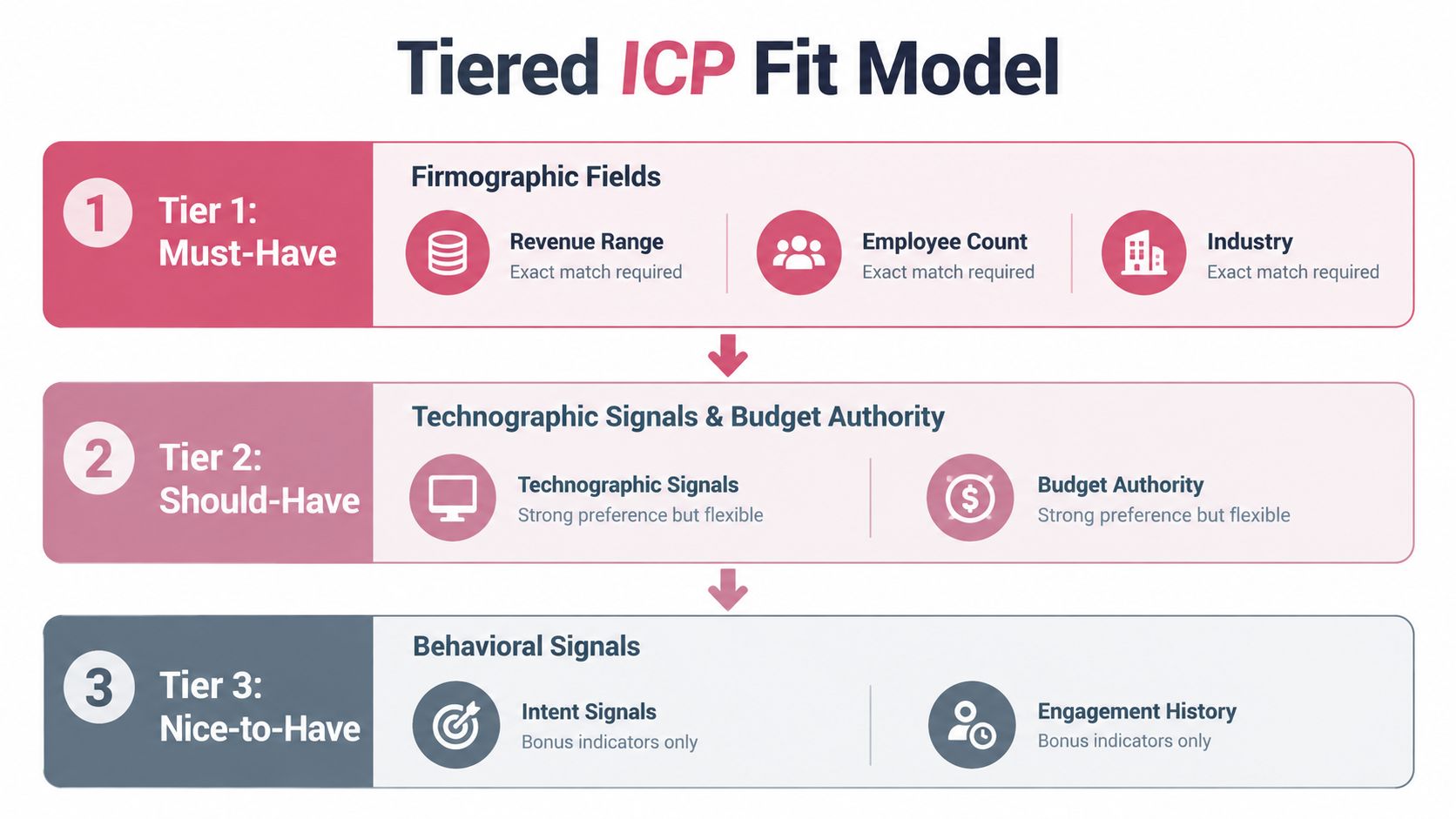
An ICP document that lists every desirable company trait is not a qualification model. It gives reps no way to choose between a strong account with one missing attribute and a weak account with several superficial matches. Build three tiers instead, and make the rule for each tier explicit enough that a system and a rep reach the same decision.
Start with your own closed won and closed lost records. Pull the accounts that bought, renewed, and expanded, then compare them with accounts that consumed sales time and died late. Look for firmographic fit, operating model, current tools, team structure, trigger events, and the job the buyer hired the product to do. Analyst taxonomies can fill gaps, but they can't replace outcome data from your funnel.
A worked example
Consider a company selling sales automation to mid market revenue teams. Tier one must have a dedicated sales development function, a CRM in active use, outbound activity as a real pipeline source, and a leader who owns pipeline generation. Instant disqualifiers include no outbound motion, no CRM, and a sales team built entirely around inbound partner referrals.
Tier two keeps the operating model but allows flexibility on stack or team maturity. The account uses a CRM and runs outbound, yet ownership sits with a founder or a growth lead rather than a sales development manager. Tier three matches on size and industry but shows no clear trigger, no relevant hiring, and no evidence that pipeline creation is a current priority. Tier three belongs in nurture, not in a rep queue.
- Must have fields: Industry, company size, geography where relevant, operating model, required systems, and the presence of the function that owns the problem.
- Should have fields: Tech stack detail, growth signals, hiring patterns, funding or expansion events, and prior engagement from relevant roles.
- Instant disqualifiers: Regulated constraints you can't meet, business models you can't serve, competitor status, and company structures that make deployment impossible.
Write each field as a rule with an allowed value, a source, and a fallback when data is missing. Missing data isn't negative evidence. It means confidence is low and enrichment or a research task should run before routing. Teams that need a primer on the underlying definitions can review the ICP definition framework before locking tier rules.
Store the final model where every play can read it. A slide in a shared drive will drift within a quarter. The CRM, enrichment workflow, scoring logic, and outbound tools should all reference the same version, with a named owner and a change log. When tier definitions change, rescrore the active pipeline and record why accounts moved.
Building a Lead Scoring Model You Can Defend
A defensible score separates fit, intent, and engagement instead of blending them into one opaque number. Fit answers whether the account can buy and succeed. Intent answers whether the account shows evidence of an active problem. Engagement answers whether people at the account interact with your company. A high fit account with no intent needs monitoring. A low fit account with heavy engagement needs disqualification, not a fast track to sales.
Score stream architecture
| Stream | Variables | Weight share | Decay rule |
|---|---|---|---|
| Fit | ICP tier, required systems, operating model, disqualifiers | Highest for routing eligibility | Changes only when firmographic data changes |
| Intent | Pricing research, comparison activity, repeated account visits, business events | High for timing decisions | Falls steadily when activity stops |
| Engagement | Content use, event attendance, email replies, meeting history | Moderate for prioritization | Falls fastest after inactivity |
| Negative evidence | Competitor domains, student or personal email, unsubscribe, hard disqualifiers | Overrides positive streams | Persists until a human reviews the record |
Set weights from outcomes, not from opinion. Export scored leads with their eventual disposition, then compare acceptance and opportunity creation across score bands. If the top band converts at the same rate as the middle band, the model isn't sorting anything. Adjust one variable group at a time, or you won't know what caused the change.
Evidence from larger datasets points in the same direction. A 2025 Rochester Institute of Technology thesis used more than 78,000 opportunity records and 17 variables and found that sales velocity, qualification board score, and opportunity size were among the strongest predictors of success, as reported in the RIT thesis on predicting opportunity outcomes. The lesson is methodological. Predictors earn weight by beating alternatives on real records, not by sounding plausible in a planning meeting.
Practical rule: If a rep can't explain why a lead scored high in one sentence, the model is too opaque to trust.
Define lifecycle states with entry and exit criteria. MQL means marketing evidence meets a threshold. SAL means a seller reviewed the record and accepted ownership. SQL means discovery confirmed business pain, a relevant use case, an identified buying role, and a next meeting with a defined purpose. Budget can stay unknown early, provided the record explains how funding could be created or approved.
Run separate thresholds by channel when behavior differs materially. Event leads, demo requests, and outbound replies don't carry the same baseline intent, and forcing one threshold across all three creates false precision. Retain the reason for every score change so operations can audit whether fit, behavior, or seller judgment moved the lead. A clear foundation helps here, and the basics of lead scoring covers the core mechanics teams should align on first.
Add decay rules from day one. A webinar view from last year should not compete with pricing research from this week. Expiry forces the model to reflect current readiness and prevents old engagement from resurrecting dead accounts every quarter.
Designing an Enrichment Waterfall That Stops Wasting Credits
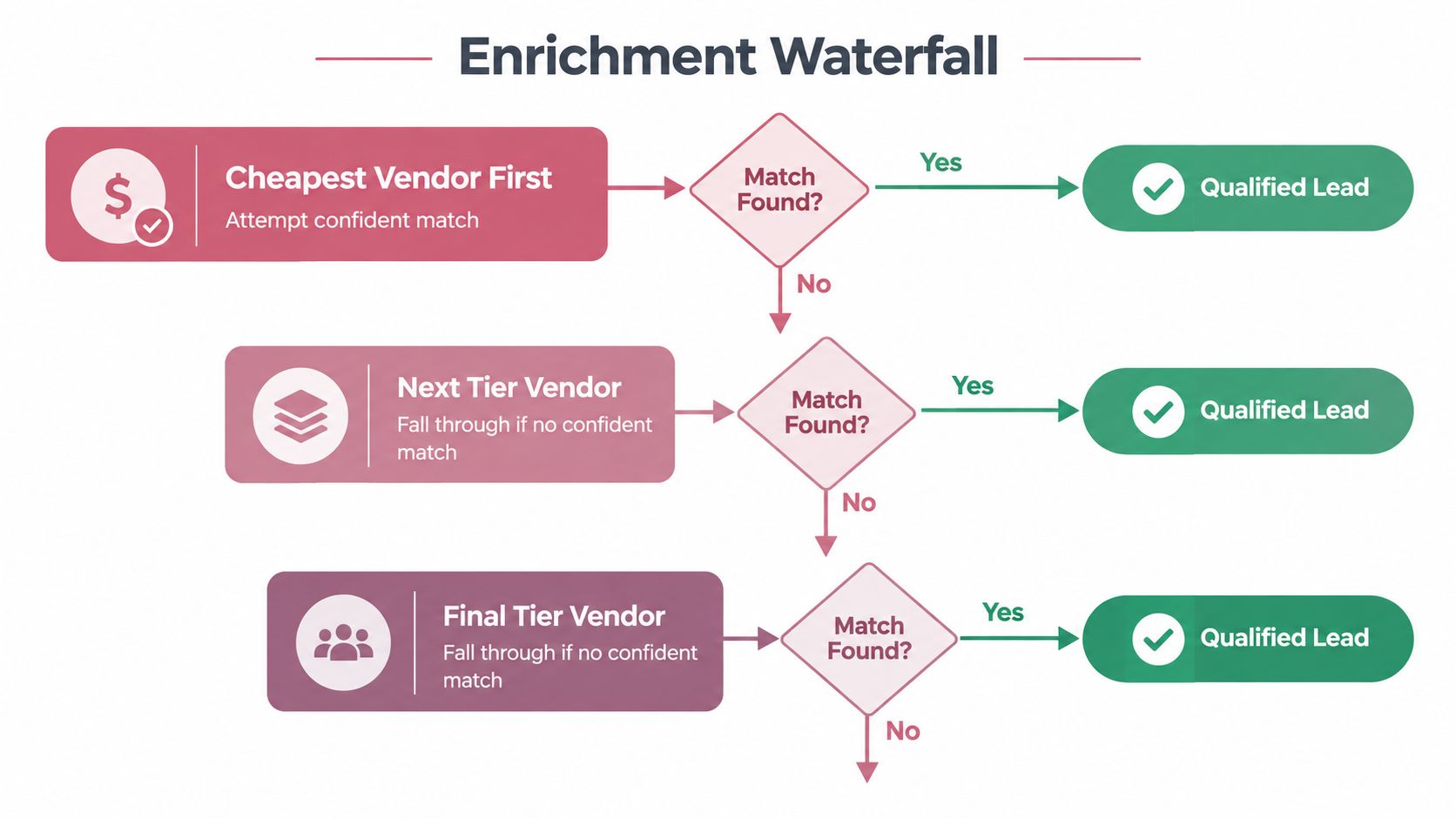
Enrichment fails in two common ways. Teams buy one provider and accept every gap it returns, or they call several providers for every record and pay repeatedly for the same fields. A waterfall avoids both errors. It asks the lowest cost source first, stops when required fields reach confidence, and moves to the next source only for fields that remain missing or weak.
Define the minimum record before choosing vendors. A B2B qualifier usually needs a verified work email, role, seniority, company size, industry, location where routing requires it, relevant tech stack, and a small set of account signals such as hiring or expansion. Nice extras like personal interests or generic company descriptions rarely change a qualification decision. Cut them from the required chain.
How the chain should run
- Normalize first: Clean company names, domains, country formats, and duplicate records before spending credits. Bad input creates confident looking bad matches.
- Match the account: Confirm domain, legal entity where needed, size, and industry. If account identity is uncertain, stop and flag the record for review.
- Fill required contact fields: Request email, role, and seniority from the first provider. Accept the result only when confidence and verification meet your threshold.
- Fall through by field: Send only missing fields to the next provider. Paying again for a known company size adds cost without adding knowledge.
- Verify before outreach: Check email validity at the end of the chain so sequences don't absorb preventable bounces.
Measure cost per completed record, not cost per credit. A cheap provider with weak coverage can cost more once reps research gaps by hand, while an expensive provider can be economical when reserved for tier one accounts. Track completion rate, verification failure, bounce outcome, and sales acceptance by provider and by field. That view tells operations which vendor wins on email, which wins on firmographic data, and which adds nothing.
Build refresh rules into the design. Roles change, people leave, and companies get acquired. Verify contact data again after a defined period of inactivity, after a hard bounce, and before a dormant account reenters outbound. Store the source and timestamp for every enriched field. When a rep disputes a title or a score looks wrong, the team can trace the value instead of guessing. Teams designing this layer will find the waterfall enrichment model useful for structuring provider order and stop conditions.
Don't let enrichment overwrite human verified data. Lock fields confirmed in conversation, and route conflicts to review when a provider returns a different role or employer. Automation should raise data quality. It shouldn't erase the most reliable evidence in the CRM.
Routing, SLAs, and the Five Minute First Touch Rule
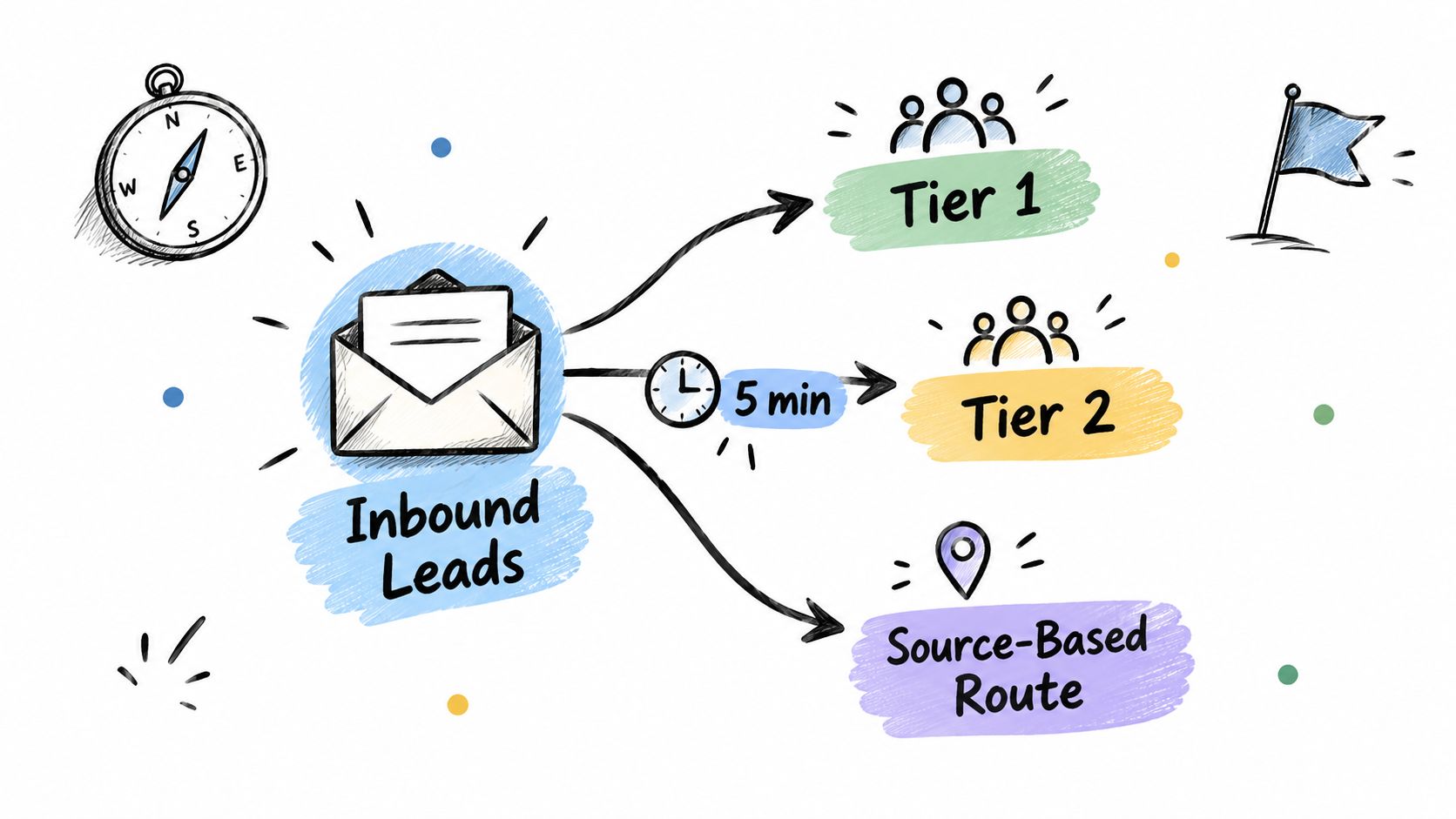
Routing is a qualification decision, not an administrative step. The owner, the clock, and the first action all shape whether the team learns anything while intent is fresh. Route by tier and source first, then territory and capacity. A tier one demo request should not wait behind a tier three content lead because both happen to sit in the same region.
Response speed deserves treatment as a measurable qualification variable. The MIT and InsideSales lead response study analyzed more than 15,000 leads and found that contacting a new inquiry within 5 minutes, rather than waiting 30 minutes, made a company about 100 times more likely to make contact and 21 times more likely to qualify the lead, as summarized in the MIT and InsideSales lead response research. The study measured contact and qualification. It did not measure closed revenue, and teams shouldn't quote it as a revenue forecast.
Instrument the clock properly
Capture separate timestamps for lead creation, enrichment completion, scoring, routing, first human touch, qualification decision, and final disposition. Report median first touch time and the slowest decile, because averages hide the leads that waited longest. Segment every view by source, geography, tier, and intent level. Aggregate speed can look healthy while enterprise demo requests breach the SLA.
- High intent inbound: Assign ownership automatically, alert the owner immediately, and start the five minute SLA at submission time.
- No owner available: Escalate to a named backup pool rather than a general queue. Record the escalation as an SLA event.
- No contact made: Log the attempt, schedule the next action, and preserve the original timestamp so later reporting stays honest.
- Low intent activity: Send the record to nurture or research. A fast sales call after weak engagement burns trust and rep time.
Keep approval rules narrow and explicit. Routine routing, enrichment retries, task creation, and internal alerts can run without review. Sensitive outreach, executive contact, pricing commitments, and messages to strategic accounts should pause for a person. That split preserves speed where risk is low and judgment where risk is real.
Test the rule instead of worshipping it. Compare contact rate and qualification rate across response time cohorts in your own data, controlling for source and fit where volume allows. Your buyers may decay faster or slower than the study population. The SLA should reflect observed behavior in your funnel, reviewed on a regular cadence by sales and operations together.
A 90 Day Rollout Plan for the Whole Qualification Stack
A rollout succeeds when each phase produces an artifact the next phase can use. Skip the grand relaunch. Ship the foundation, prove routing works, deploy plays by source, then turn on the feedback loop that keeps scores honest.
Weeks 1 to 2 lock the foundation
Finalize ICP tiers, disqualifiers, lifecycle definitions, required enrichment fields, and the first version of the three stream scoring model. Pull historical outcomes and score a sample of past leads by hand. If known good accounts land in low bands, fix the logic before any automation touches live traffic. The exit check is simple. Sales, marketing, and operations sign the same definitions document.
Weeks 3 to 5 build routing and the audit trail
Configure the enrichment waterfall, routing rules, SLAs, escalation pools, and CRM timestamps. Every lead should carry its tier, stream scores, score reasons, enrichment sources, owner, and disposition options. Run test records through every path, including duplicates, missing emails, disqualified accounts, and leads with no available owner. Most routing failures appear in edge cases, not in the happy path.
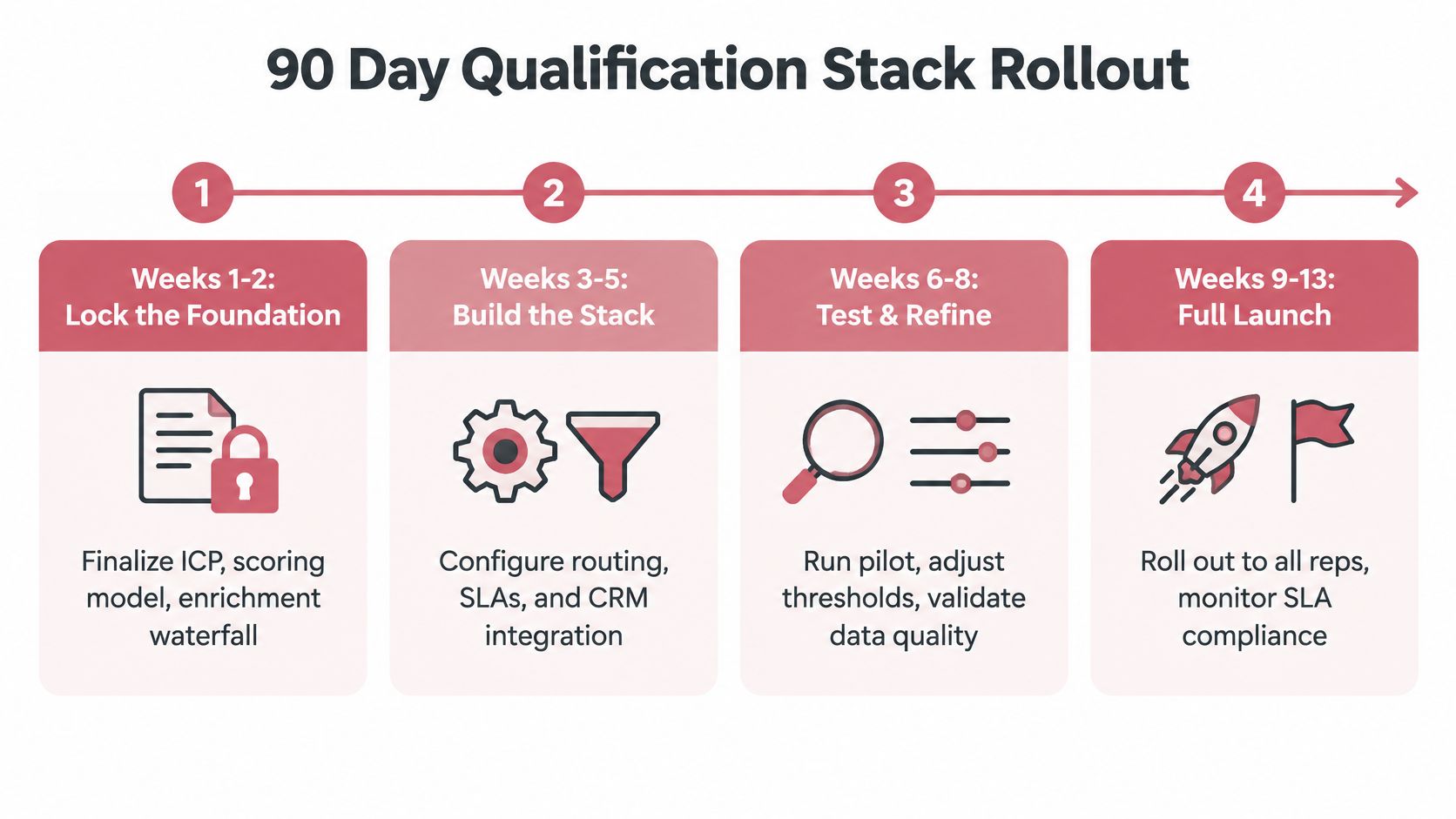
Weeks 6 to 9 deploy plays by source
Launch separate plays for demo requests, pricing page conversions, event leads, and outbound replies. Each play needs an entry rule, a first action, an evidence checklist, and a clear exit into SQL, nurture, recycle, or disqualify. Cap volume at the start so reps can report bad data and unclear handoffs quickly. Daily review beats a monthly complaints session during this phase.
Tools can compress the build if the logic stays portable. Yalc, for example, runs qualification plays that read a shared ICP and knowledge layer, enrich and score records through connected providers, and log each step for review. Whatever stack a team chooses, the requirement is the same. Rules must stay inspectable and outcomes must feed back into scoring.
Weeks 10 to 13 turn on self grading
Compare score bands against acceptance, opportunity creation, and disqualification reasons. Retire variables that add noise, raise thresholds where false positives cluster, and investigate false negatives that became opportunities through other paths. Set rollback triggers in advance. A sudden acceptance drop, a spike in bounces, or a routing backlog should pause the affected play automatically and alert the owner.
Close the rollout with an operating rhythm. Operations reviews score precision and data quality. Sales leadership reviews acceptance and evidence quality. Marketing reviews source level conversion. One meeting, one shared dashboard, and decisions recorded against the model version that produced the results.
Measuring the Funnel Without Lying to Yourself
A count of MQLs is not a measurement system. Each stage needs one owner, one acceptance rule, and reason codes for rejection or recycling. Without that structure, teams argue about volume while the actual failure sits in targeting, handoff quality, or discovery.
External benchmarks help locate questions. They don't set targets. One published benchmark reports that an average B2B funnel converts 2.3 percent of website visitors into leads, 31 percent of those leads into marketing qualified leads, and 13 percent of marketing qualified leads into sales qualified leads, according to published B2B funnel conversion benchmarks. The same source reports that top performing sales development teams convert 59 percent of sales qualified leads into opportunities, compared with an industry range of 20 percent to 30 percent.
Read each drop as a diagnosis
- Weak visitor to lead conversion: The offer, audience, or page promise is wrong. Qualification changes won't fix acquisition quality.
- Weak lead to MQL conversion: Targeting or intent rules are admitting the wrong accounts, or enrichment gaps are suppressing good records.
- Weak MQL to SQL conversion: Evidence standards, routing speed, or handoff quality are failing. Review rejection reasons before raising thresholds.
- Weak SQL to opportunity conversion: Discovery is accepting interest without problem ownership, stakeholder agreement, or a real next decision.
Add signal quality checks outside the CRM funnel. Social engagement can raise an account's visible activity without raising buying readiness, so teams should audit which content and profiles correlate with pipeline. Tools covered under LinkedIn analytics tools can help separate audience growth from account level engagement that deserves sales attention.
The final control is bias checking. Accounts with large digital footprints generate more detectable signals, which means a naive model will keep prioritizing visibility over readiness. Review precision, acceptance, and opportunity conversion by segment, source, region, and company size. When one segment wins attention mainly because it produces more trackable activity, recalibrate the intent stream and demand independent evidence such as a stated problem or a credible business event.
Every score is a hypothesis. Outcomes are the grade. A process that never checks the grade is just a sorting ritual.
Build the dashboard around decisions. Show conversion by stage, SLA compliance, score band precision, enrichment completion, rejection reasons, and time in stage. Review it on a fixed cadence and change one rule at a time. Discipline, not more data, turns qualification into a system a revenue team can trust.
Yalc gives revenue teams a shared operating layer for ICP rules, enrichment, qualification plays, routing, and audit trails, so every score carries its evidence and every outcome improves the next run. Teams can compose custom plays or run configured playbooks while keeping data and approvals under their control. Visit Yalc to see how a self grading qualification stack works in practice.