Channels for Advertising That Drive Pipeline in 2026
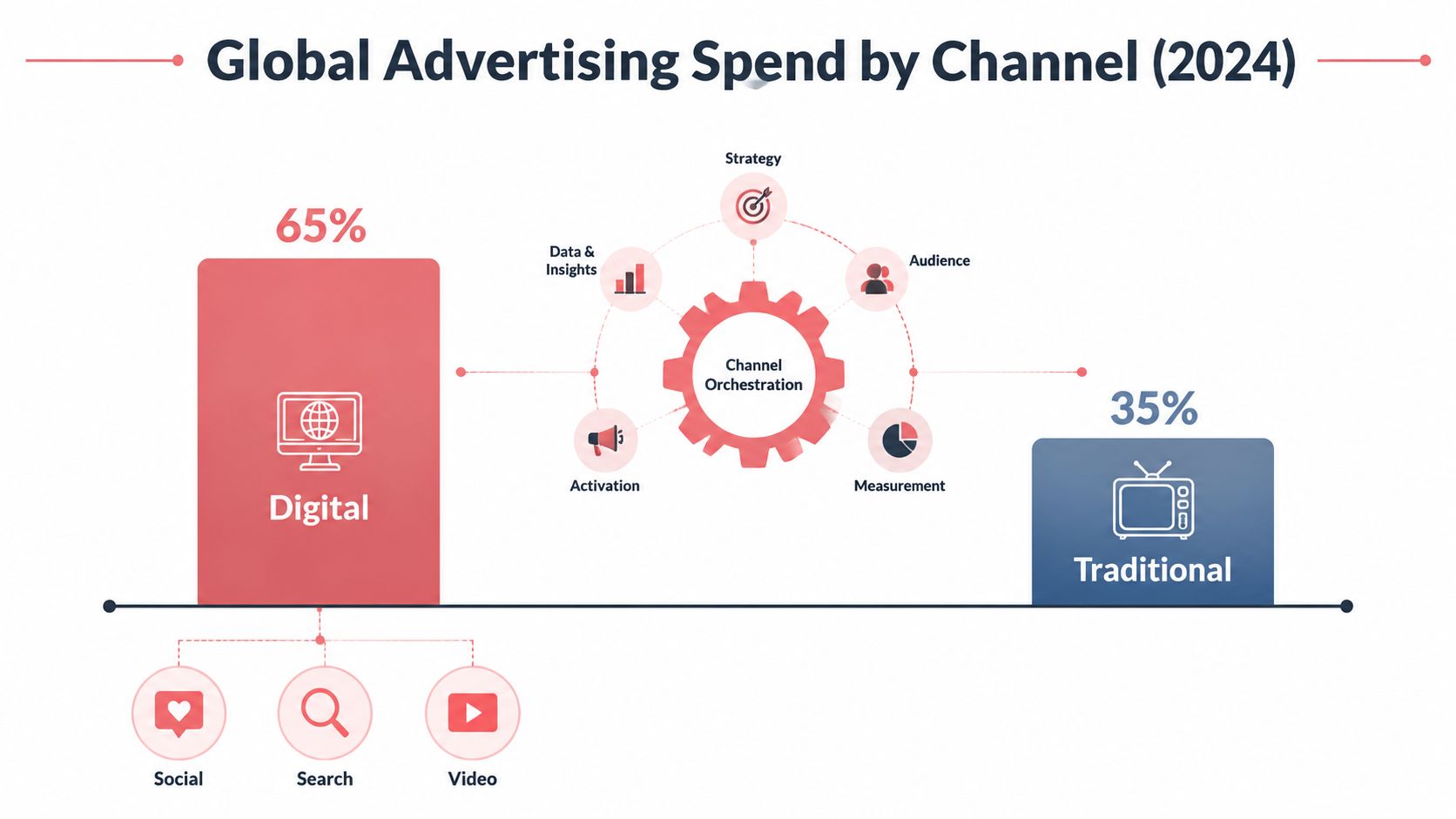
Digital advertising became the dominant advertising channel globally by 2024. Marketers spent close to US$1.1 trillion on advertising, while digital channels captured 72.7% of worldwide ad investment, with online spend exceeding US$790 billion, according to the IAB's global digital advertising data. The practical implication is clear: channel selection now shapes pipeline quality, measurement discipline, and operating complexity, not just audience reach.
The right question isn't “Which advertising channel is best?” It's “Which combination can reach this buying group, create the right demand, and produce evidence that supports the next budget decision?” Strong teams treat channels for advertising as a coordinated system. They assign each channel a job, connect activity to funnel stages, and reduce the number of channels that operators must manage when the data doesn't justify broader coverage.
Table of Contents
- Why Channel Mix Matters More Than Any Single Channel
- How Advertising Channels Map to Intent and Funnel Stage
- Core Digital Channels Explained With Strengths and Tradeoffs
- Offline Partner and Event Channels That Still Move Pipeline
- How to Choose the Right Channels for Your ICP and Budget
- Measuring Performance Across Fragmented Channels Without Bias
- Orchestrating Your Channel Mix Into One System That Learns
Why Channel Mix Matters More Than Any Single Channel
Digital now captures nearly three quarters of global advertising investment, so most growth teams are no longer choosing between digital and traditional media. They're choosing how to coordinate search, social, video, commerce media, email, events, partners, and owned content inside one pipeline motion.
A channel is more than a place where an advert appears. In go to market terms, it performs a specific job. Search captures a known problem. Social introduces a point of view or creates demand. Video builds memory and explains a complex product. Email develops permission based relationships. Events create high trust conversations. Partners lend distribution and credibility.
A useful channel plan starts by assigning those jobs before selecting platforms. A team selling technical software to a defined group of operations leaders may need search to capture active evaluation, LinkedIn to reach named accounts, email to follow up, and customer proof to reduce risk. A consumer brand may need short form video for discovery, commerce media for product evaluation, and retargeting for a purchase decision. The channel names differ, but the logic stays consistent.
Practical rule: A channel without a defined funnel job becomes a reporting line, not a growth lever.
The shift in spend also explains why orchestration matters. Digital alone is now a larger pool than the entire global advertising market was in many earlier years, and the available inventory is spread across platforms, devices, formats, and buyer contexts. Teams can easily count the same person across several environments, send conflicting messages, or judge an awareness channel only by the final click.
A practical system needs four decisions:
- Audience fit: Can the channel reach the ICP or the buying committee?
- Funnel role: Does it create awareness, capture intent, support evaluation, or drive action?
- Measurement reality: Can the team observe useful signals without overstating precision?
- Operating load: Can the team produce creative, manage targeting, handle responses, and review results?
The hottest channel is often less valuable than the channel that fits the buyer, the message, and the team's ability to learn. A narrower mix with clean feedback can outperform a broad mix that creates activity but weak accountability.
How Advertising Channels Map to Intent and Funnel Stage
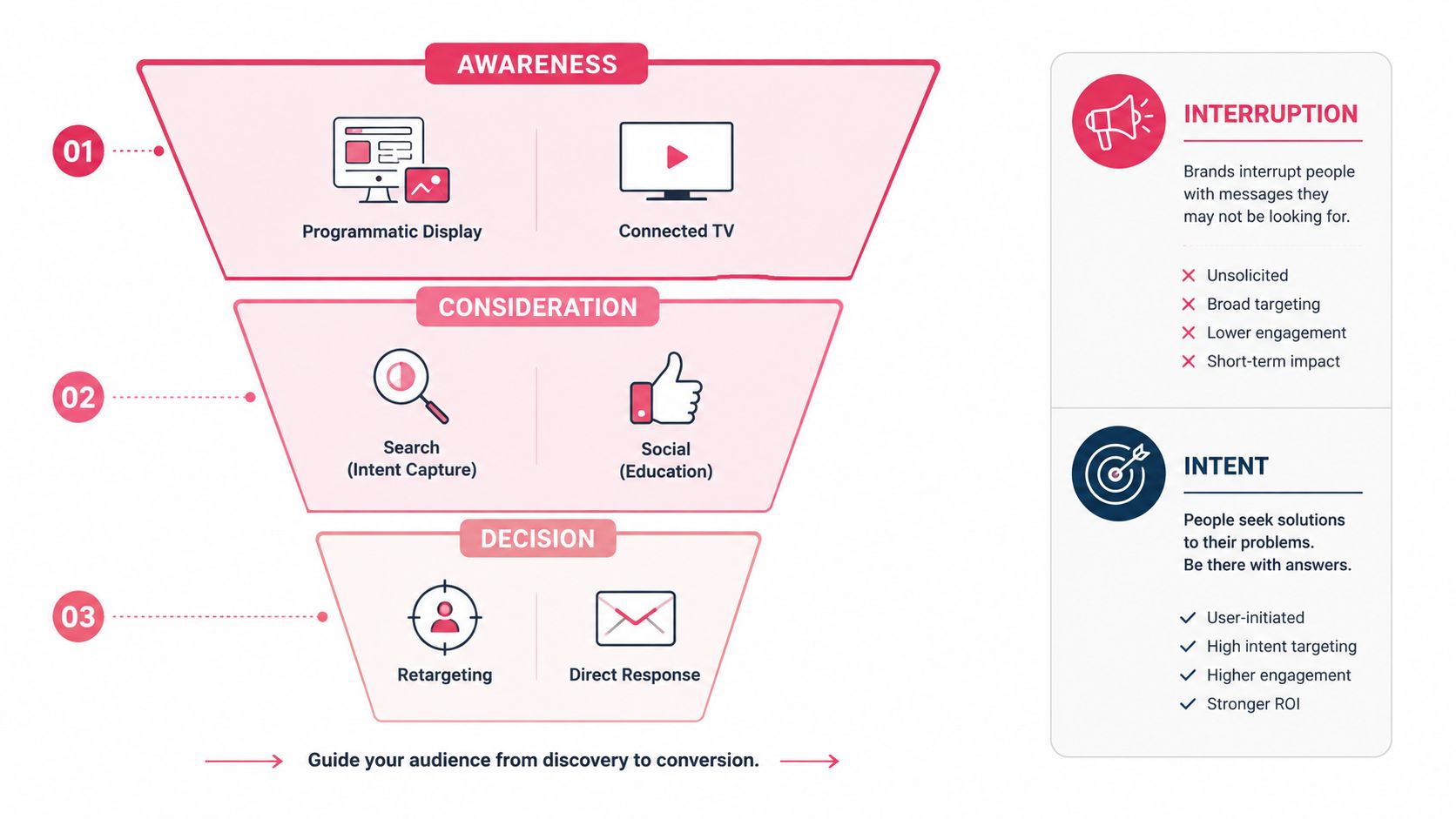
Channel choice becomes easier when the team separates intent from attention. Intent means a buyer is actively trying to solve a problem. Attention means the channel interrupts an existing activity and earns enough interest to start a future buying journey.
Awareness creates recognition
Awareness channels help a market understand that a problem exists and associate the problem with a brand or category. Connected TV, online video, programmatic display, sponsorships, influencers, and broad social distribution usually work here because they can reach people before they search for a solution.
The tradeoff is delayed feedback. A person may watch a video, remember the brand, discuss it with a colleague, and search for it later through a different device. A direct response report may not connect those steps, even though the earlier exposure influenced the decision.
Consideration supports evaluation
Consideration channels help buyers compare approaches, vendors, and proof. Search is strong when a buyer expresses a need through a query. Paid social can educate a defined audience with customer evidence, product explanations, or category content. Email can continue the conversation after a download, event, or sales interaction.
The message should match the buyer's question. Awareness asks, “Why should this problem matter?” Consideration asks, “Which approach can solve it?” A product comparison page, customer story, webinar, or technical guide is more useful here than a broad brand claim.
Decision removes friction
Decision channels help a motivated buyer take the next step. Retargeting, branded search, product listing environments, direct response campaigns, sales assisted email, and a clear landing page can support that action.
The same channel can serve different stages. Social can introduce a category, educate a prospect, or retarget someone who already visited a pricing page. Search can capture a broad informational query or a highly specific buying query. The team should classify the campaign by audience state and message, not by platform name alone.
B2B and B2C buyers also move differently. B2B campaigns often need to influence several people, support longer evaluation, and provide proof that survives internal review. B2C campaigns may have a shorter path to purchase, but they still depend on trust, relevance, price clarity, and a low friction checkout.
The funnel isn't a set of platforms. It's a sequence of buyer questions.
Core Digital Channels Explained With Strengths and Tradeoffs
Digital channels have reached substantial scale, but scale doesn't remove tradeoffs. The U.S. Internet Advertising Revenue Report for 2025 recorded $294.6 billion in total digital ad revenue, up 13.9% year over year, with social at $117.7 billion, search at $114.2 billion, digital video at $78 billion, and commerce media at $63.4 billion. The figures are reported in the 2025 U.S. digital advertising revenue summary.
| Channel | Primary Funnel Job | Intent Level | B2B vs B2C Fit |
|---|---|---|---|
| Paid search | Capture active demand and direct response | High when queries are specific | Strong for both, especially where buyers search before contacting a vendor |
| Paid social | Create demand, educate audiences, and retarget | Low to medium | Strong for B2C and useful for B2B audience development |
| Display and native | Build familiarity and support consideration | Low to medium | Useful for broad reach, account awareness, and content distribution |
| Online video and CTV | Explain, demonstrate, and build memory | Low to medium | Strong for B2C and useful for complex B2B categories |
| Nurture permission based relationships and prompt action | Medium to high | Strong for both when the audience has opted in or engaged | |
| Influencer marketing | Transfer credibility and show use cases | Varies | Often strong for B2C, with selective B2B applications |
| Partner and affiliate | Borrow distribution and connect intent to an offer | Medium to high | Useful for both, particularly where trusted ecosystems exist |
Paid search usually deserves attention first when a buyer already knows the problem. It can produce direct response efficiently, but demand is limited by the volume and quality of relevant queries. It also becomes expensive when competitors target the same commercial terms.
Paid social offers sharper audience and creative experimentation. It can introduce a problem to people who aren't searching yet, but performance depends heavily on the message, creative fatigue, audience quality, and the path after the click. Online video, including connected TV and short form formats, can communicate more context than a static placement, though production and measurement require more planning.
Email is efficient after the team earns permission, but it can't replace demand creation. Influencer and affiliate programs can add trust and distribution, yet the team needs clear rules for brand safety, disclosure, commissions, and lead quality.
Teams evaluating the broader ecosystem can use this digital marketing platforms for 2026 guide to compare platform categories before committing to a stack. For B2B teams, channel execution also needs to connect with account research and relationship building. A workflow such as LinkedIn outreach automation can help coordinate follow up, but automation should support a defined audience and message rather than multiply weak targeting.
Offline Partner and Event Channels That Still Move Pipeline
A focused offline channel can create pipeline where digital reach stops. Consider an enterprise software deal involving a security leader, operations executive, and procurement. Paid search may capture the active problem, but an executive roundtable hosted with a trusted integration partner can put the vendor in the room before the buying group has chosen a shortlist. The partner introduction supplies context, the discussion surfaces objections, and sales leaves with a qualified next conversation. That is a different channel job from generating impressions. It creates access, trust, and buying-group alignment.
The right format depends on the buying motion. A local service business may use location based outdoor media or community sponsorships. An enterprise software company may gain more from a focused conference, roundtable, or partner event where buyers can ask detailed questions. A consumer brand may connect awareness with product trial through retail media, sampling, sponsorships, and creator partnerships.
Where physical channels outperform
Events and field programs produce signals that an impression cannot. A representative can hear the language buyers use, identify use cases, and learn which objection blocks progress. The team can feed those findings into sales enablement, landing pages, and later digital campaigns.
Partners provide access as well as credibility. A reseller, integration partner, industry association, or trusted adviser may already have the audience a company needs. The motion could involve shared content, a co hosted event, referrals, or a joint offer. Partner channels take longer to establish than paid campaigns, so the team should choose them when relationship access is part of the buying decision.
Connected TV sits between physical and digital planning. It combines television-style storytelling with a broader video strategy. Video investment in the UK reached £9.3 billion in 2025, rising 20 percent, while the UK digital advertising market reached £40.5 billion, up 10 percent year on year, according to IAB UK ad spend data.
Where offline channels struggle
Offline programs make identity and causation harder to inspect. A team may know that an event produced meetings or that an outdoor placement covered a target area, yet still lack a reliable path from exposure to opportunity. The answer is not to force every program into last click attribution. Set a specific hypothesis and define how the response will enter the shared GTM system.
For an event, capture registration source, account, role, conversation notes, agreed next step, and opportunity status. For a partner motion, record the referring organization, account fit, influenced stage, and sourced pipeline. Review attendance quality, qualified opportunities, partner sourced pipeline, and post event conversion against the time and operating effort required, not only the media invoice. Fewer, better coordinated programs can outperform a crowded channel mix when sales follow up and measurement are ready.
How to Choose the Right Channels for Your ICP and Budget
A channel plan should begin with the buyer, not the media menu. The team can make a defensible choice by moving through a short sequence that connects audience reality to operating capacity.
Start with the buying group
Write down the ICP, the trigger that creates urgency, the problem each role cares about, and the evidence required for approval. B2B teams should separate the user, champion, economic buyer, procurement contact, and blocker when those roles differ. A channel that reaches one persona may still fail if the wider committee never receives supporting evidence.
Then assign one job to each funnel stage. Keep the initial mix narrow enough that the team can create strong creative, follow responses, and inspect the data. The choice might include search plus email for an intent led motion, or paid social plus video plus a conversion asset for a category creation motion.
Score the practical fit
Score each candidate channel qualitatively against five criteria:
- ICP access: Can the channel reach the right people or accounts?
- Message fit: Does the format support the explanation the buyer needs?
- Test cost: Can the team run a meaningful test without putting the budget at risk?
- Signal speed: How soon will the team see a useful response?
- Operational load: Can the team produce, launch, monitor, and improve the program?
A channel with excellent reach but weak signal quality may deserve a supporting role. A channel with lower reach but strong intent may deserve priority. Guidance on building your media marketing mix can help teams structure this evaluation without treating every available channel as mandatory.
HubSpot's 2026 marketing statistics identify website, blog, and SEO as the top ROI generating channel, with paid social following, while 12% of marketers rate search and display ads among their highest ROI channels. Those findings are summarized in channel marketing statistics from Amra and Elma. The lesson isn't that search or display never works. It's that teams should test channel economics against their own ICP and conversion path.
A product led startup might begin with SEO, search, lifecycle email, and retargeting. A mid market B2B company might add paid social for account education, outbound follow up, and a focused event motion. A commerce brand may prioritize social video, creator content, search, commerce media, and email. Teams with weak data or limited creative capacity should choose fewer channels and improve the handoff between them. For an outbound motion, outbound lead generation can sit beside advertising as a coordinated demand and follow up layer.
Measuring Performance Across Fragmented Channels Without Bias
Measurement should match the job assigned to the channel. Awareness needs reach quality, completed views, branded demand, and assisted engagement. Consideration needs qualified visits, content progression, engaged accounts, and sales acceptance. Decision campaigns need qualified conversions, pipeline, revenue, and customer economics.
The most common error is using one attribution rule for every stage. Last click is useful for understanding the final measurable interaction, but it isn't a complete explanation of the journey. Multi channel attribution research found that display and referral contribution was underestimated by about a factor of two on average, so budget decisions based only on last click can move spend away from channels that assist later conversions. The finding appears in the multi channel attribution research paper.
Build a lean measurement stack
A practical stack has four layers:
- Channel reporting: Track delivery, spend, engagement, clicks, leads, and conversions inside each platform.
- Funnel reporting: Connect anonymous activity, known contacts, qualified opportunities, pipeline, and revenue where identity and consent allow.
- Attribution views: Compare first touch, last touch, position based, and data informed approaches rather than treating one model as truth.
- Business validation: Review qualified pipeline, win rate, sales cycle, margin, and customer quality with finance and sales operations.
Fragmented media makes frequency and reach harder to control across streaming, social video, broadcaster catch up, and ad supported subscription services. The team should use consistent naming, audience definitions, exclusion rules, and campaign dates. It should also look for duplicated exposure instead of assuming that platform reported reach can be added together.
Measurement discipline: Use attribution to allocate learning budgets, not to manufacture certainty.
Consent is part of measurement design. In the UK and EU, online advertising that uses storage or access technologies for ad selection, delivery, tracking, or profiling requires consent. The UK ICO guidance on online advertising explains that advertising measurement doesn't need separate consent when it's intrinsically linked to online advertising and the original consent covers that purpose. Google's EU user consent policy applies to the EEA, UK, and Switzerland, with requirements covering cookies, mobile identifiers, personalised ads, and, where local law requires it, ads measurement.
Teams tracking referral or AI related traffic can browse Surva.ai's AI traffic guide. A well designed sales dashboard should show channel contribution alongside funnel stage, qualification status, and revenue rather than presenting clicks as pipeline.
Orchestrating Your Channel Mix Into One System That Learns
The operating challenge begins after the channel plan is approved. Someone must enrich audiences, build segments, produce variants, launch campaigns, route replies, update the CRM, reconcile platform data, and decide which experiments continue. Without a shared system, each channel creates another workflow and another source of truth.
Marketers increasingly value multichannel execution, but poor data quality remains a major barrier, and fragmented channel mixes raise operational complexity instead of automatically improving performance. The practical response isn't to eliminate every channel. It's to give each channel a clear role and connect execution through shared audience, messaging, approval, and reporting logic.
Make the system goal led
A unified GTM system should begin with an outcome such as qualified pipeline from a defined ICP, not with a request to “run LinkedIn” or “launch retargeting.” It can then select the relevant skills, data sources, and approval steps.
Yalc provides one example of this model. It runs through a unified GTM API that can connect tools such as Unipile, FullEnrich, lemlist, Crustdata, Notion, Claude, Slack, Telegram, Discord, Microsoft Teams, and email. Teams can compose plays through the Yalc MCP in Claude Code, or run configured playbooks through Slack and the Yalc interface, with the same underlying data and intelligence layer.
The system can support prospecting, enrichment, ICP scoring, sequencing, personalisation, reply handling, CRM synchronisation, campaign reporting, competitive intelligence, and SEO auditing. The important design choice is not the number of play names. It's whether every run records the audience, hypothesis, action, result, and next decision.
Grade experiments and retire weak plays
Each campaign should have a defined success metric before launch. The system can grade the outcome, record a verdict, and classify the play as a hypothesis, validated approach, or proven approach. Winning patterns become reusable defaults. Weak approaches are changed or retired instead of being relaunched because they're familiar.
A short operating cadence keeps the mix accountable:
- Review delivery and response signals frequently enough to catch waste.
- Review qualified pipeline and sales feedback on a regular revenue cadence.
- Reassess channel roles when the ICP, offer, or buying process changes.
- Keep human approval for sensitive actions and maintain an audit trail for agent activity.
The best channel mix is the one the team can explain, operate, measure, and improve. Start with the smallest combination that can reach the buying group and move a buyer through the next question. Then add channels only when evidence shows that the new touchpoint creates incremental value.
Yalc helps GTM teams coordinate audience research, enrichment, multichannel outreach, reply handling, and reporting through one operating system with your data and keys under your control. Visit Yalc to see how a unified, learning based GTM workflow can turn disconnected channel activity into a measurable pipeline motion.