8 Closing Email Statements That Earn Replies in 2026
Emails ending with gratitude received replies 62% of the time, compared with 46% for messages without a thankful closing, in Boomerang's analysis of community mailing list threads, reported by Business Insider. That's a substantial difference for language many senders add without thinking. It's also an association, not proof that changing a sign off will produce the same result in a sales sequence.
The practical lesson isn't to paste thanks into every message. It's to treat the final lines as part of the ask. A courteous ending can support a clear request, but it can't rescue an email that never tells the buyer what to do.
Closing email statements have different jobs. A demo ask needs a decision. A follow up needs a new reason to respond. A breakup email needs a clean exit. A soft close needs enough direction that the recipient doesn't have to invent the next step.
The closing sentence and the sign off also serve different purposes. The sentence names the action. The sign off sets the relationship tone. Keep both when they help, but replace a vague closing sentence with a direct question whenever progress depends on an answer.
Table of Contents
- 1. Best regards
- 2. Kind regards
- 3. Sincerely
- 4. Thank you
- 5. Looking forward to hearing from you
- 6. Let me know if you have any questions
- 7. Talk soon
- 8. Thanks in advance
- Closing Lines at a Glance
- Match the Closing to the Ask, Then Test It
1. Best regards
Best regards is the neutral control for professional outbound. Use it when the sender doesn't know the recipient well and needs courtesy without familiarity. It fits first contact, a demo request, and routine account communication.
It doesn't create urgency or give the buyer a reason to reply. That work belongs in the sentence above it. For a demo ask, use a specific scheduling question rather than relying on a polite ending to imply interest.
Use it as the baseline, not the whole close
A first contact email might end like this:
Would Thursday work for a short review of the routing workflow?
Best regards,
Jordan
Revenue Operations
The question makes the request explicit. The sign off stays out of the way. If the buyer hasn't shown interest, a lower commitment question about relevance may be more appropriate than requesting a meeting immediately.
Build the baseline into a sample sales email template, then change the closing independently from the subject and body. Otherwise, the team won't know which change affected responses.
- Keep the layout clean. Put Best regards on its own line, followed by the sender's name and title.
- Skip extra enthusiasm. An exclamation point changes a deliberately neutral tone.
- Allow exceptions. A familiar customer thread doesn't need the same ending as an introduction to procurement.
A shared standard for consistent email closings across your team can reduce random variation. The standard should still leave room for recipient context. Keep Best regards as a control, not a mandatory ending for every conversation.
2. Kind regards
Kind regards fits a relationship that has started to warm up. Use it after a prospect replies, following a discovery call, or when writing to an existing customer. It signals consideration without assuming personal closeness.
The distinction is subtle. Changing Best regards to Kind regards won't fix a weak follow up, but it can make the ending consistent with a more collaborative conversation. Match the recipient's level of formality rather than automatically becoming casual after a reply.
Pair warmth with ownership
After a discovery call, the seller might write:
Great speaking today. The proposal will include the CRM migration scope and support responsibilities.
Could the operations lead join the review on Friday?
Kind regards,
Amara
This ending acknowledges an established conversation while still requesting a concrete action. It's stronger than a warm paragraph that leaves the buyer unsure who should respond.
Relationship distance deserves attention. A workplace email study published in the Journal of Computer Mediated Communication recorded closing usage at 89% for distant colleagues, compared with 65% for close colleagues. That's evidence about workplace conventions, not a sales conversion benchmark.
Practical rule: Match warmth to the relationship, but match the final question to the next decision.
Drop Kind regards when a short, active thread no longer needs a conventional sign off. Keep it when the message introduces a new stakeholder, formalizes a commitment, or moves outside the familiar group.
For testing, compare similar audiences at the same relationship stage. A warm closing sent to existing customers shouldn't be judged against a neutral closing sent to strangers.
3. Sincerely
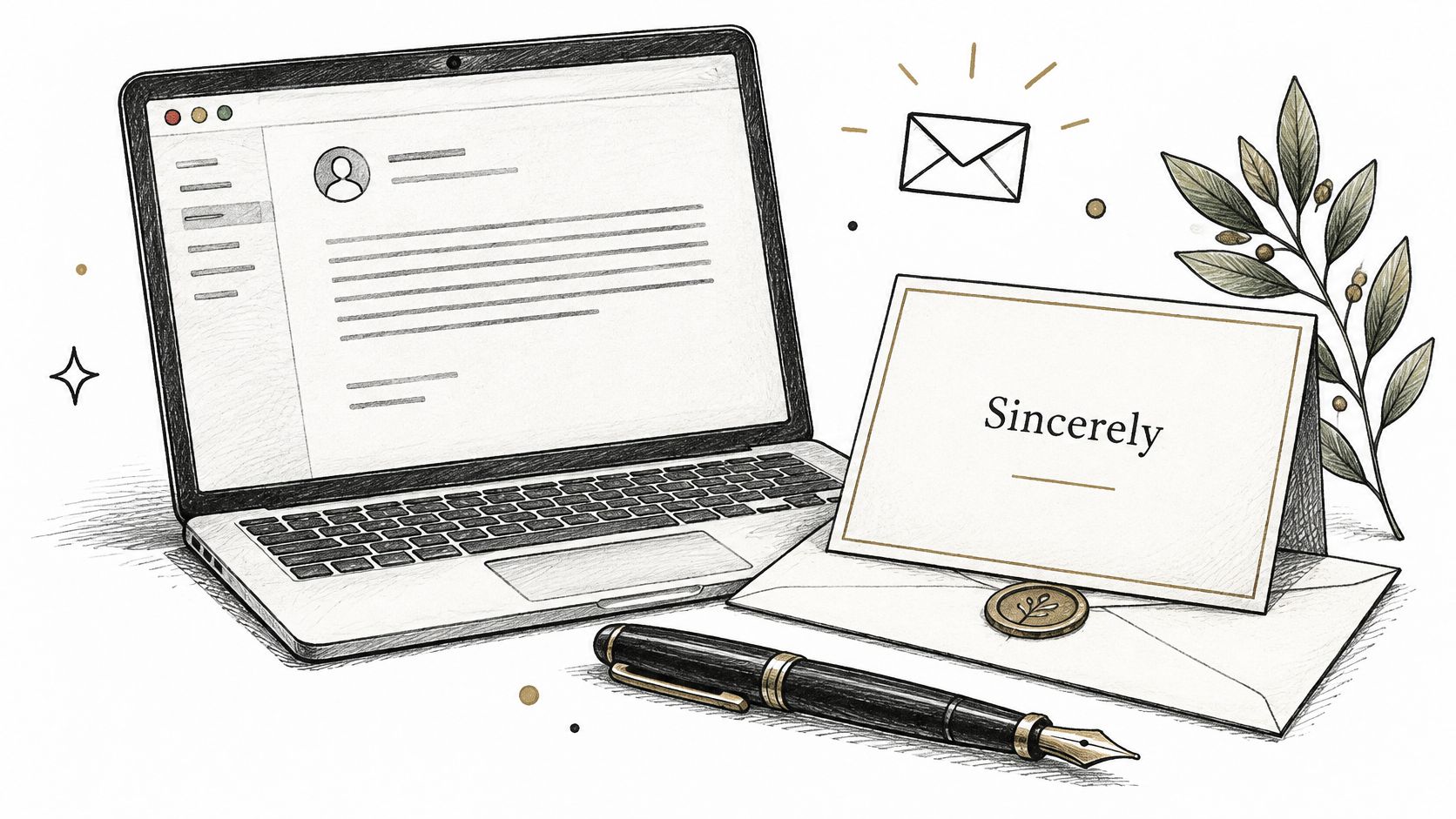
Reserve Sincerely for correspondence where formality serves a purpose. Contract changes, renewal notices, executive communications, and serious escalations are better candidates than routine prospecting. The closing signals that the sender is treating the matter as official.
It can also create unnecessary distance. A seller trying to restart a quiet conversation rarely benefits from making the message sound like a formal notice. Seniority alone isn't enough reason to use it.
Make the obligation clearer than the etiquette
A contract email could end:
The revised order form reflects the agreed implementation scope. Please return the signed copy by the approval deadline so procurement can release the purchase order.
Sincerely,
Daniel Okafor
Vice President, Procurement
The deadline must come from the actual agreement or approval process. Don't invent urgency to make a formal closing feel consequential.
- Use a complete identity. Include the sender's full name, title, and relevant company details.
- Name the required action. Specify whether the recipient must sign, approve, acknowledge, or correct something.
- Separate courtesy from consequences. Put any genuine operational consequence in the body, not in suggestive closing language.
Signature consistency matters here. In Exclaimer's State of Business Email report, 92% of IT leaders surveyed in 2025 said consistent, well managed email signatures build trust and professionalism, according to Conversational Geek's summary. That finding concerns signatures, not proof that Sincerely earns more replies.
Drop this closing from ordinary outbound sequences unless the message requires a formal register. A straightforward request followed by Best regards usually leaves less room for an unintended official tone.
4. Thank you
Thank you works best when the recipient has done something worth acknowledging. Use it after an introduction, a useful reply, a meeting, or help with an internal approval. Name the action so the appreciation doesn't read like an automated courtesy.
This is a useful closing for the follow up after a referral. The seller can acknowledge the help, explain what happens next, and avoid creating another obligation for the person who made the introduction.

Thank the person for a specific contribution
For example:
Thank you for introducing Priya. The next message will include the integration summary so she has the context before reviewing the proposal.
Best,
Sam
Here, Thank you is the closing statement, while Best is the sign off. They don't need to be repeated. If the body already contains detailed appreciation, another Thank you beneath it may add nothing.
The phrase is familiar across audiences, but preference doesn't establish effectiveness. Among Gen Z respondents who used an email sign off, 53% chose Thanks in a survey conducted from December 2024 to January 2025, according to Enflow Digital's summary of ZeroBounce survey data.
- After a referral. Acknowledge the introduction and state who will contact the new person.
- After a demo. Thank the buyer for a specific insight, then confirm the agreed next step.
- After a rejection. Acknowledge the clear answer and stop the sequence.
Don't use appreciation to hide another pitch. A message that thanks someone for declining and immediately requests a meeting disregards their answer.
Drop the extra request when no action is needed. Closing the loop cleanly is a valid outcome, even when the email doesn't generate another reply.
5. Looking forward to hearing from you
Use this soft close only after a question that deserves an answer. It fits an active evaluation, a requested proposal, or a follow up where the buyer has already agreed to consider something. It's weaker in cold outreach because it expresses the sender's expectation without defining the recipient's task.
The fix is straightforward. Put a specific question directly above the phrase, then decide whether the phrase still adds anything. Often, the question is enough.
Give the buyer something concrete to answer
A qualification follow up might end:
Could the team confirm whether outbound tooling is part of this quarter's evaluation?
Looking forward to hearing from you.
Best regards,
Marcus
If a planning decision depends on the answer, replace the soft close with a real deadline: Could the team confirm by Wednesday so the technical review can be scheduled? Don't add a deadline merely to manufacture pressure.
A follow up should also provide a new reason to respond. In one 2025 dataset summarized by NerdyJoe, follow up emails from steps two through six generated 58.6% of all cold email replies. That doesn't justify repeating the original message with a different ending.
A follow up earns its place by adding context, resolving an objection, or making the decision easier.
Use cold email follow up templates to vary the purpose of each message, not just the greeting and sign off.
For a breakup email, drop Looking forward to hearing from you. A cleaner ending is: The outreach will stop here. If the project becomes relevant later, a reply to this thread is enough to reopen the conversation.
That gives the buyer an exit without pretending a response is expected.
6. Let me know if you have any questions
This is a support closing, not a decision closing. Use it after onboarding instructions, documentation, a technical handoff, or a proposal explanation. It tells the recipient that clarification is available.
The weakness appears when the seller needs approval. A buyer can understand a proposal perfectly and still take no action. Asking whether questions exist doesn't ask whether the buyer wants to proceed.
Separate clarification from approval
An operational handoff might end:
The onboarding plan includes the CRM field mapping and sync ownership. Let me know if you have any questions before Monday's kickoff.
Thanks,
Lena
That works when the kickoff is already agreed. If it isn't, replace the ending with: Does the proposed field mapping have approval, or should the technical owner review it first?
Secondary sales guidance summarized by Prospeo reports that question based calls to action generated roughly twice the replies of statement style endings. Treat that as a testing hypothesis, not a guaranteed result, because the summary doesn't establish a transparent controlled experiment.
- For documentation. Keep the invitation to ask questions.
- For a proposal decision. Ask whether the buyer approves the scope or needs a change.
- For scheduling. Ask about availability rather than possible questions.
Keep the subject aligned with the action using email subject line best practices. A subject about approval shouldn't lead to a closing that merely offers help.
When the handoff depends on earlier decisions, preserve the relevant thread and attachments. Understanding email grouping across Mac mail clients helps teams check how that context appears to recipients.
Drop the generic invitation whenever a precise question would make the response easier.
7. Talk soon
Talk soon belongs after a conversation is expected. Use it with established customers, familiar partners, and colleagues who already write casually. It can support momentum without adding ceremony.
It's a poor default for first contact. An unfamiliar buyer hasn't agreed to talk, so the phrase can assume a relationship that doesn't exist. The same problem appears when a seller uses it after repeated silence.
Confirm the conversation before implying it
For an active pilot, the ending might read:
The pilot review is booked for next week. The agenda will cover routing accuracy, unresolved sync issues, and the rollout decision.
Talk soon,
Riley
The body confirms the next event. Talk soon matches the established tone.
If nothing is booked, ask the scheduling question instead. A closing shouldn't carry the entire burden of suggesting that a meeting will happen.
Cultural context also affects how brevity lands. The LSE publication The Intercultural Edge discusses differences between relationship oriented and more task oriented communication. Use those differences as prompts for local review, not fixed rules about every recipient in a country.
Familiarity should come from the conversation, not from a casual sign off added by the sender.
Before standardizing Talk soon, inspect the recipient's own messages. A relaxed response provides a better cue than a job title, location, or assumed company culture.
Drop it for escalations, formal notices, and communications with executives the sender hasn't met. In those situations, a neutral sign off avoids unnecessary interpretation.
For testing, keep familiar customer correspondence separate from cold prospects. Otherwise, the team may attribute the effect of an existing relationship to the closing phrase.
8. Thanks in advance
Thanks in advance is appropriate for a small, reasonable request, not an unearned commitment. Use it when asking a known contact for a document, a confirmation, or an agreed introduction. The recipient should understand the scope and remain free to decline.
It becomes presumptuous when attached to a large request or an unsolicited demo pitch. Thanking a stranger for attending a meeting they haven't accepted can make the sender sound entitled.
Keep the request bounded
A legitimate operational request could end:
Could the operations team send the pipeline export by Thursday? The regional totals and stage fields are sufficient; contact details aren't needed.
Thanks in advance,
Kara
This explains the deliverable, limits the effort, and gives a usable deadline. The appreciation follows a clear request rather than compensating for an unclear one.
Boomerang's mailing list analysis, summarized by Prospeo, found that messages ending with Thanks in advance received replies 65.7% of the time. The sample wasn't a controlled cold outbound experiment, so that figure shouldn't become a forecast for a sales campaign.
- Keep it for reasonable effort. A file already discussed is different from an unsolicited research task.
- Explain genuine timing. Connect the deadline to the actual review or dependency.
- Close the loop afterward. Replace anticipatory thanks with specific appreciation once the recipient delivers.
For a cold demo ask, use a permission question instead: Would a review of the workflow be useful? That leaves the buyer room to judge relevance.
Drop Thanks in advance if a local reviewer finds it overly transactional or if the request involves sensitive information. Politeness doesn't remove the need for consent, authorization, or a clear explanation of why the information is needed.
Closing Lines at a Glance
| Item | Best for | Tone | Formality | Use in cold outreach |
|---|---|---|---|---|
| Best regards | General professional emails | Neutral and polite | Professional | Yes; a safe default |
| Kind regards | Follow-ups with existing contacts | Warm and considerate | Professional | Usually avoid for first contact |
| Sincerely | Contracts, legal matters, and formal executive emails | Serious and respectful | Formal | Rarely; can feel distant |
| Thank you | Showing specific appreciation | Appreciative and direct | Professional | Only when you have something specific to thank them for |
| Looking forward to hearing from you | Emails with a clear question or request | Soft and encouraging | Professional | Yes; pair it with a specific ask |
| Let me know if you have any questions | Handoffs, proposals, and explanatory emails | Supportive and open | Professional | Limited; better for follow-ups than pitches |
| Talk soon | Ongoing conversations with familiar contacts | Casual and friendly | Informal | No; too familiar for first contact |
| Thanks in advance | Specific, reasonable requests | Appreciative but potentially presumptuous | Professional | Usually avoid; may presume agreement |
Match the Closing to the Ask, Then Test It
Choose closing email statements from the action required, not the sender's habit. Neutral courtesy fits unfamiliar recipients. Warmth fits an established relationship. Formality fits consequential correspondence. None of those choices replaces an explicit next step.
For a soft close, keep a clear question above the sign off. For a demo ask, propose a concrete next action and use a response deadline only when scheduling genuinely requires it. For a breakup, state that outreach will stop and leave an uncomplicated route back.
Test the sentence separately from the sign off
Run each variant against a control for two sequence cycles before standardizing it. Treat that as an operating cadence, not a universal threshold for statistical confidence. Low volume or a changing audience may require a longer test.
Keep the subject, body, audience rules, and sending conditions stable. Randomly assign comparable recipients where the sequencer supports it. Changing the offer and the ending together prevents a useful conclusion about either.
- Measure human replies. Exclude automated responses, bounces, and duplicate threads.
- Classify intent. Separate positive replies, objections, referrals, and requests to stop.
- Track progress. Check qualified meetings and attendance, not just total responses.
- Protect the audience. Review complaints and unsubscribe requests alongside apparent gains.
A closing that attracts more refusals isn't automatically better. Neither is a warmer phrase that increases replies but creates confusion about the requested action.
Review the message before it reaches a buyer
Use a linter to find email template issues, then have a person inspect the rendered message. Check the requested action, signature, thread context, and whether the tone fits the recipient. A technically valid template can still make an unreasonable request.
Yalc's Sequence Builder writes sequence steps in the team's voice, while sequences can be staged in the customer's sequencer, paused for review. That supports controlled variants without removing human approval before a message reaches a buyer.
Retire closings that stop producing useful responses, but diagnose the rest of the email before blaming the sign off. Weak targeting, an irrelevant offer, and an unclear request won't be repaired by switching Best regards to Thanks.
Choose a live sequence, identify the decision needed at each step, and replace the vaguest ending first. Keep the courteous sign off when it helps. Let the question do the selling.
Yalc builds outbound sequences from the team's own data and voice, with human approval before messages reach buyers. Visit Yalc to explore a workflow for drafting, reviewing, and improving closing statements across the sales sequence.