Data Security Compliance Standards: A GTM Playbook
The global average cost of a data breach reached USD 4.88 million in 2024, a 10 percent increase from 2023. That makes data security compliance a revenue protection priority, not just a legal checkbox.
For GTM teams, the exposure sits inside ordinary work: enriching prospect records, storing personal data, sending outreach, updating CRM fields, and allowing AI agents to act across several systems. The audit question is no longer whether a company has a security policy. It's whether the company can prove who accessed data, what an agent did, which controls applied, and whether the action succeeded.
Table of Contents
- Why Data Security Compliance Standards Matter for GTM
- The Four Major Compliance Frameworks Explained
- How to Prepare for a Compliance Assessment
- Data Residency, Key Management, and Audit Trails
- How a GTM Platform Meets Compliance Requirements
- The Future of Agent Governance in Compliance
Why Data Security Compliance Standards Matter for GTM
The financial case is direct. IBM's Cost of a Data Breach Report 2024 puts the global average breach cost at USD 4.88 million, up from USD 4.45 million in 2023. In financial services, the average reached USD 6.08 million, which was 22 percent above the global average. GTM systems may not be the primary production environment, but they often contain personal data, account intelligence, communication history, and credentials that can create a serious incident path.
Sales and operations leaders also face a commercial consequence. Enterprise buyers increasingly ask for evidence before procurement approves a vendor. They want to understand where prospect information is stored, which subprocessors receive it, how access is limited, and how quickly the vendor can respond to a privacy request or breach. A team that can produce a clear answer moves faster than one that starts assembling evidence after the security questionnaire arrives.
Practical rule: Treat every enrichment request, message send, export, and CRM update as a controlled business event, not as an invisible background task.
This matters especially for teams using LinkedIn outreach automation, enrichment providers, sequencing tools, and AI agents. A workflow can be commercially useful while still creating unnecessary risk if it copies more data than needed, grants broad permissions, or leaves no reliable record of the decision behind an action.
A practical GTM control model should answer four questions:
- What data enters the workflow? Identify personal data, firmographic information, inferred attributes, and sensitive account notes.
- Why is it processed? Connect each use to a documented business purpose and applicable privacy basis.
- Who and what can act on it? Separate human roles, service accounts, and agents.
- What evidence remains? Preserve access records, approvals, outcomes, and remediation history.
Security buyers don't need a marketing promise. They need a defensible operating record. Teams evaluating how we secure model access can use the same lens when reviewing model permissions, data exposure, and access boundaries. Compliance becomes a sales asset when the answers are precise, repeatable, and easy to verify.
The Four Major Compliance Frameworks Explained
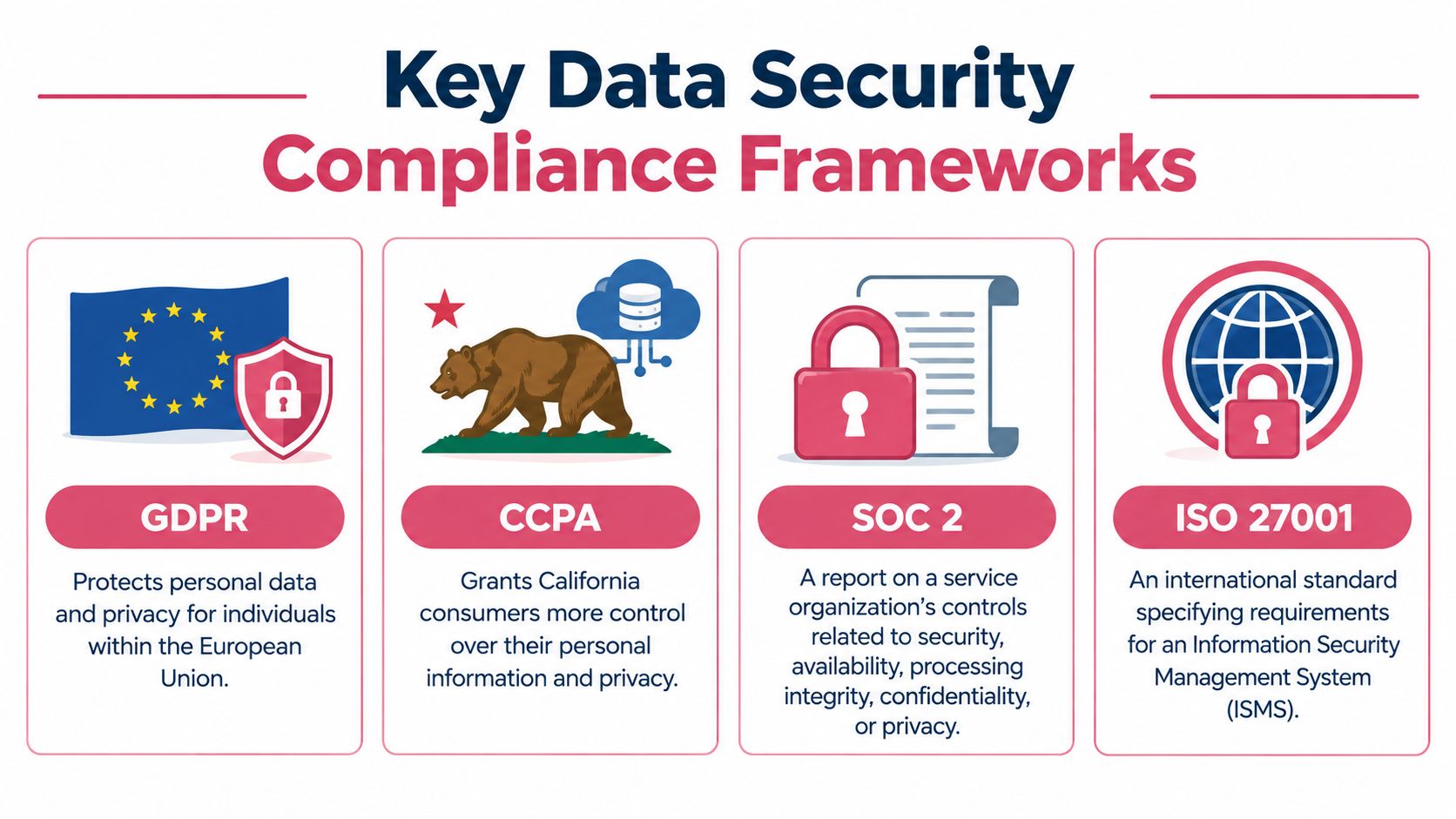
GTM leaders should choose frameworks based on scope, customer expectations, and the data handled, not on whichever certificate appears most often in a vendor deck. GDPR and CCPA are legal privacy regimes. SOC 2 provides an independent report on service organization controls. ISO 27001 defines a certifiable information security management system.
GDPR and CCPA govern personal information
GDPR applies to organizations established in the European Union and can also apply to organizations outside the EU that offer services to people in the EU or monitor their behavior. For GTM, the work centers on lawful processing, transparency, data minimization, retention, data subject requests, processor management, and breach response. GDPR Article 33 requirements require a controller to notify the relevant supervisory authority within 72 hours of becoming aware of a personal data breach, unless the breach is unlikely to create a risk to individuals' rights and freedoms.
CCPA gives California consumers more control over personal information. GTM teams should pay attention to notices, deletion requests, access requests, and opt out handling. The exact obligations depend on whether the organization falls within the law's scope and how it uses the data.
SOC 2 tests operational controls
SOC 2 is useful when a company sells a service that handles customer data. Its criteria can cover security, availability, processing integrity, confidentiality, and privacy. Buyers should inspect the report's system boundary, examination period, exceptions, complementary user entity controls, and subservice organizations. A report that excludes the workflow under review offers limited assurance.
ISO 27001 proves a managed security system
ISO/IEC 27001 gives organizations a formal path for managing information security risk through an Information Security Management System. Certification applies to a defined scope, so buyers should check whether the relevant GTM service, location, and supporting systems are included. A practical guide to implementing ISO 27001 in workflows is useful when teams need to connect formal controls with daily operating procedures.
The adoption signal is substantial. The ISO Survey 2024 data reported 96,709 valid ISO/IEC 27001 certificates covering 179,877 sites worldwide, compared with 36,362 certificates in the 2019 survey. That represents roughly 2.7 times growth over five years. The survey recorded the largest concentration in China, followed by India, Japan, the United Kingdom, and the United States.
The right combination often uses one framework as the management backbone while legal obligations define the actual duties. GTM leaders should map customer requests to the control evidence they can provide instead of treating every framework as interchangeable.
How to Prepare for a Compliance Assessment
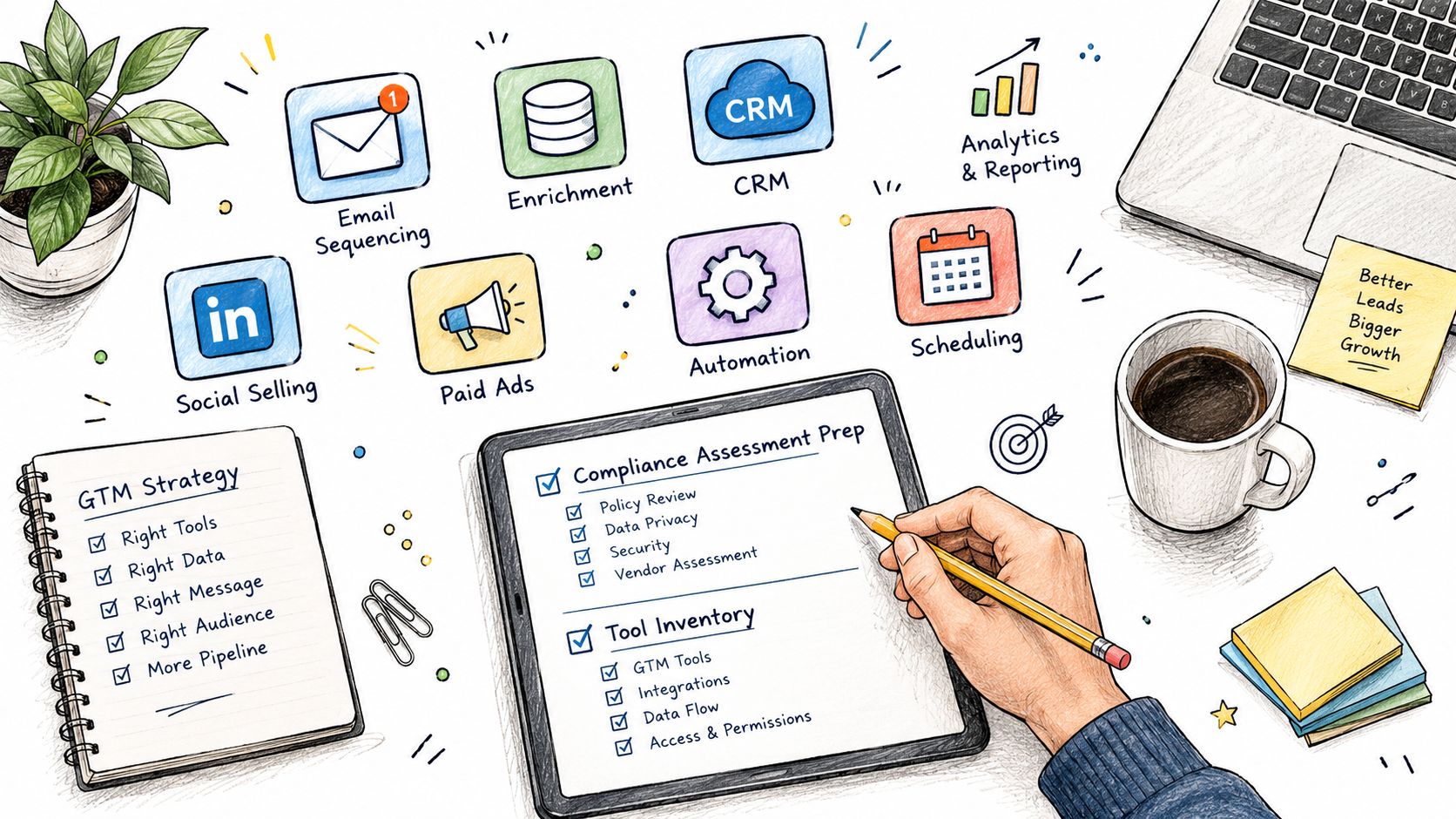
Assessment readiness starts with an inventory, not a policy rewrite. List every GTM system that collects, enriches, stores, transforms, sends, or deletes prospect data. Include enrichment vendors, sequencing platforms, CRM connectors, AI models, spreadsheets, chat tools, warehouses, and service accounts.
Build an evidence map
For each tool, record the data handled, processing purpose, owner, access method, retention rule, subprocessors, region, and linked control. The map should show which evidence supports which requirement. A buyer asking about CRM access should receive more than a general security policy. The response should connect permissions, configuration, approval records, and audit entries to the actual service.
Auditors commonly expect an evidence set that includes:
- Policy language: Define roles, retention, access review, incident handling, and logging responsibilities.
- Configuration exports: Show that required events, permissions, authentication settings, and forwarding rules are enabled.
- Sample audit records: Provide redacted production examples, not screenshots from a test environment.
- Validation reports: Demonstrate that logs are generated, centralized, retained, and available for review.
- Remediation records: Link anomalies to tickets, owners, decisions, and closure evidence.
A useful IT security compliance and audit readiness process separates control design from operating proof. A policy says what should happen. A configuration export and a production record show what did happen.
Validate the log schema
NIST AU 3 provides a concrete baseline. Each audit record should capture event type, timestamp, location, source, outcome, and identity, as described in this NIST AU 3 control reference. If an agent updates a CRM record, the log should identify the action, when it occurred, the relevant system or location, the initiating source, whether it succeeded, and the human or service identity responsible.
NIST AU 12 and AU 6 extend the requirement beyond collection. Logging should be generated at the application, database, and operating system layers, forwarded to centralized log management or SIEM infrastructure, reviewed on a defined cadence, and tied to documented responses. NIST AU 12 implementation guidance supports measuring coverage and review activity, not merely accumulating log volume.
Before an assessment, test a complete workflow from event generation to review ticket. That exercise exposes missing fields, broken forwarding, unclear ownership, and logs that nobody examines.
Data Residency, Key Management, and Audit Trails
Enterprise buyers usually ask three connected questions: where does the data live, who controls the encryption keys, and can the company reconstruct every sensitive action? A GTM architecture that answers only one of these questions remains difficult to defend.
Residency is an architecture decision
Data residency concerns the locations where prospect records, enrichment results, message content, backups, and logs are stored or processed. The answer must include vendor systems and support access, not just the company's primary database. A team selling into regulated markets should document regional boundaries, transfer mechanisms, subprocessors, deletion behavior, and the location of audit evidence.
The hard part is evidence portability. A policy may state that European data stays within an approved region, but an auditor or buyer may ask for proof after a vendor change, workflow edit, or new integration. The operational answer requires an inventory that updates with architecture changes and records which systems handled each dataset.
Keys need clear ownership
Encryption only helps when key access is controlled. Teams should define who can create, use, rotate, revoke, and recover keys, then separate those duties from ordinary GTM administration. Key management should also account for backups, vendor access, service accounts, and emergency procedures.
For payment environments, PCI DSS v4.0 allows a Customized Approach, but that path increases documentation demands. The organization must define a Customized Approach Objective, perform a Targeted Risk Analysis, demonstrate that the alternative control meets the security objective, and have the approach reviewed and validated during a ROC assessment, as explained in this PCI DSS v4.0 compliance overview. An alternative control is not an excuse to provide less evidence.
Audit trails connect action to accountability
A defensible trail should capture agent prompts or task identifiers, tool calls, records accessed, approvals, changes made, and outcomes. Human approval belongs before sensitive actions such as bulk outreach, deletion, permission changes, or exports. Read access and write access should be separated wherever the workflow allows it.
The same design supports privacy response work. When a person requests access or deletion, operators need to know which systems received the data and whether downstream copies were updated. The unified API and bring your own enrichment key approach can help teams centralize provider access while keeping the credential boundary explicit. The trade off is operational discipline. Centralization simplifies control, but it must not become a single broad permission that exposes every system to every agent.
How a GTM Platform Meets Compliance Requirements
A compliant GTM platform should make the control path visible during ordinary work. Consider a workflow that finds target accounts, enriches contacts, drafts outreach, requests approval, sends messages, and records activity in a CRM. The platform should preserve the sequence of decisions instead of presenting only the final CRM state.
Keep infrastructure and credentials under control
An on premise deployment model can keep data and credentials on infrastructure controlled by the customer. That reduces reliance on a vendor backend touching prospect lists, messages, or provider credentials. It does not remove the customer's responsibilities. Operators still need access reviews, patching, backup protection, incident procedures, and evidence that the environment is maintained.
A unified interface can also reduce fragmented credential handling. Instead of giving every agent direct access to every provider, the organization can place provider calls behind a controlled integration layer. The useful boundary is narrow permissions, clear ownership, and an explicit record of each request.
Scope every actor
Least privilege applies to people and agents. A lead scoring agent may need read access to firmographic data but no ability to send messages. A personalizer may read approved account context but shouldn't export a complete contact database. A CRM sync process may write selected fields while lacking permission to change user roles or delete records.
The operating model should define:
- Read boundaries: Which records and fields can each role or agent inspect?
- Write boundaries: Which fields can it create, modify, or delete?
- Approval gates: Which actions require a named human decision?
- Failure behavior: Does the workflow stop, retry, or create a review task?
- Evidence retention: How long are task records, approvals, and outcomes preserved?
Make the conversation the audit trail
For an agent driven workflow, the conversation can show the request, reasoning context, selected tools, returned data, approval, and final result. That record is more useful than a generic “automation completed” status because it lets an auditor reconstruct the action.
The trade off is that detailed telemetry creates its own sensitive dataset. Logs may contain names, email addresses, prompts, or account notes, so the logging system needs classification, redaction, retention limits, and access control. Compliance improves when the platform records enough detail to investigate without copying unnecessary personal data into every log.
This design also helps procurement. A security team can review a real workflow and see where data moves, where permissions stop, and where a human remains accountable. That's more persuasive than a diagram disconnected from actual execution.
The Future of Agent Governance in Compliance
Policy documents describe intended behavior. They don't prove that an autonomous system will stay within its purpose after a prompt change, integration update, or permission expansion. Agent governance therefore needs technical controls that constrain actions, stop failures, and preserve evidence.
A recent 2026 data security compliance risk forecast found that 63 percent of organizations couldn't enforce purpose limitations on AI agents, 60 percent couldn't quickly terminate a misbehaving agent, and 55 percent couldn't isolate AI systems from broader network access. Those findings frame the audit frontier clearly. A company needs to show not only that an agent has rules, but that the rules are enforced at the system boundary.
Replace static policy with tested controls
An agent governance program should define the permitted purpose, data classes, tools, destinations, approval requirements, stop conditions, and evidence fields for each agent. Operators should test those boundaries using ordinary failure scenarios, such as an agent receiving a request outside its role, attempting a bulk export, or encountering an unavailable provider.
A practical control set includes:
- Scoped credentials: Give each agent only the permissions needed for its assigned task.
- Tool allowlists: Restrict which APIs, databases, and communication channels it can call.
- Approval gates: Pause sensitive outreach, deletion, export, and permission changes for human review.
- Termination controls: Provide an operator accessible way to revoke access and stop execution.
- Containment: Isolate agents from unrelated network resources and data stores.
- Immutable evidence: Preserve the event, identity, outcome, approval, and remediation record.
The critical test is reversibility. If an agent sends an incorrect message or modifies the wrong CRM field, the team should know what happened, stop further execution, and restore affected records where possible.
The same standard applies to building your own GTM agent. A custom agent can fit a workflow precisely, but the owner also inherits responsibility for permissions, secrets, logging, testing, and change control. Teams that cannot explain those controls should not place the agent in a sensitive production path.
Cross border operations add another layer. Recent Europe focused reporting describes the remaining sovereignty gap as operational rather than informational, while overlapping obligations such as NIS2, the EU AI Act, GDPR amendments, SEC cyber disclosure rules, and the U.S. DOJ Data Security Program create different proof demands. The EU data sovereignty compliance risk forecast also reports that GDPR fines totaled about 1.2 billion euros in 2025, reinforcing the need for continuously portable evidence.
GTM leaders should ask one final question before deploying an autonomous workflow: Can the organization prove, in real time, that the agent is constrained, reversible, and auditable? If the answer depends on a policy document and a quarterly spreadsheet, the control is not ready.
Yalc provides an AI GTM operating system that runs outreach, enrichment, qualification, CRM updates, and reporting through controlled workflows with scoped permissions, human approvals, and step by step telemetry. Teams that need their data and credentials kept on infrastructure they control can visit Yalc to review an approach to GTM automation built around auditable execution.