Demand Generation Software: A Practical Buyer Guide
Most demand generation stacks fail for a reason that has little to do with missing features. They can't govern data, channels, and decisions as the system expands. That weakness matters in a category already measured in billions, with one estimate placing the global market at USD 4.49 billion in 2022 and projecting USD 8.35 billion by 2028 at about 10.9% CAGR (360iResearch market estimate).
The buyer's mistake is treating demand generation software as a campaign tool or a feature checklist. The better view is infrastructure. This guide helps GTM leaders define the category, map features to operational jobs, distinguish it from marketing automation, CRM, and sales engagement, evaluate vendors, and pressure test architecture, security, attribution, and AI governance before budget is committed.
Table of Contents
- What Demand Generation Software Solves in 2026
- The Four Jobs Every Demand Gen Platform Must Do
- Core Features and Workflows Inside the Stack
- How Demand Generation Software Differs From Marketing Automation, CRM, and Sales Engagement
- A Buyer Decision Framework That Cuts Through Vendor Noise
- Two Playbooks and the KPIs That Prove They Work
- Architecture, Security, and AI Governance Questions to Ask
- Your 30 Day Evaluation Checklist and Next Move
What Demand Generation Software Solves in 2026
Demand generation software coordinates the work between market attention and revenue outcomes. It captures signals, identifies meaningful intent, activates channels, routes action to the right team, and records what happened. A platform that only sends campaigns or produces AI-written copy is an execution tool, not a complete demand generation system.
The category has expanded alongside marketing automation and the wider martech ecosystem. Statista forecasts worldwide marketing automation revenue of USD 8.23 billion (Business Research Insights market overview). Separate tracking describes the martech ecosystem's expansion from 150 solutions in 2011 to 15,384 in 2025, a 100 times increase over that period. More tools have not automatically produced better decisions. They have made ownership, integration, and data flow harder to ignore.
The system decision behind the software
AI-assisted outbound, signal-based targeting, and privacy obligations require buyers to test the operating model, not just the feature list. Can the platform explain why an account was prioritized? Can marketing suppress a contact after a sales conversation? Can operations trace an AI-generated action to its inputs and approval?
Lead scoring shows why governance matters. A systematic review covered 44 studies across B2B contexts, while a newer CRM-based evaluation tested 15 classification algorithms on real lead data from January 2020 through April 2024 and found that Gradient Boosting performed best in that evaluation (systematic review and CRM model study). The takeaway is not that every team should deploy Gradient Boosting. Model choice, training labels, and closed-won outcomes shape prioritization quality.
Operator rule: If a vendor cannot show the data lineage behind a recommendation, that recommendation should not control spend or sales capacity.
Start the buying process by defining system boundaries. Marketing owns audience and message decisions. Sales owns human judgment in active opportunities. Revenue operations owns definitions and routing, while security owns access and retention. Demand generation software should enforce these boundaries through permissions, workflows, audit trails, and approval controls, rather than conceal them behind a polished dashboard.
The Four Jobs Every Demand Gen Platform Must Do
Demand generation software earns its place only when it turns scattered buyer activity into governed, revenue-ready action. The system must collect signals, decide what matters, coordinate engagement, and show whether those actions create pipeline. A gap in any job produces activity without dependable commercial value.
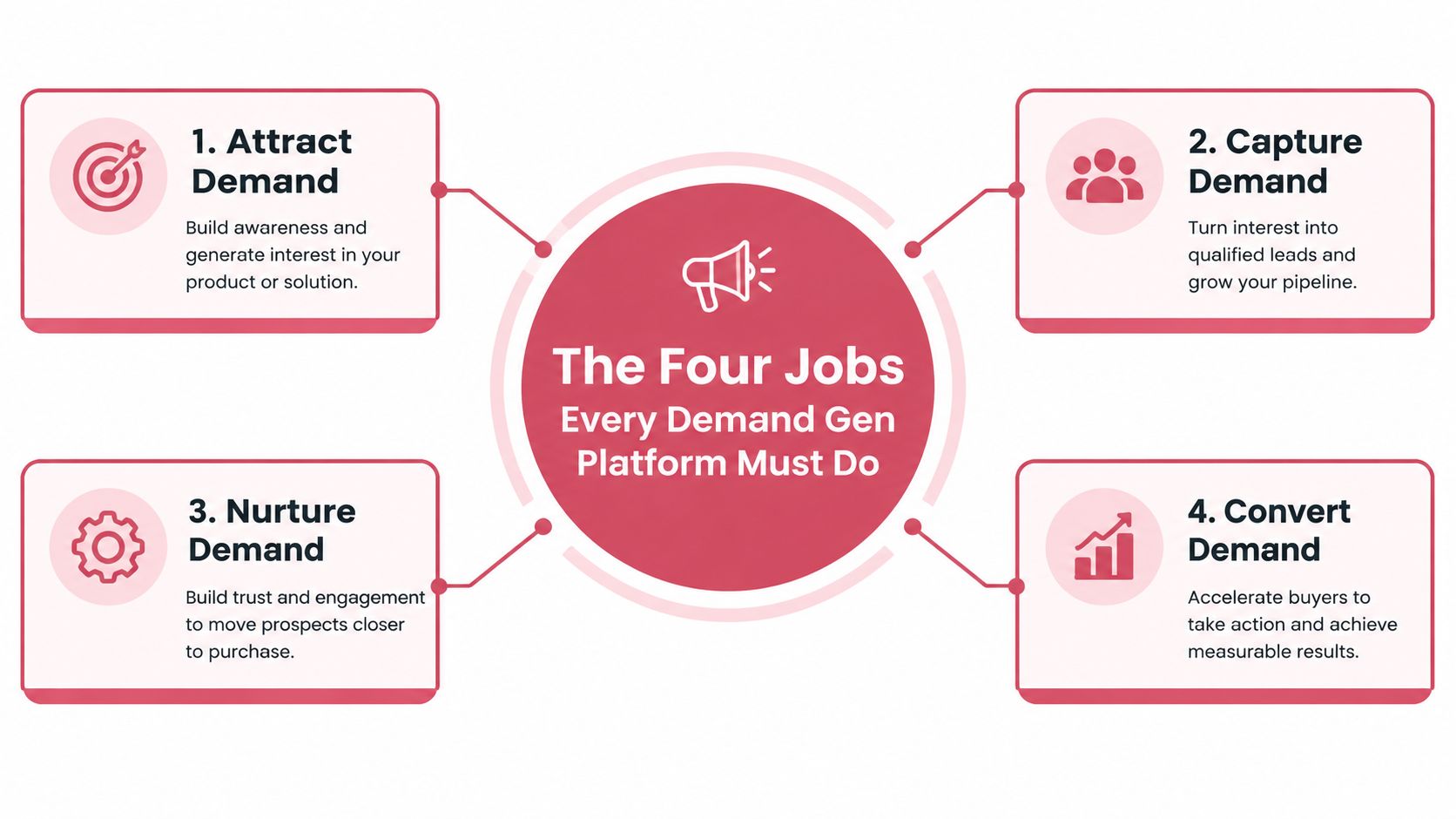
Capture and unify demand signals
The platform should combine contact, account, intent, product usage, event, web, and campaign signals into an identity that operators can inspect. It must distinguish a known person from an account-level signal and retain each event's source and timestamp.
Test this with a real scenario. A pricing visit may sit in analytics, product activity in a warehouse, and a form submission in the CRM. If the platform cannot connect those records without manual cleanup, it is displaying data rather than governing demand.
Score and route intent
Scoring should rank prospects against defined business outcomes, then send the next action to the right owner. Require account and contact scores, negative signals, expiration rules, and routing by territory, segment, or capacity.
Static scoring that rewards every click equally creates inflated queues and trains sales to ignore marketing alerts. Buyers should understand how lead scoring models work before comparing interfaces. Ask vendors to show the inputs, weighting, decay, and approval path behind a recommendation.
Orchestrate multi touch campaigns
The platform should coordinate email, paid advertising, social actions, events, chat, and community activity through shared entry, exit, and suppression rules. A prospect entering an SDR sequence should not continue receiving an unrelated nurture stream.
Channel duplication exposes weak architecture. Each tool may perform its task correctly, while no system knows that another channel already contacted the same account. Require cross-channel suppression and an audit trail showing why an action ran or stopped.
Measure pipeline and revenue contribution
A credible platform connects activity to opportunity stages, influenced revenue, and closed won outcomes. It should expose attribution assumptions and let operators inspect the touch history behind every reported contribution.
MQL volume is easy to produce and easy to misuse. It can conceal poor fit, duplicate activity, and opportunities that never progress. Map your stack against these four jobs before a vendor demo. The missing controls, ownership boundaries, and evidence paths will reveal more than a feature page.
Core Features and Workflows Inside the Stack
A serious platform has four architectural layers. Each layer has a responsibility, and each responsibility can be tested in a live demonstration. Feature count matters less than whether identity, permissions, and decision history move cleanly across the layers.
The data layer
This layer should unify contacts, accounts, intent, product activity, event attendance, campaign interaction, and enrichment. Look for identity resolution, field history, consent status, deduplication, and deletion propagation.
Ask the vendor to show a single account after it appears through an event, a product signal, and an enrichment provider. If the representative opens three disconnected screens or manually edits the record, the integration is probably shallower than the presentation suggests.
The orchestration layer
Journey builders, triggers, branching logic, playbooks, timers, and approval gates belong here. Good orchestration lets operations change a route without waiting for engineering, while still enforcing permissions around sensitive actions.
The useful question is simple: can the team build a play that starts with product usage, checks account fit, suppresses active opportunities, requests approval, and then selects email or sales action? A sequence that only moves a contact from form submission to email isn't orchestration across the funnel.
The channel layer
Email, paid advertising, social, events, chat, and community should consume the same audience and suppression logic. The platform should record delivery, response, opt out, handoff, and failure states rather than treating each channel as an isolated export.
Email quality is a hard constraint. B2B data quality benchmarks recommend hard bounce rates below 1% on verified contacts, spam complaints under 0.1%, and report that verification with active decay management can support 95% or higher deliverability. Crossing roughly 2% hard bounces or 0.3% spam complaints is associated with deliverability and domain reputation risk (B2B data quality report).
The intelligence layer
Scoring models, predictive routing, send time optimization, recommendations, and AI copy assistance belong here. The operator needs model inputs, version history, confidence, override controls, and outcome feedback.
| Layer | Core Features | Demo Question to Ask |
|---|---|---|
| Data | Identity resolution, enrichment, event unification | Show the full record history after duplicate signals arrive |
| Orchestration | Triggers, branching, playbooks, approvals | Can operations build a cross channel workflow without engineering? |
| Channels | Email, ads, social, events, chat | Which suppression rules apply across every channel? |
| Intelligence | Scoring, routing, AI assistance, feedback loops | What evidence changed the score and who can override it? |
How Demand Generation Software Differs From Marketing Automation, CRM, and Sales Engagement
Demand generation software is the coordination layer between systems of record and systems of action. It does not replace every adjacent category. The buyer must define which system owns identity, consent, scoring, opportunity status, and external activation before signing a platform.
Marketing automation owns forms, nurture programs, segmentation, and scheduled email. Choose it when nurture depth and repeatable campaign execution are the main requirements. Its limits appear when the team needs cross-channel orchestration, account-level context, or pipeline calculations that include offline activity.
The CRM owns accounts, contacts, opportunities, activities, and the official revenue record. Keep it authoritative for customer and opportunity data. Do not expect it to determine every message, place every account into an advertising audience, or govern approval for an AI-generated play.
Sales engagement software sequences representative outreach across channels. It improves individual seller productivity through task creation, sequencing, and reply handling. Its performance depends on upstream signals, clean lists, accurate ownership, and qualification rules. Better sequencing cannot repair weak identity resolution.
| Category | Primary Job | Owns Pipeline Math? | Typical User | Known Weakness |
|---|---|---|---|---|
| Marketing automation | Nurture and campaign execution | Usually limited | Marketing operations | Weak cross channel and revenue ownership |
| CRM | System of record for customer and opportunity data | Yes, as the official record | Sales and revenue operations | Doesn't orchestrate every action |
| Sales engagement | Rep outreach and task sequencing | No | SDRs and account executives | Depends on upstream signals and data |
| Demand generation software | Cross channel orchestration and contribution measurement | Should, with explicit assumptions | GTM, marketing, sales, and operations | Can create overlap without clear ownership |
Demand generation software earns its place by connecting execution to governed measurement. It should coordinate channels, preserve decision context, and show how each interaction contributes to pipeline without taking ownership from the CRM.
Modern AI native platforms, including Yalc, combine several layers in one governed workspace. Fewer handoffs can simplify operations, but centralization increases the cost of weak controls. Before signing, document where scores are calculated, where consent is stored, which system is authoritative for opportunities, and who can launch an external action. Ask how those decisions are logged, changed, and reversed.
The operating rule is clear: use marketing automation for nurture depth, CRM for record truth, sales engagement for rep productivity, and demand generation software for coordinated execution across channels with explicit revenue attribution.
A Buyer Decision Framework That Cuts Through Vendor Noise
A vendor evaluation should test the system under pressure, not reward the smoothest presentation. Five checks expose most weaknesses quickly.
Check signal quality first
Ask the vendor to ingest intent, product usage, and third party enrichment into one account without manual cleanup. Then inspect the original values, timestamps, source labels, and conflict handling. A polished profile means little if the platform automatically overwrites data or treats stale intent as current.
Test workflow composability
Give the team a scenario that crosses channels. For example, start with an account visiting a high intent page, check fit, exclude an open opportunity, notify an owner, and place the account into a paid audience only after approval. The vendor should build the workflow during the session, not promise professional services after purchase.
Challenge attribution honesty
Ask which touches count, how offline conversion imports work, how duplicate influence is handled, and whether the model can show alternative views. The system should expose assumptions instead of presenting one definitive number that nobody can audit.
Inspect governance in action
Request a demonstration of role based permissions, approval gates, suppression lists, consent updates, and audit logs. Then ask what happens when an operator edits a live play. The answer should include versioning and rollback, not only a generic claim about administrative controls.
Price the exit before the entry
Ask for a complete export of contacts, events, scores, workflow definitions, prompts, and attribution history. Ask which models belong to the customer and whether the team can move them to another system. A platform that makes data portable and logic inspectable has a healthier commercial posture than one that keeps the operating model trapped inside proprietary screens.
One particularly revealing test is deletion and re entry. Ask the vendor to delete a prospect, confirm the deletion across connected channels, then re enter that prospect with a new signal. Weak identity resolution and incomplete deletion propagation usually become visible immediately.
Two Playbooks and the KPIs That Prove They Work
An inbound motion and an outbound motion should share data but not identical rules. The first prioritizes response speed after a high intent action. The second prioritizes account selection and disciplined seller capacity.
Playbook one for inbound demand
A visitor requests a demonstration or shows a strong buying signal. The platform verifies account fit, enriches the record, checks for an existing opportunity, assigns ownership, and starts the appropriate follow up. Marketing can continue education for people who aren't ready, while sales receives context instead of a bare name.
The useful KPI set is compact:
- Demo to opportunity rate: Shows whether the handoff produces qualified pipeline.
- Speed to lead: Shows whether routing and ownership work operationally.
- Content assisted pipeline: Shows whether educational activity influenced later opportunities.
The workflow needs channel suppression. Once sales accepts the handoff, generic nurture should pause or change. If the account enters an opportunity, prospecting should stop unless the account team deliberately reactivates it.
Playbook two for outbound demand
An outbound motion starts with product usage, account fit, intent, or another defined signal. The platform ranks accounts, assigns them to SDR capacity, prepares relevant context, and launches a sequence only after list quality and approval checks pass.
The KPI set should focus on signal quality and execution:
- Account penetration: Shows whether the motion reaches the relevant people inside target accounts.
- Response rate by signal source: Shows which signals deserve trust.
- Meetings held per launched sequence: Shows whether activity turns into attended conversations.
A detailed reference on building this motion is available in outbound lead generation workflows. For teams comparing measurement and analytics products, the MyMentions marketing tool roundup offers a useful way to broaden the evaluation beyond campaign sending.
Email open rate and total MQLs shouldn't decide whether either playbook works. They're easy to inflate and weakly connected to revenue. The operator's scorecard should favor pipeline movement, accepted opportunities, meetings held, and closed won outcomes.
Architecture, Security, and AI Governance Questions to Ask
Architecture and governance separate similar looking platforms. A vendor can match a competitor on campaign features and still create unacceptable risk through weak isolation, vague retention rules, or untraceable AI actions.
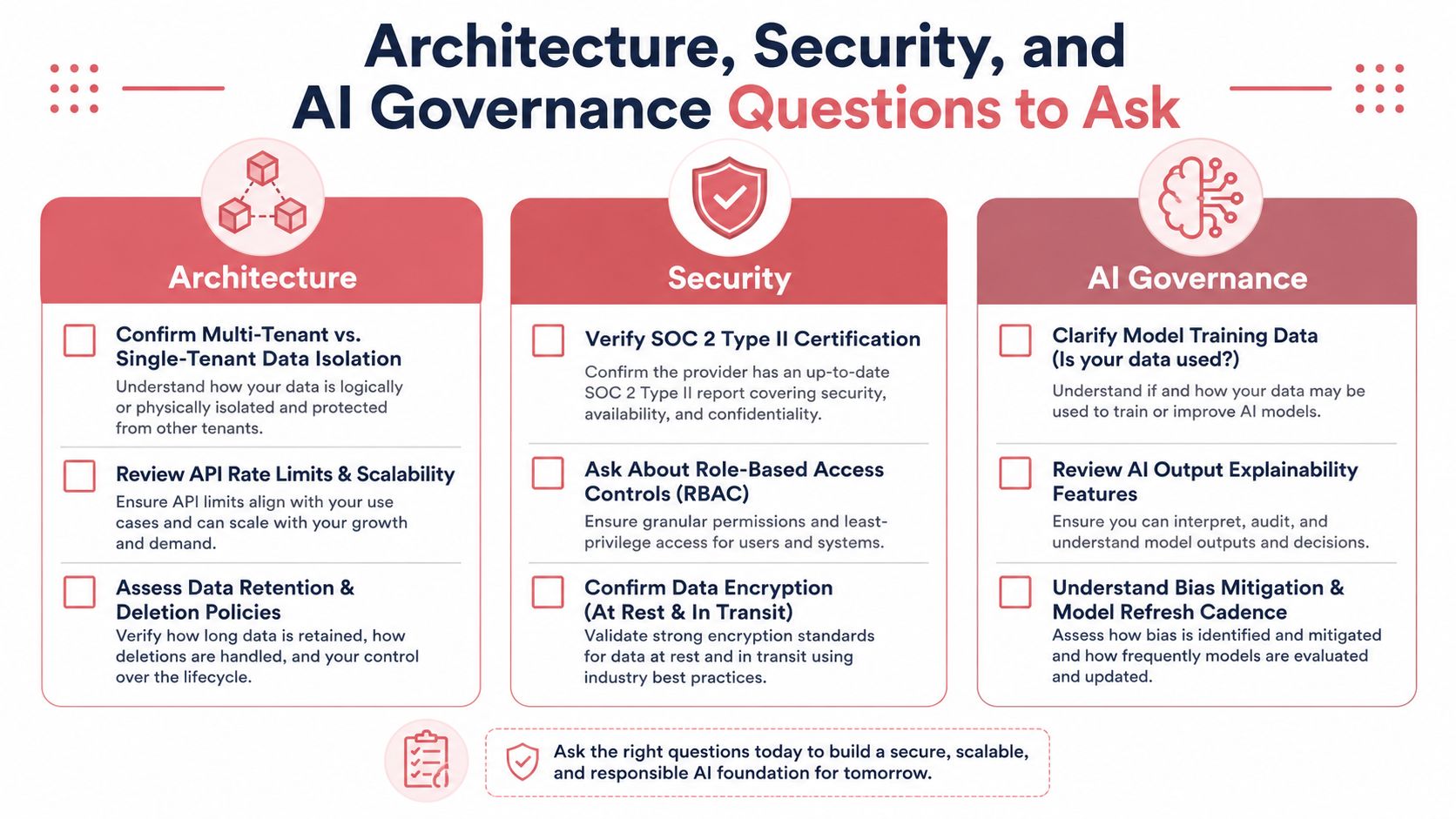
Start with architecture. Confirm whether the environment is multi tenant or single tenant, how data is isolated, what API rate ceilings apply, how reliable webhooks are, and how identity propagates across connected tools. Ask where failures appear, how retries work, and whether an operator can inspect a complete event trail.
Security review should cover data residency, encryption at rest and in transit, evidence for SOC 2 and ISO 27001, single sign on, SCIM, role based access, retention, deletion, and administrative logs. The U.K. ICO guidance matters for outbound planning. PECR's direct marketing rule for electronic mail doesn't apply to corporate subscribers, but GDPR still applies when personal data is processed (global compliance guidance). Sole traders are treated as consumers for B2B email marketing and need prior opt in, while incorporated organizations don't need opt in under the cited guidance but still require clear opt out and sender identification (B2B and B2C email consent guide).
AI controls that deserve contract level answers
Training opt outs, model transparency, prompt and output logging, approval gates, bias review, refresh practices, and rollback paths should be documented. A platform should let the team identify what data an AI action used and stop external execution until a person approves sensitive steps.
Ask these questions during the sales call:
- Where is customer data stored, and can the region be pinned?
- Can model training on customer data be disabled through a contract clause?
- Who can approve external messages and audience changes?
- Can the team export prompts, outputs, scores, and decision logs?
- What happens when an AI recommendation is wrong?
AI native GTM platforms like Yalc publish these controls as part of their operating model, but any serious competitor should answer the same questions on request. Buyers can also use a practical guide to AI orchestration for GTM workflows when assessing how models, tools, and approvals fit together.
Your 30 Day Evaluation Checklist and Next Move
Run the evaluation as an operating exercise, not a procurement exercise.
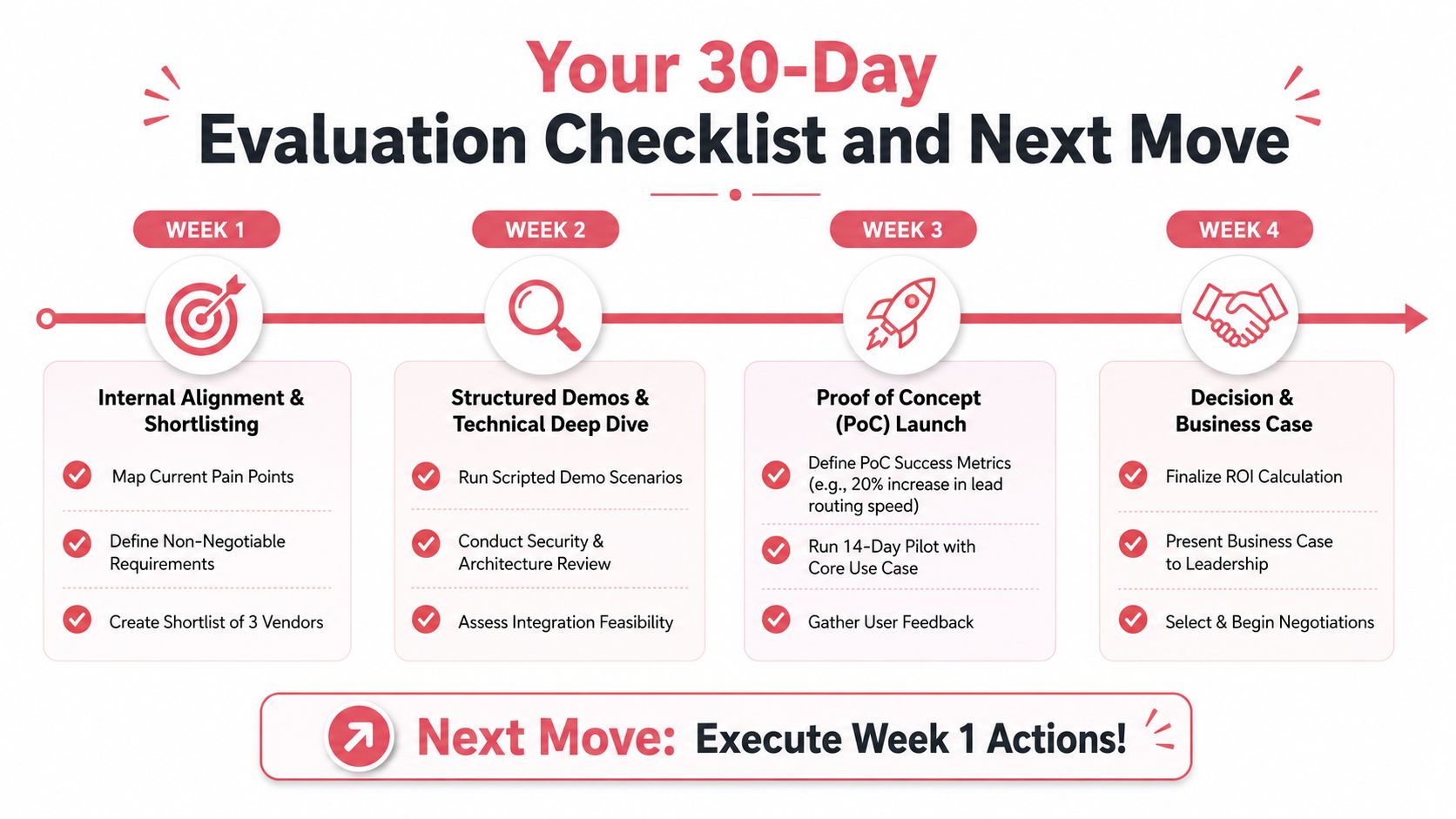
Week one starts with internal alignment. Map the current pain, define non negotiable architecture and security requirements, and shortlist three vendors that can meet them. Include marketing, sales, operations, security, and finance in the requirement review.
Week two is structured discovery. Give each vendor the same scenarios, score signal quality, workflow composition, attribution, governance, and exit cost, then request references from companies with a similar motion and segment.
Week three is proof. Pilot one inbound and one outbound playbook in a sandbox account. Measure lead quality, reply rate, routing time, and time to first meeting. Keep the workflows narrow enough that the team can identify what caused a result.
Week four is the business decision. Compare total cost, integration effort, data portability, security evidence, and governance controls. Choose the platform whose trade offs the security and finance teams can defend, not the one with the longest feature list.
Teams ready to evaluate should book demos with the scripted checks above and require vendors to perform them live. Teams already burned by a legacy stack should keep the incumbent running while piloting an AI native alternative against one controlled motion, with clear stop conditions and export requirements.
Yalc provides a governed AI GTM operating system for sourcing, enrichment, qualification, multichannel outreach, play execution, telemetry, and human approvals. Teams can compose plays through its MCP in Claude Code or run configured workflows from Slack and the Yalc interface, while keeping data and keys under their control. Visit Yalc to assess whether its architecture fits the demand generation workflows and governance standards defined here.