Go to Market Engineering, the Operator's Playbook
Go to market engineering isn't mainly a job title. It is the operating system that keeps a revenue motion from falling apart into disconnected tools, stale lists, and guesswork. The field now looks more like a specialized revenue function than a sidecar to sales ops, because hiring demand has risen sharply, compensation sits in a specialist range, and the workflow itself requires coordination across data, orchestration, and reporting. As summarized in the industry guide on GTM engineering at ZoomInfo Pipeline, demand is up 205% between 2024 and 2025, median pay is around $127,500 a year, senior pay is above $180,000, and job postings rose from roughly 1,400 in mid 2025 to more than 3,000 by January 2026.
That growth matters because companies are no longer hiring someone just to move data between systems. They are hiring people to design a repeatable motion that learns, scores itself, and improves the next run. That is the shift, and it explains why the term keeps showing up in 2026 hiring plans.
Practical rule: If the motion only works when one person remembers every exception, it is not engineered yet.
Table of Contents
- The Operator's View of Go to Market Engineering
- What Go to Market Engineering Actually Means
- The Architecture That Holds the Motion Together
- Four Playbooks the Function Runs
- A 90 Day Implementation Roadmap for Startups and Scale Ups
- What Should Never Run on Autopilot
- A Measurement Framework That Compounds
- Common Failure Modes and How to Avoid Them
The Operator's View of Go to Market Engineering
Many teams still describe go to market engineering as a hybrid of RevOps, outbound ops, and automation work. That description is too small. A mature function is closer to an internal operating system that coordinates the full revenue motion, from target selection to enrichment, sequencing, reporting, and the logic that decides what should happen next.
The useful mental model is simple. Go to market engineering designs the system, connects the data, automates the recurring work, and creates feedback loops so the motion gets better with each run. That is why structured GTM systems outperform ad hoc execution, with documented GTM strategy linked to a 3.4x higher chance of a successful launch, along with benchmarks showing three times greater revenue growth and 10% higher launch success rates in structured programs, as summarized in the 2026 go to market statistics roundup at SearchLab.
What a mature function actually owns
It owns the work that usually gets scattered across teams. One layer handles target definition and message knowledge, another keeps identity and enrichment clean, another runs orchestration and approvals, and another pushes work through channels without breaking governance.
The point is not “more automation.” It's repeatability. Companies with documented GTM systems do better because the rules are visible, the inputs are measurable, and the outcomes can be compared run to run.
For a team like Yalc, that is the core design idea. The system should hold the ICP, voice, prior wins, and decision rules in one place, then reuse them every time a play runs. A good starting reference for how operators think about early ownership is the practical guide on the first 30 days of a GTM engineer.
A revenue motion becomes engineerable when the team can explain why a play worked, not just that it worked.
What Go to Market Engineering Actually Means
Go to market engineering is the practice of building a measurable revenue system instead of running isolated campaigns. It combines data, automation, and workflow design so the team can prospect, enrich, route, sequence, and report in a way that is consistent enough to improve. The discipline is not about replacing commercial judgment. It's about making that judgment executable at scale.
The five operational areas that matter
According to Norwest's breakdown of the role, mature GTM engineers concentrate on five areas, and each one maps to a real operational problem. Pipeline automation and enrichment covers waterfall enrichment, lead scoring, and identity cleanup. CRM architecture and data integrity covers deduplication, lifecycle management, and Salesforce or HubSpot setup. Outbound infrastructure covers sequencing, deliverability, and personalization at scale. GTM analytics and attribution turns activity into dashboards and funnel visibility. AI native GTM workflows use LLM powered research and scoring pipelines to reduce manual prep. See the role summary at Norwest.
A simple way to score the function is to ask whether each area is visible and governed.
- Pipeline automation and enrichment: Can the team enrich leads through a waterfall, then validate the result before it touches a rep?
- CRM architecture and data integrity: Are duplicates, ownership conflicts, and lifecycle rules managed on purpose?
- Outbound infrastructure: Can the system sequence across email and LinkedIn without sending the same message twice?
- Analytics and attribution: Can leaders tell which play produced replies, meetings, and pipeline?
- AI native workflows: Does AI help with research and scoring, or is it just being used to draft generic copy?
The difference between a tool stack and an engineered motion is that the second one has rules. A useful comparison appears in Yalc's note on AI native GTM engineering, where the point is not the model itself but the knowledge layer underneath it.
The Architecture That Holds the Motion Together
The architecture has to survive vendor swaps, channel changes, and new owners. If a team changes enrichment providers and the motion breaks, the stack was never really a system. It was just a set of connected shortcuts.
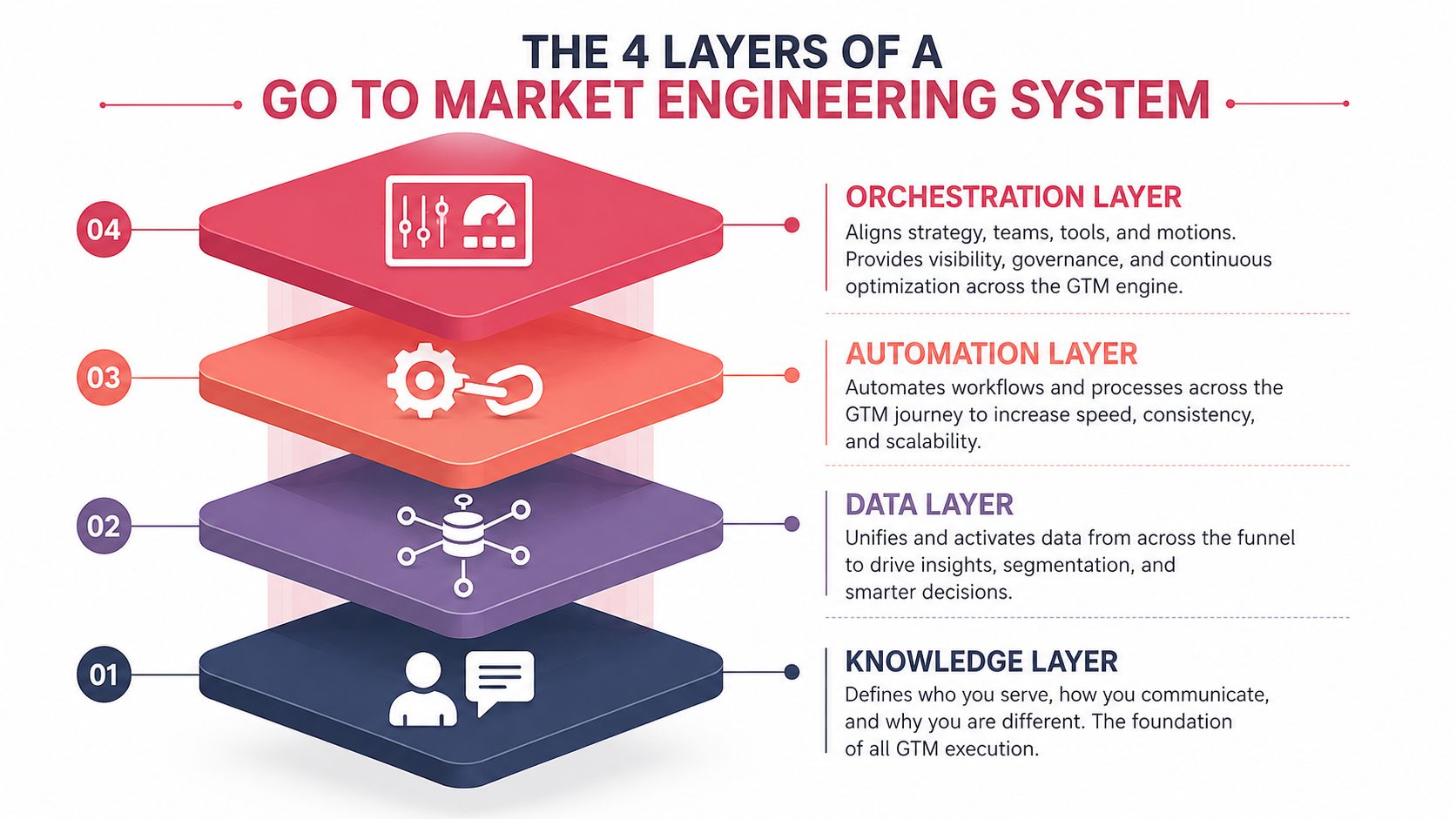
The stack needs four layers, not four random tools
The knowledge layer holds the ICP, voice, positioning, and prior winning patterns. This is the layer teams frequently underinvest in, because it feels less urgent than shipping a sequence. In practice, it decides what a good account even looks like and what a strong message should sound like.
The data layer handles enrichment, identity resolution, and validation. Records get deduped, fields get normalized, and bad inputs are rejected before they create noise downstream. The operator's job here is to make sure the data can be trusted enough to drive action.
The orchestration layer manages sequencing, routing, approvals, and fallback logic. It is where a prospect gets assigned, a message waits for review, or a workflow pauses when confidence is low. This layer is also where rollback logic belongs, because automation without an exit path becomes hard to control.
The channel layer executes through LinkedIn, email, chat, and CRM. That layer should be replaceable without rewriting the system above it. If one provider changes, the motion should still work because the knowledge, data, and orchestration layers remain intact.
A useful design rule is to keep guardrails above channels, not buried inside them. If approvals live only inside a sender tool, the system is fragile. If success metrics and verdicts live in the orchestration layer, the team can evaluate the motion independent of the vendor.
For teams comparing orchestration patterns, the practical framing in Yalc's orchestration guide is useful because it treats orchestration as control logic, not as another app.
If a vendor changes, the system should degrade gracefully, not lose its memory.
Four Playbooks the Function Runs
A GTM engineer does not “work automation.” The job is to run a small set of measured loops that start with a trigger, follow a sequence, produce a result, and feed a verdict back into the knowledge layer. That is where the operating system becomes operational.
| Playbook | Trigger | Main Steps | Success Metric |
|---|---|---|---|
| Prospecting | New target segment, signal, or campaign goal | Pull accounts from the source list, validate firmographic fit, map key fields in Notion CRM, score each record against an ICP threshold of 0.7, then send only qualified accounts forward | Qualified accounts added to the motion |
| Sequencing | A validated account or contact enters outreach | Personalize the message from CRM fields, route the record by channel, manage replies in one inbox view, and pause the workflow when confidence drops | Replies, meetings, positive response quality |
| Enrichment | Missing or stale firmographic or contact data | Run a waterfall enrichment flow, validate phone and email, deduplicate against the CRM, apply lifecycle rules, and write the cleaned record back to the system of record | Complete, trusted records with fewer errors |
| Reporting | A campaign or play finishes a run window | Aggregate replies, meetings, and pipeline outcomes, compare the run against the prior baseline, and write the verdict into the reporting layer | Clear verdict for the next decision |
Prospecting and sequencing work as one system
Prospecting is not just list building. It is the discipline of pulling target accounts, checking fit, and deciding whether a record deserves attention. If the ICP is weak, the prospecting output will be noisy no matter how good the automation looks.
Sequencing comes next, and it should be tied to the same knowledge base. The sequence needs to reflect the buyer, the trigger, and the channel mix. Personalization should be timely and relevant, not full of shallow tokens that scream automation.
Enrichment and reporting close the loop
Enrichment is where many teams waste time on manual cleanup. A better motion runs a waterfall across providers, dedupes the result, and pushes only validated data into the CRM and outreach layer. That reduces the amount of rep time spent fixing records later.
Reporting is the verdict layer. Weekly review should answer one question, did the play move the motion or not. A practical sales operations reference that fits this mindset is the MakeAutomation sales ops guide, especially for teams trying to connect process design to operating discipline without turning the stack into a maze.
The point of reporting is not to celebrate activity. It's to decide what survives.
A 90 Day Implementation Roadmap for Startups and Scale Ups
The first 90 days should produce a working motion, not a perfect architecture. Teams that try to scale too early usually automate the wrong thing, then spend the next quarter cleaning up their own assumptions.
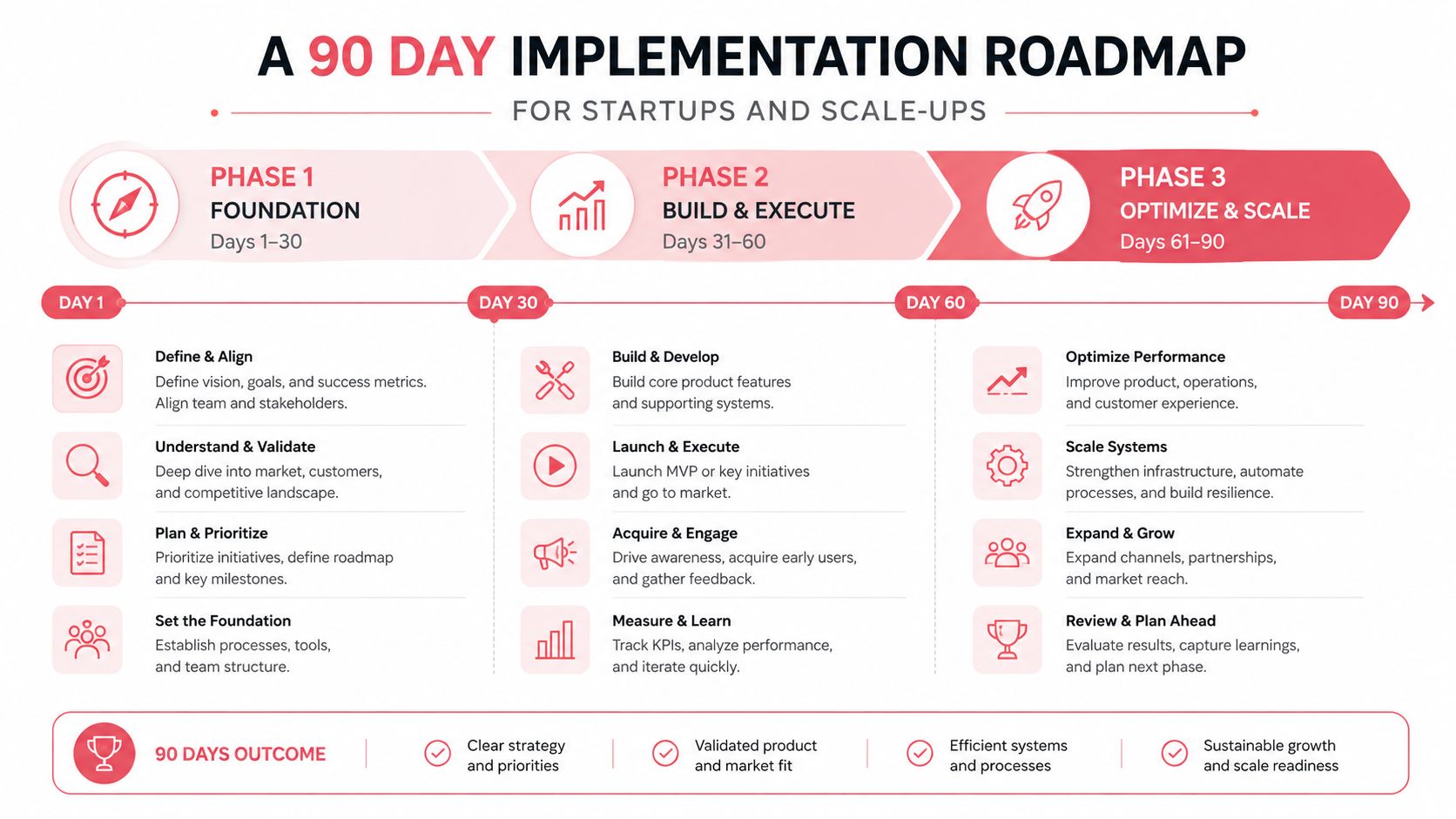
Days 1 to 30 build the foundation
Start with discovery. Capture the ICP, the current voice, the channels in use, and the places where reps are losing time. Audit the tools, the fields, and the data quality rules before touching the automation layer.
The deliverable at the end of this phase is a simple decision map. It should show what the system knows, what it can trust, and what success will look like for the first two plays. Exit this phase only when the team agrees on a baseline and the records are good enough to test against it.
Days 31 to 60 prove two playbooks
Build the first prospecting and enrichment loops, then run them against a small and controlled prospect pool. Keep the scope narrow so the team can see what breaks. Add sequencing only after the input data and targeting logic stop producing obvious noise.
The exit criterion here is not scale. It is evidence. The team should be able to say whether the play created better records, cleaner routing, or more useful replies, and it should know which step caused the result.
Days 61 to 90 scale what survived
Expand the channel set, wire reporting into a regular review cadence, and retire anything that did not meet the agreed standard. Document the motion so a new operator can run it without tribal knowledge.
That documentation should include the trigger, the steps, the success metric, the verdict rule, and the rollback path. If a new hire cannot understand the motion without asking the original builder, the system is still too brittle.
What Should Never Run on Autopilot
Not every GTM step should be fully automated end to end. High value deal motions, regulated industries, and any workflow that touches sensitive customer data need human review, scoped permissions, and clear approvals. The mistake is not automation itself. The mistake is automating bad assumptions at scale.
The safest model is to separate action from approval. Let the system prepare the work, but pause before sensitive sends, list changes, or data moves that could create trust or compliance risk. That keeps speed without surrendering control.
Where humans need to stay in the loop
- High stakes deal motions: Human review matters when a message or action could alter a large opportunity or relationship.
- Regulated or privacy sensitive workflows: Sensitive customer data needs permission boundaries and auditability.
- New or unproven plays: Early runs should stay supervised until the verdict is clear.
- Edge cases and exceptions: If the data is messy or the account is strategically important, automation should defer.
- Anything with unclear consent or source quality: Bad data becomes a bigger problem once it starts moving on its own.
A good rule is to require a human checkpoint anywhere the cost of a mistake outweighs the cost of review. That means the system can still draft, rank, or prepare, but a person decides whether the final action is acceptable.
The audit trail matters just as much. If something goes wrong, the team needs to see what ran, what data it used, who approved it, and why the verdict was what it was. Without that record, nobody can debug the motion.
A Measurement Framework That Compounds
Teams measure activity. Better teams measure learning. Every play should begin as a hypothesis, run against a baseline, and end with a verdict that tells the system whether to promote it, revise it, or retire it.
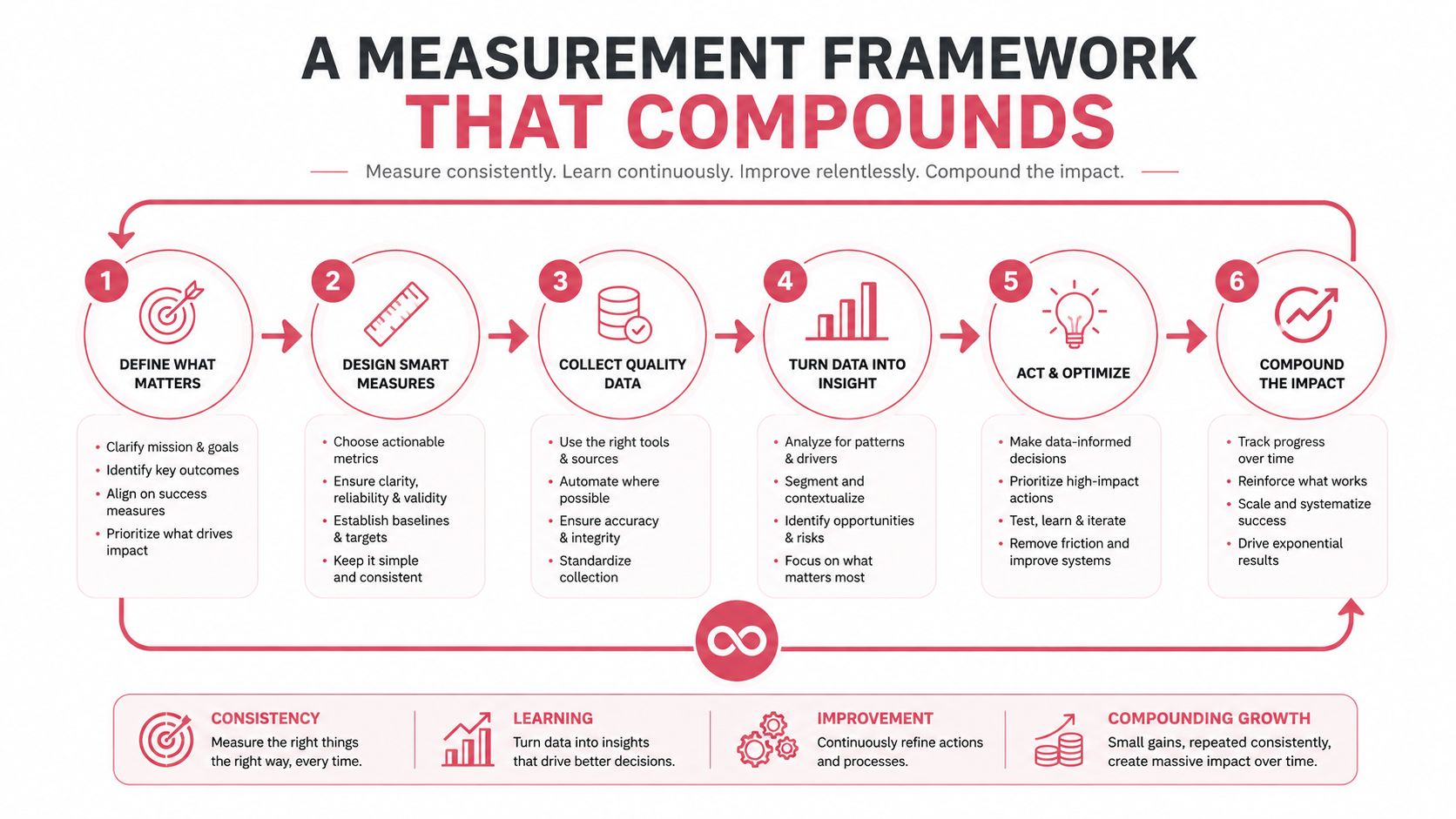
The cleanest model is confidence scoring. A new play starts as a hypothesis, then becomes validated when it meets the metric, and eventually becomes proven when it keeps performing under normal operating conditions. Anything below that threshold stays in testing or gets cut.
Keep the baseline honest
The baseline has to be set before the run, not after the fact. Use the same success metric for the same play type, and avoid overfitting to one persona or channel just because it won once.
That bias check is what keeps the system honest. If one segment performs, that does not mean the motion is broadly healthy. It may only mean the message fits one slice of the market.
The measurement layer is where discipline compounds. If every run produces a verdict, the team builds institutional memory instead of another pile of screenshots and opinions.
Common Failure Modes and How to Avoid Them
The most common failure mode is tool sprawl without orchestration. The symptom is lots of activity and no shared decision logic. The fix is to define the knowledge layer, then make every tool serve that layer.
Another failure is automating a bad ICP. The system gets faster, but the wrong people keep entering it. Fix that by tightening the qualification rules before adding more volume.
A third failure is no success metric. Every campaign looks busy, and nobody can tell whether it helped. Fix it by assigning one metric and one verdict rule per play.
The fourth failure is no human review on sensitive actions. That creates trust and compliance risk. Fix it with scoped permissions and approval checkpoints.
The fifth failure is no audit trail. When a workflow breaks, nobody can trace the cause. Fix it by logging every run, every approval, and every outcome.
Before the next launch, run this checklist. Is the ICP explicit? Is the success metric defined? Does the system know when to pause for human review? Can the team trace the run from trigger to verdict? If any answer is no, the play is not ready.
Yalc is built for teams that want go to market engineering to work like a measured operating system, not a pile of disconnected tools. It combines research, enrichment, sequencing, approvals, and reporting around a shared knowledge layer, so the motion learns from each run instead of starting over. Visit Yalc if the team wants to run that kind of system with less manual assembly and more control.