Google Company Leadership Profile and Org Chart
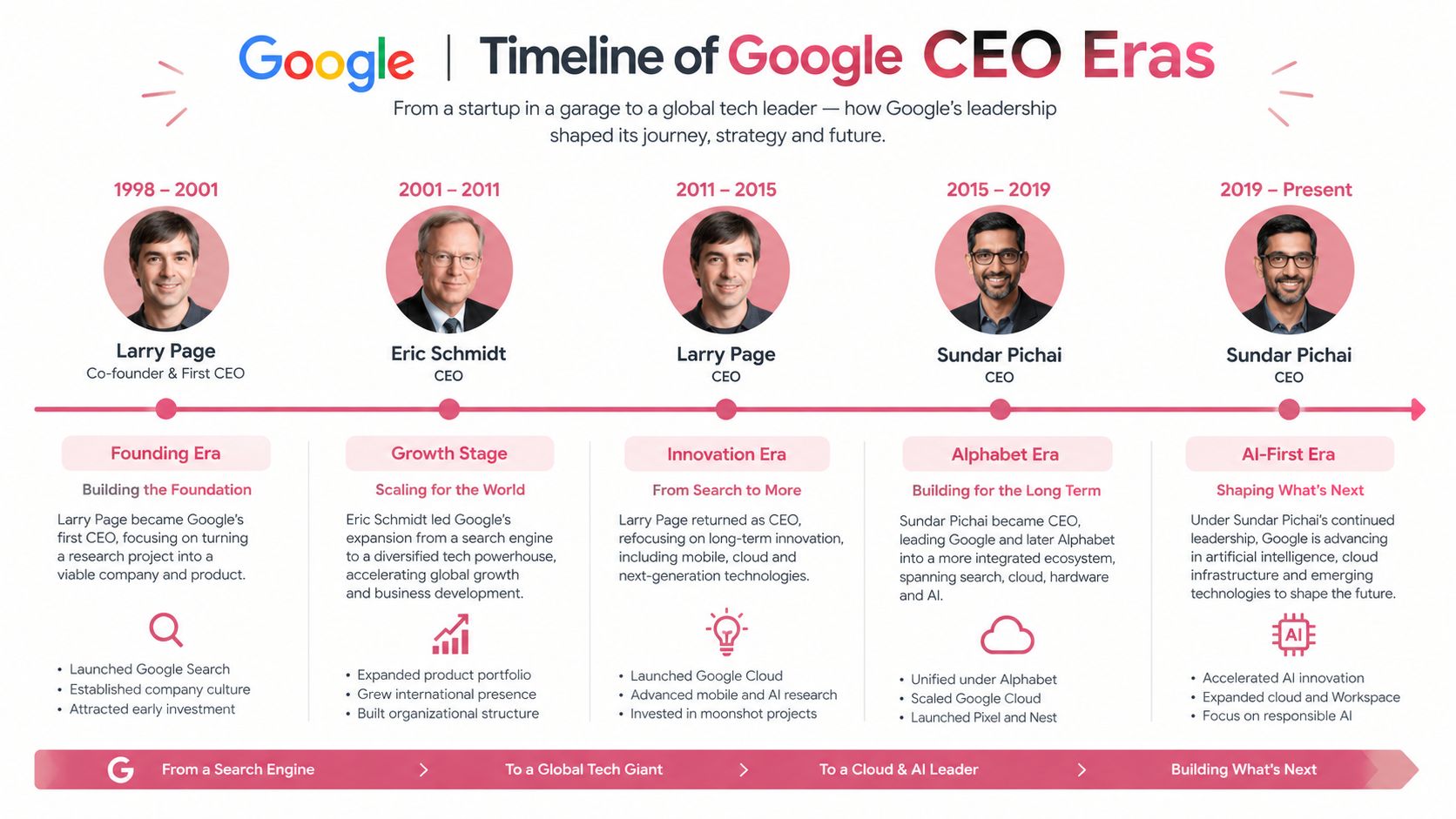
Only three people have served as Google's chief executive since the company's incorporation in 1998. Larry Page led first, Eric Schmidt took over in 2001, Page returned in 2011, and Sundar Pichai became Google CEO in October 2015. Pichai then became Alphabet CEO in December 2019, making him the third chief executive in Google's history, as documented by Business Insider's Google CEO timeline.
That continuity gives Google company leadership an unusual degree of institutional stability, but it also makes the current structure easy to oversimplify. Google operates inside Alphabet, Pichai holds both top executive roles, the board retains a separate oversight function, and a new AI governance layer is changing who controls model development, product integration, and commercialization.
For GTM leaders, those distinctions affect more than executive biographies. They shape partner access, escalation routes, cloud and AI negotiations, roadmap confidence, and the way enterprise teams should interpret organizational changes. The broader shift from search and advertising leadership toward AI centered governance also makes resources such as How Google killed the click useful context for understanding how product decisions can reshape commercial relationships.
Table of Contents
- Introduction to Google Leadership
- Alphabet and Google Dual Layer Governance
- Timeline of Google CEO Eras
- Alphabet Board Composition and Oversight
- Profiles of Corporate Executives
- Profiles of Functional Executives
- Google Leadership Org Chart
- Quick Reference Table and Sources
Introduction to Google Leadership
Google's top leadership has changed only a few times, while its operating scope has expanded sharply. The company moved from founder-led management to external executive stewardship, returned to founder leadership, and then placed a product executive at the center of both Google and Alphabet. Each transition preserved institutional continuity while changing how Google handled scale, products, and corporate complexity.
Larry Page led during the founding era. Eric Schmidt's arrival in 2001 added external executive management during Google's growth stage. Page returned in 2011, and Sundar Pichai became Google CEO in October 2015. He assumed the Alphabet CEO role in December 2019, after Page and Sergey Brin left executive duties.
Practical rule: Treat Google as a stable institution with changing decision layers, not as a company where every reorganization resets the relationship.
For GTM teams, the relevant question is where a decision originates, who can approve it, and which executive owns the consequence. A cloud partnership can cross commercial operations, product leadership, legal review, and Alphabet-level capital priorities. An AI integration may follow a different route as research leadership and product execution become more distinct.
That distinction is becoming more important as Google DeepMind develops an emerging AI governance layer. Changes in DeepMind leadership can shift authority over model development, product integration, and commercialization without changing the senior executive titles that partners recognize. Executive continuity therefore does not guarantee continuity in access or approval paths.
A partner should identify the responsible workstream before escalating. Sending a commercial issue to the most visible executive can slow resolution when authority sits with a functional leader, product organization, or AI research and governance team. Resources such as How Google killed the click also provide context for how product decisions can reshape commercial relationships.
Alphabet and Google Dual Layer Governance
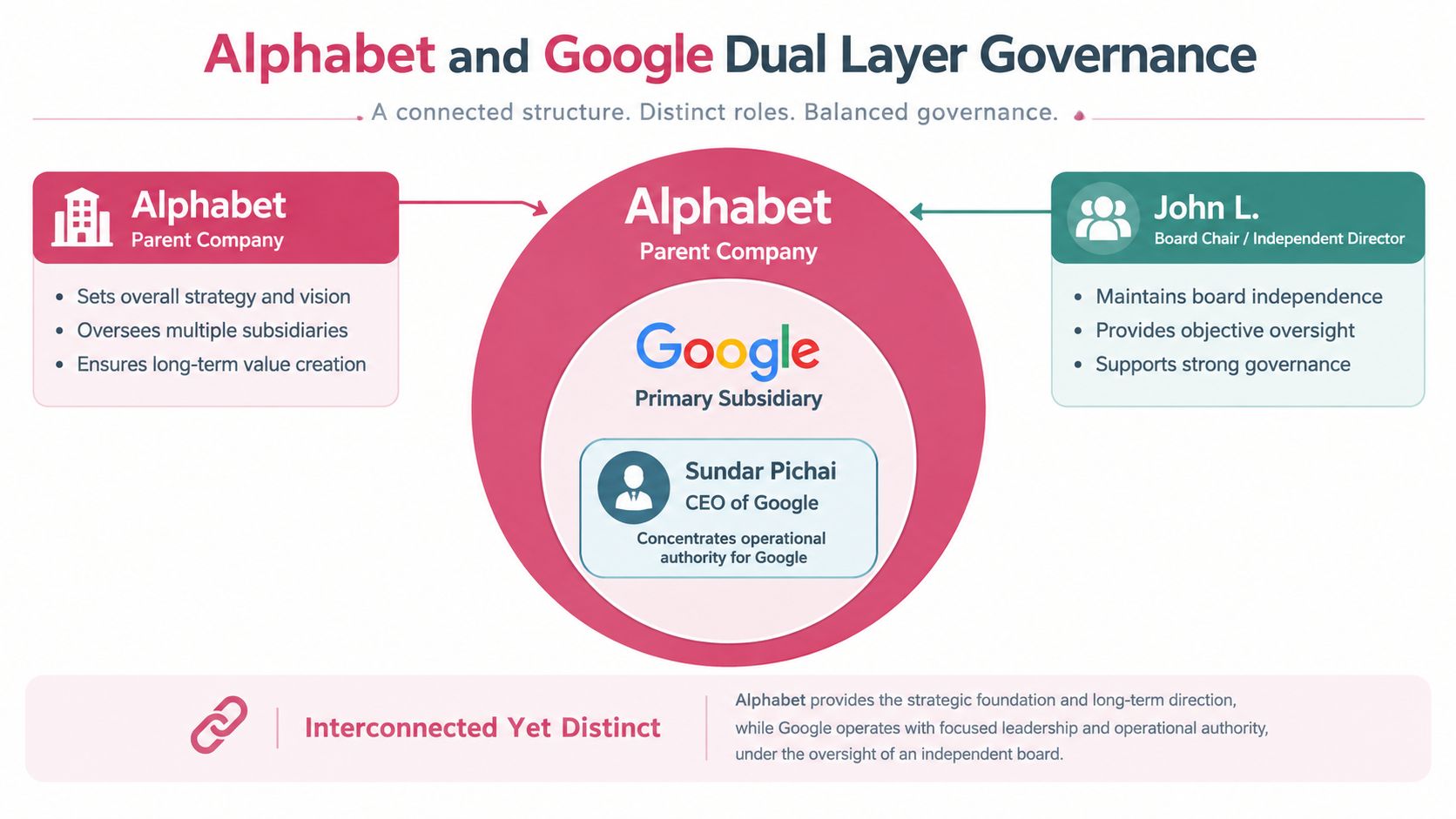
Alphabet is the parent company, while Google remains its primary operating company. This arrangement places Google's daily execution inside a wider corporate structure, creating two connected decision layers rather than one unified management channel.
Sundar Pichai serves as CEO of both Alphabet and Google. John L. Hennessy serves as Alphabet's independent board chair, separating operating management from board oversight, as described in Google's executive leadership overview.
One CEO across two entities
Pichai's dual appointment concentrates top-level operating authority. Google's product direction, AI priorities, cloud execution, monetization choices, and coordination across major businesses can connect through one executive line. Individual decisions still sit with product, commercial, legal, finance, or research leaders. Pichai's role links those operating decisions to Alphabet's broader priorities.
For partners, this creates a simple executive map but a more detailed escalation process. A Google commercial issue may remain within an operating function. A matter involving significant capital allocation, regulatory exposure, or company-wide policy may require review at the Alphabet level.
AI adds another layer. Google DeepMind's evolving leadership structure can influence authority over model development, product integration, and commercialization, even when senior corporate titles remain familiar. Partner access should therefore follow the relevant decision right, not only the most visible executive name.
Independent oversight remains separate
Hennessy's board chair role provides a distinct governance control point. Alphabet's board reviews strategy, risk, executive performance, compensation, and major policy direction. Pichai brings management knowledge into board governance, while Hennessy represents a separate oversight position.
Access to Google's operating leadership does not automatically provide access to Alphabet's governance process. Pichai connects the two layers, but they serve different purposes.
What the structure means for GTM teams
A practical escalation model follows the decision's subject:
- Product or roadmap issue: Start with the relevant Google product organization and operating leader.
- Cloud or infrastructure agreement: Engage commercial and product owners first. Add finance or legal when the agreement creates wider corporate commitments.
- AI partnership: Establish whether the request concerns research, model development, product integration, or commercialization. DeepMind leadership changes can affect which team controls each stage.
- Risk or policy concern: Treat board oversight as separate from account management. Route the issue through the appropriate legal, compliance, or corporate channel.
Pichai coordinates Alphabet and Google, while Hennessy provides independent review. Partners that distinguish operational sponsorship from governance approval can identify the right approver earlier, especially for AI partnerships whose authority may span research, product, and corporate functions.
Timeline of Google CEO Eras
Google has moved through three principal CEO eras since its incorporation in 1998: Larry Page, Eric Schmidt, and Sundar Pichai. Page held the position during two separate periods, so the sequence reflects both leadership continuity and deliberate changes in operating emphasis.
The sequence is documented in the Google CEO history. It also shows why CEO succession alone does not explain Google's partner decision paths. Each era placed different weight on founder control, operational scale, and coordination across the Alphabet structure.
Larry Page and the founding model
Larry Page was Google's first CEO. His tenure represented the founder-led stage, when product ambition, company formation, and strategic direction remained closely connected. Page returned as CEO in 2011 after Eric Schmidt's tenure, bringing founder leadership back into direct operational control.
The return signaled a renewed link between product development and corporate direction. For partners, that model raises the importance of showing how a relationship advances a strategically important product area, rather than presenting commercial value alone.
Eric Schmidt and growth-stage stewardship
Eric Schmidt became CEO in 2001 and led Google through major organizational expansion. His role was growth-stage stewardship: an external executive supplied operating discipline while the founders continued shaping the company's identity and long-term product priorities.
That division established a pattern Google later adapted. Daily management could be separated from founder influence without removing founders from the broader governance picture. For GTM teams, the Schmidt era demonstrates how Google has used executive specialization to manage scale while preserving founder-level strategic influence.
Sundar Pichai and enterprise-scale governance
Sundar Pichai became Google's CEO in October 2015 and Alphabet's CEO in December 2019, according to Pichai's leadership chronology. He first assumed operating control of Google, then took on the parent-company role as the founders stepped back from executive responsibilities.
The result was a single executive spanning Google's operating layer and Alphabet's corporate layer. That arrangement supports coordination across search, cloud, products, advertising, and AI, while placing more decision weight on functional leaders beneath Pichai.
AI adds a newer governance layer. DeepMind leadership changes can shift authority among research, model development, product integration, and commercialization. A partner engaging Google on AI therefore needs to identify the accountable leader for each stage, rather than treating the CEO timeline as a complete approval map.
The partner strategy lesson
CEO continuity supports long-term planning, but it does not ensure continuity within every function. A partner should separate three questions:
- Who sets the company-wide priority?
- Who owns the relevant product or research area?
- Who approves the commercial, legal, or operational commitment?
The CEO timeline answers the first question most clearly. The other two depend on the functional structure beneath Pichai, particularly where AI research, product execution, and corporate commitments intersect. This distinction helps GTM teams identify the right sponsor and avoid assuming that executive visibility equals approval authority.
Alphabet Board Composition and Oversight
Alphabet's board includes 11 members, combining founders Larry Page and Sergey Brin, long-serving outside directors such as John Doerr and Kavitark Shriram, and executive representation from Sundar Pichai. Its composition creates two oversight inputs: historical knowledge from the founders and independent review from outside directors.
John L. Hennessy has chaired Alphabet's board since February 2018. Ruth Porat became president in August 2023, while Robert Andreatta has served as COO since May 2019. These appointments separate board leadership from operating responsibilities, a distinction that matters because Pichai holds the CEO role at both Alphabet and Google.
Founder presence without daily management
Page and Brin stepped away from executive responsibilities in December 2019. They remained connected to Alphabet through board roles and ownership structures, as reported by PBS NewsHour's coverage of the founders' transition.
The result is a split between operational authority and continuing influence. Pichai leads daily execution, while the founders' board participation and ownership preserve a channel for company history, governance input, and long-term perspective.
Oversight and accountability
The board reviews strategy, risk, capital decisions, executive compensation, and management performance. Outside directors add perspectives that sit outside Google's operating chain. Founder directors contribute institutional context.
This arrangement lets the board assess management without becoming the management team. Hennessy's independent chair role has added significance because Pichai leads both Alphabet and Google. Alphabet therefore has one central operating chief and a separate chair responsible for board leadership.
AI introduces another governance layer. Decisions about research, model development, product integration, safety, and commercialization may involve different leaders as DeepMind's role evolves. For partners, the relevant approval path can therefore extend beyond the executive hierarchy visible in public company charts.
Implications for enterprise partnerships
A major partnership may raise questions about data use, AI safety, cloud commitments, regulatory exposure, pricing authority, and strategic dependence. A proposal focused only on revenue can miss the controls that shape approval.
GTM teams should prepare two connected cases:
- An operating case: The product, customer, technical, and commercial outcomes.
- A governance case: The risk, control, compliance, capital, and reputational implications.
The board is not a second sales channel. It is the review layer that determines whether management's operating plan is acceptable at Alphabet level.
Senior sponsorship can improve internal alignment, but it does not replace board oversight. Partners that identify both the operating owner and the governance concerns earlier can set more realistic timelines and route AI-related proposals to the leaders with decision authority.
Profiles of Corporate Executives
Google's corporate leadership centers on executives with distinct decision responsibilities. Sundar Pichai connects Google's operating businesses with Alphabet's broader strategy. Ruth Porat adds a president role focused on coordination across the parent structure, while Robert Andreatta's COO remit centers on execution across teams and processes.
Public leadership records identify Pichai as Alphabet CEO since December 2, 2019, Porat as president since August 31, 2023, and Andreatta as COO since May 31, 2019. These titles indicate where a partnership may require corporate coordination, but they do not replace business-level ownership.
Sundar Pichai
Title: CEO of Alphabet and Google
Appointment path: Google CEO in October 2015, Alphabet CEO in December 2019
Primary responsibility: Company wide strategy, product direction, AI priorities, capital allocation, and executive coordination
Reporting context: Works with the Alphabet board, chaired by John L. Hennessy
Pichai is the central executive in Google company leadership because he holds both the operating-company and parent-company roles. That combination gives his office visibility across Google products, Alphabet's portfolio, and major strategic initiatives.
His involvement matters most when a partnership crosses organizational boundaries. A proposal combining Google Cloud, AI infrastructure, product distribution, and corporate investment may need one senior sponsor who can align several businesses. A request limited to one feature, integration, or product workflow usually belongs lower in the operating organization.
AI adds a further decision layer. Research, model development, product integration, safety, and commercialization can sit with different leaders as Google DeepMind's role changes. Partners should therefore map the requested decision, not rely on the highest visible title in a public organization chart.
Ruth Porat
Title: President of Alphabet
Appointment date: August 31, 2023
Primary responsibility: Corporate coordination, financial discipline, and strategic execution across the parent structure
Reporting context: Works within the Alphabet executive structure under Pichai
Porat's role connects parent-level priorities with operating execution. Her layer becomes relevant when a proposal spans multiple Alphabet businesses, requires long-term investment, creates material financial commitments, or supports a company-wide initiative.
The title does not automatically make Porat the owner of every commercial discussion. It signals corporate breadth. A practical engagement plan identifies the business sponsor first, then tests whether the proposal requires president-level coordination because of its scope, capital needs, or cross-company effects.
For partners, that distinction prevents premature escalation. Corporate sponsorship can align interests, but the operating team still needs to define the product, customer, technical, and commercial case.
Robert Andreatta
Title: COO of Alphabet
Appointment date: May 31, 2019
Primary responsibility: Operational coordination and execution across the company's management system
Reporting context: Works within the corporate leadership chain and coordinates with business and functional executives
The COO layer matters when partnership success depends on execution across teams. Implementation standards, operating cadence, internal handoffs, and repeatable processes are more likely to require this function than a standalone product discussion.
GTM leaders should involve the COO function when the problem is delivery rather than sponsorship. If several teams support a joint program but no group owns the operating rhythm, the gap is organizational. Mapping that owner can produce more progress than escalating through additional sales contacts.
How to approach the corporate layer
A disciplined sequence improves partner routing:
- Start with the business owner. Find the executive responsible for the product or market outcome.
- Test the scope. Decide whether the proposal affects one product, several Google businesses, or Alphabet broadly.
- Add corporate leadership selectively. Include Porat or the COO function when financial, operational, or cross-company coordination is material.
- Reserve Pichai-level engagement for strategic convergence. His involvement fits partnerships with company-wide importance, not routine commercial requests.
Role changes and organizational redesign can also create a need for structured leadership support. Teams assessing that dimension can review this discussion of executive coaching for leaders.
Sales operations should record decision ownership separately from relationship ownership. A contact may influence a proposal without approving its commitments. Capturing both fields lets teams use sales intelligence to monitor executive changes without treating every title update as a new buying signal.
Profiles of Functional Executives
Google's functional layer converts strategy into products, models, cloud services, contracts, and policies. The clearest organizational shift is in AI governance: research authority and operating control now sit in more distinct roles, while the reporting line to Sundar Pichai keeps major AI decisions close to the company's central leadership.
Koray Kavukcuoglu became chief AI architect in June 2025 and senior vice president of Google DeepMind in August 2026. He reports directly to Pichai, as reported by Reuters' report on the AI leadership change.
Koray Kavukcuoglu and AI execution
Title: Senior vice president of Google DeepMind and chief AI architect
Primary responsibility: AI architecture, model direction, and AI-powered product development
Reports to: Sundar Pichai
The direct reporting line matters to partners because it connects AI product development with Google's central operating authority. AI work is therefore less likely to remain separated from decisions about products, distribution, and commercial deployment.
Partners should classify the decision before choosing an executive route:
- Model or platform access: Engage the AI and technical ownership layer.
- Product integration: Identify the Google product executive responsible for user experience and launch.
- Commercialization: Add the relevant business and finance owners.
- Safety, data, or policy: Include legal and governance stakeholders early.
The chief AI architect title signals technical breadth. The DeepMind senior vice president role adds operating authority. Together, they place Kavukcuoglu at the point where models, product development, and Google offerings must connect.
Demis Hassabis and research authority
In the 2026 reshuffle, Demis Hassabis moved from day-to-day CEO duties at DeepMind into chair and chief scientist roles. He remains associated with research direction and scientific leadership, while Kavukcuoglu assumes operational control of Google DeepMind.
That division changes partner routing. Hassabis is relevant to research credibility, scientific collaboration, and long-horizon technical direction. Kavukcuoglu is the more direct operating contact for execution, product development, and incorporating AI capabilities into Google services.
The structure also raises a continuity question. Jeff Dean left after 27 years to start a new company, alongside other senior departures, during an overhaul described by Reuters' coverage of the DeepMind leadership shift and CNBC's report on the reorganization. For partners, the issue is whether internal promotions and concentrated authority can preserve execution quality and institutional memory.
Product, cloud, finance, and legal ownership
AI initiatives still require approvals outside the research and AI leadership chain.
Product leaders own user experience, roadmap sequencing, and launch readiness. A partner seeking a beta or integration needs product sponsorship, not only support from AI researchers.
Cloud leaders control infrastructure relationships, developer distribution, and enterprise adoption paths. Cloud teams should distinguish a technical integration from a strategic cloud commitment.
Finance leaders influence pricing logic, investment review, and the commercial structure of major agreements. Their involvement becomes more relevant when a proposal extends beyond one product team.
Legal leaders assess data rights, licensing, privacy, competition concerns, safety obligations, and contract exposure. Legal review should begin before an AI proposal reaches a customer. Late involvement can force business teams to revise assumptions already presented.
The operating interpretation
Google's AI governance is more centralized at the top and more differentiated underneath. Pichai provides central authority, Kavukcuoglu leads an important operational AI layer, and Hassabis retains scientific stature in a more strategic capacity.
This arrangement may improve coordination, but it requires precise stakeholder mapping. Sales operations teams must separate technical feasibility, product integration, and commercial deployment authority. A mature sales operations process should record each authority as a distinct stakeholder instead of treating one account owner as responsible for every decision.
Google Leadership Org Chart
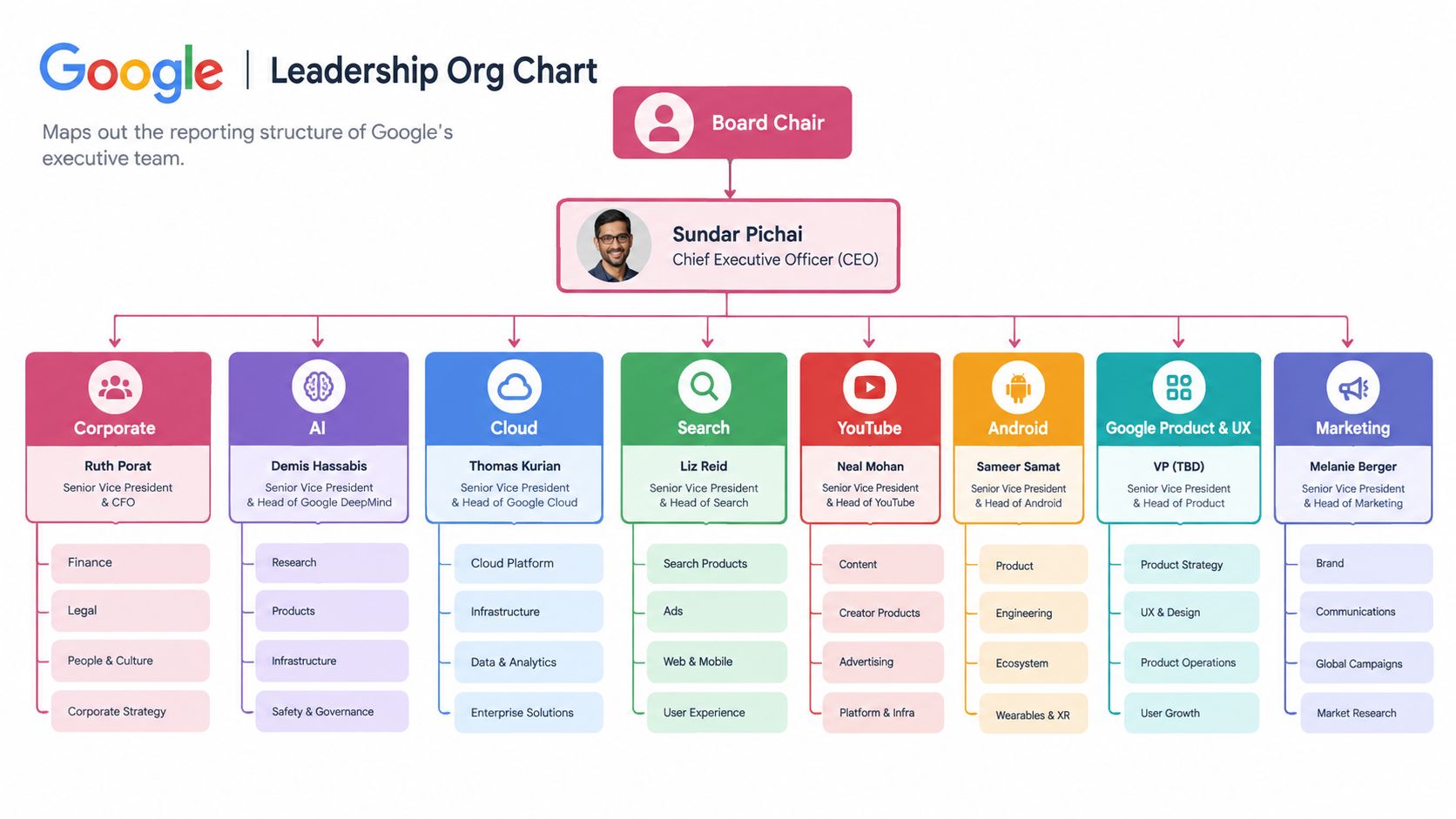
The most useful org chart for a partner isn't a list of famous names. It's a decision map showing how governance, corporate management, product execution, AI research, and commercial approval connect.
At the top, John L. Hennessy chairs the Alphabet board. Sundar Pichai sits below that oversight layer as CEO of both Alphabet and Google. Corporate leaders such as Ruth Porat and Robert Andreatta support parent level coordination and operating execution.
Reading the hierarchy
The structure can be interpreted in five clusters:
- Governance: John L. Hennessy and the Alphabet board oversee strategy, risk, compensation, and management accountability.
- Corporate leadership: Sundar Pichai, Ruth Porat, and Robert Andreatta connect parent company priorities with operating execution.
- AI and research: Koray Kavukcuoglu leads the operational Google DeepMind layer under Pichai, while Demis Hassabis contributes scientific and strategic leadership.
- Product and platform: Google product executives translate company priorities into search, advertising, YouTube, cloud, and consumer experiences.
- Control functions: Finance, legal, compliance, and operations determine whether initiatives can scale safely and commercially.
The chart should be used as a routing tool, not as a substitute for account knowledge. A partner approaching the wrong cluster may receive enthusiasm without authority, or approval without implementation capacity.
The escalation path
A reliable escalation path follows the decision rather than the title:
- Define the requested outcome. Is it access, integration, co selling, launch approval, investment, or policy clearance?
- Locate the operating owner. Find the executive responsible for that outcome.
- Map dependencies. Add AI, cloud, finance, legal, or operations based on the actual risk and scope.
- Escalate through Pichai's line only when the issue crosses businesses or requires company wide coordination.
- Treat the board as oversight, not execution.
The emerging AI structure makes this discipline more important. Research authority, technical architecture, product execution, and commercialization may sit with different leaders. GTM teams that map those roles separately will make more credible requests and reduce internal routing delays.
Quick Reference Table and Sources
The table below is designed for account plans, partner briefs, and CRM notes. It records the executive, role, decision area, and reporting context without implying that every executive approves every type of request.
| Name | Title | Role | Reports To | Source |
|---|---|---|---|---|
| Sundar Pichai | CEO of Alphabet and Google | Company strategy and operating direction | Alphabet board | Leadership chronology |
| John L. Hennessy | Chair of Alphabet board | Governance and oversight | Alphabet board | Alphabet governance profile |
| Ruth Porat | President of Alphabet | Corporate coordination and financial strategy | Sundar Pichai | Alphabet leadership profile |
| Robert Andreatta | COO of Alphabet | Operating coordination | Corporate leadership | Alphabet leadership profile |
| Koray Kavukcuoglu | SVP of Google DeepMind and chief AI architect | AI architecture and product development | Sundar Pichai | Reuters AI leadership report |
| Demis Hassabis | Chair and chief scientist roles at DeepMind | Scientific and strategic AI leadership | Alphabet leadership | Reuters DeepMind leadership report |
For additional GTM operating resources, teams can use the Yalc resources library to support account research, stakeholder mapping, and workflow design.
Yalc helps GTM teams turn leadership research into repeatable account workflows through a unified GTM API, connected data sources, AI reasoning, and auditable playbooks. Visit Yalc to map stakeholders, automate research and outreach preparation, and keep sensitive execution under your team's control.