High Intent Leads: How to Identify, Score and Prioritize
The usual advice to collect more signals and route anyone above a score threshold creates busy sales queues, not necessarily high intent leads. A useful score needs an expiration date, evidence behind it, and a routing rule that keeps poor fit accounts out. The playbook itself also needs a grade, based on qualified opportunities rather than activity.
Table of Contents
- What a High Intent Lead Is and Is Not
- Score Fit and Intent Separately
- Behavioral Signals That Show a Buying Window
- Keep Outreach Compliant Before the First Send
- Respond Within Minutes, Not Days
- Attract Buyers Who Research Without Filling a Form
- Run a Playbook That Grades Itself
What a High Intent Lead Is and Is Not
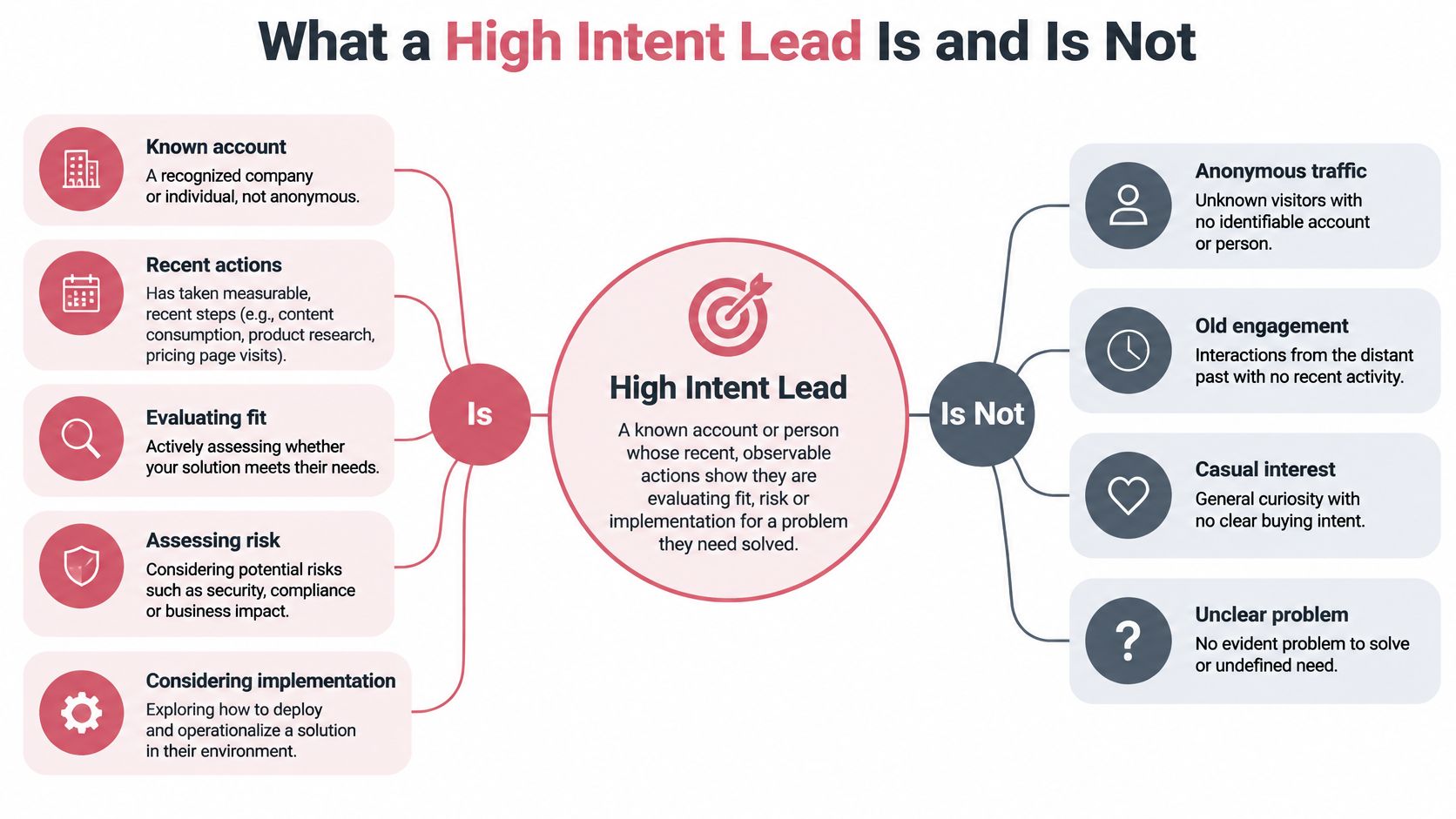
A high intent lead is a known account or person whose recent, observable actions show they're evaluating fit, risk, or implementation for a problem they need solved now. Content consumption alone doesn't qualify.
In Gartner's survey of 632 B2B buyers conducted in August and September 2024, 61% preferred an overall rep free buying experience, but buyers still turned to sellers for contextual tasks such as determining whether a solution fit their organization. That distinction matters more than the volume of pages someone reads.
Compare the question behind the action
These hypothetical examples separate general interest from an active evaluation.
| Observed behavior | Intent assessment | Appropriate response |
|---|---|---|
| A visitor reads three blog posts | Low intent. The problem and purchase context remain unclear | Offer relevant educational content |
| A visitor compares two pricing plans and asks about implementation time | High intent. The buyer is evaluating cost and execution | Answer the implementation question and clarify requirements |
| A champion forwards a comparison page to a colleague with a budget question | High intent involving multiple people, if the forwarding and question are observable | Help the champion address the budget decision |
A forwarded page only counts when the team can observe the action, perhaps through a reply or a shared conversation. An assumed internal discussion isn't evidence.
Treat the label as a working assessment
Intent describes a likely buying state, not a permanent property of a contact. A senior title establishes neither urgency nor an active project. Conversely, an individual contributor asking detailed deployment questions may be doing serious evaluation work for a buying group.
Qualification test: Name the action, its date, the account behind it, and the next question a seller could reasonably ask because of it.
If the team can't complete that sentence, the record needs more evidence before it receives priority. The next question should follow naturally from the buyer's behavior, not from the seller's desire to book a meeting.
Score Fit and Intent Separately
Starting points for fit and intent signals
| Signal | Type | Starting points | Why it counts |
|---|---|---|---|
| Demo or pricing request | Intent | +30 | Explicit action that shows the buyer is evaluating |
| Pricing page visited twice in 14 days | Intent | +15 | Repeat visits suggest cost evaluation |
| Two or more page views in one session | Intent | +5 | Meets the page view condition for an engaged session |
| Identifiable business email | Fit | +10 | Helps establish a reachable contact at a company |
| Industry and headcount match the ICP | Fit | +20 | Confirms the account fits the target market |
| Personal email domain | Fit | Minus 10 | Weakens account matching and reachability confidence |
| Outside the target market | Fit | Minus 25 | Fails the ICP gate and goes to nurture |
| Anonymous visit only | Intent | 0 | Holds until an identifiable signal appears |
These are proposed starting values, not industry benchmarks. Keep separate fit and intent subtotals even if the CRM displays a combined score.
Fit answers whether the account matches the ideal customer profile on industry, headcount, region, and relevant role. Intent answers whether the person is taking commercially meaningful action now. Route only when both gates pass. Strong fit without intent belongs in nurture; strong intent outside the target market doesn't override the exclusion.
Work the score without hiding the gates
Say an operations director at a hypothetical fintech with 120 employees requests a demo. The account matches the target industry, size, and region, and the director supplies a business email.
The proposed model awards +30 for the request, +20 for fit, and +10 for the email, totaling 60 points. A pilot could use that total as its routing threshold, provided the separate ICP and intent gates also pass.
Contrast that with a personal email associated with a company outside the target market that visits pricing twice. Its +15 intent points, minus 25 for market mismatch and minus 10 for the personal domain, total minus 20. It goes to nurture, not the sales queue.
Calibrate against opportunities
Yalc's lead scoring guide provides context for structuring the model. For teams qualifying marketplace inquiries, Earlybird AI's guide to qualify Upwork leads with Earlybird AI offers a useful channel specific resource.
Review the cutoff weekly against opportunities created and available rep capacity. As a proposed pilot schedule, calibrate after 60 days by comparing opportunity creation across score bands, then raise or lower the threshold.
A founding team of four typically ends up with 300 to 900 verified, scored leads with verified emails after Yalc's filtering and enrichment. That's a reachable pool, not proof that everyone in it is ready to buy. Don't let a clean email address substitute for buying evidence.
Behavioral Signals That Show a Buying Window
A page visit or topic surge isn't a purchase declaration. The operator's job is to distinguish an observed action from a claim about what that action might mean.
Google Analytics 4 counts a session as engaged when it includes a key event, at least two page views, or more than 10 seconds of activity. Those are measurement conditions, not equivalent levels of commercial interest. A brief visit shouldn't carry the same weight as a buyer requesting a product demonstration.
Rank evidence by proximity to a decision
Use this order as a starting judgment, then test it against opportunity outcomes:
- Explicit requests. Demo requests, trial starts, contact forms, and substantive replies establish an observable action. A reply declining interest is still an action, but it's negative evidence.
- Repeat pricing or implementation visits. These suggest evaluation when the account is identifiable and fits the market.
- Comparison page visits. Useful supporting evidence, especially when paired with a specific question.
- Hiring for the owning function. A job posting suggests a possible need. It doesn't establish a software project.
- Funding or leadership change. These provide context, not permission to assume budget or urgency.
- Third party topic surges. Treat these as account hypotheses until corroborating evidence appears.
According to DataPartners' summary of intent data research, 71% of B2B marketers used third party intent data in 2024, up from 55% in 2022. Adoption doesn't establish signal quality. A purchased topic signal can still be less useful than a direct implementation question.
Expire evidence deliberately
A pricing visit yesterday deserves more attention than the same visit six months ago. The following are proposed operating windows, not measured industry standards.
Decay windows by signal family
| Signal | Type | Decay window |
|---|---|---|
| Demo or pricing request | Action | 30 days |
| Repeat pricing or implementation page visits | Action | 14 days |
| Comparison page visit | Action | 14 days |
| Hiring for the owning function | Claim | 30 days |
| Funding or leadership change | Claim | 30 days |
| Third party intent topic surge | Claim | 14 days |
A signal stops adding points when its window closes unless a fresh action renews it. Reprocessing an old event must not refresh its timestamp.
A decay window controls prioritization. It doesn't tell a seller to abandon an active conversation when the original signal expires.
This week, select five signals, label each as an action or claim, and assign its expiration rule. Require corroboration before claims affect routing. Use Yalc's guide to intent data and buying signals to help distinguish the evidence sources.
Keep Outreach Compliant Before the First Send
Buying interest doesn't remove email obligations. For US commercial email, the FTC's CAN SPAM compliance guide requires accurate header information, truthful subject lines, identification as an advertisement, and an opt out method; the sender remains responsible when a contractor sends on its behalf.
The FTC evaluates a message's primary purpose. Adding educational content doesn't automatically remove commercial email requirements. A demo request shows interest, but follow up still needs the appropriate controls.
Keep the required record with the lead
Store the lead's source, consent or lawful outreach basis where relevant, sender identity, suppression status, and date of the last opt out check. Mailbeam's guidance on how to manage consent logs for email marketing is useful when designing that record, particularly for workflows spanning jurisdictions.
Check before releasing a message
- Verify the sender. Confirm that the sender name and reply address match the company sending.
- Inspect the subject. It must accurately describe the content.
- Identify commercial content. Include advertisement identification where required.
- Test the opt out. Confirm it works and writes to the suppression list.
- Check synchronization. Suppression must reach every sending tool, not just the current campaign.
Pause sending if suppression status is unknown. Check local requirements before applying the same workflow outside the United States.
Yalc starts with one mapping call to map how the customer's team sells and where it leaks. Its process has five steps: book that call, receive a written audit, have the agent fleet built, approve the first handoffs, and then let the system run and learn.
New users who sign up through Yalc's link get 50 free FullEnrich credits to test the skill. Contact enrichment establishes reachability, not permission, so those records still need the same checks.
Respond Within Minutes, Not Days
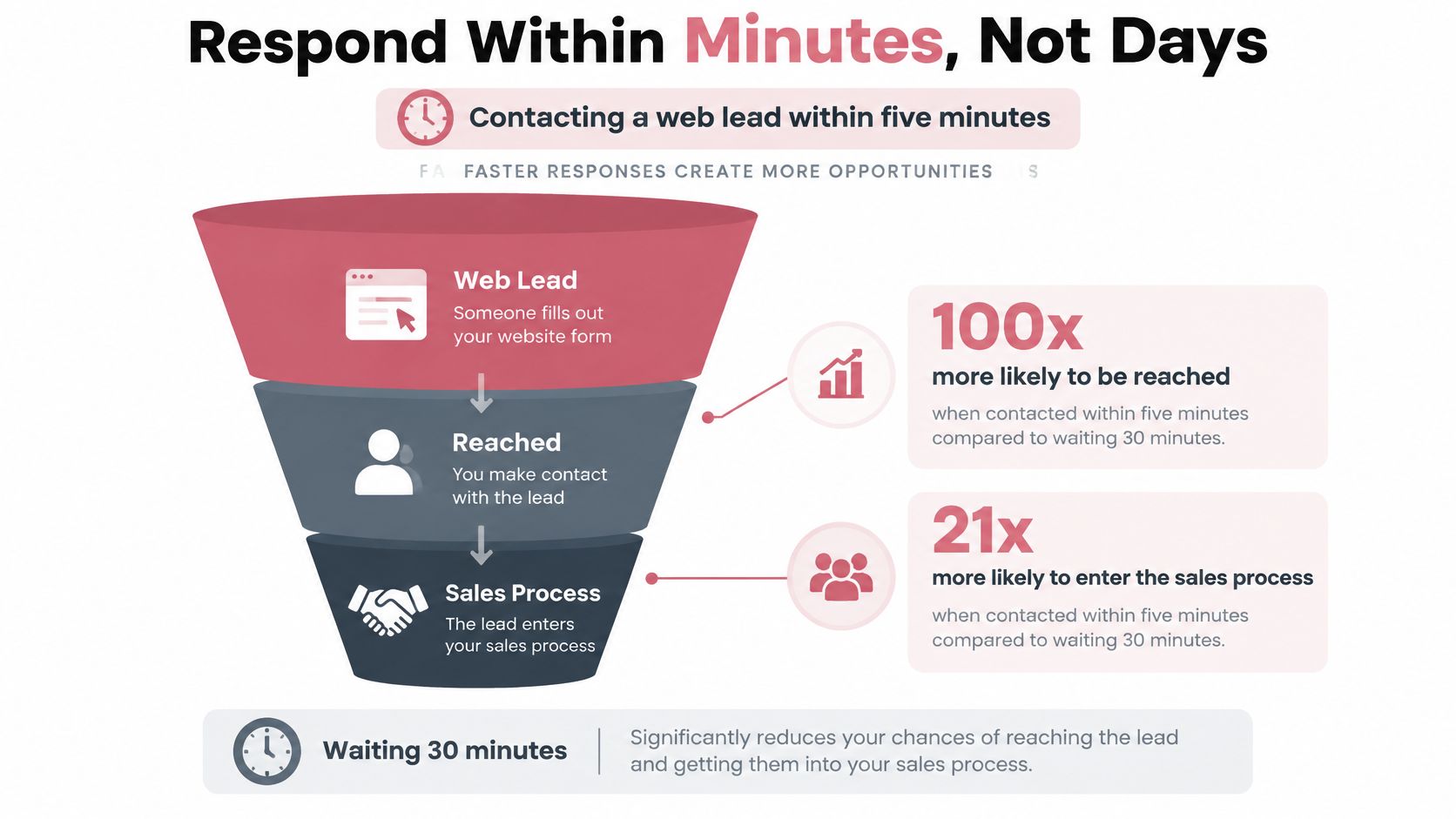
The lead response studies summarized by Lead Spot's benchmarks report that contacting an inbound lead within five minutes produces roughly 100 times higher contact odds and approximately 21 times higher qualification odds than waiting 30 minutes. Use that historical benchmark as an operational target, not a guaranteed lift for every segment.
A demo request marks an active window. Another vendor can answer while the buyer is still evaluating, or an internal priority can interrupt the task. Leaving the request in an unowned queue wastes the relevance of the original action.
A Martal summary of the 2011 Harvard Business Review audit reports that, among 2,241 US companies, only 37% responded within an hour, 24% took more than a day, and 23% never responded. Those historical figures illustrate the operational failure: identifying interest is useless when nobody owns the response.
Make routing an execution path
- Stamp the event. Preserve the original signal time, not just the CRM import time.
- Enrich in parallel. Don't block assignment while optional fields are being collected.
- Apply the gates. Check ICP eligibility and confidence in the signal.
- Assign a person. Route to a named owner with coverage for absence and region.
- Release or review. Send the approved first touch or place it in a monitored approval queue.
- Escalate inactivity. As a proposed operating rule, alert a backup owner after 15 minutes without action.
Response latency bands and the action for each
| Latency band | Benchmark | Action |
|---|---|---|
| 0 to 5 minutes | Fast response target from the cited contact benchmark | Send the approved first touch now |
| 5 to 60 minutes | Outside the fastest target, but still within the first hour | Notify the owner and queue the follow up |
| Over 60 minutes | Missed response target. Don't assign one qualification multiplier to this entire band | Escalate to the backup owner and log the miss |
The associated analysis summarized by Vida found that contact within an hour was nearly seven times more likely to qualify than waiting an additional hour, and more than 60 times more likely than waiting at least 24 hours. Those are distinct comparisons, not a single penalty for every late response.
Measure time from intent event to first meaningful action, not time to task creation. Report qualification and opportunity conversion by latency band. Speed only pays when the fit gate keeps irrelevant accounts out.
Attract Buyers Who Research Without Filling a Form
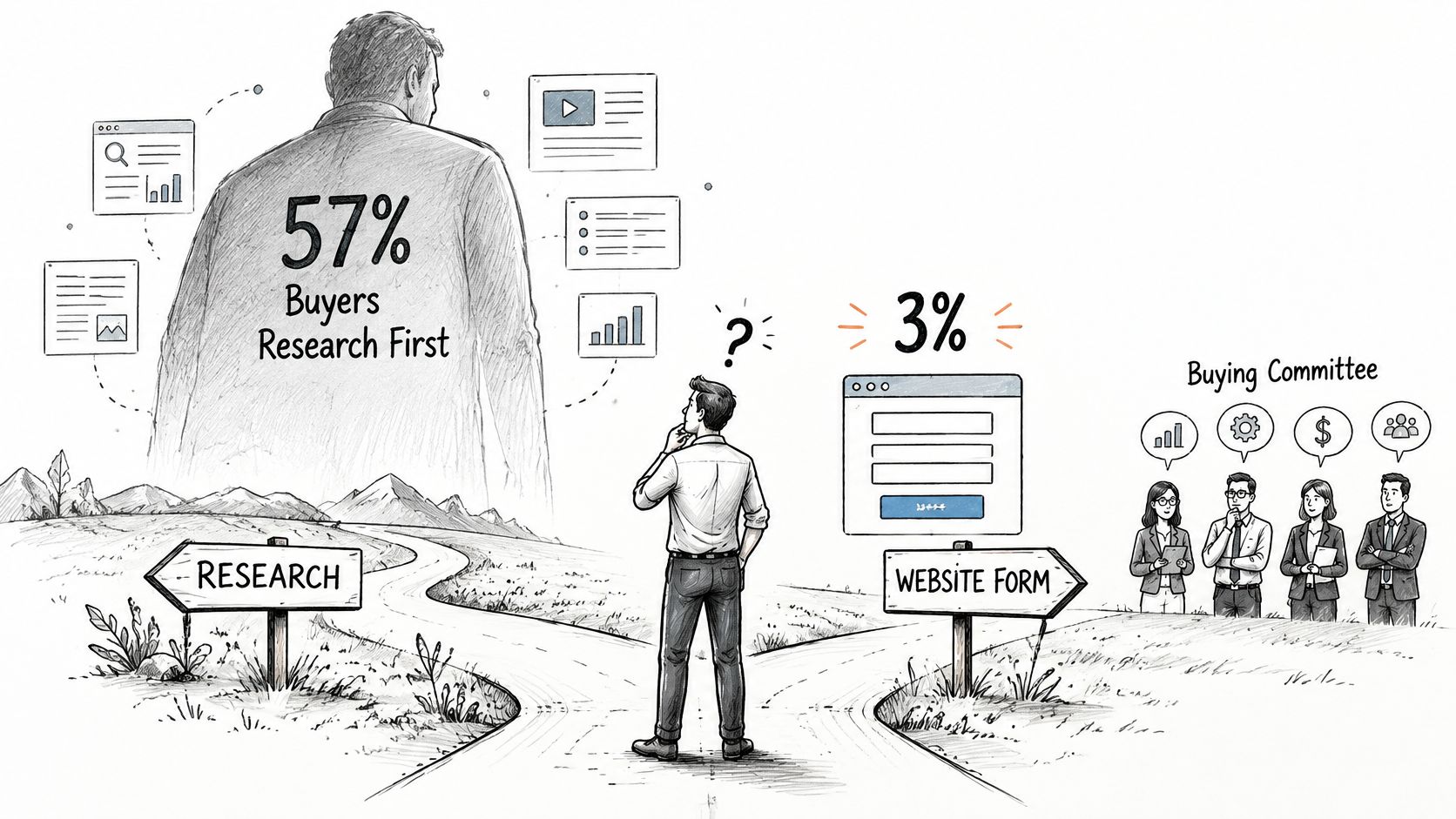
Forms expose only part of an account's evaluation. MarketOne's buyer study and accompanying analysis report that buyers in the UK and Ireland control 57% of their journey before vendor contact, alongside findings that only 3% of website visitors self identify through forms and buying committees average 10.1 people.
A contact form can't describe everything those people discussed, compared, or rejected. Publish decision content that lets them resolve real buying questions: implementation guides, pricing explanations, integration requirements, and comparisons written for the roles involved.
Build account hypotheses without pretending to know the person
Monitor account activity. Use a visitor identification tool to flag relevant visits to pricing and integration pages. Keep account identification separate from person identification. Yalc's guide to website visitor outbound offers context for connecting that evidence to a workflow.
Read the conversation history. Synthesize CRM notes and replies for mentions of the problem, a competitor, or an implementation constraint. Preserve the underlying excerpt so a seller can verify the interpretation.
Attach confidence to a permitted action. A high confidence account can receive an appropriate first touch after fit and compliance checks. A medium confidence account needs corroboration or human review. A low confidence account gets relevant content and a recheck when another signal appears.
Measure influence without inventing attribution
Track which accounts engaged before a qualified conversation, which buying roles were represented, and whether comparable accounts without the signal produced opportunities. Match comparisons on fit rather than giving every difference to the signal.
Sopro's State of Prospecting 2025 summary reports that 88% of B2B buyers wanted to hear from vendors while researching and evaluating options. The useful message adds judgment, such as explaining an integration trade off, rather than announcing that someone's browsing was detected.
Sending readiness is a separate operational check. Teams evaluating that part of the workflow can review Mailwarm, without treating email preparation as evidence of buyer interest.
Credit a signal that preceded and plausibly influenced a qualified conversation, not merely the final click. Record uncertainty rather than forcing complete attribution.
Run a Playbook That Grades Itself
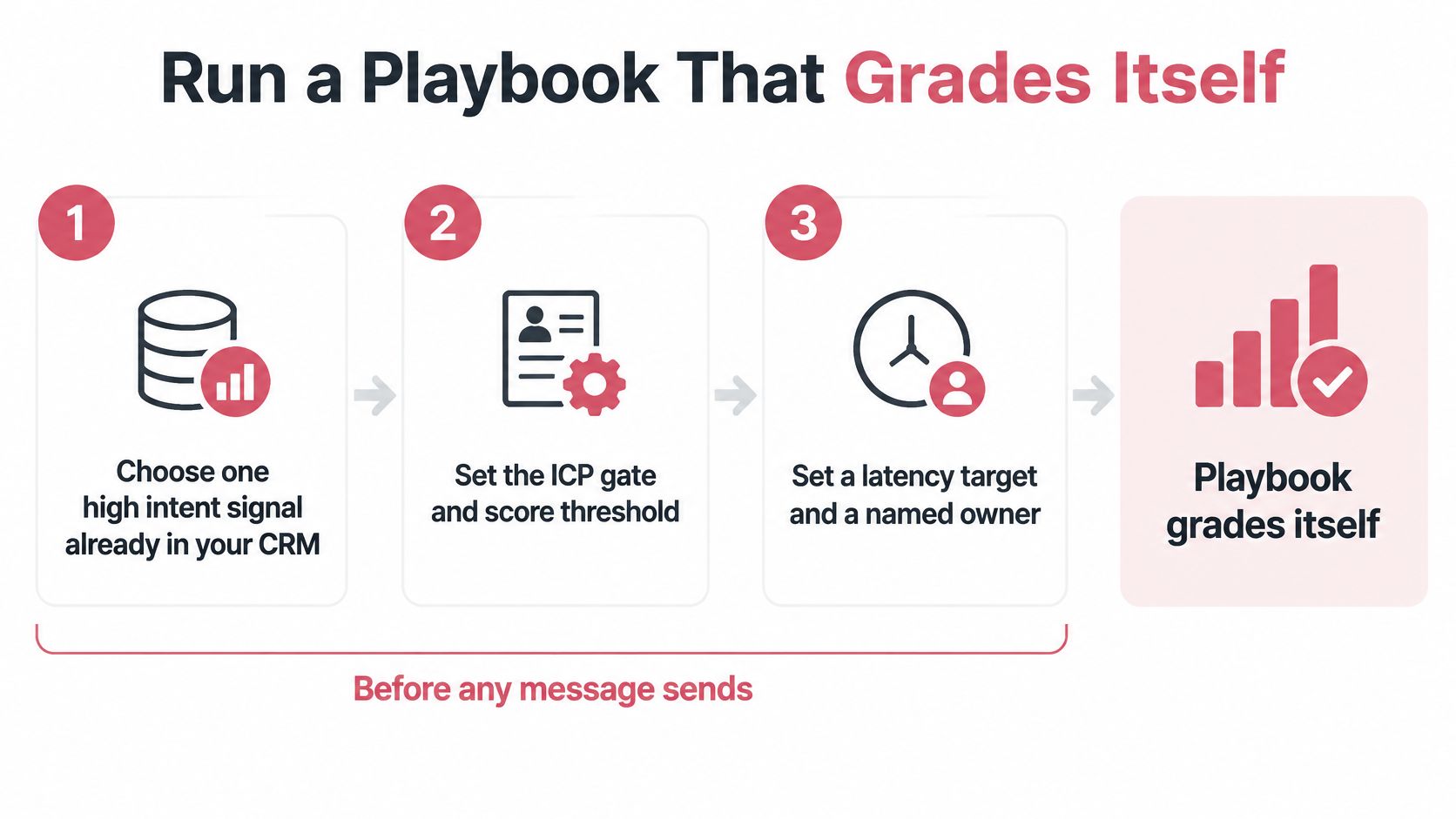
Before sending anything, choose a signal already recorded in the CRM, define the ICP gate and score threshold, and assign a latency target to a named owner. Keep the first test narrow enough that the team can explain what changed.
Write a prediction that can fail
Consider a hypothetical team testing demo requests from operations leaders at companies with 50 to 200 sales reps. Its prediction is that these requests convert to opportunities at twice the rate of other demo requests, with meetings held within 10 days as the operational success metric.
Those are test parameters, not performance claims. The written hypothesis should name the segment, signal, action, primary outcome, and measurement window before the play runs.
The action might be an implementation response from an assigned seller. The opportunity prediction needs an opportunity metric; meetings held are a useful supporting measure, but they can't validate an opportunity claim on their own.
Run the proposed pilot against a fixed control group for a full sales cycle, or use 30 days as an initial review window if downstream outcomes haven't matured. Don't declare pipeline success just because the calendar review arrives.
To test the routing action, compare similar eligible leads receiving the new treatment with similar leads receiving the current treatment. Comparing the selected segment with every other demo request may reveal segment quality, but it won't isolate whether the new response caused the improvement.
Require evidence before promotion
Promotion rules for each hypothesis stage
| Stage | Evidence required | Action |
|---|---|---|
| Hypothesis | Written prediction, segment, and success metric set before the play runs | Run the play against a fixed control group |
| Validated | Result beats the control across one full cycle and passes a bias check | Keep the play running and tag its signal source |
| Proven | Repeats across segments and ties to qualified pipeline | Make the play the default and retire the weaker variant |
The bias check should inspect rep assignment, account fit, existing relationships, and coverage hours. A play assigned only to the strongest seller hasn't established that its signal is better.
Record the verdict with the revenue owner. Preserve the score version, eligibility rules, approval decision, and outcome so the team can reconstruct why a lead received treatment.
Feed verdicts back into operations
Yalc's standard for every play has four parts: it starts from the customer's own data, carries the customer's voice, is held to what's working right now, and gets a person's approval before reaching a buyer.
Yalc includes a monitoring dashboard wired to the customer's live pipeline, and what works feeds back into the routine and the agents. The weekly view should place score bands beside latency cohorts, qualified opportunities, and disqualification reasons.
Promote the winning play, reduce unsupported signal weights, and retire signals that stop predicting opportunities. Keep the written verdict even when the play fails. A useful system improves its decisions, not just its execution speed.
Yalc connects qualification, routing, approvals, and outcome monitoring so teams can act on high intent leads without treating every signal as a buying decision. Visit Yalc to book a mapping call and identify where the team's current lead handling loses qualified conversations.