How to Find Trending Topics That Actually Drive Pipeline
A sales leader sees a topic spike in search, notices a few posts gaining attention on social platforms, and asks the team to move quickly. By the time the article is approved, the conversation has moved on. The problem usually isn't a lack of ideas. It's that the team treated trend discovery as brainstorming instead of validating whether a signal deserves a campaign, prospecting angle, content investment, or outbound test.
Table of Contents
- Why Most Trending Topic Lists Waste GTM Time
- Where to Find Trending Topics Across Search Social and News
- How to Validate a Trend Before You Act on It
- Tools and Signals That Make Trend Discovery Repeatable
- Turning Validated Trends Into Content Outreach and GTM Plays
- Putting Your Trending Topic System Into Practice
Why Most Trending Topic Lists Waste GTM Time
Generic lists of rising keywords produce activity, not necessarily pipeline. They show what appears popular, but they rarely answer the questions a GTM team needs answered: Who cares about this topic, why now, and what commercial action should follow?
A topic can attract broad attention without matching buyer intent. A breaking news story might generate discussion but offer no useful connection to a product category. A keyword can show rapid growth from a tiny starting point, yet fail to sustain interest long enough to support a serious campaign. Raw popularity also hides regional differences, audience differences, and differences between awareness and purchase intent.
That makes how to find trending topics a signal validation problem. Search, social, news, video, and community platforms each expose a different part of the market conversation. YouTube, for example, says its Trending page considers view count, how quickly a video generates views, traffic from outside YouTube, the video's age, and performance against recent uploads from the same channel. That design shows why trend detection isn't just a popularity list. It's a ranking problem with multiple signals. YouTube's explanation of Trending provides useful context for evaluating those signals.
Durable demand versus temporary attention
A durable trend keeps appearing across time windows, related queries, regions, or independent channels. A short lived spike usually has a sharp peak, a narrow context, and little evidence that buyers are changing priorities.
The distinction matters because GTM actions have different costs. A sales representative can mention a timely issue in a relevant conversation with limited preparation. A product marketing team shouldn't rebuild positioning around a topic that disappeared after a news cycle.
Practical rule: Match the time horizon to the action. Use fast signals for conversation starters, stronger validation for campaigns, and sustained evidence for positioning or playbook changes.
A useful trend has three properties:
- Audience relevance: The topic connects to a defined ICP, account segment, or buyer problem.
- Commercial intent: The conversation reveals urgency, a new objection, a change in priorities, or a trigger for evaluation.
- Actionability: The team can route it into a specific motion, such as content, prospecting, personalization, objection handling, or competitive intelligence.
Trend research connects with sales intelligence. The value isn't the topic itself. The value is the decision it helps the team make about a real account, buyer, or message.
The workflow should therefore move through discovery, validation, routing, execution, and measurement. A topic earns attention only when it survives that sequence. The rest belongs in a watchlist, not in the quarterly plan.
Where to Find Trending Topics Across Search Social and News
A practical sweep starts with search, then uses social and media surfaces to test whether the signal has substance. Each source has a different job, so the team shouldn't treat every feed as equivalent.
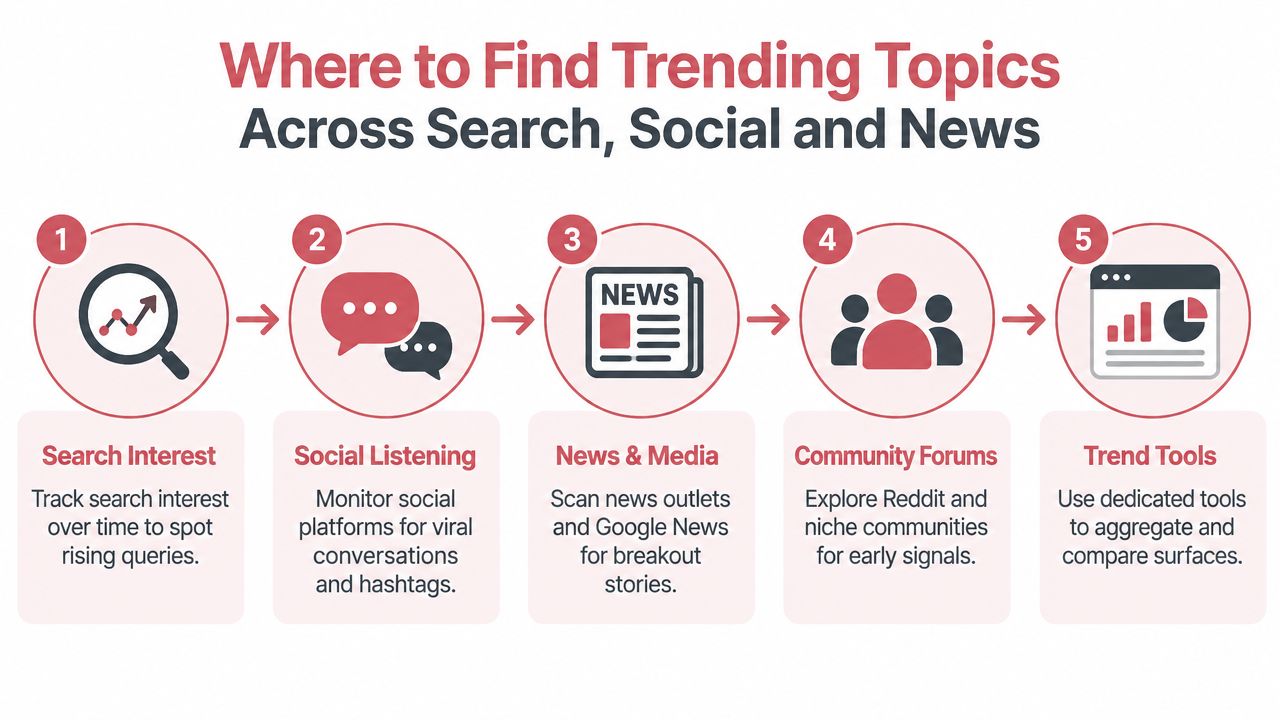
Start with search interest over time
Google Trends is the strongest starting point for historical context. It launched in May 2006 and used search data collected from 2004 onward, giving analysts a window that predates the public product. Google later described the service as live since the summer of 2006 and used it to compare search behavior across a 15 year span. Google's retrospective on Google Trends explains why the tool is useful for separating recurring interest from temporary attention.
Search interest over time helps answer whether a topic is new, seasonal, regional, or part of a longer shift. Use Explore to compare related concepts, examine regions, review categories, and inspect related queries. Google Trends supports comparison of up to five groups of terms, with up to 25 terms in each group, and recommends comparing topics with topics or search terms with search terms. Google's Trends training lesson documents those comparison rules.
Capture the query, time range, region, category, related rising terms, and your initial buyer hypothesis. Without that context, a screenshot of a trend line isn't useful evidence.
Check social and video feeds for language
Social platforms show how people frame a topic, not just whether they search for it. Review recurring phrases, objections, questions, and examples. Pay attention to who is discussing the issue and whether the audience resembles the accounts your team sells to.
X's Personalized Trends endpoint uses location, interests, and account activity, so the trend surface may be specific to the authenticated user rather than globally representative. X's Personalized Trends documentation makes the regional and profile based filtering explicit. Teams operating across markets should record the location and account context before treating an X trend as broad demand.
YouTube adds a different confirmation layer because video trends reflect narratives, demonstrations, and creator behavior. Review titles, comments, recurring questions, and the sources sending viewers to the videos. Teams studying the mechanics of distribution can also use guidance on how to make Facebook posts go viral, but the objective should be understanding audience response, not copying formats without buyer relevance.
Scan communities, news, and creators
Forums and niche communities often reveal problem language before a topic becomes a broad search category. Read the questions people ask repeatedly, the workarounds they share, and the objections they raise. Don't treat one popular thread as validation. Use it as a source of vocabulary and hypotheses.
News and creator ecosystems help explain why interest is moving. Google Trends' Trending now view includes related news articles and terms, which can connect a rising query to an event or story. Creator newsletters and specialist publications add interpretation that a raw trend line can't provide.
Finally, review competitor content. Look for new pages, changed positioning, fresh customer language, and topics appearing across several competitors. Competitor activity doesn't prove buyer demand, but it can reveal which signal the market is already testing and where the messaging remains shallow.
How to Validate a Trend Before You Act on It
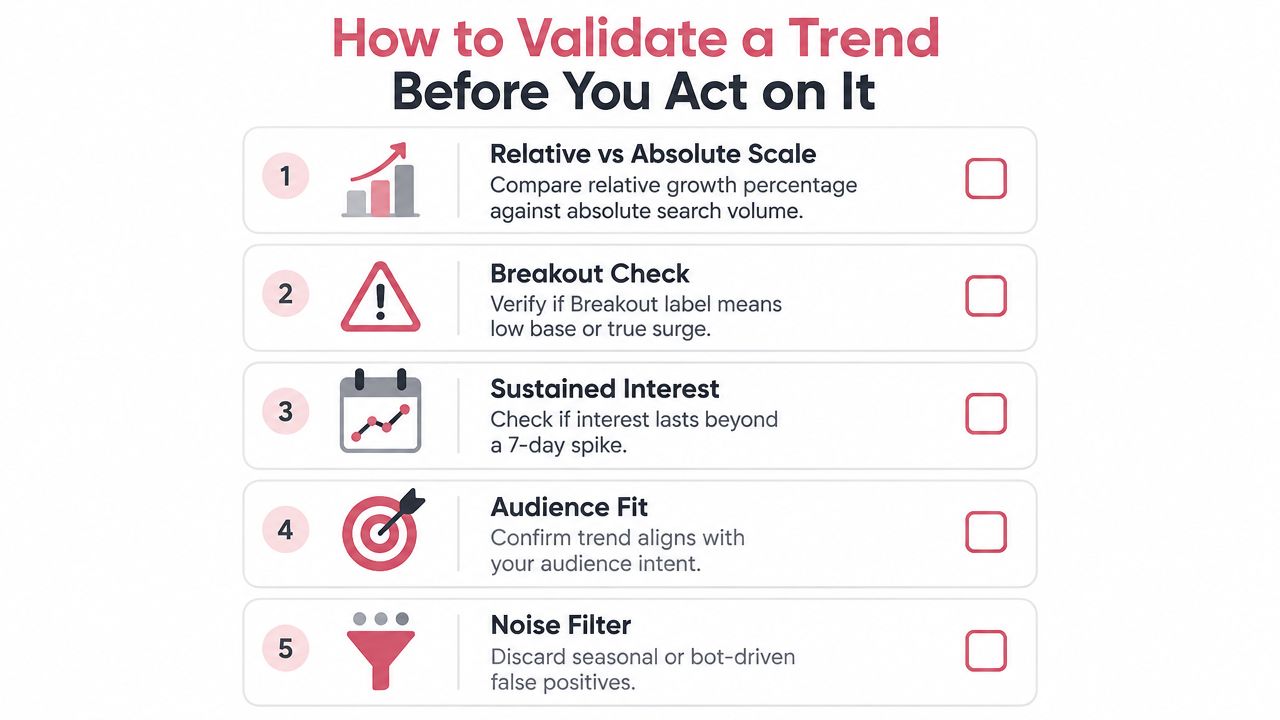
Validation begins by separating relative growth from absolute demand. Google Trends measures search interest over time, so a rapidly rising query isn't automatically a large opportunity. A term marked “Breakout” has grown by more than 5,000% versus the prior period, but that label can describe a very low base. Google's data methodology highlights why growth signals need qualification before action.
A useful decision rule is simple: act when a topic shows buyer fit and at least two independent signals, monitor when it has only one strong signal, and ignore it when it has neither relevance nor persistence.
Use the right time window
Short windows identify movement. Longer windows establish context. Compare a recent 7 day or 30 day view with the immediately preceding period, then check the topic against the multi year history available in Google Trends. A sharp rise in a short window may be valuable for a timely post or sales conversation. It isn't enough by itself for a major positioning change.
Trending now is designed for fast moving terms across 4 hours, 24 hours, 48 hours, or 7 days, while Explore supports custom comparisons over time, regions, categories, and related queries. Google Trends separates those jobs, and GTM teams should do the same.
Ask four questions:
- Is the rise recurring? Does the topic return in similar contexts, or did it appear once?
- How quickly did it peak? A sudden peak may reflect news, controversy, or a platform event.
- How long does interest last? A topic that continues after the initial trigger has more strategic value.
- Where is the interest concentrated? Regional concentration can create a useful local play or expose a misleading global assumption.
Normalize signals across channels
Search, social, video, and Wikipedia don't measure attention in the same way. A view, mention, search, or page visit has a different meaning and scale. Teams should record direction and persistence rather than adding incomparable figures into one score.
Academic work on online media trends supports a multi source approach that collects daily signals across Google, Twitter, and Wikipedia, clusters similar items, and scores recurrence, time to peak, and trending duration. One forecasting study using Wikipedia page views reported forecasts that were 9,000 to 48,000 views closer to actual traffic than baselines and mean absolute percentage error of about 19% to 45% over horizons up to 14 days, showing that forecasting is feasible but noisy. The forecasting study also demonstrates why teams need a baseline and should measure error before relying on predictions.
Apply the buyer fit test
A trend passes validation only when it connects to a real commercial question. Map it to the buyer stage, urgency, account segment, and channel where the team can act. If the topic has attention but no clear problem, keep it in research. If it has problem language and account relevance, route it to a controlled test.
The intent data and buying signals framework can help teams distinguish general interest from signals that suggest a company or buyer may be moving toward action.
Tools and Signals That Make Trend Discovery Repeatable
The right stack depends on the job. Google Trends Explore is built for depth and comparison. Trending now is built for speed. YouTube and X provide platform specific signals, while forums, news feeds, and internal account data add context.
| Surface | Best For | Key Signal | Watch Out |
|---|---|---|---|
| Google Trends Explore | Historical comparison and regional research | Interest over time, related and rising queries | Relative interest isn't the same as absolute demand |
| Google Trends Trending now | Rapid event detection | Fast rises across short time windows | News spikes can fade quickly |
| YouTube Trending | Narrative and format discovery | View velocity, video age, outside traffic, channel comparison | Broad appeal may not equal ICP fit |
| X Personalized Trends | Local and profile filtered conversations | Location, interests, and account activity | The trend may be personalized |
| Forums and communities | Early problem language | Repeated questions, objections, and workarounds | A single active thread isn't enough |
| News and creator feeds | Context and explanation | Related stories, editorial framing, and recurrence | Coverage can follow attention rather than buyer intent |
| Competitor monitoring | Market response | New topics, pages, and positioning changes | Competitor activity isn't proof of demand |
Use tools by speed and depth
A weekly workflow can begin in Trending now to catch fast movement, then move into Explore to test the topic against historical data, regions, categories, and related terms. YouTube helps the team understand how the issue is being explained visually. X helps identify conversation patterns, but the operator must record whether the view is personalized or location based.
A common mistake is building a large tool collection without a decision system. One reliable spreadsheet, database, or channel can hold the topic, source, date found, region, buyer segment, evidence from each surface, validation status, and recommended action.
For teams that need aggregation, automation should handle collection and clustering, not judgment. Similar terms can be grouped, recurring themes can be flagged, and forecasts can be compared with a baseline. Human review still decides whether a signal is commercially relevant and safe to use in outreach.
The best signal tracking tools for 2026 can help teams evaluate monitoring options, but tool selection should follow the operating question. If the team can't explain what action a signal triggers, another dashboard won't solve the problem.
Turning Validated Trends Into Content Outreach and GTM Plays
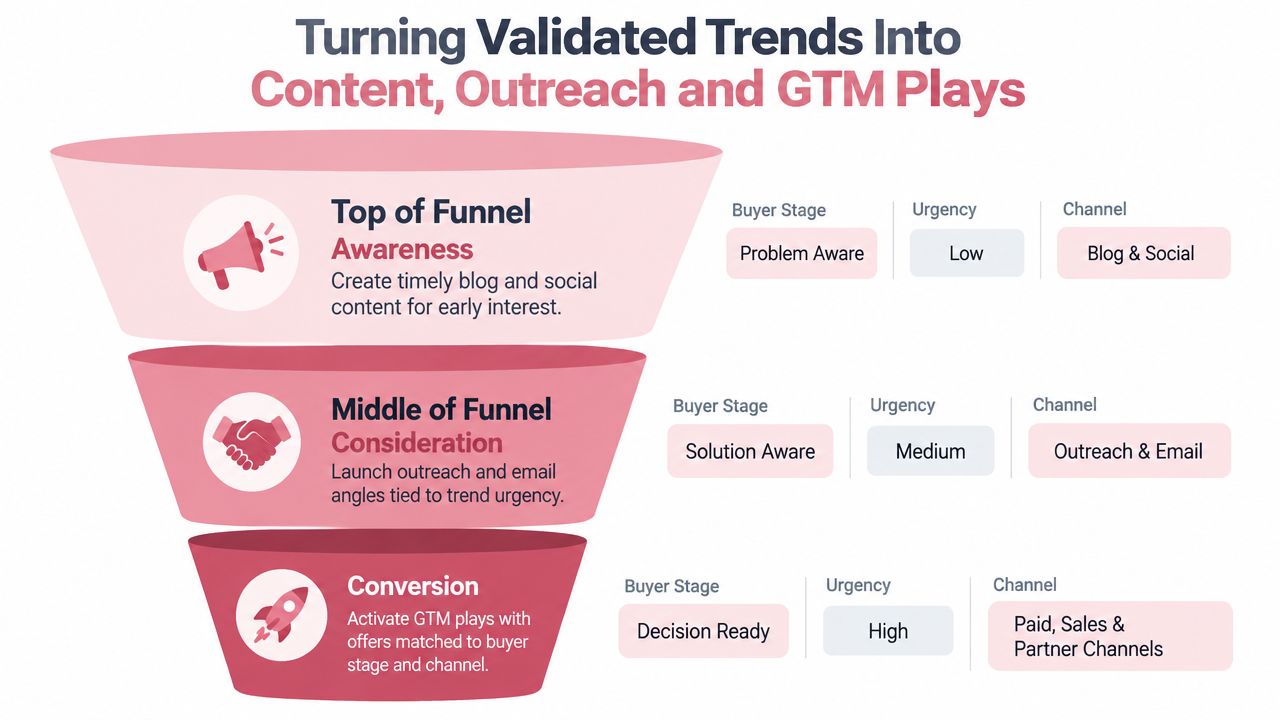
A validated trend becomes useful only after the team assigns it a route. The routing decision should include buyer stage, urgency, and channel fit. Without those tags, every signal gets pushed toward content, even when the better response is account research, sales enablement, or competitive intelligence.
Route the signal by buyer stage
A broad emerging topic belongs near the top of the funnel when it helps the audience understand a problem. The content should explain the shift, define the stakes, and use the language people already use in search and communities.
A topic tied to an active objection belongs in the middle of the funnel. Product marketing can turn the signal into a comparison, response guide, webinar, or email angle. Sales representatives can use it when an account has already shown related behavior.
A topic connected to an account trigger belongs closest to revenue action. Examples include a rising query that maps to a prospect's current initiative, a regional spike that supports localized messaging, or related news that changes the context around an active opportunity.
| Tag | Decision | Possible play |
|---|---|---|
| Buyer stage | Awareness, consideration, or conversion | Educational content, proof, or direct offer |
| Urgency | Immediate, developing, or stable | Real time response, monitored campaign, or evergreen asset |
| Channel fit | Search, social, email, sales, or intel | Article, post, sequence angle, enablement, or account brief |
Convert evidence into a specific play
A rising related query can feed a prospecting sequence when the query reflects a problem owned by a defined buyer. The sequence shouldn't claim that the prospect searched for the term. It should use the trend to frame a relevant question, then give the buyer an easy way to confirm or reject the premise.
A regional concentration can support a localized campaign when the company sells into that geography and the topic fits local buyer intent. Related news articles can inform messaging for open opportunities, especially when the event changes urgency or introduces a new objection.
Competitive intelligence is another route. If several competitors publish around the same emerging concern, the team can compare their claims, identify unanswered questions, and create sales guidance without assuming that publication equals market demand.
Keep execution consistent
Trend based execution creates a quality risk. Urgency can tempt teams to abandon ICP rules, approved voice, or existing positioning. The operating system should preserve those constraints while allowing the timely signal to change the angle.
Yalc's Trending Radar is designed for monitoring trend signals alongside GTM knowledge orchestration, so teams can route a validated topic into prospecting, personalization, content, or competitive intelligence while retaining their ICP and voice. The important control is the feedback loop. Each trend led play should record its hypothesis, audience, channel, outcome, and verdict so the team learns which signals deserve promotion and which should be retired.
Putting Your Trending Topic System Into Practice
A durable system doesn't require constant monitoring by every team member. It needs a clear owner, a shared record, and a short weekly review.
During the review, the operator should collect new signals, remove duplicates, compare recent movement with historical context, and mark each topic as act, monitor, or discard. Act only when the topic has audience fit and independent confirmation. Monitor when the evidence is promising but incomplete. Discard when the signal is irrelevant, isolated, or clearly tied to a passing event.
Track three operational outcomes:
- Signal quality: How often validated topics pass the buyer fit test.
- Execution quality: Whether the chosen channel and message match the trend.
- Commercial result: Whether the resulting play creates meaningful engagement, conversations, or pipeline movement.
Teams producing rapid creative assets can use an AI UGC creator tool to test a timely video angle, but the asset should remain an experiment tied to a defined audience and action. Speed is useful only when the team can measure what happened afterward.
The next run can fit into one focused working session. Review search movement, inspect social and video context, scan communities and news, compare the strongest candidates, and assign each one a route. Store the evidence and revisit the result at the next review. Over time, the system compounds because proven signals and effective plays remain available, while weak ideas stop consuming operator attention.
Yalc helps GTM teams turn validated trends into coordinated prospecting, content, outbound, and intelligence plays through a unified GTM API and knowledge orchestration layer. Visit Yalc to see how teams can monitor signals, run controlled plays, and feed measured outcomes back into their operating system.