How to Handle Sales Objections with Frameworks
49.5% of objections are dismissive responses such as “not interested,” hang ups, or “send me an email,” while 42.6% are situational concerns such as budget or timing, according to an analysis of more than 300 million cold calls summarized by Prospeo. That changes how sales leaders should think about objection handling. Most objections aren't detailed product challenges waiting for a clever rebuttal. They're signals that the pipeline, message, timing, or buying group isn't aligned.
The practical answer isn't to give reps longer scripts. It's to build a system that identifies recurring friction, teaches reps to diagnose it, and feeds the outcome back into the next call. The teams that learn how to handle sales objections well treat every objection as both a conversation and a data point.
Table of Contents
- Why Objections Are Costing You Deals
- The Four Objections That Cover Most Conversations
- The Five Step Response Flow Every Rep Should Drill
- Three Frameworks Worth Knowing and When to Use Each
- Objection Handling Scripts That Work in Real Calls
- Building a Role Play Loop That Actually Improves Reps
- Turning Objection Handling Into a System That Compounds
Why Objections Are Costing You Deals
An objection is rarely only the sentence a rep hears on a call. “Send me an email” can point to weak targeting, an irrelevant opening, unclear value, or outreach that arrived before the business problem became urgent.
That distinction changes how leaders manage objection handling. When brush offs make up a large share of early responses, inspect list quality, opening relevance, and the first touch before rewriting rebuttal language. A stronger answer cannot rescue outreach aimed at a poor fit or disconnected from the prospect's context.
Operating rule: Treat objections as pipeline diagnostics first and rep coaching prompts second.
Map the signal to the funnel stage
Recurring objections point to different failures in the GTM system:
- Timing mismatch: The prospect entered the funnel before the problem became a priority. Review qualification and intent signals.
- Weak discovery: The rep reached a proposal without understanding the operational or financial consequence of the current state.
- Missing consensus builders: The champion understands the value, but finance, legal, operations, or an executive sponsor has not reached the same conclusion.
- Positioning gap: Marketing, the website, and sales describe the solution differently, leaving the buyer to reconcile conflicting evidence.
Positioning gaps create internal friction that a rebuttal cannot solve. Gartner reports that 74% of B2B buying teams show unhealthy conflict during the decision process, while 69% of buyers say information on a seller's website conflicts with what sellers tell them. A buyer hearing three versions of the value proposition needs a coherent internal case, not another persuasive line from one rep.
Fix the system before blaming the rep
Sales operations should tag objections by source, stage, persona, and outcome. If price objections cluster at proposal, the team established value too late. If authority objections appear after a demo, stakeholder mapping happened too late. If “not interested” dominates outbound, review ICP quality before judging objection technique.
Managers should connect each recurring objection to the funnel condition that produced it, then feed that pattern into qualification, messaging, enablement, and call review. This creates a GTM system that grades its own weak points instead of forcing every rep to invent a response from memory.
Objection handling costs deals when the organization treats symptoms as isolated conversations. It improves when pipeline design, internal consensus, timing, and rep coaching work from the same evidence.
The Four Objections That Cover Most Conversations
Reps hear many variations, but most useful diagnosis fits four working buckets: budget, timing, authority or consensus, and need or fit. The categories are practical rather than academic. They give managers a shared tagging system and help reps choose a question before choosing a rebuttal.
The historical data supports this pattern recognition. In the analysis summarized by Prospeo's sales objection research, the top five objections represented 74% of all objections, with dismissive, situational, and existing solution objections forming distinct groups. The lesson is straightforward: a small library of strong plays will cover more real conversations than a giant script repository.
Budget
“I can't justify that price,” “we don't have budget,” and “your competitor is cheaper” may indicate a real funding limit. They may also mean the buyer hasn't connected the investment to an outcome, or the buyer is comparing unlike solutions.
The upstream cause is usually value sequencing. If pricing appears before the buyer agrees on the cost, risk, or operational consequence of the current problem, the number becomes the entire conversation. Tag whether the concern is budget availability, comparison, scope, or perceived value.
Timing
“Q4 is frozen,” “reach out next quarter,” and “this isn't a priority right now” can describe a genuine business constraint. They can also hide weak urgency or uncertainty about implementation.
The upstream cause is typically discovery. The rep hasn't established what changes if the buyer waits, what event would create urgency, or which competing priority controls the calendar.
Authority or consensus
“I need to speak with finance,” “my boss has to approve this,” and “we need the team aligned” are not invitations to wait passively. They show that the buying group hasn't reached a shared decision.
The cause is incomplete stakeholder mapping. The champion may support the purchase but lack the evidence, language, or access needed to represent it internally.
Need or fit
“We already have a tool,” “I don't see the value,” and “that doesn't solve our problem” point to relevance, capability, or trust in the proposed outcome. The buyer may have a need, but the rep hasn't connected the solution to the buyer's specific workflow.
The cause is often targeting or discovery. Teams should tag the exact gap, not just mark “need objection,” because a product limitation and an unclear value case require different responses.
A manager who uses these buckets can review patterns across calls instead of debating isolated anecdotes. The rep's first question becomes, “Which category is this?” That decision cuts improvisation and makes coaching repeatable.
The Five Step Response Flow Every Rep Should Drill
The strongest response flow is Pause, Acknowledge, Clarify, Respond, Confirm. It works because it controls the rep's behavior before it supplies language. Reps don't need to remember a clever line when they know the next move.
The sequence also reflects the active listening and clarification process described in Vidya Prasar's sales training guide, which recommends listening, restating the concern, checking understanding, acknowledging it, and answering directly.
1. Pause
Purpose: Stop the reflex to defend.
Script: “I hear you. Let me think about that for a moment.”
The pause gives the buyer room to finish and gives the rep time to avoid answering the wrong objection. The watch out is filling silence with a feature list. A quiet moment is useful only if the rep uses it to listen.
2. Acknowledge
Purpose: Show that the concern is legitimate enough to examine.
Script: “That makes sense. Budget would need to be clear before you could take this forward.”
Acknowledgment isn't agreement with every conclusion. It signals respect and lowers the chance that the buyer will spend the next minute defending the objection. Avoid “but” and any sentence that starts by correcting the buyer.
3. Clarify
Purpose: Find the root concern.
Script: “When you say the price is too high, are you comparing it with another proposal, or is the available budget the main constraint?”
This is the step reps skip most often. They hear “too expensive” and launch into ROI. That response fails when the actual issue is procurement policy, missing consensus, or a competitor feature. Ask one focused question, then restate what the buyer said: “So the issue is approval timing rather than the amount itself. Is that right?”
4. Respond
Purpose: Address the confirmed issue with relevant evidence.
Script: “Given that approval timing is the constraint, the useful next step is to map the business case finance needs and separate the required scope from the optional scope.”
The response should be short and specific. Don't invent proof, promise an outcome the team can't support, or answer with a generic capability. If the evidence isn't available, say so and commit to finding it.
5. Confirm
Purpose: Check resolution and secure forward motion.
Script: “Does that address the concern well enough to involve finance, or is there another issue we need to resolve first?”
A nod isn't a commitment. Confirmation should lead to an explicit next step, such as bringing in a stakeholder, reviewing a business case, or scheduling a technical discussion. If the buyer still hesitates, return to Clarify rather than forcing a close.
Rep habit: Never respond to the first version of an objection. Respond to the version the buyer confirms.
Three Frameworks Worth Knowing and When to Use Each
Frameworks help only when they match the buyer's state. LAER is useful when the objection is unclear. Feel Felt Found helps when the buyer needs validation. The 1 2 3 frame works when a fast stall needs a simple choice.
| Framework | Best For | Sample Opening Line | Failure Mode |
|---|---|---|---|
| LAER, Listen, Acknowledge, Explore, Respond | Diagnostic ambiguity and layered concerns | “I understand. Can I ask what part is creating the most hesitation?” | Reps use it mechanically and keep exploring after the real issue is already clear |
| Feel Felt Found | Buyers who need empathy and social validation | “Other operations leaders have felt that concern before, especially when changing an established process.” | It can sound patronizing or like a canned customer story |
| 1 2 3 | Fast yes or no stalls and simple next steps | “There are three ways to handle this. We can pause, reduce scope, or bring finance into the review.” | Reps create false choices before understanding the concern |
LAER should be the first framework managers teach because it enforces listening and exploration. The sales playbook examples from Yalc can help leaders organize those moves into reusable plays, but the framework still depends on accurate discovery.
Use Feel Felt Found selectively. It works when the buyer's concern is emotional or rooted in prior experience, but it shouldn't replace evidence. A buyer who distrusts implementation claims needs a credible implementation explanation, not a sentimental comparison.
Use 1 2 3 when the buyer has already explained the issue and needs a decision path. It is not a shortcut around discovery. Managers should layer it after reps can resolve objections consistently, with a target of 70% resolve rates as an internal coaching threshold, not as a universal industry benchmark.
Objection Handling Scripts That Work in Real Calls
The following examples use the five move flow. The wording is deliberately plain. Reps should adapt the language to the buyer's situation rather than memorize every sentence.
Scenario one, price pressure
Buyer: “The SaaS proposal is $24K, and a competitor is offering something cheaper.”
Rep, Pause and Acknowledge: “I understand. If another option costs less, finance will want to know why this proposal deserves the difference.”
Rep, Clarify: “Is the concern the total budget, or are you comparing the scope and expected outcome between the two proposals?”
Buyer: “The budget is available. We're not sure the extra cost is justified.”
Rep, Respond: “Then the decision is about value, not budget. Let's compare the workflows, adoption requirements, and business outcomes included in each proposal. If the additional scope doesn't matter to your team, we should remove it rather than defend it.”
Rep, Confirm: “Would that comparison give finance enough evidence to decide whether the difference is justified?”
The move works because the rep doesn't discount immediately. The response converts a price challenge into a comparison the buyer can evaluate.
Scenario two, timing
Buyer: “Q4 is frozen. We can't take on another project.”
Rep, Pause and Acknowledge: “That sounds like a real capacity constraint. The team shouldn't start work it can't support.”
Rep, Clarify: “Is the freeze about budget, implementation capacity, or the number of internal priorities already committed?”
Buyer: “Implementation capacity. We can't manage another rollout.”
Rep, Respond: “Then a full rollout isn't the right next step. We can use the next conversation to define the smallest viable scope and identify the work your team would own.”
Rep, Confirm: “If the required effort is clear and manageable, would you be open to reviewing that scope with the person who owns implementation?”
The rep respects the constraint while testing whether the timing objection applies to every possible path.
Scenario three, consensus
Buyer: “I'm convinced, but finance is blocking it.”
Rep, Pause and Acknowledge: “That's useful to know. Finance needs a case they can validate, not just your recommendation.”
Rep, Clarify: “What question is finance asking that you can't answer yet?”
Buyer: “They want to understand the financial impact and the risk of adoption.”
Rep, Respond: “Let's build the review around those two questions. I'll provide the evidence we can support, and we'll mark any assumptions clearly.”
Rep, Confirm: “Can we invite finance to a short review so they can challenge the assumptions directly?”
For teams building evidence led conversations, interactive sales pitches with data offer a useful model for making the business case easier to inspect. A call preparation workflow such as Yalc's call prep agents can also surface account context and likely objections before the conversation.
These are scaffolds, not theatrical scripts. The durable pattern is to pause, understand, answer the confirmed concern, and secure a real next step.
Building a Role Play Loop That Actually Improves Reps
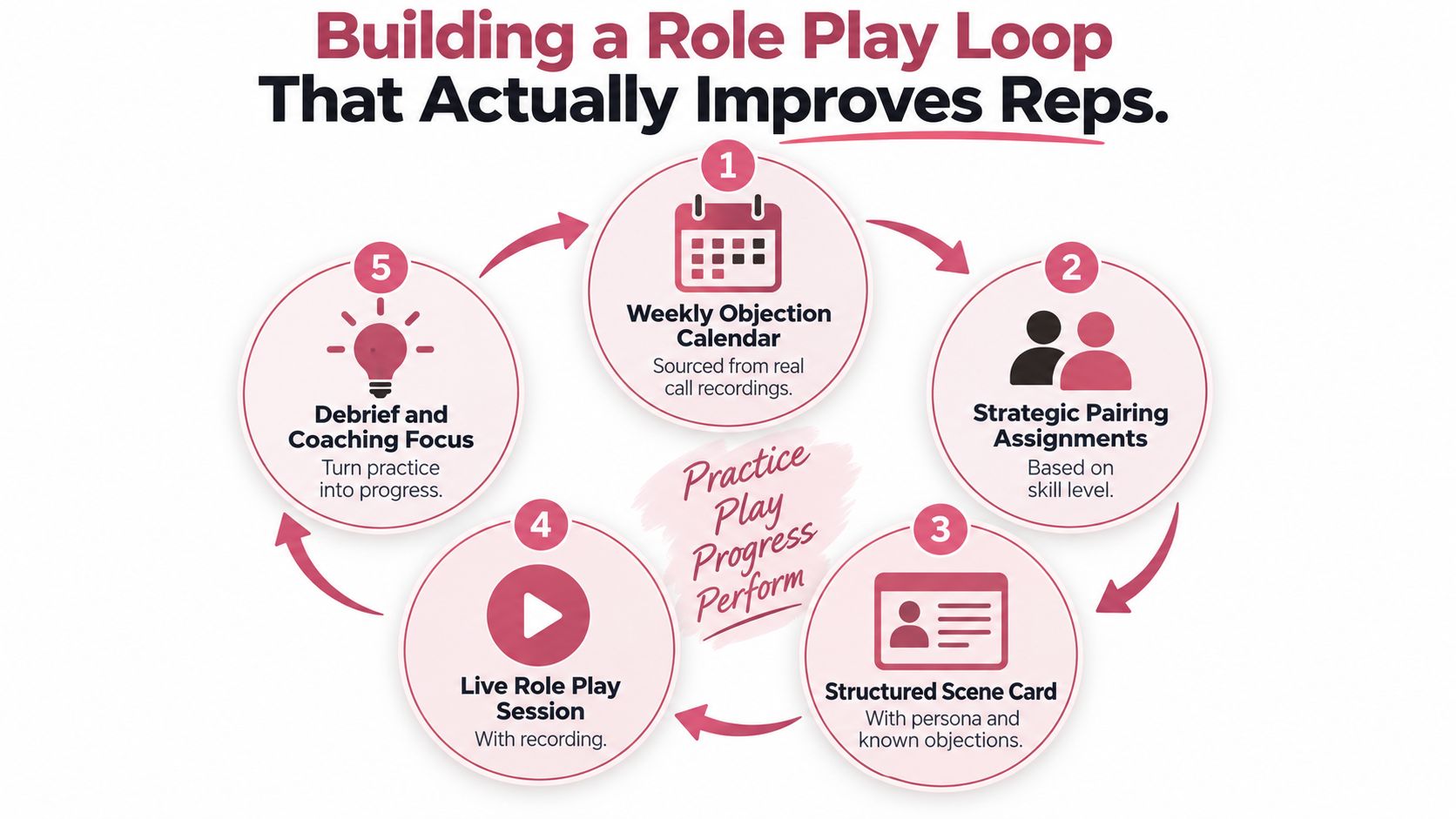
Role play improves reps only when it resembles the calls they lose. A weekly exercise built around generic objections creates confidence without accuracy. A useful loop takes 25 minutes, uses recorded calls, and produces language that managers can ship into the playbook.
Run the five part loop
- Build the objection calendar: Pull one recurring objection from real call recordings each week. Sort it by category and sales stage.
- Assign pairs deliberately: Match a rep who needs practice with a peer or manager who can create realistic pressure. Rotate the roles.
- Prepare a scene card: Include the persona, account context, deal stage, known objection, and information the buyer won't volunteer unless asked.
- Record the role play: Run the conversation without interruption. Record it in a conversation intelligence tool such as Gong or Chorus so the rep can review the exact moment where the response changed.
- Debrief and ship a line: Score the exchange, identify one improvement, and add the three strongest lines from the week to the shared objection log.
Score behavior, not charisma
The evaluator should use four criteria:
- Clarifying question: Did the rep identify the underlying concern?
- Empathy: Did the rep acknowledge the buyer without becoming defensive?
- Response accuracy: Did the answer match the confirmed issue and stay within supported evidence?
- Committed next step: Did the rep secure a specific action rather than accept vague interest?
A team can store recordings, scene cards, and approved responses in a broader sales enablement tools guide. The important point is ownership. Completion belongs in the rep's development plan, with managers reviewing progress during regular coaching, not treating role play as optional meeting filler.
Turning Objection Handling Into a System That Compounds
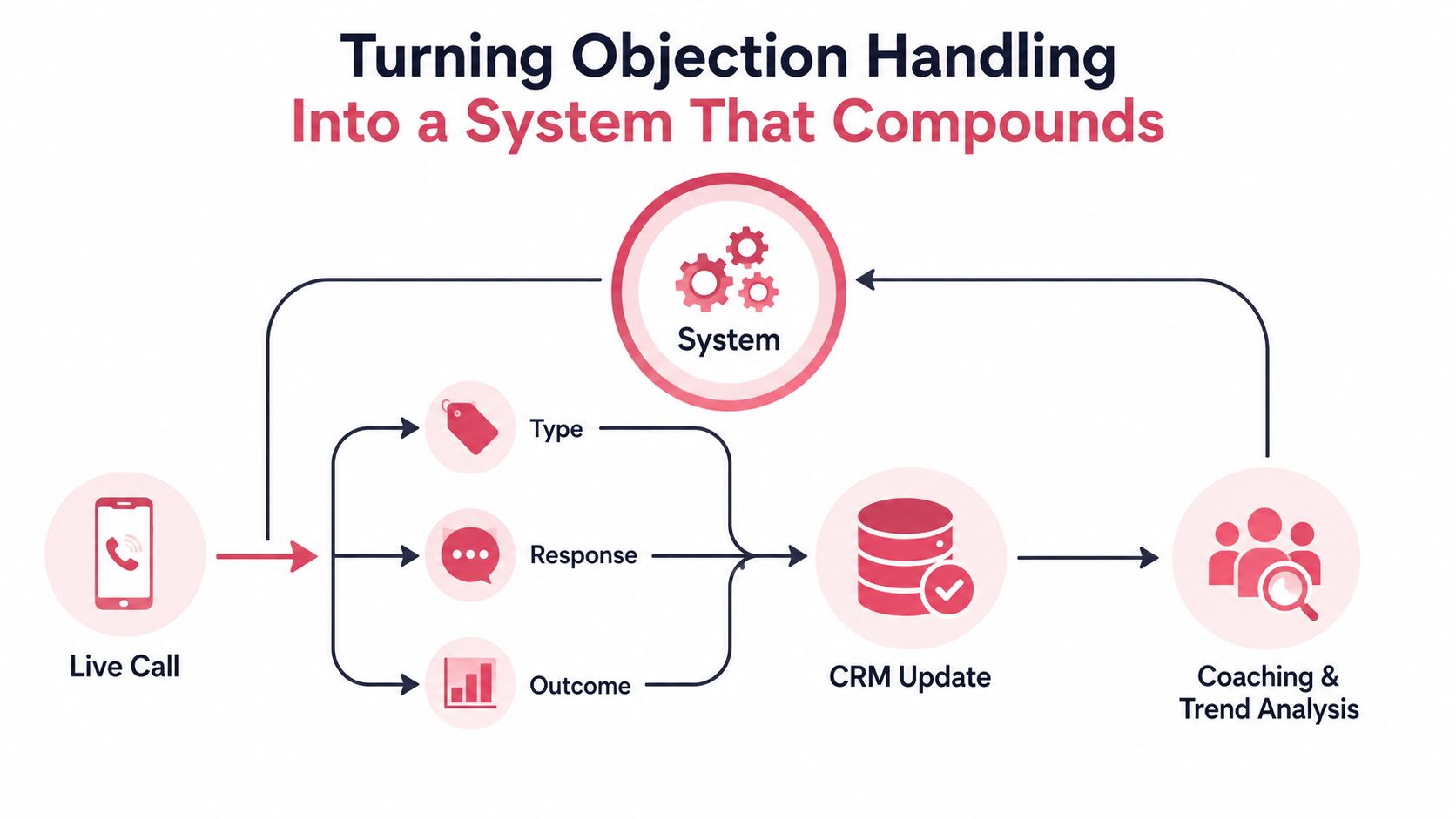
Objection handling becomes durable when every call produces structured learning. The minimum record is simple: objection type, response used, and deal outcome. Store those fields in the CRM instead of burying them in free text, because managers need to compare patterns across reps, stages, and segments.
The system should grade responses against three operating questions: Did the rep show empathy? Did the rep use accurate evidence? Did the rep create forward motion? A response that sounds polished but produces no next step isn't a successful play.
Build a library that can retire bad advice
The playbook should have levels. New reps start with tier one plays that cover the most common categories and approved evidence. Senior reps earn tier two plays when they can handle ambiguity, multi stakeholder conflict, and unusual buying conditions without losing control of the call.
Every play needs a verdict. Review it against a 50 call sample before making a major decision, then retire plays that underperform and promote responses that repeatedly advance qualified opportunities. This prevents one memorable call from becoming company doctrine.
Conversation intelligence can support the workflow by tagging objection language, finding counterexamples in recordings, and flagging repeated misses for manager review. A rep who keeps responding to budget before clarifying value needs a targeted intervention, not another general training session.
Ship the first 30 days
A short rollout creates evidence faster than a broad training program.
- Week one: Tag every objection across the last 90 days of calls and establish baseline win rates by objection type.
- Week two: Rebuild the playbook around budget, timing, authority or consensus, and need or fit. Assign a framework and evidence path to each cluster.
- Week three: Run daily 15 minute role plays, score them with a five point rubric, and share recordings in Slack for focused review.
- Week four: Instrument the CRM, automate response grading where possible, and review the results in a team retrospective.
Track these four metrics weekly:
- Objection rate per opportunity
- Response to advance rate
- Time to first objection in the sales cycle
- Win rate conditional on objection type
Publish the dashboard. Recognize the rep with the highest advance rate. Retire the play with the lowest result. Set the next 30 day target based on what the data shows, not on a generic activity goal.
Connect objections to buyer behavior
The system also needs to account for objections that form before a live conversation. Gartner found that 61% of B2B buyers prefer a rep free buying experience, and 73% actively avoid suppliers that send irrelevant outreach. That means targeting, relevance, and self serve evidence belong in objection handling too.
A rep can't answer an objection from a buyer who filtered out the company before contact. Marketing and sales should therefore review which messages create engagement, which pages contradict the sales narrative, and which signals indicate that a buyer wants information before interaction.
The operating model is the same as product iteration: ship a play, measure the outcome, inspect the evidence, and update the play. Yalc can serve as one system option for teams that need a unified GTM knowledge layer, audit trail, and validated play system to retain what has worked and retire weak plays. Compounding starts when the response becomes a reusable organizational asset rather than a rep's private technique.
Yalc gives GTM teams a unified knowledge layer, audit trail, and play system for preparing calls, standardizing responses, and feeding outcomes back into future plays. Visit Yalc to see how the system can help turn objection handling from scattered rep judgment into a measurable operating loop.