How to Identify Leads That Actually Convert

More names don't create more pipeline. They create more records for sales teams to ignore, enrich, sequence, and eventually remove from the CRM. The practical question isn't how to collect contacts. It's how to identify leads that show a credible combination of fit, need, authority, and timing.
That distinction changes the operating model. A reachable person isn't automatically a viable prospect, and a website visitor isn't necessarily a buyer. Strong B2B teams treat lead identification as a system that combines verified firmographics, behavioral signals, qualification rules, routing speed, and continuous measurement.
Table of Contents
- Treating Lead Identification as an Engineering Problem
- Building a Rigid Qualification Framework
- Layering Intent Signals Over Static Firmographics
- Capturing Inbound Signals with Minimal Friction
- Prioritizing Routing and Channel Sequencing
- Automating the Identification and Scoring Engine
Treating Lead Identification as an Engineering Problem
The common advice is to build a larger list, add more contacts, and increase outreach volume. That approach confuses activity with identification. A list can grow while pipeline quality declines, especially when records lack a real business need or contain inaccurate contact and company data.
A more useful model treats identification as a measurable funnel problem. One benchmark places typical identification rates around 2% to 5% of website traffic, with data accuracy targets above 85% and a conversion timeline of 30 to 90 days for identified leads to progress through the pipeline. These benchmarks come from FullContact's framework for measuring B2B lead identification success.
The four metrics that matter
The benchmark frames lead identification around four operational measures:
- Lead quality score: Whether a surfaced lead matches the ideal customer profile and has a plausible reason to buy.
- Identification accuracy rate: Whether the company and contact records are reliable enough for enrichment, routing, and outreach.
- Conversion velocity: How quickly an identified lead advances after entering the funnel.
- Cost per identified lead: The resources consumed to produce a usable prospect, including data, enrichment, tooling, and operator time.
These metrics expose problems that database growth hides. A campaign may create many records but perform poorly on accuracy, produce weak quality scores, or generate leads that sit untouched long enough to lose relevance.
Practical rule: Count a lead only when the record is accurate, the account fits, and the available evidence supports a sales action.
This is why lead identification resembles engineering more than traditional prospecting. Operators define thresholds, inspect inputs, measure outputs, and retire processes that generate noise. Sales still supplies judgment, but the system gives that judgment consistent evidence.
Set thresholds before adding volume
A team should decide what qualifies as usable before it buys more data or launches another sequence. For example, it can require a verified active company, a relevant role, a clear account fit, and at least one meaningful signal. The exact scoring model will vary by market, but the decision criteria must remain explicit.
The funnel also needs stage definitions. A company showing relevant website activity may be an identified account, but it shouldn't become a sales accepted lead until the team confirms contact relevance and business context. A practical guide for B2B lead qualification can help teams turn that distinction into operating rules.
The result is a smaller but more useful lead pool. The team knows why each account is present, what evidence supports action, and which metric will reveal whether identification is improving.
Building a Rigid Qualification Framework
Qualification should begin before enrichment or outreach. If an account fails a fit or legitimacy check, buying more contact data only increases the cost of a bad decision. Lead identification works better when each gate has a clear pass condition and an auditable reason for rejection.
A strong framework combines binary disqualifiers with scoring criteria. Binary rules remove obvious mismatches quickly. Scoring ranks the accounts that remain, so sales can focus on records with stronger evidence instead of treating every technically eligible lead as equally urgent.
Start with verification, not engagement
Confirm that the company exists and operates before treating clicks, page views, or social activity as intent. Useful checks include:
- Official presence: Review the company website, active domain, public company information, and current business descriptions.
- Operating activity: Look for recent LinkedIn activity, news mentions, trade show participation, or other evidence that the business is active.
- Status checks: Exclude companies in liquidation, suspension, or another inactive state.
- ICP alignment: Compare industry, company size, geography, business model, and use case against the target profile.
- Technical compatibility: Check whether the account's current stack can support the proposed solution.
These checks reflect the verification process described in Belkins' lead qualification guidance. For a deeper walkthrough of scoring models and disqualification rules, see our guide to lead qualification. Together, these checks prevent an old directory entry, inactive domain, or irrelevant organization from entering the active pipeline.
Use five qualification gates
The qualification model should answer five questions:
- Does the account fit the ICP? The company must belong to a market the product can serve well.
- Can it pay? Budget may be unknown, but the organization needs a plausible ability to fund the solution.
- Does the contact influence the decision? A useful contact has authority or can identify the people who do.
- Is there a defined need? Engagement without a business problem does not justify sales action.
- Is the timing realistic? The account needs a credible window in which a decision could happen.
The lead qualification framework from ZoomInfo helps translate these checks into disqualifiers and scoring criteria. Keep the rules visible. Sales and marketing should be able to explain why an account passed, failed, or entered nurture.
A rigid framework does not remove judgment. It makes judgment faster, more consistent, and easier to audit. Metrics can then show which gates reject good-fit accounts and which ones allow noise through.
Layering Intent Signals Over Static Firmographics
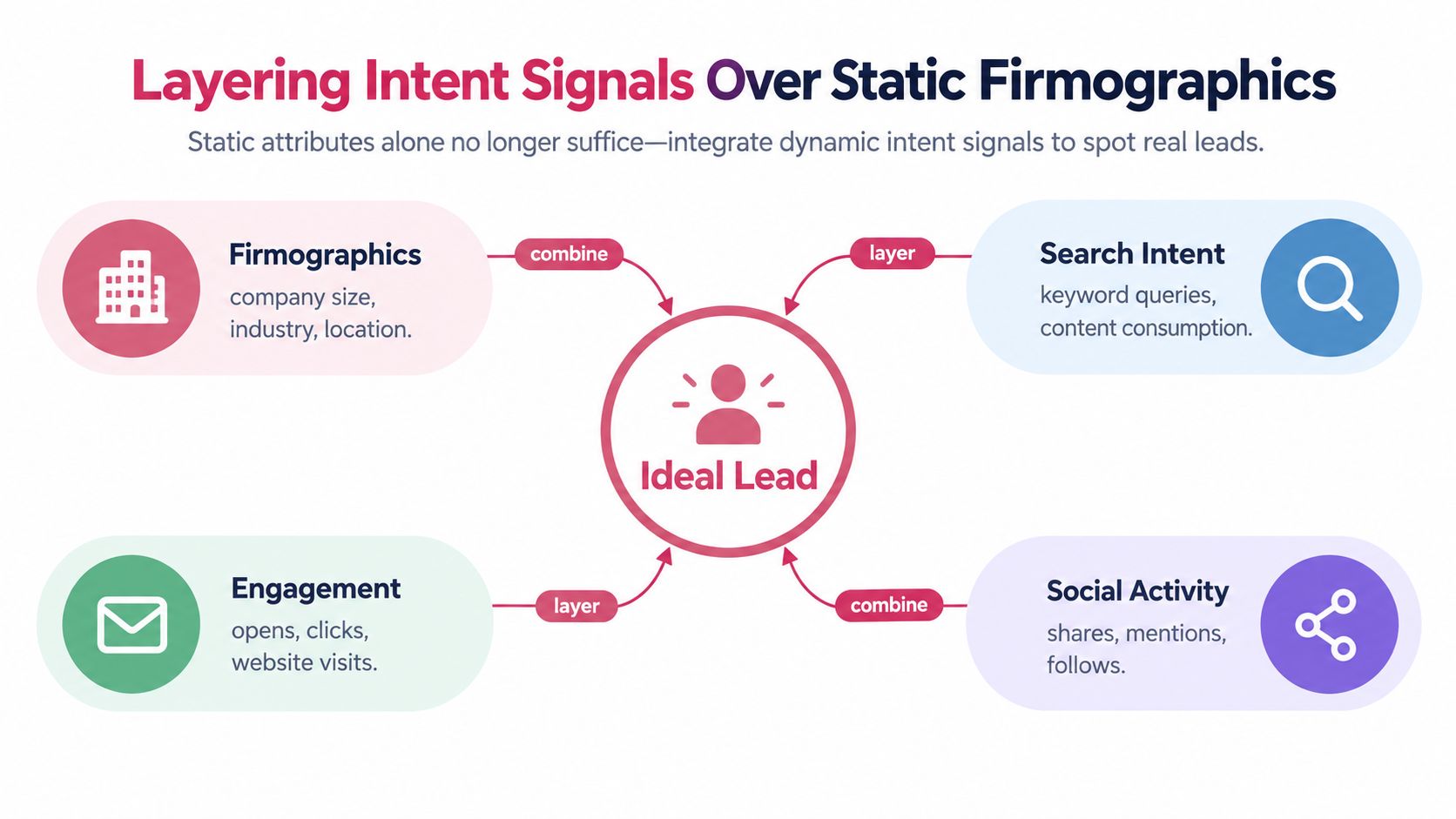
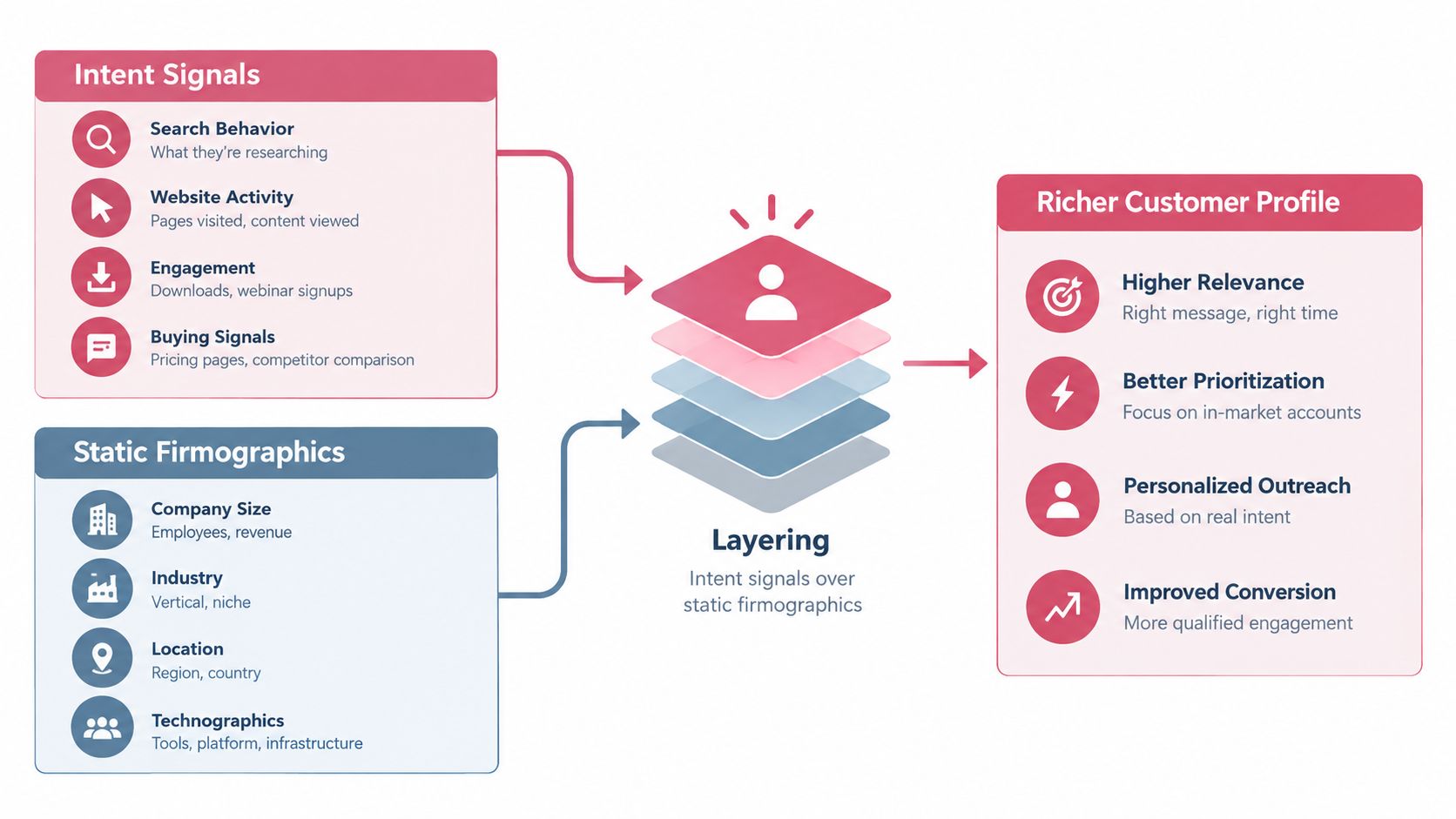
Job title and company size tell a team who might buy. They don't tell the team who is buying now. Static firmographics are useful for defining the addressable market, but dynamic signals determine which accounts deserve attention first.
Signal based identification starts with a qualified account and adds evidence of movement or friction. Relevant events include funding, active hiring, technology changes, leadership transitions, complaints about an incumbent, and visible research into a problem the product solves.
Separate reachability from buying evidence
A reachable contact has an address, profile, or public presence. A real lead has a reason for the sales team to act. That reason might be a new executive responsible for the problem, hiring that indicates operational expansion, or a technology change that creates an integration gap.
Website behavior can add another layer. A single educational visit is weak evidence. Repeated visits to product, pricing, comparison, or implementation content create a more useful behavioral picture, especially when multiple stakeholders from the same account appear engaged.
Teams should record the signal, its date, the affected account, and the recommended action. This prevents vague labels such as “high intent” from becoming permanent CRM decoration.
Mass outreach hides signal quality
The difference between reachable and qualified becomes obvious in outbound results. A 2025 study of 7.53 million B2B cold emails reported an average reply rate of 0.45%, while broader campaign benchmarks from 2025 and 2026 cluster around approximately 3% to 5.1%. The figures are summarized in EmailChaser's cold email statistics.
The lesson isn't that cold email never works. It's that undifferentiated volume produces weak feedback. A low reply rate may reflect poor positioning, but it may also reveal that the targeting system selected contacts who were merely available.
Data teams building these systems can use Captapi's guide to consumer behavior insights for broader context on turning observed behavior into usable customer understanding. For B2B operators, the practical application is straightforward:
- Define the event: Record exactly what happened, not an interpretation.
- Assess recency: Recent activity generally deserves faster review than old activity.
- Combine evidence: Pair intent with ICP fit and role relevance.
- Choose an action: Route, nurture, research, or disqualify.
- Measure the outcome: Keep signals that lead to meaningful pipeline and retire weak ones.
A deeper guide to intent data and buying signals can help teams formalize this layer without treating every behavioral event as purchase intent.
Capturing Inbound Signals with Minimal Friction
High intent traffic has little value if the capture process makes buyers abandon it. Forms should collect enough information to identify and route a lead, then rely on enrichment and progressive profiling for the rest.
A form optimization guide recommends keeping visible fields to 3 to 5 and using a multi step layout when the business needs more information. It also recommends capturing UTM parameters through hidden fields, keeping first name and work email as core fields, and adding company name or website when the form serves a B2B audience. Those recommendations are documented in SpiceForm's lead generation form guidance.
Ask for the minimum useful record
Start with information the buyer can provide quickly:
- First name: Supports a human follow up.
- Work email: Enables identity resolution and routing.
- Company name or website: Adds essential B2B context when it doesn't create unnecessary friction.
- One qualifying question: Use only when the answer changes the next action.
Avoid asking for information the team can retrieve elsewhere. Company size, industry, role seniority, and technology data can often be enriched after capture. The form's first job is to preserve the signal, not complete the entire CRM record.
Form completion guidance from LeadSquared reports that 66.7% of people who start a form complete it and recommends requesting less sensitive information, such as name and email, first. That supports a practical sequencing rule: ask for low friction identity details before questions that feel invasive or require research.
Preserve source and context
Hidden UTM fields should capture campaign, source, medium, and content context without adding visible fields. The CRM record should also retain the landing page, conversion event, timestamp, and any relevant behavioral history.
That context affects qualification. A request from a pricing page should be handled differently from a general newsletter subscription. A return visitor who submits a demo form should not enter the same workflow as a first time content download.
The routing system should validate the email, deduplicate the contact, enrich the account, apply the qualification gates, and send the lead to the right owner. The faster that chain runs, the less likely the team is to lose the original buying context.
Prioritizing Routing and Channel Sequencing
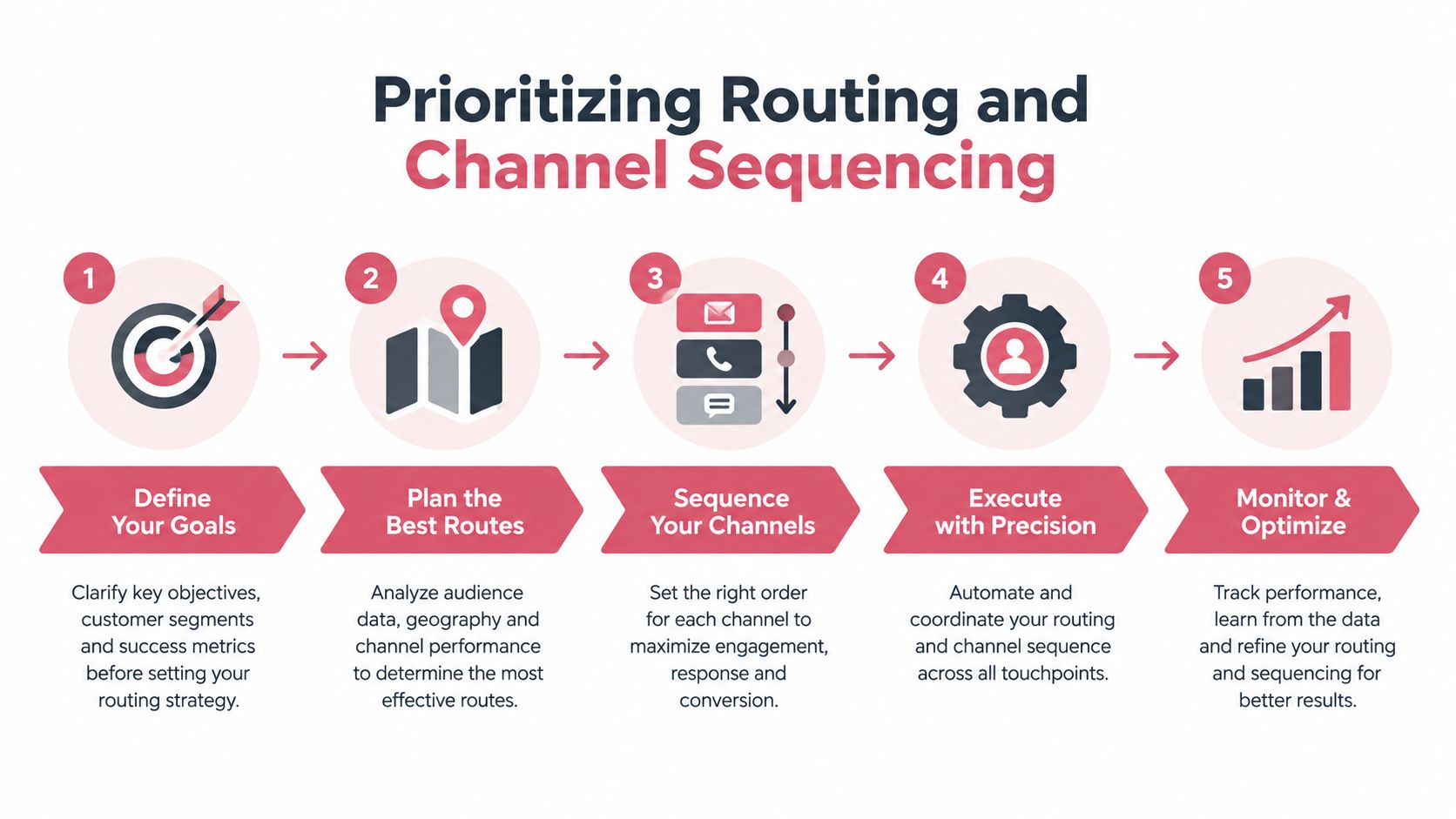
Identification doesn't create revenue until someone acts on it. Routing determines ownership, while sequencing determines which channel receives the first and subsequent attempts.
Speed matters because lead interest can cool while a record waits in a queue. One qualification benchmark cites a 1 hour speed to lead target and reports that responding within that window can improve results by 7x. The benchmark also reports an average 31% lead to MQL conversion rate, a 13% MQL to SQL rate, and conversion around 40% for properly qualified leads. These figures and their context appear in Landbase's lead qualification statistics.
Route by evidence, not territory alone
A useful routing policy considers account fit, intent strength, role, geography, existing ownership, and channel preference. A high fit account with recent buying activity should not wait behind a lower fit form submission because both entered the CRM through the same source.
The first action should match the signal:
- Direct request: Assign a human owner immediately and respond through the requested path.
- Strong account activity: Alert the assigned representative and provide the observed context.
- Relevant but weak activity: Add the account to a focused nurture path.
- Unclear identity: Hold the record for verification rather than triggering blind outreach.
Let the sequence adapt
The first email may achieve the highest per step reply rate, but follow ups generate 58.6% of all replies, according to Belkins' sales follow up statistics. That makes sequencing part of identification, not merely a later execution detail. A lead that doesn't reply to email may still be worth a LinkedIn touch when the account signal remains strong.
The same source reports that LinkedIn produced more than 7% reply rates when email sequences ran dry across 2025. Cold calling benchmarks remain modest, with one 2025 report placing average success around 2.3%, also covered in the source. These figures shouldn't become universal promises. They show why channel choice must depend on fit, signal, and the lead's observed behavior.
A practical sequence starts with the channel that best matches the available context, adds follow ups that provide new value, and changes channel when the evidence justifies it. Landing page quality also influences what happens after the click, so teams may consult Polish's guidance on autonomous AI for page copy when the capture experience fails to support the campaign.
Automating the Identification and Scoring Engine
Manual research works for a small test. It breaks when every new signal requires a person to open a spreadsheet, check a company, find a contact, enrich the record, assign a score, and notify a representative.
The answer isn't to automate every action blindly. It's to build one system in which enrichment, qualification, scoring, routing, outreach, and reporting share the same definitions. Every campaign should act as a hypothesis, with a clear outcome that determines whether its signal is promoted, revised, or retired.
Build the decision flow
A practical identification engine can follow this order:
- Ingest the source: Accept inbound forms, website activity, event responses, social engagement, referrals, CSV files, or webhooks.
- Resolve the record: Match the person and account, remove duplicates, and preserve source context.
- Verify the company: Check active operations, ICP attributes, geography, business model, and technical compatibility.
- Apply qualification gates: Test fit, ability to pay, authority, need, and timing.
- Score the evidence: Weight intent and role relevance rather than allowing any single activity to dominate.
- Route the next action: Assign a person, sequence, nurture path, research queue, or disqualification reason.
- Grade the result: Compare the signal and action against pipeline progression and data quality.
The scoring model should remain inspectable. If a lead receives a high score, an operator should be able to see which facts produced it. Teams looking to formalize the model can use this lead scoring framework as a reference point, then adapt the gates to their own ICP and sales motion.
Retire weak signals
A unified system makes it easier to distinguish a productive signal from an attractive distraction. If a source repeatedly produces accurate contacts but no qualified opportunities, the team should change the qualification rule or reduce that source's priority. If a specific buying event consistently leads to useful conversations, it should receive stronger routing and better coverage.
Yalc can serve as one option for this operating model. It connects research, enrichment, qualification, routing, and campaign measurement through a unified GTM interface, and its play library includes prospecting, lead qualification, visitor pipeline, ICP scoring, and CRM synchronization workflows. Teams can run prepared playbooks through Slack and its interface, or compose custom plays through its MCP in Claude Code, while keeping data and credentials under their control.
The important capability is the feedback loop, not the interface. A lead engine should record what it believed, what it did, what happened next, and whether the original signal deserves more or less confidence. That turns lead identification from a recurring data cleanup project into a compounding operating asset.
Yalc helps B2B teams identify, qualify, enrich, score, and route leads from sources such as website activity, social engagement, forms, lists, and webhooks through one GTM operating system. Visit Yalc to run preconfigured playbooks from Slack or the Yalc interface, or compose signal based workflows in Claude Code with your own data and keys.