How to Improve Team Collaboration for GTM Teams
More communication isn't the same as better collaboration. Adding a Slack channel, buying another platform, or scheduling another check in won't resolve a handoff nobody owns. It can leave sales and operations teams spending more time coordinating work than completing it.
Leaders deciding how to improve team collaboration should start with expectations: who decides, what information travels with the work, when people need to interact, and which hours remain protected for execution. Tools should support those agreements, not substitute for them.
Table of Contents
- Why Team Collaboration Breaks Down in GTM Teams
- Define Ownership with RACI and Workflow Maps
- Build Shared Knowledge and Playbooks That Stay Current
- Set Communication Norms That Match the Work
- Choose Tooling and Orchestration for GTM Collaboration
- Measure Collaboration Health and Close the Feedback Loop
- Roll Out Collaboration Changes in 30 Days
Why Team Collaboration Breaks Down in GTM Teams
Don't buy another tool until the team can explain where its current process fails. A missed follow up might reflect missing information, disputed ownership, or an overloaded rep. Each problem requires a different response.
The gap between buying collaboration software and improving work is visible in Cisco's global hybrid work study: 53% of employers said collaboration tools significantly improve productivity and efficiency, compared with 42% of employees. That difference doesn't prove tools are ineffective. It does justify checking whether employees experience the benefit leaders expect.
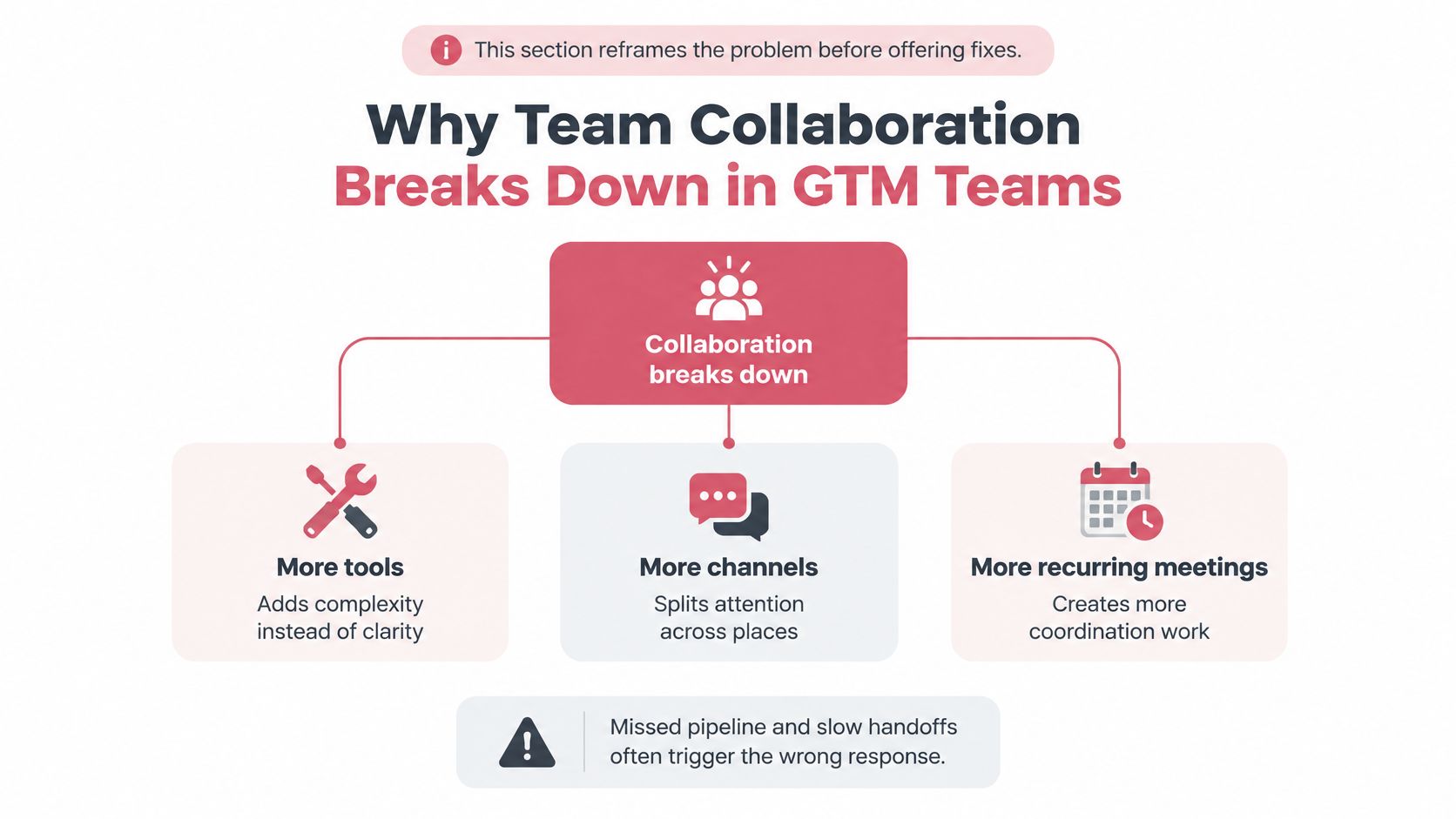
Diagnose the failed expectation
Start with a recent delayed opportunity or campaign. Reconstruct the actual work from CRM entries, approval requests, and messages rather than relying on how the process supposedly operates.
Look for these failure patterns:
- Unclear ownership: Marketing considers a lead delivered, while sales considers it incomplete. Nobody owns resolving the difference.
- Knowledge trapped in individuals: A rep needs a colleague to explain qualification rules or locate approved messaging before proceeding.
- Interaction overload: Employees attend updates and answer status requests while the underlying deliverable remains unfinished.
These are diagnostic categories, not reasons to blame departments. The useful question is which missing agreement forced people to improvise.
Separate collaboration from constant availability
A team also needs permission to work without responding immediately. Otherwise, a leader can describe focused execution as a priority while rewarding whoever answers Slack fastest.
Research on well being in virtual and hybrid teams describes how communication norms, job demands, resources, choice, and leadership behavior can support either positive or negative experiences. Connection and sustainable workload need to be designed together.
Operating principle: Reduce unnecessary interaction while making important interaction more inclusive and visible.
Before changing the stack, ask whether people can identify the next owner, find the relevant context, and proceed without another clarification meeting. If they can't, fix those expectations first.
Define Ownership with RACI and Workflow Maps
Assign ownership to outcomes, not broad departments. Marketing, sales, and customer success can all contribute to an opportunity, but shared participation shouldn't mean ambiguous accountability.
Use a RACI, which distinguishes Responsible, Accountable, Consulted, and Informed, for a specific motion. Start with a marketing qualified lead moving through sales qualification and into customer success.
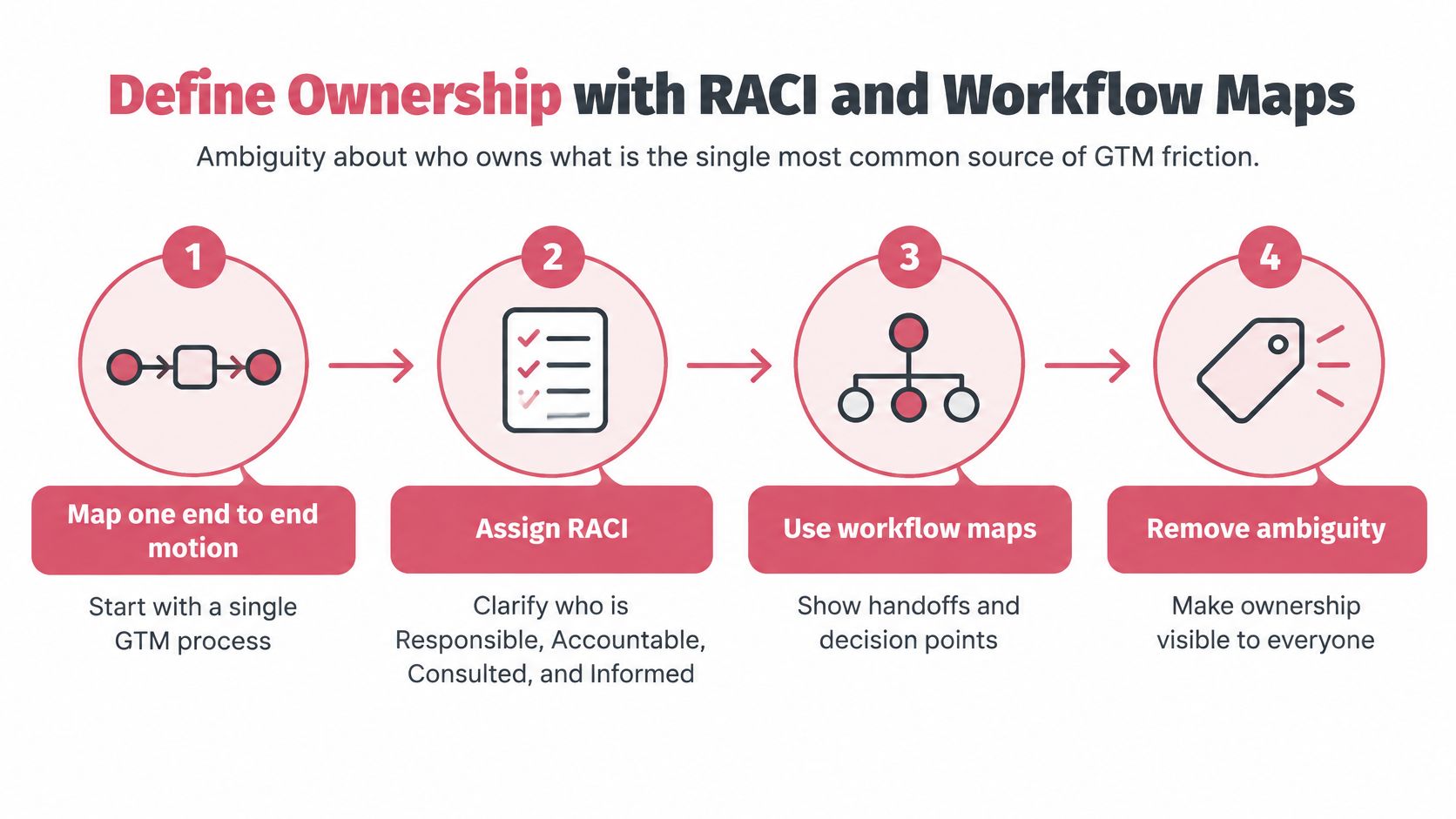
Map the motion before assigning roles
Describe the trigger, required work, acceptance criteria, and next destination at each stage. Then replace role labels with actual names in the working document.
A proposed ownership model could look like this:
- Lead preparation: Marketing operations prepares the record. The demand generation owner approves its readiness, sales operations advises on routing, and the assigned rep receives notice.
- Sales qualification: The rep completes discovery. The sales manager owns the qualification decision, a technical specialist contributes when needed, and marketing receives the disposition.
- Customer success handoff: The account executive prepares customer context. The customer success lead accepts the handoff, implementation advises on delivery constraints, and finance receives relevant contract information.
These are example assignments, not universal rules. The essential requirement is that each outcome has a named accountable owner and an explicit acceptance decision.
Turn the RACI into a working map
A RACI clarifies participation. A workflow map shows what happens when work can't proceed.
For every transition, record the sending owner, receiving owner, required inputs, definition of done, agreed turnaround, and escalation route. If enrichment is missing, the rep should see who owns completing it. If legal review is pending, the map should identify the reviewer and the expected response window.
A handoff isn't complete because someone sent it. It's complete when the receiving owner can use it.
Keep the working group small enough to coordinate deliberately. Research examining large collaborative teams found that cooperation tended to decline beyond 20 members, supporting smaller working groups with explicit connections between them.
Publish decisions, dependencies, and unresolved risks beside the workflow. Prioritize lead routing, opportunity acceptance, contract review, and customer onboarding, especially where employees repeatedly chase another department for an answer.
Build Shared Knowledge and Playbooks That Stay Current
Document the decisions a new rep needs to execute, not everything the organization knows. A useful playbook explains whom to approach, why the outreach matters, what to do next, and how to judge the result.
For example, a prospecting playbook could target revenue operations leaders whose companies show a relevant hiring signal. It would specify the evidence required to use that signal, the approved message angle, and the conditions for stopping outreach.
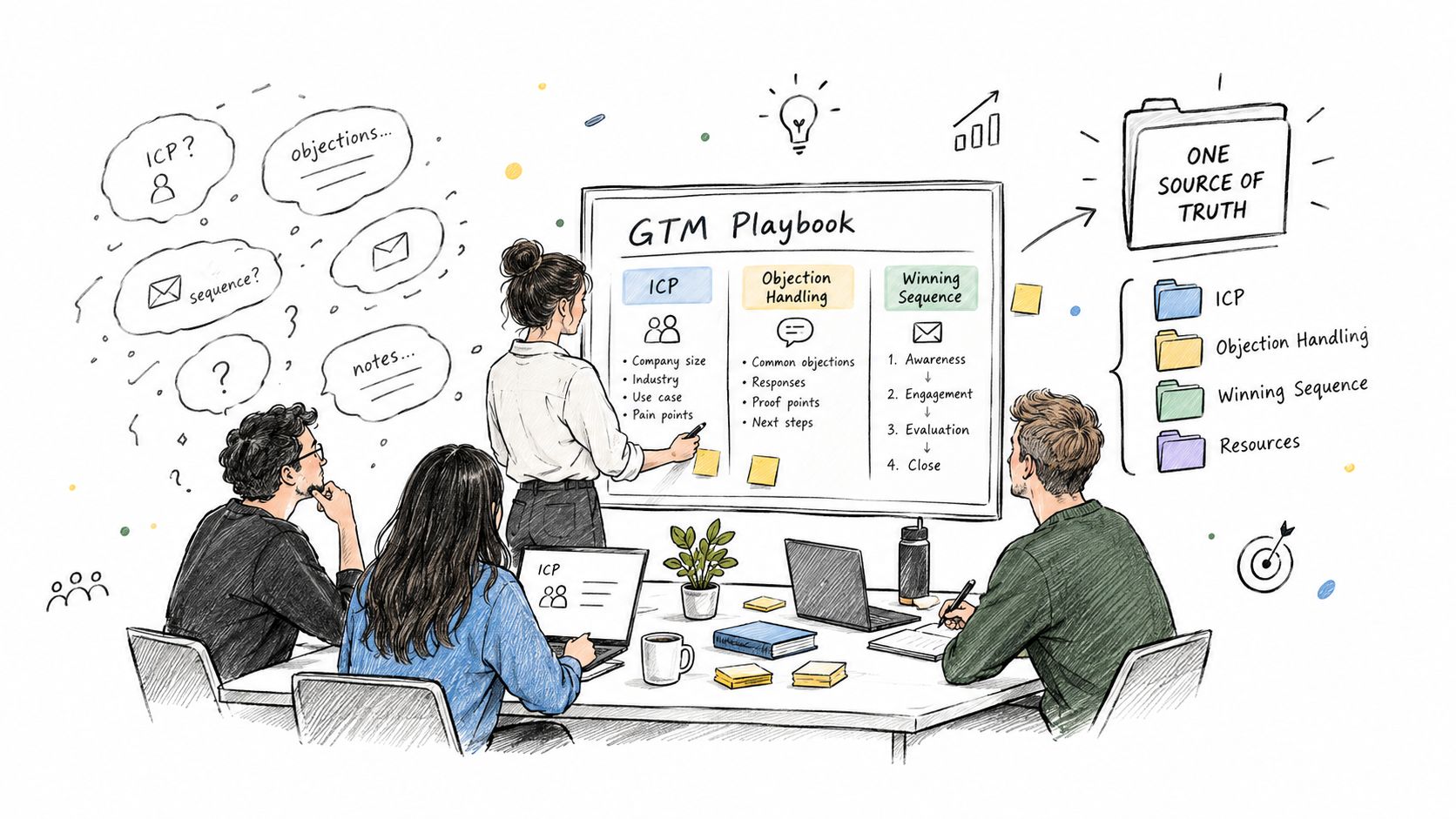
Keep the playbook usable during execution
Use this compact structure:
- Target segment: Define the ideal customer profile, buying role, exclusions, and disqualifying conditions.
- Trigger and evidence: Identify the signal and how the rep verifies it before acting.
- Message angle: Explain the relevant problem, approved positioning, and claims that require supporting evidence.
- Sequence steps: Record the channels, order of actions, branching conditions, and stop rules.
- Success metric: Define the intended outcome and where its evidence will be recorded.
- Maintenance: Name the owner, review cadence, status, and revision history.
In the prospecting example, hiring activity is a reason to investigate, not proof that a prospect has a particular operational problem. The playbook should make that distinction explicit so reps don't turn a plausible hypothesis into an unsupported assertion.
For additional planning resources, EmailScout's sales enablement recommendations can sit alongside the team's own operating documents. Concrete sales playbook examples can also help leaders choose a usable format rather than building an oversized handbook.
Separate durable guidance from live information
Keep changing account lists, active campaign results, and current assignments in their operating systems. Link to those records instead of copying them into a document that someone must continually reconcile.
Preserve the approved play while testing a proposed revision separately. Label its status clearly, record what changed, and explain the evidence needed before adoption.
The owner should review the playbook when positioning changes, an assumption fails, or execution exposes missing guidance. A scheduled review is useful, but an obvious defect shouldn't wait for the next calendar reminder.
Set Communication Norms That Match the Work
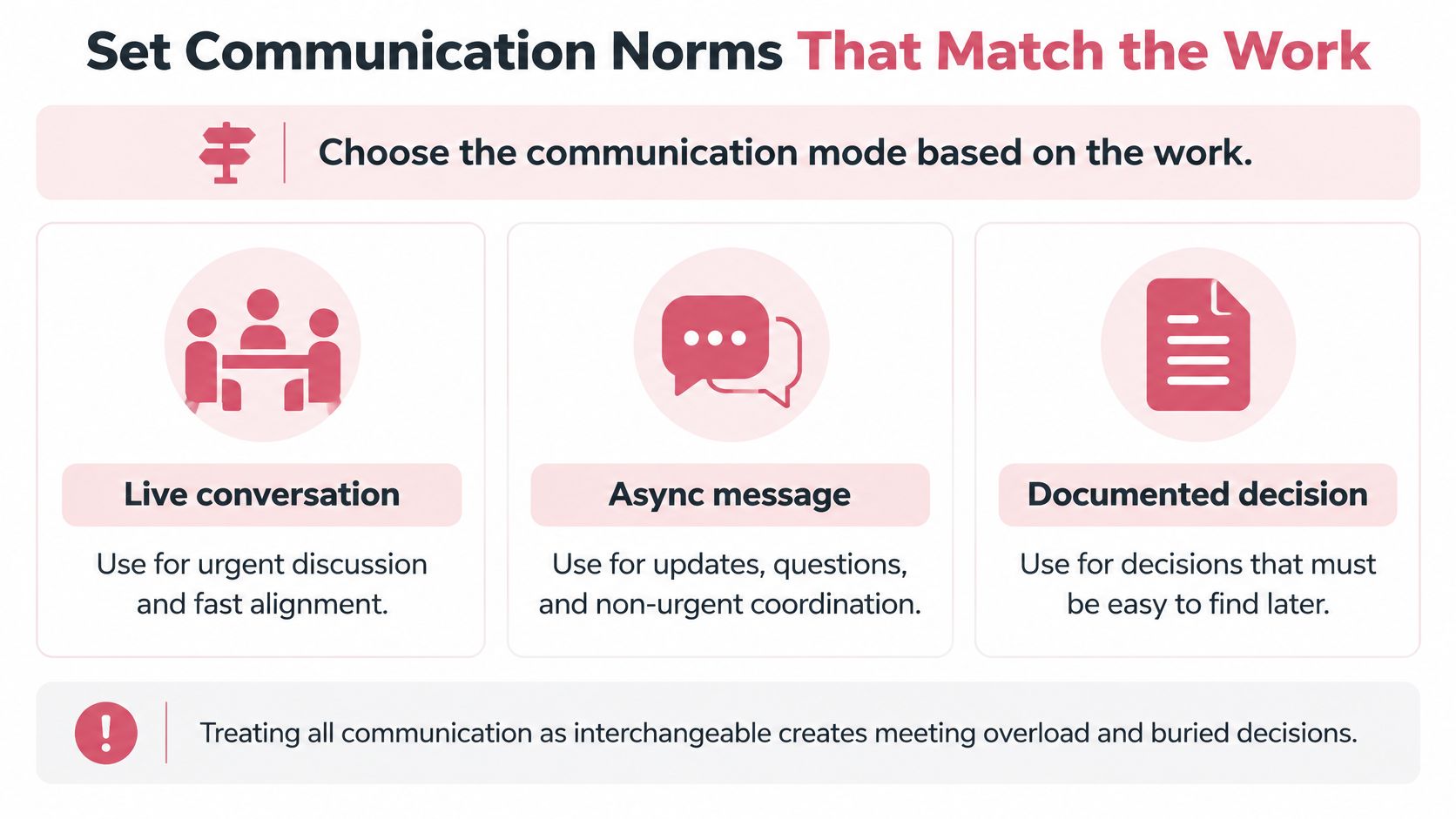
Choose the communication mode from the task, not from the tool employees happen to have open. Live conversation is useful for ambiguity, conflict, and relationship building. Written communication suits routine coordination and durable records, while focused execution needs protected individual time.
MIT Sloan's analysis of collaboration failures emphasizes how information and relationships flow through teams. The practical response is to give each forum a distinct purpose rather than funneling every issue into the same meeting.
Write rules people can apply
Make the communication agreement specific enough to resolve everyday choices:
- Live discussion: Use it when participants need to explore competing interpretations or resolve a disagreement. Invite the people needed to reach the outcome.
- Asynchronous update: Include progress, evidence, blockers, and requests. State whether a response is required and when.
- Decision record: Capture the decision, rationale, owner, deadline, and conditions that would justify reconsidering it.
- Protected work: Define normal response expectations and an exception route for urgent issues.
The team can use hireSDR's guide to communication protocols as an additional resource while drafting its own agreement. Internal norms still need to reflect working hours, customer commitments, and dependencies.
Audit meetings by their output
Meeting time deserves scrutiny. Microsoft's Work Trend Index reported that global time spent in Teams meetings increased 2.5 times between February 2020 and February 2021, while average meeting length increased from 35 minutes to 45 minutes.
Require every recurring meeting to have a written purpose, expected output, and named owner. Replace information only sessions with written updates, unless discussion serves a clear purpose beyond distributing the information.
For decision meetings, send the question and supporting context beforehand. Ask participants for input before the senior leader states a preference, and ensure remote colleagues have the same materials and opportunity to contribute.
Meeting test: If the organizer can't name the decision, deliverable, or blocker the session should resolve, reconsider the invitation.
Don't eliminate human connection in pursuit of calendar efficiency. Preserve intentional relationship building, but don't disguise routine reporting as connection.
Choose Tooling and Orchestration for GTM Collaboration
Select software against a defined workflow. A team shouldn't automate an unclear approval path or connect systems before deciding which record governs the work.
The options involve trade-offs. Separate specialist tools preserve choice but leave someone responsible for integration. A shared project workspace can clarify assignments without executing the underlying sales motion. An orchestration layer can connect execution, but it requires explicit permissions and failure handling.
Compare the operating burden
Evaluate options through practical questions:
- Rep effort: Which systems must a seller open to complete the motion, and where must they reenter information?
- Operator control: Can operations staff change an approved play without waiting for an engineer?
- Engineering access: Can technical staff extend the workflow, inspect failures, and replace a provider?
- Data boundaries: Where do credentials and customer information live, and who can access them?
- Outcome evidence: Can the team inspect results, approvals, and failed steps rather than merely confirm that an automation ran?
A small team with a straightforward motion may need little beyond a CRM, a shared playbook, and explicit ownership. A more complex operation should evaluate the maintenance burden of custom integrations against the constraints of a unified platform.
The comparison should include exit costs. Ask how the team would export its playbooks, change enrichment providers, or recover work after an execution failure.
Match orchestration to the team's capabilities
Yalc is an option built as an AI GTM operating system with a unified GTM API and a knowledge orchestration layer containing the ICP, voice, positioning, and proven plays. Engineers can compose custom plays through its MCP in Claude Code, while operators can run preconfigured playbooks from Slack and the interface with little to no setup, using the same engine and data.
The system grades campaigns against success metrics, pauses sensitive actions for human approval, and keeps data and keys on infrastructure the team controls. Those capabilities should be assessed against the team's actual approval requirements and technical capacity, not treated as reasons to automate every interaction.
Use a review of GTM orchestration tools with AI to frame the evaluation. Pilot a complete motion, including an exception case, before expanding its scope.
Measure Collaboration Health and Close the Feedback Loop
Measure whether people can move work forward, not how visibly busy they appear. Message counts and attendance can't distinguish useful coordination from repeated attempts to get an answer.
Build a monthly scorecard from existing work records and a short team pulse. Use it to identify process defects, not rank employees by activity.
Track friction without adding surveillance
- Decision latency: Use request and decision timestamps to examine how long a named question remains open. Separate waiting time from active evaluation.
- Duplicated work: Record cases where people independently rebuild a list, research the same account, or recreate an existing asset.
- Unresolved conflict: Track disputed priorities or decisions that still lack a resolution owner. Don't turn this into a register of personal complaints.
- Inclusion in decisions: Ask whether affected colleagues had access to the context and a meaningful chance to contribute.
- Recovery time: Ask whether employees can protect focus and disconnect outside agreed working hours.
CRM timestamps and handoff logs can supply operational evidence. A short pulse should cover experiences those systems can't reveal, especially exclusion and pressure to remain available.
For reporting layout ideas, sales dashboard examples can help organize the scorecard. Avoid creating another dashboard that requires employees to manually narrate work already recorded elsewhere.
Fix the condition behind the signal
Act first on the issue creating the most serious customer risk or repeatedly blocking dependent work. A reopened decision might require clearer decision rights. Duplicated research might require a visible asset location.
Make the review safe enough for employees to report inconvenient evidence. Google's Project Aristotle findings identified psychological safety as the most important team effectiveness factor, alongside supporting conditions including dependability and clarity.
When a campaign fails, examine the targeting, assumptions, execution, and available evidence. Don't equate a failed hypothesis with a failed person. Leaders should respond to bad news with questions about what happened and what needs to change, while still holding owners accountable for agreed actions.
Roll Out Collaboration Changes in 30 Days
Limit the rollout to a specific motion with visible friction. Redesigning every sales and operations process simultaneously makes it harder to tell which change helped and which created extra work.
Name a rollout owner and explain the purpose in operational terms. The team should understand which delay, repeated clarification, or unnecessary task the change is intended to remove.
Sequence the work
- Week one, diagnosis: Map the chosen motion as people perform it. Identify the top friction points and audit its recurring meetings.
- Week two, design: Draft the ownership model, playbook, and communication agreement for that motion. Ask receiving teams to test the proposed acceptance criteria.
- Week three, pilot: Run the revised process with a single team and collect the scorecard signals. Compare against existing records without requiring duplicate execution.
- Week four, review: Keep useful changes, retire unnecessary steps, and select the next motion only after the pilot has a stable owner.
During the pilot, maintain a clear fallback for customer commitments. Employees should know when to escalate an exception instead of improvising around the new process.
Protect the capacity the team recovers
Don't refill every canceled meeting with another initiative. Reserve the released time for account preparation, campaign analysis, customer work, or recovery, depending on the original problem.
Publish what changed and why. A concise decision record is more useful than a broad announcement that collaboration is now a priority.
The immediate next step is concrete: choose a handoff this week and write down its owner, definition of done, and expected turnaround. Ask the receiving colleague whether those terms would let them proceed without chasing clarification. Resolve any disagreement before adding another tool or meeting.
Yalc offers shared GTM knowledge, configurable sales playbooks, and coordinated execution with human approval for sensitive actions. Visit Yalc to explore how those capabilities could support a clearly defined handoff and reduce repetitive coordination.