How to Sell Software as a Service in 2026
Pipeline looks busy. Meetings fill calendars, sequences send every morning, and dashboards show activity moving in the right direction. Then finance asks why new revenue costs so much to win, why customers stall during onboarding, and why last quarter wins already look fragile. That gap is the problem to solve when learning how to sell software as a service. The close isn't the finish line. It's the point where the economics either start compounding or start leaking.
Table of Contents
- What Selling SaaS Really Means in 2026
- Defining the ICP and Qualifying With Evidence
- Pricing and Packaging That Change the Sales Conversation
- Running Inbound and Outbound as One Motion
- Turning the Close Into an Onboarding Path
- Measuring the SaaS Sales Motion the Way Operators Do
- Wiring It Together With a Goal Led GTM System
What Selling SaaS Really Means in 2026
Selling SaaS means selling a recurring relationship, not a finished license. The customer doesn't buy software once and manage it alone. The vendor hosts the product, updates it, supports it, and earns the right to keep charging for it. That changes the sales job completely.
Traditional software selling rewarded a large initial purchase. SaaS rewards fast activation, regular use, renewal, and expansion. A deal that closes but never gets adopted isn't a win. It is future churn with a contract attached. Sales teams therefore need to connect the product to a business outcome the buyer can measure, reduce friction during implementation, and leave a clear path for broader use after signature.
Salesforce shows how durable that model can become. Salesforce helped establish subscription software as a viable business model, with its 2004 IPO raising approximately $110 million and fiscal 2025 subscription and support revenue reaching approximately $35.7 billion, representing about 94% of total revenue. The lesson isn't historical trivia. It explains why recurring value matters more than a feature tour.
The Building Blocks Behind the Close
A workable SaaS motion rests on connected decisions.
- ICP and qualification: Teams choose accounts with a durable problem and demand evidence before pipeline advances.
- Pricing and packaging: The charging model shapes buyer confidence, procurement effort, and expansion potential.
- Inbound and outbound: Both paths should produce the same thing, qualified pipeline that can pay back its acquisition cost.
- Onboarding and activation: Sales promises become dated milestones that customer success can deliver.
- Metrics and economics: Operators judge revenue quality, retention, and payback, not activity volume alone.
- AI GTM system: Research, enrichment, outreach, and reporting run from one shared view of the customer and what has worked before.
A SaaS sale creates value only when the customer adopts, renews, and finds more reasons to stay.
Treat each block as separate and the leaks show up later as churn, discounting, and expensive replacement pipeline. Connect them and every new customer can produce renewal revenue, additional users, wider department use, or a larger contract over time. That's the compounding curve a sales team is really building.
Defining the ICP and Qualifying With Evidence
An ICP is useful only when a system and a seller can score an account against it. A slide that says mid market operations leaders are the target doesn't help anyone decide which account deserves time today. Write criteria that can be checked in data, then add exclusions that stop wasted work early.
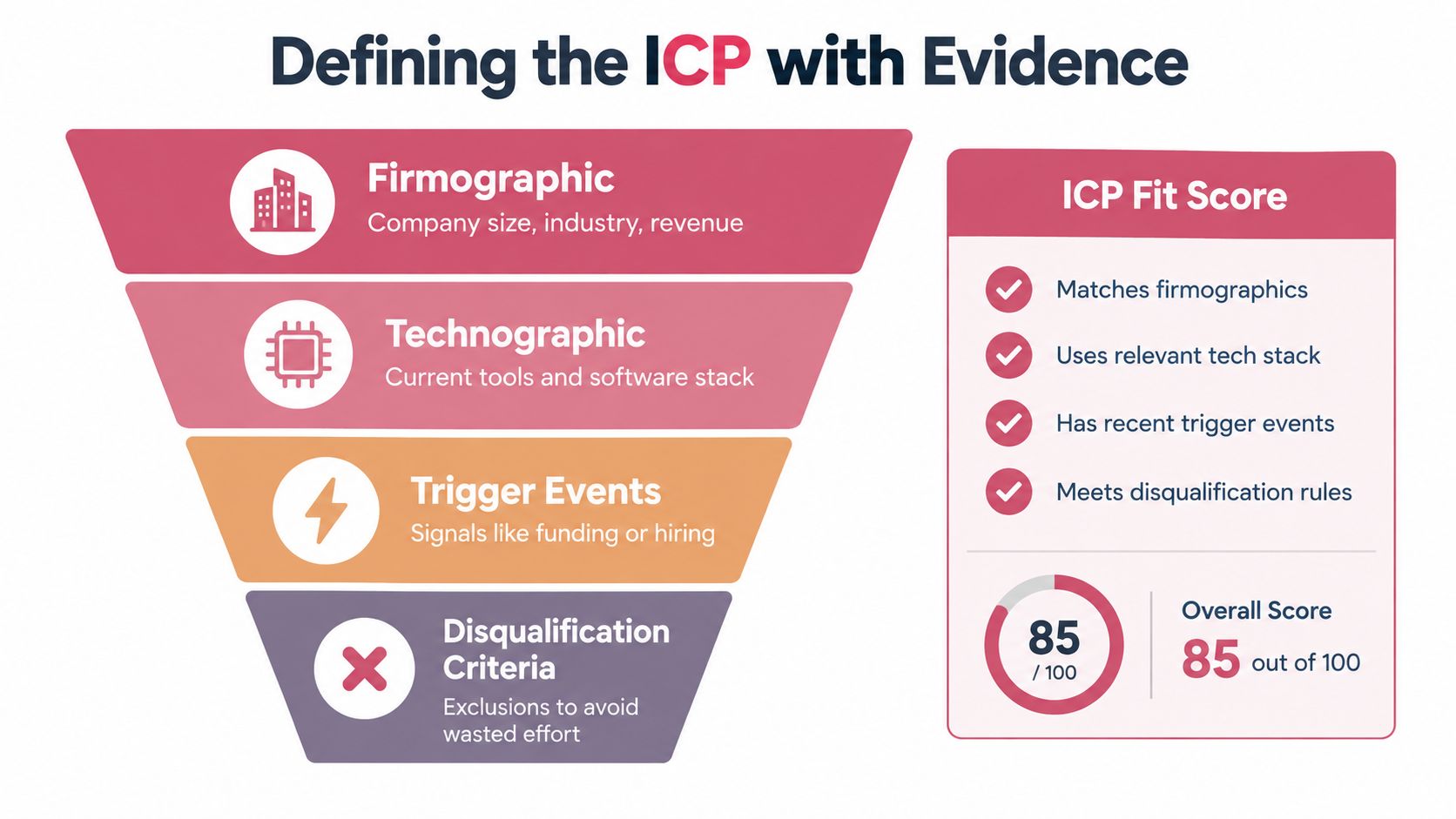
Start with firmographic fit such as industry, company size, geography, and revenue range where the product solves an expensive problem. Add technographic fit, including systems the product must integrate with and tools it replaces. Then add trigger events that create urgency, such as hiring for a relevant role, opening a new location, changing a core platform, or facing a compliance deadline. Finish with disqualification criteria, such as missing integrations, no budget owner, or a workflow the product cannot support.
For a sharper starting point, Captiwate on ICP for sales is a useful companion when translating a broad market view into sales criteria. Teams can also align internal language through a shared ICP definition guide so marketing, sales, and customer success score accounts the same way.
Evidence Required Before Advancement
Qualification should require proof, not enthusiasm.
- Measurable problem: The buyer can describe the current workflow and where it breaks.
- Economic consequence: The cost of doing nothing is named in time, money, risk, or lost revenue.
- Decision process: The seller knows who evaluates, who approves budget, and who can block the purchase.
- Next step: A dated action sits on the calendar with an owner on the customer side.
Track conversion by segment and channel rather than celebrating blended volume. Broad B2B SaaS benchmarks place visitor to lead around 1.5% to 2.5%, lead to MQL at 25% to 35%, MQL to SQL at 15% to 21%, SQL to opportunity at 40% to 60%, and opportunity to close at 15% to 25%, with top quartile performance materially higher at several stages.
Review those handoffs by ICP cohort every week. Loose MQL rules can make early conversion look strong while downstream pipeline stays weak. Each play should declare entry criteria, required evidence, owner, exit condition, and success metric. If a play keeps producing meetings that never become revenue, revise it or retire it.
Pricing and Packaging That Change the Sales Conversation
Pricing isn't just how the invoice looks. It decides what sellers must prove, what finance must forecast, and how easily a customer can expand. Choose the model that matches the way value shows up in the product, then build the sales process around its risks.
Seat based pricing is simple when value rises with the number of users. Buyers can forecast cost from headcount, procurement can compare vendors quickly, and expansion follows team growth. The weakness appears when customers limit seats to control spend, which can restrict adoption and weaken the business case.
Usage based pricing ties cost to consumption such as records processed, messages sent, or workflows completed. That can align price with outcomes and make a small starting contract easier. It can also create budget anxiety. Buyers who cannot predict consumption may delay procurement or demand caps, discounts, and long legal review.
Platform pricing with included usage gives buyers a base commitment plus room to use the product before overages apply. Flat fee pricing feels predictable, but it can hide expansion. Heavy users may consume support and infrastructure without paying more, while light users may feel they are subsidizing others.
Data to Test Rather Than Copy
Benchmark data summarized by The SaaS CFO reports net revenue retention of 108% for usage based pricing, 98% for seat based pricing, and 102% for a hybrid subscription and usage model. Treat those figures as hypotheses to test in your own cohorts, not proof that one model wins everywhere. Product type, buyer budget habits, and expansion mechanics all affect the result.
Pricing rule: Make the charging unit obvious, show the bill at realistic usage levels, and name the event that creates expansion.
Controls That Reduce Buyer Risk
- Pricing metric: Pick one unit buyers already track in their own operations.
- Forecast ranges: Show low, expected, and high consumption scenarios before proposal.
- Usage guardrails: Add alerts, caps, and approval thresholds so finance stays in control.
- Paid pilot: Charge for a scoped test with success criteria, data access, and a decision date.
- Overage treatment: Define rates, true up timing, and rollover rules in plain language.
- Outcome link: Connect expansion to verified results such as completed workflows or cost removed.
Flexible pricing doesn't automatically improve conversion. Without transparent forecasting and operational proof, it shifts risk to the customer and lengthens the deal. Finance and revenue operations should compare retention, expansion, discounting, and support cost by pricing cohort. Strong expansion with deteriorating margin still signals a pricing problem.
Running Inbound and Outbound as One Motion
Inbound and outbound fail when each team optimizes its own dashboard. Marketing celebrates leads. Outbound celebrates touches. Sales inherits accounts with different definitions of quality and no shared view of cost. Both motions should end at the same destination, qualified pipeline that fits the ICP and carries evidence of a real problem.
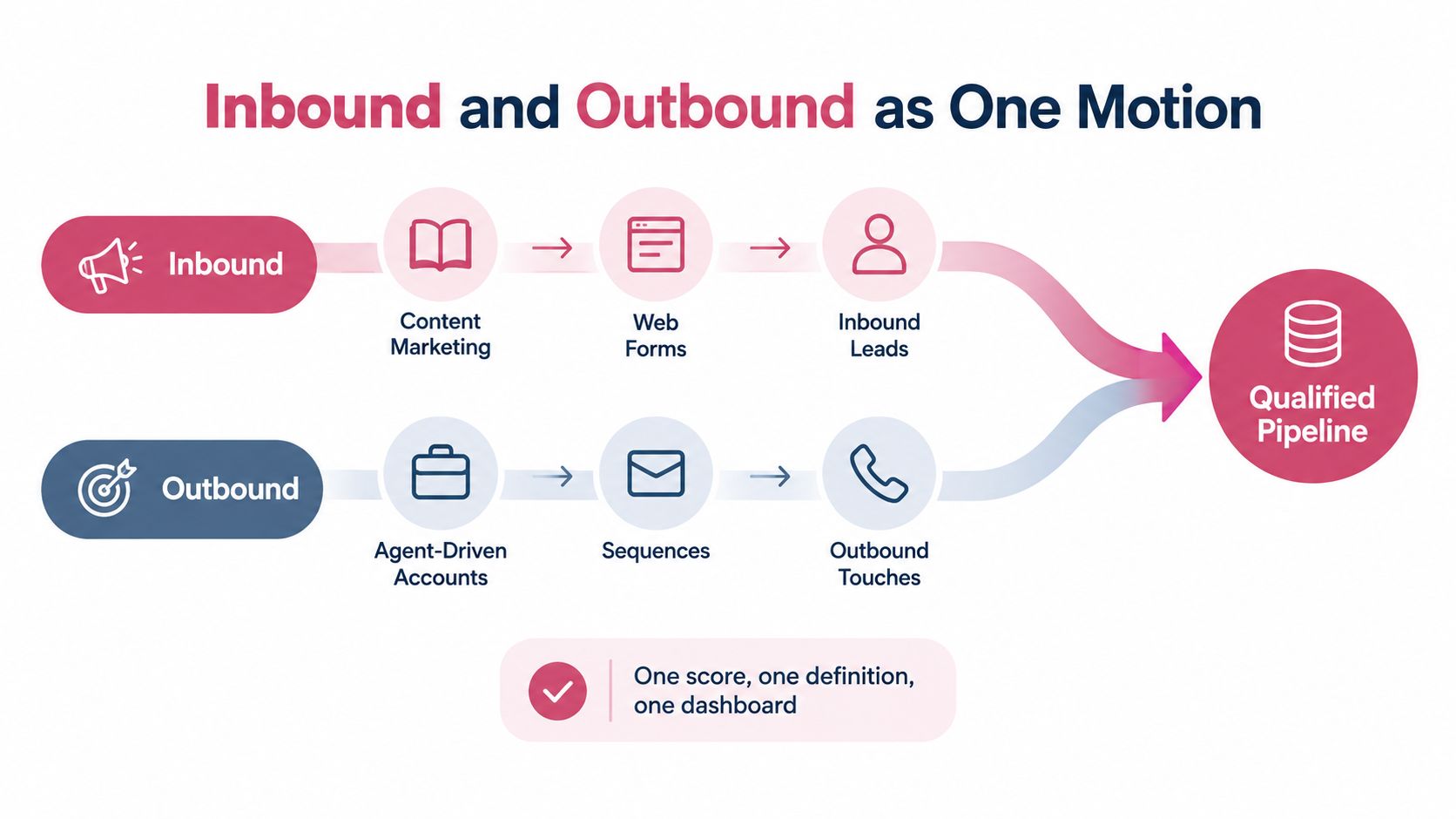
Account research should happen before the first touch. Agents can assemble firmographic data, technology signals, hiring clues, and relevant proof points so sellers start with a reason to contact this account now. Waterfall enrichment across several providers improves coverage for email and phone data and reduces time wasted on bad records. Sequencing should run through one workspace across email, LinkedIn, and calls, with reply handling that sorts responses by intent, objection, timing, and referral. A useful external view of signal based execution appears in the intent-triggered outreach playbook, while teams reviewing channel structure can compare approaches in this outbound and inbound breakdown.
Respect the Representative Free Buyer
A 2025 industry analysis reports that 75% of B2B buyers prefer a representative free experience when possible, particularly during early research, while the median SaaS sales cycle reportedly increased from 107 days in 2022 to 134 days in 2025. Forcing a call too early can add friction instead of trust.
Build a self directed layer that answers product, integration, security, and pricing questions without a seller. Use product tours, documentation, calculators tied to forecast ranges, and clear pilot criteria. Watch behavior for high intent signals such as repeated pricing views, security page visits, trial activation, or multiple people from one account engaging. Human help should enter when consensus, technical validation, or commercial negotiation needs judgment.
Two failure modes waste budget. Teams stack point tools until data lives in disconnected tabs and no one owns the handoff. Or they push outbound volume while inbound accounts showing intent sit untouched. Judge every channel by qualified pipeline, conversion to opportunity, win quality, and acquisition cost. Activity is an input. It isn't the outcome.
Turning the Close Into an Onboarding Path
Late stage deals need structure because interest from one champion doesn't equal an approved purchase. Average B2B win rates are roughly 20% to 21%, while post proposal win rates can range from 31% to 50%, making deal quality and proposal execution critical levers. A mutual action plan turns that late stage into visible customer commitments.
Discovery should establish the current workflow, measurable cost of the problem, affected users, required integrations, security constraints, procurement path, and target outcome. The demo then proves only the capabilities connected to those requirements. Anything else adds noise and invites feature comparison against problems the buyer doesn't have.
Milestones That Connect Sale to Adoption
- Technical validation: Data access, integrations, and success tests have owners and dates.
- Security review: Required documents, reviewer identity, and approval criteria are confirmed early.
- Stakeholder approval: Economic buyer, users, legal, and procurement agree on scope and outcome.
- Commercial proposal: Pricing scenarios, pilot terms, and expansion triggers are documented.
- Implementation start: Training, data migration, and first value milestones begin immediately after signature.
Multi thread the account before proposal. Record the economic buyer, operational users, security reviewer, legal owner, procurement contact, decision criteria, budget source, and next approval event. Document the compelling event that makes delay costly. Require a scheduled next meeting rather than accepting a vague promise to reconnect.
Do not trade a signed contract for a failed implementation.
Discounting heavily or overselling capability can force an initial win and create churn later. Sales should hand customer success the promised outcomes, usage signals to watch, risks raised during evaluation, and the expansion path discussed with the buyer. Onboarding then tracks activation events inside the product, such as first workflow completed, core integration live, and priority users active. When those signals stall, both teams intervene while the customer still expects value.
For smaller deals, compress the same logic. A self serve buyer still needs a success checklist, clear first value moment, and a trigger for human help. The format changes. The principle doesn't.
Measuring the SaaS Sales Motion the Way Operators Do
Operators don't ask how busy the team looks. They ask what each dollar of new recurring revenue costs, how long payback takes, and whether existing customers stay and expand. Those questions expose motions that produce bookings while destroying economic value.
Benchmarkit data summarized by Orb Billing reports that companies spent $2.00 in sales and marketing for every $1.00 of new annual recurring revenue in 2024, with net revenue retention of 101% in 2024. Calculate acquisition efficiency by dividing sales and marketing costs for new customers by the new annual recurring revenue those customers generate. Review it by channel, segment, contract size, and sales motion.
A channel can look productive and still be unattractive. Expensive human selling, repeated qualification work, and heavy discounting all raise the cost of each new dollar. Set a maximum CAC payback period before increasing spend. Compare acquisition cost with gross margin and expected retention so growth plans rest on revenue that can survive long enough to repay its cost. Forecast discipline matters here, and teams can tighten it with the practices in this sales forecast accuracy guide.
Separate Retention Signals
Gross revenue retention shows how much starting recurring revenue remains after churn and contraction, before expansion. Net revenue retention adds expansion, so it shows whether the installed base grows or shrinks overall. Reporting one blended number hides the commercial work required after the first sale.
Run a cohort review that separates the moving parts.
- Logo churn: Customers lost completely during the period.
- Revenue churn: Recurring revenue lost from those customers.
- Contraction: Downgrades, removed seats, or reduced usage.
- Expansion: Upgrades, added users, new modules, or higher consumption.
Review these by ICP cohort, acquisition channel, pricing model, and onboarding outcome. New bookings can hide a weak installed base for a while, but sales then has to replace lost revenue before it can grow. Measure stage aging, stakeholder coverage, proposal to close rate, no decision rate, and loss reasons alongside retention. Weight every test by its effect on recurring revenue quality, not meetings booked. A cheaper meeting that produces poor fit customers isn't progress. It's deferred cost.
Wiring It Together With a Goal Led GTM System
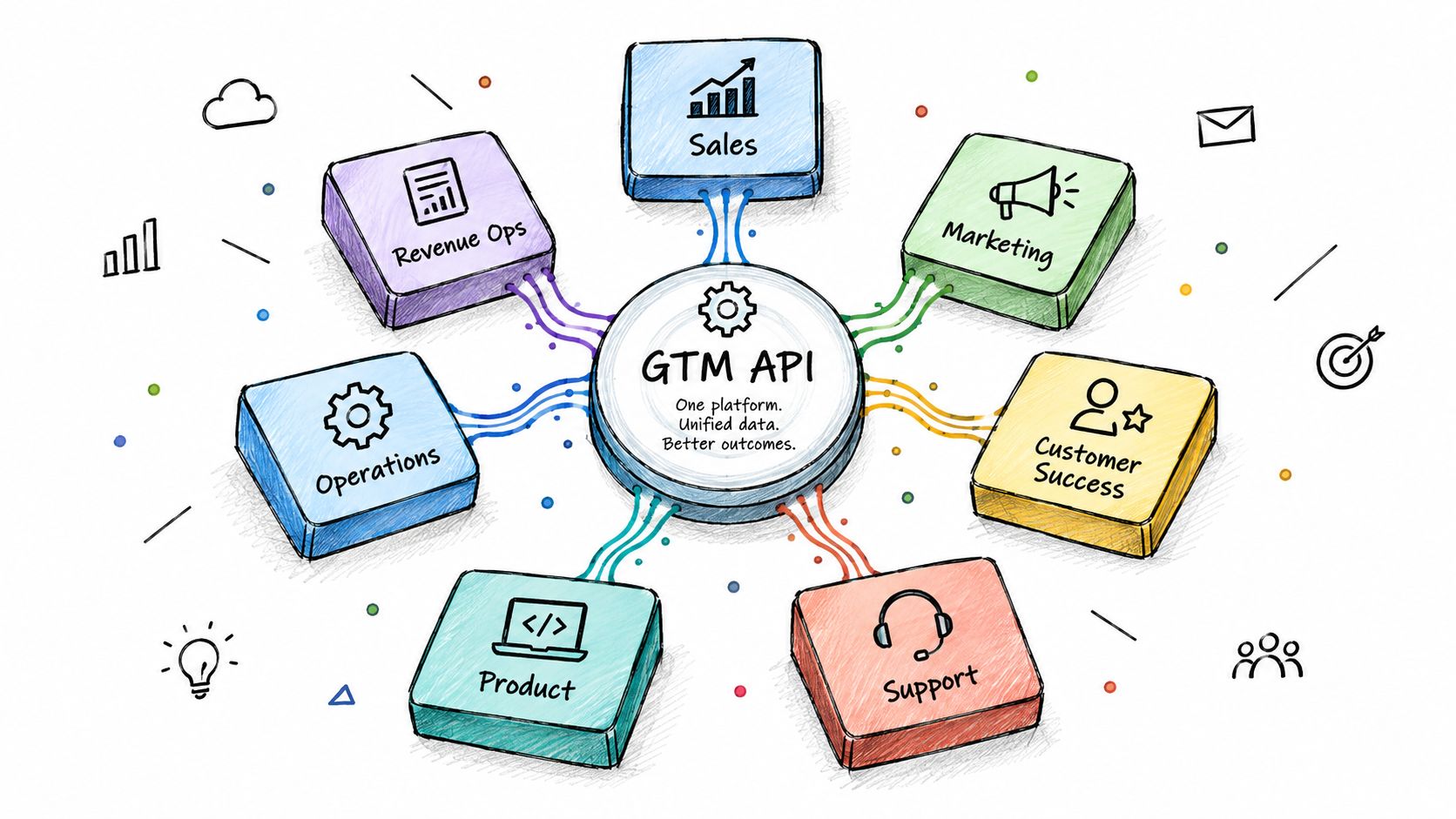
The blocks work when sales, marketing, and customer success read from the same operating system. That system needs a unified GTM API behind research, enrichment, qualification, outreach, and reporting. It also needs a knowledge layer that holds the ICP, positioning, voice, and plays that have won, so each run starts from accumulated evidence rather than a blank prompt.
SaaS Capital survey results summarized by Founderpath covering more than 1,000 private B2B SaaS companies found median net revenue retention of 101% in 2024 and median gross revenue retention of 91%, showing that installed base health determines how much growth must come from new sales. A connected system keeps that reality visible while campaigns are running, not after renewal season exposes it.
Playbooks That Grade Themselves
Each play should carry a goal, entry criteria, owner, success metric, and verdict. Pipeline plays can cover Prospecting, Lead Qualifier, ICP Scorer, and CRM Syncer. Outbound plays can cover Campaign Builder, Sequence Runner, and Reply Handler. Intelligence plays can track competitors, sentiment, and search gaps, while onboarding plays support customer communication and activation follow through. Yalc is one option for running this kind of system. It connects GTM tools behind one interface, stores shared knowledge for each run, and scores plays against their own success metrics with human approval for sensitive actions.
Start with three moves. Pick one ICP definition that every team uses. Pick one pricing model with a forecast guardrail buyers can understand. Then run one closed loop playbook that records its result and either earns promotion or gets retired. Learning how to sell software as a service becomes manageable when the system shows which customer, offer, and motion create durable recurring revenue.
If your team is ready to connect ICP scoring, outbound, qualification, and reporting in one goal led system, Yalc gives you pre configured playbooks and a unified GTM API that grades each play against real outcomes. Visit Yalc to run your first closed loop SaaS sales play with your data, your keys, and human approval where it matters.