Lead Data Enrichment in 2026: A Practical Operator's Guide
A B2B contact database can lose approximately 2.1% of its reliability each month, compounding to about 22.5% over one year. Lead data enrichment is the ongoing process of verifying, completing, and updating contact and account attributes so each record stays accurate, routable, and compliant, rather than a one time email lookup.
That distinction changes how revenue teams design their systems. A CRM field that was correct when someone entered it is only a timestamped observation. People change jobs, companies restructure, domains change, and contact details stop working. Enrichment has to preserve what was known, show when it was checked, explain where it came from, and make uncertainty visible before a campaign or routing rule acts on it.
Table of Contents
- Why Lead Data Enrichment Is a Recurring Discipline, Not a One Time Cleanup
- What Breaks Downstream When Lead Records Go Stale
- Entity Resolution and the Precision Versus Recall Trade Off
- Anatomy of a Modern Lead Enrichment Workflow
- Why the Best Enrichment System Returns Fewer Records on Purpose
- Compliance and Privacy Built Into the Pipeline
- How to Run Enrichment Inside a Unified GTM Stack
Why Lead Data Enrichment Is a Recurring Discipline, Not a One Time Cleanup
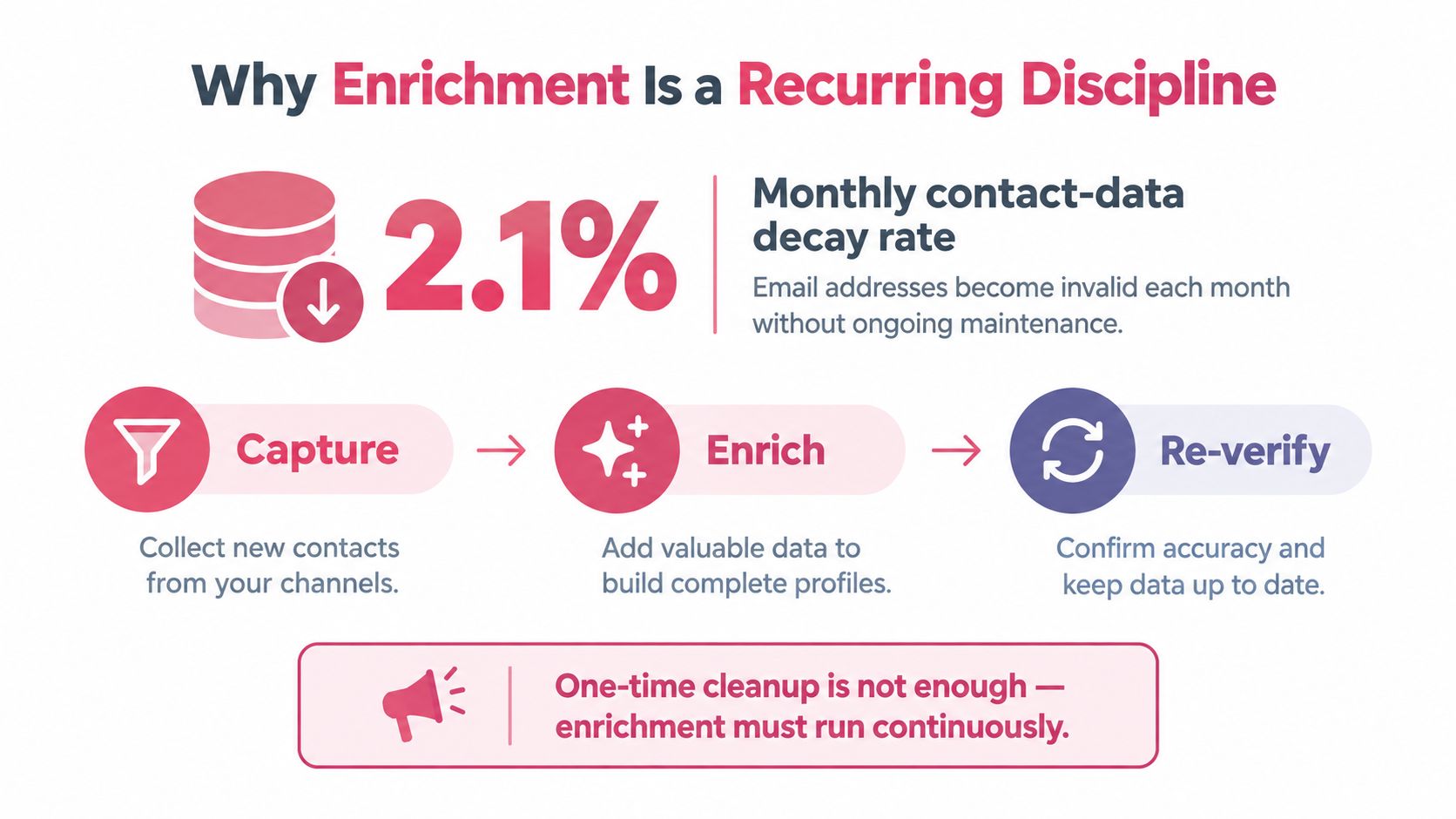
The commonly cited benchmark of 2.1% monthly contact data decay, which compounds to approximately 22.5% over a year, comes from industry reporting on CRM data decay. In a database of 10,000 leads, that annual benchmark implies roughly 2,250 records could become unreliable through job changes, title changes, restructuring, or obsolete contact details. If decay were spread evenly, about 210 records would need review or replacement each month.
That calculation isn't a promise about every database. Email addresses, phone numbers, job titles, and firmographic fields change at different speeds, and sectors with high employee turnover may move faster. The useful conclusion is operational: a populated field isn't a permanent fact.
Treat every attribute as an observation
A reliable enrichment program records at least:
- Observed date: When the provider or internal system saw the value.
- Verification date: When the team last confirmed it.
- Source: Which provider, system, or user supplied the value.
- Confidence: How strongly the evidence supports the value.
- Change event: What caused the record to be checked again.
This changes enrichment from a vendor action into a maintenance discipline. The team isn't merely appending an email. It is checking whether the person, role, company, and reachable channel still belong together.
The distinction matters because stale data spreads uncertainty into every downstream decision. ICP scoring may rank the wrong department. Personalization may mention an obsolete title. Routing may send an enterprise lead to a small business queue. Sequencing may use a dead address and treat the resulting bounce as a campaign problem.
Practical rule: Never let “field is populated” stand in for “field is trusted.”
A useful process combines scheduled refreshes with event driven checks. High value or actively sequenced records deserve closer attention than dormant leads. A bounce, job change signal, domain change, CRM edit, or failed validation should trigger re enrichment rather than waiting for the next general cleanup.
The dashboard should therefore track freshness, precision, recall, field coverage, confidence, and correction rate, not just the number of fields added. A one time append can make a CRM look complete while leaving the operating system of revenue decisions just as fragile.
What Breaks Downstream When Lead Records Go Stale
Consider a representative database containing 10,000 leads. The records are still present, the CRM sync is healthy, and dashboards load normally. Yet a meaningful share may contain at least one stale field under the commonly used decay benchmark, which means the system can appear operational while making poor decisions.
A senior contact changes employers but keeps the old company and title in the CRM. The ICP model sees a target account and a relevant role, so the lead receives a high score. The sequence then references responsibilities the person no longer has. The email may be well written, but it is aimed at an outdated identity.
A second contact still works at the company, but the stored email no longer reaches them. The sequence records a bounce, sales sees low engagement, and marketing may blame the message or the segment. The actual failure happened earlier, when the system treated reachability as permanent.
Follow the failure back to the field
| Pipeline symptom | Likely data problem | Preventive control |
|---|---|---|
| High score, poor qualification | Stale title, department, or company relationship | Recheck role and account identity before scoring |
| Bounces in an otherwise relevant segment | Obsolete or unverified email | Validate deliverability and retain verification dates |
| Wrong sales territory | Changed location, company structure, or account ownership | Refresh firmographic and routing fields |
| Generic personalization | Missing or uncertain role context | Suppress unsupported claims and label inferred signals |
| Conflicting account reports | Duplicate or incorrectly merged records | Resolve identity with confidence and veto rules |
A wrong company size can route an account to the wrong segment. An outdated domain can cause the matcher to attach a person to a former employer. A title change can make a formerly relevant decision maker irrelevant to the current buying motion. None of these failures necessarily breaks the CRM itself, so they often survive until a salesperson notices the pattern.
Defend the fields that drive action
Teams shouldn't enrich every possible attribute at the same cadence. They should first protect fields that control a downstream action:
- Identity fields, such as name, work email, domain, and company identifier.
- Routing fields, such as country, segment, employee range, and account ownership.
- Qualification fields, such as role, department, and buying authority.
- Personalization fields, which should be used only when their evidence is current and clear.
The CRM data quality reporting cited in industry coverage illustrates why field level checking matters. A record can retain a valid email while its title, phone number, or company relationship has changed. A binary valid or invalid label hides that distinction.
The practical response is simple: connect every important field to the decision it influences. If the field has no clear use, don't add the maintenance burden. If it controls scoring, routing, or outreach, give it a freshness rule and a confidence threshold.
Entity Resolution and the Precision Versus Recall Trade Off
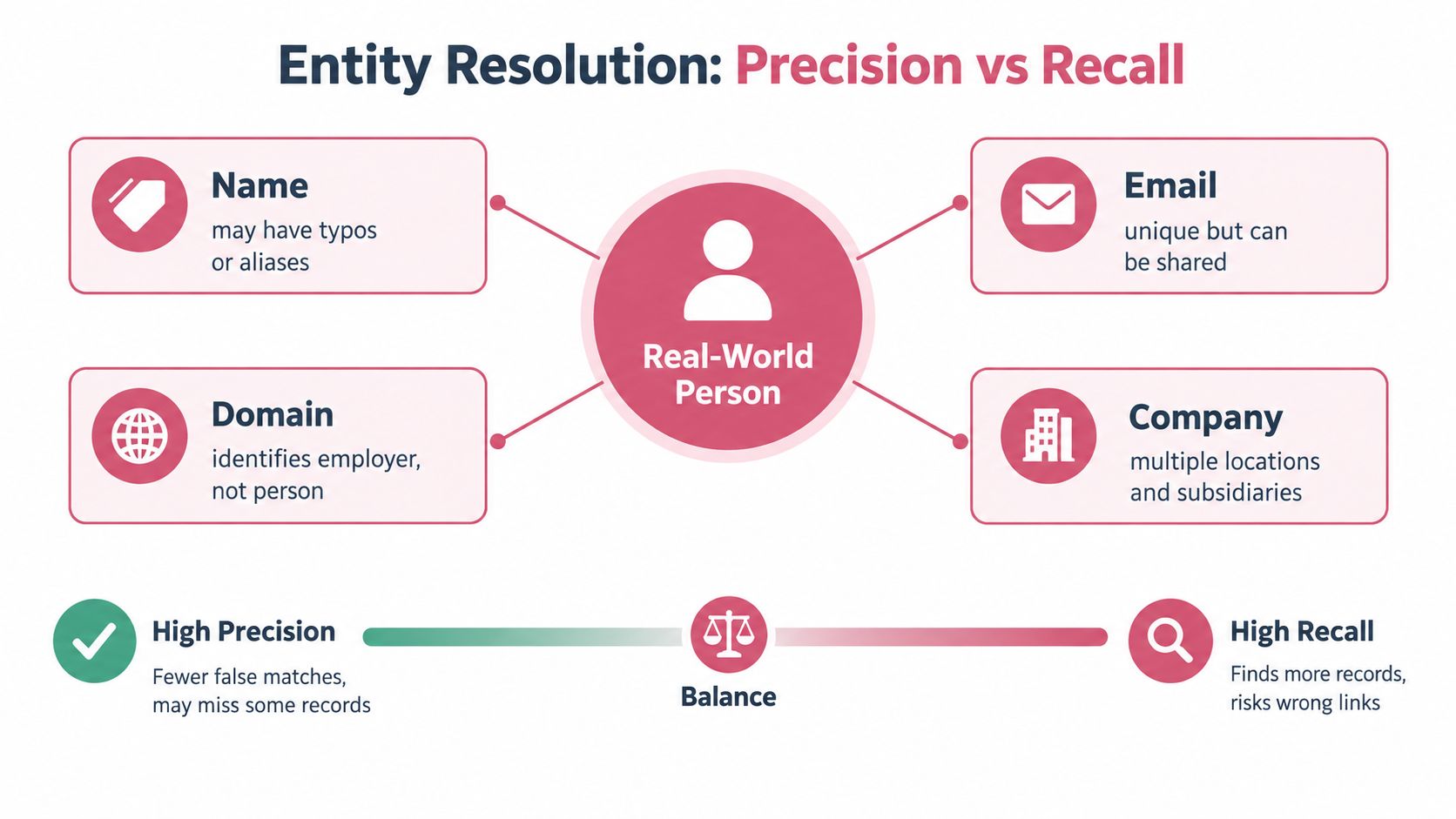
Entity resolution means deciding whether several clues describe the same real world person and company. A name may match many people. An email may be shared or forwarded. A domain identifies an employer, not necessarily the individual. A company may have subsidiaries, locations, or a changed legal name.
The easiest mental model is a filing cabinet. The name, email, domain, and company are labels attached to a folder. The system's job isn't to collect more labels. It must decide whether the labels belong on one person's folder, on separate folders, or in a review queue.
Two different errors
Precision asks how many proposed matches are correct. Low precision creates false positive merges. The system may attach one person's phone number or role to another person's CRM record, then propagate the mistake into every connected tool.
Recall asks how many true matches the system finds. Low recall leaves valid records unresolved, which reduces coverage but keeps uncertainty visible. The team can review those records later instead of acting on a confident looking error.
Recent benchmark work across six datasets ranging from 864 to 5 million records found that no single matching algorithm performed best in every setting, as documented in the entity resolution benchmark. That result supports a layered design rather than faith in one universal matcher.
A practical pipeline uses several candidate generation methods, then applies deterministic veto rules. Incompatible domains, countries, or company identifiers should block a proposed merge even if the name looks similar. Ambiguous matches should remain separate, receive a confidence score, and enter a review or retry queue.
Store the reason, not just the result
Every match should carry:
- Candidate evidence, including the fields that supported the link.
- Match method, such as exact email, domain plus name, or provider identity.
- Confidence score, separated from the enrichment values.
- Veto outcome, showing whether any hard conflict was found.
- Match rationale, so an operator can understand the decision.
Transitive propagation deserves particular caution. If record A is incorrectly linked to B and B is linked to C, an automated system may merge unrelated people or accounts into one cluster. The first wrong link then becomes evidence for the next wrong link.
A match is a decision supported by evidence, not a fact that becomes true because a provider returned it.
The safest write policy protects trusted data. A weaker source shouldn't overwrite a value that has stronger evidence. New values can sit beside existing values until the system decides which one is active, and unresolved records can stay unresolved without blocking the rest of the workflow.
Anatomy of a Modern Lead Enrichment Workflow
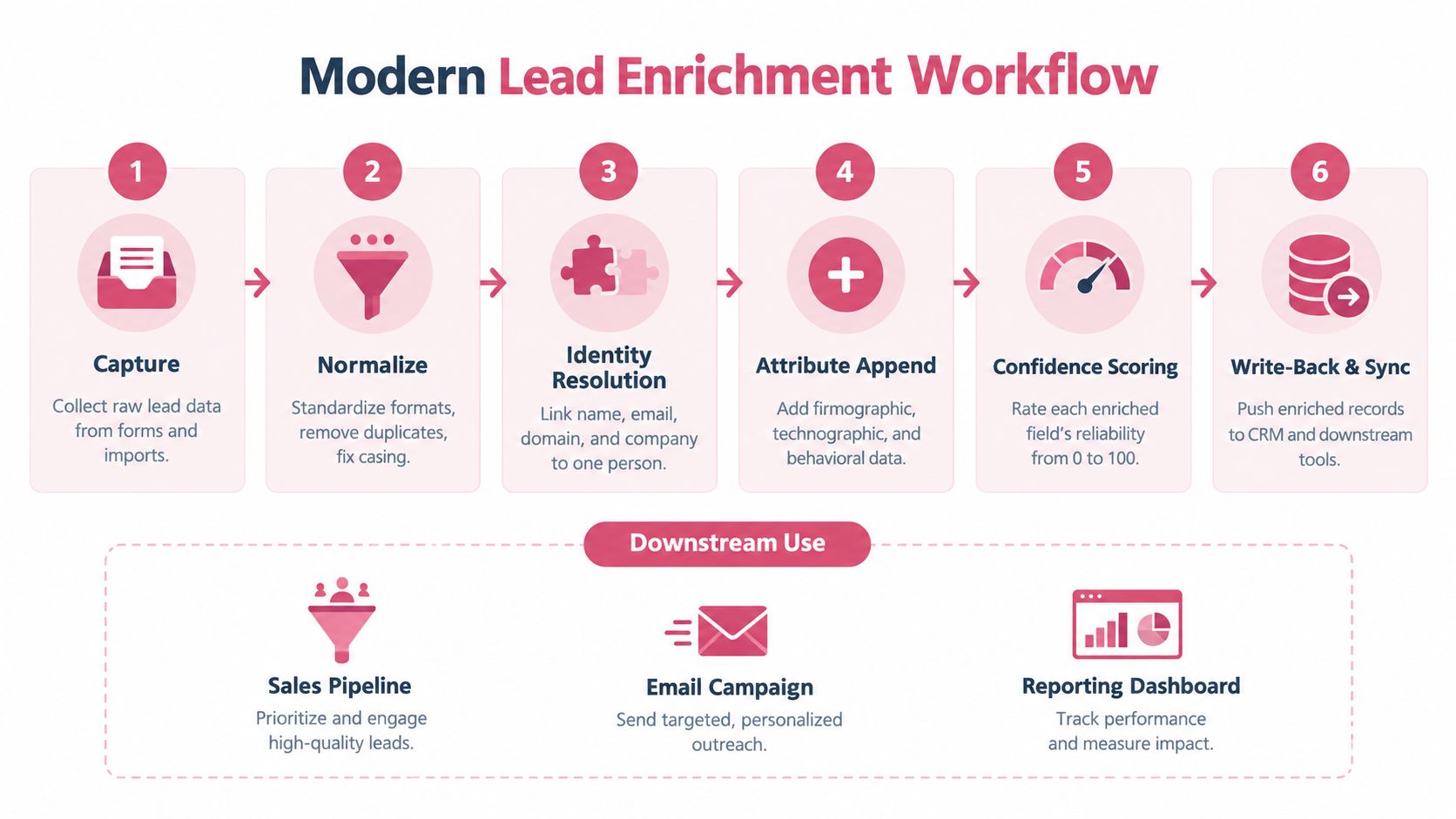
A dependable workflow separates capture, identity, attributes, confidence, and action. Each stage needs a quality gate because a clean looking output can still contain an incorrect person or an unsupported inference.
Start with raw input and normalization
Capture preserves the original submission, import, or event. Keep the raw value even after normalization so the team can trace what changed.
Normalize standardizes casing, phone formats, company names, domains, and duplicate patterns. It should not erase meaningful distinctions. A subsidiary and its parent may share a brand while requiring different routing or ownership.
Resolve identity only after normalization. Use several candidate methods, apply hard vetoes, and leave ambiguous matches separate. The system should be able to say “unresolved” without forcing a merge.
Append with field specific checks
Attribute append can add role, industry, employee range, company profile, contact details, or behavioral context. The quality gate must match the field:
- Email: Syntax checks only establish that a string looks like an email. They don't prove deliverability or ownership.
- Phone: A valid format doesn't prove that the number belongs to the intended person.
- Firmographics: Company size and industry may depend on provider definitions, so store the source and retrieval date.
- Buying signals: Treat inferred intent as a hypothesis, not as confirmed personal data.
Confidence belongs to each attribute, not only to the overall record. A work email may have strong evidence while a buying signal has weak evidence. Collapsing both into a single “enriched” flag hides the operational difference.
Write back without destroying history
Write only values that pass the relevant threshold. Preserve the previous value, source, verification date, and reason for change. Never replace a trusted value with an unverified null or a weaker source merely because the latest response is incomplete.
Then propagate approved changes to the CRM, sequencing system, reporting layer, suppression lists, and other destinations. The record isn't complete until downstream copies reflect the same decision.
For teams building a repeatable sales process, this guide for SaaS sales teams offers useful context on connecting enrichment with CRM workflows. Teams evaluating the surrounding stack can also compare best lead enrichment tools for 2026 by looking beyond coverage and checking how each handles provenance, confidence, and write back.
Trigger refresh by time and event
A scheduled cadence is necessary, but it isn't sufficient. Recheck high value or actively sequenced records more often, and trigger immediate review after:
- A bounce or failed validation.
- A job change or employer change signal.
- A company domain change.
- A material CRM edit.
- A provider conflict.
- A downstream correction request.
The pipeline should measure median enrichment time, completion before first contact, match rate, field accuracy from sampled audits, bounce rate, and correction latency. Speed matters because enrichment often supports a live response workflow. A Workato summary of lead response research reports that qualification odds fell by 400% when response time increased from five minutes to ten minutes, and that a test of 114 B2B companies found more than 99% did not respond within five minutes, with an average response time of 14 hours and 29 minutes. If a field can't be verified in the response window, pass the lead onward with an explicit uncertain status instead of blocking the handoff.
Why the Best Enrichment System Returns Fewer Records on Purpose
Maximum coverage is a tempting dashboard metric, but it can reward the wrong behavior. A system that fills every blank field may create more records for sales while making fewer records trustworthy. Missing data invites review. Incorrect data often looks complete and gets acted on.
A 2025 survey of more than 200 marketing operations and demand generation professionals found that nearly 75% said at least 10% of their lead data was inaccurate, outdated, or non compliant. More than 60% said poor data disrupted handoffs and reduced sales productivity, while 55% considered their current cleansing and enrichment tools inadequate. The same research reported that only 31% expressed complete confidence in compliance and 34% had experienced reputational or financial harm from privacy or governance failures, according to the cited contact enrichment quality control research.
Those findings point to a better operating question: how many records can the team use safely and confidently? Coverage still matters, but it should sit behind precision, freshness, explainability, and downstream outcomes.
Suppression is a quality feature
A record should be held back when:
- The person to company match is ambiguous.
- The source values conflict on a critical identity field.
- The email or phone cannot be verified to the required standard.
- The data is too old for the action being taken.
- The inferred signal is being mistaken for a factual attribute.
- A correction or suppression request is unresolved.
This doesn't mean discarding the record. Store it with a reason, a retry date, and the evidence required for resolution. A review queue is healthier than a sequence full of uncertain contacts.
A waterfall approach can help when one provider has no answer, but the system still needs stopping rules. Each additional source can increase coverage while also introducing conflicting definitions, weaker matches, and governance questions. The provider order should be based on field accuracy and business value, not on whether another response exists. The waterfall enrichment workflow discussion is useful when designing that fallback logic.
Measure the outcome, not the append count
A controlled test should compare an existing data group with a group receiving verified firmographic, role, and contact fields. Keep the offer, territory rules, channel mix, and follow up window consistent. Track valid account rate, delivery, replies, meetings, qualified opportunities, and revenue per accepted lead.
Industry compilations report that 88% of B2B marketers said enriched data improved lead quality and three quarters reported a positive effect on lead conversion rates, as summarized by data enrichment statistics from Data Partners. Those figures are directional because the compilation combines different sources and methods. A holdout test gives the operator a stronger answer for the actual motion.
The best system may therefore return fewer usable records. It wins when the accepted records are fresher, explainable, and more likely to survive contact with sales operations.
Compliance and Privacy Built Into the Pipeline
Data accuracy is a compliance requirement, not only a sales preference. Under the General Data Protection Regulation, organizations must keep personal data accurate and up to date and rectify or delete inaccurate data without undue delay. The European Commission's GDPR principles state that an individual's correction request should generally be handled without undue delay, in principle within one month.
That requirement becomes an engineering problem when the same person appears in a CRM, sequencing tool, reporting warehouse, suppression list, and provider cache. A correction process that updates only the CRM leaves the old value available for future outreach.
Map the obligation to a control
| Obligation | Operational Control |
|---|---|
| Keep personal data accurate | Store field level source, observation date, verification date, and confidence |
| Rectify inaccurate data | Create a correction workflow that updates every downstream copy |
| Delete data when required | Maintain deletion and suppression propagation across connected systems |
| Complete incomplete data | Add missing values only when the source and purpose are documented |
| Distinguish fact from inference | Label buying signals and scores as hypotheses rather than confirmed attributes |
| Handle individual requests | Provide an intake path, owner, deadline, evidence log, and completion record |
| Inform relevant third parties | Track where a value was propagated and send rectification notices where required |
The European Data Protection Board guidance on individual rights explains that people have the right to correction of inaccurate data and completion of incomplete data. If an organization has passed personal data to third parties, it must inform those parties of the rectification unless doing so is impossible or requires disproportionate effort.
Keep provenance attached to the value
A field should carry the provider, retrieval date, match method, confidence, and permission context. A common name match shouldn't receive the same treatment as a work email verified against a company domain and a corroborating account identity.
When a contact changes jobs, preserve the event rather than overwriting history. Update the active record, mark the former employer relationship as inactive, and propagate the change to CRM, sequencing, reporting, and suppression systems. Give people a clear way to challenge an obsolete title, wrong employer, or incorrect contact detail.
The one month correction principle also requires ownership. Someone must be able to find every copy, decide which values are active, pause affected campaigns, and record completion. If the enrichment architecture cannot answer where a value came from or where it went, the team won't have a defensible correction process.
How to Run Enrichment Inside a Unified GTM Stack
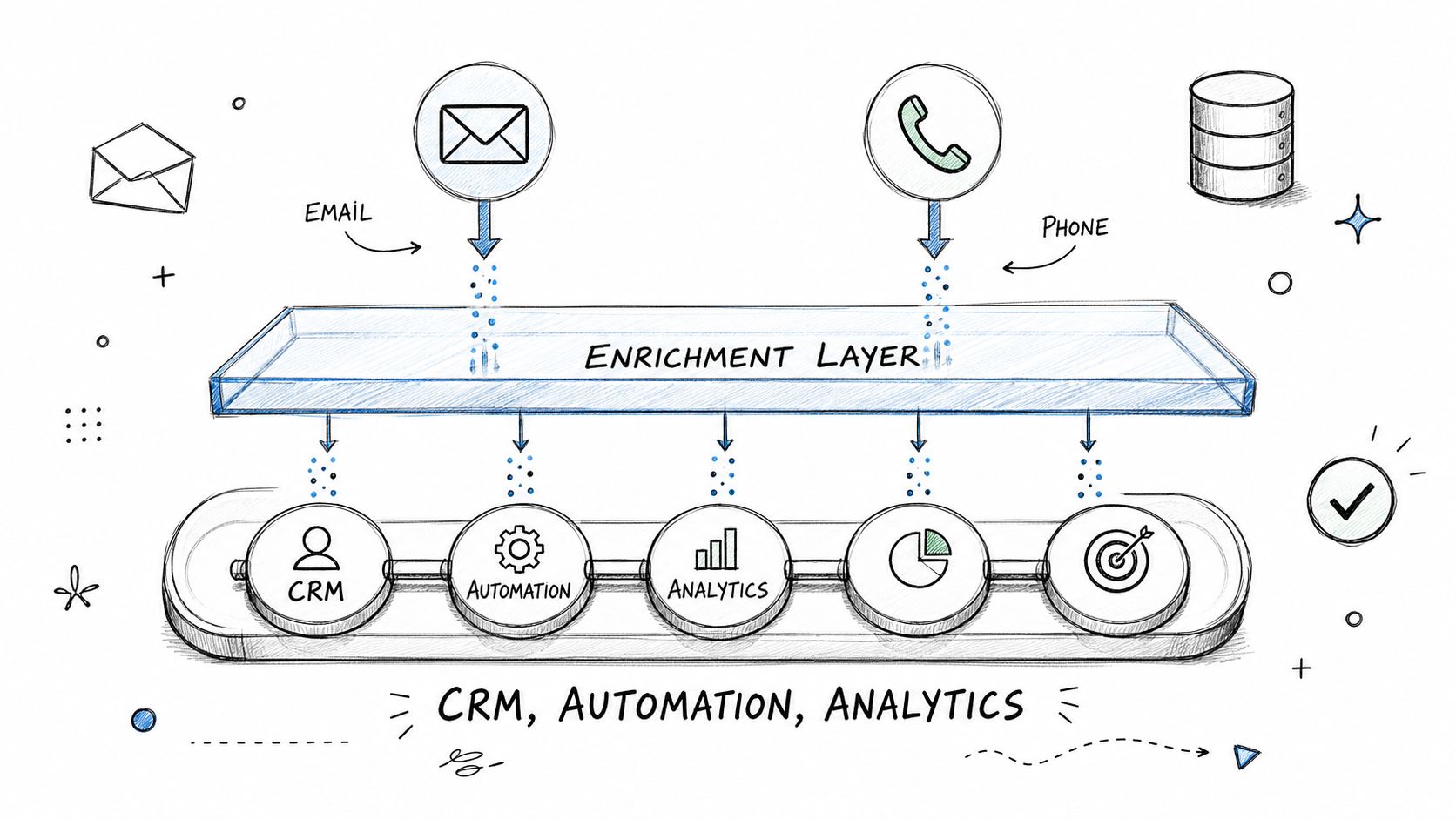
Lead data enrichment works best as a layer inside the GTM operating path, not as a spreadsheet export between disconnected tools. The workflow should accept a raw lead, normalize it, resolve identity, call the relevant enrichment providers, score the evidence, route the record, and report the result through one controlled interface.
Design the interface around decisions
A unified GTM API should expose actions rather than force every workflow to understand every provider. The orchestration layer can call email and phone enrichment, profile and firmographic data, CRM records, sequencing tools, chat surfaces, and reporting through one consistent pattern.
A useful request might ask the system to:
- Accept a lead from a form, inbox, import, or chat.
- Normalize the name, email, domain, and company.
- Resolve the person and account using multiple candidate methods.
- Apply veto rules before any write.
- Enrich only fields required for scoring, routing, or outreach.
- Attach source, timestamp, confidence, and rationale to each value.
- Route high confidence records automatically.
- Send uncertain records to review without contaminating the CRM.
- Return the result to the workflow that needs it.
- Log every step for audit and measurement.
This architecture lets a team swap providers without rewriting the entire motion. It also prevents a familiar failure mode, where the enrichment vendor knows the answer but the CRM, sequence, and reporting layer each hold different versions.
Separate hypotheses from proven plays
A useful intelligence layer can classify findings as hypothesis, validated, or proven. A new buying signal should begin as a hypothesis. After the team observes reliable performance across the defined test, it can become validated. Only repeated downstream evidence should promote it further.
Campaign telemetry should include:
- Source provenance, for every enriched attribute.
- Confidence state, for each decision and write.
- Human approval, for sensitive routing or outreach actions.
- Provider performance, by market and field.
- Correction history, including who changed what and why.
- Outcome feedback, such as replies, meetings, bounces, and accepted leads.
Campaigns should be graded against their success metrics. Underperforming plays can then retire instead of consuming more records. Winning plays become reusable operating knowledge, while weak assumptions remain visible and easy to challenge.
Put the human at the right control points
Automation should handle repetitive preparation, not remove judgment from sensitive actions. A human approval gate makes sense when the match is ambiguous, the data is privacy sensitive, the confidence is below threshold, or the next action sends a message to a prospect.
Yalc provides one example of this model. Its unified GTM API connects enrichment, CRM, sequencing, reasoning, and reporting so teams can compose workflows through an MCP or run configured playbooks from Slack and its interface. Teams comparing the architectural trade offs can review how to bring your own enrichment key into a unified GTM API, especially when provider flexibility and control over credentials matter.
The practical economics are straightforward. A standalone enrichment tool may return a useful answer, but operators still need to move it into the CRM, apply routing, start or suppress a sequence, and measure what happened. Orchestration reduces those handoffs and makes the record's journey observable.
A strong implementation starts with one high value workflow, such as inbound qualification or account based prospecting. Define the fields required for the decision, set confidence thresholds, log every write, and compare downstream outcomes with the previous process. Expand only after the workflow proves that better data changes a real operating result.
Yalc connects CRM enrichment, verified contact data, firmographic context, routing, sequencing, approvals, and campaign measurement through a unified GTM API. Visit Yalc to explore a controlled enrichment workflow that keeps provenance and confidence attached to every record before the next GTM action.