Lead Enrichment API: A Practical Guide for GTM Teams
A lead enrichment API can return hundreds of fields and still make a CRM less reliable. The constraint is governance, not coverage. B2B contact data decays at 2.1% per month and 22.5% annually, according to Apollo's guide to B2B data enrichment. If a team adds records without controlling match confidence, field ownership, provenance, and overwrite rules, a larger dataset creates more ways to route the wrong lead.
A production enrichment pipeline needs to answer four questions for every update. Which provider supplied the value? How confident is the identity match? When was the field last checked? What happens when the value conflicts with the CRM? The best architecture treats enrichment as a governed decision system behind a stable interface, not as a binary lookup.
Table of Contents
- Why Lead Enrichment Is a Governance Problem, Not a Data Problem
- Anatomy of a Lead Enrichment API
- Integration Patterns with CRMs and GTM Stacks
- Single Provider, Waterfall, or Unified GTM API
- Compliance and Security for Enrichment Pipelines
- Accuracy Under Real World Identity Resolution
- Choosing and Swapping Providers Behind One Interface
Why Lead Enrichment Is a Governance Problem, Not a Data Problem
Enrichment quality is decided by governance, and the API is only the delivery mechanism. A lead enrichment API accepts an identifier such as an email address, domain, company name, or LinkedIn URL, then returns firmographic, demographic, technographic, and intent fields. A production response should also include a confidence score, source information, and update timing.
Consider a RevOps team that raises its match rate from 70% to 85% without overwrite rules. It will route more incorrect contacts, not fewer. A smaller set of governed records supports better routing than a larger set with uncertain identity matches, unclear ownership, and no provider fallback.
The four decisions that control quality
The API call is simple. The operating policy determines whether its output improves the CRM.
- Trust: Define which providers and source types may populate each field. A provider may identify a title, industry, or phone number, but the CRM needs field-level source rules.
- Overwrite: New data must pass a field-specific rule before replacing a CRM value. A recently verified work email may take priority, while an inferred industry label may require review.
- Route: Set confidence thresholds for assignment, scoring, and outreach eligibility. A low-confidence match should enter a review queue or lower-intent motion, not the same path as a confirmed contact.
- Prove: Preserve the source, timestamp, previous value, new value, and decision behind every write.
Practical rule: Never let a provider response become CRM truth without a documented field contract and overwrite policy.
Provider drift creates another failure mode. Matching behavior, field definitions, and response structures can change while the endpoint stays stable. Put each provider behind one unified GTM API, capture provider versioning, store confidence and diffs, and keep match order configurable. If the first provider misses, the system should apply a defined fallback sequence rather than mixing untraceable results.
Document authentication, retries, pagination, webhooks, error handling, data ownership, and provider swap requirements before engineering starts. A practical guide to API integration requirements helps frame that work. The goal is accountability for every attribute, including its source, confidence, freshness, and permitted CRM action.
Anatomy of a Lead Enrichment API
A useful enrichment API has a small number of predictable operations. The person enrich endpoint usually accepts an email, or a full name combined with a company identifier, and returns professional attributes such as job title, seniority, function, social profiles, employment history, and a confidence score.
The company enrich endpoint normally uses a domain as its key. Its response can include firmographics such as headcount, revenue, industry, and funding, alongside technographics such as installed tools, content management systems, and advertising pixels. Some providers also return intent signals, but those fields need especially clear definitions because intent isn't a universal taxonomy.
The request and response contract
Bulk enrichment follows a different execution pattern. The client submits a CSV or creates a job, receives a job identifier and status URL, polls for completion, then retrieves the results. The pipeline should persist the job state and support retries without submitting the same records repeatedly.
A compact schema might look like this:
POST /person/enrich
{
  "email": "person@example.com",
  "company_domain": "example.com",
  "confidence_threshold": 0.80,
  "fields": ["title", "seniority", "email_status", "last_updated"],
  "include_lifecycle": true
}

{
  "match_score": 0.91,
  "email_status": "valid",
  "title": "Revenue Operations Lead",
  "seniority": "manager",
  "data_source": "provider_name",
  "last_updated": "timestamp",
  "confidence": 0.91
}
The exact payload will vary, but the concepts shouldn't. email_status should distinguish valid, catch all, and invalid results. match_score and confidence should remain numeric rather than being reduced to a yes or no value. last_updated and data_source should be retained when the record is written.
| Endpoint | Input Key | Returned Field Categories |
|---|---|---|
| Person enrich | Email, full name, company | Title, seniority, function, social profiles, employment history, confidence |
| Company enrich | Domain, company name | Firmographics, technographics, funding, intent, confidence |
| Bulk enrich | CSV or job ID | Requested person and company fields, job status, errors, source metadata |
The most important controls are usually a confidence_threshold, a fields selector, and an include_lifecycle option. Selective fields reduce unnecessary writes and make it easier to monitor which attributes affect conversion. Engineers looking for adjacent implementation material can use these data enrichment resources for engineers. Teams can also review the lead enrichment documentation on Yalc when mapping enrichment into a broader GTM workflow.
Integration Patterns with CRMs and GTM Stacks
Choosing between a CRM native workflow and a middleware layer is a common decision. Both can work. The wrong choice usually becomes obvious when the pipeline needs multiple providers, conditional writes, retries, or a reliable audit trail.
Pattern one, CRM native
A Salesforce Flow, HubSpot Workflow, or Zapier automation can call the enrichment API when a record is created. The workflow writes returned fields to the CRM and routes the record based on confidence.
This pattern is fast to launch and accessible to RevOps teams. It also creates predictable problems:
- Administration spreads: Each field mapping and exception becomes another CRM workflow to maintain.
- Rate limits move inward: Retries and batching compete with CRM automation limits.
- Objects diverge: Contact, lead, account, and campaign objects can develop different enrichment rules.
- Observability weakens: A failed API call may appear as a workflow error without a complete provider response or diff history.
CRM native enrichment suits a narrow motion with one provider and modest exception handling. It becomes fragile when the same identity logic must serve multiple systems.
Pattern two, middleware
A serverless function, reverse ETL job, or unified GTM API sits between the CRM and the provider. It receives the record, normalizes fields, applies match and overwrite rules, handles retries, and writes only approved changes.
This takes longer to build, but it centralizes the logic that matters. A provider swap becomes configuration rather than a rewrite of multiple Salesforce Flows. The middleware can batch calls, redact sensitive values from workflow logs, and preserve the source lineage outside the CRM.
| Dimension | CRM Native Workflow | Middleware or Unified GTM API |
|---|---|---|
| Latency | Often immediate for single records | Immediate or batched, depending on design |
| Observability | Fragmented across workflow logs | Centralized request, response, and diff logs |
| Rate limit handling | Constrained by CRM automation | Custom queues, retries, and batching |
| Field mapping | Distributed across objects | Normalized in one contract |
| Provider swap | Touches workflows and mappings | Usually a configuration change |
| PII exposure | More data may pass through workflow tools | Can be limited to the middleware boundary |
| Salesforce flow limits | Consumes native automation capacity | Reduces enrichment logic inside Salesforce |
| Build effort | Lower at the start | Higher initially, lower for ongoing change |
A thin API layer often wins once enrichment supports routing, scoring, personalization, and CRM synchronization. HubSpot teams can also use a HubSpot MCP integration when they need structured access to CRM actions inside a controlled automation layer.
Single Provider, Waterfall, or Unified GTM API
Provider choice should follow your governance model, not a preference for one vendor. A single provider keeps implementation simple, but it creates concentration risk. If coverage weakens for a region, role, or company type, the pipeline has no fallback. A waterfall tries provider A first, then calls provider B or C only when the result fails a defined test. A unified GTM API places those providers behind one contract and centralizes the decision rules.
The waterfall decides where data comes from. The unified API decides how that data is governed. Your team still needs explicit normalization, retry handling, confidence thresholds, match order, and provider replacement rules. Put those policies behind the interface so downstream workflows do not change when a provider does.
Published coverage ranges vary too widely to serve as benchmarks. Measure each route against a representative CRM sample instead. The figures cited in Explorium's B2B data API guide illustrate the problem: single-source APIs are reported at roughly 70% to 80% email match rates and 30% to 60% phone match rates, while multi-provider waterfalls can reach 98% verified email and 85% direct dial coverage on the same lead set. Treat those figures as directional, not as a promise for your records.
| Pattern | Match rate coverage | Swap cost | p95 latency | Operational risk |
|---|---|---|---|---|
| Single provider | Provider dependent | Low initially, high dependency later | Provider dependent | Blind spots and vendor drift |
| Waterfall | Can improve across providers | Moderate implementation effort | Adds sequential calls | Duplicate writes and inconsistent schemas |
| Unified GTM API | Depends on configured providers and retries | Lower after the abstraction exists | Must be measured by route | Governance complexity if policy is unclear |
A unified interface earns its place when enrichment feeds more than one workflow. It can normalize person and company records, apply scoring and routing decisions, and expose controlled CRM actions. Engineering gets one place to enforce idempotency. Operators get one view of failed matches, stale records, and provider responses.
Do not call every provider by default. Set the match order around the strongest identity key, stop when the confidence threshold is met, and record why each later provider was skipped or used. Add decay rules for fields that age quickly, then re-enrich only when their freshness window expires. More calls do not guarantee better data.
Teams comparing implementations can review waterfall enrichment patterns before deciding whether fallback logic belongs in the CRM, data warehouse, or unified API.
Compliance and Security for Enrichment Pipelines
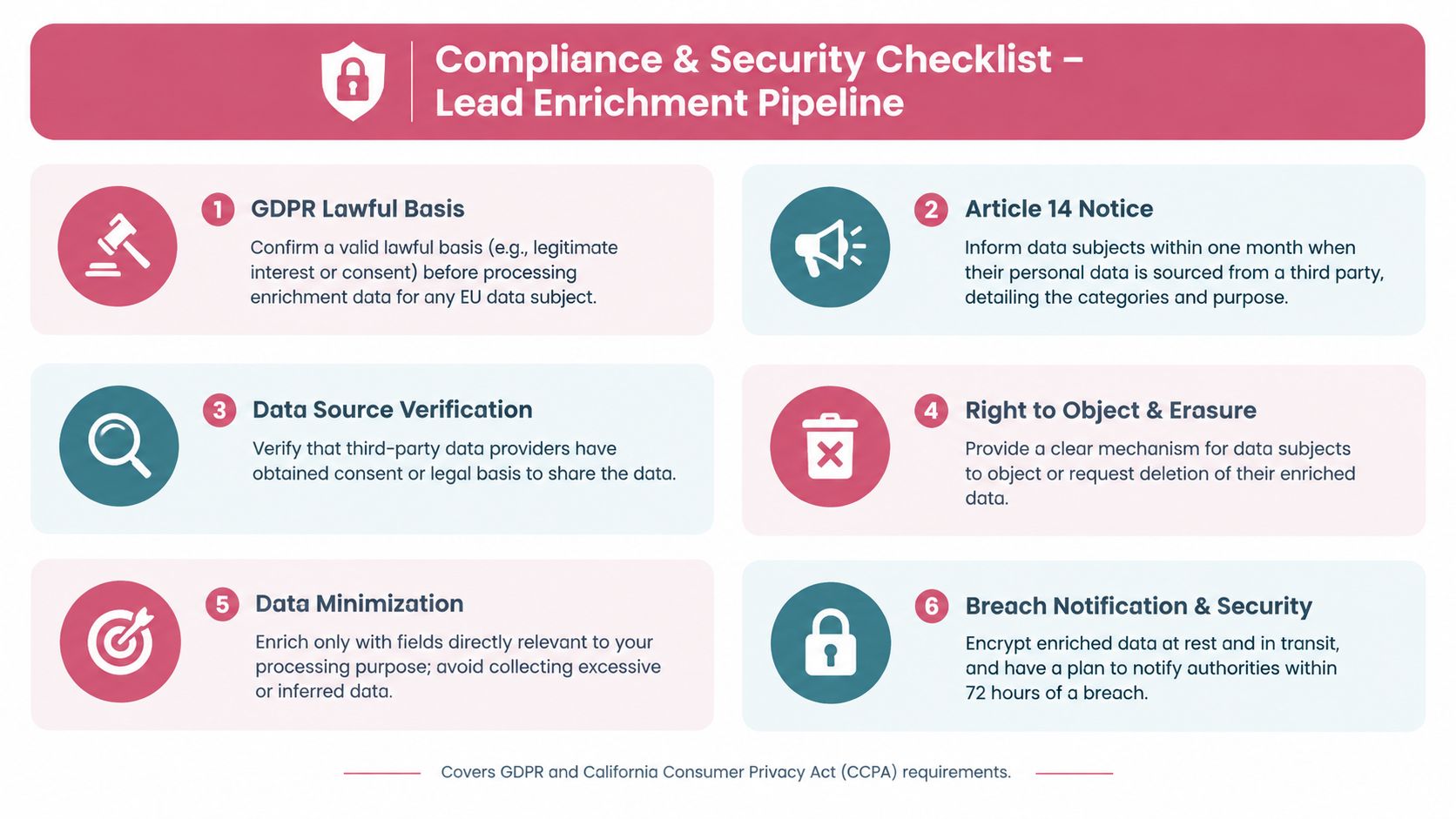
Compliance starts before the first API request. A team needs a lawful basis, vendor contracts, source documentation, retention rules, and a deletion path before enriched personal data enters an EU or California workflow.
GDPR doesn't always require individual consent for B2B contact enrichment. A legitimate interest basis under Article 6(1)(f) can cover business contact enrichment when the company documents a Legitimate Interest Assessment, explains where the data came from, and honors objections, according to Verum's guidance on GDPR and data enrichment.
The controls that need evidence
A pipeline should maintain the following records:
- Lawful basis: Store the processing purpose and the decision supporting legitimate interest or another applicable basis.
- Article 14 notice: When personal data comes from a third party, tell the person who controls it, why it is processed, the legal basis, the categories held, and the source. Vocal Media's practical Article 14 guidance describes these notice requirements.
- Vendor governance: Review each provider's DPA, subprocessors, data residency, retention period, and deletion commitments.
- Source lineage: Log the provider, source record, timestamp, fields returned, confidence, and final write decision.
- Rights handling: Propagate objections, suppression requests, and deletion requests to internal systems and relevant providers.
- Security: Restrict access, encrypt data in transit and at rest, and keep sensitive values out of general purpose workflow logs.
The controls that fail audits are usually operational omissions. There is no logged consent or legitimate interest state. The business can't show when a match occurred. A deletion request removes a CRM record but leaves the provider copy untouched.
A good audit trail should also capture negative decisions. If the API returned a low confidence match and the system refused to overwrite the CRM, that refusal is useful evidence. It demonstrates that the company applied a policy rather than accepting every provider response.
Accuracy Under Real World Identity Resolution
Vendor coverage does not solve identity resolution. A record can include an email, domain, and name while still identifying the wrong person. Shared domains, job changes, and catch all corporate addresses create false matches that look usable until they reach routing, scoring, or outreach.
Set an ordered match policy and enforce it in the API. Start with work email plus employer match. Then try work email plus LinkedIn match. Use domain plus name only as a fallback. Do not treat these paths as equivalent.
Confidence must control the write
A confidence threshold is a numeric gate, not a Boolean label. Records below 0.80 deserve cautious handling because a weak match can introduce noise into downstream systems, as detailed in Explorium's identity resolution guidance. Use that value as an initial policy, then validate it against known CRM records and each segment's error tolerance.
The write policy must vary by field. A high confidence identity match may allow a title update. It does not authorize overwriting a manually verified phone number or account owner. Define a source priority, freshness rule, and exception path for every field. Store the decision and confidence score, including rejected writes.
Accuracy rule: A failed match is safer than a confident looking match attached to the wrong human.
Given the decay rates covered earlier, enrichment cannot be a one time cleanup. Job changes, company moves, and market churn continually reduce the value of stored contact data.
Set recheck schedules by field risk. Recheck email validity and employment status more often than relatively stable company attributes. For example, a pipeline can recheck employment fields on a recurring schedule, while checking company attributes less frequently. The schedule should reflect segment risk and the cost of a bad write.
On each recheck, compare the new payload with the stored payload. Update only changed values. Retain the previous state, provider response, confidence score, and write decision for review. Put provider selection behind one GTM API so the same thresholds and match order apply when coverage changes.
Choosing and Swapping Providers Behind One Interface
Provider selection should be based on the team's own CRM sample, not a vendor demonstration. The sample needs records across target regions, company sizes, job functions, and data quality levels. The team should measure correct identity matches, usable fields, confidence behavior, latency, error handling, and the number of records that require manual review.
Eight criteria matter in production:
- Match rate on the team's data: Test against known CRM records and inspect wrong matches, not just returned values.
- Confidence granularity: Require a numeric score and the ability to set thresholds by workflow or field.
- Field taxonomy depth: Check whether titles, seniority, functions, industries, technologies, and lifecycle values map cleanly to internal definitions.
- Latency budget: Measure single record and bulk behavior separately, including retries and provider fallbacks.
- Article 14 support: Confirm that the provider can explain source categories and support the notices and records the controller needs.
- Cost per enriched record: Count successful matches, failed attempts, retries, and waterfall calls. A nominal lookup price isn't the full operating cost.
- Swap time: The provider should be replaceable in under four hours of engineering work once the field contract and adapter exist.
- Webhook idempotency: Replayed events must not create duplicate writes or erase a newer value.
Lock the contract before choosing the vendor
A unified GTM API collapses switching cost by exposing one internal endpoint while adapters handle provider specific requests. The internal contract owns field names, confidence semantics, source lineage, retry rules, and overwrite decisions. Providers become interchangeable only when those rules live outside the provider response.
Yalc offers this kind of unified GTM API approach, with connected enrichment providers behind one interface and orchestration that can preserve logs, approvals, and scoped data access. The team still needs to own the policy. An abstraction doesn't fix an undefined match order or a threshold that nobody reviews.
Three decisions should be locked this quarter:
- Field contract: Define the fields, types, allowed values, sources, and update rules.
- Match order: Establish which identifiers can produce an automatic match and which require review.
- Confidence threshold: Set the score that blocks automatic overwrite, then monitor false positives and rejected matches.
The team that makes those decisions can change providers without rebuilding its GTM motion. The team that skips them will keep buying new data while debugging old records.
Yalc connects enrichment providers through a unified GTM API, so teams can place matching, confidence rules, CRM writes, and audit steps behind one controlled interface. Visit Yalc to see how its API and GTM orchestration can support a governed enrichment pipeline without forcing the team to rebuild its motion around one provider.