10 Lead Enrichment Tools Compared for GTM Teams
No single data source wins every enrichment job. A database that finds US enterprise contacts may be a poor choice for European mobile coverage, while a privacy focused email verifier may be useless for company only discovery. The right selection depends on the workflow that turns a raw record into a qualified account, a routed CRM object, or an approved outbound action.
This comparison evaluates coverage, verification, compliance, API access, credit economics, CRM and engagement integrations, setup effort, and orchestration. The ten tools serve different operating models: enterprise databases, European privacy focused providers, developer APIs, self serve prospecting platforms, outbound capture products, and a unified GTM operating layer such as Yalc.
The practical decision is usually not “Which tool is best?” It's “Which tool should be the primary source, which should fill its gaps, and which system should govern the workflow?” Teams should define that sequence before signing a contract. A clean prospecting process needs reliable inputs, controlled enrichment, sensible CRM writeback, and a clear approval path, not another disconnected tab. Guidance on building clean prospect lists from BAMF supports the same operational principle: list quality starts with disciplined data handling, not with database size alone.
Table of Contents
- 1. Yalc
- 2. ZoomInfo
- 3. Apollo.io
- 4. Clearbit by HubSpot
- 5. Cognism
- 6. Lusha
- 7. People Data Labs
- 8. Dropcontact
- 9. UpLead
- 10. LeadIQ
- Top 10 Lead Enrichment Tools Comparison
- Choose the Data Layer That Fits the Motion
1. Yalc
Yalc is the strongest fit when the problem isn't merely missing contact data, but a fragmented GTM motion. It combines a unified GTM API, enrichment providers, CRM actions, sequencing, signals, models, and reporting behind one operating layer. That makes it different from a database such as ZoomInfo or a capture tool such as LeadIQ. Those products supply or retrieve data. Yalc governs what happens before and after the lookup.
The platform can connect enrichment, CRM, sequencing, and communication tools through one interface. Its enrichment layer includes waterfall lead enrichment for email and phone data through FullEnrich, while the broader system can connect providers such as Unipile, lemlist, Crustdata, Notion, Slack, and other API based services. The benefit is provider flexibility. A team can change an underlying source without rebuilding every play that depends on it.
Yalc also stores the operating context that most point tools leave scattered across documents and prompts. The GTM knowledge layer holds the ICP, positioning, voice, and proven plays. Engineers can compose workflows through the Yalc MCP in Claude Code. Operators can run prepared playbooks from Slack or the Yalc interface. Both surfaces use the same data and execution engine.
Where Yalc earns its place
The play library covers prospecting, lead qualification, visitor workflows, email enrichment, ICP scoring, CRM synchronization, campaign building, sequence running, reply handling, competitive intelligence, and reporting. Each campaign can be measured against its success criteria, with outcomes moving from hypothesis to validated to proven. Weak plays can be retired instead of being reused without scrutiny.
Practical rule: Use Yalc when enrichment needs to trigger a governed GTM process, not just populate another field.
Telemetry, scoped permissions, audit logs, and human approvals matter when the workflow can send messages or modify customer records. Yalc is delivered through an audit and forward deployed engineering engagement, with the system installed on infrastructure controlled by the customer, using the customer's keys and accounts. There's no public list price. The cost depends on the build scope and how much of the motion the operating system runs.
The trade off is implementation effort. Teams looking for a zero setup browser extension may find Yalc too involved. B2B startups, scaleups, RevOps leaders, founders, and agencies that want an owned, auditable GTM routine will get more value from the deeper setup. Explore the Yalc GTM operating layer.
2. ZoomInfo
ZoomInfo is the enterprise database choice for teams that need broad account intelligence, intent signals, and mature operational integrations. It fits a sales or marketing organization that wants one large commercial data environment connected to Salesforce, HubSpot, Marketo, and related systems. Its enrichment is packaged within a wider SalesOS and MarketingOS approach, rather than sold as a lightweight standalone lookup tool.
The platform covers contact, account, technographic, and intent data. Bulk enrichment and API access support scheduled CRM maintenance, while engagement, conversation intelligence, advertising, and other modules can extend the commercial workflow. That breadth is useful when sales, marketing, and operations need a shared account view and centralized governance.
ZoomInfo's main strength is operational scale. A large team can standardize account research, route records, identify buying signals, and connect enriched fields to downstream campaigns without assembling every connector independently. It's particularly compelling for US focused teams with a defined territory model and enough usage to justify an enterprise contract.
The contract deserves as much scrutiny as the data
The buying risk is not just price. ZoomInfo uses quote based contracts, and buyers need to understand duration, credit consumption, module boundaries, export rights, refresh behavior, implementation support, and renewal terms. A broad database can become expensive if reps use it sporadically or if enrichment runs against records that don't meet the ICP.
Reported 2026 comparisons place ZoomInfo's verified email performance at 85% in a mainstream vendor comparison, cited in the 2026 lead enrichment benchmark. That figure should be treated as a benchmark signal, not a guarantee for a specific segment. Geography, industry, role, and refresh cadence still affect results.
Enterprise buyers should test their own records before accepting a large data contract.
Teams comparing ZoomInfo with broader workflows can also review lead enrichment tools for 2026. ZoomInfo is best when breadth and intent justify the commercial complexity. It's a poor fit for a small team that needs occasional verified emails and a simple export.
3. Apollo.io
Apollo.io is the practical self serve choice for teams that want prospect data and outbound execution in one product. It combines people and company enrichment with CSV enrichment, form enrichment, CRM synchronization, native sequences, a dialer, inbox tools, job change alerts, and AI research. That combination reduces setup time for startups and smaller sales teams.
Apollo works well when the workflow is straightforward. A team can identify a target segment, enrich a list, select contacts, place them into a sequence, and monitor replies without passing records through several separate systems. Its API also supports programmatic lookups and enrichment, although teams need to understand how credits are consumed across searches, exports, and enrichment actions.
The advantage is speed. Sales teams can get from an ICP definition to a working outbound motion without building a custom data pipeline. The limitation is that the same convenience can hide unit economics. If users export broadly, enrich repeatedly, or run automations against low quality inputs, credits can disappear without improving pipeline quality.
Best for combined data and outreach
Apollo's reported verified email performance was 80% in a 2026 comparison of mainstream enrichment vendors, according to the vendor benchmark. That result places it below some enterprise and specialist options in that comparison, but the product can still win on total workflow value because sequencing and prospecting live beside the data.
Teams should establish credit rules before opening access. Search, export, enrichment, and sequence entry should have distinct permissions where possible. CRM writeback also needs field ownership rules, especially for job titles, company domains, and phone numbers.
Apollo is a good primary tool for a lean outbound team. It's less suitable as the only source for a niche international market where coverage needs to be proven account by account. For teams that want to compare adjacent prospecting products, the guide to Apollo competitor tools provides another useful reference.
4. Clearbit by HubSpot
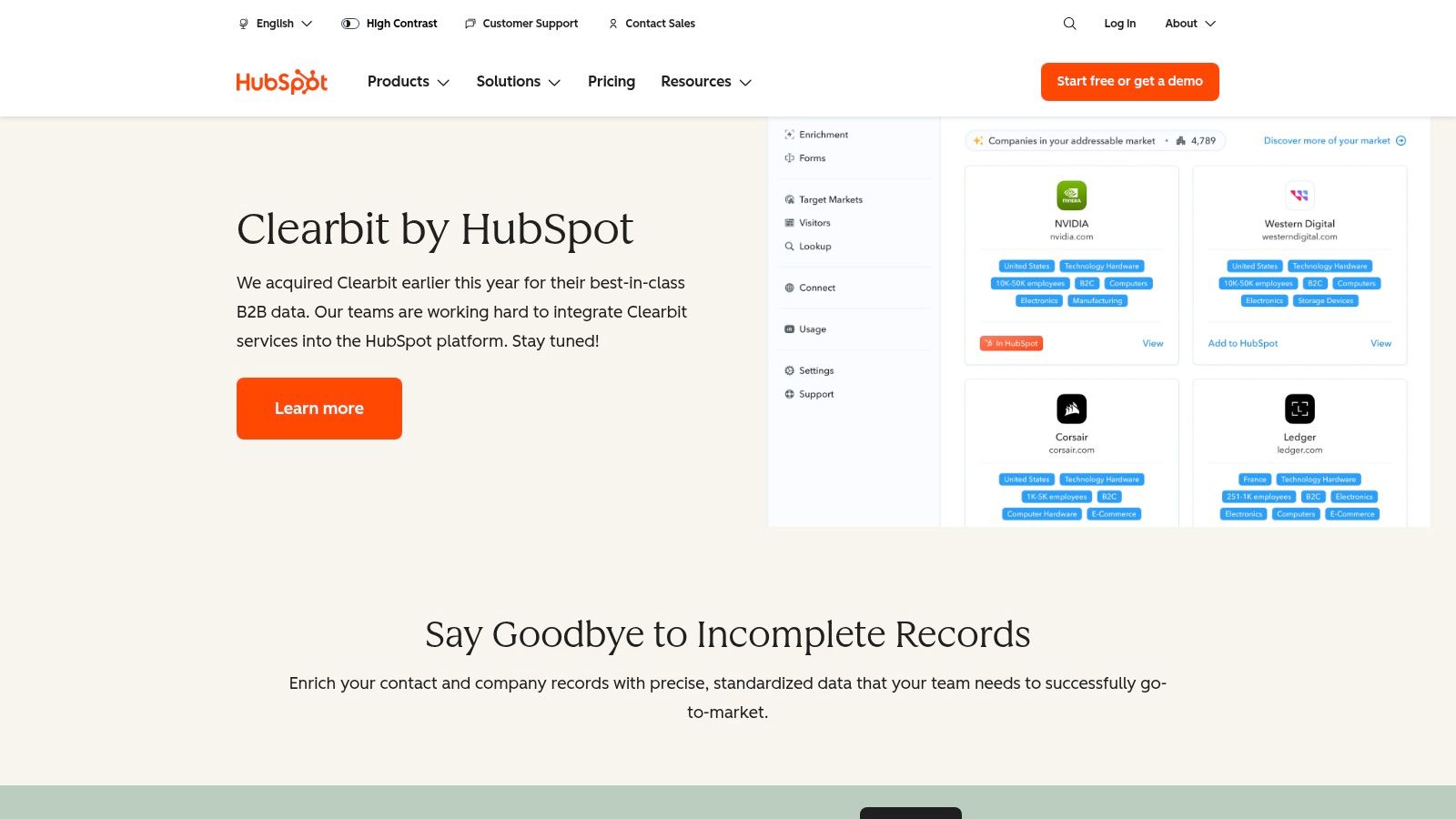
Clearbit by HubSpot makes the most sense for a HubSpot first organization. Its value comes from the connection between enrichment, website visitor identification, audiences, marketing automation, advertising, and CRM workflows. Teams already operating inside HubSpot can reduce integration overhead by keeping company and person enrichment close to the objects, forms, and workflows that use the data.
Clearbit's Reveal functionality helps identify companies interacting with a website and supports audience building inside the HubSpot environment. Company and person attributes can feed segmentation, routing, personalization, and automation. That's a different job from building a large outbound database. Clearbit is strongest when inbound activity already exists and the team needs more context around it.
The platform is no longer a standalone buying decision
Since the acquisition, packaging and pricing run through HubSpot. The previous standalone free product is no longer the right reference point, and buyers should assess the capability within their HubSpot plan, data requirements, user permissions, and automation design. Teams outside HubSpot lose much of the operational advantage because they'll need to recreate the surrounding workflows elsewhere.
The key implementation question is field behavior. Decide which values Clearbit can overwrite, which values require review, and how HubSpot handles conflicts between enrichment, form submissions, sales edits, and CRM imports. A clean integration can improve routing. An uncontrolled one can replace useful human context with stale values.
Clearbit is a strong fit for marketing operations teams that already trust HubSpot as the system of record. It's not the obvious choice for a Salesforce first team, a developer building a warehouse pipeline, or an outbound team that mainly needs direct dials. Review the current Clearbit product experience from HubSpot before evaluating contract scope.
5. Cognism
Cognism is the specialist choice for teams that sell across Europe and need compliance controls alongside mobile coverage. Its data workflow emphasizes GDPR focused collection, multi region do not call screening, and verified mobile numbers. That makes it more relevant to EMEA prospecting than a US first provider that happens to offer international records.
Cognism supports contact and company enrichment, CRM and engagement integrations, browser access, and compliance tooling. Its security and privacy program includes ISO 27001, ISO 27701, and SOC 2 Type II claims in the product positioning. Buyers should still review the current contractual documentation and processing arrangements for their own use case.
The main operational advantage is governance. A European sales team can build phone based outreach with clearer screening requirements and a workflow designed around regional compliance. That doesn't remove the need for a lawful basis, internal suppression rules, retention controls, and documented outreach policies. The tool supports the process, but the customer remains responsible for how the data is used.
Coverage needs a regional test
Cognism reported 87% verified email performance in a 2026 comparison, as recorded in the lead enrichment vendor benchmark. The number is useful for comparison, but it doesn't establish performance for every country or vertical. Buyers should test the specific markets where reps will call and email.
Cognism is quote based and generally isn't the lowest cost option. US coverage breadth can also trail US centric incumbents. Choose it when EMEA mobile reach, compliance rigor, and governance matter more than finding the broadest possible database at the lowest apparent unit cost.
6. Lusha
Lusha is built for fast, flexible capture. Its browser extension, Workspace, API, CRM integrations, and shared credit model let reps find contact details during research while operations teams run enrichment through a more controlled workflow. The same credit pool can support extension usage, workspace searches, API calls, and data waterfall actions.
That flexibility helps mixed teams. A rep can reveal a contact while working in a browser, while RevOps can use the API to enrich inbound records or update selected CRM segments. Lusha is easier to introduce than a heavy enterprise database, and users generally understand the basic interaction quickly.
The trade off is credit velocity. Phone reveals and high volume API usage can consume credits rapidly, especially when users enrich records that aren't qualified or repeat the same lookup across systems. A shared pool needs clear rules for who can spend credits and when a CRM record is considered sufficiently complete.
Use Lusha for targeted gaps
Lusha is a sensible choice when the team needs practical contact enrichment without a lengthy deployment. It can also support a waterfall strategy, where one provider is queried and another is used when the first source returns no usable field. The operational design matters more than the label. Teams should document which provider owns each field and whether a new value can replace an existing verified value.
A useful explanation of this approach appears in the guide to waterfall enrichment. Waterfalling can improve contactability, but it can also create duplicate charges and conflicting values if matching and provenance aren't tracked.
Lusha is less attractive for teams that need very deep intent data, large enterprise governance, or heavy phone enrichment at predictable cost. It's strong for targeted capture, smaller teams, and workflows where user adoption matters as much as database breadth.
7. People Data Labs
People Data Labs fits engineering-led teams that need to build enrichment into their own GTM data workflow. It provides person and company APIs, bulk endpoints, match tuning, SDKs, documentation, and data delivery options. Rather than operating as a sales application, it supplies a data layer that sends enriched fields to the CRM, warehouse, scoring system, or internal product.
That separation gives technical teams control over schema design, matching logic, retries, field normalization, caching, and writeback rules. Revenue operations can define a data contract covering trusted attributes, conflict resolution, provenance, and the conditions that return a record to the enrichment queue.
The trade-off is ownership. PDL does not replace a sequencer, CRM administrator, lead router, or quality process. The implementation must handle incomplete matches, monitor API behavior, and map inputs consistently across systems. Weak schema decisions can make a capable API appear unreliable.
The right fit is a controlled internal pipeline
PDL's pay-per-match model and match-tuning support suit teams measuring successful identity resolution instead of paying for every broad search. Developers should test domain, email, name, and company matching separately, then review false positives rather than counting returned records alone.
An API is not a data quality strategy. Matching, provenance, validation, and writeback rules still belong in the customer's system.
Review security and compliance documentation with the technical materials. PDL works well when engineering owns enrichment as an internal capability and several products need consistent access to the same data. It is less suitable for sales teams seeking a browser extension and an immediately usable outbound list.
Read more about People Data Labs enrichment, then compare the build and maintenance work with a unified operating layer such as Yalc. The broader lead enrichment guide can help place PDL alongside databases, APIs, and CRM workflows before you commit to a custom pipeline.
8. Dropcontact
Dropcontact is the privacy focused European option for teams that need nominative business emails generated and verified in real time. It works from person level inputs such as first name, last name, and company, then enriches contact and company details. Its approach is different from a static database because the workflow focuses on generating and checking the address rather than just returning a stored contact record.
That model can appeal to privacy conscious teams selling in Europe. Dropcontact positions itself as GDPR compliant and CNIL audited, which gives buyers a clearer basis for due diligence. The customer still needs to document its lawful basis, suppression process, retention policy, and outreach controls. Vendor positioning isn't a substitute for internal compliance ownership.
The product integrates with CRMs and supports CSV or batch processing. It's useful when a team already has a named contact and needs a work email for routing or approved outreach. It isn't designed for company only discovery, where the team has a domain but no person identity.
Email strength, limited phone depth
Dropcontact's focus is email. Mobile direct dials are limited, so a phone first outbound motion may require a second provider. That limitation is not a flaw if the team mainly needs verified business email generation. It becomes a constraint when the workflow expects one tool to supply email, mobile, intent, firmographics, and sequencing.
Teams should validate domain patterns, role changes, catch all handling, and suppression behavior before writing results into a CRM. The most useful implementation keeps the original input, generated value, verification status, timestamp, and source visible to downstream users.
Explore Dropcontact's enrichment service if EMEA privacy expectations and real time business email verification outweigh the need for a broad contact database.
9. UpLead
UpLead is a good self serve option for SMB and mid market teams that want verified email focused prospecting, company enrichment, technographics, and buyer intent without a heavyweight enterprise deployment. The interface is approachable, and the product supports CRM, outreach, suppression, and API workflows at higher plan levels.
Its strongest use case is a team that has a clear ICP and needs a manageable prospecting database. Users can search for people and companies, enrich existing records, and move selected contacts into downstream sales tools. The self serve model makes testing easier than a quote only procurement process.
The limitation is depth. UpLead may trail enterprise incumbents in some segments, especially where the team needs broad account intelligence, complex intent signals, or unusual international coverage. API access and more advanced capabilities also depend on plan level, so buyers should evaluate the actual workflow rather than the feature list.
Validate fields, not just matches
Independent guidance suggests buyers should expect roughly 85% to 95% accuracy from top B2B enrichment platforms, while also warning that industry and geography can materially change results. The same recommendation advises testing 150 to 200 of your own accounts and checking the output with a third party verifier, as described in guidance on evaluating data enrichment software.
UpLead is a reasonable first provider for smaller teams, but it shouldn't be trusted blindly. Test verified email, title, company, industry, technology, suppression, and CRM routing separately. A record with one correct field isn't equivalent to a contact ready for outreach.
Choose UpLead when transparent self serve access and a balanced feature set matter more than enterprise breadth. Review UpLead's current platform before selecting a plan, since access to API and intent capabilities can affect the operating model.
10. LeadIQ
LeadIQ is an outbound capture product. It helps reps source contacts, often from LinkedIn, enrich people and companies, and route the results into CRM or engagement systems. Its browser extension and job change tracking support a fast workflow where a rep identifies a relevant account, captures contacts, and sends clean records into the next sales action.
That focus makes LeadIQ different from ZoomInfo and PDL. It isn't trying to be the deepest enterprise database or the most flexible raw API. It optimizes for the moment when a seller has found a prospect and needs to capture useful data without switching between multiple tools.
LeadIQ supports people and company search, email and mobile discovery, CRM and webform enrichment, API access, and job change monitoring. Paid tiers determine database access and credit allocations, so operations teams need to understand how searches, captures, and exports are charged.
Capture quality still needs governance
A filled phone field isn't automatically a usable phone field. In a May 2026 independent test of 1,400 US B2B contacts across ten providers, 60% of returned mobile numbers reached the right person, 25% reached someone else, and 15% couldn't be confirmed, according to the phone enrichment benchmark. The result reinforces a simple rule: routing accuracy and verification status belong in the workflow, not just the output schema.
LeadIQ is well suited to outbound teams that value capture speed and job change signals. Its database breadth may be narrower than large data providers, and credit access varies by plan. Use it as a capture layer, or pair it with a stronger enrichment source when the team needs broader coverage.
Top 10 Lead Enrichment Tools Comparison
| Product | Core features | Quality & Rating ★ | Value / Pricing 💰 | Target audience 👥 | Unique selling points ✨ |
|---|---|---|---|---|---|
| Yalc 🏆 | Unified GTM API, GTM knowledge layer, play library, two surfaces (MCP + Slack/UI), telemetry & approvals | ★★★★☆, self‑grading, audit trail | 💰 Custom / scoped build; positioned vs hiring GTM engineers | 👥 B2B startups & scaleups, RevOps, founders, agencies | ✨ Forward‑deployed GTM + software engineers; runs on your infra; plays as portable IP |
| ZoomInfo | Contact/account/intent data, bulk & API enrichment, RevOps integrations | ★★★★☆, broad coverage & signals | 💰 Quote-only, enterprise contracts | 👥 Enterprise / US-focused RevOps teams | ✨ Deep firmographics & intent signals; mature integrations |
| Apollo.io | Prospecting + enrichment + native sequencer, dialer, API | ★★★★☆, strong time‑to‑value for SMBs | 💰 Mid-tier, credit-based consumption model | 👥 Startups & SMBs needing an all‑in‑one stack | ✨ Native outreach stack (sequences, dialer) + AI research |
| Clearbit (HubSpot) | Company/person enrichment + Reveal; native HubSpot mapping | ★★★★, seamless HubSpot UX | 💰 HubSpot‑packaged pricing; no free tier | 👥 HubSpot-first marketing & sales teams | ✨ Tight HubSpot object integration & Reveal visitor ID |
| Cognism | Contact & company enrichment, verified mobile, DNC/TPS screening, certifications | ★★★★, compliance‑forward, strong EMEA mobile | 💰 Quote-based; premium for compliance features | 👥 Teams selling in EMEA or requiring strict compliance | ✨ GDPR-first sourcing, mobile verification, ISO/SOC certs |
| Lusha | Email & phone reveals, browser extension, unified credit pool | ★★★, fast onboarding & adoption | 💰 Credit-based; flexible across extension/API | 👥 SDRs and SMB sales teams | ✨ Simple browser extension + shared credit model |
| People Data Labs (PDL) | Developer APIs, bulk feeds, match‑tuning, SDKs | ★★★★, engineering-friendly & scalable | 💰 Pay-per-match / transparent pricing guidance | 👥 Engineering teams building internal enrichment | ✨ Robust docs, match tuning, enterprise delivery options |
| Dropcontact | Real‑time nominative email gen/verification, CRM sync, GDPR/CNIL focus | ★★★★, privacy-first accuracy | 💰 Subscription (privacy/compliance emphasis) | 👥 Privacy-conscious EMEA prospecting teams | ✨ Generates/verifies emails in real time without a static DB |
| UpLead | Verified email accuracy, technographics, API (pro), intent | ★★★, approachable pricing & verified emails | 💰 Transparent plans; free trial path | 👥 SMBs & mid-market GTM teams | ✨ Emphasis on verified email accuracy and transparent pricing |
| LeadIQ | Prospect capture (Chrome ext), CRM/webform enrichment, job-change alerts | ★★★, purpose-built for outbound list building | 💰 Tiered plans with credits | 👥 Outbound teams, SDRs, recruiters | ✨ Fast LinkedIn capture and CRM routing for quick lists |
Choose the Data Layer That Fits the Motion
Start with the motion, not the vendor category. A team running US focused enterprise selling with account based marketing, intent signals, and formal RevOps governance should begin with ZoomInfo. Its value comes from breadth across contacts, accounts, technologies, intent, and mature CRM integrations. The contract needs careful review, but the operating model fits organizations that can use the depth consistently.
A smaller team that wants to search, enrich, and sequence from one workspace should test Apollo.io. UpLead is a better comparison when self serve access, verified email focused prospecting, and approachable operations matter more than a built in outbound suite. Neither should be judged only by the number of records returned. Field level validity, export behavior, and deliverability determine whether the data survives contact with production.
HubSpot teams should evaluate Clearbit by HubSpot inside their existing CRM and marketing architecture. It can reduce integration work for visitor identification, enrichment, segmentation, and automation. Teams selling across Europe should compare Cognism and Dropcontact. Cognism is the stronger fit when verified mobile coverage, EMEA reach, and compliance tooling drive the buying decision. Dropcontact is more focused when the input already identifies the person and the priority is generating and verifying a business email.
Engineering led organizations should consider People Data Labs for APIs, feeds, match tuning, and internal data products. The team will need to own schema mapping, QA, retry logic, provenance, and CRM writeback. Lusha is the more flexible choice for mixed browser, workspace, CRM, and API usage, while LeadIQ fits reps who need fast outbound capture and job change monitoring.
The final category is orchestration. A team can use multiple providers, but without a governing layer it may create duplicate records, conflicting fields, repeated credit charges, and inconsistent approval behavior. Yalc fits teams that want to connect enrichment providers with CRM, sequencing, signals, research, and reporting through one GTM API. Its value isn't another isolated database. It is the operating system that preserves context, runs playbooks, grades results, and keeps sensitive actions under human control.
Buyers should test a representative sample before signing a contract. The underserved operational question is not whether a vendor claims strong coverage. It's whether the vendor returns the fields the team needs, in the regions and verticals it serves, with enough validity to support real outreach. Independent benchmarking found email coverage ranging from 41.3% to 87.1% across 14 tools, with a median of 58.9%, in a June 2026 test of 5,000 submitted contacts. A separate test of 20,000 contacts reported real enrichment rates from 14.2% to 54.9%, showing why coverage and validity must be measured separately, as detailed in the B2B enrichment accuracy benchmark.
Use a sample of 500 to 1,000 CRM records for the buyer test. Measure field level fill rates rather than record level match rates, then run a 30 day deliverability test on enriched emails. Check verified fields, credit consumption, routing accuracy, duplicate handling, suppression logic, API limits, approval steps, and CRM writeback. Also test whether a value is verified at query time or merely resold from a static list. A database that looked accurate months ago may already be stale, and adding more unverified data to a dirty CRM can compound error instead of fixing it.
Teams can add a LinkedIn capture or LinkedIn scraping API to the test only when the use case and compliance review support it. The important point is to test the complete path from source to approved action. Enrichment should improve qualification and contactability, not just increase the number of populated fields.
The data enrichment solutions market shows why this category keeps attracting budget. One estimate valued the global market at USD 2.37 billion in 2023 and projected USD 4.58 billion by 2030, with a 10.1% CAGR from 2024 to 2030. North America held 35.07% of regional revenue in 2023, while cloud deployment represented about 56% of the market, according to Grand View Research's market analysis. A separate estimate put the market at USD 2.2 billion in 2024 and projected USD 3.4 billion by 2030, with a 7.4% CAGR, as reported by Research and Markets. The estimates differ, but both point to sustained investment in data quality, compliance, and customer intelligence.
That investment doesn't make a single provider correct for every team. Choose the source that matches the geography, contact method, CRM architecture, and operating budget. Then add orchestration when the workflow spans several providers or requires repeatable approvals, measurement, and learning.
Yalc connects enrichment providers, CRM systems, sequencing, signals, and GTM playbooks through a unified operating layer, so teams can improve data workflows without stitching every action together manually. Visit Yalc to see how an owned, auditable GTM system can turn enrichment into a repeatable sales motion.