Lead Generation AI Explained for Modern GTM Teams
By 2025, 81% of B2B sales teams had adopted AI, while 67% of B2B companies were using AI in at least one marketing automation workflow. The more important shift is happening underneath those adoption figures: 62% of B2B marketing teams had moved from raw MQL volume to sales accepted lead rate as the primary scoring health metric. The 2025 B2B lead generation trend data points to a change in operating logic, not just a change in software.
A typical GTM morning makes the difference clear. Without a coordinated system, a marketer exports a list, an operations manager cleans duplicates, a sales development representative researches accounts, and a manager checks whether anyone followed up. The process produces activity, but the team may still struggle to explain why a prospect was selected or whether the timing made sense.
With lead generation AI connected to the CRM, enrichment sources, website events, and outreach channels, the workflow starts with context. The system identifies a relevant account, checks its fit, looks for a meaningful buying signal, prepares a message in the company voice, and routes the action according to confidence and approval rules. A human still decides what requires judgment. The system handles repetitive preparation and follow through.
This guide gives sales, marketing, and revenue operations leaders a practical way to evaluate that setup. It focuses on signal quality, response speed, pipeline economics, integration design, and governance, rather than on sending more messages.
Teams comparing the wider mechanics of outbound can also use this outbound lead generation guide as a practical reference.
The mental model is simple: lead generation AI is a decision system before it's a messaging system. It should answer three questions for every action:
- Who fits the ideal customer profile?
- Why is this person or account relevant now?
- What can the team prove about the decision afterward?
Table of Contents
- Introduction to Lead Generation AI for Busy GTM Teams
- What Lead Generation AI Is and How It Thinks
- How Lead Generation AI Pipelines Work
- Where Lead Generation AI Creates Real Pipeline Value
- Measuring ROI and Speed to Lead Economics
- Implementing Lead Generation AI in Your GTM Stack
- Risks Compliance and How to Govern Lead Generation AI
Introduction to Lead Generation AI for Busy GTM Teams
The first useful distinction is between automation that executes a fixed rule and AI that helps a team interpret changing context. A rule can add a contact to a sequence after a form submission. A more capable system can consider the form, the account, the person's role, previous activity, current campaign, and the company's ICP before deciding whether outreach is appropriate.
That difference matters because GTM teams rarely suffer from a total absence of names. They suffer from poor prioritization. A large contact list can contain outdated records, weak role matches, duplicate accounts, and people who fit the company profile but show no reason to engage. More volume makes those problems harder to see.
A useful analogy is a capable coordinator sitting between the CRM and the sales team. The coordinator doesn't merely follow a checklist. They compare new information with the company's targeting rules, remember what has worked, notice exceptions, and ask for approval when the consequence of a mistake is high.
What changes in the morning workflow
A marketing team might previously review website visits in a dashboard, export accounts, enrich contacts in a separate tool, and send a spreadsheet to sales. A lead generation AI system can turn those handoffs into an event driven workflow.
A new signal enters the system. The account is enriched, scored against the ICP, checked for duplicates, and assigned a next action. If the evidence is strong and the action is permitted, the system can prepare a sequence. If the evidence is incomplete, it can hold the lead for review instead of forcing a decision.
That doesn't remove ownership. Marketing still defines audience and message boundaries. Sales still decides how conversations should progress. Operations still controls fields, permissions, data quality, and measurement.
Practical rule: If the team can't explain why a lead was prioritized, the system isn't ready to automate the next action.
What success should mean
Success isn't a larger activity report. It's a cleaner path from signal to qualified conversation.
The team should be able to see which inputs drove a score, whether the assigned rep acted quickly, whether the prospect accepted the conversation, and whether the resulting opportunity was qualified. That standard keeps AI focused on sales accepted quality, not surface level output.
What Lead Generation AI Is and How It Thinks
Lead generation AI works best when it combines three jobs: reading signals, ranking opportunities, and preparing actions. It doesn't treat every contact as equal, because the same person can be a poor prospect in one context and a strong prospect in another.
Consider a sales team selling workflow software to operations leaders. A basic automation might target every company in a chosen industry and send the same sequence. An AI assisted workflow can combine company characteristics, role, recent activity, website behavior, hiring context, and previous engagement. The output is not a list. It's a judgment about fit, timing, and the next sensible step.
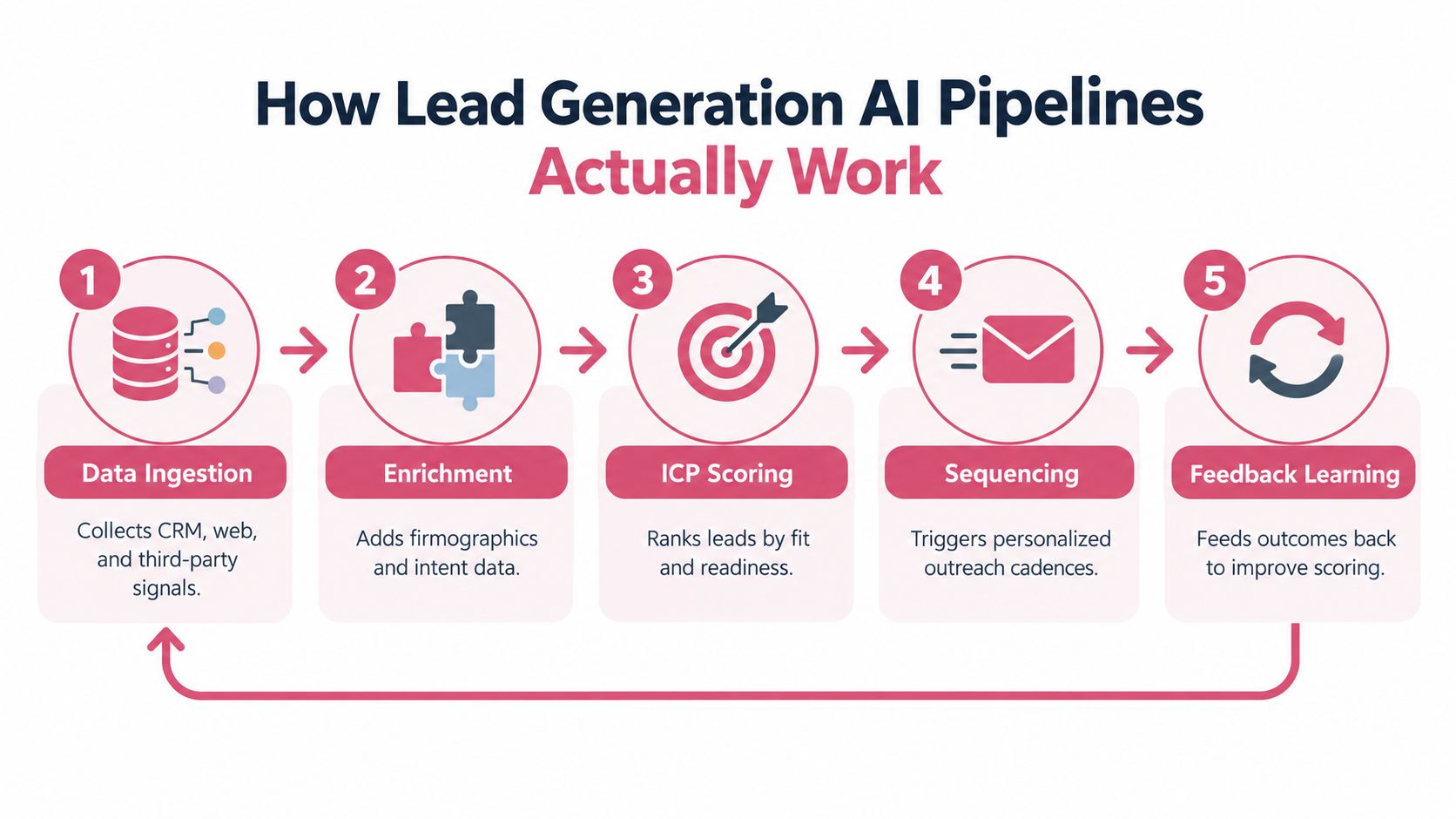
The system generally follows this sequence:
- Collect context. It reads CRM records, web events, enrichment data, campaign activity, and other permitted inputs.
- Add missing detail. It fills gaps in firmographics, role information, intent, and account relationships.
- Score the opportunity. It compares the lead with the ICP and estimates readiness.
- Select an action. It might route the record, start research, prepare outreach, or request approval.
- Learn from outcomes. Replies, meetings, disqualifications, overrides, and opportunities become feedback.
Why context beats raw volume
A model can write a polished email without understanding whether the recipient belongs in the campaign. That's why message generation is only one layer of the system. The stronger source of performance is usually the selection of the right account, contact, reason, and timing.
Independent 2026 benchmarks report roughly 15% to 25% reply rates for signal personalized outreach, compared with about 3% to 5% for traditional cold email. The same benchmark coverage reports that multi signal targeting, such as combining funding, hiring, and behavioral context, reached 25% to 40% in some datasets, while lists of 50 or fewer recipients produced a 5.8% reply rate, compared with 2.1% for lists of more than 500 recipients. The prospecting benchmark source attributes the difference to better context selection, relevance, timing, and deliverability.
These figures shouldn't become universal targets. They show where the lift comes from. A model that receives fresh buying signals and role specific context can reduce the mismatch between the message and the prospect.
Teams wanting a broader foundation can review this guide to AI driven prospecting, especially when defining the relationship between data, prioritization, and outreach.
How Lead Generation AI Pipelines Work
A pipeline creates value when every stage passes reliable context to the next. Separate AI tools may draft copy, enrich records, or assign scores, yet still force operators to connect decisions manually. The pipeline should function like a relay, where each handoff carries both the record and the evidence behind the next action.
Data ingestion and enrichment
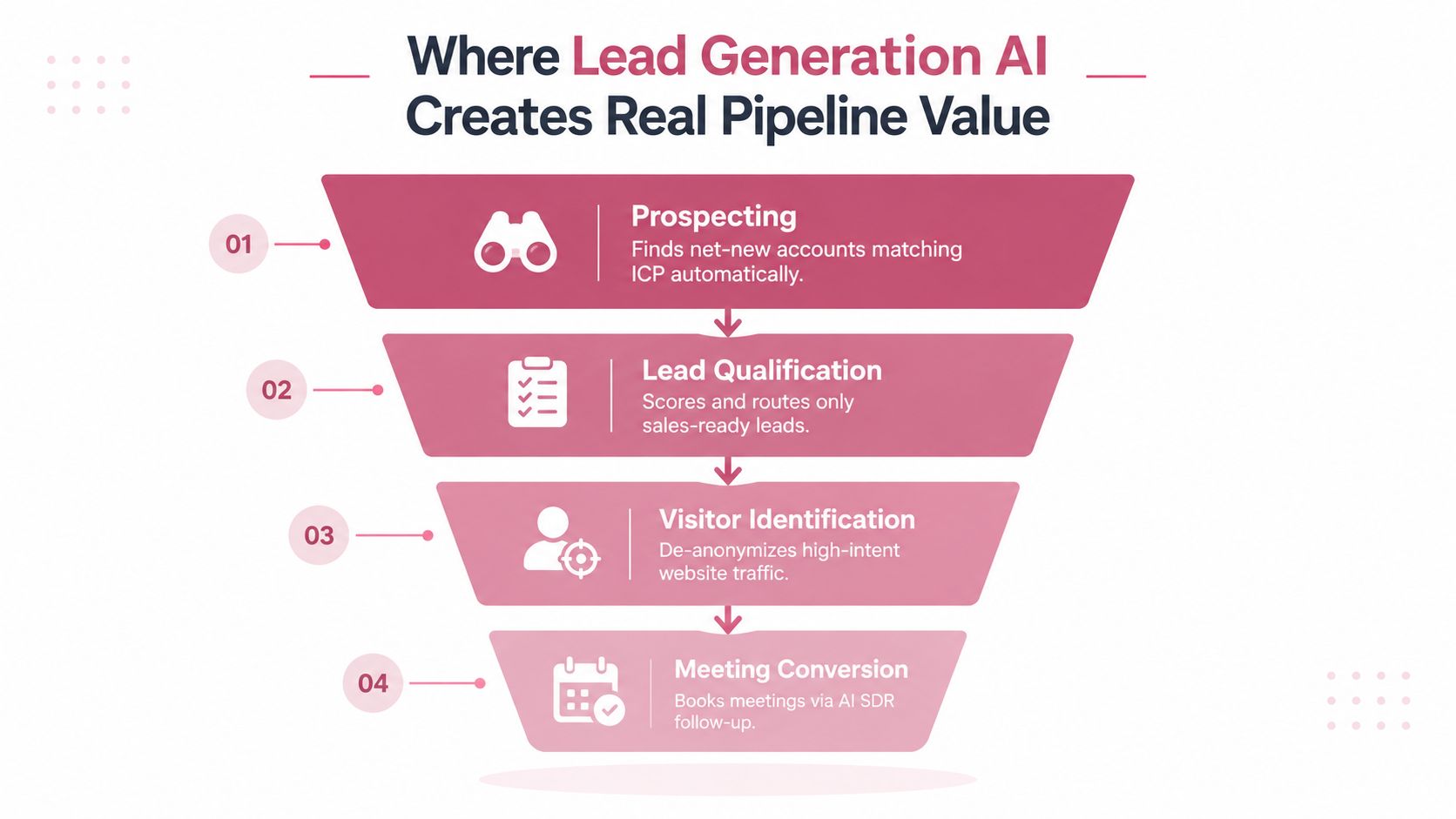
The workflow begins with permitted inputs from the CRM, website, forms, campaigns, product events, and external data providers. A unified record reduces false confidence. A contact score without account context can point a rep toward the wrong person.
Enrichment adds missing firmographics, role details, technology context, and intent signals. Validation rules should check each addition. If providers return conflicting company details or a contact's role remains uncertain, the system should retain that uncertainty instead of turning it into a confident score.
ICP scoring and routing
Scoring should mirror the company's buying pattern rather than a generic template. A practical model can assess company fit, role match, region, account status, intent, engagement, and disqualifying conditions.
Every score needs a reason. “High score” gives a rep little to act on. “Matches the target role, fits the account segment, and revisited the pricing page after a relevant campaign interaction” provides a clear starting point.
Routing turns that assessment into ownership. The system can assign records by territory, segment, product area, owner, or availability. Uncertain records can enter a review queue instead of moving directly into outreach. This governance layer protects quality by separating evidence-backed actions from guesses.
Sequencing and feedback
Sequencing converts a decision into controlled action. Depending on the channel and available evidence, the workflow may prepare an email, LinkedIn task, research brief, or chat response. Actions involving uncertain identity, intent, or consent should pause for approval.
Teams connecting several tools can examine how automatizza processi con workflow AI across operational processes. The operating rule is simple: preserve the context that justified every handoff.
Feedback closes the loop. Positive replies, meetings, accepted opportunities, disqualifications, rep overrides, and incorrect enrichments should become structured outcomes. Teams building agent-based outbound can also review how AI agents do cold outreach to see where human approval fits.
Trend reporting cited earlier found that 41% were running three or more AI agents in a single prospecting workflow, up from 9% in Q3 2024. More agents do not repair weak inputs or unclear ownership. Audit trails, signal quality, and speed to an appropriate action determine whether orchestration improves pipeline performance.
Where Lead Generation AI Creates Real Pipeline Value
Lead generation AI creates value in specific GTM jobs, not everywhere at once. The right starting point depends on where the team loses time or quality today.
| GTM job | Useful AI input | Sensible action | Where human judgment stays important |
|---|---|---|---|
| Prospecting | ICP, firmographics, intent, account changes | Find and prioritize relevant contacts | Confirm strategic account fit |
| Qualification | Role, company, activity, disqualifiers | Score and route records | Review ambiguous or high value leads |
| Visitor identification | Page activity, known account data, consented signals | Create an account task or qualification event | Decide whether outreach is appropriate |
| Reply handling | Message content, sentiment, prior context | Classify, draft, route, or schedule | Handle nuance, objections, and sensitive situations |
Prospecting works when the system has a reason to search
A prospecting workflow should begin with a defined ICP and a signal set. For example, a team may ask the system to find operations leaders at companies that fit its target profile and show a relevant business change. The output should include the account, contact, evidence, confidence, and suggested next step.
A broad database can support coverage, but it won't determine timing by itself. Static filters are useful for narrowing the market. Signal selection determines who deserves attention now.
Qualification works when rejection is as careful as acceptance
A scoring system should identify a strong fit, but it should also explain why a record was excluded. Over qualification is a serious failure mode. A chatbot or agent can reject a lead because one field is missing even though a human rep would recognize the opportunity.
That's why qualification should use gates rather than one opaque score. Check fit, role, region, intent, duplication, account ownership, and known exclusions. Keep the raw inputs available for review.
Visitor identification needs restraint
Website activity can indicate interest, but not every visit authorizes personal outreach. The workflow should distinguish between an account level signal and an identifiable contact, then apply the team's consent and communication rules before creating an action.
The best output may be a sales task, an account update, or a content recommendation. Automatic messaging isn't always the correct response.
Meeting conversion depends on routing and timing
A qualified reply can lose value if it sits unassigned. AI can classify the response, identify the appropriate owner, suggest available meeting options, and prepare the CRM update. A human should still handle unusual objections, strategic accounts, and conversations where the model's confidence is weak.
The pattern is consistent across use cases: AI adds value by reducing decision latency and preparation work, not by flooding every channel.
Measuring ROI and Speed to Lead Economics
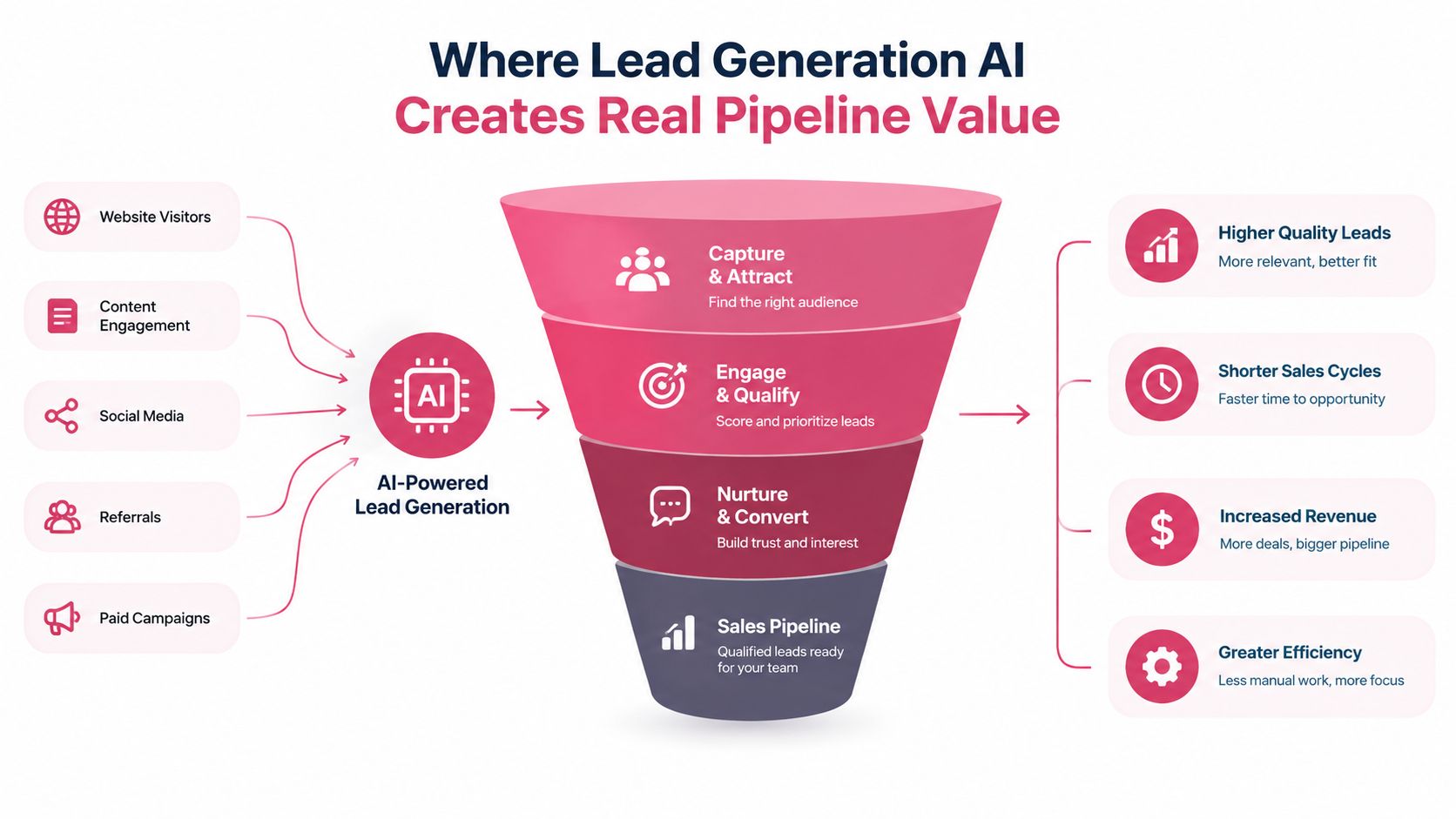
ROI comes from a small set of operational levers. Teams should measure qualified lead creation, lead to opportunity conversion, sales cycle length, cost per lead, and response latency together. A higher lead count can hide deterioration in qualification or rep capacity.
Independent benchmark summaries for 2024 to 2025 report that AI implementation produced an average 73% increase in qualified leads within six months, a 43% improvement in lead to opportunity conversion, a 31% reduction in sales cycle length, and a $2.40 reduction in average cost per lead through automated initial qualification. The AI lead generation benchmark summary provides the source for these figures.
These are benchmark results, not a forecast for every team. Operators should establish a baseline, define the qualifying event, and compare matched segments rather than attributing every improvement to AI.
Speed to lead is a separate economic lever
Intent decays quickly after a prospect takes action. A 2026 benchmark cited by sales follow up response time analysis reports that contacting a lead within 5 minutes makes the lead 9 times more likely to convert than waiting an hour. The same source reports that most companies respond in about 47 hours, while only about 7% reach the 5 minute window.
AI assisted teams in that dataset reached a median first response time of 22 seconds, compared with 52 hours for human only teams. The reported full funnel conversion rate was 13.1% for AI assisted teams, compared with 5.9% for human only teams.
| Metric | AI Assisted Teams | Human Only Teams |
|---|---|---|
| Median first response time | 22 seconds | 52 hours |
| Full funnel conversion rate | 13.1% | 5.9% |
| Contact timing benchmark | Within 5 minutes | About 47 hours for most companies |
The practical lesson is architectural. Event driven routing, instant qualification, and clear exception handling usually matter more than generating another batch of copy.
Implementing Lead Generation AI in Your GTM Stack
Implementation should begin with the decision the team wants to improve, not with a tool shortlist. If the bottleneck is slow inbound routing, start there. If the problem is poor outbound targeting, start with signal collection and ICP scoring. A system that tries to solve every GTM problem on the first release creates tool sprawl and weak ownership.
Choose the operating surface
Technical teams may prefer a composable MCP style build, where they assemble atomic skills and control the logic directly. Other teams may need preconfigured playbooks that run from Slack or a user interface with little setup.
Both approaches can work if they share the same data, permissions, and outcome records. The choice should reflect who owns the motion, how often the logic changes, and how much operational maintenance the team can support.
Connect the stack behind a stable interface
A unified API reduces custom work between the CRM, enrichment providers, LinkedIn, email, chat, and reporting. The interface should preserve lead ID, account ID, source, timestamp, action status, score, confidence, and owner as the record moves through the system.
A practical stack might connect Unipile for LinkedIn sequences, FullEnrich for email and phone enrichment, lemlist for multichannel outbound, Crustdata for profiles and firmographics, Notion for CRM tracking, Claude for reasoning, and Slack or email for approvals. The provider choices can change without forcing the team to rewrite the entire GTM motion.
Roll out one validated play
Start with one play, such as a seven gate qualification workflow. Define the input sources, ICP criteria, disqualifiers, approval points, output fields, and success metric. Run the workflow in review mode before allowing external actions.
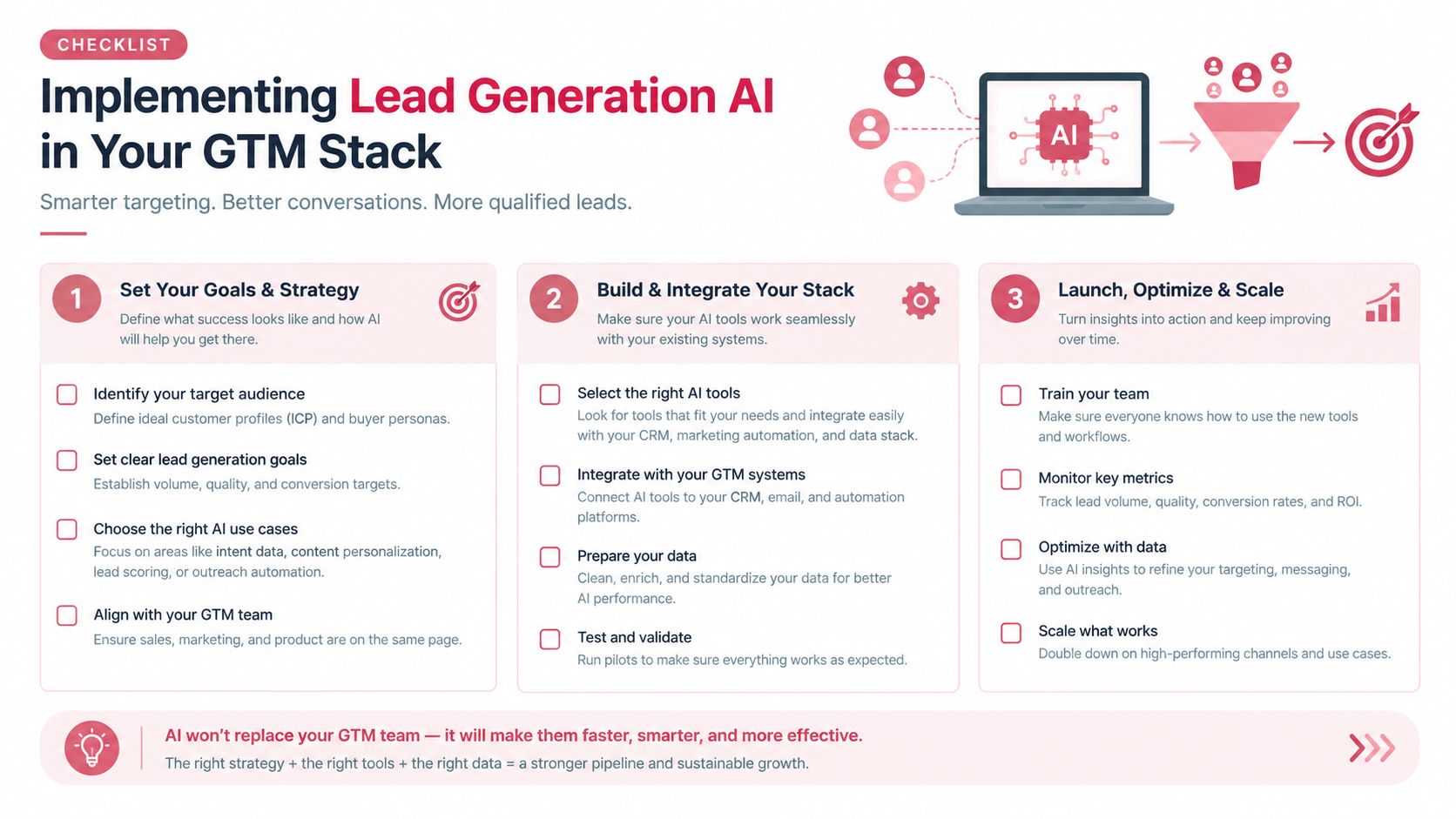
Track every run. Review false positives, false negatives, routing mistakes, duplicate records, and message edits. Then promote the play only when the team can explain its decisions and verify its outcomes.
For a deeper explanation of how multiple agents and tools coordinate, see this guide to AI orchestration. The implementation principle is portability: keep play logic versioned, keep credentials under the team's control, and avoid tying core decisions to one model or provider.
Risks Compliance and How to Govern Lead Generation AI
Lead generation AI is a quality and governance system, not a volume engine. Independent coverage identifies recurring operational problems, including data silos affecting 61% of teams, quality inconsistency affecting 58%, workflow context switching affecting 44%, and significant integration challenges reported by 68% of B2B teams. Coverage of AI lead generation risks also highlights overqualification, where automated systems reject leads that human sellers would accept.
Governance must cover the data and the decision. Prospect records may be incomplete, generated systems may invent details, and scoring logic may exclude valuable segments through biased inputs. Consent verification needs evidence as browser restrictions weaken some attribution signals and privacy enforcement becomes stricter. The lead generation industry outlook discusses these pressures around consent, attribution, data quality, and model bias.
Put approval around consequential actions
AI-generated actions should wait for explicit human approval before execution when they can affect outreach, routing, or CRM records. The approval record should capture the required approval, approver, timestamp, approved or rejected status, authorized action, and any modifications. AI agent audit trail guidance outlines the value of retaining this evidence.
A defensible lead-action record should also include the action type, lead ID, model version, input features, output score, assigned representative, alternatives considered, and an override flag. Model governance should retain a version identifier, deployment date, changelog, and quarterly accuracy review against holdout deals. These records let operators reconstruct what happened instead of treating the model's output as an unexplained recommendation.
Limit access and review outcomes
Agents should have only the permissions required for their assigned play. Configure allowlists for objects, fields, and actions, then restrict exports, bulk updates, and deletion rights. Higher-level access should require ticketed approval, business justification, and an expiration date, followed by regular recertification reviews.
Salesforce documents two access approaches for Sales Workspace data governance, attribute-based access control and role-based access control. Salesforce's Sales Workspace governance documentation shows how teams can limit access to specific data instead of granting broad permissions.
The operating routine is practical: sample decisions, inspect overrides, test for coverage gaps, verify consent evidence, and review model accuracy every quarter. Speed to lead matters only when the routed record is accurate, authorized, and explainable. Governance protects those conditions, which is what makes automation economically useful.
Yalc connects prospecting, enrichment, ICP scoring, sequencing, reply handling, CRM updates, and reporting through a unified GTM API, with data and keys under the team's control. Visit Yalc to evaluate a governed lead generation AI workflow with composed plays or preconfigured playbooks, approvals, and step-by-step telemetry.