Lead Generation in Sales: A GTM Operator's Playbook
Lead generation in sales is a structured process for identifying and nurturing potential buyers, but the modern reality is that only 0.94% of captured leads become closed won revenue, or roughly one in 106. The practical answer isn't to generate leads indiscriminately. It's to improve qualification, response speed, handoffs, and the orchestration that moves a viable buyer toward a deal.
A lead becomes valuable only when the business can recognize buying intent, route the opportunity quickly, and give sales enough context to have a relevant conversation. That makes lead generation less like filling a bucket and more like operating a revenue system. More traffic won't repair weak qualification rules, slow follow up, poor data, or a nurture process that stops after the first form submission.
Table of Contents
- What the Funnel Numbers Actually Say About Lead Generation in Sales
- Understanding the Lead Lifecycle Stages
- Building the Operational Workflow
- Manual Processes vs Automated Systems
- Measuring What Actually Matters
- Common Pitfalls That Kill Pipeline
- Operationalizing Better Lead Generation
What the Funnel Numbers Actually Say About Lead Generation in Sales
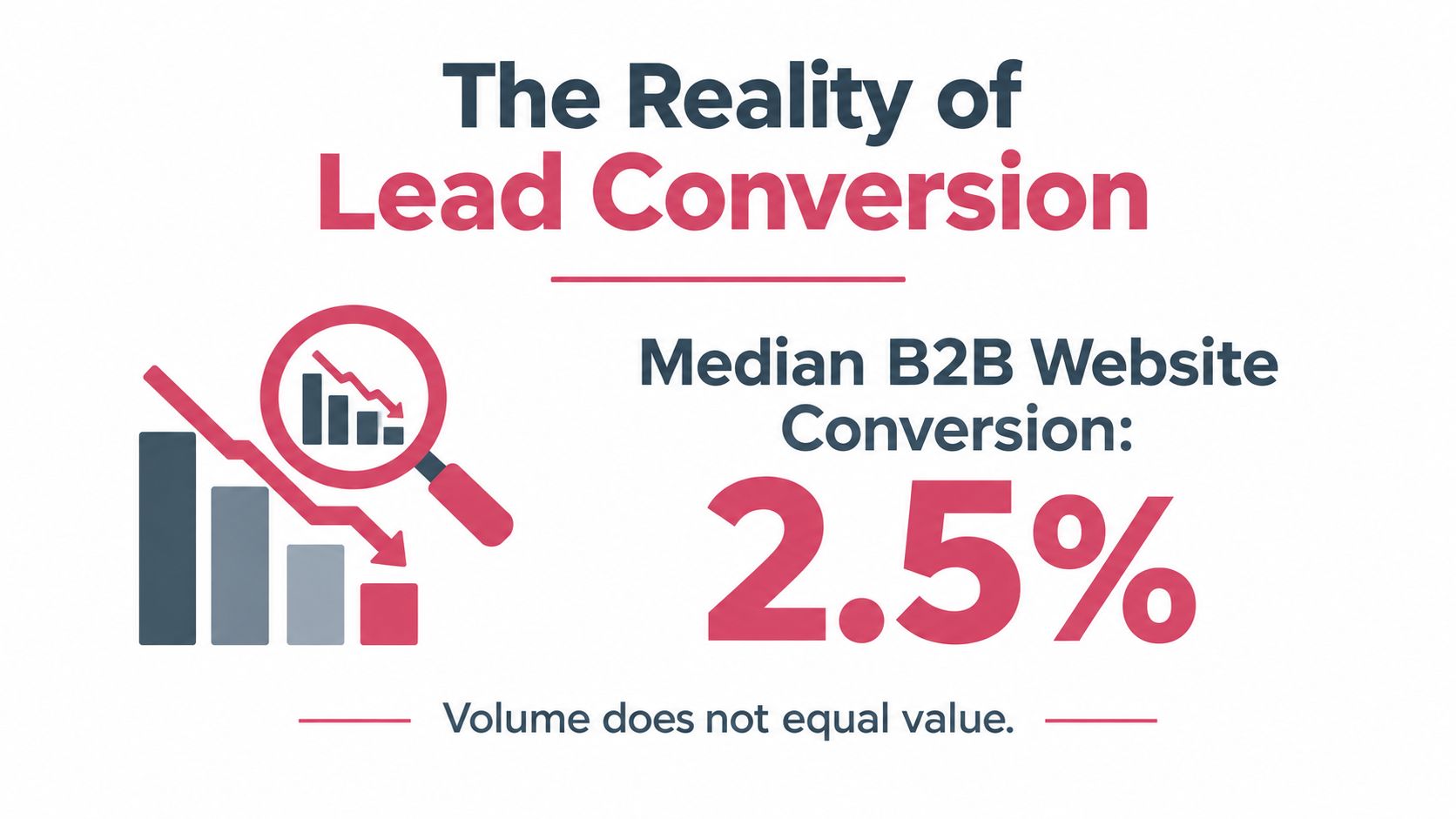
A growing contact database can conceal a weak revenue process. The 2026 benchmark data on conversion by channel and stage shows why operators should judge pipeline health by movement between stages, not by records collected. A median B2B website conversion rate of 2.9% still says little about revenue when qualification, routing, or follow-up loses viable demand.
Channel performance is uneven. Organic search and email produce stronger median conversion than paid search and paid social, according to the benchmark. Reporting every captured lead as one pool hides the difference between a high-intent visitor and a low-context form fill.
The middle of the funnel is the constraint
The same benchmark reports a decline in median MQL-to-SQL conversion from 2024 to 2026. That stage exposes the difference between interest and sales readiness. Someone can download content, attend a webinar, or visit a pricing page without having the problem, budget, authority, or timeline needed for a buying conversation.
Qualification must therefore connect fit with current intent. Across a 2,400-account B2B cohort, intent-sourced leads converted at 18.7% to closed won, compared with 5.5% for cold ICP-match leads, according to this B2B lead generation benchmark summary. The operating implication is straightforward: a good account is not automatically a timely opportunity. Each requires an appropriate motion, context, and handoff.
Practical rule: Treat every lead source as a separate operating motion. Score its fit, intent, response time, and eventual pipeline contribution independently.
Sales teams also need clear ownership after capture. This guide to timing and qualification for sales explains how those decisions interact. Review the cost of converting a lead into a meeting, not only the cost of acquiring the contact, with frameworks for reducing cost per meeting. The useful question is whether qualification and follow-up turn demand into accepted pipeline, not whether the top of the funnel keeps expanding.
Understanding the Lead Lifecycle Stages
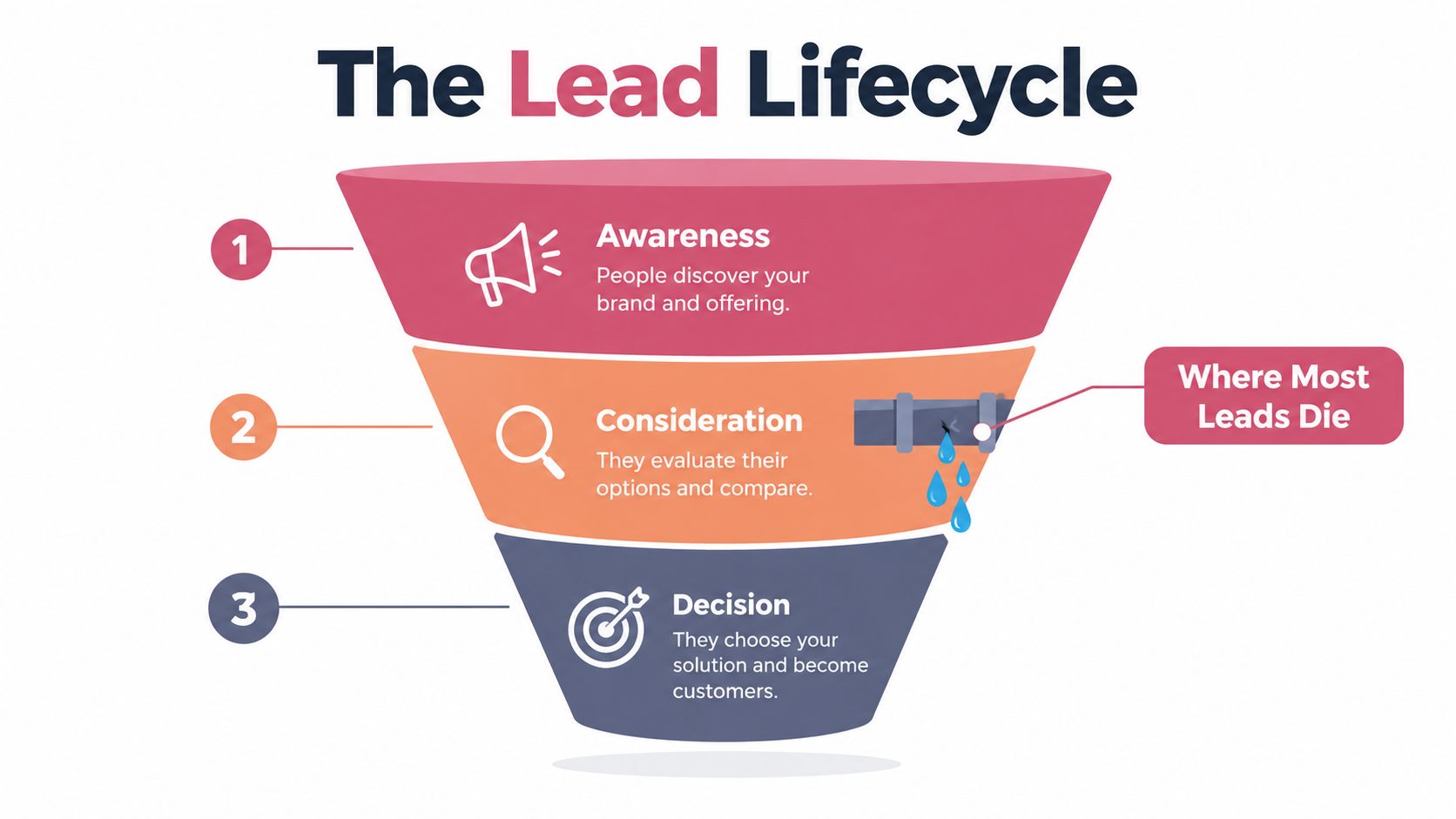
A lead lifecycle needs explicit entry and exit criteria at every stage. Without them, marketing promotes contacts because they engaged, sales rejects them because they aren't ready, and neither team can identify where the loss occurred.
The benchmark funnel is blunt. Visitor to Lead is 2.9%, Lead to MQL is 36%, MQL to SQL is 13%, SQL to Opportunity is 43%, and Opportunity to Customer is 27%, according to this 2026 lead generation funnel synthesis. Top quartile teams reach 5.8%, 52%, 21%, 62%, and 41% at those same stages. The gap is not explained by traffic alone. It points to better targeting, qualification, routing, and sales execution.
What each transition should mean
Visitor to lead means the person exchanged contact information for a clear reason. The offer should match the visitor's problem, and the form should collect only information that changes routing or qualification.
Lead to MQL means the contact meets a documented combination of fit and engagement criteria. A job title alone isn't enough. Useful signals include relevant company characteristics, meaningful content consumption, repeat visits, or a request that indicates an active problem.
MQL to SQL is the critical handoff. Sales should receive a lead only when the account fits the target profile and the available evidence supports a timely conversation. The record should include source, pages or assets engaged with, stated problem, prior messages, and the reason for the handoff.
SQL to Opportunity means a sales conversation uncovered a credible use case and a possible path to purchase. An opportunity isn't just a completed meeting. It needs a defined problem, relevant stakeholders, and a next step that both sides accept.
Opportunity to Customer measures whether the qualification was honest and whether sales created enough value to earn a decision. A weak close rate often reflects poor upstream standards rather than a closing problem.
Historical benchmarks reinforce why nurture and handoff matter. One widely cited source says 27% of B2B leads are sales ready when first generated, while 73% aren't ready for immediate purchase. The same source reports that 79% of marketing leads never convert into sales because of weak nurturing, and only 20% of sales qualified leads are followed up correctly, as detailed in these lead generation statistics.
Use a qualification framework to make the middle mile visible. Teams reviewing lead qualification methods should ask one question at each transition: what new evidence justifies moving this record forward?
Building the Operational Workflow
Speed to lead is an operating discipline, not a motivational slogan. A frequently cited study covering about 15,000 leads and roughly 100,000 call attempts found that prospects contacted within five minutes were 21 times more likely to qualify than prospects contacted after 30 minutes. Qualification odds dropped by 80% between five and 30 minutes, according to this speed to lead analysis.
A workflow should make the fast response the default, even outside business hours.
Set the routing rules first
Start with a small number of paths:
- High fit and high intent: Create an immediate sales task, send the owner the full interaction context, and offer a relevant next step.
- High fit and unclear intent: Add the contact to a targeted nurture path while notifying the account owner when new buying signals appear.
- Low fit and high activity: Keep the record out of the main sales queue until a human or rule confirms that the activity is relevant.
- Low fit and low activity: Suppress unnecessary outreach and preserve the record for future review.
The workflow needs a service level agreement that states who owns the lead, what happens when that person is unavailable, and when an unworked record is escalated. Research cited in another speed to lead resource reports that firms responding within an hour were nearly 7 times more likely to have a qualifying conversation with a decision maker than firms waiting one additional hour, and more than 60 times more likely than firms waiting 24 hours or longer.
Automate movement, not judgment
Automation should capture the form, enrich the record, check for duplicates, calculate a score, assign an owner, and create a task. It should also stop a sequence when the contact replies, changes status, books a meeting, or asks not to be contacted.
Human judgment belongs at the points where context matters. A salesperson should decide whether an unusual account is worth pursuing, whether a reply contains a real business problem, and whether a buying group is forming. A useful collection of practical workflow examples can help teams identify which repetitive actions are safe to automate.
Keep the feedback loop short. Sales should mark whether a lead was accepted, rejected, recycled, or converted, with a reason. Marketing and operations can then adjust scoring and routing from observed outcomes rather than opinions. Documentation on sales process automation is useful when teams need to turn those rules into repeatable system behavior.
Manual Processes vs Automated Systems
Manual lead generation feels controllable at low volume because one person can inspect a spreadsheet, copy data into a CRM, and remember which prospects need follow up. The problem appears when the motion expands across email, LinkedIn, webinars, chat, enrichment tools, and multiple sales owners. Records become stale, duplicate contacts enter the system, and nobody can explain why one lead received attention while another disappeared.
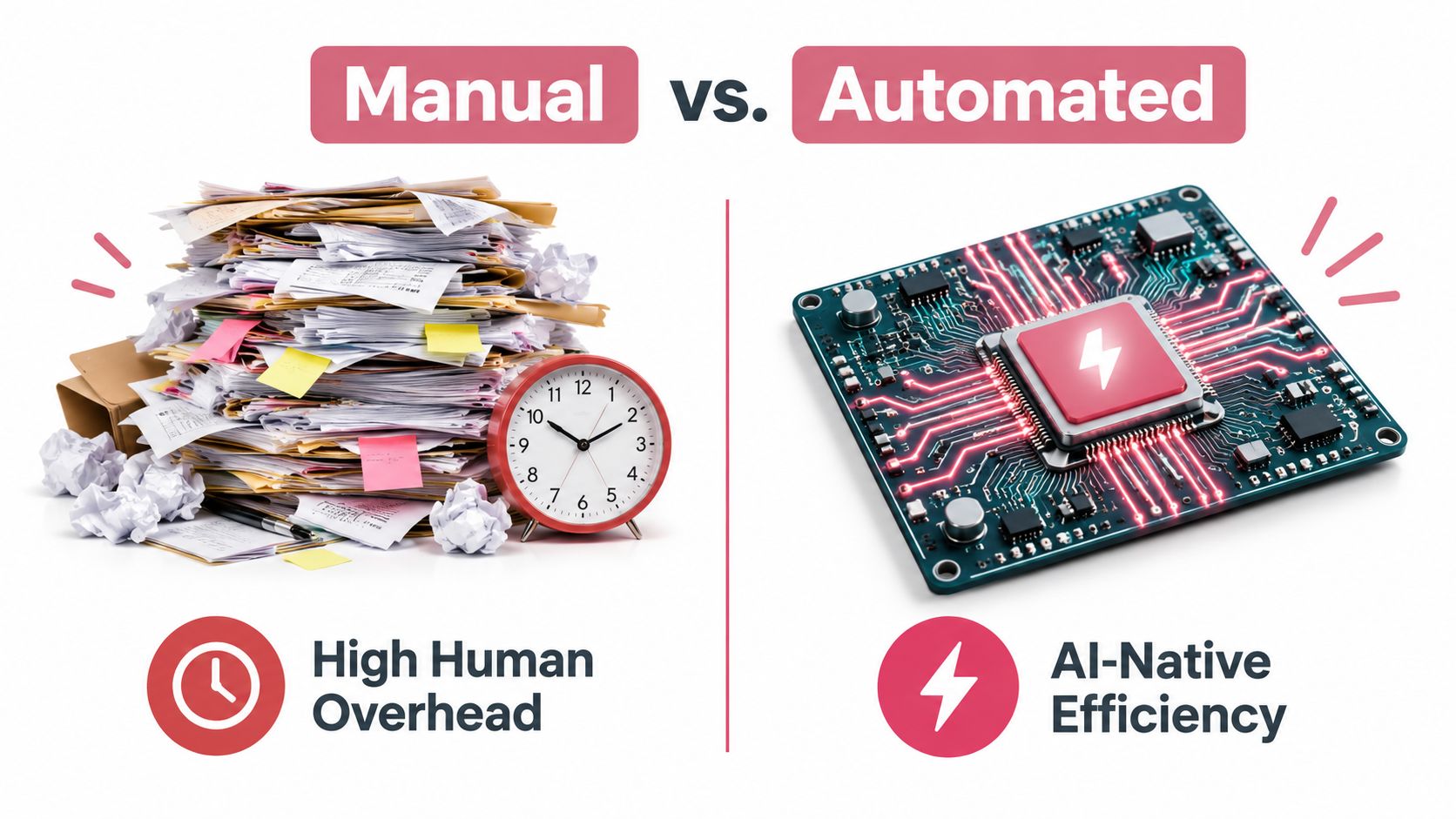
The right comparison isn't people versus software. It is judgment versus repetition.
| Work | Manual process | Automated system |
|---|---|---|
| Research | An operator searches several sources and pastes findings into a record | A workflow gathers approved signals and preserves the context |
| Enrichment | A rep checks fields one at a time and updates the CRM | Rules resolve missing data and flag uncertainty |
| Qualification | Each salesperson applies personal standards | Shared criteria produce a consistent first pass |
| Routing | A manager monitors notifications and assigns records | Rules assign by fit, territory, intent, or account ownership |
| Reporting | Someone assembles spreadsheets after the campaign | The system records activity and stage movement as it happens |
Automation doesn't make a bad process good. If the ICP is vague or the qualification criteria are contradictory, software will spread the problem faster. Teams should first define the decision rules, then automate the mechanical actions around them.
Where humans should stay involved
A salesperson should approve sensitive outreach, interpret ambiguous replies, and decide when a prospect deserves a custom approach. Operations should review exceptions, audit data quality, and retire rules that create noise. Software should handle enrichment, deduplication, scoring updates, task creation, sequence pauses, and routine reporting.
A unified GTM API can connect research, enrichment, qualification, outreach, and reporting without forcing every step into a separate spreadsheet or disconnected tool. A system such as Yalc combines those workflows with an internal layer for ICP, voice, prior results, and play definitions, while keeping human approvals for sensitive actions and recording the execution trail.
The useful test is simple. If a task requires the same decision every time, automate it. If it requires context, judgment, or accountability, keep a human in the loop.
Measuring What Actually Matters
Lead volume is an activity metric. Revenue teams need measures that explain whether activity is producing qualified pipeline.
Cost per lead is a good example of a metric that becomes misleading when stripped of context. A 2026 summary citing HubSpot data reports a median B2B CPL of $213, with channel figures ranging from about $98 for organic content and SEO to $487 for account based marketing. The CPL benchmark summary shows why a single target CPL can't govern every channel.
Build the dashboard around movement
Track the funnel as a chain, not as one total:
- Source quality: Record which sources produce accepted leads, sales conversations, opportunities, and closed revenue.
- Stage conversion: Monitor each transition from visitor to customer so the largest leak becomes visible.
- Speed to lead: Measure the time from inquiry or intent signal to the first relevant human or automated response.
- Acceptance rate: Track how often sales accepts marketing's handoff and why it rejects records.
- Pipeline velocity: Watch how quickly qualified opportunities move and where they stall.
- Revenue attribution: Connect campaigns and sources to pipeline impact instead of crediting every form fill equally.
MQL volume can rise while the business gets worse. For example, a campaign may generate many contacts but send few qualified conversations to sales. That pattern calls for a review of audience, offer, scoring, and routing, not an automatic increase in budget.
Use a practical reporting cadence
Operations should review source and stage data regularly enough to catch broken routing quickly. Sales managers should inspect rejected leads and stalled opportunities with specific reasons, not vague comments such as “bad fit.” Marketing should use those reasons to revise targeting and content.
A useful report shows the current funnel, the change from the prior period, the owner of each bottleneck, and the action being tested. Every experiment should have a success condition. If a new qualification rule produces fewer handoffs but a higher acceptance rate, the result may be positive even if total MQLs fall.
Common Pitfalls That Kill Pipeline
The first mistake is treating lead generation as a volume problem. Recent coverage reports that 58% of B2B marketers identify high quality leads as their biggest challenge, while one report cites an average of 1,877 leads per month with 80% never converting to customers, according to this lead generation statistics analysis. More records won't solve a system that cannot separate fit from curiosity or route interest while it is active.
The second mistake is assuming every channel should use the same definition of success. Organic content, paid search, outbound email, events, and account based campaigns create different levels of context. A channel that produces fewer leads but more accepted opportunities can be healthier than one that fills the CRM with unworked names.
Data problems become revenue problems
Fragmented identity data makes qualification unreliable. Recent reporting says only 62% of submitted addresses were valid in 2025, while buyer journeys increasingly span LinkedIn, Slack communities, webinars, chat, YouTube, and email, as discussed in this targeted lead generation coverage. When systems can't resolve the same person or account across those touchpoints, attribution breaks and scoring loses signal.
Operators should check for duplicate accounts, stale titles, missing source values, invalid contact details, and records that change owners without an audit trail. Data cleaning isn't an implementation detail. It determines whether the sales team can trust the queue.
Another common failure is the black box promise. A tool that claims to qualify, personalize, and send without showing its rules can create risk faster than it creates pipeline. Teams need visible scoring factors, approval controls, logs, and a way to compare results against the original hypothesis.
Operator warning: If the team can't explain why a lead was routed, scored, or contacted, the system isn't saving operational risk. It's hiding it.
The final trap is weak sales and marketing alignment. Shared definitions need an owner, a review process, and an agreed response standard. Without those controls, marketing optimizes capture while sales optimizes time, and the pipeline absorbs the conflict.
Operationalizing Better Lead Generation
Start with a funnel audit. Measure every transition from first response through closed revenue, then fix the steepest meaningful drop rather than adding another acquisition channel. The audit should identify rejected leads, unworked leads, slow responses, duplicate records, and opportunities that stalled after a handoff.
Next, write the operating rules in plain language. Define what qualifies an MQL and SQL, who owns each record, what response time applies, when nurture begins, and what feedback sales must provide. Enforce the response standard with routing, escalation, and visible reporting.
Finally, consolidate the workflow where fragmentation is creating blind spots. Keep the tools that produce useful signal, connect them through reliable data flows, and automate repetitive preparation without removing human approval from consequential actions. Teams looking for a broader operator's playbook for leads can use the same principles to document their process.
The target isn't more leads. It is a predictable stream of sales ready opportunities that fit the ICP, receive timely attention, and can be traced to revenue.
Yalc gives GTM teams a unified operating layer for prospecting, enrichment, qualification, outreach, reply handling, and campaign reporting, with playbooks available through its UI or Slack and composable workflows through its MCP. Visit Yalc to evaluate whether a connected, measurable workflow can repair the qualification and handoff gaps in your sales pipeline.