Lead Generation on LinkedIn: A Practical 2026 Playbook
Posting more often won't fix weak lead generation on LinkedIn. Volume fails when targeting is broad, the sender profile gives prospects no reason to trust the outreach, and nobody tracks whether conversations create opportunities. Teams that win treat LinkedIn as a place to spot relevance and start useful conversations, then they measure every step toward pipeline.
Table of Contents
- Why Lead Generation on LinkedIn Works Differently in 2026
- Turning Your Profile Into a Qualifying Landing Page
- Running an Organic Content Program That Earns Conversations
- Building a Signal-Driven Prospecting Sequence
- Choosing Between LinkedIn-Only and Multichannel Plays
- Automating Without Burning the Account
- Measuring Pipeline, Not Just Connections
Why Lead Generation on LinkedIn Works Differently in 2026
LinkedIn isn't a dependable reach engine. It's a signal and conversation layer built on professional data that few other channels can match. Role, employer, seniority, industry, and geography sit in one place, so operators can define an audience by business context instead of guessing from vague interest data. That structure is the advantage.
Adoption is broad, but adoption isn't results. LinkedIn cites Wpromote research showing 89% of B2B marketers used LinkedIn for lead generation and 62% said it generated leads, more than twice the share for the next social channel, in its LinkedIn lead generation resources for advertisers. The gap matters. Many teams are present on the platform. Fewer run a motion that connects audience selection to qualified pipeline.
What Operators Should Stop Doing
Stop treating connections as progress. A larger network of poor fit contacts creates noise, weak engagement, and misleading dashboards. Stop treating content as a volume contest too. Organic distribution is volatile, so a posting calendar can't carry the whole plan.
The working model has six parts that must support each other:
- Prospecting: Build narrow account and contact cohorts from clear fit criteria.
- Qualification: Separate curiosity, politeness, and actual buying relevance.
- Personalization: Tie each message to a visible business reason.
- Content: Earn recognition inside target accounts before outreach lands.
- Sequencing: Follow up with useful context, not empty nudges.
- Measurement: Judge plays by qualified conversations, opportunities, and revenue.
Teams that want a wider view of channel choices can compare this model with Sprints & Sneakers B2B tactics, which places LinkedIn within a broader B2B demand mix. The point isn't to copy every tactic. It's to see where LinkedIn creates an edge and where another channel does the job better.
LinkedIn creates value when it helps a team identify the right account, understand the moment, and start a conversation a buyer can answer.
The playbook that follows connects profile, content, prospecting, multichannel choices, automation discipline, and measurement into one operating loop. Each part has a job. If one part breaks, sending more volume usually makes the problem worse.
Turning Your Profile Into a Qualifying Landing Page
A prospect who sees a sharp comment on a competitor's post does one thing next: clicks the profile. That visit is short. What they find decides whether the connection request that follows gets accepted, ignored, or answered with real interest.
Treat the profile as a conversion surface with a qualification job. The right prospect should recognize fit in the first screen, and the wrong prospect should move on. Both outcomes are wins. Every accept from a poor-fit contact inflates the accept rate and corrupts every signal the team measures downstream, all the way to qualified pipeline.

Audit the Page Top to Bottom
Walk the profile in the order a buyer sees it and score each element on one question: does this help a target buyer decide?
| Element | Its job | Typical failure |
|---|---|---|
| Headline | Name who is helped, the problem, the outcome | Job title alone, or a vague growth label |
| Banner | Carry one proof point or the buyer's problem | Stock imagery and empty decoration |
| Featured | Give curiosity a path: one asset, one proof post, one next step | Pinned engagement bait, or nothing pinned |
| About | Open with the buyer problem, then the approach, then proof | Written to impress a future employer |
| Experience | Describe outcomes and customers served | Internal duty lists and tool names |
| Contact route | Make the ready buyer's next step obvious | Buried under recruiter-facing details |
The about section is where outbound reps lose the page. Copy about passion, synergy, and career growth speaks to a hiring manager. Buyers weigh risk, cost, timing, and whether the sender understands their world. Rewrite accordingly.
Headlines follow a plain formula: role, audience, problem, outcome. A founder selling revenue operations support to early stage software firms writes exactly that. Specificity beats clever every time.
Diagnostic question: Would the best fit prospect recognize themselves in the first three lines?
If the answer is no, fix the profile before the next sequence goes out. Outbound pushes traffic here, and a weak page taxes accept rates, reply quality, and the pipeline numbers reported at the end. The measurement loop only works when the page at the top of it qualifies.
Running an Organic Content Program That Earns Conversations
A founder posts a teardown of an outbound sequence that failed. Reach is modest, but two heads of sales at target accounts comment with their own versions of the problem. One becomes a call a few weeks later. That is the deal on the table: content as a conversation engine inside named accounts, not a reach contest.
Impressions flatter this setup constantly. A post that reaches thousands of people outside the ICP can look like a win while opening zero doors and teaching the team nothing. Treat reach as noise unless it produces replies, profile views, or movement from people who can buy.
Three formats earn their keep. A short contrarian take backed by one concrete example from real work. A teardown of an actual workflow, including what broke and what changed. A focused question that invites target buyers to describe a problem in their own words, which the team then feeds back into outbound copy with care.
Comments Are Field Research
Commenting isn't a visibility trick. It's reconnaissance. Track who posts about the problem, which constraints they name, and which peers pile into the thread. A useful comment adds a specific observation, a tradeoff, or a short example from practice. Generic praise wastes the slot.
Keep the cadence small enough to sustain. Two substantive posts a week, each tied to a target account theme. Comments outnumber posts, aimed at target buyers and credible category voices. A promising thread moves to direct message only when a natural reason to continue exists. Repeated phrases, objections, and trigger events get logged in the CRM, because that language is tomorrow's outreach copy.
The Scoreboard
Judge the program by account progression. Did people in named accounts view the profile, reply with substance, accept a relevant connection, agree to talk? Likes from peers and other sellers don't pay for it.
Engagement on the wrong account is worse than none at all. It pulls the feed and the network toward an audience that will never buy. Leave rooms that produce applause and no buyer relevance. The content program exists to feed the same measurement loop as everything above it: accepted requests, substantive replies, qualified pipeline.
Building a Signal-Driven Prospecting Sequence
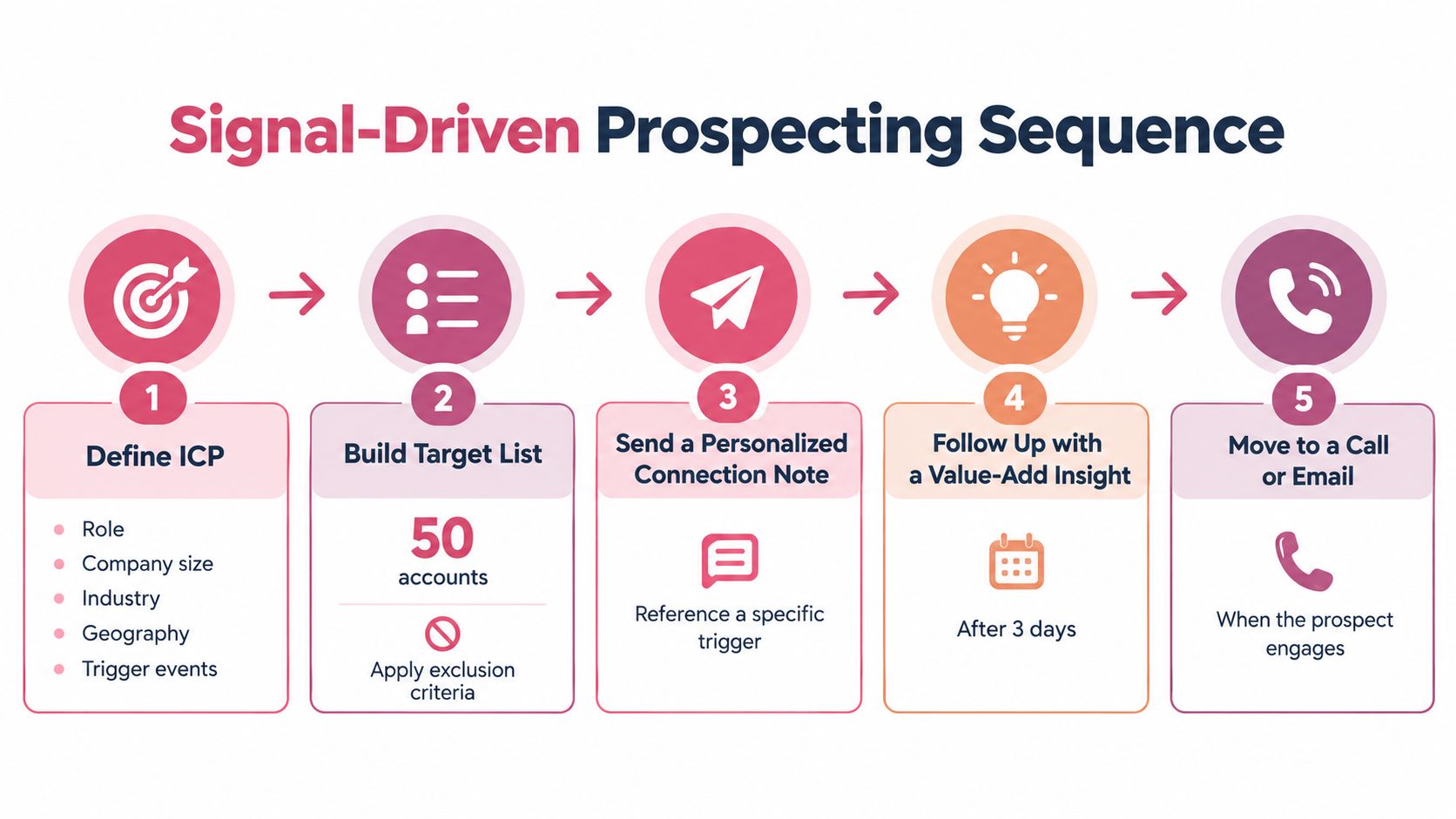
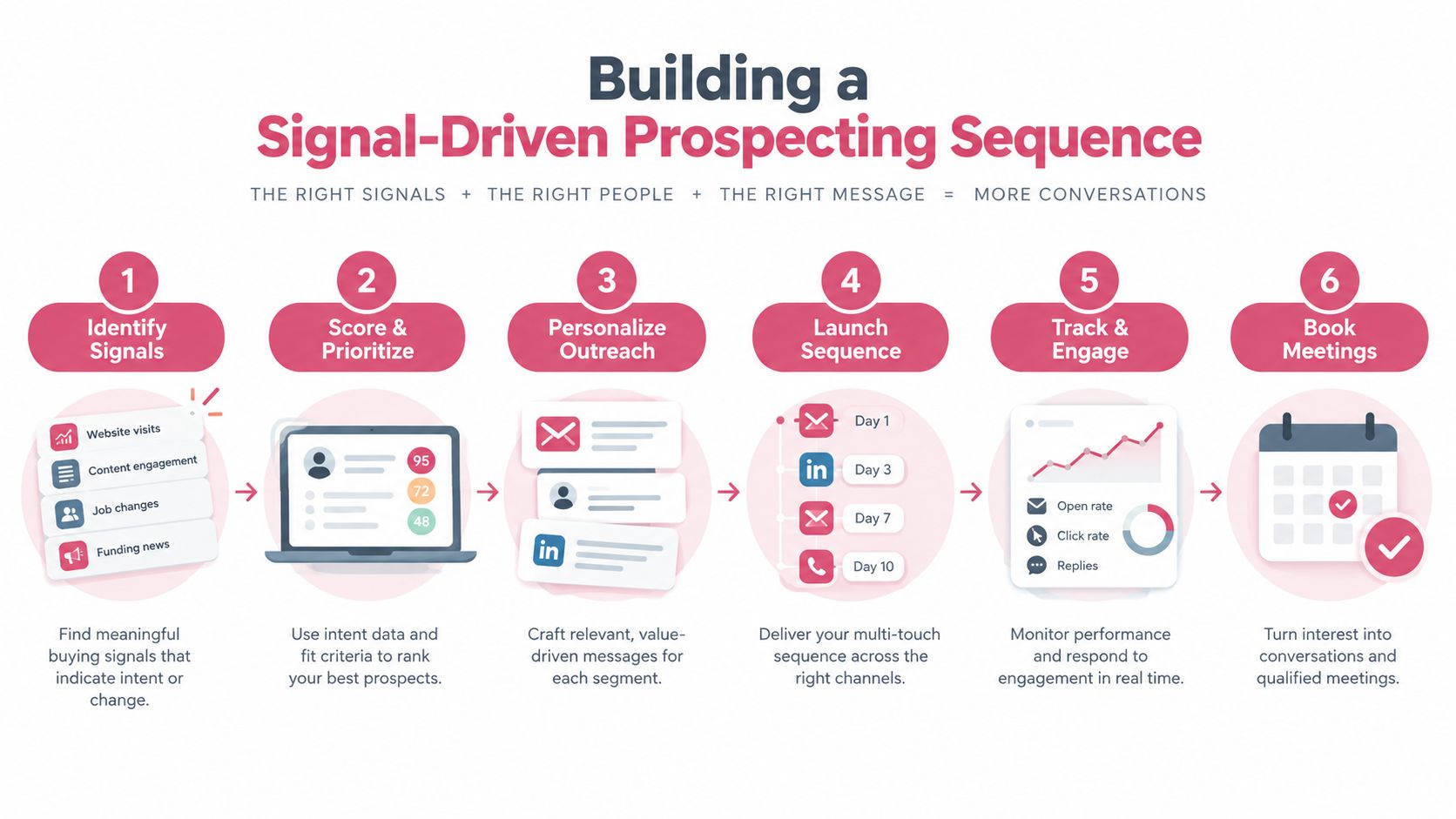
The fastest way to waste a sequence is a polished message aimed at someone with no reason to care. Build the filter before writing a single line. Define the ICP with role, company size, industry, geography, trigger event, and exclusion criteria, and treat exclusions as seriously as inclusions. They keep reps off lists full of companies that can't buy, won't benefit, or just signed with a competitor.
Then rank what's left. Recent job changes, relevant posts, competitor engagement, hiring movement, and stated operational problems all give outreach a reason to exist. Teams that need a deeper view of signal quality can apply the framework in intent data and buying signals for outbound teams to separate usable triggers from background noise.
Know the math before the first touch goes out. A study of more than 15 million contacts reported an 18.7% connection acceptance rate, a 17.6% reply rate among accepted connections, and a 1.3% meeting booking rate among connected prospects, according to the Belkins study of LinkedIn outreach performance. Small lists need strong fit and strong relevance, because the conversion math won't forgive a sloppy one.
Practical rule: Treat acceptance below roughly 20% as a targeting or sender-positioning problem, not a volume problem.
Score account fit separately from signal strength.
A perfect-fit account with a weak signal gets patience. A strong signal from a poor-fit account gets a pass. Before any contact, confirm the role is current, the company still fits, and the signal is recent enough to reference without sounding stale. With that settled, run the touches in this order:
- Connection request. One specific reason for contact. Reference the trigger without pretending to know private intent.
- First follow up. Add a useful observation, a short asset, or a relevant question. A meeting pitch in disguise kills the thread.
- Second follow up. Connect the trigger to a likely business consequence and ask whether it ranks as a priority.
- Meeting request. Ask only after context exists or the prospect engages with substance.
- Human review. Route uncertain records and sensitive replies to a person before anything sends.
Record each stage on its own: accepted contacts, replies, positive replies, qualified opportunities, meetings. Repeated follow ups can inflate reply counts if the team isn't watching. Compare segments and message variants by qualified meeting conversion, keep the winners as validated plays, and retire variants that earn polite replies but no pipeline. That discipline is what turns a sequence into an accountable system instead of a message cannon.
Choosing Between LinkedIn-Only and Multichannel Plays
Multichannel isn't automatically better. It adds tools, timing choices, inbox work, and more ways to annoy the same person. The variable that moves results most is signal quality. Channel count comes second.
The benchmark spread makes the tradeoff plain. Signal based outreach is reported at roughly 40% to 60% acceptance and 25% to 55% reply rates, compared with 10% to 20% acceptance and 3% to 8% reply rates for cold list outreach, in the LinkedNav analysis of B2B LinkedIn outreach benchmarks. Adding email to a weak list won't close that gap. Better timing and relevance might.
| Outreach type | Acceptance range | Reply range | When to use |
|---|---|---|---|
| Cold list outreach | 10% to 20% | 3% to 8% | Broad lists with fit data but no current trigger |
| Signal based outreach | 40% to 60% | 25% to 55% | Recent engagement, job change, or relevant public discussion |
A Simple Decision Rule
Run LinkedIn only when the signal is strong, the context sits inside LinkedIn, and a rep can monitor replies promptly. Add email when the signal is moderate and the message needs more room for proof, detail, or a useful asset. Teams adding that layer should keep the follow up logic tight, as shown in cold email follow up templates for structured outbound, rather than copying the same message into a second inbox.
Add chat only when the prospect has shown context outside LinkedIn, such as a community discussion, an event exchange, or an existing support or partner thread. Without that context, chat feels intrusive fast.
A unified inbox helps when one rep handles LinkedIn and email from the same signal. The rep can see the trigger, prior touches, and reply history in one place, which reduces duplicate outreach and dropped context. The tooling still doesn't fix a bad reason for contact.
Multichannel earns its complexity only when positive reply rate and meeting rate both improve against a comparable LinkedIn only cohort. If raw replies rise but qualified conversations don't, the team bought more work, not more pipeline.
Automating Without Burning the Account
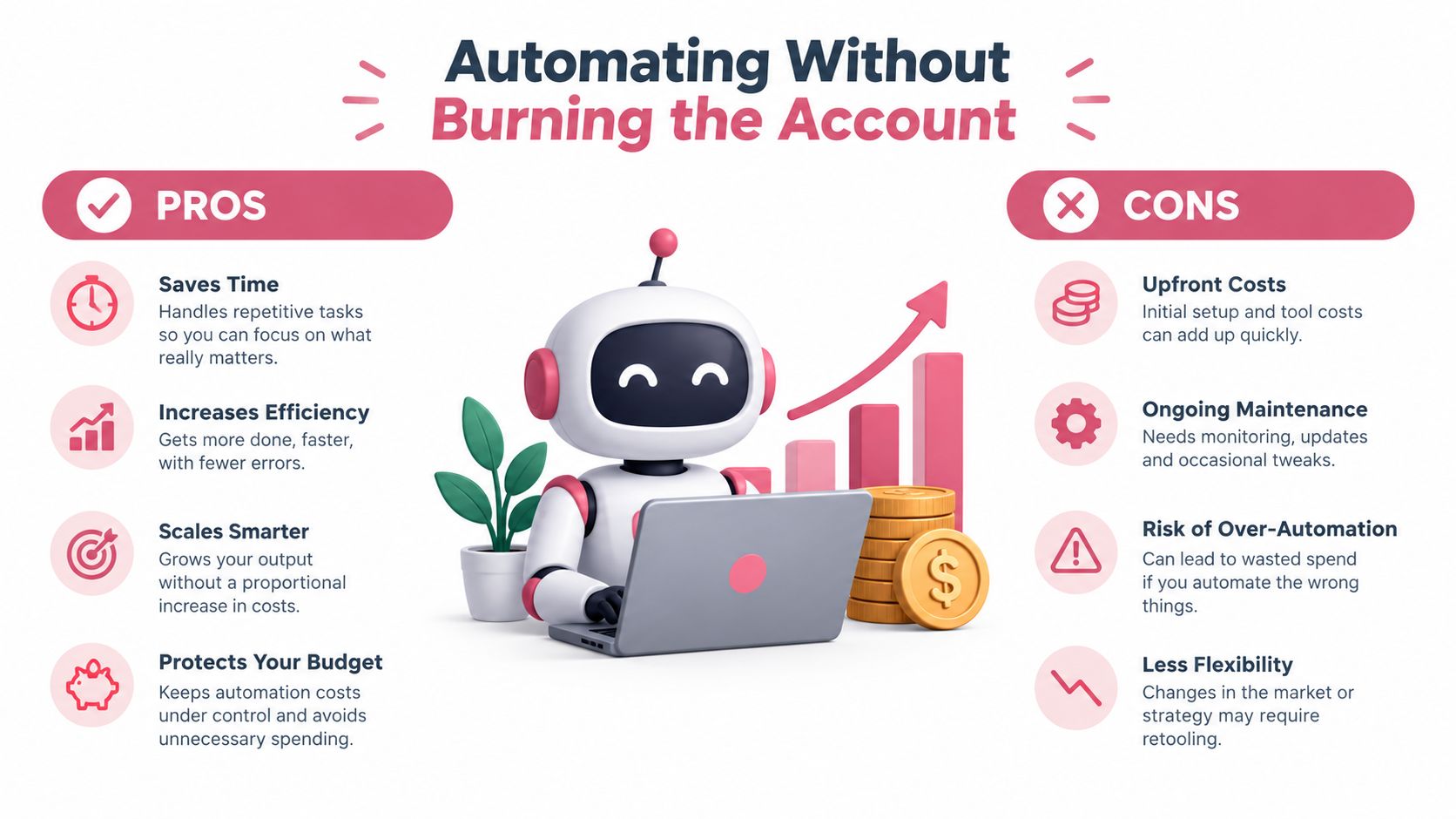
Most account damage comes from confusing orchestration with prohibited automation. Orchestration prepares work, routes data, and asks a human to approve sensitive actions. Prohibited automation imitates member behavior at scale. Operators need to know the difference before they buy tools.
LinkedIn prohibits third party software, browser extensions, crawlers, bots, and scripts used to scrape data, send or redirect messages, or automate likes, comments, and shares, and it warns that violations can breach the User Agreement and create privacy law issues in some jurisdictions, as stated in LinkedIn guidance on prohibited software and extensions. That rule covers more than mass messaging. Automated data collection and automated engagement sit inside the same problem.
Operating Rules That Protect the Account
Use approved access methods and lawful enrichment sources. Keep a person in the loop for connection decisions, first messages, and any reply that involves claims, pricing, or sensitive context. Teams that want a fuller safety check before changing tooling should read whether LinkedIn automation is safe for sales accounts and then audit their current stack against it.
Respect invitation limits. LinkedIn doesn't publish one universal quota, and restrictions can follow when an account reaches its limit, so operators should follow LinkedIn guidance on invitation restrictions rather than treating folklore numbers as policy. Reserve personalized notes for the highest value prospects, send fewer relevant invitations, and pause when warning signs appear.
Validate InMail before launch. The subject line allows up to 200 characters and the body allows up to 1,900 characters, per LinkedIn InMail character limit guidance. Shorter is usually clearer. Put the business reason and relevance signal near the start.
Scheduling content is a different decision from automating prospect contact. Teams that want to plan posts without turning engagement into a bot exercise can browse LinkedIn scheduler options and keep comments, replies, and connection choices under human control.
Every automated workflow should leave a clear audit trail showing source data, generated claims, approvals, and final action.
Scoped permissions matter too. An agent that prepares research doesn't need authority to send messages. Separate preparation from action, log each step, and make approval easy to inspect. That discipline protects the account and improves the work.
Measuring Pipeline, Not Just Connections
Connection count is a vanity metric when it sits alone. A serious measurement chain starts at the account level and follows target account exposure, profile engagement, connection acceptance, qualified conversation, opportunity creation, and revenue. Each stage needs a time window, an exclusion rule, and one source of truth.
Measurement isn't a solved problem. LinkedIn 2025 research surveyed 1,014 senior B2B marketers across the US, UK, France, and India about proving campaign performance, according to LinkedIn research on proving B2B campaign performance. That scale tells operators to design attribution carefully instead of trusting the nearest dashboard.
Attribution Without Self Deception
Don't over credit the last LinkedIn touch. Prospects convert through email, referrals, events, direct visits, and sales follow up after LinkedIn creates familiarity. The harder question is whether LinkedIn created buying momentum when the final conversion happens elsewhere.
Use holdout accounts or matched market comparisons where the motion is large enough. Track whether exposed accounts progress faster, create more opportunities, or reach qualified conversations at a higher rate than comparable accounts that didn't receive the play. Cost per lead can't answer that question by itself.
Operators who want an executive view of the same problem can compare their funnel with the fractional CMO guide to LinkedIn pipeline, especially where content and outbound share credit for later opportunities. The useful lesson is discipline. Define credit before the campaign runs, not after results arrive.
The Campaign Verdict Loop
Grade every campaign against metrics chosen in advance. Promote plays from hypothesis to validated to proven only when sample size and downstream results support the move. Retire underperformers instead of letting them consume list quality and rep attention. Feed each verdict back into ICP choices, signal selection, sender positioning, and message structure.
- Weekly review metrics: Qualified positive replies, opportunities created, and revenue influenced.
- Diagnostic metrics: Acceptance rate, raw reply rate, profile visits, and content engagement.
- Bias checks: Segment quality, sender differences, timing effects, and repeated contacts inside one account.
- Retirement rule: Stop plays that produce activity without qualified progression.
A Thirty Day Launch Sequence
Week one locks the ICP, exclusion rules, profile rebuild, and measurement chain. Week two starts the content and commenting routine inside named accounts. Week three launches signal based prospecting with human approval on first messages and one controlled message test. Week four adds multichannel touches only where signal quality supports them, then runs the first campaign verdict.
Change course when acceptance stays weak after targeting and sender fixes, when replies don't become qualified conversations, or when any account restriction appears. Don't push harder into a broken motion. The goal is a system that learns which signals, senders, and messages create pipeline, then repeats what works with evidence.
Yalc gives B2B teams an AI GTM operating system that connects ICP knowledge, enrichment, LinkedIn and email plays, reply handling, and campaign verdicts in one loop. Teams can run ready playbooks from Slack or compose custom plays with full control, while keeping human approvals and audit trails on sensitive actions. Visit Yalc to turn LinkedIn signals into measured pipeline without relying on send volume alone.