Lead Generation Software Compared for B2B Teams
The most popular advice about lead generation software is wrong: buying the tool with the largest contact database won't fix a weak pipeline. A database can't compensate for stale records, a sequencer can't repair poor targeting, and a CRM integration that logs only the final status leaves operators unable to explain what happened.
The practical decision is a stack decision, not a single tool purchase. Lead generation software now sits across prospect discovery, enrichment, intent capture, outreach, qualification, CRM updates, reporting, and compliance. If those layers don't share reliable data and clear handoffs, automation moves bad information faster.
The category reflects that shift. One market estimate puts lead generation software at $5.88 billion in 2025 and $6.44 billion in 2026, implying 9.6% year over year growth, with a projection of $8.9 billion by 2030 at an 8.4% CAGR (Research and Markets market report). A separate estimate values global B2B lead generation software at $4.8 billion in 2025 and projects $11.6 billion by 2034, while placing the software component at 63.4% of the market in 2025 (Dataintelo B2B lead generation software analysis). These are different market definitions, but they point in the same direction. Software has become operating infrastructure for revenue teams.
This guide gives buyers a way to decide whether the main constraint is data coverage, outreach execution, governance, or integration flexibility. It also shows when a focused point tool makes sense, when a suite is more practical, and when an orchestration layer should connect the systems already in place. Teams that first define ideal accounts by product will make better tooling decisions because they can judge data quality against a specific account model rather than a generic database count.
For a broader process view, the B2B lead generation guide from Yalc is useful context. The central question remains operational: can the stack produce usable, traceable pipeline without creating data decay or compliance drag?
Table of Contents
- Introduction Why Lead Generation Software Is Now Infrastructure
- The Four Categories of Lead Generation Software Explained
- How to Compare Lead Generation Software on What Actually Matters
- Representative Tools by Category and Where Each One Wins
- Which Lead Generation Software Fits Your Team Size and Motion
- Implementation Checklist That Prevents Data Decay and Compliance Drag
- Final Recommendation and Decision Framework for Buyers
Introduction Why Lead Generation Software Is Now Infrastructure
A lead generation platform used to mean a list builder, a form tool, or an email sender. Modern B2B teams need all three jobs connected to the systems that score, route, contact, and report on prospects. A disconnected collection of point tools creates duplicate records, inconsistent qualification, missing activity history, and unclear ownership.
The market's delivery model reinforces this change. Cloud based deployment accounted for 71.8% of revenue in 2025 in one lead generation tools estimate (Dataintelo lead generation tools analysis). Cloud delivery isn't valuable merely because it avoids local installation. It allows enrichment, routing, sequencing, and reporting systems to exchange updates continuously through integrations and APIs.
What breaks in a point tool stack
A database first workflow may find a contact, but it still needs verified details, a qualification rule, an outreach path, and a place to record the result. A sequencer may send a polished campaign, but it can't decide whether the account fits the product or whether a contact's permission and lawful basis are documented.
The common failure is a handoff that depends on a spreadsheet or an operator remembering to update the CRM. Marketing sees an MQL, sales sees an unqualified name, and RevOps has no record level history to resolve the disagreement. Independent sales operations guidance recommends tying calls, emails, and meetings to specific records so teams can trace what happened to every lead or opportunity (audit ready lead tracking guidance).
Practical rule: A tool belongs in the stack only if its output arrives in the next system with enough context to support a decision.
The buying question has changed
Feature count is a weak comparison method. Buyers should ask how a vendor verifies contact data, how often records can be refreshed, how activity reaches the CRM, which integrations are native, and how the system handles consent, retention, deletion, and access requests.
That framework changes the shortlist. A smaller database with clear provenance can outperform a larger one that provides no useful verification methodology. A sequencer with conservative controls can be more valuable than one that maximizes sending options while leaving deliverability and compliance to the operator.
The Four Categories of Lead Generation Software Explained
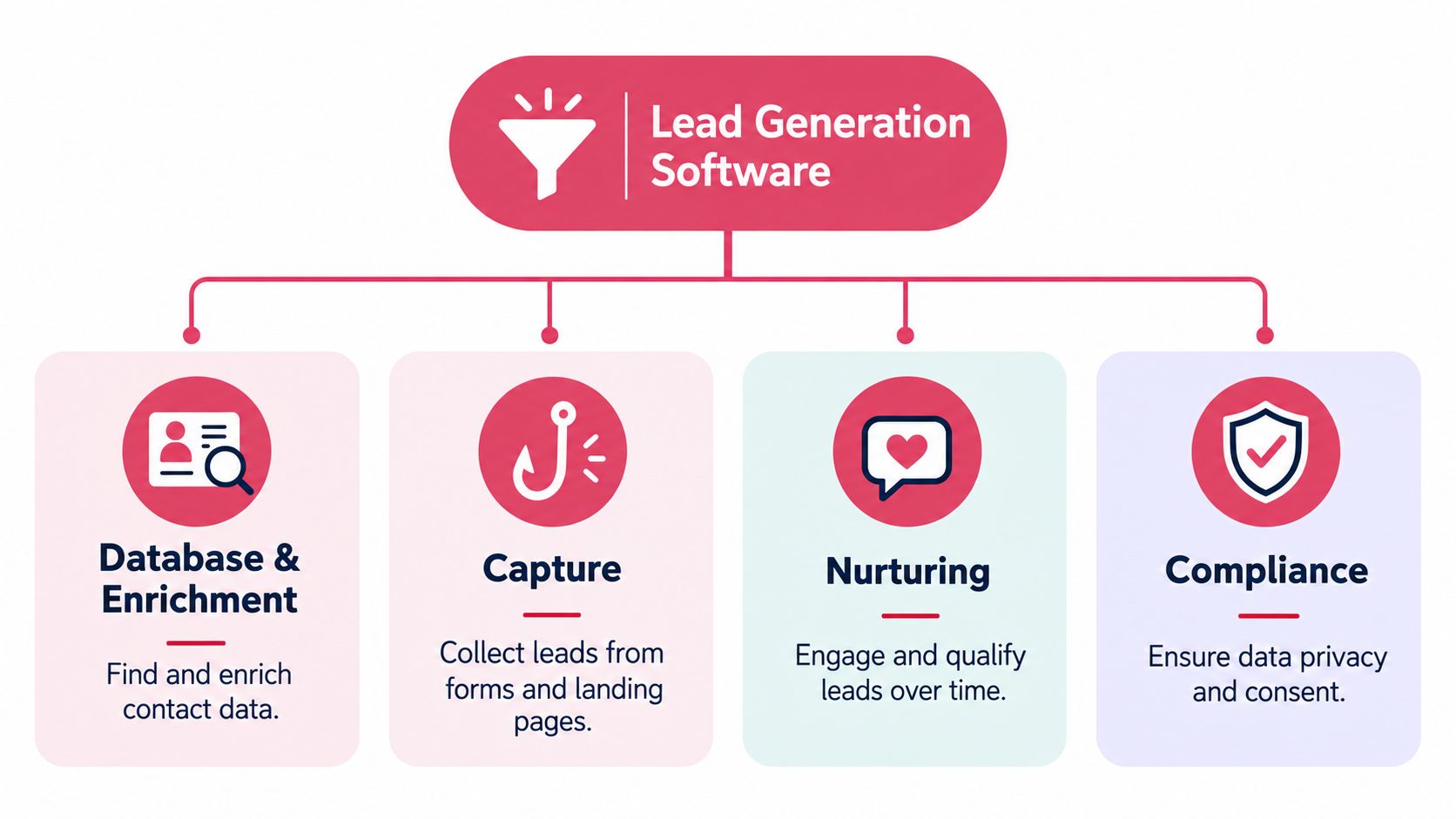
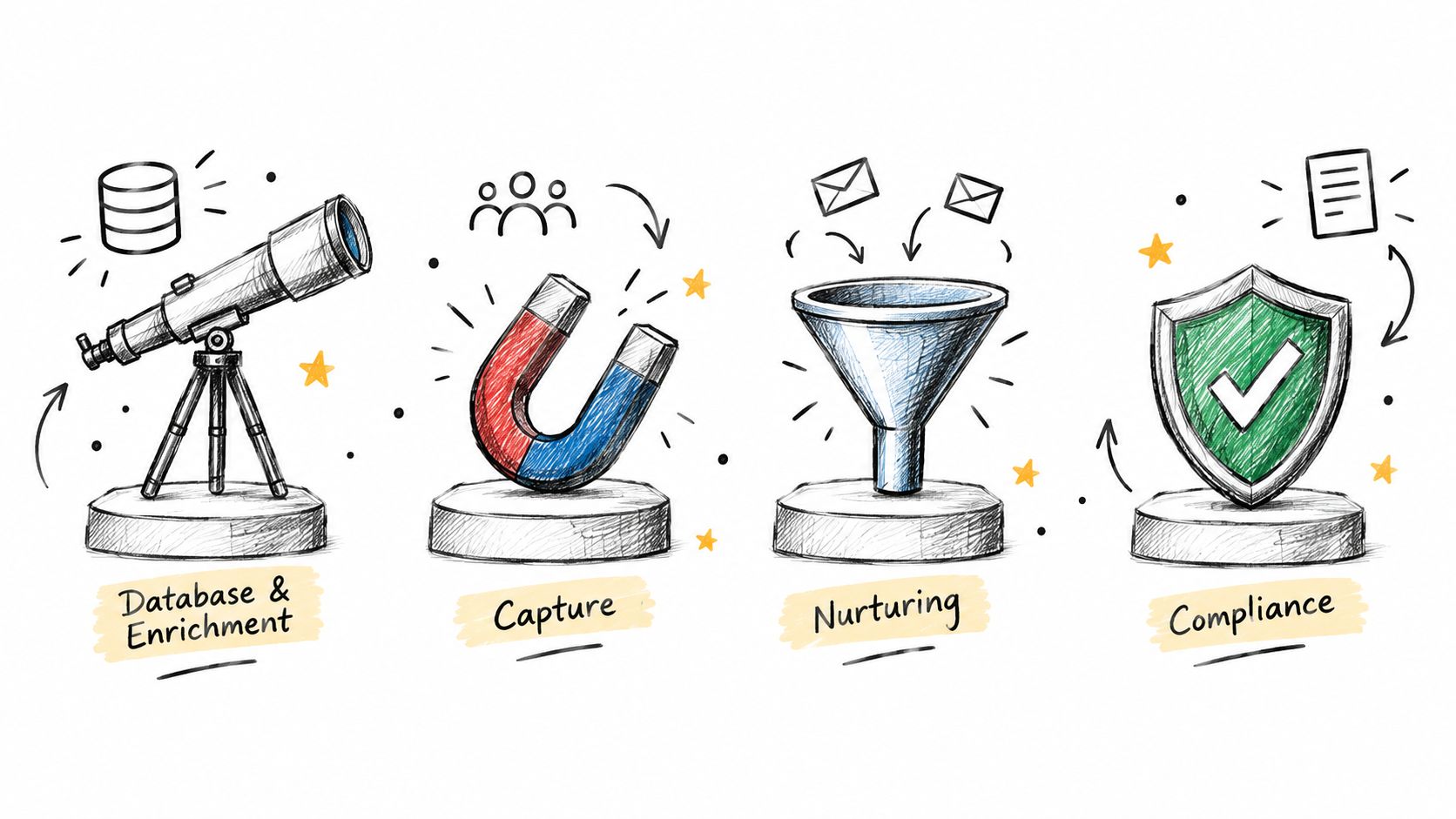
Lead generation software falls into four practical categories. Each solves a different problem and hands information to the next layer. Comparing them as though they're interchangeable is how teams buy the wrong system.
Database and enrichment
These platforms find people and companies, then add firmographic, contact, role, or technographic information. Their primary buyers are sales development, growth, and RevOps teams that need account lists or better records inside an existing CRM.
The important handoff is not the exported CSV. It is a structured record with source, verification status, matching logic, and a clear update path. If the enrichment layer can't explain where a field came from or when it was checked, the team can't judge whether the record is safe to use.
Capture and intent
Capture tools collect demand through forms, landing pages, chat, event workflows, or visitor and intent signals. They suit marketing teams that want to identify interest before a prospect speaks with sales.
Capture is useful only when the signal reaches a routing or qualification process. A form submission without ownership, a visitor alert without account fit, or intent data without a follow up rule creates notifications rather than pipeline.
Sequencing and outreach
Sequencers coordinate email, calling, social touches, and follow ups. They belong to SDR teams and sales operators who already have a defined audience and message.
This category executes a motion. It shouldn't be expected to determine the entire ICP, repair missing contact details, or replace CRM governance. The quality of the input list and the rules for stopping or escalating a sequence matter more than the number of available steps.
Orchestration and unified GTM layers
Orchestration connects research, enrichment, qualification, outreach, CRM activity, and reporting. It suits teams that have several specialist tools and need one operating layer rather than another isolated destination.
A unified layer should preserve provider flexibility, expose failures, support approvals for sensitive actions, and keep the account context available throughout the workflow. Its job is to make the stack behave like a process instead of a pile of subscriptions.
How to Compare Lead Generation Software on What Actually Matters
Lead generation software is a stack decision, not a single-tool purchase. Compare every category against the same operating requirements: trustworthy records, controlled execution, traceable activity, flexible integration, and lawful data use. A database can have excellent coverage and still fail if it cannot pass clean records into CRM workflows. A sequencer can execute perfectly and still underperform when its inputs are stale.
Independent comparisons commonly assess contact databases, email verification, multichannel outreach, CRM integrations, AI-powered scoring, and intent data. They also examine coverage by market, verification methods, native integrations, compliance controls, and pricing transparency (lead generation software feature comparison).
| Category | Enrichment and Verification | Sequencing and Outreach | CRM Sync and Integrations | Best Fit Signal |
|---|---|---|---|---|
| Database and enrichment | Strong coverage and field enrichment, with quality varying by market and source | Usually limited or secondary | Useful when records match and update reliably | The team lacks account and contact data |
| Capture and intent | Focused on submitted or observed signals rather than broad contact coverage | Nurture and routing may be available | Sends context and ownership to sales | Demand exists but remains invisible or unworked |
| Sequencing and outreach | Depends heavily on upstream data quality | Strong execution, scheduling, stop rules, and channel control | Activity logging and reply handling matter | The audience is known and follow-up is the bottleneck |
| Orchestration and unified GTM layers | Combines enrichment sources and preserves provenance | Coordinates specialist outreach tools | Strongest with native APIs, webhooks, approvals, and logs | Tool sprawl and broken handoffs slow execution |
Enrichment coverage and verification
Vendor record counts are a weak buying criterion. Test representative contacts from the markets, roles, company sizes, and fields that define your ICP. Check whether the product shows verification status, records when a field was last checked, and lets your team preserve a trusted CRM value instead of overwriting it with uncertain enrichment.
Data accuracy now limits the usefulness of AI personalization (B2B lead generation software market analysis). A system connected to weak data can produce messages that sound specific while making claims the prospect cannot trust. Ask vendors how they source, refresh, verify, and expose provenance for each important field.
Sequencing and deliverability
A production sequence needs controlled enrollment, suppression, stop conditions, reply classification, and human review. It should also remove contacts when an account changes status or a person objects. These controls are more valuable than a long menu of automated steps.
Volume alone says little about pipeline quality. B2B funnel benchmarks include a 31% lead to MQL rate, 13% average MQL to SQL or SAL conversion, 15% healthy MQL to SQL or SAL conversion, and 47% SQL or SAL to opportunity conversion (B2B lead generation ROI metrics). Treat those figures as directional rather than promised outcomes. They show why evaluation should follow records through qualification and opportunity creation, not stop at delivered emails or new leads.
CRM sync, APIs, and activity logging
A stack used in production needs deterministic matching, field ownership, retry handling, and a visible failure queue. Email, calls, meetings, status changes, and qualification decisions should attach to the correct account or contact. If activity lands in separate tools without a reliable history, managers cannot audit what happened or explain pipeline movement.
Native integrations reduce setup work. API quality determines whether the stack can change later. Look for webhooks, structured exports, idempotent updates, clear authentication, and event logs. These capabilities let a team replace an enrichment provider, add a channel, or connect a unified GTM API without rebuilding every workflow.
The integration test is simple: create a test record, enrich it, enroll it, reply to it, stop it, and inspect the CRM history. If an operator cannot reconstruct that journey, the integration is not ready.
Compliance and data governance
GDPR can apply to B2B lead generation because these systems process information about identifiable people, not only companies. Cold outreach may rely on legitimate interests or consent. Consent must be freely given, specific, informed, and unambiguous. A pre-ticked checkbox does not qualify (GDPR consent and B2B lead generation guidance).
Evaluate lawful-basis records, suppression lists, retention rules, access and deletion workflows, regional processing, and audit logs. Also confirm which system owns consent and suppression status when several tools exchange data. Compliance changes the workflow design, so it belongs in the stack evaluation before contracts are signed, not after campaigns begin.
Representative Tools by Category and Where Each One Wins
Tool names help buyers understand patterns, but they shouldn't turn a comparison into a universal ranking. Apollo and similar database first products are useful when a team wants prospect discovery, enrichment, and some outreach in one workspace. Their trade off is that a broad suite can make it harder to isolate the source of a bad record or replace one component without changing the entire workflow.
ZoomInfo is typically evaluated by teams that prioritize a large commercial data operation, account intelligence, and sales workflows. The trade off is cost and procurement complexity, along with the need to validate coverage for the specific markets and roles that matter. Buyers should request a methodology explanation, not rely on a database size claim.
Sequencer first tools
Outreach, Salesloft, and lemlist illustrate the sequencer first model. These tools are strongest when the team already has an approved audience, defined messaging, and a process for handling replies. They can coordinate follow up and expose execution data that a general CRM often handles poorly.
They don't remove the need for accurate sourcing or governance. A sequence that runs smoothly against the wrong account list is still a failed campaign. Pricing transparency also varies, so buyers should compare the cost of active seats, contacts, channels, usage, and required implementation rather than looking only at the advertised starting plan.
Capture and intent tools
HubSpot represents a broader CRM and marketing automation approach, while visitor identification and intent products focus on detecting interest that doesn't arrive through a form. These tools can be valuable for demand generation teams, but account identification isn't the same as permission to contact an individual. Legal basis, messaging relevance, and regional rules still need an owner.
Tracking also extends beyond forms and email. Teams running events, QR campaigns, or partner programs can use tools for tracking QR scans and referrers to connect an offline or distributed touchpoint to a source and destination. That data becomes useful only when it enters the same attribution and qualification model as other leads.
For a focused review of the data layer, the lead enrichment tools comparison from Yalc provides a useful way to assess providers by workflow rather than by brand familiarity.
Orchestration as the differentiator
Teams with Unipile for LinkedIn, FullEnrich for contact enrichment, lemlist for outbound, Crustdata for profiles and firmographics, and Notion for tracking may not need another specialist application. They need an operating layer that can pass context between those systems, record outcomes, and preserve the ability to change providers.
That distinction matters for pricing too. The visible subscription is only part of the cost. Operators also pay in connector maintenance, manual cleanup, implementation time, and the opportunity cost of repairing failed handoffs.
Which Lead Generation Software Fits Your Team Size and Motion
Lead generation software works best when it matches the motion, not when it tries to do everything. A founder running focused outbound usually needs a light capture path, targeted enrichment, a simple CRM, and controlled follow-up. Buying an enterprise suite before the ICP, qualification rule, and message are stable creates more review work than useful conversations.
Start with a small set of target accounts and test them manually before automating enrollment. If the team cannot explain why each account fits, more records will only add noise.
Small SDR teams
A small SDR team does well with a database or enrichment source, a sequencer, and CRM activity logging. The handoff should include account fit, role context, verification status, owner, and the reason a sequence stopped.
The common mistake is tracking completed tasks instead of accepted opportunities. Sales acceptance should be above 70%, and inbound response time should be under 5 minutes in benchmark guidance for B2B lead generation measurement. Those figures are operating references, not promises. They help leaders see whether routing and follow-up are working.
RevOps led scale ups
A scale-up needs field ownership, deduplication, permissions, suppression handling, and a reliable audit trail. The stack should separate the system of record from enrichment and outreach systems, then define which system can create, update, or delete each field.
Let every tool write to the CRM without conflict rules, and you get silent overwrites and unreliable reporting. RevOps should own the data contract and require vendors to show error handling before volume expands.
Agencies and multi client teams
Agencies need client workspace isolation, reusable playbooks, separate consent rules, and reporting that preserves campaign provenance. A shared sequence template can save time, but copying assumptions from one client into another can hurt targeting and compliance.
The handoff point is the client report. It should show what was sourced, what was enriched, what was sent, which replies were classified, and what reached the CRM. Without that chain, an agency can report activity but not defend lead quality.
Implementation Checklist That Prevents Data Decay and Compliance Drag
Implementation quality determines whether lead generation software remains useful after launch. The following checklist focuses on the controls that prevent a clean first week from turning into a polluted database.
Start with waterfall enrichment
Use a defined order of data sources instead of asking one provider to fill every field. Set rules for which source wins, what happens when verification fails, and when an existing CRM value must remain untouched.
Document field provenance and review stale records on a recurring schedule. Data accuracy is a process, not a feature toggle.
Make CRM sync observable
Create deterministic matching rules for accounts and contacts. Configure retries, duplicate handling, and a failure queue that a named operator reviews.
Log calls, emails, meetings, replies, and status changes against specific records. That history supports sales handoff, RevOps review, and compliance investigation.
Record consent and lawful basis
For each campaign, store the lawful basis, collection context, relevant region, retention rule, and suppression status. Give prospects a workable path for access and deletion requests.
GDPR and CCPA obligations can require workflow changes, not just a policy page. The compliance owner should approve the campaign logic before the team scales outreach.
Test integration reliability before volume
Run a complete test through enrichment, qualification, sequencing, reply handling, CRM logging, and reporting. Inspect each record after every step and deliberately test failures, duplicate matches, opt outs, and missing fields.
A unified GTM API approach can reduce fragmented connectors and manual cleanup by giving the workflow one control surface. Teams planning outbound execution can also use the outbound lead generation workflow from Yalc as a process reference.
Keep a cleanup owner
Assign responsibility for duplicate removal, stale record review, failed syncs, and suppression list accuracy. Software can surface problems, but an accountable operator must decide how to resolve them.
Final Recommendation and Decision Framework for Buyers
Choose based on the bottleneck, not the vendor category.
If data coverage is the constraint, start with a database and enrichment provider. If the audience is known but follow up is inconsistent, prioritize sequencing, stop rules, reply handling, and activity logging. If governance is the concern, evaluate lawful basis records, permissions, retention, suppression, and auditability before discussing automation depth.
A suite makes sense when a small team values one vendor and low integration overhead. Best in class point tools make sense when a team has strong RevOps capacity and needs specialized performance. An orchestration layer is the better fit when several useful tools already exist but their data and workflows remain fragmented.
For teams that need that connective layer, Yalc provides a unified GTM API that can orchestrate Unipile, FullEnrich, lemlist, Crustdata, and Notion from one interface. It supports sourcing, enrichment, qualification, outbound execution, CRM synchronization, approvals, and step by step telemetry while keeping provider choice available.
Before signing, require a live test with representative accounts. Verify the enrichment methodology, inspect provenance, run a full CRM handoff, trigger an opt out, review the activity history, and ask what happens when an integration fails. Marketing claims matter less than whether the system can produce a clean, explainable record from first signal to pipeline outcome.
Yalc connects prospecting, enrichment, qualification, outreach, CRM synchronization, and reporting through a unified GTM API, with workflows that can run from its interface, Slack, or Claude Code. Visit Yalc to evaluate whether its orchestration layer can reduce tool sprawl while keeping your data, approvals, and execution history under your control.