Lead Generation Strategy: How to Build One That Converts
Most advice on lead generation still starts with volume. Buy a larger list, send more email, and hand every name to sales. That order spends money on people who were never going to buy, and it does it before a campaign is even written.
A lead generation strategy that converts ranks qualification ahead of volume. The useful question is not how many names you can capture. It is which accounts deserve a conversation, and what must be true before sales ever sees them.
Buyers research on their own, often for weeks, and they drop vendors who show up with a generic pitch. Chasing reply rate before you have a written ideal customer and a score cutoff fills the CRM with noise. Sales then spends the week saying no. The alternative is six decisions, taken in a fixed order, each with an owner and a finish signal. Write those outputs before you open a vendor demo.
Table of Contents
- The Six Decisions Behind a Lead Generation Strategy
- How to Define Your ICP and Qualification Score
- How to Map Channels to Buyer Research Stages
- How to Design Campaigns and Route Leads Within Five Minutes
- How to Measure Each Stage and Test Hypotheses
- How to Pick Tooling and Enrichment Without Tool Sprawl
- Launch Your First 90 Day Lead Generation Cycle
The Six Decisions Behind a Lead Generation Strategy
Volume is the wrong starting metric. A lead generation strategy is six linked decisions, made in this order.
The ICP defines who is worth reaching. The channel map decides where those buyers research before they talk to sales. Campaigns and routing decide what happens after a reply or a form fill. Tooling makes each step repeatable. Measurement shows which stage is leaking. Testing decides what to change next.
Change the channel before you define the ICP and you only buy more of the wrong leads. A HubSpot summary of MarketingSherpa findings reports that 79 percent of marketing leads never convert into sales. The same summary says 61 percent of B2B marketers send all leads directly to sales, even though only 27 percent of those leads are qualified. Forwarding the whole list doesn't create pipeline. It creates waste, and it trains sales to ignore marketing.
Practical rule: If sales hasn't signed the score cutoff, you don't have a strategy yet. You have a list.
Teams that want a plain split between filling contacts and shaping demand can compare generation strategies with Wojo Media before they assign a single channel.
| Decision | Output | Owner | Done when |
|---|---|---|---|
| ICP and scoring | Written criteria with values, tiers and a score cutoff | Marketing and sales leadership | Sales signs off on the cutoff |
| Channel map | Channels assigned to buyer stages with one primary per stage | Demand generation | Each stage has one primary channel per tier |
| Campaigns and routing | Sequences, response target and exit states | Revenue operations and SDR lead | Every lead has an owner and an exit state |
| Tooling and enrichment | System of record, enrichment order and sequencing tools | Revenue operations | Data moves between tools without manual copying |
| Funnel measurement | Stage definitions and baseline conversion by segment | Revenue operations | Two to four quarters of baseline data exist |
| Testing cadence | One variable per test and a decision rule | Growth lead | Each success metric is set before launch |
Write the six outputs on one page before you buy a tool. That page is the checklist for every choice that follows.
How to Define Your ICP and Qualification Score
Start with a list you can defend, not a persona sketched on a whiteboard.
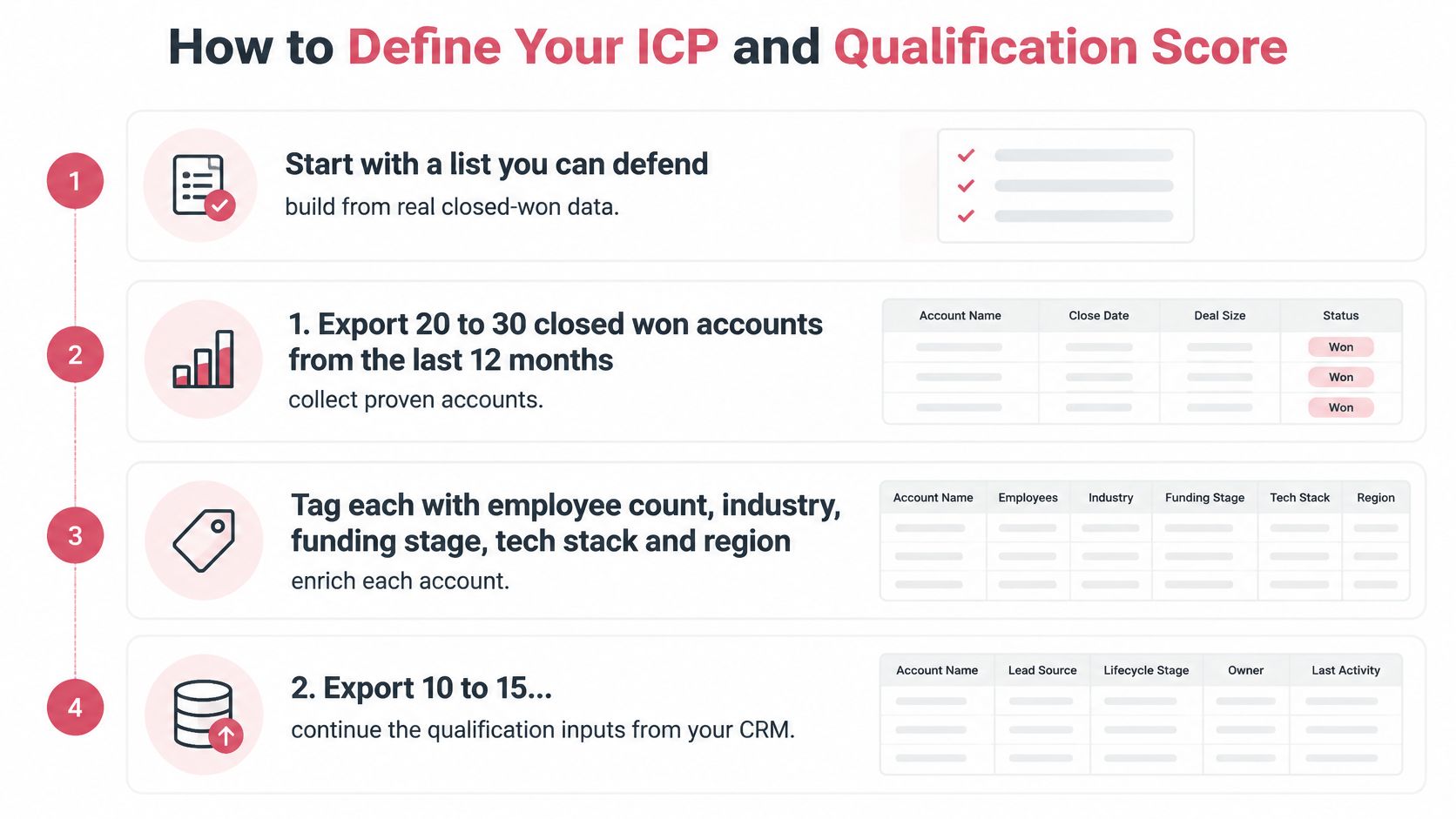
Build the score from won and lost accounts
Export recent wins. Pull 20 to 30 closed won accounts from the last 12 months. Tag employee count, industry, funding stage, tech stack, and region. You need a pattern you can point to, not a wish list of logos.
Export the failures. Pull 10 to 15 churned or stalled accounts and tag the same fields. Look for exclusion rules, such as companies below a headcount where the product sits unused. Those rules stop outbound before it starts.
Split the market into three tiers. Tier 1 matches the winning profile and shows a live buying signal. Tier 2 matches firmographics only. Tier 3 sits outside the ICP and gets no outbound. Tiers keep the expensive touches on accounts that resemble revenue.
Score five criteria with explicit values. Use firmographic fit, a documented business problem, evidence of current intent such as a hiring spike or a new executive, buying authority, and timing. A label like "good fit" can't be audited later.
Set the threshold before any campaign runs. A lead enters the active sales queue only with an ICP match, a documented pain point, and a buying signal from the last 90 days. Lead qualification benchmarks compiled by Landbase put conversion at 40 percent for thoroughly qualified leads, against 11 percent for unqualified prospects. That gap is why the cutoff exists before the first send.
Log the reason for every score. Each month, audit false positives and false negatives by source. The number alone doesn't tell you which field lied.
For a fuller pass on writing the profile itself, use this ICP definition guide.
Score the account and the contact separately. A Tier 1 company can still have no reachable buyer. A filter you use to identify qualified B2B leads should hit both records before anyone is routed to sales.
How to Map Channels to Buyer Research Stages
Map each channel to the stage the buyer is in when they meet it. Don't map it to what the channel costs.
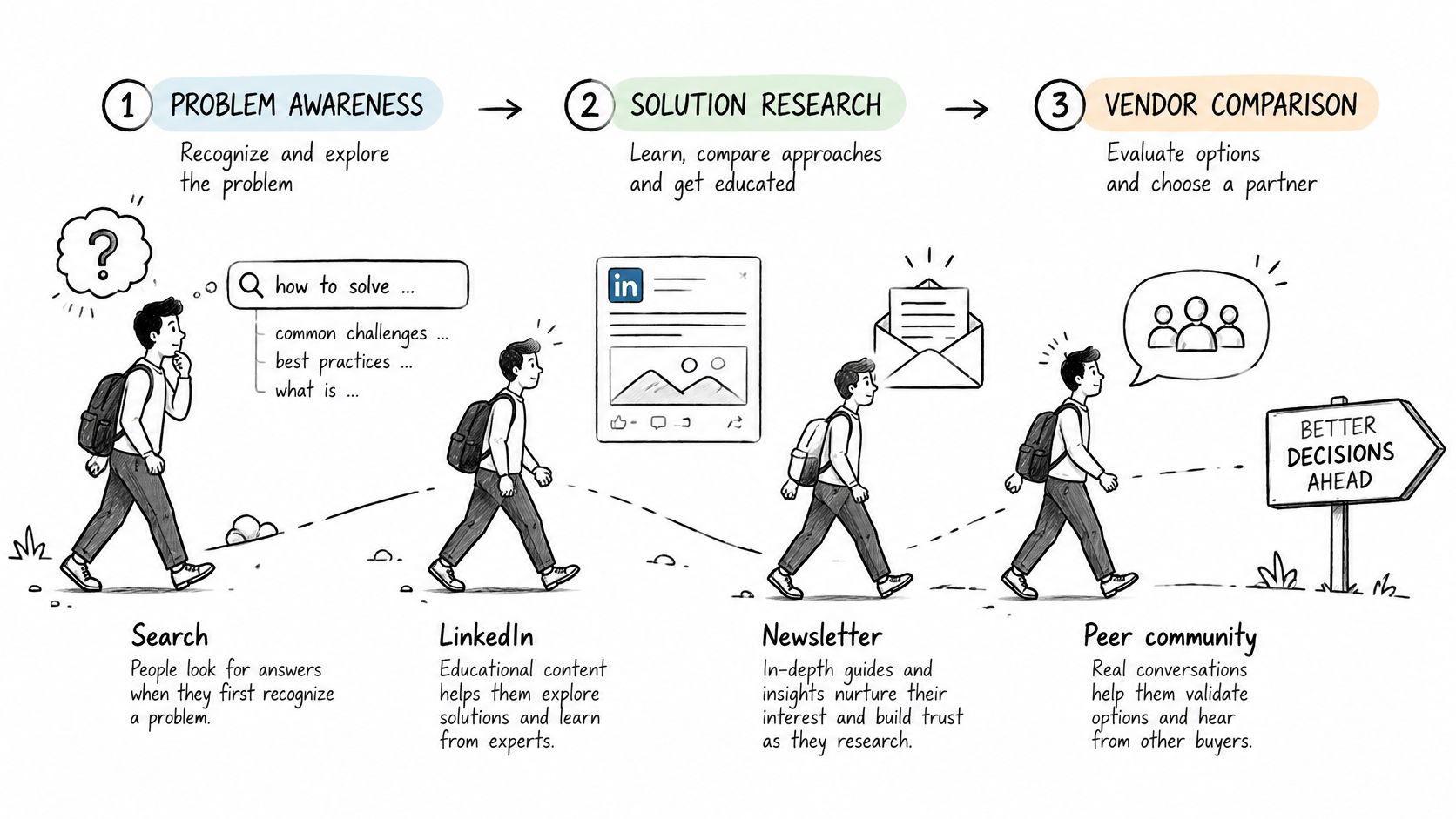
Problem awareness is research into the problem, not into vendors. Solution evaluation is a comparison of approaches, and it is where proof has to stand alone. Vendor selection is a check on fit, risk, and price, and it is the first stage that needs a rep.
Assign one primary channel per tier
- List every channel you already run or could run in the next quarter.
- Assign each channel to one stage. A channel that tries to do all three does none of them well.
- Name one primary channel per stage for each ICP tier. Secondaries can support. They don't lead.
- Set outbound volume by tier. Reserve the highest touch count for Tier 1. Tier 3 gets none.
Gartner sales research found that 61 percent of B2B buyers prefer a buying experience with no sales rep. Content has to answer the research questions before a rep joins. In the 2025 Demand Gen Report benchmark survey, 57 percent of surveyed demand generation professionals named case studies as their top content format. That asset belongs in evaluation, not as another cold email variant.
A large share of research never hits the CRM. A 2026 buyer synthesis from Innovative Group estimates that 70 to 80 percent of the journey can occur in untracked places such as private communities, peer messages, and AI tools. Add a CRM field for how each opportunity first heard of you, and ask what shaped the shortlist. Compare those answers with branded search and direct traffic. Don't pretend that path is precise. Rank the hypotheses and test them.
Say a Series A team has two SDRs. Outbound goes only to Tier 1 accounts with a buying signal. Two case studies carry search. Sales follows up after a shortlist signal, not after a page view. The split between outbound and inbound is a stage decision, not a budget slogan.
| Buyer stage | Buyer behavior | Primary channels | Channel job |
|---|---|---|---|
| Problem awareness | Buyer researches the problem, not vendors | Search, LinkedIn posts, newsletters, peer communities, podcasts | Earn attention and trust |
| Solution evaluation | Buyer compares approaches and vendors | Case studies, comparison pages, webinars with proof | Answer research questions before a rep joins |
| Vendor selection | Buyer confirms fit, risk and price | Sales calls, references, pricing and security answers | Turn the shortlist into an opportunity |
How to Design Campaigns and Route Leads Within Five Minutes
Design one campaign per ICP tier, with one message per buying stage. Don't design one campaign per channel. Channel-first planning repeats the same pitch everywhere and still misses where the buyer is.
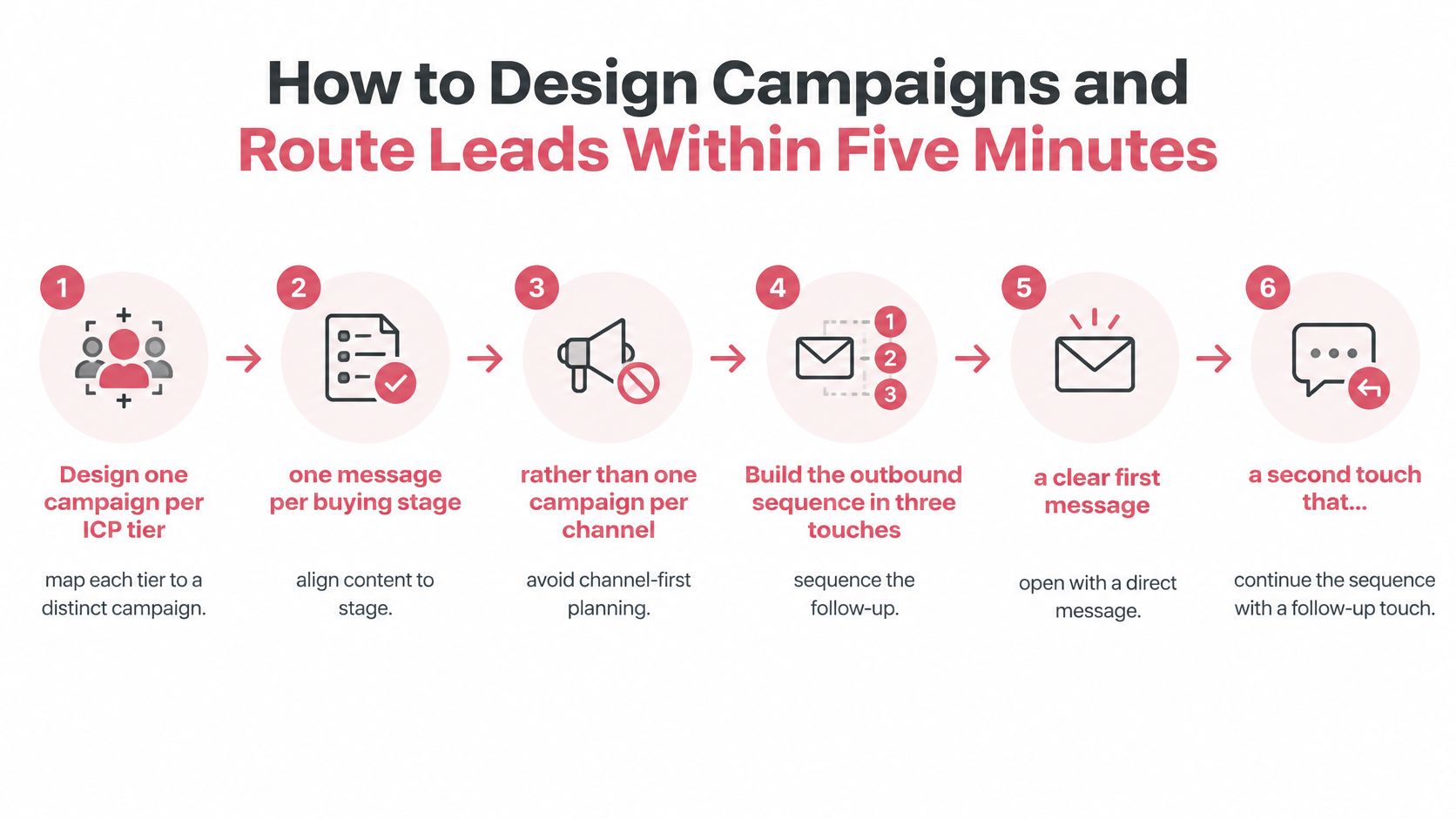
Build three outbound touches
Touch one states the problem and one proof point in plain language. Touch two adds a new reason to reply, such as a result from a similar account or a change you can see at theirs. Touch three goes out before anyone marks the lead unresponsive.
A 2025 Belkins study of omnichannel sales outreach reported that follow up messages generated 58.6 percent of all replies, even though the first email had the highest reply rate of any single step. The same study found the third email was the most productive for booking appointments, producing more meetings than the first two emails combined. Judge the sequence by replies and meetings per touch number. The first email is not the campaign.
Stop or switch channel when the prospect replies, opts out, or shows clear disinterest. Suppress existing customers and open opportunities before any sequence sends. A message to a live deal is how trust gets spent.
Route inbound inside five minutes
- Capture submission time in the workflow that creates the record.
- Assign an owner in that same workflow. A shared queue with no name isn't a route.
- Target first contact within five minutes. Research cited by InsideSales and Harvard Business Review, summarized by Searchlab, found that companies contacting a lead within five minutes were nine times more likely to qualify that lead than companies responding later.
- Record first contact time, channel, and result so revenue operations can see whether delay is cutting conversion.
- Apply an exit state to every lead. No record stays in limbo because nobody chose a next step.
A Harvard Business Review audited study covered by Lead Spot, across 2,241 companies, found that the average first response among responding firms was 42 hours. The five minute target holds only when routing is automated. Manual triage adds hours before anyone reaches out.
Paid search and paid social should land in the same fields. Teams comparing SEO and PPC lead campaigns still need one owner and one timestamp on every form fill. The channel doesn't change the exit states below.
| Exit state | Trigger | Action | Owner |
|---|---|---|---|
| Sales ready | Score at threshold with a recent buying signal | Book a call with an AE within two business days | Account executive |
| Nurture | Good fit with no current intent | Enroll in a long sequence with proof content | Marketing |
| Disqualified | Outside ICP or no pain point after two touches | Stop outreach and log the reason | Revenue operations |
| Unreachable | No valid contact after three touches | Suppress and try a new contact or channel | Revenue operations |
| Suppressed | Existing customer or active opportunity | Remove from all sequences | Revenue operations |
How to Measure Each Stage and Test Hypotheses
Define each stage with an entry event and an exit event, then calculate conversion at every handoff. Use your own CRM. Market, offer, and data quality move the rates, so a borrowed benchmark will mislead you.
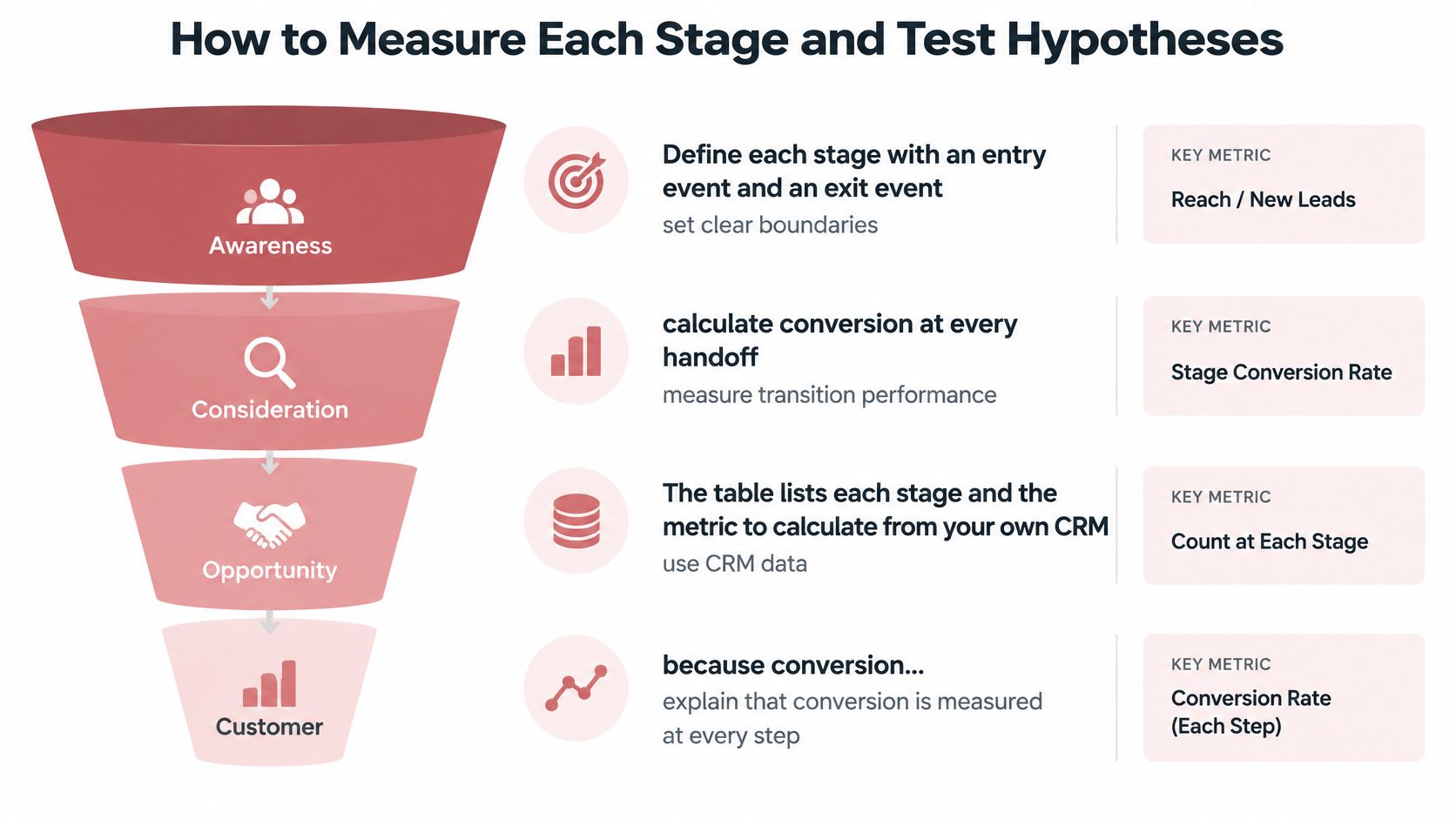
| Stage | Entry event | Exit event | Metric to calculate |
|---|---|---|---|
| Lead | Form fill, list import or account signal | Passes fit check | Pass rate by channel and source |
| MQL | Meets scoring threshold | Accepted by sales | Acceptance rate by ICP tier |
| Sales accepted lead | Sales accepts ownership | Opportunity created | Opportunity rate by channel |
| Opportunity | Discovery call booked | Proposal or closed lost | Win rate by segment |
| Customer | Signed contract | Renewal or churn | Retention by cohort |
Run one variable at a time
- Name the stages in writing. Lead, MQL, sales accepted lead, opportunity, and customer. Write the event that moves a record between them so two people can't invent two definitions.
- Pull a baseline of two to four quarters. Segment by channel, ICP tier, company size, geography, and intent. A single blended rate hides the tier that is working.
- Find the weakest handoff. Calculate conversion at every step. Fix that stage before you pour more volume in above it.
- Change one variable. Targeting criteria, offer, routing speed, qualification rule, or message. Two changes at once make the result unreadable.
- Compare with the baseline before you keep the change. A busier week isn't evidence.
Personalization is the clean model for this kind of test. A buyer engagement study reported by Yahoo Finance found personalized emails averaged a 29 percent open rate and a 5.2 percent click through rate, against 21.5 percent and 2.3 percent for generic emails. That is about a 35 percent relative lift in opens and more than a 125 percent lift in clicks. Treat those figures as directional. Audience, offer, sender reputation, and list quality all move the result.
Hold audience, offer, send window, and call to action constant. Change only the personalization, whether that is company context, a role specific pain, or a signal such as a hiring spike. Judge positive replies and meetings, not opens.
Promote a play to validated only when the lift in meetings and pipeline holds against the control group. A higher open rate isn't a verdict.
How to Pick Tooling and Enrichment Without Tool Sprawl
A tool earns its seat only when it removes a repeated manual step and writes a field the funnel needs. Another login, with no new field, is sprawl.
Five layers, one tool each
- System of record. The CRM stores every stage event. If a timestamp lives only in a spreadsheet, the funnel is fiction.
- Enrichment. Run one waterfall for email, phone, and firmographic data, ordered by coverage and then by cost. Log which provider filled each field. A stable order for lead enrichment stops two reps from buying the same contact twice.
- Outbound. One email sequencing tool. If LinkedIn is a primary channel for a tier, add one LinkedIn tool, not three.
- Reasoning. An AI model can draft scoring notes, classify replies, and draft personalization. It doesn't press send.
- Alerts. Slack or Microsoft Teams carries routing notices and approval requests. The alert is a trigger, not a second database.
Map every manual task from last month. Keep the ones that repeat weekly, and automate those first. Require a human approval before any outbound message reaches a prospect. Speed without that gate just scales a bad note.
Some teams collapse these layers into one GTM platform such as Yalc, which can score against the ICP, enrich contacts, and run sequences from the same record. The test doesn't change with the vendor. Does the tool remove a repeated step, and does it write the field the funnel needs?
I would not buy a sequencer until marketing and sales have signed the score cutoff. Tools will score the wrong accounts faster when the ICP is still a slide.
Launch Your First 90 Day Lead Generation Cycle
Run the first cycle in four phases. Name one owner for each phase before day one, or the dates will slip without anyone noticing.
Days 1 to 14. Marketing and sales write the ICP tiers, the score criteria, and the stage definitions. Revenue operations pulls the baseline from the CRM. Nothing sends in this window.
Days 15 to 30. Demand generation maps channels to stages and builds one outbound campaign for Tier 1 only. Revenue operations switches on automatic routing with a five minute first contact target. Inbound without an owner doesn't count as live.
Days 31 to 60. The growth lead runs one test on one variable. The success metric and the decision rule are written before launch. If the metric is "more leads," the test is invalid.
Days 61 to 90. That same owner reviews results, promotes or retires the play, and names the next variable. One change enters the next cycle. A pile of ideas doesn't.
Three review gates
- Day 30. Every inbound lead has an owner and recorded timestamps. If either field is blank, routing isn't finished.
- Day 60. The test group is large enough to read. A handful of replies is an anecdote, not a decision.
- Day 90. The baseline is refreshed with the new cohort. Old conversion rates don't judge a new offer.
If a test shows no lift after its full window, retire it. Don't extend it because the creative felt strong. A retired play is a result. An endless test is a stall.
This week, pick one Tier 1 segment, write its score criteria, name the owner for inbound routing, and set the first response target. Do that before the first campaign goes live.
Yalc gives B2B teams one place to score accounts against a written ICP, enrich contacts, route replies, and grade each campaign against the metric you set before launch. That is the same order this lead generation strategy uses, from cutoff to verdict, without copying records between tools by hand. See how the plays run at Yalc.