10 Lead Generation Techniques That Build Pipeline
The most popular advice about lead generation is also the least useful: pick the channel with the highest average conversion rate and scale it. No channel wins by default. SEO captures existing demand, content and events create or shape demand, paid campaigns accelerate access to known audiences, and outbound works best when a team has a defined account list and a credible reason to reach out.
The right choice depends on the signal available and the operating conditions around it. A team with strong search demand needs a different motion from a team selling into a small group of named accounts. A company with trusted partners can build pipeline without adding another outbound sequence. A revenue operation already managing LinkedIn, email, enrichment, and CRM data may need orchestration more than another isolated tactic.
The techniques below compare each motion by buying signal, execution requirements, failure points, trade offs, and decision metrics. The objective isn't to collect leads indiscriminately. It's to identify which motion produces qualified opportunities, which one needs better routing or nurturing, and which one should be retired.
Table of Contents
- 1. Account Based Marketing with Intent Data
- 2. Content Marketing and SEO for Organic Lead Generation
- 3. Email Sequences with Cadence Optimization
- 4. LinkedIn Outbound Sequences with Personalization
- 5. LinkedIn Lead Gen Forms and Sponsored Content
- 6. Website Visitor Identification and Retargeting
- 7. Webinar and Virtual Event Lead Capture
- 8. Referral Programs and Partnership Networks
- 9. Account Expansion and Customer Referral Programs
- 10. Unified GTM Automation and Campaign Orchestration
- 10-Point Lead Generation Techniques Comparison
- Build the Motion Around the Signal
1. Account Based Marketing with Intent Data
Account based marketing works when the sales team knows which companies matter and can detect when those companies are researching a relevant problem. Firmographic fit narrows the account list. Intent data, website activity, hiring changes, and content engagement help determine when outreach is timely.
The mistake is treating intent as proof that an account is ready to buy. It's a prioritization signal, not a qualification decision. A company can research a category for competitive intelligence, hiring, or general education. Sales still needs to validate the problem, stakeholders, and timing.
Start with a small group of high fit accounts. Map the likely buying committee, research each role's priorities, and prepare account specific assets that reflect the company's context. A case study from a similar business is more useful than a generic product brochure.
Execution that keeps ABM practical
Create one shared account record for marketing, sales development, and account executives. Record the signal, its date, the affected topic, the stakeholders involved, and the action the team expects to take. If the signal is meaningful, route it quickly. If it produces no response, move the account into useful education rather than escalating every channel.
Coordinate email, LinkedIn, calls, and content around one narrative. A prospect shouldn't receive disconnected messages from several teams. Intent data and buying signals can help teams connect research activity to a specific play, but the play still needs human review.
Measure account progression, stakeholder coverage, qualified meetings, opportunity creation, and account velocity. Individual reply rates can be misleading when several people influence one deal.

2. Content Marketing and SEO for Organic Lead Generation
Content and SEO work when prospects already search for answers to the problem the company solves. The channel compounds through useful pages, internal linking, distribution, and regular updates, but it rarely works as a quick replacement for sales activity.
A strong content program begins with conversion intent, not a list of topics that merely sound relevant. Separate educational searches from evaluation searches, then give each page a clear next step. A practical guide can offer a template, assessment, consultation, or related technical resource. A comparison page may need a product explanation and evidence that helps a buyer make a decision.
Content marketing became a core B2B lead motion because educational assets help build trust before a sales conversation. One industry benchmark reported that 87% of B2B marketers used content marketing to generate leads, while another widely cited benchmark found that only 20% to 21% of marketing leads convert into customers. Those figures support a practical conclusion: publishing is only the capture layer. Qualification and follow up determine whether attention becomes revenue. The benchmark source explains the lead generation and nurturing context.
What to build and what to measure
Create complete pages with original examples, relevant data, clear titles, useful metadata, and links from established pages. Promote new work through email, LinkedIn, and paid distribution when early reach matters. Refresh pages that still attract qualified visitors instead of producing more thin articles.
Use AI SEO automation to support research, briefs, internal links, and updates, not to remove editorial judgment. Measure qualified organic sessions, form completion, assisted pipeline, sales usage, and opportunity conversion. For off page work, evaluate backlink building sites carefully for relevance and editorial quality rather than link count.
3. Email Sequences with Cadence Optimization
Email sequences work when the team has a well defined audience, a credible reason to make contact, and enough information to write something relevant. They fail when automation substitutes for research. More touches won't repair a weak list, an unclear offer, or an irrelevant message.
Segment prospects by company fit, role, trigger, and previous engagement. Each sequence should have one central hypothesis. For example, a sequence may test whether operations leaders respond to a workflow problem, while another tests whether founders care more about speed of execution.
A useful sequence changes the reason to respond across its messages. The first email can introduce an observation, the next can explain a comparable situation, and a later message can offer a specific way to evaluate the problem. Keep each email focused on one action, and remove anyone who unsubscribes or reports the message.
Cadence is an operating decision
Test delivery windows with comparable segments, then examine replies and qualified meetings rather than relying on opens. A subject line that earns attention but no useful conversation isn't a winning asset. Sender reputation, list hygiene, and permission also matter more than clever copy.
Practical rule: Retire a sequence when it produces activity without qualified conversations. Don't keep it alive because the dashboard shows opens.
Use cold email follow up templates as a starting point, then adapt the language to the signal and persona. Validate addresses before sending with an email validation API. Track positive reply rate, qualified meeting rate, opportunity rate, unsubscribe rate, and revenue per contacted segment.
4. LinkedIn Outbound Sequences with Personalization
LinkedIn outbound works best when the prospect is active on the platform and the sender can use context that an email list does not carry. Recent posts, role changes, company news, and shared professional interests can create a real opening. A connection request without that context is still cold outreach.
Start with account research, then choose the trigger that justifies the first message. If a prospect publishes useful material, leave a meaningful comment before asking for time. The first direct message should be short, specific, and built around one question. Keep the product explanation out of message one.
Personalization must change the conversation
Rotate message angles by role and trigger, not by superficial wording changes. A finance leader, a sales operations manager, and a founder can face the same problem in different ways, so the message has to reflect that difference.
LinkedIn matters in B2B workflows, but the signal is only useful when the targeting matches the buying state. A compiled benchmark reports that 89% of B2B marketers use LinkedIn for lead generation, and that LinkedIn accounts for 80% of B2B leads originating from social media. The same source cites a Gartner survey in which 73% of B2B buyers avoid suppliers that send irrelevant outreach, which makes relevance an operating requirement, not a copy choice. The benchmark includes the channel and relevance findings.
The channel still has a trade off. If the signal is weak, more personalization only creates polite replies. If the signal is strong, a simple sequence can produce qualified conversations without heavy lift.
Measure acceptance quality, positive response rate, booked conversations, account coverage, and replies by segment. Retire a sequence when it gets attention but no commercial progress. For a broader view of channel mix and sequencing, see this guide to multichannel lead generation.
5. LinkedIn Lead Gen Forms and Sponsored Content
LinkedIn lead forms reduce friction because prospects can submit information without leaving the platform. Sponsored content can target company characteristics, industries, roles, and seniority, which makes it useful when the audience is known but organic distribution is too slow.
The trade off is intent ambiguity. A form fill may represent genuine evaluation, curiosity, content interest, or an accidental click. More fields can improve qualification but reduce completion. Fewer fields increase volume while placing more work on sales and operations.
Build separate campaigns for distinct personas and offers. A technical guide should not use the same promise as an executive briefing. Keep the form limited to information the team can use immediately, then pass submissions into the CRM with campaign, persona, asset, and timestamp data.
Paid capture needs a fast handoff
Write the follow up before launching the campaign. The first response should reference the asset or offer, provide the promised value, and ask a relevant qualifying question. Sales shouldn't receive a record with no context and be expected to reconstruct the campaign.
Test creative formats and audience groups, but judge them on qualified lead rate, sales acceptance, meeting rate, opportunity creation, and cost per qualified opportunity. A campaign that produces cheap form fills but poor sales acceptance should be narrowed or retired.
6. Website Visitor Identification and Retargeting
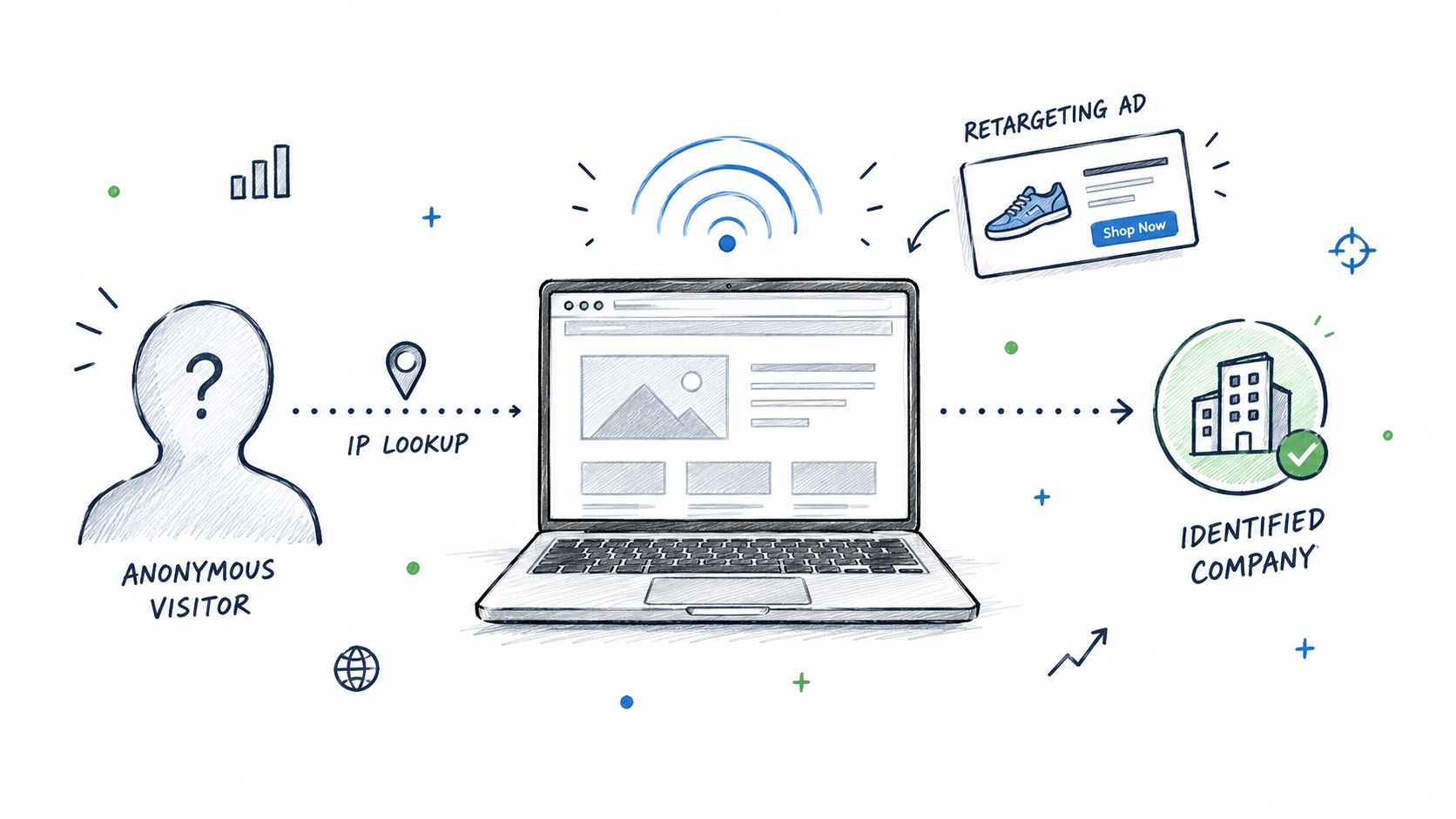
Visitor identification is useful when a meaningful portion of site traffic comes from identifiable target companies. It can reveal account activity that would otherwise remain anonymous, then help marketing and sales choose a relevant next action.
The technology doesn't identify every individual visitor or establish buying intent by itself. It may identify a company, but the company can have multiple teams, vendors, or research purposes. Treat the output as a signal that needs enrichment and fit scoring.
Connect visitor activity to a specific play
Install tracking across the site, verify that it works on different devices, and send identified account activity to the CRM with the pages viewed and engagement context. Someone visiting pricing deserves a different message from someone reading an introductory article. Build audiences around page intent, then exclude existing customers and people who have opted out where required.
Retargeting ads can reinforce useful content, but repetitive product ads create fatigue. Pair advertising with a relevant email or sales action only when the account fits the ICP and the activity is meaningful.
Measure identified account quality, return visits, content engagement, sales acceptance, assisted opportunities, and pipeline influenced. Retire audiences that generate traffic without movement in the buying process. Privacy controls and consent settings need to be part of the implementation, not a later fix.

7. Webinar and Virtual Event Lead Capture
Webinars work when the subject solves a specific problem and the audience believes the session will be worth its time. Registration creates a useful capture point, while attendance, questions, poll responses, and replay activity provide stronger qualification context than a passive download.
Choose a narrow topic with a clear audience. Promote it through existing email, LinkedIn, partners, and paid distribution where appropriate. The registration page should explain what attendees will learn and collect only the information needed for routing and follow up.
A webinar also creates reusable material. The recording can become an on demand asset, sales enablement content, short clips, and follow up resources. That makes the motion more efficient than a one time campaign, provided the team continues to distribute the material.
Attendance is a signal, not a sales verdict
Send useful reminders, start on time, and keep the session focused. Follow up based on behavior. Someone who asked a detailed question should receive a different message from someone who registered but didn't attend. A recording link alone isn't a nurture strategy.
One B2B benchmark reported 430% ROI for webinars and a seven month breakeven period, illustrating why the format can be economically attractive when promotion, delivery, and follow up are managed as one motion. The benchmark compares webinar economics with other B2B channels.
Track qualified registrations, attendance quality, engagement, meetings, sourced pipeline, and event influenced revenue. Retire topics that attract broad interest but no ICP participation.
8. Referral Programs and Partnership Networks
Referrals and partnerships work when trust already exists between the source and the prospective buyer. A customer, consultant, integration partner, or specialist can provide context that a cold campaign can't create quickly.
Start with customers who have achieved a clear outcome and partners who already serve the target market without competing directly. Give them a concise description of the ICP, the problems to listen for, and the easiest way to make an introduction. A simple email template and a clear referral process remove avoidable friction.
The financial incentive should reflect the economics of the business and local compliance requirements. Cash isn't the only option. Co marketing, access to expertise, joint events, and reciprocal referrals can be more useful for strategic partners.
Trust must survive the handoff
Assign ownership for every referred opportunity. Keep the referrer informed without exposing confidential details, and make sure the prospect doesn't receive conflicting pitches from both organizations. Partnership leads should enter the same qualification process as other leads, even when the introduction is warm.
Measure referral source quality, acceptance rate, opportunity conversion, sales cycle, partner activity, and revenue by partner. A large partner list with no active introductions is not a channel. Start with a small group, learn which partner behaviors predict quality, then expand selectively.
9. Account Expansion and Customer Referral Programs
Existing customers are often the clearest source of additional pipeline because the company already understands the product, the implementation, and the value delivered. Expansion can involve more users, new departments, new use cases, or adjacent products. Referrals extend that trust into new accounts.
Expansion requires signals that indicate readiness. Review usage, feature adoption, team growth, new leadership, support conversations, and business changes. The account manager should understand the customer's current objective before proposing a broader deployment.
Treat expansion as a customer outcome
Create a small set of repeatable expansion motions, then map each one to a problem the customer already recognizes. A volume offer may help one account, while another needs enablement, integration support, or a joint planning session. Avoid presenting every possible product at renewal.
Ask for referrals at a moment when the customer has expressed satisfaction or completed a meaningful milestone. The request should identify the type of company that benefits and make the introduction easy. Track expansion separately from new business so the team can see the distinct economics of the motion.
Measure expansion pipeline, product adoption, expansion close rate, referral acceptance, renewal health, and revenue by account. If expansion conversations are consistently rejected, investigate customer value and timing before changing the offer.
10. Unified GTM Automation and Campaign Orchestration
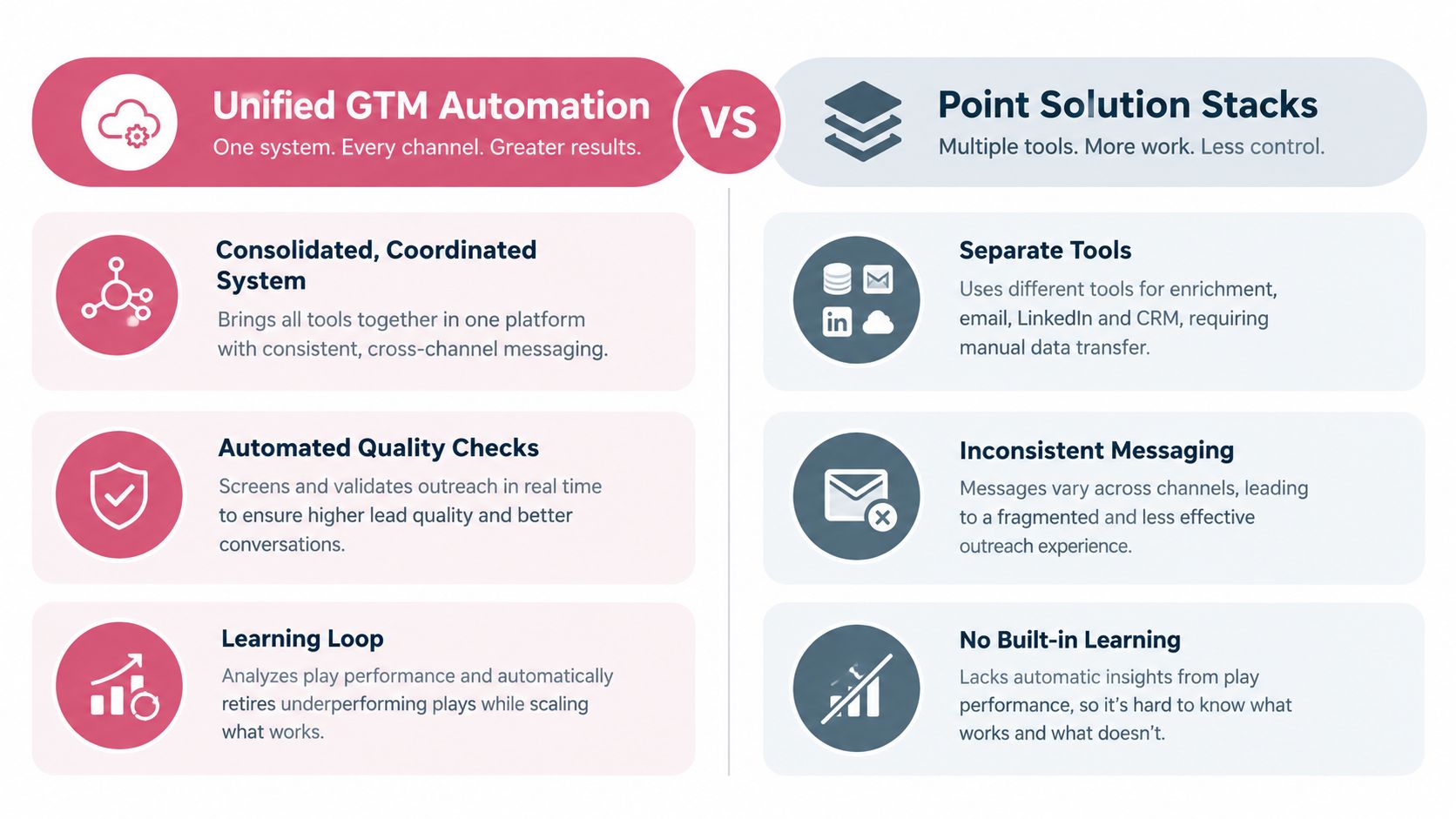
Orchestration becomes valuable when multiple lead generation techniques share the same accounts, data, and handoff problems. A unified system can connect research, enrichment, scoring, outreach, CRM updates, and reporting so that one signal triggers a coordinated action instead of several disconnected tasks.
The point isn't to automate every interaction. It's to remove repetitive preparation and preserve operator judgment for strategy, qualification, and sensitive actions. A team should be able to see why a prospect entered a play, what data supported the decision, which message was sent, and what happened next.
Start with plays, not a sprawling stack
Begin with core motions such as prospecting, lead qualification, and outbound follow up. Load the ICP with firmographic, role, and behavioral criteria. Define the success metric before launching, then record the result as a hypothesis, validated motion, or proven play. Weak plays should retire instead of becoming permanent background noise.
A unified GTM API can connect LinkedIn, email, enrichment, CRM, chat, and reporting tools behind one interface. Yalc also supports composed plays through Claude Code and ready playbooks through Slack and its UI, with human approvals and audit logs for sensitive actions.
Measure qualified pipeline, conversion by play, routing speed, data completeness, operator time saved, and the rate at which campaigns produce useful learning. Automation that increases activity but creates cleanup work hasn't solved the operating problem.
10-Point Lead Generation Techniques Comparison
| Approach | Implementation Complexity 🔄 | Resource Requirements ⚡ | Expected Outcomes 📊 | Ideal Use Cases 💡 | Key Advantages ⭐ |
|---|---|---|---|---|---|
| Account Based Marketing with Intent Data | High, data integration, cross‑team coordination, personalization at account level 🔄 | High, intent data subscriptions, ABM tooling, dedicated SDR/AEs ⚡ | High‑quality, larger deals; longer sales cycles; stronger account velocity 📊 | Enterprise or high‑ACV targets where a focused list is viable 💡 | Higher conversion and deal size from targeted, intent‑driven outreach ⭐ |
| Content Marketing and SEO for Organic Lead Generation | Moderate, ongoing content production and technical SEO work 🔄 | Moderate, content creators, SEO tools, time investment for rank building ⚡ | Sustainable, long‑term lead flow and credibility; variable volume over months 📊 | Inbound growth, thought leadership, markets with strong search intent 💡 | Low long‑term CPL and durable brand authority when consistent ⭐ |
| Email Sequences with Cadence Optimization | Low–Moderate, sequence design and ongoing A/B testing 🔄 | Low, email platform, templates, analyst for cadence tests ⚡ | Scalable outreach with measurable opens/clicks; requires follow‑ups to book meetings 📊 | High‑volume prospecting and SDR outreach where scale matters 💡 | Cost‑efficient, testable channel that yields engagement data quickly ⭐ |
| LinkedIn Outbound Sequences with Personalization | Moderate, research‑heavy and constrained by platform limits 🔄 | Moderate, time for profile research or automation tools, careful scaling ⚡ | High deliverability and credibility; variable conversion if templated 📊 | Executive or role‑level outreach and relationship‑driven selling 💡 | Native professional channel enabling contextual personalization and warmer responses ⭐ |
| LinkedIn Lead Gen Forms and Sponsored Content | Moderate, ad setup, creative testing, campaign management 🔄 | High, paid LinkedIn budgets and creative resources ⚡ | Fast lead capture with higher form conversion but cost per lead can be high 📊 | Targeted role‑ or company‑level acquisition and event/promotional signups 💡 | Low‑friction capture (auto‑populated forms) reaching decision makers quickly ⭐ |
| Website Visitor Identification and Retargeting | Moderate, pixel setup, enrichment, CRM integration, retargeting coordination 🔄 | Moderate, visitor intelligence tools, retargeting spend, integration work ⚡ | Reveals anonymous interest; enables timely outreach and account retargeting 📊 | ABM motions and capturing competitors' or passive buyer interest 💡 | Identifies high‑intent accounts you otherwise wouldn't know about ⭐ |
| Webinar and Virtual Event Lead Capture | Moderate, event production, promotion, live moderation and follow‑up 🔄 | Moderate, webinar platform, promotion budget, presenters ⚡ | Higher‑intent leads from attendees; requires nurture for many registrants 📊 | Product demos, thought leadership, demand gen for topical problems 💡 | Live engagement enables qualification and creates reusable content assets ⭐ |
| Referral Programs and Partnership Networks | Low, program design and partner/customer enablement 🔄 | Low–Moderate, incentives, tracking, partner management ⚡ | High conversion and LTV from trusted referrals; slower ramp to volume 📊 | Product‑led or customer‑satisfied businesses with network effects 💡 | Very high conversion and lower CAC from advocate‑driven channels ⭐ |
| Account Expansion and Customer Referral Programs | Moderate, CS + sales coordination, usage analytics, enablement 🔄 | Low, internal resources (CS, product) and modest incentives ⚡ | High conversion and revenue lift from existing accounts; predictable retention gains 📊 | Companies with established customer base focusing on land‑and‑expand 💡 | Most cost‑efficient revenue growth with higher close rates and retention ⭐ |
| Unified GTM Automation and Campaign Orchestration | High, integrations, playbook design, ICP modelling, change management 🔄 | High, unified platform, engineering/data work, time to train teams ⚡ | Consistent multi‑channel execution, faster optimization, reduced manual errors 📊 | Organizations scaling multi‑channel outbound/ABM that suffer tool sprawl 💡 | Consolidates stack, enforces quality checks, and learns which plays work best ⭐ |
Build the Motion Around the Signal
The best lead generation techniques match the evidence available at the moment of action. SEO and educational content suit markets where buyers search for answers and need confidence before speaking with sales. Webinars and virtual events work when a specific problem can bring the right audience together and attendance provides a useful engagement signal.
Paid social and retargeting are better accelerators than foundations. They can reach known personas and reinforce a message, but they need strong audience definitions, useful offers, and a follow up process that separates curiosity from genuine interest. Lead forms reduce friction, yet the resulting records still need qualification.
Outbound sequences work when the team has a defined segment, clean data, a relevant trigger, and a message that respects the buyer's context. LinkedIn is useful for professional research and engagement, while email is useful for direct follow up. Neither channel can compensate for irrelevant targeting. The Gartner finding cited earlier, where 73% of B2B buyers avoid suppliers that send irrelevant outreach, should be treated as an operating warning, not merely a channel statistic.
Partnerships and referrals suit companies with customer trust, complementary relationships, or specialist distribution. They may take longer to establish than a paid campaign, but the introduction carries context that advertising cannot provide. Account expansion belongs in the same planning conversation because customer usage and stakeholder changes can reveal demand before a new account does.
Choose one primary technique based on the strongest available signal. Define its leading metrics, such as qualified engagement and sales acceptance, alongside revenue metrics such as opportunity creation and pipeline conversion. Run a measured test with a clear audience and stop condition. Scale only when lead quality, handoff quality, and conversion remain stable as volume increases.
When several motions share the same accounts, the operational cost changes the decision. A unified system such as Yalc can connect sourcing, enrichment, qualification, outreach, and reporting while keeping data and credentials under the team's control. The important test is not whether the system sends more activity. It's whether the team learns which plays work, routes good opportunities faster, and retires weak motions without manual cleanup.
The most reliable program is rarely the one with the most channels. It's the one that captures a clear signal, gives a qualified buyer a relevant next step, and feeds the outcome back into the next decision.
Yalc provides lead sourcing, enrichment, qualification, multi channel outreach, and campaign reporting through a unified GTM API, with playbooks available from Slack and the Yalc UI or composable through Claude Code. Visit Yalc to connect your lead generation signals to measured GTM plays.