Lead Qualification Bot: A Guide to Real Bookings
A lead qualification bot earns its place only on high intent traffic, where speed and conversational triage beat static forms. The strongest benchmark is stark: a response within 5 minutes makes qualification 21 times more likely than a response after 30 minutes, while chatbot qualification can take about 2.3 minutes.
That doesn't mean every B2B SaaS website needs a bot. Most failed deployments aren't caused by weak conversation copy. They fail because the team hasn't defined the data inputs, scoring rules, ownership model, or CRM handoff. The bot becomes an expensive widget instead of one step in a goal led GTM system.
The right question isn't whether a lead qualification bot works. It's whether it beats a form, a routing rule, or a human first response for a specific traffic segment, and whether the rest of the revenue system can act on the result.
Table of Contents
- When a Lead Qualification Bot Beats a Form or a Human
- The Data and Enrichment Inputs the Bot Actually Needs
- Designing the Conversation for Qualified Outcomes
- Scoring Logic and Routing Rules That Hold Up
- Wiring the Bot to Your CRM and GTM Stack
- Testing, Measurement, and Iteration After Launch
- Compliance Guardrails and Your 30 Day Build Plan
When a Lead Qualification Bot Beats a Form or a Human
A lead qualification bot belongs inside a goal-led GTM system, not beside it as a decorative chat widget. Deploy one only when it can identify buying intent, collect the answers that affect qualification, and trigger the right next action faster than a form, a routing rule, or a human first response.
The speed case is measurable. A published benchmark citing the MIT Lead Response Management Study reports that the odds of qualifying an inbound lead are 21 times higher when the response arrives within 5 minutes instead of 30 minutes. It also reports an average first response time of 17 hours for forms compared with 1.3 seconds for chatbots. That gap matters on pricing, comparison, demo, and product pages where visitors are already evaluating a commercial decision. The lead response and chatbot qualification benchmark provides the underlying comparison.
Speed alone does not justify automation. A bot creates waste when traffic is sparse, every opportunity requires expert discovery, or partner and territory rules make automated handoffs unsafe. A form remains the better capture layer when the segment is small, the questions are straightforward, and a human must review every submission. Human first response wins when the account is strategic, the buyer needs technical reassurance, or the conversation requires judgment before a meeting is appropriate.
Use a hard decision test
Set the success metric before building the conversation. Compare each channel by cost per qualified meeting, acceptance by sales, and downstream quality. Engagement rate is a diagnostic metric, not a business outcome. A bot that produces more chats while increasing weak meetings has made the funnel worse.
Use this test:
- Choose a bot when high-intent pages receive sustained inbound, buyers can explain their needs without a discovery call, qualification depends on several connected answers, and sales can act on a qualified handoff immediately.
- Choose a form when volume is lower or inconsistent, the logic fits a few fields, or the business needs a low-maintenance capture layer that is easy to audit.
- Choose human first response when the buyer needs discovery, the account has strategic value, or partner, territory, and product rules are too complex for a safe automated route.
The bot must improve completion and SQL rate on the same high-intent segment. One benchmark reports chatbot-led qualification increasing average form or chat completion from 33% to 72%, while SQL rate moved from 18 to 25% up to 38 to 52%. Treat those figures as a benchmark, not a forecast. Run a controlled comparison, calculate cost per accepted meeting, and expand only when the quality gain survives sales review. Do not approve a bot because it generates conversation volume.
| Channel | Best traffic level | Sales cycle fit | Disqualification rate trigger | Cost per qualified meeting |
|---|---|---|---|---|
| Form | Lower or inconsistent volume | Simple or review-led sales | Use when qualification needs few fields | Usually lowest build and maintenance cost |
| Bot | Sustained high-intent volume | Self-directed B2B buying | Use when form responses contain substantial noise | Wins only if meetings are accepted by sales |
| Human first response | Strategic or complex accounts | Consultative and partner-led sales | Use when context matters more than speed | Justified when deal value and complexity support it |
A practical benchmark places conversation-to-lead conversion around 10 to 15%, while visitor-to-lead conversion is closer to 1 to 2%. The chatbot lead generation benchmark from Elfsight supports the operational distinction: the bot should move engaged visitors toward a qualified next step, not force every visitor into a conversation. That rule keeps automation focused on the segment where it can beat the existing process.
The Data and Enrichment Inputs the Bot Actually Needs
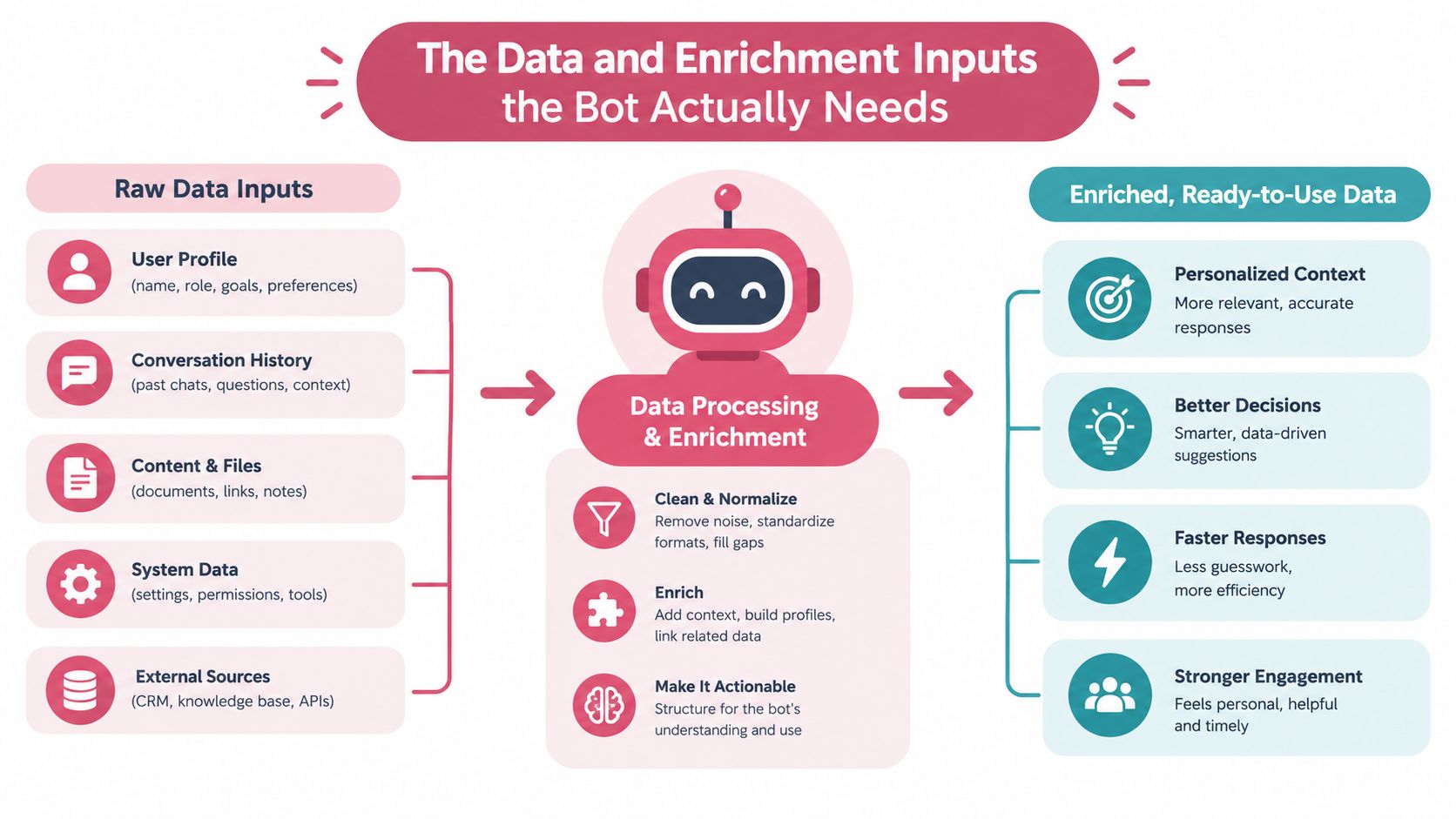
The build starts before the first greeting. A lead qualification bot needs a reliable identity, useful account context, and a clear contract for how each signal changes the route.
Start with the inputs that affect fit and intent:
- Firmographic data: Company name, company size, industry, region, role, and business email.
- Technographic data: Installed tools, relevant platforms, and product category signals.
- Behavioral data: Traffic source, page visited, repeat visits, ad click ID, pricing activity, and product usage where available.
- Account signals: Reverse IP or account intent signals from providers such as 6sense or Bombora.
- First party data: Trial activity, feature usage, prior conversations, customer status, and known opportunity history.
The bot shouldn't ask for information it can resolve safely. If the visitor is already associated with a known account, enrichment can remove repetitive questions and let the conversation focus on need, timing, or next action.
Build the identity layer first
A useful sequence is:
- Capture consent and a stable conversation ID.
- Collect an email or another approved identity key.
- Resolve the contact to a company domain and account.
- Enrich the account with firmographic and technographic data.
- Check for existing contacts, opportunities, ownership, and suppression rules.
- Ask only the questions that remain unresolved.
Clearbit or ZoomInfo can supply firmographic context. 6sense or Bombora can add intent signals. Product qualified data should come from the company's own product and CRM systems, because first party behavior usually deserves more weight than an opaque external score.
Teams comparing providers should use a structured guide to lead enrichment tools and evaluate coverage, freshness, consent handling, latency, and failure behavior. A provider that returns incomplete data shouldn't turn an unknown field into a positive score.
Define the data contract
Every enrichment request needs a logged request ID, a timestamp, a source, a cache policy, and a response status. Cache stable account attributes where policy permits. Don't call an enrichment provider repeatedly during one conversation because the bot failed to retain a result.
The contract should also define what happens when data is missing. Unknown company size is not the same as a small company. An unverified role is not a decision maker. Missing data should route to a review or nurture path, not inflate the score.
Consent capture belongs in the first meaningful prompt. The system should record the purpose of collection, the region relevant to the visitor, and the fields that were shared. This makes the bot easier to govern and gives operations a defensible trail when a contact asks how the record was created.
Designing the Conversation for Qualified Outcomes
A good bot asks fewer questions than many teams expect. A practical guide recommends 3 to 5 questions, with 4 questions working well for a BANT style assessment, while 6 to 8 questions create enough drop off that the interaction starts behaving like a form. The chatbot qualification guide from Conferbot gives the operating range.
The sequence should be direct:
- Open with the visitor's likely goal.
- Confirm the firmographic detail that matters most.
- Test intent or use case.
- Ask about timing, current stack, or the next commercial step.
- Route to a calendar, human, nurture path, or useful content.
Don't ask for company size if enrichment already provides it. Don't ask for budget before the buyer understands why the question matters. The bot should explain the next step before requesting information, for example, “A few answers will show whether a specialist or a self serve path makes more sense.”

Use a compact decision tree
A B2B SaaS flow might look like this:
- Opener: “Are you evaluating a solution now, researching options, or trying to solve an active problem?”
- Firmographic check: “Which company size or operating model best describes your team?”
- Intent check: “What outcome needs to improve first?”
- Timeline or stack question: “Is this a current project, and what system does the team use today?”
- Handoff: “The answers suggest a specialist can help. Would you prefer a meeting, or should the team send a relevant guide?”
The answer options should be clear, but the bot must accept free text when the buyer needs to explain a situation. Vague answers should trigger one concise clarification, not a loop. A dead end should offer a useful exit, such as self serve documentation or a human request.
Know when to stop automation
The bot should hand off when the visitor asks for a contract interpretation, raises a sensitive issue, challenges pricing, reports a production problem, or gives an answer the scoring rules cannot classify confidently. The handoff must include the transcript, captured fields, account context, score reasons, and the requested outcome.
Conversation copy is the last 20% of the build, not the first. If identity resolution, enrichment, scoring, or CRM ownership is broken, polished wording only makes a broken process feel more pleasant.
Scoring Logic and Routing Rules That Hold Up
A transparent rules layer beats a single mysterious AI score. Sales teams need to know why a lead was routed, which signal caused the decision, and what they can override.
Separate the model into three dimensions:
- Fit: Firmographics, region, role, company profile, and relevant technology.
- Intent: Pricing views, repeat visits, demo behavior, offer engagement, and stated project need.
- Engagement: Answer quality, response speed, consistency, and willingness to take a next step.
BANT or MEDDIC can provide structure, but the bot should strip the framework down to the few fields that change routing. Use 3 to 4 disqualifiers and 2 to 3 accelerators as an operating recommendation, not as a universal formula. A competitor, student, known bad domain, or excluded region should stop the route even when the visitor has strong engagement.
Negative signals must override positive ones. A visitor who views pricing repeatedly but is outside the service region shouldn't reach an account executive. A good fit with no active need belongs in nurture, not an immediate meeting queue.
Make every bucket trigger an action
The following structure is a practical starting point:
| Score range | Lead bucket | Routing action | Owner | SLA |
|---|---|---|---|---|
| 80 or higher | Sales ready | Send to round robin assignment with a calendar link | Account executive | Immediate alert and same session handoff |
| 50 to 79 | Developing fit | Start nurture and create a sales assist trigger | SDR or marketing operations | Review after new intent activity |
| Under 50 | Low priority | Provide self serve content and suppress unnecessary sales outreach | Marketing automation | Re evaluate when signals change |
These thresholds are recommendations for a first version. They aren't evidence that every business should use the same cutoffs. The team should calibrate them against accepted meetings, pipeline, and false positives.
A useful score record includes the total, the positive signals, the negative signals, the missing fields, and the rule version. That makes it possible to challenge a decision without rebuilding the entire conversation.
Teams formalizing ownership should review lead assignment best practices, especially around territory logic, response expectations, and feedback from sales. The routing process must define what happens when an assigned owner rejects a lead, not just what happens when the bot creates one.
For a deeper explanation of the underlying scoring discipline, the guide to lead scoring is a useful reference. The key principle is simple: a score is valuable only when it changes the next action.
Wiring the Bot to Your CRM and GTM Stack
A lead qualification bot is one step in a goal-led GTM system, not a standalone widget. Write the CRM handoff contract before building conversation logic. If the bot cannot produce a complete, validated record and trigger the right next action, it has not qualified the lead.
Define these fields:
- Email and company domain
- Company name and role
- Qualification score and score reason
- Source and campaign identifiers
- Conversation URL or transcript reference
- Assigned owner
- Consent status
- Routing status and error code
Specify field types, required values, allowed picklists, and validation behavior. For example, if the company domain is missing or fails MX validation, hold the record in a review queue with error code MISSING_DOMAIN. Send the exception to Slack for manual resolution instead of creating a partial contact or duplicate account.
Protect ownership and record quality
HubSpot or Salesforce should sync in both directions. Use a Salesforce connector for field mapping and ownership rules to keep routing logic consistent across systems. Dedupe on normalized email plus company domain. Before creating a contact, check for an existing person, account, open opportunity, assigned owner, and closed record.
The bot must not overwrite account executive ownership, change a closed-won stage, send a proposal, negotiate pricing, or make an unapproved commercial commitment. Those actions require human approval.
Use this handoff sequence:
- Validate captured fields and consent.
- Resolve the account and existing contact.
- Write the conversation and score reasons.
- Apply ownership and territory rules.
- Alert the assigned team in Slack for hot leads.
- Offer Calendly or Chili Piper scheduling when appropriate.
- Log the outcome in the GTM warehouse.
Teams using Salesforce can review the cxconnect.ai data connector overview for connector behavior, field mapping, and synchronization requirements. Verify that the integration preserves ownership, validation errors, and audit history. A successful API call is not proof of a usable handoff.
Store partial progress when a visitor leaves early, provided consent and data policy allow it. Use those records to identify drop-off points, but keep them out of the qualified sales queue.
Testing, Measurement, and Iteration After Launch
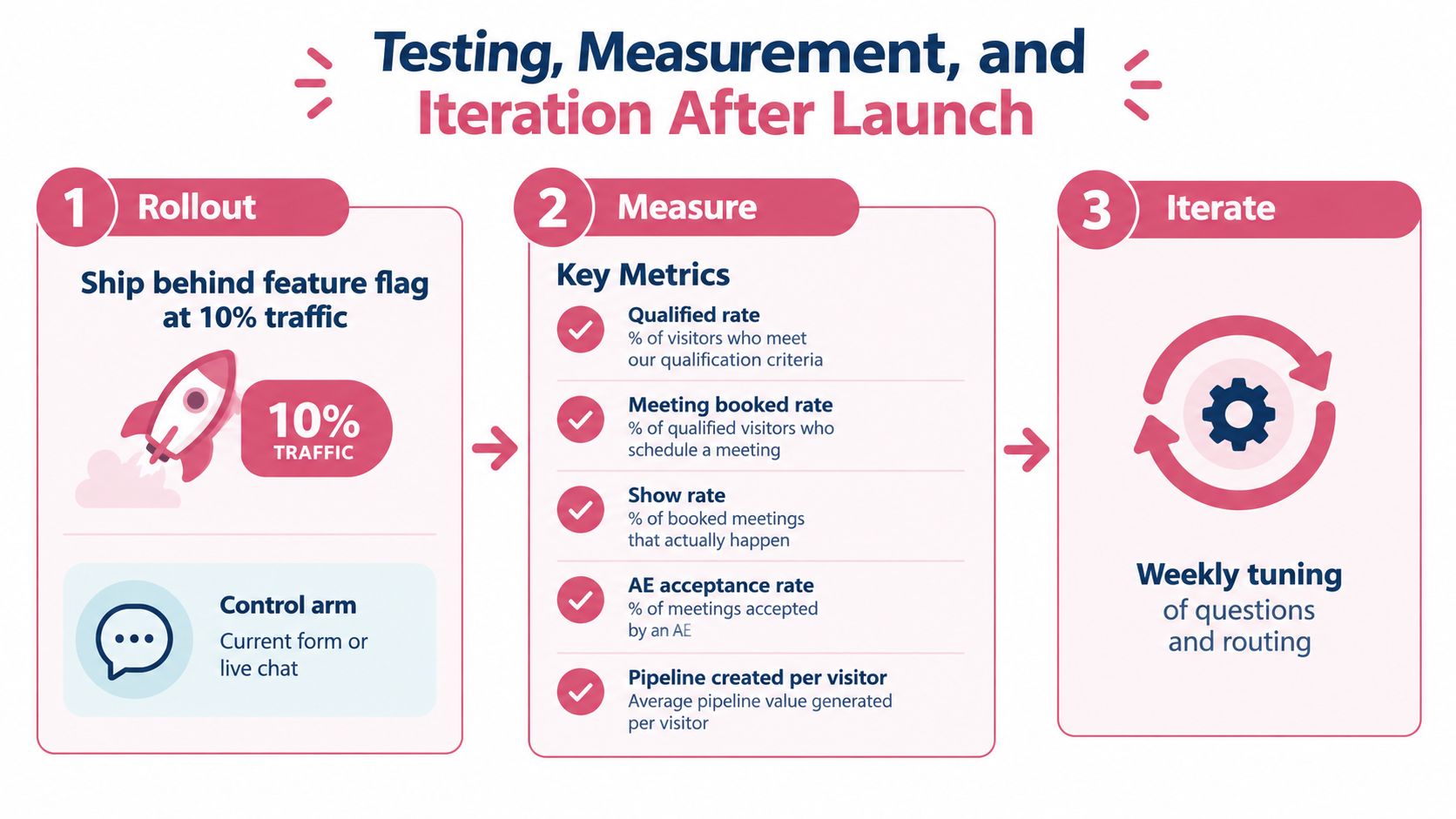
Launch the bot as an experiment, not a permanent replacement. Put it behind a feature flag at 10% of traffic and keep the current form or live chat as the control arm. This isolates the bot's effect from changes in campaigns, traffic quality, seasonality, or sales capacity.
Baseline the pre bot funnel before judging performance. The dashboard should track:
- Qualified rate
- Meeting booked rate
- Show rate
- Account executive acceptance rate
- Pipeline created per conversation
- Drop off by question number
- Routing errors and duplicate creation
- Human handoff completion
The bot isn't successful because it produces more meetings. It must produce meetings that sales accepts and that create useful pipeline. A high booking rate paired with low acceptance usually means the score is rewarding engagement without fit.
Review the conversation as operating data
A weekly transcript review should classify:
- False positives: The bot routed a weak opportunity to sales.
- False negatives: The bot buried a buyer who should have received help.
- Dead ends: The visitor couldn't complete a path.
- Unclear answers: The bot asked a question the buyer couldn't answer.
- Handoff failures: The system captured intent but didn't create a usable task.
Change one major variable at a time. Test question order, tone, answer options, branching, and handoff language separately. If the bot asks about budget early and drop off rises, the team needs to compare the commercial value of the extra data with the lost conversations.
Set a maintenance cadence
Tune questions and routing weekly. Retrain enrichment thresholds monthly. Review scoring rules quarterly. Run a complete conversion audit every quarter, including segment level results and sales feedback.
Independent reporting says websites using chatbots can see a 23% increase in conversion rates, while optimization over the first 30 to 90 days may move early conversion from 8 to 12% toward 15 to 25% after testing and flow tuning. The same source reports chatbot assisted lead capture in B2B SaaS around 8 to 15%, compared with 2 to 4% for forms. These are reported benchmarks, not a forecast for a specific company, and they reinforce the need for a control group. The chatbot statistics and optimization benchmarks from Ringly provide the cited context.
Kill the bot if it doesn't beat the baseline after two full cycles. A form that creates clean records is better than an automated conversation that consumes budget and damages sales trust.
Compliance Guardrails and Your 30 Day Build Plan
Compliance is a launch gate. The bot should capture consent at the first prompt, state the purpose of collection, apply region aware redaction, follow data residency rules, and provide a documented human handoff for sensitive conversations.
The bot must never handle these matters alone:
- Contract interpretation or legal commitments
- Pricing promises beyond published tiers
- Requests involving regulated data categories
- Security incidents or production emergencies
- Complaints requiring a formal response
- Changes to ownership or closed CRM stages
Use approval workflows and role based overrides between the bot and CRM writes. Sensitive fields should have restricted access. Every automated action needs an audit record showing the rule version, source data, decision, and human override where applicable.
Week one builds the foundation
The data and revenue operations owners should define the ICP fields, identity keys, enrichment providers, consent fields, dedupe logic, and failure states. The exit criteria are a documented data contract, a tested account resolution path, and a list of fields the bot can trust.
The dashboard should already show source, account match status, enrichment response, and duplicate rate. If the team can't inspect those values, it isn't ready to score leads.
Week two designs the decision system
Marketing operations and sales leadership should agree on the four question conversation, disqualifiers, accelerators, score buckets, and route owners. The team should write the human handoff language and test vague answers, missing data, competitor responses, and urgent requests.
The exit criteria are approved conversation paths, visible score reasons, defined fallback routes, and transcript review from test users. The flow should be short enough to complete without feeling like a form.
Week three wires the stack
Revenue operations should connect HubSpot or Salesforce, Slack, Calendly or Chili Piper, enrichment providers, and the GTM warehouse. Engineering or an integration owner should validate field types, dedupe, two way sync, permissions, retries, and sandbox behavior.
The exit criteria are clean test records, no duplicate contacts, preserved ownership, working calendar handoff, and an audit log for every automated write. The bot must fail safely when a provider or connector is unavailable.
Week four rolls out under control
The GTM owner should launch behind the feature flag at 10% of traffic, retain the existing form or live chat as the control, and schedule weekly transcript reviews. Compliance must approve consent language, data handling, retention, human escalation, and regional behavior before production traffic begins.
The final dashboard check is commercial, not cosmetic. It should show whether qualified buyers are being accepted by sales, whether meetings are attended, whether pipeline is created, and where visitors abandon the conversation. If those signals don't improve against the baseline after two full cycles, turn the bot off and return to the simpler route.
A lead qualification bot is one component in a goal led GTM system. It collects and sorts intent, but enrichment, scoring, routing, CRM hygiene, human judgment, and measurement determine whether that intent becomes revenue.
Yalc helps B2B GTM teams enrich, score, route, and re score leads through connected qualification plays rather than treating chat as an isolated widget. Visit Yalc to see how its goal led GTM system can connect qualification decisions with the rest of the revenue workflow.