Lead Qualification Marketing: A 2026 Operator's Playbook
A familiar failure pattern appears in many B2B teams. Marketing celebrates a full form queue, sales rejects most of it, operations adds another scoring rule, and nobody can explain which signal predicted pipeline. The database grows, but sales capacity remains fixed.
Lead qualification marketing is the operating system that decides which captured interest earns sales attention, which interest stays in nurture, and which records should be suppressed. It combines fit, intent, timing, data quality, routing, human review, and sales outcomes. A score is only one component.
Table of Contents
- What Lead Qualification Marketing Actually Solves
- Frameworks and Scoring Models That Actually Hold Up
- Qualifying the Buying Group Instead of the Individual
- Negative Qualification and When to Refuse an MQL
- Speed to Lead as a Qualification Mechanic
- Automation and AI Driven Qualification in Practice
- Metrics, Feedback Loops, and Common Pitfalls
What Lead Qualification Marketing Actually Solves
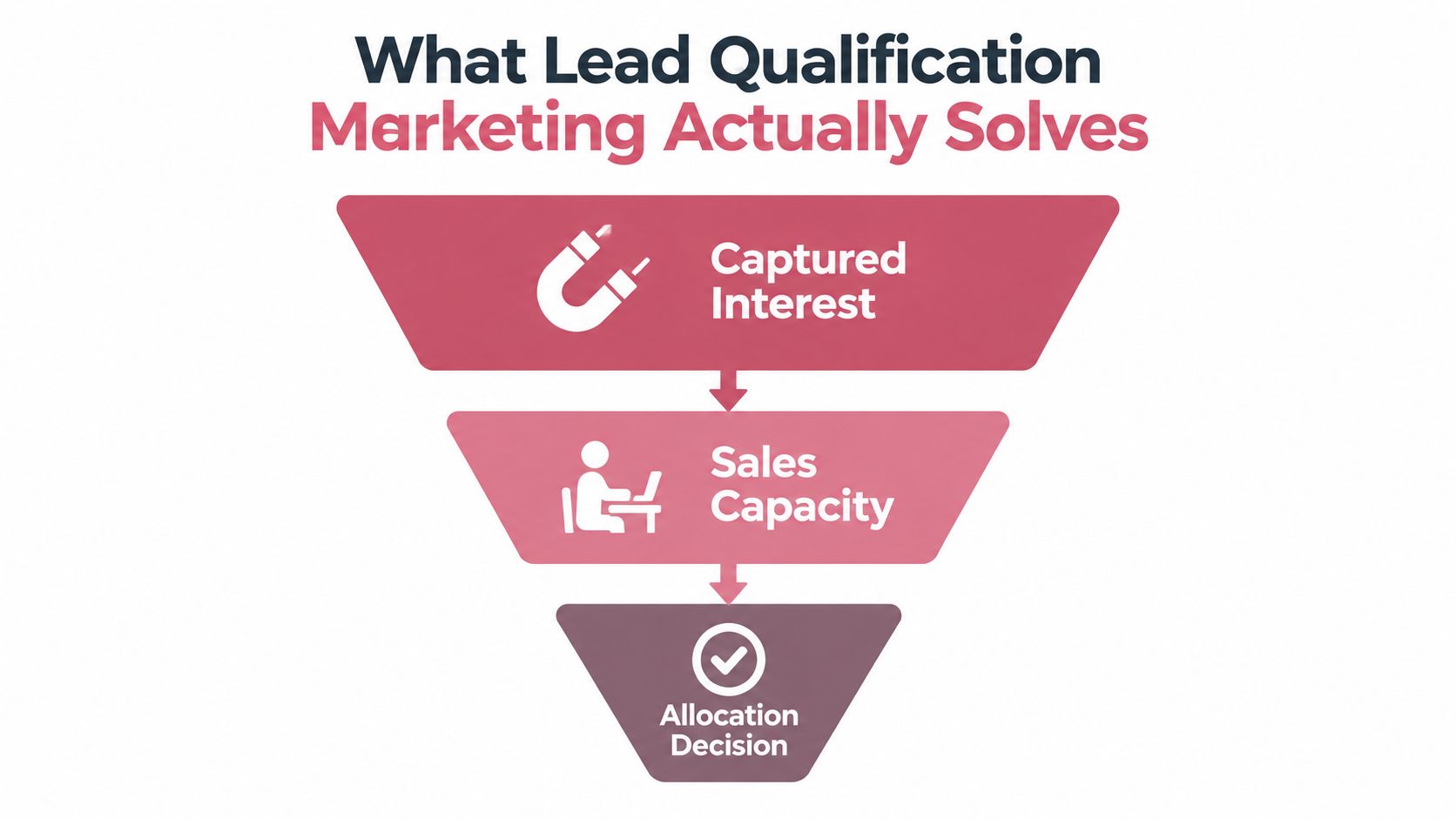
A campaign can produce a crowded form queue while sales capacity stays fixed. The practical problem is allocation: which captured interest deserves a representative's time, which account belongs in nurture, and which record should be suppressed. Lead qualification marketing answers those questions across the account and buying group, not just the person who completed a form.
A 2025 synthesis of B2B benchmarks provides a directional funnel: roughly 2.3% of website visitors become leads, 31% of leads become MQLs, and 13% of MQLs become SQLs. At later stages, approximately 30% to 59% of SQLs become opportunities, while 22% to 30% of opportunities become customers. Treat these as comparison points, then recalibrate them by segment, channel, geography, deal size, and buying cycle. (B2B lead quality benchmarks)
The funnel math changes the operating question
Using 100,000 monthly visitors as an example, those benchmark rates produce approximately 2,300 leads, 713 MQLs, 93 SQLs, 28 to 55 opportunities, and 6 to 17 customers. The calculation uses the same benchmark synthesis cited above.
| Stage | Conversion rate | Implied count |
|---|---|---|
| Website visitors to leads | 2.3% | 2,300 |
| Leads to MQLs | 31% | 713 |
| MQLs to SQLs | 13% | 93 |
| SQLs to opportunities | 30% to 59% | 28 to 55 |
| Opportunities to customers | 22% to 30% | 6 to 17 |
The table is not a forecast for every company. It shows why qualification is a closed-loop operating system. Better targeting, enrichment, scoring, routing, or sales acceptance can influence every stage that follows. An unqualified lead consumes attention. A qualified lead that waits too long loses momentum. A loosely defined SQL inflates the pipeline without improving revenue.
Practical rule: Define qualification by the next resource you're willing to commit, not by the last action a contact took.
Run each record through four decisions:
- Fit: Does the account match the ideal customer profile, including company characteristics, market, region, technology, and role relevance?
- Intent: Is there evidence of a problem, commercial trigger, or active evaluation?
- Exclusion: Is the record a competitor, student, job seeker, customer, automated clicker, or otherwise outside the motion?
- Action: Should the system route, review, nurture, suppress, or request more information?
Buying-group coverage and negative qualification deserve equal weight. One engaged contact may represent a real opportunity, or an isolated research visit with no access to the decision process. A system that records missing stakeholders, disqualifying conditions, and sales outcomes can distinguish those cases.
The loop closes when marketing tests a qualification hypothesis, automation enriches and routes the record, sales accepts or rejects it, and opportunity or revenue data determines whether the rule survives. MQL volume is an input, not the finish line.
Frameworks and Scoring Models That Actually Hold Up
A qualification framework should help a rep make a defensible decision with incomplete information. It should not turn every form field into a false signal. The right choice depends on deal complexity, sales motion, and how much evidence exists before a conversation begins.
| Framework | Best motion | Core emphasis |
|---|---|---|
| BANT | Simple inbound or transactional sales | Budget, authority, need, timing |
| CHAMP | Sales led discovery | Challenge, authority, money, prioritization |
| MEDDIC | Complex enterprise deals | Metrics, economic buyer, decision criteria, decision process, pain, champion, competition |
| GPCTBA/C+I | Intent heavy inbound | Goals, plans, challenges, timeline, budget, authority, consequences, implications |
BANT works as a compact starting checklist for simpler motions. Its sequence can create problems. Asking about budget before establishing the business problem makes the exchange feel like procurement, especially when the contact has not yet described what they are trying to change.
CHAMP starts with the challenge and tests whether the problem has enough priority to justify action. That suits consultative discovery, where urgency and business impact matter more than a contact's title.
MEDDIC belongs later in a complex opportunity. It gives enterprise teams a way to examine measurable value, economic ownership, decision criteria, decision process, paper process, competition, and champion strength. Applying it to an anonymous visitor or an early form submission adds work without producing comparable insight.
GPCTBA/C+I fits inbound conversations where the buyer has already framed a business problem. It prompts the rep to examine goals, plans, consequences, and implications instead of treating page views or downloads as buying evidence.
The framework becomes useful only after each concept has a field, event, or review decision attached to it:
- Firmographics: Industry, employee count, geography, funding, and company stage.
- Technographics: Relevant systems, integrations, or infrastructure that affect fit.
- Behavior: Repeat visits, pricing or product page activity, meeting requests, replies, and trial activity.
- Timing: A launch, hiring plan, funding event, renewal window, or stated project deadline.
- Account context: Existing contacts, buying group roles, prior conversations, and open opportunities.
- Negative signals: Competitor domains, student addresses, existing customer status, automated activity, and missing consent.
A model can use explicit rules, predictive scoring, or both. Rules remain transparent and easy to debug, but they become brittle as channels and segments expand. Predictive scoring can detect interactions no one specified, yet it needs reliable historical outcomes and can conceal weak assumptions inside a single score. The practical answer is often a rules layer for exclusions and routing, with prediction supporting prioritization rather than replacing review.
One benchmark summarized from research across more than 500 revenue leaders reported 28% MQL to SQL conversion when qualification happened before lead delivery, compared with 9% when leads were delivered first and qualified later. Treat the finding as directional, while keeping the operating lesson: qualify before routing where the available evidence supports it. (Pre delivery qualification benchmarks)
Route certainty, review ambiguity, and suppress obvious mismatch.
Two thresholds usually outperform one universal cutoff. High-confidence records can route automatically. Borderline records should enter human review or nurture, while low-fit records should be suppressed. Calibrate thresholds against sales acceptance and opportunity creation, then revisit them when outcomes expose a weak rule.
For a practical explanation of how scores connect fit, intent, and action, see this guide to lead scoring design. A score prioritizes work. It does not prove that a buyer is ready. The operating system becomes reliable when those scores are checked against buying-group coverage, negative qualification, sales feedback, and revenue outcomes.
Qualifying the Buying Group Instead of the Individual
A lead can look sales-ready while the account remains untouched. One contact may be researching, benchmarking vendors, or acting for a wider committee. Qualification improves when the account becomes the unit of analysis and several relevant people show connected activity.
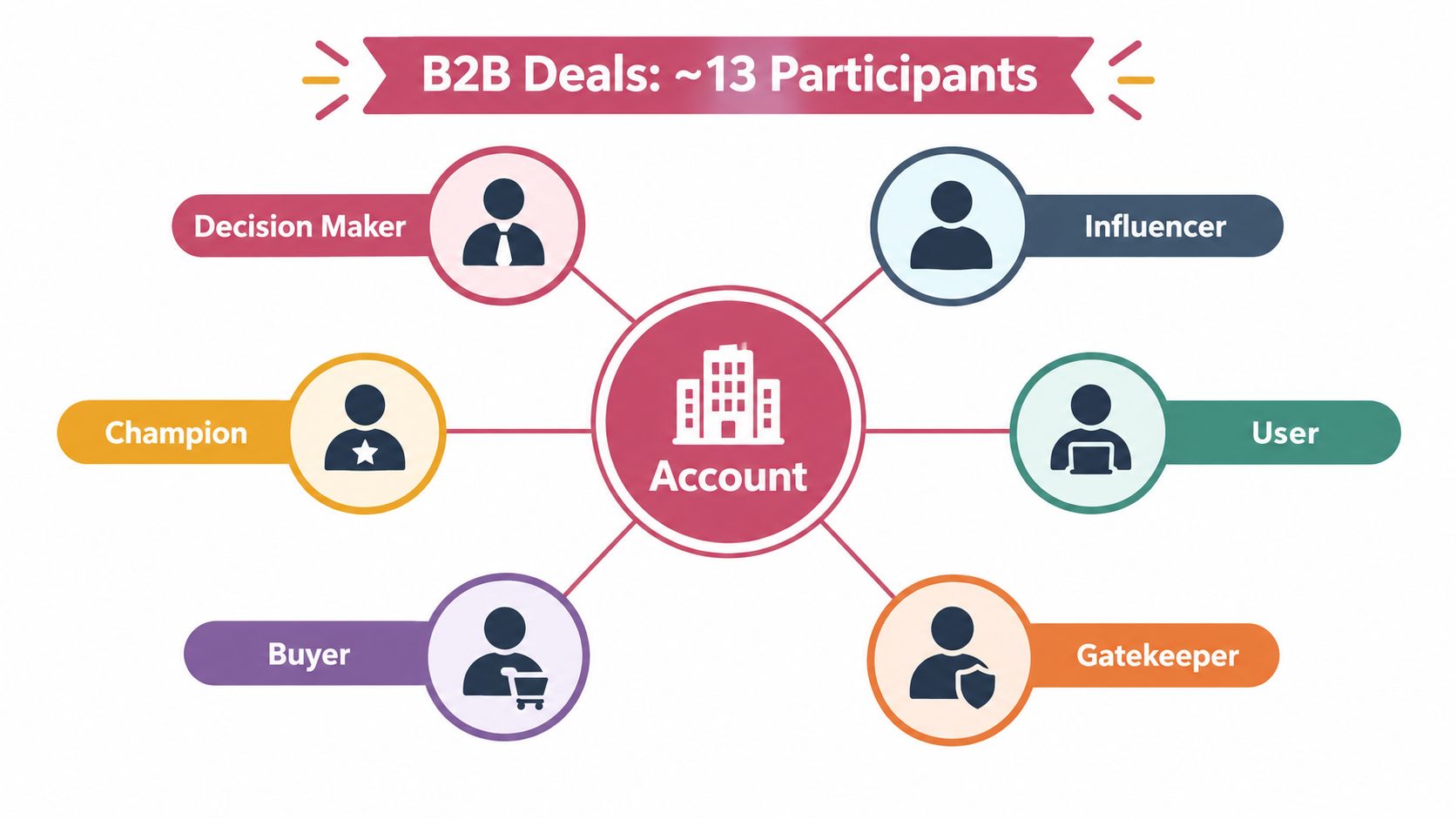
A 2025 benchmark reports that B2B deals involve nearly 13 participants, while another recent benchmark puts the average buying group at 6.8 people. The benchmarks use different samples, so treat the figures directionally. Their shared operational message is clear: an individual score can miss the decision process. (B2B buying group participation benchmark)
Measure decision coverage, not just contact activity
A contact score asks how active one person is. Account qualification asks which parts of the decision are represented, how credible the intent is, and where the evidence is missing.
Map the roles that matter to the deal:
- Economic buyer: Owns or controls the commercial decision.
- Champion: Has a reason to advance the project internally.
- Technical evaluator: Tests requirements, security, integration, or implementation.
- Procurement: Controls purchasing mechanics and vendor onboarding.
- User: Understands daily pain and adoption requirements.
- Likely blocker: Can stop the deal through risk, budget, policy, or competing priorities.
Role weights should follow the sales motion. A technical product may require evaluator coverage early. A finance platform may need evidence from the economic buyer and procurement sooner. Smaller deals may combine roles, but the system should distinguish one person repeating actions from several people representing different functions.
Connect contacts with domain matching, CRM account IDs, enrichment, and email relationships. Deduplicate records before calculating engagement. Ten visits from one power user should not outweigh signals from a champion, evaluator, and buyer.
Anonymous activity belongs in a separate queue. A matching company domain can raise a research flag, especially if known contacts later appear. Keep the signal, but do not assign it to a person you cannot identify.
A smaller contact set with broad committee coverage can be more qualified than a large set of highly active individual leads.
A buying committee mapper for connecting roles, contacts, and signals can support this account view. Routing still needs explicit rules. Send an account to sales when coverage and intent meet the threshold, ask sales to multi-thread when one role dominates, and keep it in nurture when activity lacks commercial context. Feed the handoff result back into the qualification system so account coverage improves with each completed deal.
Negative Qualification and When to Refuse an MQL
Engagement isn't the same as readiness. A download can represent research. An email click can come from automation. A webinar attendee can be a student, competitor, existing customer, or job seeker. Positive scoring without negative qualification turns every visible action into a reason to send more work to sales.
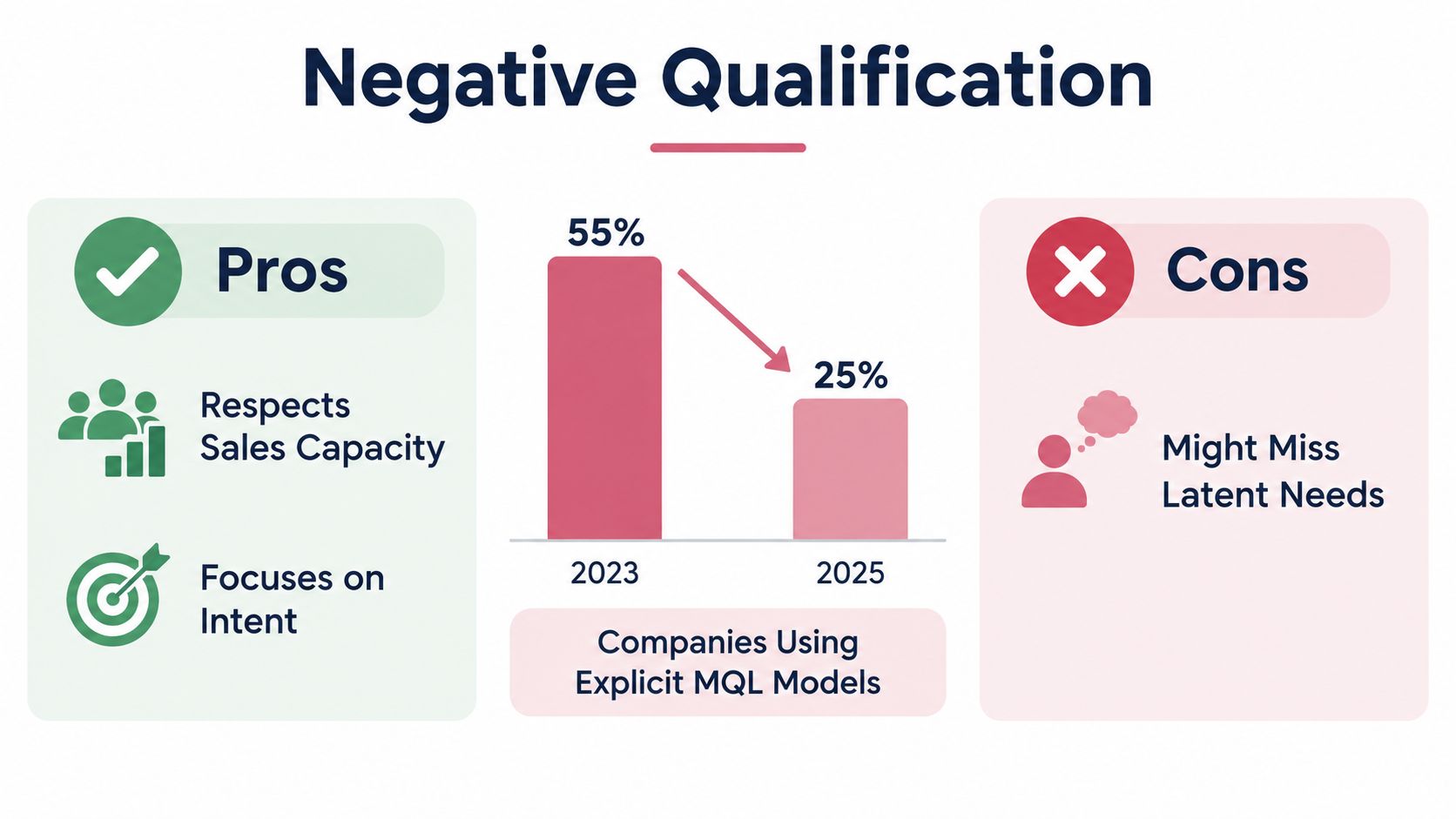
The 2025 Norwest benchmark reported that companies relying on explicit MQL models fell from 55% in 2023 to 25% in 2025, while reliance on high intent actions such as demo or sales requests rose from 19% to 30%. (Norwest 2025 B2B benchmark report)
Build a refusal layer beside the score
Negative qualification is the deliberate use of exclusion signals to prevent a record from becoming an MQL, even when positive activity is present. It protects sales capacity and forces the team to distinguish commercial intent from information consumption.
A starter suppression matrix might look like this:
| Signal | Default action | Review condition |
|---|---|---|
| Automated clicks or unusual activity | Suppress engagement points | Keep a separate activity flag |
| Student or academic address | Nurture or suppress | Review if the account matches a target |
| Competitor domain | Suppress outreach | Route only for an explicit partnership or research motion |
| Existing customer | Send to customer marketing or account team | Route for expansion or renewal intent |
| Job seeker | Suppress demand qualification | Keep recruiting workflows separate |
| Anonymous or privacy restricted journey | Do not qualify on activity alone | Preserve account signal for later identification |
The last row needs care. Unknown activity isn't worthless, but it shouldn't create a person level MQL. Store it as account evidence, then require a known contact, a high intent request, or corroborating stakeholder activity before routing.
The same logic applies to fit. A target account consuming educational content may still lack a problem, timeline, authority, or commercial trigger. A lead can be a good fit and remain unqualified.
Measure refusal quality as seriously as acceptance quality. Track qualified opportunities, pipeline, win rate, revenue, and sales cycle by qualification path. MQL volume is useful for capacity planning, but it cannot tell the operator whether the system is sending the right work.
A suppression rule also needs a reentry path. Existing customers may become expansion opportunities. Students may later join target accounts. Anonymous research may become meaningful after identification. Negative qualification should pause or redirect the motion, not erase useful context forever.
Speed to Lead as a Qualification Mechanic
A form submission is a live buying signal, not a row waiting for the next spreadsheet review. Intent can cool, shift to another stakeholder, or turn into a sales conversation while a record sits unassigned. Qualification should therefore enrich, score, route, and select a contact channel as one connected event.
The MIT and InsideSales Lead Response Management study covered approximately 15,000 web leads and 100,000 call attempts. It found that contacting a lead within five minutes made qualification 21 times more likely than waiting 30 minutes. A related Harvard Business Review analysis of 2,241 companies found that responding within one hour made firms nearly seven times more likely to qualify a lead than responding after the first hour. (Speed to lead study summary)

Make the first five minutes useful
The first action should reflect the evidence available, not trigger a generic sequence by default. Capture submission time, source, page context, consent status, and requested action. Resolve the email and domain against the account, contact, customer record, and open opportunity. Then add firmographic, geographic, role, and technology context.
Apply fit, intent, negative signals, and buying group context before choosing the route. Send high-confidence records to the correct owner, place borderline records in review, and suppress obvious mismatches. Only then start an approved email, call task, chat response, or sequence enrollment.
This workflow depends on connected systems. A form tool, CRM, enrichment provider, routing layer, sequencing platform, and notification channel must pass events reliably. If enrichment fails, mark the record for fallback handling and preserve the uncertainty. Treating missing data as low fit hides an operational failure.
Store timestamps for conversion, enrichment completion, first contact, response, and qualification. Compare contact rate, qualified rate, and opportunity rate by segment, channel, geography, and intent. The cited studies address contact and qualification, not a guaranteed closed-revenue multiplier, so speed should not be presented as a revenue promise.
Set a sub five minute first action objective, then inspect where the clock actually stops.
Alert on queue failures, duplicate assignments, missing enrichment, and approval delays. Speed without relevance produces fast spam. The operating target is prompt, permission-aware qualification with the buying context available to the person making contact. That makes response time part of a closed-loop qualification system, rather than a standalone service-level target.
Automation and AI Driven Qualification in Practice
Automation should be layered. The cheapest reliable layer handles deterministic facts. Predictive systems handle patterns supported by historical outcomes. AI agents handle interpretation and preparation, while humans retain approval over sensitive actions.
Choose the layer that matches the risk
Deterministic enrichment and routing works well for explicit rules. A CRM workflow can identify an account domain, check region, reject a competitor, assign territory, and create a sales task. This approach is transparent and easy to audit. It fails when data is incomplete, provider coverage changes, or the market moves beyond the original rules.
Predictive scoring can learn from closed won, closed lost, accepted SQL, and opportunity data. It may identify combinations of industry, role, behavior, and timing that manual rules miss. Its trade off is dependency on clean labels. If sales acceptance is inconsistent, the model learns inconsistent judgment.
LLM led agents can read account context, summarize conversations, identify missing qualification evidence, draft a next action, and wait for approval before sending. They are useful where signals are unstructured, such as reply sentiment, call notes, and stakeholder language. They need scoped permissions, visible reasoning artifacts, source links inside the record, and a hard boundary around sending messages or changing pipeline stages.
A useful confidence system grades each play as:
- Hypothesis: The rule is plausible but lacks reliable outcome evidence.
- Validated: The rule has passed controlled checks across relevant segments.
- Proven: The rule repeatedly produces the intended downstream result and remains monitored.
This keeps the system from treating every successful looking campaign as permanent truth. It also creates a retirement path for rules that generate activity without accepted SQLs or opportunities.
Keep the stack replaceable
A unified API can place enrichment, CRM, sequencing, chat, and reasoning behind one interface. One motion might use Unipile for LinkedIn sequences, FullEnrich for contact data, lemlist for outbound, Crustdata for profiles and firmographics, Notion for tracking, and Claude for reasoning. If one source degrades, the operator can swap the provider without rebuilding the qualification logic.
Yalc is one example of this operating pattern. Its qualification pipeline can accept records from CSV uploads, LinkedIn engagers, profile visitors, Notion lists, and webhooks, then evaluate company size, region, role match, intent, deduplication, and a weighted fit score before routing records to campaigns. Its AI sales automation approach also supports human approvals, scoped permissions, step by step logs, and feedback that moves plays from hypothesis to validated to proven.
The conversation itself should remain the audit trail. An operator reviewing an automated decision needs to see which facts were used, which rule fired, who approved the action, and what happened afterward.
Metrics, Feedback Loops, and Common Pitfalls
A qualification system is working only when its decisions improve the quality of downstream work. The score itself is not the outcome.
Track the operating chain:
- MQL to SQL acceptance: Shows whether sales agrees that routed records meet the shared definition.
- Opportunity creation rate: Tests whether accepted leads create real pipeline.
- Win rate by source: Separates productive acquisition from attractive but weak activity.
- Sales cycle by score band: Shows whether higher confidence leads move with better commercial timing.
- Calibration error: Tests whether predictive probabilities match observed outcomes.
- False positive rate on triggers: Measures how often a high intent action creates a lead that sales rejects or cannot validate.
The 79% non conversion benchmark attributed to MarketingSherpa has long been used to describe the cost of weak nurturing and qualification. If a company generated 10,000 marketing leads, that benchmark would imply approximately 7,900 fail to become customers, although the benchmark is directional and not a controlled universal rate. (Lead qualification benchmark context)
Run every campaign as a testable play
A useful loop is simple:
- Marketing states the hypothesis, such as a specific account trigger predicting sales acceptance.
- The qualification system enriches, scores, routes, and records the evidence.
- Sales marks acceptance, rejection, no response, opportunity, or disqualification reason.
- Operations grades the result by segment and source.
- The team promotes the rule, keeps it under review, or retires it.
The loop needs reasons, not just statuses. “Bad fit,” “no project,” “wrong person,” “duplicate,” and “timing” lead to different model changes.
Common failures are predictable. Teams copy a vendor threshold that labels most of the database as qualified. They award too many points for engagement and too few for business context. They never return sales outcomes to marketing. They add suppression rules that remove real buyers without monitoring reentry. They also treat a high score as permission to send, even when no human has reviewed the message or the account context.
A score threshold should come from historical CRM outcomes. If 80% of records exceed the cutoff, it isn't separating likely buyers from low intent contacts. (Lead scoring threshold guidance)
The operator's job is to keep the system honest. Every rule needs an owner, an evidence standard, a downstream metric, and a retirement condition.
Yalc helps B2B teams connect enrichment, ICP scoring, deduplication, routing, campaign execution, and outcome feedback in one controlled GTM system. Visit Yalc to evaluate a qualification playbook that keeps buying group coverage, negative signals, approvals, and sales results in the same operating loop.