10 Lead Qualification Software Tools Compared for 2026
Most lead scoring setups mislead sales teams because the score measures activity, not buying intent. A prospect can open emails, visit several pages, and still have no problem, authority, or reason to buy. Another prospect can show fewer clicks but match the right company profile and arrive with a clear business trigger.
This guide compares 10 lead qualification software tools on the factors that determine whether reps work the list: how each product qualifies, what it connects to, what it costs in practice, and how much build work it needs. Each entry ends with an honest limit, so teams can rule tools out quickly instead of buying another layer that creates a more complex queue.
Speed matters as much as scoring. A Harvard Business Review study of 2,241 U.S. companies found that only 37% responded to online sales inquiries within one hour, while 23% never responded. Companies that contacted leads within one hour were nearly seven times more likely to qualify them than companies that waited another hour, although the study measured meaningful contact and qualification, not closed revenue. The evidence on lead response time supports a practical conclusion: qualification software must enrich, decide, route, and trigger an approved first touch quickly.
Teams still need clean inputs. Before changing a score, operators should review their approach to mastering contact data enrichment, because weak records make even well designed qualification rules unreliable.
Table of Contents
- 1. Yalc
- 2. 6sense
- 3. Demandbase
- 4. MadKudu
- 5. Breadcrumbs
- 6. Clearbit by HubSpot
- 7. Qualified
- 8. Chili Piper
- 9. Leadspace
- 10. ZoomInfo
- Top 10 Lead Qualification Tools, Feature Comparison
- Choose the Tool Your Data and Team Can Run Next Month
1. Yalc
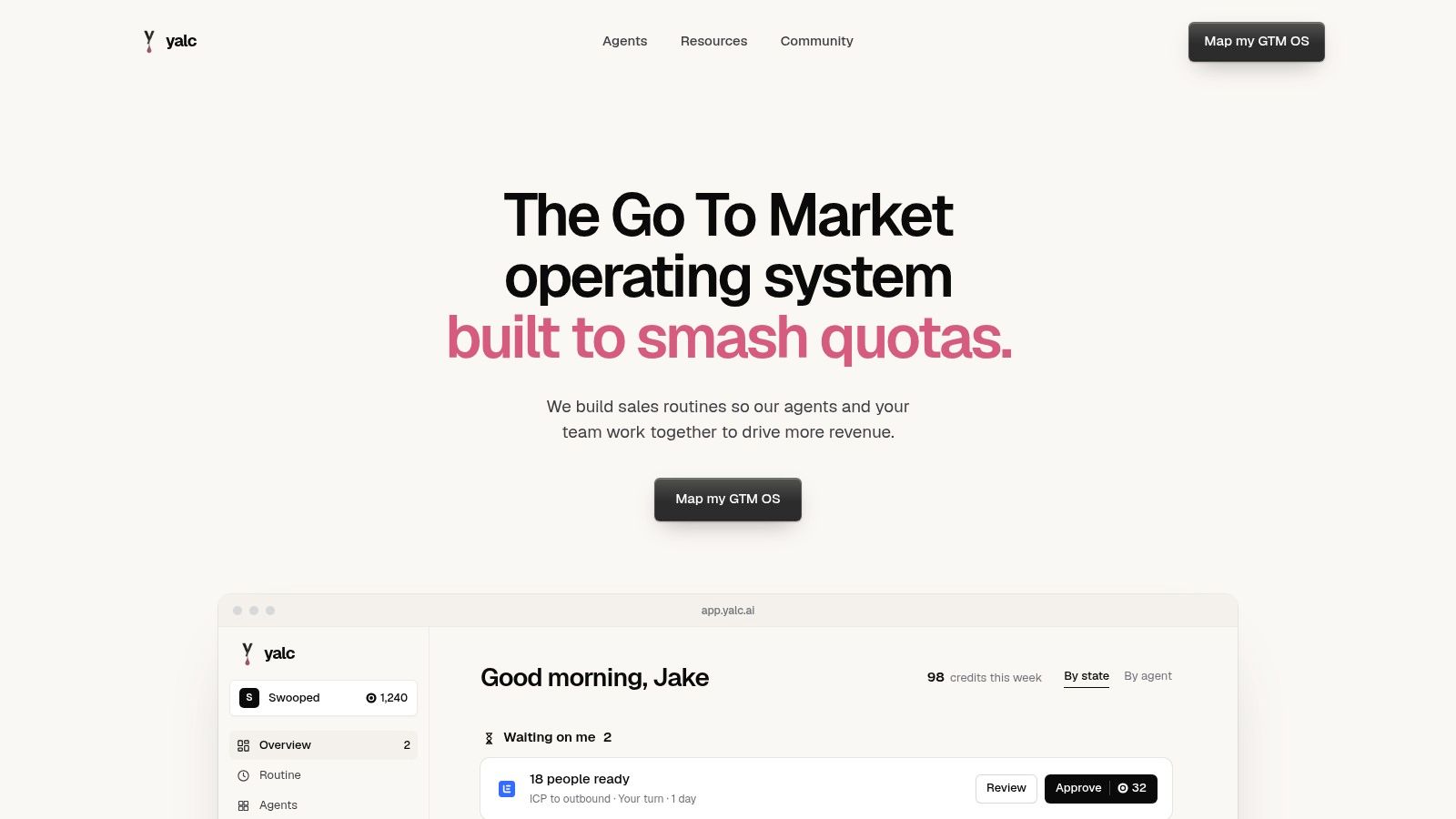
Yalc suits revenue teams that need qualification to trigger work across the GTM motion, rather than sit as an isolated score field. Its Leads Qualification seven gate skill checks ICP fit, company size, region, role match, intent signals, duplicate records, and a final weighted score. Leads can arrive through CSV, LinkedIn activity, Notion, or webhooks, then receive a 0 to 100 fit score in a unified leads database.
The operational value is the handoff. A high fit and high intent lead can route to a sales representative, a borderline record can enter nurture, and a weak or duplicate record can move to a watch list or disqualification path. Yalc also records the qualification rationale and agent steps in an auditable play log.
Practical rule: A score matters only when it changes ownership, response time, or the next message.
Yalc's broader architecture separates it from point scoring tools. Its unified GTM API puts enrichment, CRM, LinkedIn workflows, sequencing, reporting, and reasoning behind one interface. Teams can change providers without rebuilding the entire qualification motion. The knowledge layer keeps the ICP, positioning, voice, and proven plays available on each run. Engineers can compose skills through the Yalc MCP in Claude Code, while operators can run configured playbooks from Slack or the Yalc interface. Both surfaces use the same engine, data, and accumulated intelligence.
Fit, cost, and implementation effort
Yalc fits B2B startups, scale ups, founders, growth teams, and revenue operations groups that need controlled automation across an existing stack. It can run on infrastructure the team controls, using its own keys, scoped permissions, human approval gates, and step level telemetry. Campaigns are treated as measured hypotheses, then graded as hypothesis, validated, or proven. Teams can retire weak plays instead of sending sellers more low quality work.
The trade-off is commercial and operational. Yalc is not self serve SaaS with a public per seat price. Cost depends on build scope, installation, data connections, playbook work, and ongoing fractional GTM engineering support. Setup requires more design than a basic scoring tool, but the platform can replace disconnected workflows when orchestration is the core requirement.
Verdict: Choose Yalc when qualification must connect to enrichment, routing, outbound, CRM synchronization, reporting, and governed AI execution. Avoid it when the team only needs a basic score inside a small existing CRM.
See how the Yalc Lead Qualifier play works
2. 6sense
6sense is designed for enterprise teams that qualify accounts through predictive models, intent data, and buying stage signals. It doesn't treat a form submission as the whole buying event. Instead, it scores accounts and people, identifies in market activity, and can write real time scores into marketing automation and CRM workflows through its API.
The account focus is useful for complex B2B sales where several people influence a purchase. A sales team can prioritize an account showing relevant research activity even when no individual contact has submitted a form. Multiple models can support different products or segments, and ongoing retraining helps the system adapt as the sales motion changes.
Fit, cost, and implementation effort
6sense fits organizations with established account based marketing programs, meaningful historical data, and RevOps capacity to manage model definitions, data flows, and sales adoption. Its mature API surface makes it easier to operationalize scores than a dashboard only product, but the implementation still reaches across CRM, marketing automation, data governance, and seller workflows.
Cost is enterprise oriented and quote based. Buyers should evaluate the full operating cost, including implementation, data contracts, administration, and change management, rather than comparing only the software license with a lighter scoring product.
Verdict: Choose 6sense when account level intent and predictive qualification justify enterprise complexity. Avoid it when the team lacks clean CRM history or needs a fast, narrow routing fix.
3. Demandbase
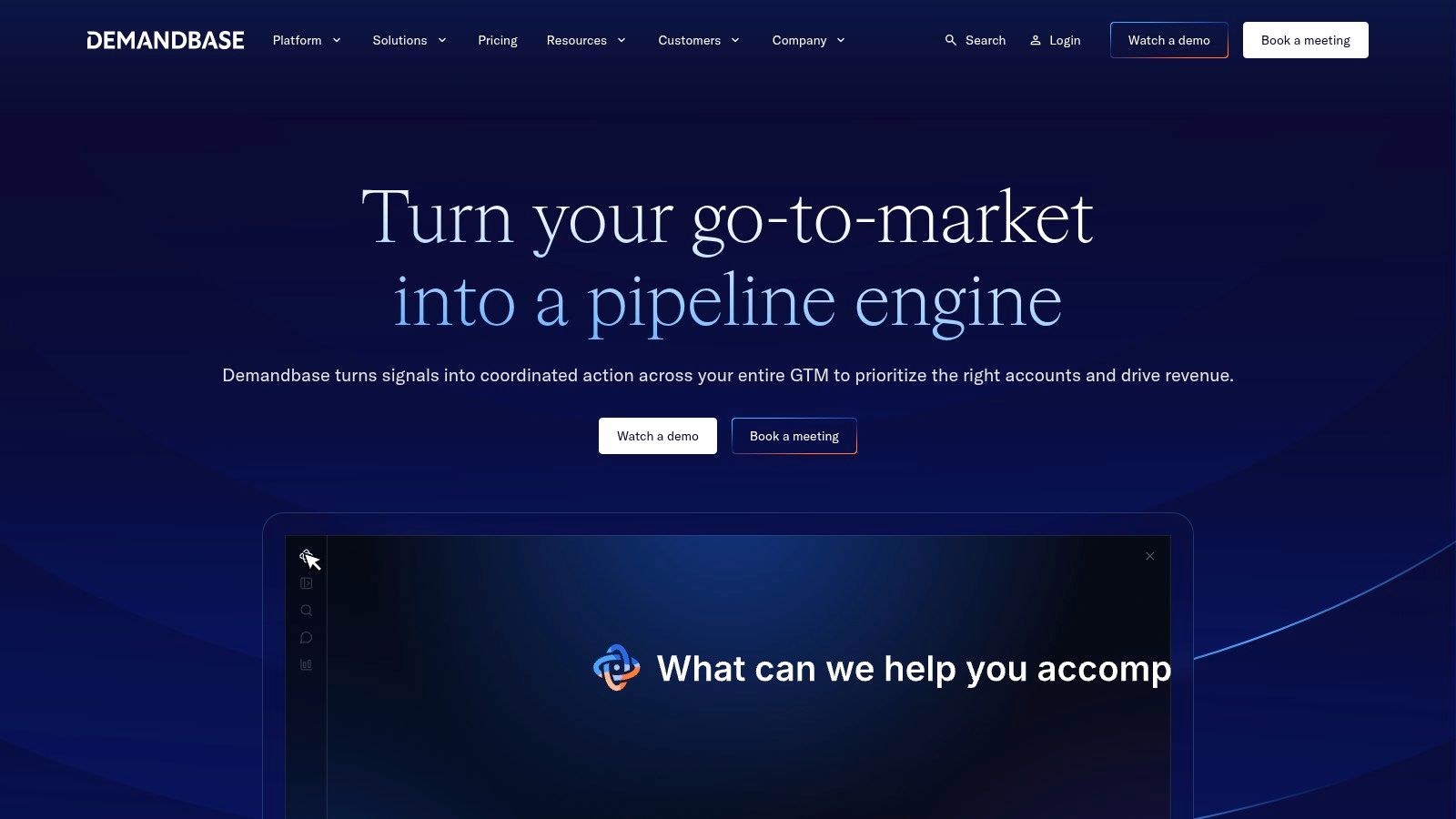
Demandbase combines fit, intent, engagement, and account journey signals to prioritize accounts and route them faster. Its predictive products include Qualification Score and Pipeline Predict, with models that can support different product lines. Technographic information, engagement patterns, and buying stage context give sales more than a single activity total.
The useful distinction is operational. Demandbase helps marketing and sales discuss whether an account is in a relevant buying stage, not merely whether a person crossed a score threshold. Auto retraining can reduce manual model maintenance, although the team still needs to define what a qualified account means and decide how sales should act on each score band.
Fit, cost, and implementation effort
Demandbase works best for ABM teams that already coordinate target accounts, campaigns, territories, and sales plays. Its analytics can improve handoffs when the business has multiple segments or product lines, but the platform will not repair unclear ownership rules or weak follow up.
Pricing isn't published as a standard self serve schedule. The commercial structure is generally described as a platform fee plus per user costs, with the final price provided through sales. In practice, buyers should budget for dedicated RevOps attention, data mapping, model review, and enablement.
Verdict: Choose Demandbase when account journey analytics and predictive qualification are central to an ABM motion. Avoid it when the immediate problem is that inbound leads aren't assigned quickly.
4. MadKudu
MadKudu, now presented through the HG Insights scoring stack, focuses on predictive qualification for SaaS teams. Its core model combines fit and engagement, then places leads into A, B, C, D, or E grades so sales and marketing can prioritize records without interpreting a complex probability score.
The product is particularly relevant to product led companies. Product usage and engagement can sit beside firmographic signals, which gives the team a way to distinguish a well matched active user from a high fit contact who hasn't shown meaningful interest. Scores can be written to standard Salesforce and HubSpot objects, and engagement scoring is designed for operational use rather than a separate analyst dashboard.
Teams rebuilding their models should first understand what lead scoring actually measures. A predictive grade can rank records, but it doesn't prove that the score caused incremental pipeline. Holdout groups, accepted opportunities, pipeline created, and closed won revenue remain better tests than score distribution alone.
Fit, cost, and implementation effort
MadKudu is a good fit when the CRM is Salesforce or HubSpot and the team wants an opinionated scoring workflow without buying a full ABM platform. It still needs trustworthy historical outcomes, clear lifecycle definitions, and someone who can challenge false positives.
Pricing is quote based and sold through a sales process. Documentation and interface references under HG Insights can also create avoidable confusion during evaluation.
Verdict: Choose MadKudu for predictive scoring around SaaS engagement and product usage. Avoid it if the team has little usable conversion history or needs enrichment, routing, and outreach orchestration in one system.
5. Breadcrumbs
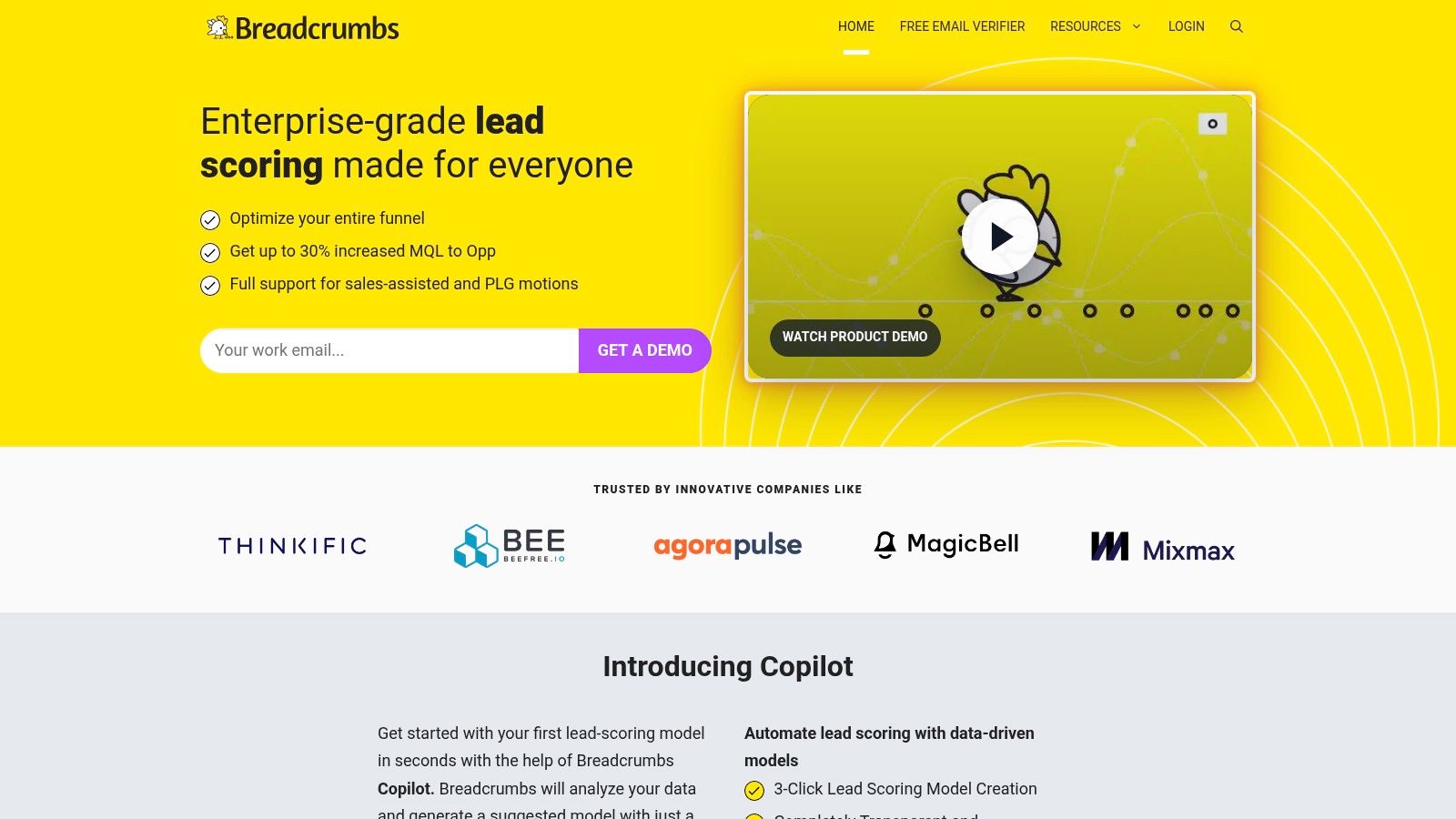
Breadcrumbs is a focused scoring and routing platform for teams that want to build, test, and iterate models without assembling a large ABM program. Its guided model builder helps operators combine contact, company, email, and product engagement signals, then adjust the logic as sales feedback arrives.
The practical strength is speed of iteration. Teams can prototype a model before activation, compare the result with their existing process, and connect the output to HubSpot, Salesforce, or a marketing automation platform. Copilot suggestions can help identify useful attributes and actions, but the operator still owns the definition of a qualified record.
A workable model should separate fit from intent. One published framework gives 25 points to demographic fit, 25 to firmographic fit, 40 to behavioral engagement, and deducts 10 points for negative signals. It places the MQL threshold near 65 points and the SQL threshold near 85 points, but those thresholds should be calibrated against historical pipeline rather than copied unchanged across segments. The scoring framework and threshold guidance provides a practical starting point.
Fit, cost, and implementation effort
Breadcrumbs fits marketing operations and sales operations teams that need a faster path from messy assumptions to a documented model. It isn't an end to end ABM suite, and its analytics are lighter than enterprise platforms, but that limitation can be useful when the team wants to fix scoring without starting a broad transformation project.
The free test mode lowers evaluation effort. Buyers should still account for data cleanup, CRM field mapping, threshold reviews, and seller training.
Verdict: Choose Breadcrumbs when the main need is practical scoring and routing iteration. Avoid it when qualification depends on deep account intent, conversational discovery, or broad GTM orchestration.
6. Clearbit by HubSpot
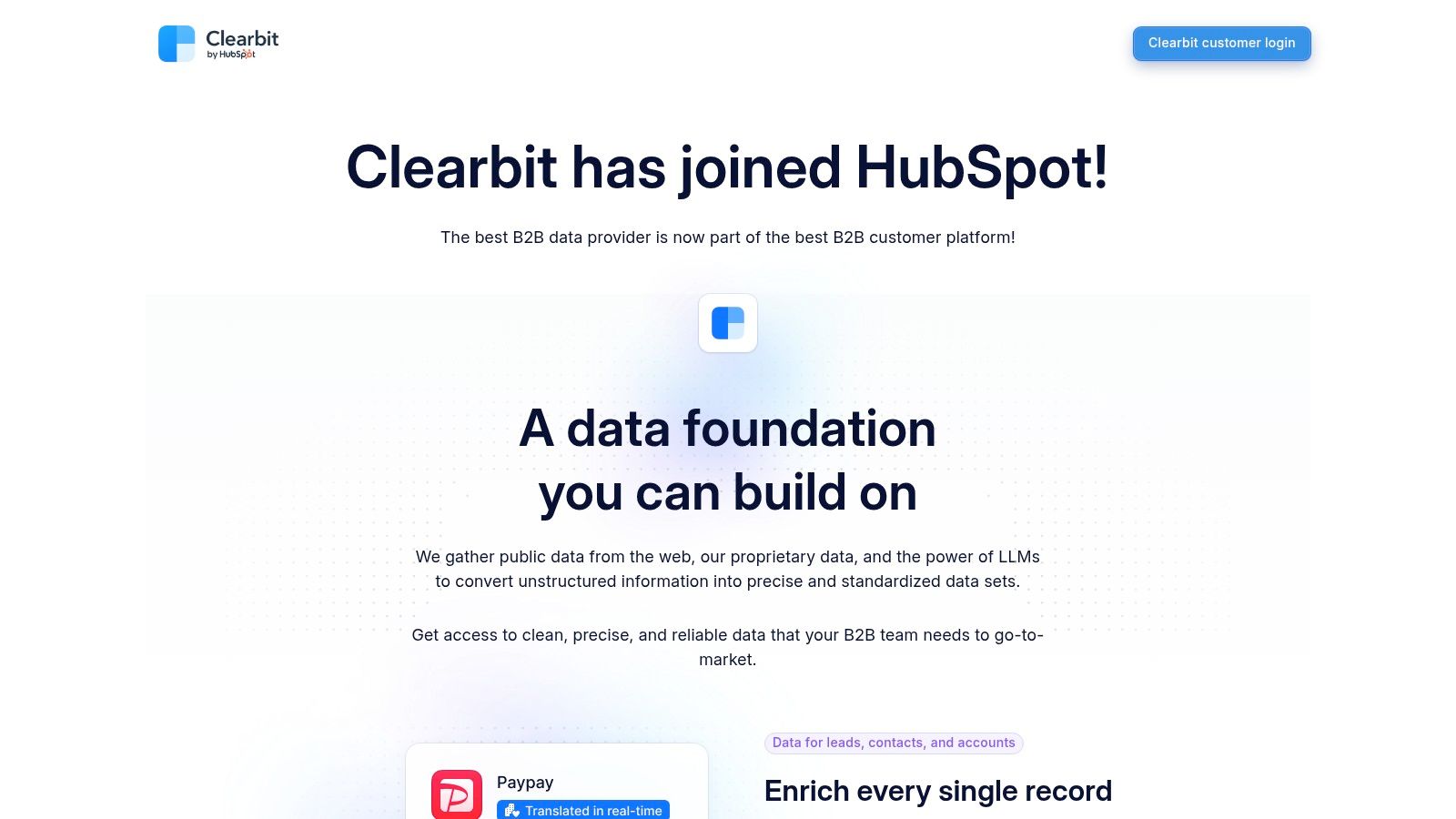
Clearbit is an enrichment and intent layer, not a complete qualification system. It supplies company and person data, pageview alerts, form shortening, and selective enrichment controls. Inbound teams can use those signals to trigger routing or playbooks when an identified visitor matches the ICP or views a meaningful page.
The operating boundary matters. Clearbit improves the record, while another system usually determines qualification, ownership, and next action. Keep fields that change routing or messaging. Extra enrichment creates credit usage without improving a decision.
Clearbit uses credits and supports batch enrichment. The free platform has been sunset, so finance and RevOps teams need a usage budget rather than treating enrichment as an unlimited background process. Teams comparing providers can find enrichment tools for lead discovery. Teams weighing Clearbit against an alternative identification layer should also review the RB2B versus Clearbit comparison before committing to a credit-based enrichment budget.
Fit, cost, and implementation effort
Clearbit suits inbound teams that want shorter forms and stronger firmographic context in a HubSpot-centered workflow. It can trigger Slack, marketing automation, and analytics actions, such as notifying a team when an ICP account reaches a pricing page.
Its intent coverage is lighter than a full ABM platform. A separate scoring model, routing engine, or engagement system may still be required. Build effort is moderate when CRM field mapping, enrichment rules, and credit controls are defined in advance. Without those decisions, implementation becomes a data-governance project.
Verdict: Choose Clearbit when data quality and inbound enrichment are the bottleneck. Budget for usage and operational controls. Avoid using it as the sole qualification product, because enriched records do not create a governed sales decision.
7. Qualified
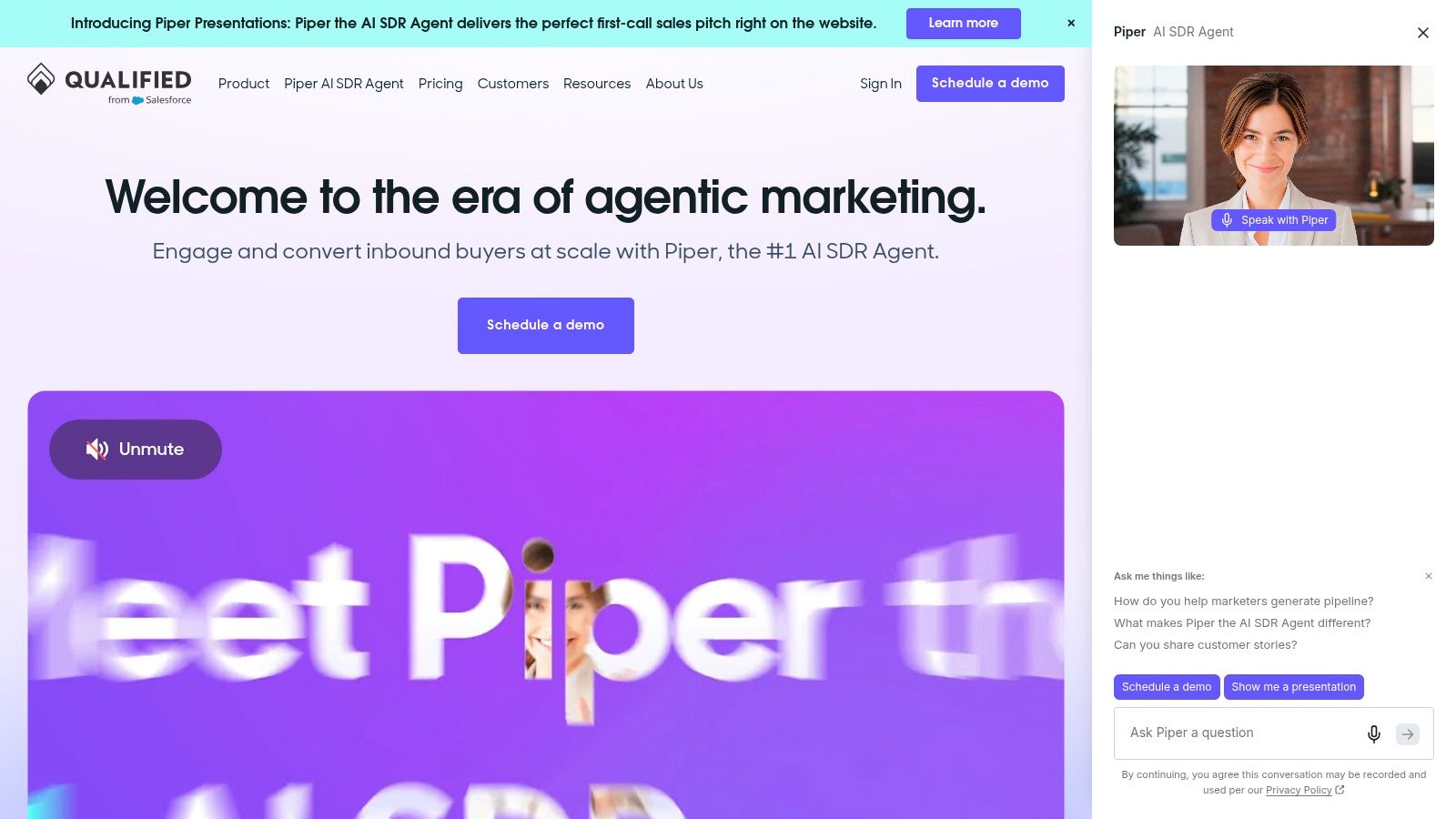
Qualified is built for high intent website qualification. Its AI SDR, Piper, can engage visitors through video, voice, and text, ask questions, book meetings, and follow up. Account segmentation and waterfall enrichment help identify visitors and connect the conversation to the account context that Salesforce teams already use.
The product is strongest when a buyer is on the website and the business has enough inbound activity for immediate conversation to matter. Deep Salesforce reporting and more than 20 GTM integrations support attribution and handoff, while account aware experiences can give strategic visitors a different path from unknown or low fit traffic.
Teams should distinguish meeting booking from qualification. A visitor who agrees to a meeting has shown engagement, but that doesn't automatically establish budget, authority, need, or timeline. The workflow should preserve the answers, route the record, and let sales verify the evidence. A practical guide to lead qualification explains why a booked meeting and a qualified opportunity aren't interchangeable.
Fit, cost, and implementation effort
Qualified suits Salesforce first organizations with significant demo or website traffic and a clear response process. It needs website configuration, CRM objects, routing rules, calendars, approved answers, and people ready to respond when the system escalates.
Pricing is custom and typically oriented toward mid market and enterprise buyers. Smaller teams may not generate enough qualified website conversations to justify the platform and the operational coverage around it.
Verdict: Choose Qualified when website conversations and fast Salesforce handoffs are the core problem. Avoid it when inbound volume is low or qualification needs to span outbound, enrichment, and CRM operations beyond the website.
8. Chili Piper
Chili Piper solves the post form gap well. It can qualify in real time, match a lead to an owner or territory, offer an immediate booking path, and use Distro for lead to account matching. Weighted round robin, response SLAs, and audit logs make routing decisions visible to operations rather than burying them in manual queue work.
This is a routing first product. It doesn't replace enrichment or predictive scoring, and it won't tell the team whether a contact has a real business problem unless the form, chat, or upstream system captures that evidence. Its value comes from enforcing the next action after the qualification inputs exist.
A practical scorecard should treat BANT as evidence, not box ticking. Budget, Authority, Need, and Timeline can each receive a score from 0 to 2. Public research can support only a score of 1, because public signals don't prove internal budget, authority, or urgency. The BANT evidence framework gives sales teams a way to require seller verified evidence before promoting a record to an opportunity.
Fit, cost, and implementation effort
Chili Piper fits inbound teams that lose meetings between form completion and rep follow up. Its rule builder is accessible to operations teams, and published pricing gives buyers more commercial visibility than many enterprise qualification products.
Implementation still requires clean CRM ownership, territory rules, calendars, fallback paths, and an agreed SLA. Advanced ABM qualification usually needs another tool beside it.
Verdict: Choose Chili Piper when speed, ownership, and instant booking are the constraint. Avoid it if the team expects predictive scoring, deep enrichment, or full funnel qualification from the same product.
9. Leadspace
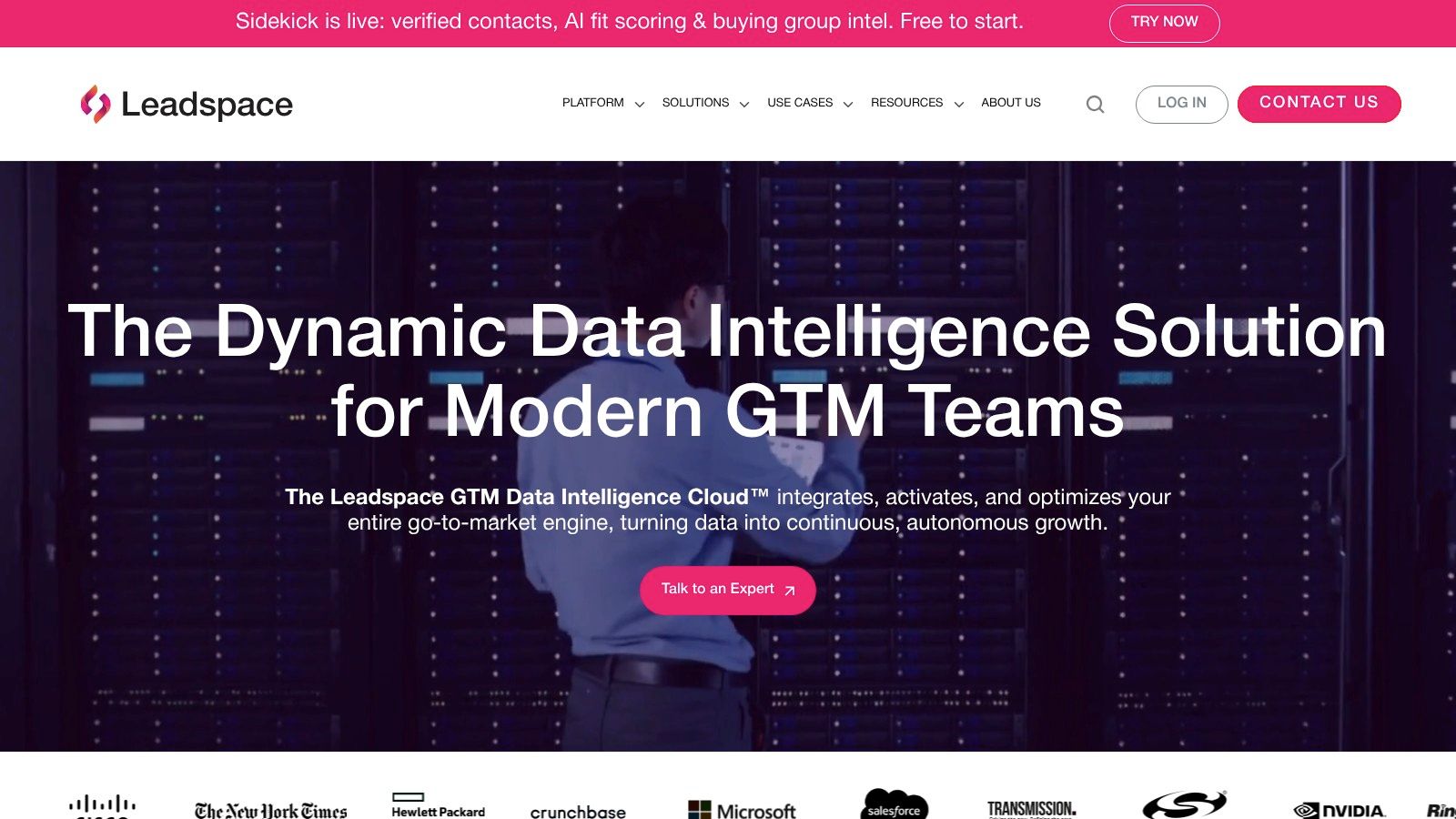
Leadspace brings qualification into a broader B2B customer data platform. It can enrich inbound records, calculate ICP and fit signals, add intent context, match leads to accounts, and route the result into Marketo, Eloqua, or HubSpot workflows. Persona and propensity models help teams work from a unified buyer profile rather than from disconnected lead fields.
Lead to account matching is the operational centerpiece. A new contact should reach the account owner when the account already exists, rather than creating duplicate ownership or triggering competing outreach. Sidekick contact intelligence adds a more accessible user layer, while the larger platform supports teams that need qualification across marketing automation and CRM programs.
Data governance deserves equal attention. Third party intent accuracy varies by provider and methodology, and IP to company mapping is imperfect across shared networks and distributed workforces. First party visitor behavior is usually more direct than broad third party coverage, so the workflow should preserve signal lineage, distinguish account inference from person facts, and show why a record received its score. The intent data discussion highlights why confidence, provenance, retention, and human review belong in the design.
Fit, cost, and implementation effort
Leadspace fits organizations that need a CDP foundation and already operate complex marketing automation programs. The trade off is implementation weight. A full deployment can exceed the effort required for a point scoring tool, especially when identity resolution, historical data, and account hierarchies need attention.
Pricing includes published per user tiers for some Sidekick capabilities, while broader platform pricing is handled commercially. Buyers should evaluate the complete data and administration workload.
Verdict: Choose Leadspace when unified buyer profiles and lead to account matching matter across systems. Avoid it when the team wants a quick self serve scoring experiment.
10. ZoomInfo
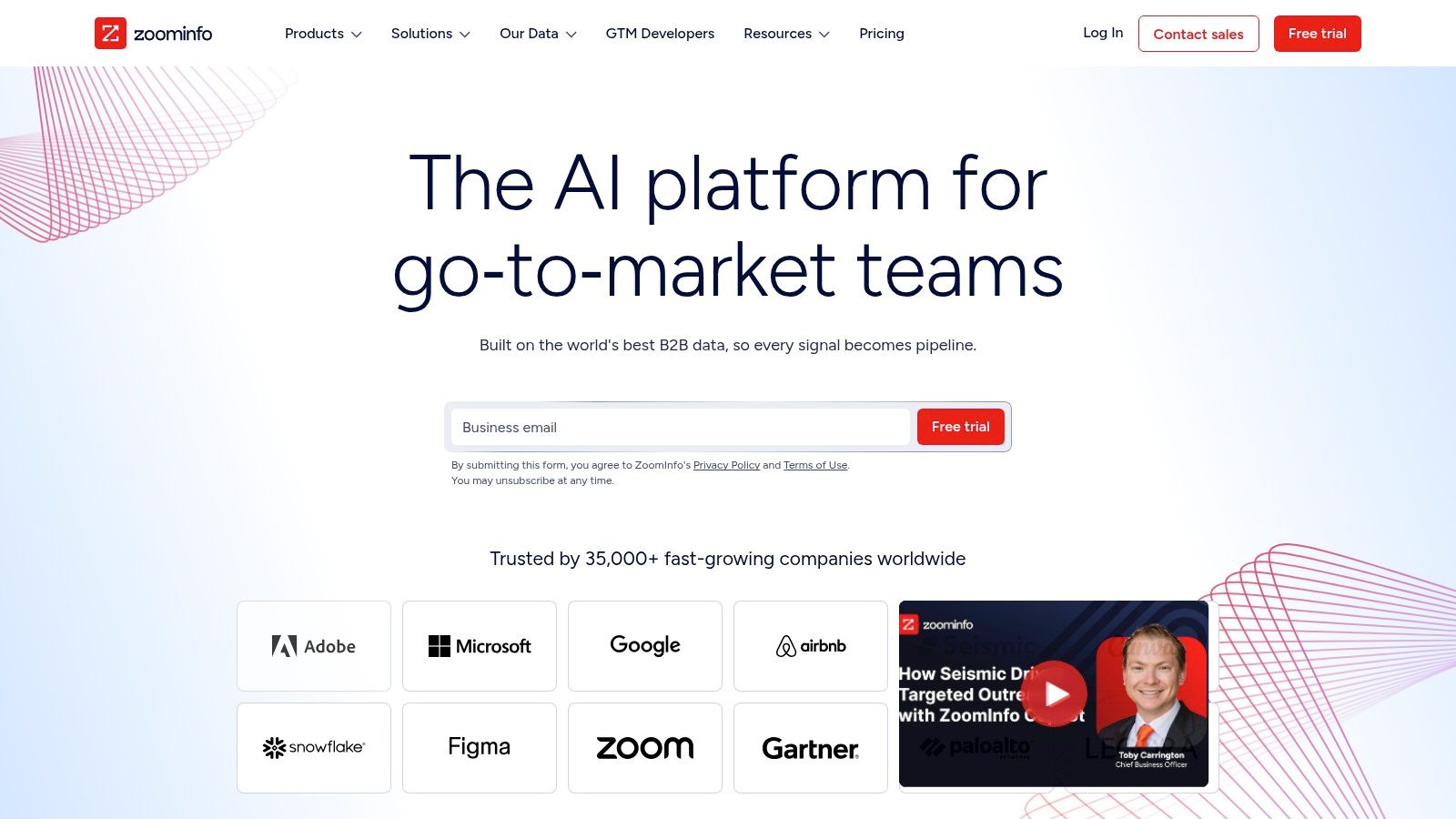
ZoomInfo is a data, intent, and engagement platform that teams use to improve qualification across inbound and outbound motions. SalesOS, MarketingOS, and OperationsOS can provide firmographic and contact data, intent topics, anonymous visitor identification, CRM activation, and triggers for routing or sequencing.
Its strength is breadth. A team can start with company and contact intelligence, add intent topics, identify visitors, and activate the information inside a larger GTM workflow. That makes ZoomInfo useful as the data foundation beneath qualification, especially for organizations with many territories, segments, and sales plays.
The limit is equally clear. ZoomInfo isn't a complete qualification decision engine by itself. The team still needs rules for ICP fit, evidence for buying intent, routing ownership, response timing, and human approval for sensitive outreach. Data quality can also vary by geography, segment, and role, so a pilot should test the exact records the business cares about rather than relying on a general database reputation.
Fit, cost, and implementation effort
ZoomInfo fits enterprise sales and marketing teams that need broad data coverage and established CRM integrations. Pricing isn't publicly listed, and contracts, credits, product bundles, and add ons can become complex. The commercial review should include enrichment usage, intent access, implementation, services, and the cost of the downstream tools that turn data into action.
Verdict: Choose ZoomInfo when enrichment and intent coverage are the main constraint. Avoid it if the team expects the database to replace qualification logic, routing governance, or sales judgment.
Top 10 Lead Qualification Tools, Feature Comparison
| Solution | Core capability | Target audience 👥 | Effectiveness ★ | Value & pricing 💰 | Unique differentiator ✨ |
|---|---|---|---|---|---|
| Yalc 🏆 | Unified GTM API + AI playbooks, knowledge orchestration, telemetry | 👥 Revenue ops, sales leaders, founders, scale-ups | ★★★★★ | 💰 Custom build + fractional GTM engineering (vs hire) | ✨ Two surfaces / one engine, installs on your infra, portable playbooks |
| 6sense | Predictive intent & account/contact scoring, real‑time APIs | 👥 Enterprise ABM/marketing teams | ★★★★☆ | 💰 Enterprise pricing, quote-based | ✨ Deep predictive stack and re‑training for in‑market windows |
| Demandbase | ABM + Pipeline Predict (fit + intent + engagement) | 👥 ABM teams, RevOps | ★★★★☆ | 💰 Platform + per‑user, custom | ✨ Strong journey analytics and multi‑model scoring |
| MadKudu (HG Insights) | Fit + engagement lead scoring, SF/HubSpot writeback | 👥 SaaS Rev teams, CRM users | ★★★★ | 💰 Quote‑based | ✨ Opinionated lead grades (A–E) and CRM operationalization |
| Breadcrumbs | No‑code guided scoring builder, real‑time tweaks | 👥 Mid‑market ops, HubSpot/Salesforce users | ★★★ | 💰 Freemium/test mode → paid tiers | ✨ Fast prototyping with copilot suggestions |
| Clearbit (by HubSpot) | Enrichment, pageview alerts, selective batch enrichment | 👥 Inbound teams, SDR/ops | ★★★ | 💰 Credit‑based, per‑record pricing | ✨ Fine‑grained enrichment controls and form shorteners |
| Qualified | Website AI SDR, account‑aware chat/video/voice qualification | 👥 Salesforce‑first orgs with high inbound | ★★★★ | 💰 Custom / mid‑market → enterprise | ✨ AI agent that books meetings and follows up on site |
| Chili Piper | Real‑time form qualification, routing, instant scheduling | 👥 Inbound conversion teams, SDR ops | ★★★★ | 💰 Clear published plans, seats included | ✨ Distro routing, SLA/audit logs, instant booking |
| Leadspace | CDP with inbound enrichment, ICP scoring, lead‑to‑account match | 👥 Enterprise CDP/marketing teams | ★★★★ | 💰 Custom CDP pricing | ✨ Unified buyer profiles + persona/propensity models |
| ZoomInfo (SalesOS) | Broad firmographic/contact data, intent, anonymous ID | 👥 Large inbound/outbound revenue teams | ★★★★ | 💰 Expensive, contract/add‑ons | ✨ Extensive coverage + RevOS ecosystem |
Choose the Tool Your Data and Team Can Run Next Month
Start with one question: where does a qualified lead get decided today, in a form, a CRM rule, or a rep's judgment? The answer identifies the layer that needs repair. If the form lacks useful evidence, improve enrichment or capture intent. If the score exists but nobody acts on it, fix routing and ownership. If reps override the model constantly, review the ICP, negative signals, and the difference between fit and intent.
The evidence supports treating response time as part of qualification, not as a separate sales metric. A Harvard Business Review audit found that 24% of tested companies took more than 24 hours to respond, and 23% never responded. The same research found that firms contacting leads within one hour were nearly seven times more likely to qualify them than firms waiting an additional hour. The response time benchmark also supports timestamped measurement across lead creation, enrichment, scoring, assignment, contact, and qualification.
A five minute versus thirty minute execution window is a useful production test. Research summarized from the MIT and InsideSales lead response study reports that leads contacted within five minutes were 21 times more likely to qualify than leads contacted after thirty minutes, based on more than 15,000 leads and 100,000 call attempts. The operational analysis of speed to lead recommends webhook intake, parallel enrichment, deterministic fallbacks, idempotent processing, and human approval for sensitive outreach.
Test incremental revenue, not attractive scores
The hardest buyer question is whether scoring improves revenue or merely creates a more refined queue. One review reports no statistical difference in connection, re engagement, or win rates between leads selected as ready for sales by scoring and randomized non scored leads. That finding doesn't make scoring useless. It means the buyer should demand randomized holdouts and downstream measures such as accepted opportunities, pipeline created, and closed won revenue. The review of lead qualification evidence makes the causal problem explicit.
A 30 day test can be simple:
- Keep the current process as a control group.
- Send the new workflow only the traffic or accounts assigned to the test.
- Record lead creation, enrichment completion, score, assignment, first contact, connection, qualification, opportunity creation, and revenue.
- Segment results by source, geography, company size, campaign, and intent level.
- Compare accepted leads and pipeline quality, not only MQL volume or model accuracy.
Teams should also define an action for every score band. One published model sends scores from 90 to 100 to sales immediately with a contact requirement within 24 hours, routes scores from 75 to 89 to sales with a 48 hour response service level, places scores from 60 to 74 into active nurture, and sends scores below 60 to standard nurture or suppression when fit is weak. The score band routing model is useful because it turns ranking into ownership, timing, and a next step.
No platform can compensate for an undefined ICP, duplicate records, stale enrichment, or a sales team that doesn't trust the output. Point tools are often the right choice when one layer is broken. Chili Piper can fix routing and booking. Clearbit can improve inbound context. MadKudu can focus predictive scoring. Qualified can handle website conversations. 6sense and Demandbase can support enterprise account intelligence. Yalc makes more sense when the business needs those decisions orchestrated across a wider GTM system, with portable playbooks, unified provider access, audit logs, and a learning loop that retires weak motions.
Pick the tool that moves the qualification decision, run the test against closed won outcomes, and keep the model only if it ranks those deals better than the current process. For teams extending the workflow beyond qualification into outreach, reporting, and execution, use this guide to sales outreach automation to review the next layer without losing the original evidence trail.
Yalc combines ICP based qualification, enrichment, routing, CRM synchronization, outreach playbooks, and campaign telemetry behind a unified GTM API, with deployment on infrastructure the team controls. Visit Yalc to map the current qualification workflow, identify the agents worth building, and decide whether a governed GTM operating layer fits the team's next month of work.