Linkedin Marketing Strategy: A 2026 Playbook for GTM Teams
Most LinkedIn advice starts with posting frequency. That's the wrong starting point. A team can publish every day, collect likes, and still fail to create a single useful sales conversation.
A practical LinkedIn marketing strategy treats the platform as a demand generation operating system. The work begins with a precise ICP, uses personal profiles as the main distribution layer, and connects engagement to outreach, qualification, CRM data, and pipeline. Content matters, but content is only one part of the system.
Table of Contents
- The Real Value of LinkedIn in B2B Marketing
- Defining ICP and Optimizing Your Profile
- Content Formats and Distribution Cadence
- Outreach Sequencing and Connection Strategy
- Automation and the Unified GTM Stack
- Measuring Pipeline Influence and ROI
- Building a Sustainable Operational Rhythm
The Real Value of LinkedIn in B2B Marketing
LinkedIn deserves serious attention because it combines professional identity, company information, buying context, and direct access to decision makers. Microsoft reported approximately $16.37 billion in LinkedIn revenue in FY2024, followed by roughly $18 billion in trailing twelve month revenue by FY2026 Q1, while industry coverage cites around 1.3 billion registered members and 310 million monthly active users in 2026. These figures are summarized in LinkedIn's latest marketing statistics.
That scale changes the operating model. LinkedIn isn't a niche networking site where a few executives occasionally share updates. It functions as a major B2B media and demand generation channel, with audience data that helps teams identify companies, roles, industries, and professional interests.
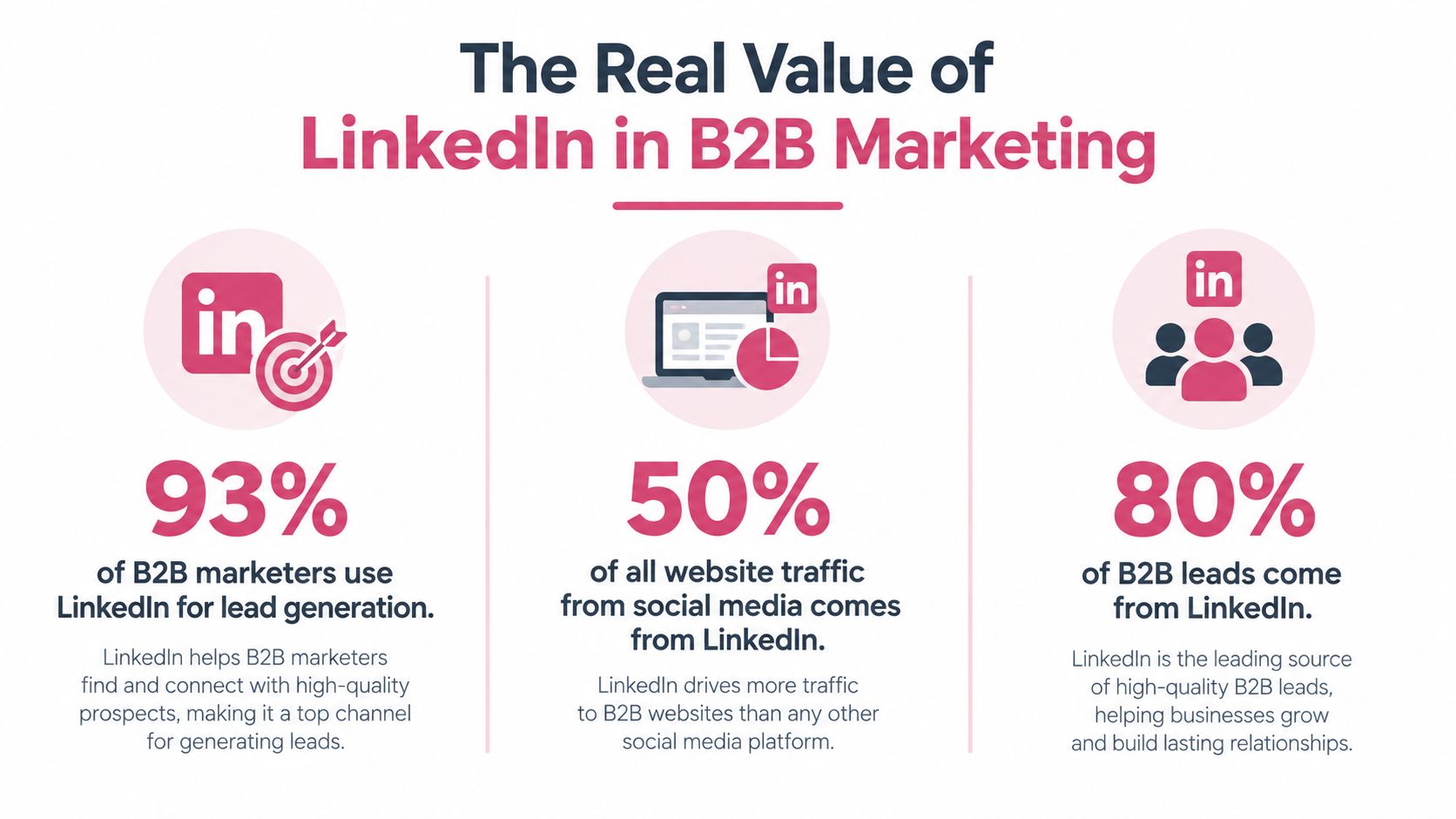
Multiple surveys summarized in the same industry coverage report that 87% of B2B marketers use LinkedIn for content distribution, 85% say it delivers the best value among organic social platforms, and 53% of B2B professionals rank it as the most important social platform for B2B marketing. Another roundup reports that 87% use LinkedIn for marketing and 89% use it for lead generation, while a separate source cites 93% of B2B marketers using LinkedIn as a primary channel. These figures come from LinkedIn usage data for B2B teams.
Measure commercial relevance, not applause
The important question isn't whether a post received reactions. It's whether the right accounts saw it, engaged with it, entered a conversation, or appeared later in an opportunity.
Dreamdata's 2026 benchmark data, covered in LinkedIn statistics for B2B decision makers, reports that LinkedIn influenced 35% of new B2B deals, compared with 3% for Meta. The same benchmark says companies shifted LinkedIn's share of advertising budgets from 31% to 39%, and that LinkedIn's cost per company influenced was 31% cheaper than Meta.
Native conversion also matters. LinkedIn marketing materials and secondary coverage report an average lead generation form conversion rate of 13%, compared with 4.02% for landing pages, which helps explain why native forms can work well for high intent offers. The benchmark summary also cites a 121% return on ad spend for LinkedIn B2B campaigns, compared with 67% for Google Search and 51% for Meta in the same dataset.
Those figures don't justify spending blindly. They justify building a measurement system that evaluates LinkedIn against influenced pipeline, account quality, and sales progression rather than vanity metrics alone.
Defining ICP and Optimizing Your Profile
A vague audience creates vague content. Before a team writes posts or builds a prospect list, it needs a working ICP that sales, marketing, and operations can apply consistently. The profile should describe the type of company, the operating situation that creates urgency, the people involved in the decision, and the evidence that an account is worth prioritizing.
Use the ICP as a filter, not a branding exercise. Document the market category, company characteristics, buying trigger, current alternative, likely objections, and business outcome. Then list the language prospects use in calls, job descriptions, community discussions, and support requests. Teams that need a deeper framework can use this ICP definition guide to structure the document.
Turn the personal profile into a landing page
A personal profile usually does more commercial work than a company page because buyers want context about the person behind the idea. The headline should identify the audience, problem, and practical outcome. “Helping revenue teams reduce manual prospecting work” gives a visitor more direction than a title alone.
The banner and About section should reinforce the same position. A visitor should understand:
- Who the profile serves: Name the market and role clearly.
- What problem it addresses: Describe the costly or frustrating situation.
- What proof exists: Use relevant experience, customer patterns, or specific operating knowledge.
- What to do next: Offer a useful resource, conversation, or clear route to learn more.
The Featured section should hold the strongest evidence, not a random collection of company links. Add a practical guide, a strong point of view, a relevant product explanation, or a page that helps a qualified visitor self identify.
Let the company page support the people
The company page still matters for legitimacy, hiring, branded search, and paid campaigns. It shouldn't compete with executive and employee profiles for attention. Use it to publish product updates, customer education, open roles, research, and proof that supports the conversations created by people.
Practical rule: If a post sounds like it was approved by everyone, it probably belongs on the company page. If it contains a sharp observation from real work, a relevant person should publish it.
Profile optimization also requires alignment. Sales representatives shouldn't promise a different outcome from the one marketing presents, and executives shouldn't publish opinions that conflict with the ICP's real concerns. A consistent profile network gives every engagement a clearer path toward a commercial conversation.
Content Formats and Distribution Cadence
The strongest LinkedIn content strategy starts with a useful idea and then chooses the format that helps people consume it. Teams often do the reverse. They decide to publish a video, carousel, or link post, then search for something to fill the format.
Native documents and carousel style assets deserve priority. Independent benchmark summaries report average LinkedIn engagement of around 5.2% in 2026, with native document and carousel posts at approximately 7.0%, ahead of video, image, text only, and link posts. These figures appear in LinkedIn benchmark data from Sprinklr.
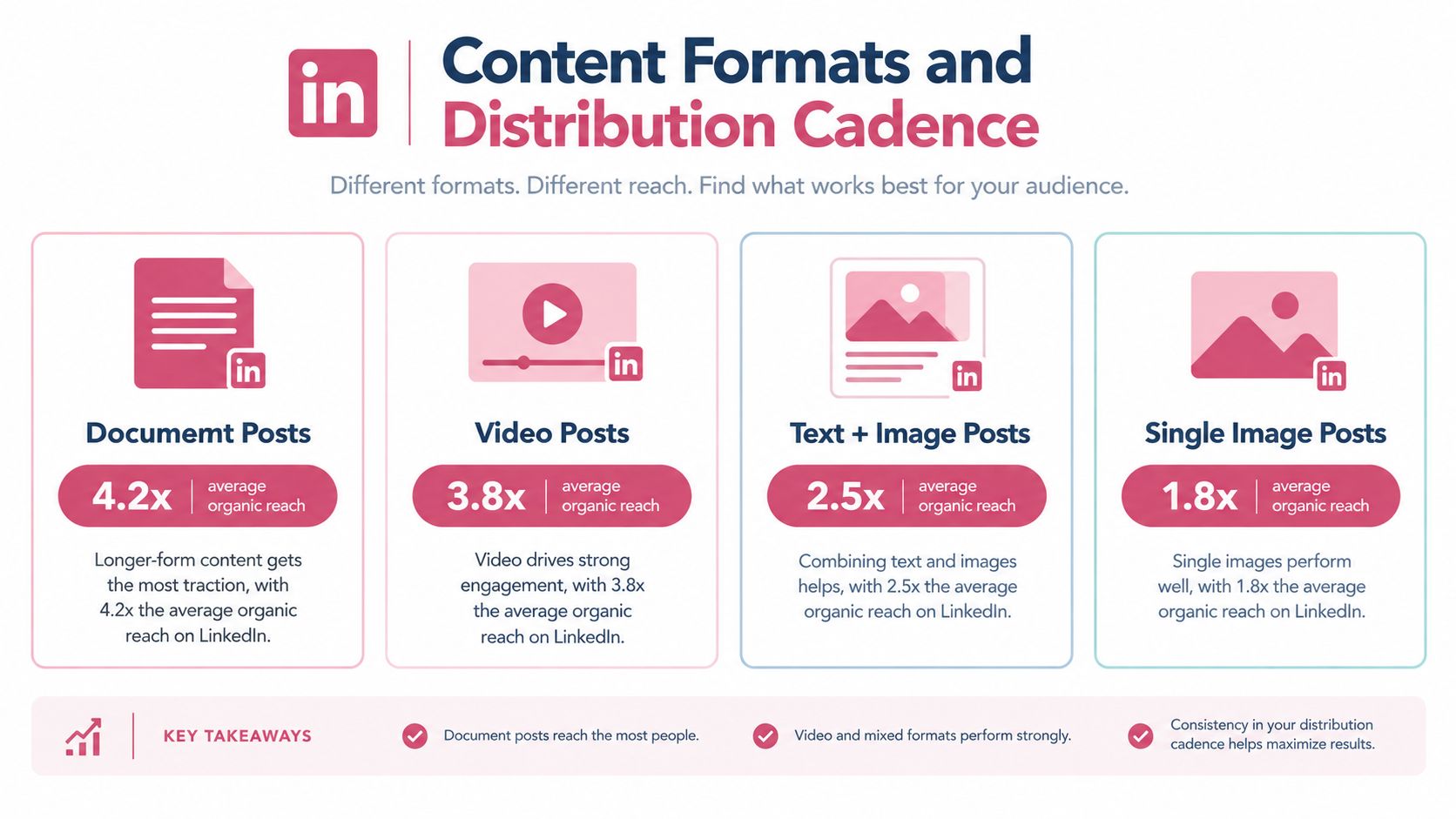
Another analysis reports that document posts generate 39% more reach and 30% more engagement than the average post. That data is available in analysis of the best performing LinkedIn content. Teams should treat these figures as directional benchmarks, then validate performance against their own ICP and account mix.
Build a format portfolio
A sustainable portfolio can include:
- Documents for teaching: Break a process, audit, checklist, or operating model into pages that stand alone.
- Text posts for judgment: Share a clear opinion about a problem the target buyer already understands.
- Video for demonstration: Show a workflow, review a decision, or explain a complex operational choice.
- Images for evidence: Use diagrams, screenshots, or simple visual summaries when the image adds information.
- Links for depth: Use external links selectively, with a strong reason for leaving the platform.
A document should not become a disguised brochure. Each page needs to move the argument forward, answer a question, or make the next page necessary. A text post should lead with the conclusion, then explain the evidence and operational implication.
Connect organic content to outreach
Organic content creates familiarity, but it doesn't automatically create pipeline. A demand generation team should watch for meaningful signals such as profile visits from target accounts, comments that reveal a problem, repeated engagement from one company, or a direct response to a point of view.
The next action can be a relevant reply, a profile review, a connection request, or a retargeting audience. It shouldn't be an immediate pitch. Teams building a repeatable editorial process can use this engaging LinkedIn post workflow to keep posts useful and consistent without making them sound mechanically produced.
A simple cadence is better than an ambitious calendar that collapses after a month. Assign owners for ideas, drafting, review, publishing, comment response, and signal capture. Review engagement by format using total engagements divided by total impressions, multiplied by 100, then shift production toward formats that consistently attract the right accounts.
Outreach Sequencing and Connection Strategy
Outreach works when it follows a signal and respects the prospect's context. It fails when a team treats every profile as an invitation to send the same pitch.
LinkedIn enforces a hard outbound connection request limit of about 100 requests per week, according to LinkedIn outreach statistics. That limit makes prioritization necessary, but volume isn't the only constraint. Poor targeting, repetitive copy, and irrelevant follow ups damage response quality long before the platform limit becomes the issue.

Use a signal based sequence
A practical sequence has distinct stages:
- Prioritize the account: Confirm ICP fit, role relevance, business situation, and a reason to contact the person now.
- Create familiarity: Engage with a relevant post or share a useful observation before sending a request when the context supports it.
- Send a short connection note: Mention the shared business context, not a generic compliment or product description.
- Wait for a response: Don't attach a pitch to the first follow up. Ask a question that can be answered without a meeting.
- Qualify the conversation: Explore the current process, friction, ownership, and urgency.
- Offer a next step: Suggest a resource, comparison, or call only when the exchange supports it.
A message might refer to a public hiring change, a stated operational challenge, or a post the prospect wrote. It shouldn't pretend that a scraped detail represents deep research. Personalization is useful when it changes the relevance of the message, not when it merely inserts a first name.
The LinkedIn connection message guide helps teams structure that first interaction around context and restraint. For larger programs, lead generation use cases for enterprises provide useful context for separating research, prioritization, and follow through.
Automate the sequence, not the judgment
Automation can schedule touches, record status, and prevent follow ups from disappearing in a spreadsheet. It shouldn't invent urgency, respond to objections without review, or continue messaging after a prospect has asked for space.
Use explicit stop conditions. Pause the sequence when someone replies, changes roles, becomes a customer, asks not to be contacted, or shows a clear mismatch. Route positive replies to a human owner with the account context and previous messages attached. This preserves speed while keeping the conversation credible.
Automation and the Unified GTM Stack
Manual execution breaks through coordination, not just workload. One person researches accounts in a browser, another enriches a spreadsheet, a third launches sequences, and an operations manager tries to reconcile outcomes later. Each handoff creates missing fields, inconsistent definitions, and delayed feedback.
A unified stack should connect research, enrichment, qualification, outreach, replies, and reporting. The exact tools can vary, but the operating principle stays the same. One account record should carry the ICP fit, source, signal, owner, sequence state, consent or suppression status, and commercial outcome.
Compare fragmented work with orchestration
| Fragmented process | Unified operating model |
|---|---|
| Research lives in separate browser tabs | Account research is stored with the prospect record |
| Enrichment happens before anyone checks fit | ICP scoring determines which records deserve enrichment |
| LinkedIn and email sequences run separately | Channel steps share timing, status, and suppression rules |
| Replies sit in individual inboxes | Replies route to owners with context and next actions |
| Reporting focuses on activity | Results connect to opportunities and account influence |
A team can connect LinkedIn workflows through Unipile, enrichment through FullEnrich, multichannel execution through lemlist, firmographic data through Crustdata, and tracking through Notion or an existing CRM. The goal isn't to assemble the largest tool list. It's to make each system contribute to one decision about the next best action.
Yalc is one option for this model. It provides a unified GTM API, connects data and execution tools, supports LinkedIn workflows, and lets teams run composed plays through Claude Code, Slack, or its interface. Its agents can record campaign outcomes and grade plays against defined success metrics, while human approvals remain available for sensitive actions.
Teams that want to examine the implementation details can review this guide to LinkedIn outreach automation. Whatever stack a team chooses, it should retain an audit trail, use scoped access, and make it easy to stop a campaign without searching across several platforms.
Make feedback operational
Every sequence should begin as a hypothesis. Define the target accounts, expected signal, acceptable reply quality, meeting criteria, and pipeline outcome before launch. After the sequence runs, record what happened and classify the result as a targeting issue, message issue, offer issue, timing issue, or execution issue.
That classification prevents teams from rewriting copy when the core problem is weak account selection. It also gives operations a way to promote successful plays and retire those that produce activity without useful conversations.
Measuring Pipeline Influence and ROI
Likes and comments are useful diagnostic signals, but they aren't proof of commercial value. A post can attract broad attention from people who will never buy, while a small interaction from the right account can precede a serious opportunity.
The measurement model should connect four layers:
- Exposure: Record the post, profile, campaign, or ad that created awareness.
- Engagement: Capture meaningful actions, including comments, saves, profile visits, and direct replies.
- Account movement: Track connection acceptance, conversation quality, meeting progression, and opportunity creation.
- Commercial influence: Compare LinkedIn touchpoints with sourced and influenced pipeline, revenue stage movement, and cost per company influenced.
Use UTMs on destination links and consistent CRM campaign tags for every offer. Capture the LinkedIn profile or company identifier where appropriate, then pass the source into the opportunity record. Conversion APIs can help send qualified outcomes back into advertising measurement, giving the platform a stronger signal than a raw form completion.
Dreamdata's benchmark, summarized in LinkedIn marketing performance data, reports that firms shifted LinkedIn ad budget from 31% to 39% of total budget and that LinkedIn was 31% cheaper than Meta on cost per company influenced. Those benchmarks support a pipeline based evaluation, not a universal promise of performance.
Measurement principle: A click explains what someone did. Influenced pipeline helps explain why the account mattered.
The reporting view should let an executive answer which audience, message, profile, format, and sequence created valuable account movement. If the team can't answer that, more posting volume will only create more noise.
Building a Sustainable Operational Rhythm
A LinkedIn program becomes durable when the team treats it like an operating process instead of a collection of posts. The weekly rhythm should connect editorial planning, signal review, outreach quality, and revenue feedback.
A practical operating cycle looks like this:
- Monday, review account signals: Inspect engagement from target companies, new profile activity, replies, role changes, and open opportunities.
- Tuesday, develop content: Turn sales calls, customer questions, implementation lessons, and market changes into post ideas.
- Wednesday, publish and respond: Release the strongest native asset and give the owner time to answer substantive comments.
- Thursday, run prioritized outreach: Contact the accounts that meet the ICP and show a relevant signal. Keep the list within LinkedIn's connection limits.
- Friday, inspect outcomes: Review replies, meetings, disqualified accounts, pipeline movement, and failed assumptions.
The process needs clear ownership. Marketing can manage themes and production, sales can supply field insight and respond to conversations, and revenue operations can maintain tags, suppression rules, and reporting. An executive profile should have an accountable editor, but the executive must still approve opinions that carry personal authority.
Keep quality intact at volume
Volume creates predictable failure modes. Content becomes generic because approvals multiply. Outreach becomes repetitive because personalization is reduced to surface details. Reps continue sequences after a reply because the systems don't share status. Reporting celebrates activity because opportunity data arrives too late.
Controls should be designed before scale:
- Use an approval queue: Require review for sensitive messages, regulated claims, customer references, and unusual account situations.
- Maintain suppression lists: Remove customers, active opportunities, employees, competitors, unsubscribed contacts, and people who request no further contact.
- Audit message quality: Sample sent messages for relevance, accuracy, tone, and appropriate stopping behavior.
- Review the ICP: Update account criteria when sales learns that the original segment has weak urgency or poor retention.
- Retire weak plays: Stop sequences that create replies without fit, meetings without progression, or engagement without account movement.
A mature team also separates learning from blame. If a campaign underperforms, the review should identify whether the issue was the audience, offer, timing, channel mix, or execution. That makes improvement specific and gives operators a reason to trust the data.
LinkedIn can become a reliable part of the GTM system when people, profiles, content, outreach, automation, and CRM measurement work from the same commercial logic. The lasting advantage doesn't come from posting more often. It comes from knowing which accounts matter, giving them useful reasons to engage, and routing those signals into a disciplined human follow up process.
Yalc gives B2B GTM teams a unified way to run LinkedIn prospecting, enrichment, sequencing, reply handling, and campaign measurement while keeping sensitive actions under human control. Visit Yalc to explore preconfigured playbooks or compose your own GTM workflows through its API and MCP.