LinkedIn Message Sequence That Books More Meetings
A LinkedIn message sequence isn't a volume contest. A 2026 benchmark covering 13,218,869 connection requests, 6,730,447 outbound messages, and 13,302 accounts found a 28.5% connection acceptance rate and a 10.4% reply rate on post connection messages between May 2025 and April 2026, according to SalesBread's coverage of the benchmark. The practical lesson is simple: the connection request opens access, but the follow up carries the conversation.
Strong teams treat sequencing as governance, not volume. They define what each touch must accomplish, give the prospect a clear reason to respond, and stop when the probability of a useful reply falls. More messages don't automatically create more meetings. A short, relevant sequence usually beats a long drip that turns a real prospect into a stale thread.
Table of Contents
- Why LinkedIn Message Sequences Outperform Single Messages
- The High Performing LinkedIn Sequence Architecture
- Personalization That Earns Replies Without Slowing You Down
- Playbook Ready Templates and Timing for Every Touch
- Automation A/B Testing and Guardrails That Protect Deliverability
- Measure Grade and Scale What Works
Why LinkedIn Message Sequences Outperform Single Messages
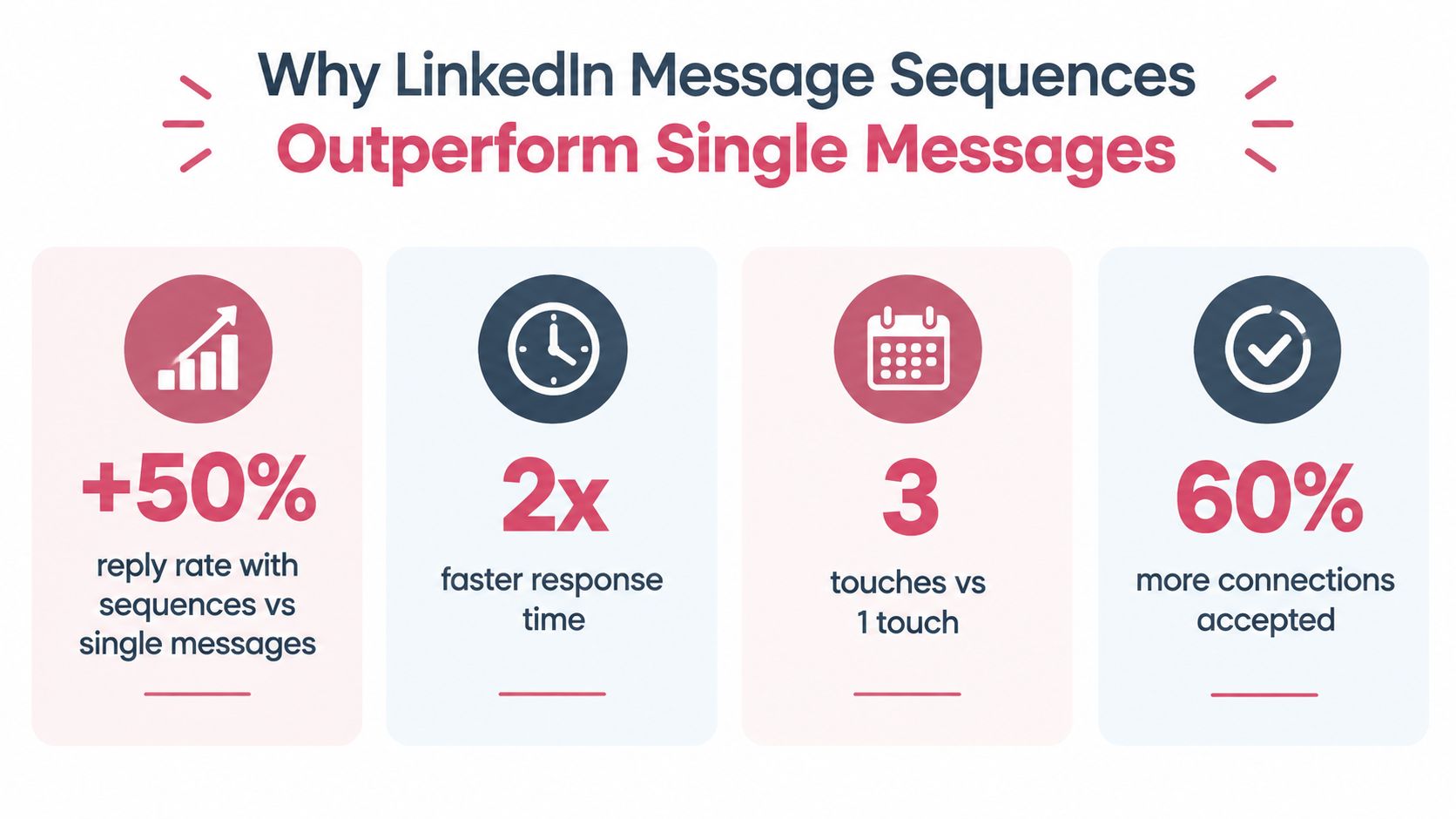
A connection note generated a 3.0% reply rate, while messages sent after connection reached 10.4%, according to the benchmark reported by SalesBread. The gap gives each touch a distinct job. The request earns access, and the follow-up creates the conversation.
A single cold message must establish relevance, build trust, explain the reason for contact, and propose a low-friction next step at once. A sequence distributes that work across a controlled set of touches. Strong teams govern each message by defining its purpose, its reply signal, and the condition that retires the play.
The connection request should make acceptance sensible, using enough context for recognition without forcing a meeting. After acceptance, the first direct message carries the clearest value proposition. The next touch can add a sharper point of view, a useful resource, or a diagnostic question. A final close gives the prospect room to defer, redirect, or decline.
Three messages should be the default operating limit. Add a fourth only when the account has a credible reason for another touch and the earlier messages earned continued relevance. This keeps automation from turning interested prospects into stale threads.
The right definition of success
Acceptance measures targeting and the request. Post-connection replies measure relevance and timing. Meetings measure the offer, qualification, and call to action. Sequence completion measures whether the play stops at the right point.
A separate 2026 benchmark covering 180,155 connection requests found 27.1% accepted, 27.6% of accepted connections replied, and 2.0% of accepted connections produced booked meetings, based on Reachium's LinkedIn outreach benchmark research. Each stage exposes a different failure.
Teams that watch only acceptance keep scaling weak follow-up copy. Teams that watch only meetings may miss a broken second message before the offer receives a fair test. Grade each touch by reply quality, positive intent, and progression, then retire sequences that repeatedly fail at the same stage.
For wider channel planning, LinkedIn for B2B lead generation places LinkedIn prospecting within a broader B2B motion. Review the practical ways to improve LinkedIn reply rates before increasing send volume.
The High Performing LinkedIn Sequence Architecture
The strongest sequence is governed as a three-message play, with a fourth touch available only when the prospect has shown enough relevance to justify it. Treat the architecture as a set of stop rules, not a quota for sending reminders.
Touch one establishes relevance
Send the connection request when the prospect has a credible reason to recognize the sender. Reference a recent post, shared professional relationship, relevant company change, or specific area of responsibility. Keep the note focused on starting a connection rather than compressing a sales pitch into the request.
The request should answer one question: why this person, now? If the answer is vague, improve the account selection before rewriting the message.
Touch two carries the value proposition
After acceptance, send the first direct message while the context remains fresh. This message carries the reply. The 2026 outreach report found that the second message was the strongest individual touch at 8.8% reply rate, while campaigns with exactly three messages reached 9.8% reply rate and sequences with five or more messages fell to 5.0%, according to Expandi's State of LinkedIn Outreach report.
Use it for the clearest insight, proof point, diagnostic question, or resource. “Just checking in” spends the highest-value touch without giving the prospect a reason to respond. Acceptance creates room for a focused explanation of the problem being addressed.
Touch three adds a new angle
Give the second message enough time to be read, then add information rather than repeating the same request. A RevOps leader might receive an observation about handoff friction. A founder might receive a comparison between two approaches. A demand generation leader might receive a relevant campaign pattern.
The message should still make sense if touch two was missed. Include one easy next step, such as asking whether the issue is active, offering a relevant example, or inviting a short exchange.
Touch four closes cleanly
Use the final touch to close the thread without pressure. Say that the sender will stop for now and leave the door open if the priority changes. If the prospect has shown no engagement, retire the play instead of extending it because the automation tool permits more sends.
Timing is another governance rule. Messages sent in the morning, between 7am and 11am, had roughly 32% acceptance, compared with 24% in the evening, in the same report. Use that finding as a testing benchmark, not a universal rule. Send in the recipient's time zone where possible, then stop at the defined limit.
Personalization That Earns Replies Without Slowing You Down
Personalization works when it changes the reason for contact. Replacing a first name or company name in a fixed template doesn't make the message materially more relevant. A useful signal explains why the prospect's current situation connects to the problem being discussed.
A 2026 study found that connection requests mentioning a specific detail, such as a recent post, shared professional relationship, or past company, outperformed blank requests by 18 to 22 percentage points, according to PhantomBuster's personalization research. That result supports a practical rule: personalize the opening around evidence, then let the sequence adapt around the prospect's response.
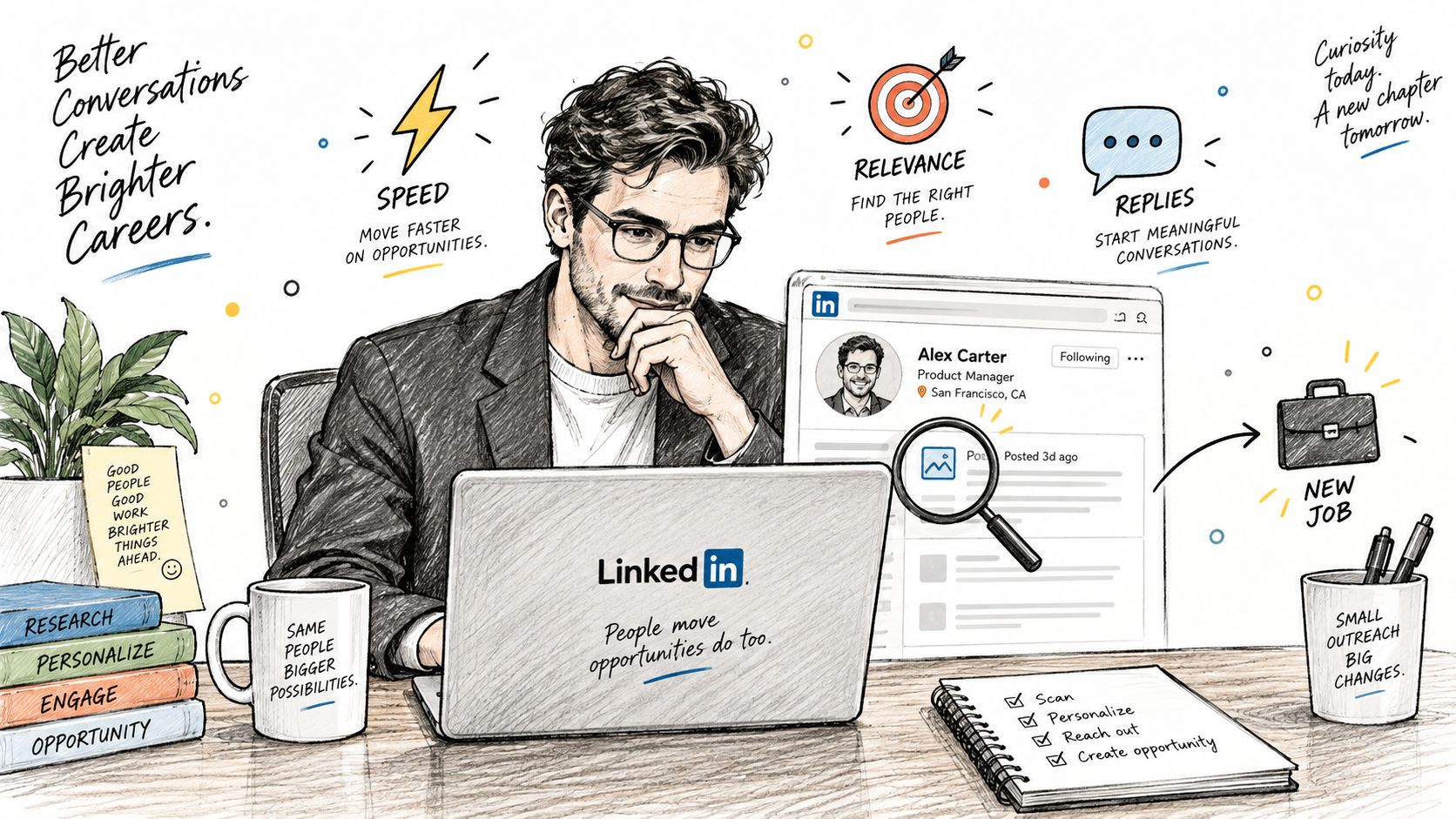
Use signals with a shelf life
Recent activity usually beats static profile facts. Useful triggers include:
- Recent posts: Reference a clear argument, observation, or announcement, not the fact that the person posts.
- Job changes: Connect the new responsibility to a problem that commonly appears in that role.
- Hiring activity: Use relevant hiring as a sign of team expansion or operational pressure.
- Funding or company news: Tie the message to an execution issue created by the change, not to the announcement itself.
- Shared relationships: Explain the professional connection without implying an endorsement that wasn't given.
The signal needs to be fresh enough to represent the prospect's current context. If the person changes roles, publishes a contradictory view, or replies through another channel, the sequence should pause and recalculate. A message that was relevant at enrollment can become careless later.
Keep research lightweight and structured
A scalable workflow doesn't ask a researcher to write an essay for every prospect. It collects a small evidence set:
- The prospect's role and current company.
- One recent or specific trigger.
- The likely business problem.
- The reason the sender has credibility.
- The smallest reasonable next step.
Store those fields separately from the message copy. That lets the operator audit why a message was generated and swap the copy without losing the underlying context. Teams looking for a broader operating model can review guidance on achieving personalization at scale in 2026. For the connection note itself, this LinkedIn connection message guide gives a useful focus on relevance and restraint.
Personalization rule: If the sender can't explain the trigger in one sentence, the message isn't ready to automate.
Playbook Ready Templates and Timing for Every Touch
Templates should constrain the writer, not replace judgment. Each message needs one purpose, one relevant idea, and one low friction action. The placeholders below work best when the operator fills them with a real signal rather than a generic compliment.
Touch one connection request
Goal: Earn the connection.
Template:
Hi [Name], your work on [specific post, initiative, or responsibility] stood out. [Company] seems to be focused on [relevant context], and I work with teams handling [related problem]. It would be useful to connect.
Keep the note concise. Don't introduce a full product explanation, attach a calendar link, or ask for a meeting before the prospect has accepted. For a founder, reference the company direction or operating challenge. For RevOps, reference a process, system, or handoff issue. For a marketing leader, reference a clear campaign or market signal.
Touch two post acceptance message
Goal: Deliver the strongest value.
Template:
Thanks for connecting, [Name]. I noticed [specific signal]. Teams in that situation often run into [relevant problem]. We found [brief insight or useful observation]. Is [problem] something your team is working through?
This message should stand on its own. It doesn't need a long company introduction. The benchmarked 10.4% post connection reply rate and the much lower 3.0% reply rate for connection request notes reinforce why the substantial context belongs after acceptance, as reported in the 2026 connection benchmark from Reachium.
Touch three value led follow up
Goal: Add a different reason to respond.
One additional thought, [Name]. When [specific situation] changes, teams often review [process or metric]. I can share a short example of how others approach it. Would that be useful, or is this not a current priority?
Don't write “bumping this.” That phrase adds no information and makes the sender responsible for carrying a thread that has already gone quiet.
Touch four graceful close
Goal: End the play without damaging the relationship.
I'll close the loop for now, [Name]. If [problem or initiative] becomes a priority, feel free to reach out. I'll leave you to it.
The close should trigger a stop, not another scheduled nudge. If the prospect replies with a future time frame, move them into a specific follow up state. If they decline, record the reason and suppress related outreach until the context changes.
| Sequence Touch | Goal and Timing | Template Focus |
|---|---|---|
| Connection request | Establish relevance before acceptance | One specific signal and a clear reason to connect |
| Post acceptance value | Send after acceptance, while context is fresh | Insight, diagnosis, or useful resource |
| Sharp follow up | Send after the prospect has had time to consider the first message | New angle and one low friction question |
| Graceful close | Use as the final touch if there is no reply | Respectful disengagement and a clean stop |
The benchmarked sequence results support using three messages as the default operating point, while the fourth touch should remain conditional. A team can test timing, tone, and offer, but it shouldn't test all three at once. Otherwise, a winning or losing result can't be explained.
Automation A/B Testing and Guardrails That Protect Deliverability
Automation should improve decision consistency rather than lower the bar for sending. The operator needs one record for the prospect, trigger, message version, acceptance, reply, and stop reason. Without that record, a test becomes anecdotal, and the team cannot separate changes in targeting, timing, copy, or audience mix.
Test one decision at a time
Set one hypothesis before launch. Compare a recent-post trigger with a shared-relationship trigger while holding audience, sender, sequence length, and timing steady. Track acceptance, post-acceptance replies, positive replies, and meetings as separate outcomes.
The second message deserves its own review because it often determines whether the sequence earns a response. Pause a play when that message performs poorly, prospects reject its premise, or the audience does not recognize the problem. Retire the play after repeated tests fail to improve the diagnosis or offer. Adding more touches rarely repairs a weak premise, and a sequence should stop at three messages when the evidence supports that operating point.
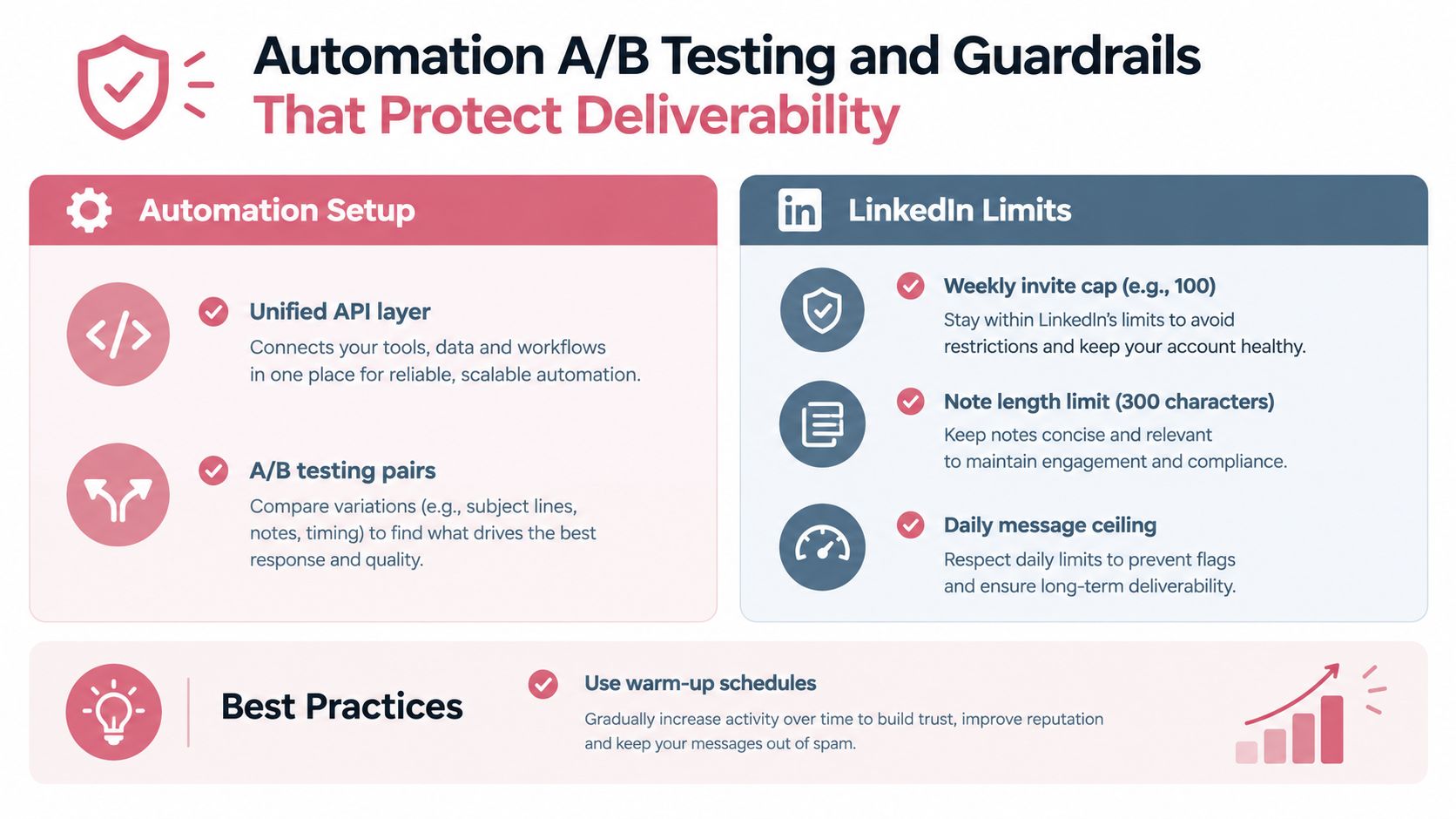
LinkedIn's invitation controls must shape the workflow. LinkedIn Help guidance summarized by UseCarly says that reaching the invitation limit typically creates a restriction lasting one week. It also states that Basic and free members can add a personalized note to only five connection requests per month, while Premium members can send unlimited personalized messages with connection requests.
Free accounts should reserve personalized notes for the highest-priority prospects and let the sequence do its work after acceptance. Premium access permits broader note use, but it does not make generic targeting safe or effective.
For list preparation, a structured workflow for B2B sales data extraction can gather the fields needed to support a defensible signal. Review that data before turning it into a message.
A unified workflow can coordinate connection requests, follow-ups, reply detection, and routing into email or a CRM. LinkedIn outreach automation guidance is useful for teams setting stop conditions and human approval around sensitive actions. Automation should stop immediately when a prospect replies, declines, asks not to be contacted, or becomes irrelevant. Grade each play on those outcomes, then retire weak variants automatically instead of extending them for volume's sake.
Measure Grade and Scale What Works
A sequence earns scale only when the team can explain why it worked. Track each stage separately, then turn the result into an operating verdict rather than a dashboard ornament.
The core scorecard includes:
- Acceptance rate: Tests list quality, profile fit, and the connection note.
- Post connection reply rate: Tests the value message and the strength of the trigger.
- Positive reply rate: Separates polite responses from genuine interest.
- Booked meeting rate: Tests the offer, qualification, and call to action.
- InMail response rate: Provides a comparison point for prospects outside the network.
InMail performance varies by audience and execution. Independent 2026 benchmark coverage places common InMail response rates in the 10% to 25% range, with high performers at 18% to 25% and elite senders exceeding 30% to 40%, according to Taplio's benchmark coverage. Use those ranges as planning context, not as a promise for every segment.
Grade the play by evidence
A simple grading system keeps campaigns from scaling too early:
- Hypothesis: The audience, trigger, and offer are defined, but the team hasn't established a repeatable result.
- Validated: The play produces credible replies from the intended segment, and the operator can identify which message created the response.
- Proven: The play repeats across comparable segments without creating a rise in negative responses, removals, spam signals, or dead thread clutter.
The second message deserves its own review. If acceptance is healthy but replies are weak, don't rewrite the connection note first. Inspect the post acceptance message for a vague problem, an unsupported claim, or an ask that requires too much effort.
Governance rule: Continue a sequence only while each additional touch adds expected value. Otherwise, retire the play or shift the conversation to another channel.
A mature system records the reason for every outcome. “No reply” is different from “not now,” “wrong person,” “asked for email,” and “not a fit.” Those outcomes should change the next play, the audience definition, or the channel choice.
That is how a LinkedIn message sequence becomes a compounding operating asset. The team doesn't send more. It promotes clear winners, repairs weak value messages, suppresses poor fits, and stops before persistence becomes a deliverability problem.
Yalc connects LinkedIn sequencing with prospect research, enrichment, reply detection, and campaign grading through a unified GTM workflow. Teams can visit Yalc to run governed playbooks, keep their GTM knowledge and message logic in one system, and retire underperforming sequences automatically.