LinkedIn Outreach Strategy: A B2B GTM Playbook
A LinkedIn outreach strategy can produce a 7.2% overall reply rate across more than 15 million outreach touchpoints, yet that figure hides the operational problem many companies miss. Connection acceptance, connection note replies, and post acceptance replies are separate conversion events, with different causes when performance weakens. Belkins' 2026 LinkedIn outreach benchmark and Expandi's 2026 benchmark dataset make the practical conclusion clear: teams should stop treating LinkedIn as one blended channel and manage it as a funnel with independent stages.
Table of Contents
- What a Modern LinkedIn Outreach Strategy Actually Looks Like
- Connection Requests and Platform Limits
- Messaging Playbooks That Earn Replies
- Sequencing and Multichannel Cadence
- Choosing Your Outreach Stack
- Measurement and Iteration
- Putting the Playbook to Work in 90 Days
What a Modern LinkedIn Outreach Strategy Actually Looks Like
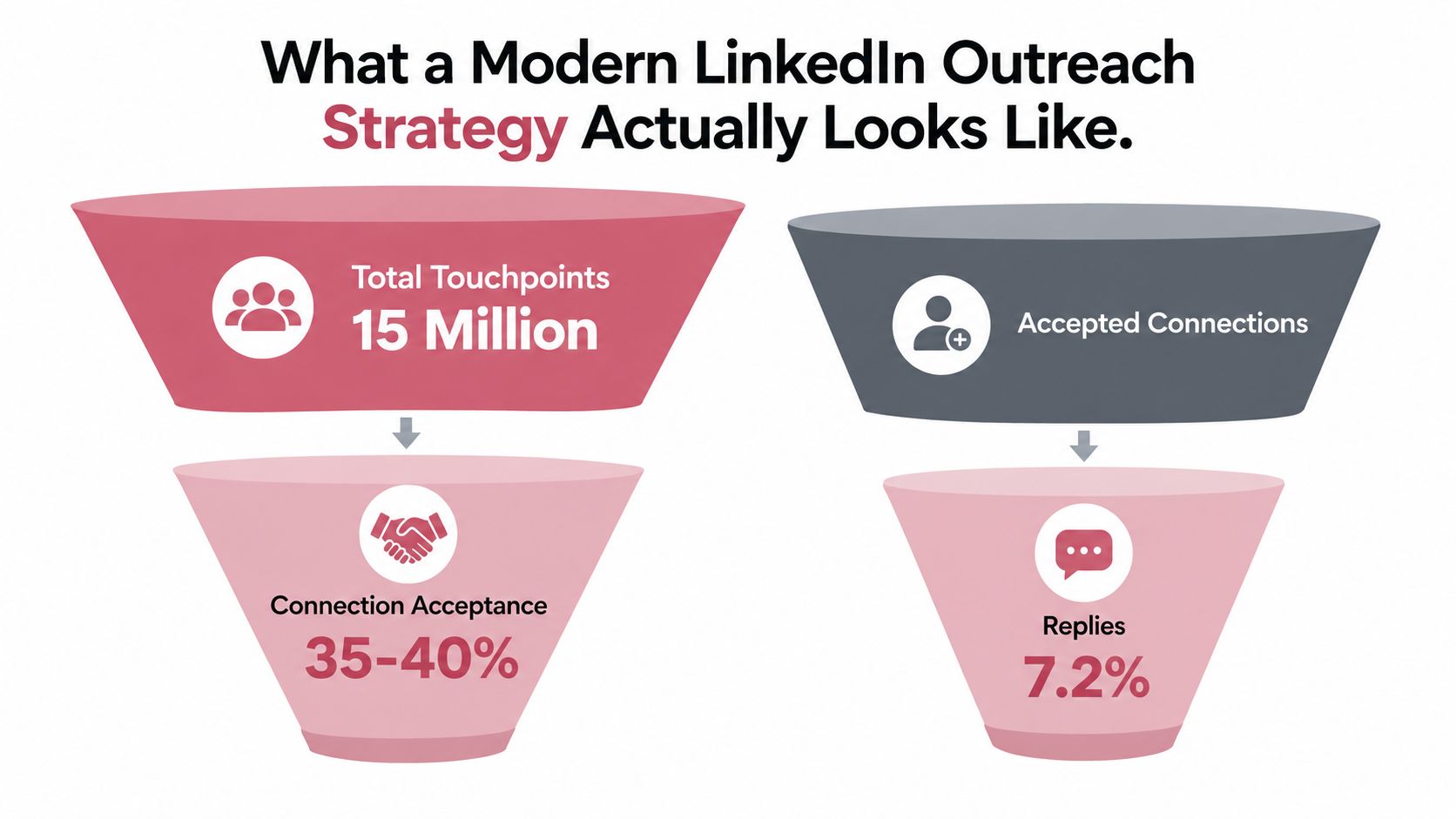
A strong LinkedIn outreach strategy starts by separating connection acceptance from post acceptance replies. Belkins reported a 7.2% overall reply rate across more than 15 million LinkedIn outreach touchpoints, with industry results ranging from 4.2% to 10.5%. The same benchmark recorded a 7.9% peak in April and 6.3% in September, showing that timing and market context can change the outcome even when the motion stays consistent.
Expandi's dataset measured another part of the funnel across 13.2 million connection requests and 6.7 million messages. It found 28.5% connection acceptance, 3.0% reply rates on connection notes, and 10.4% reply rates on messages sent after acceptance. Those figures shouldn't be blended into one campaign score. A team can have acceptable acceptance but weak follow up, or strong post acceptance replies while its targeting and profile prevent enough prospects from entering the conversation.
Diagnose the leaking stage first
Low acceptance usually points toward the profile, targeting, or trust signal. Prospects may not recognize the sender, the sender's role may look disconnected from the buyer, or the list may include people with no reason to engage. A weak headline and an incomplete profile can undermine every message before the buyer reads it.
Low post acceptance replies usually indicate a different issue. The message may arrive too quickly, lead with a product pitch, ignore the trigger that made the prospect relevant, or ask for a meeting before earning attention. Changing the connection note won't fix a follow up problem.
Operating rule: Treat acceptance as a list and credibility problem. Treat replies as a relevance and sequencing problem.
The operating motion is straightforward:
- Define an ICP that maps to LinkedIn filters.
- Build a segmented prospect list from that definition.
- Polish each sender profile before sending.
- Run LinkedIn and email touches from one coordinated sequence.
- Measure each funnel stage independently.
- Change one variable at a time, starting with the weakest conversion.
The B2B LinkedIn outreach glossary from Grou is useful for aligning sales, marketing, and operations teams on the channel's mechanics before execution begins.
Turn the ICP into an executable list
An ICP paragraph isn't enough. It must become a repeatable search and list building process.
Start with title clusters, grouped by function and seniority rather than relying on one exact title. For a revenue product, one cluster might include VP RevOps, Head of Revenue Operations, and Revenue Operations leader. Another might include Director of Sales Enablement, Head of Enablement, and Sales Productivity leader. LinkedIn search often returns overlapping title variants, so clusters create more reliable coverage.
Add firmographic filters:
- Industry: Focus on the industries where the problem is structurally relevant.
- Company size: Use employee bands that match the product's implementation model.
- Revenue and funding: Add financial maturity when budget or operating complexity matters.
- Technology: Filter for tools that indicate the prospect has the workflow the product replaces or improves.
- Geography: Start with the markets where sales coverage, language, and customer support are strongest.
Then add triggers. Recent funding, a leadership hire, geographic expansion, a product launch, or hiring for the role a solution replaces can give the first message a specific reason to exist.
A practical example would target VP RevOps and Director of Sales Enablement at Series B to D SaaS companies in North America with 50 to 500 employees. The list could prioritize companies that recently raised funding or hired a CRO. That definition should live in Sales Navigator, a CRM view, a Clay table, or another list source with fields for title, seniority, company size, trigger, owner, and suppression status. If the ICP can't produce a clean list, it isn't operational yet.
Connection Requests and Platform Limits
Connection requests are a constrained entry point, not an unlimited prospecting surface. LinkedIn says an account that reaches its invitation limit may be temporarily restricted from sending invitations for about one week, and withdrawing pending invitations doesn't remove that restriction. The platform also warns that many invitations sent in a short period, ignored or pending invitations, spam reports, and suspected automation can trigger restrictions. These rules are documented in LinkedIn's invitation restriction guidance.
LinkedIn also states that the network has a maximum of 30,000 first degree connections, creating a hard ceiling for connection based outreach. Basic and free members can add a personalized note to only five connection requests per month, while Premium members can send unlimited personalized connection messages, according to LinkedIn's invitation limit help article.
Independent 2026 coverage reports that most accounts should expect roughly 100 connection requests per week, enforced on a rolling seven day window. Newer or lower trust profiles may face lower practical ceilings, with reporting identifying ranges closer to 20 to 30 invites per day or about 50 per week for some accounts. The 2026 overview of LinkedIn outreach limits is a useful reference, but operators should treat account behavior and platform warnings as the controlling signals.
The connection note deserves less attention than is commonly given. Expandi's benchmark recorded a 3.0% reply rate on connection notes, compared with 10.4% on messages sent after acceptance. That difference supports a simple operating choice: use the invite to establish credible context, then reserve the best personalization for the first direct message.
A short note can mention a shared event, relevant trigger, or professional context. It shouldn't carry the whole pitch. The request is an access step, not the persuasion stage.
Teams using automation should document account ownership, daily activity, pending invitations, and restriction signals in one operating log. The LinkedIn automation limits and rules guide can help operators formalize those controls before adding volume.
Messaging Playbooks That Earn Replies
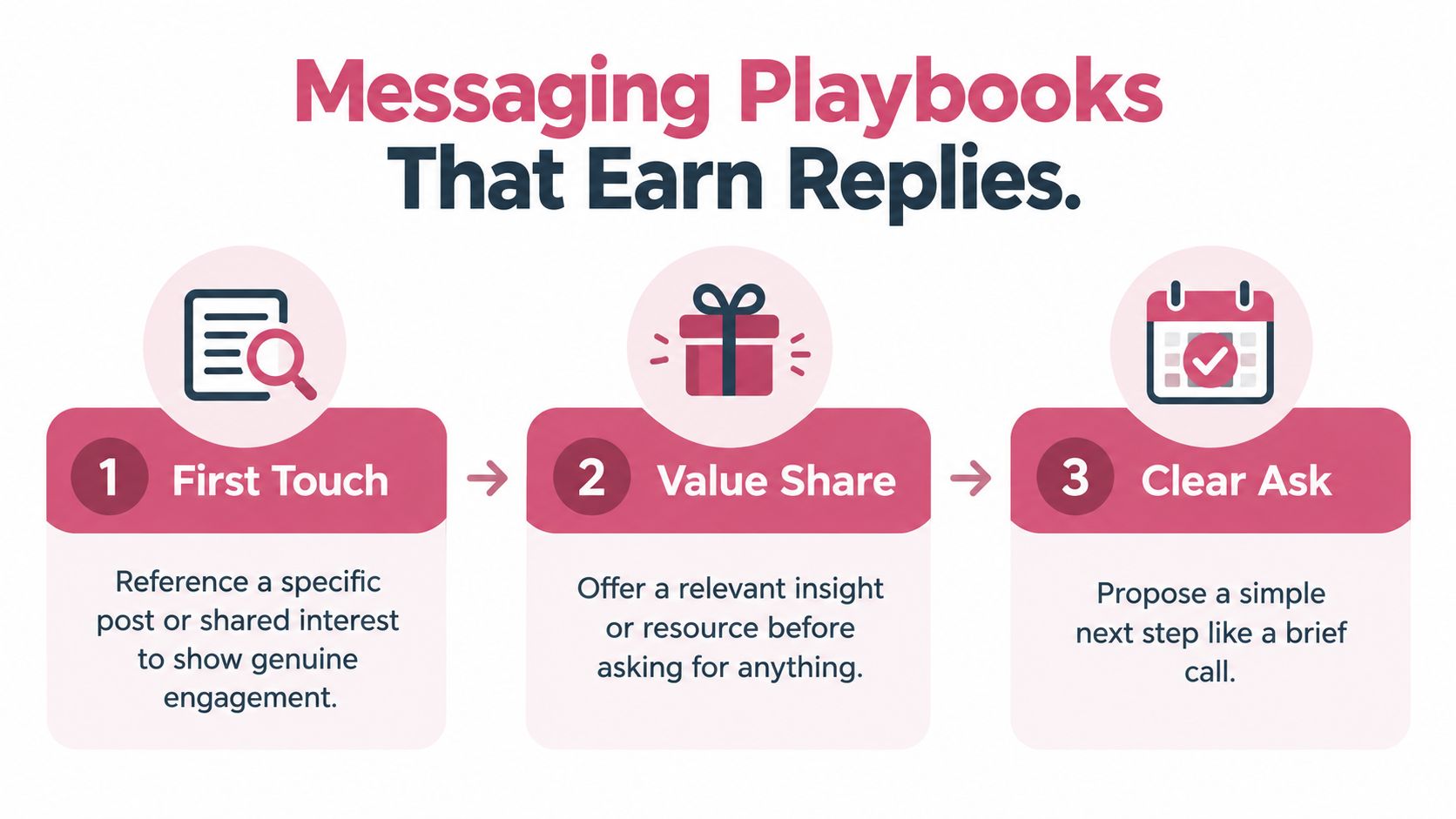
The first post acceptance message should earn a response, not force a meeting. The most reliable structure is a specific observation followed by a low friction question. It gives the prospect something recognizable to answer without making them process a full pitch.
First touch
A useful first touch connects the prospect's role, company, or recent activity to a narrow question.
“Noticed your team is expanding revenue operations after the CRO hire. Is reporting consistency or process adoption the harder problem right now?”
The sentence works because it demonstrates relevance without pretending to know the answer. It also gives the buyer two reasonable directions for a reply. Keep this message under 400 characters and remove product language unless the prospect has already asked for it.
Value led follow up
After three to four days of silence, send something useful that follows naturally from the first observation. That might be one relevant benchmark, a short explanation of a common operating pattern, or an asset tied directly to the problem.
“A pattern seen in growing SaaS teams is that RevOps owns the workflow while enablement owns adoption, which creates a handoff gap. A short checklist for that handoff is available if it would help.”
The value doesn't need to be elaborate. It needs to be specific enough that the recipient can judge its relevance immediately. Keep later messages under 800 characters, and don't bury the useful point beneath company background.
Soft ask
A meeting request belongs after engagement. A reply is the clearest threshold. A profile view combined with content engagement is another reasonable signal that the prospect has shown active interest.
“Your point about improving sales process adoption is close to the issue discussed above. Would a 15 minute call be useful to compare how other teams are handling that handoff?”
The reason for the call should relate to the prospect's stated goal, not the sender's need to fill a calendar. If no engagement has occurred, continue nurturing or suppress the prospect rather than escalating the ask.
For additional message ideas, the LinkedIn reply rate improvement guide offers a useful reference for testing relevance, timing, and follow up structure.
Sequencing and Multichannel Cadence
A LinkedIn and email sequence should feel like one conversation managed across channels. The operational failure is usually not the number of touches. It's the duplicate touch, where a LinkedIn message and an email arrive on the same day because two systems have no shared state.
A practical cadence uses seven to nine touches while preserving clear wait windows:
| Day | Channel | Action | Wait Window |
|---|---|---|---|
| Day 0 | Send connection request without a note | Wait for acceptance | |
| Day 1 to 2 | Send the first post acceptance message | Wait four days if unanswered | |
| Day 5 to 6 | Send a value led follow up | Wait three to four days | |
| Day 9 to 10 | Send a soft ask if engagement exists | Stop or move to nurture | |
| After four unanswered days | Send a related email with a distinct angle | Avoid same day LinkedIn activity | |
| Following day | View a profile or leave a relevant comment as a re warm touch | Use only when context is genuine |
The email step should follow an unanswered first LinkedIn message by four days, not compete with it. A profile view or relevant comment can happen the day before the email, but it shouldn't be manufactured as a substitute for useful content.
Define break sequence rules
A positive reply stops automation immediately. A clear “not now” should move the prospect into a future nurture state, not trigger another sales message. Any negative signal on either channel should suppress the person from the active sequence.
The suppression logic must work across reps and tools. A CRM or Clay table can own the state, with fields for connection status, last touch, next permitted touch, response classification, owner, and suppression reason. LinkedIn tools and email tools should read that state before taking action.
The sequence should be allowed to pause. Silence isn't permission to keep escalating indefinitely.
Teams should also record replies that arrive after the formal sequence ends. Attribution belongs to the latest meaningful touch that preceded the reply, while the opportunity record should preserve the full path. This keeps reporting honest without pretending every meeting came from the final message.
Choosing Your Outreach Stack
The right stack depends on how much control the team needs before adding automation. More tooling can improve coordination, but it can also hide poor targeting and make a weak sequence harder to diagnose.
| Approach | Examples | Cost per Seat | Control | Scale Ceiling |
|---|---|---|---|---|
| Manual outreach | LinkedIn Sales Navigator and personal inbox | Subscription and labor cost | Highest message control | Limited by rep time and account limits |
| Point tools | Expandi, lemlist, Zopto | Flat monthly seat cost | Strong sequence control, less custom orchestration | Suitable for small rep teams |
| Enrichment and agent platform | Clay | Platform and provider costs | Strong data, enrichment, and trigger control | Suits complex, larger motions |
| Orchestration layer | Yalc | Depends on deployment and connected tools | Coordinates accounts, data, and actions | Designed for multi account operations |
Manual outreach is the right starting point for founders and first reps. It forces the team to learn which triggers matter, which profiles earn acceptance, and which messages create real conversations. Manual work is slower, but early learning is often more valuable than early volume.
Point tools such as Expandi, lemlist, and Zopto fit teams with a small number of reps that need connection sending, follow ups, and inbox workflows in one place. They work well when the sequence is known and the main requirement is consistent execution.
Clay becomes more useful when the team needs enrichment waterfalls, AI written personalization, webhook triggers, and custom list logic. It adds control over data preparation, but it also demands stronger governance so operators know which fields and decisions drive each message.
Orchestration layers suit teams managing several LinkedIn accounts and connected channels. Yalc can coordinate LinkedIn actions with enrichment, multichannel outbound, reply handling, CRM synchronization, and reporting through a unified GTM API. Its LinkedIn outreach automation workflow is relevant when the problem is no longer sending one sequence, but managing state across a broader motion.
The verdict is practical: start manual, standardize with point tools as the motion repeats, then add enrichment or orchestration when account volume and channel coordination become the bottleneck.
Measurement and Iteration
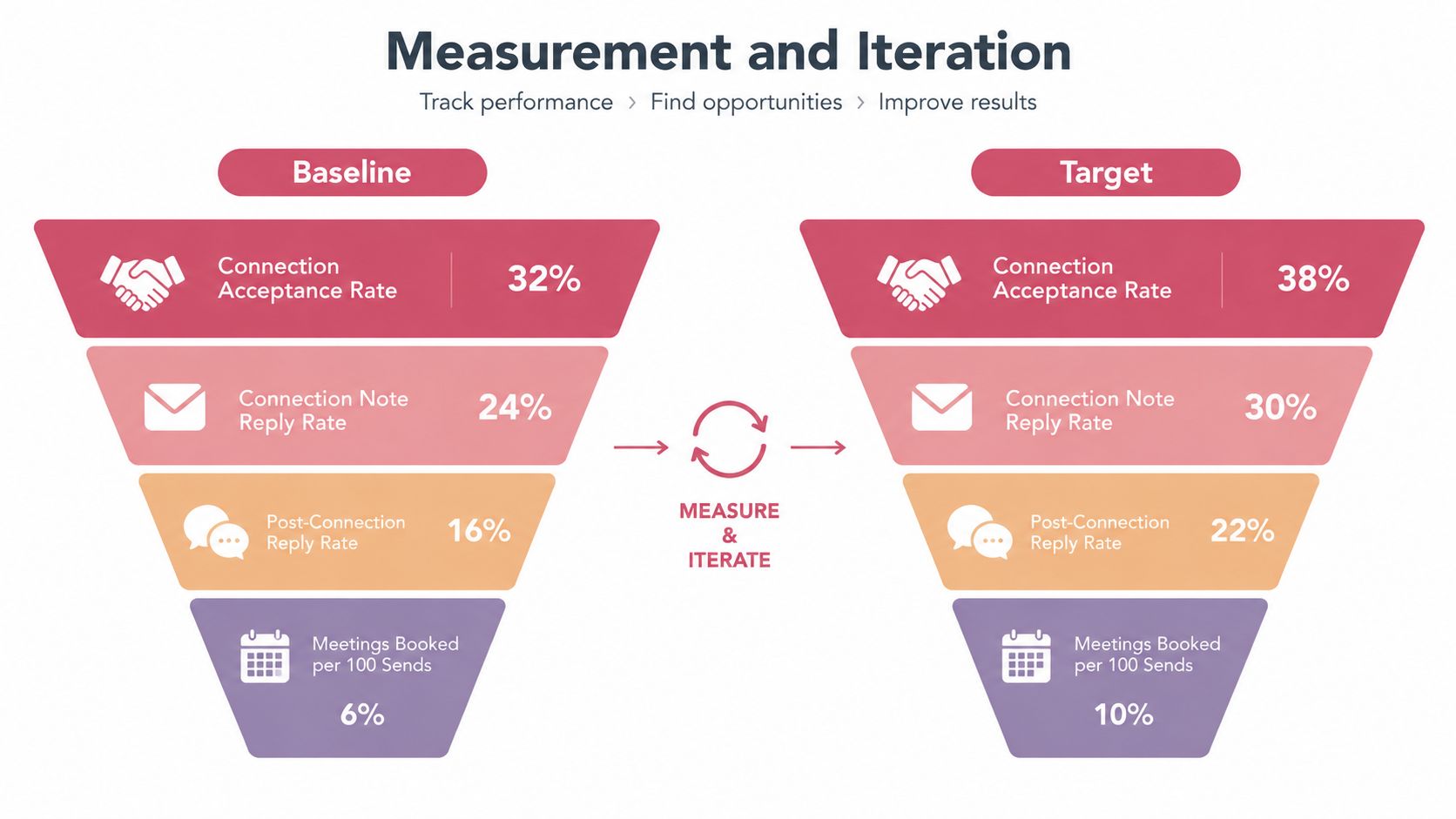
A blended reply rate can hide the exact place where a campaign breaks. Four KPIs expose the full path:
- Connection acceptance rate: Accepted connections divided by connection requests sent.
- Connection note reply rate: Replies to notes attached to invitations, tracked separately from acceptance.
- Post connection reply rate: Replies to direct messages sent after acceptance.
- Meetings booked per 100 sends: Booked meetings divided by the relevant send volume, with the attribution window documented.
Expandi's benchmark gives teams useful stage specific reference points: 28.5% connection acceptance, 3.0% connection note reply, and 10.4% post connection message reply across its measured dataset. Belkins' broader benchmark reported a 7.2% overall reply rate across more than 15 million touchpoints. These figures aren't universal targets. They are diagnostic reference points, and each team should segment results by market, ICP, sender, trigger, and message variant.
Run a weekly operating loop
Every Monday, export the prior period's results and identify the weakest stage. Don't rewrite the entire campaign. Create two or three hypotheses, then change one variable.
If acceptance is weak, test a tighter segment, stronger sender profile, or different trigger. If connection note replies are weak, reduce the note to context and move the stronger idea into the post acceptance message. If post acceptance replies are weak, test the opening observation, value offered, or wait window. If meetings are weak despite replies, review qualification and the relevance of the ask.
Attribute each meeting to the message or touch that created the explicit meeting intent. If a reply arrives after the sequence ends, keep the original touch history and classify the late reply separately. That distinction helps the team understand whether the sequence created demand or whether a later human interaction changed the outcome.
Testing discipline: Change one meaningful variable per iteration. If audience, sender, message, and timing all change together, the result can't explain what worked.
Two mistakes appear frequently. Teams optimize acceptance by broadening the audience, then discover that meeting quality falls. Others run multivariate tests on a sample too small to distinguish a real pattern from noise. Stage metrics should guide the next experiment, but sales quality must remain part of the decision.
Putting the Playbook to Work in 90 Days
A new LinkedIn outreach strategy needs an operating plan, not just message templates. The first 30 days should establish the foundation:
- Define the ICP: Create title clusters, firmographic filters, triggers, exclusions, and ownership rules.
- Build the list: Store every prospect in a list source with trigger, segment, profile, company, and suppression fields.
- Prepare senders: Complete profiles, align headlines with the buyer problem, and train SDRs on the two stage funnel.
- Set the initial volume plan: Use a target of roughly 250 connection requests per rep per week, then review it against platform restrictions and the account's observed behavior.
That volume target should not override account safety or quality. LinkedIn restrictions can follow high invitation activity, ignored or pending requests, spam reports, or suspected automation, so the team should ramp responsibly and pause when acceptance or account health deteriorates.
Days 31 to 60 are for live learning. Run the highest intent segment first, review every accepted but silent conversation, and coach SDRs on message relevance. Lock the four KPI dashboard views so managers can see acceptance, note replies, post acceptance replies, and meetings without merging them into one score.
Days 61 to 90 introduce the broader motion. Add email only when the LinkedIn state permits it, enforce cross channel suppression, and test message variants one variable at a time. Document the winning sequence, qualification rules, response categories, and escalation paths so a new hire can execute without rebuilding the system from memory.
Two failure modes waste most first quarter programs:
- Scaling before the funnel stabilizes: More volume won't repair poor targeting, weak profiles, or irrelevant messages. It only consumes the list faster and increases platform risk.
- Treating LinkedIn as a standalone channel: Buyers move between professional networks, email, content, and internal conversations. The team needs one outbound motion tied to qualified and closed pipeline, not disconnected channel activity.
The operating standard is simple. Build the list carefully, measure the stages separately, coordinate every channel, and let the weakest conversion determine the next change.
Yalc helps B2B teams coordinate LinkedIn prospecting, enrichment, sequencing, reply handling, and measurement through connected GTM workflows. Visit Yalc to evaluate a system that keeps ICP context, sender rules, channel state, and campaign learning in one operating layer.