LinkedIn Profile Headline: A Formula for B2B Leaders
Adding more keywords isn't a LinkedIn headline strategy. A crowded list of titles, tools, and ambitions can make a profile harder to understand, even when every term is relevant.
A strong LinkedIn profile headline helps the right person decide whether to start a conversation. For a B2B leader, that means choosing who matters most: the recruiter searching for a role, the buyer evaluating a service, or the founder looking for an operator.
Table of Contents
- Matching Your Headline to Your Buyer and Voice
- Headline Formulas to Start From
- How to Write Your Headline in Six Steps
- Headline Versus Current Position Field
- A/B Test Plan for Headline Variants
- Publish the Headline and Measure It in 30 Days
Matching Your Headline to Your Buyer and Voice
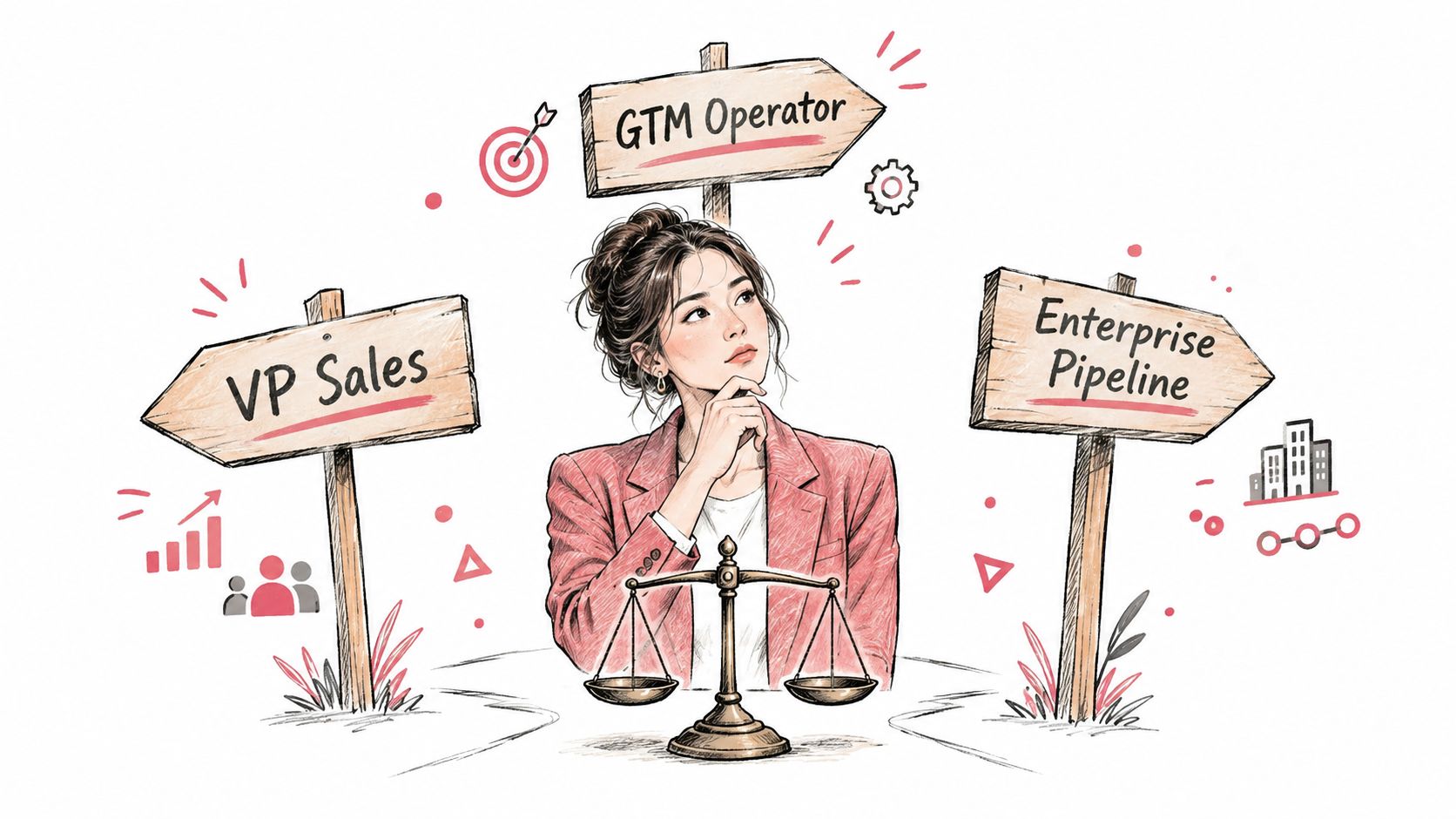
The most important headline decision is which reader gets priority. A revenue leader may be discoverable as VP Sales, credible to buyers as a GTM operator, and differentiated by experience building enterprise pipeline.
Those descriptions aren't interchangeable. A headline written only for recruiters can sound like a résumé to a prospective customer. A headline written only for positioning can omit the familiar title a recruiter would search for. Choose a primary audience, then give the secondary audience supporting space rather than equal billing.
Headline language by reader
| Reader | What they search for | Lead with | Risk if ignored |
|---|---|---|---|
| Recruiter | Exact job title and core skills | Title, then two or three skills | Profile never appears in role searches |
| Prospective buyer | Problem, category or segment | Audience and outcome | Profile reads like a job seeker, not a vendor or operator |
| Founder or peer | Market category and point of view | Category and a specific angle | Generic title gets skipped in comments and connection requests |
| Agency client | Proof of fit for their segment | Segment and outcome | Credibility gap in the first scan |
| Investor or partner | Market and traction language | Category and scale | Weak positioning in first conversations |
The recruiter risk isn't absolute. Search also draws on other profile fields, so a missing headline term doesn't automatically make someone invisible. The practical issue is whether the most visible description reinforces the intended role or forces the reader to investigate.
For a leader seeking an employed sales role, VP Sales should usually beat GTM operator as the opening term. For a consultant selling pipeline systems to founders, the audience and commercial outcome deserve that space. Keeping both identities doesn't require leading with both.
Match the voice to the buying conversation
Enterprise buyers need named categories, clear scope, and outcomes they can discuss internally. Reliable forecasting for B2B sales teams says more than transforming revenue excellence.
Startup founders often respond better to direct operating language. Builds outbound systems before the first sales hire describes a concrete situation without dressing it up as a grand mission.
The headline should also sound like the outbound message that brought someone to the profile. A LinkedIn prospecting approach works more coherently when the message and profile describe the same buyer, problem, and service.
Audience rule: Lead with the reader who can create the next useful conversation within 30 days. Move the competing identity into the About section.
Headline Formulas to Start From
These five formulas cover most B2B founders, sales leaders, and GTM operators. The best choice follows the intended reader, not whichever example sounds most impressive.
Five LinkedIn headline formulas for B2B leaders
| Formula | Structure | Sample headline | Best for |
|---|---|---|---|
| Title first | Exact job title, then one proof term | Head of Sales; GTM Systems and Outbound Pipeline | Leaders who want recruiter and internal search matches |
| Audience first | Who you serve, then the outcome | Helping Series A SaaS founders build outbound pipeline without a sales hire | Founders and operators selling to a named buyer |
| Capability stack | Title, capability, channels, segment | GTM Engineer; AI Prospecting and Enrichment; LinkedIn, Email and CRM Workflows; B2B SaaS | Operators who sell a system or service |
| Problem solved | Title, problem, scope | RevOps Lead fixing forecast gaps for B2B teams with fragmented CRM data | Leaders known for fixing a specific pain |
| Proof led | Title, scale or credential, segment | Sales leader who has rebuilt outbound for B2B SaaS teams | Senior leaders with a visible track record |
Title first is the safest starting point for recruitment. Head of Sales establishes the category immediately; GTM systems and outbound pipeline explain the operating focus. The supporting phrase signals relevance, but it isn't proof by itself.
Audience first suits a founder selling a defined service. Helping Series A SaaS founders build outbound pipeline without a sales hire names both the customer and the buying situation. That promise belongs in a headline only when the service can actually deliver it.
Capability stack works when buyers need to understand how an operator executes. GTM Engineer followed by prospecting, enrichment, and workflow channels makes the service legible. The cost is density, so remove terms that don't influence the buying decision.
Problem solved works for an established pain. RevOps Lead fixing forecast gaps is easier to evaluate than a broad claim about revenue transformation. The profile should then explain the diagnostic work and implementation behind that promise.
Proof led requires evidence. Sales leader who has rebuilt outbound for B2B SaaS teams is useful when the experience section supports that history. Without supporting detail, it remains an assertion.
Write for the preview, not the ceiling
LinkedIn's headline guidance allows 220 characters and recommends communicating the main message in the first 45 characters. Put the essential role and audience there where possible; use the remaining space for context rather than delaying the point.
Cut passionate, results driven, and experienced professional. A list of more than three tools should also trigger an edit: buyers need to understand the work, not inventory the software.
For drafting alternatives, AiHeadshots can help generate headline ideas for LinkedIn. Treat the output as raw material, then remove unsupported claims and restore the language the intended reader uses.
Title first favors recruiter matches. Audience first favors buyer recognition. Founders selling services usually benefit from naming the audience alongside the outcome.
How to Write Your Headline in Six Steps
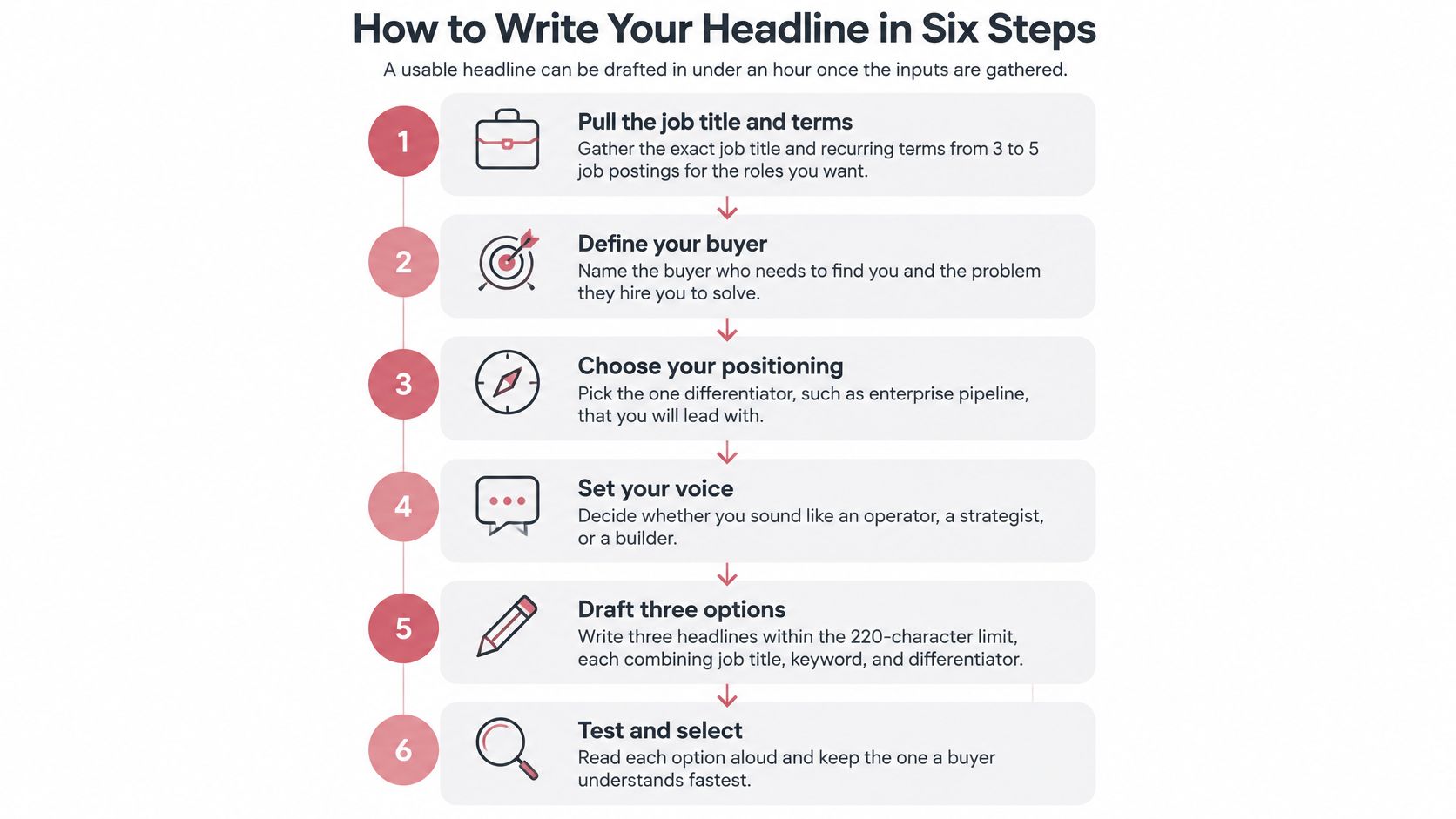
A usable draft can be produced quickly once the inputs are gathered; the time-consuming part isn't writing the sentence, it's deciding which role, customer, and claim deserve the space. Treat that choice as a routing decision: recruiter visibility may depend on a recognizable title, while buyer clarity depends on naming the audience and the problem you address.
Build from evidence, then compress
Pull the exact job title and recurring terms. Review three to five relevant job postings and note repeated titles, skills, and responsibilities. For commercial profiles, compare these terms with buyer language in discovery notes and replies.
Choose a primary audience. For example, a headline aimed at RevOps leaders at B2B SaaS companies with 50 to 300 staff will differ from one aimed at recruiters hiring for revenue operations. Naming the priority audience makes it easier to remove language meant for everyone else.
Pick a searchable category. Use the title or market term your chosen reader would search, such as Head of Sales, Revenue Operations, or GTM Engineer. When your formal title and market-facing identity differ, keep the formal role visible if recruiter matching is the priority; lead with the market category if buyers are the priority.
Add a defensible outcome or proof point. Reliable forecasting, cleaner CRM data, or a rebuilt outbound process gives the category practical meaning. Choose a claim you can explain clearly, including what changed and what you did.
Select two to four supporting terms. Keep tools, channels, or domain terms that explain how you work or establish fit. A software name takes up space without helping if it does not clarify the problem you solve.
Count characters and inspect the opening. Include spaces and punctuation in your count. Check whether your category, audience, and outcome fit within the preview budget. If they do not, preserve the message for your primary audience and cut supporting detail before weakening the positioning.
Each pass should make the headline easier to recognize and evaluate.
Correct the category before polishing the wording
Start with:
Passionate Growth Leader
This could describe many roles and tells neither recruiters nor buyers what the person does. A more useful working version is:
GTM Engineer | AI Prospecting and Enrichment | B2B SaaS Revenue Teams
The category, method, and audience are clear, but the audience comes late in the line. If buyer recognition matters more than a recruiter's exact title match, tighten the opening:
GTM Engineer for SaaS Pipeline | AI Prospecting and Enrichment
Growth Ninja or Revenue Wizard adds little when the target reader searches for Head of Sales. Put creativity into the point of view, not into hiding the professional category.
Make sure the rest of the profile supports the headline. The About section, skills, and experience should use consistent vocabulary and explain the work behind the claim. Keep capitalization readable rather than decorative. For consistent presentation across profile language and outbound messages, see this guide to email subject line capitalization.
If a sentence could sit unchanged on a thousand other profiles, it needs another positioning pass.
Headline Versus Current Position Field
Don't duplicate the current position verbatim in the headline. LinkedIn's Recruiter help documentation states that when the professional headline is identical to the current position, the current position isn't displayed in the profile's top section.
These fields perform different jobs. The current position records organizational status; the headline explains professional relevance. Exact repetition adds no useful context and can affect what appears in the introduction.
Give each field a distinct purpose
| Field | Example |
|---|---|
| Current position | Vice President of Revenue |
| Headline | Revenue leader helping B2B companies turn fragmented GTM data into predictable pipeline |
This pairing preserves the formal title while explaining the leader's operating focus. A recruiter can identify seniority, and a buyer can understand the business problem.
Founders should keep Founder and CEO in the position title and the company in the organization field. Their headline can then name the market served and the outcome offered. Repeating Founder at Company adds little when the company name doesn't yet communicate the category.
Employed sales leaders exploring new roles face a different trade off. They should retain an accurate employment title while adding relevant market terminology to the headline, without implying they already hold a position they haven't earned.
Audit the profile introduction
- Compare the fields directly. Check the headline against the current position rather than reviewing each in isolation.
- Remove exact duplication. Replace repeated wording with audience, specialty, scope, or outcome.
- Inspect the published card. Confirm that the current role is clear and that the headline adds a reason to keep reading.
The objective isn't to make the fields completely different. Shared role terminology can help clarity. The waste comes from making both fields say nothing beyond the same title.
A/B Test Plan for Headline Variants
LinkedIn does not offer a built-in headline split test, so compare variants in sequence. Set a schedule, save the wording for each version, and change one variable per cycle. A headline is a routing choice: lead with the formal job title when recruiter visibility matters most, or put the audience and outcome first when buyer clarity is the priority.
Offerjet AI's profile optimization guide recommends comparing variants over a fixed two to four week period, tracking profile appearances, views, qualified connection requests, and booked conversations. Treat those measures as directional signals, not proof that a wording change caused a conversion lift.
Headline variables to test first
| Test element | Variant A | Variant B | Decision metric |
|---|---|---|---|
| Lead term | Exact job title first | Audience and outcome first | Profile views from people outside the network |
| Outcome language | Capability, such as AI prospecting | Result, such as pipeline without a new hire | Qualified connection requests |
| Tools named | Two or three tools in the headline | Tools moved to the About section | Booked conversations from the profile |
| Length | Up to 220 characters | Shorter, front-loaded wording | Profile views per search appearance |
| Category term | Advisor or consultant | Operator or engineer | Replies to connection notes |
LinkedIn allows headlines up to 220 characters, but previews show much less. A shorter, front-loaded version is often easier to scan. Compare a full headline with a concise version, keeping the audience and promise consistent so the test isolates length rather than changing the message.
Choose the decision metric before publishing. A qualified request should come from the intended role and company type, not merely from someone willing to connect. Track conversations attributed to the profile separately from meetings produced by unrelated campaigns.
Avoid tests that can't answer the question
Changing the headline and About section together makes it difficult to tell which edit influenced the result. The same applies if posting or outreach activity changes substantially without being recorded. Apply the same isolation principle used in email subject line testing: change the wording under examination while keeping other conditions as steady as practical.
Measurement caution: Sequential tests offer directional evidence. Different weeks can bring different audiences.
A winner declared after five days of low traffic is more likely noise than a reliable conclusion. Set a minimum visitor count before the test, using normal profile activity as the reference. If the count is not reached, record the result as inconclusive rather than choosing a headline on weak evidence.
Publish the Headline and Measure It in 30 Days
Publish the headline, inspect it on mobile and in a comment thread, then keep it stable for a 30 day measurement window. Treat that window as an operating schedule, not a promise that every profile will receive enough traffic for a verdict.
Use a simple publishing checklist
Check the live display. Confirm that the opening reads clearly in search and comment previews. Look for awkward truncation, unclear abbreviations, and separators that consume attention without adding meaning.
Record the baseline before editing. Save the available search appearances, profile views, and qualified connection requests. Keep the exact headline text alongside the baseline so the team doesn't have to reconstruct which wording was active.
Inspect the trend after seven days. Use the early check to catch display problems or an obvious audience mismatch, not to declare victory. Wait until the visitor threshold established for the test has been reached.
Attribute conversations in the CRM. Record the active headline version, change date, contact role, and stated reason for reaching out. Distinguish a profile influenced conversation from a meeting that would have happened through an existing relationship.
Keep the winner and extend its language. Carry useful terms into outbound messages and ideal customer profile notes. Narrareach's guide to optimize your LinkedIn profile for readers can support the broader readability review.
Judge the conversation, not the counter
A headline that attracts fewer visitors but more relevant conversations can be the better commercial choice. Recruitment profiles need a different verdict: relevant recruiter interest matters more than buyer inquiries.
The winning language should also remain consistent with the team's LinkedIn outreach strategy. A prospect shouldn't encounter a different offer after opening the profile.
If the headline doesn't improve buyer conversations within two test cycles, rewrite the lead term before changing anything else.
Yalc connects prospecting, enrichment, outreach, and reporting with the team's ICP, voice, and positioning, so profile language and outbound execution stay aligned. Visit Yalc to explore GTM playbooks that turn a clear audience and offer into measurable outreach workflows.