Marketing Automation AI: The Operator's Guide to Real ROI
Only 7 percent of companies had embedded AI in ways that delivered measurable business results, according to an Adobe survey. The difference is a self evaluating layer that learns from outcomes, not another collection of isolated automation tools.
Most GTM teams already automate something. They schedule email, enrich records, score leads, sync a CRM, and generate reports. The problem is that these actions often run as disconnected jobs, each optimized for activity rather than commercial impact.
Marketing automation AI earns its place when it can connect the full motion. It should understand the goal, select an appropriate play, execute within defined permissions, measure the result, record a verdict, and stop repeating motions that create noise. That is the operating standard for teams that want automation to improve over time.
Table of Contents
- What Marketing Automation AI Actually Is
- From Campaign Tools to a Unified GTM Engine
- How Goal Led Workflows Turn Hypotheses Into Proven Plays
- Real GTM Use Cases That Demonstrate the Architecture
- Choosing Compositional Control versus Preconfigured Playbooks
- Trust, Consent, and Human Checkpoints in Automated GTM
- Adoption Checklist and Measurement Rules for GTM Teams
What Marketing Automation AI Actually Is
A credible marketing automation AI system must answer five questions for every automated play: what was the goal, what hypothesis guided the play, what did the system do, what happened afterward, and what changes next. Those answers turn automation from a collection of tasks into a self-evaluating GTM operating system.
The business case is the gap between adoption and measurable impact. An Adobe survey of 150 marketing leaders and practitioners across the United States, United Kingdom, Canada, France, and Germany found that only 7 percent had embedded AI in ways that delivered measurable business results. More than 8 in 10 had missed an opportunity in the previous quarter because they could not respond quickly enough. Adobe's research on AI impact supports a practical conclusion: deploying AI does not demonstrate that a GTM motion is learning.
Marketing automation AI coordinates research, enrichment, qualification, messaging, execution, measurement, and revision around a defined business outcome. Language models can draft emails, and sequencing tools can choose send times, but neither function proves that a play worked.
The operator standard
- What was the goal? For example, create qualified conversations within a defined account segment.
- What was the hypothesis? A specific pain point and proof point might earn a response from a particular buyer.
- What did the system do? The record should identify the data used, channels selected, messages sent, and human approvals.
- What happened afterward? Outcome data matters more than delivery or activity counts.
- What changes now? A successful motion can be promoted, while a weak one should be revised or retired.
This architecture builds on established marketing automation. Unica launched enterprise marketing management software in 1992, Eloqua followed in 1999 with capabilities such as lead scoring, and HubSpot, Pardot, and Marketo expanded access to automated, data driven marketing in 2006. Campaign scheduling, contact records, scoring, multichannel orchestration, and analytics provide the operating foundation. AI adds decision support and feedback loops to that foundation. The history of marketing automation provides context for the progression.
Practical rule: If a system cannot explain why it selected a play and what happened after execution, it has automation, but not operational learning.
The implementation layer also needs a clear connection between data, workflows, and execution. The Mallary.ai API implementation guide offers a technical reference for that connection without reducing the problem to prompt generation.
Autonomous agents can increase activity while making judgment harder to inspect. A self evaluating GTM system records its inputs, reasoning, approvals, outcomes, and changes, giving operators the evidence needed to improve a motion or retire it.
From Campaign Tools to a Unified GTM Engine
By 2021, 76 percent of companies used marketing automation, and the market was valued at approximately 6.85 billion dollars in 2024, with projections above 15 billion dollars by 2029 and roughly 17 percent annual growth. The challenge is not adoption. It is fragmentation across disconnected tools, handoffs, and measurement systems.
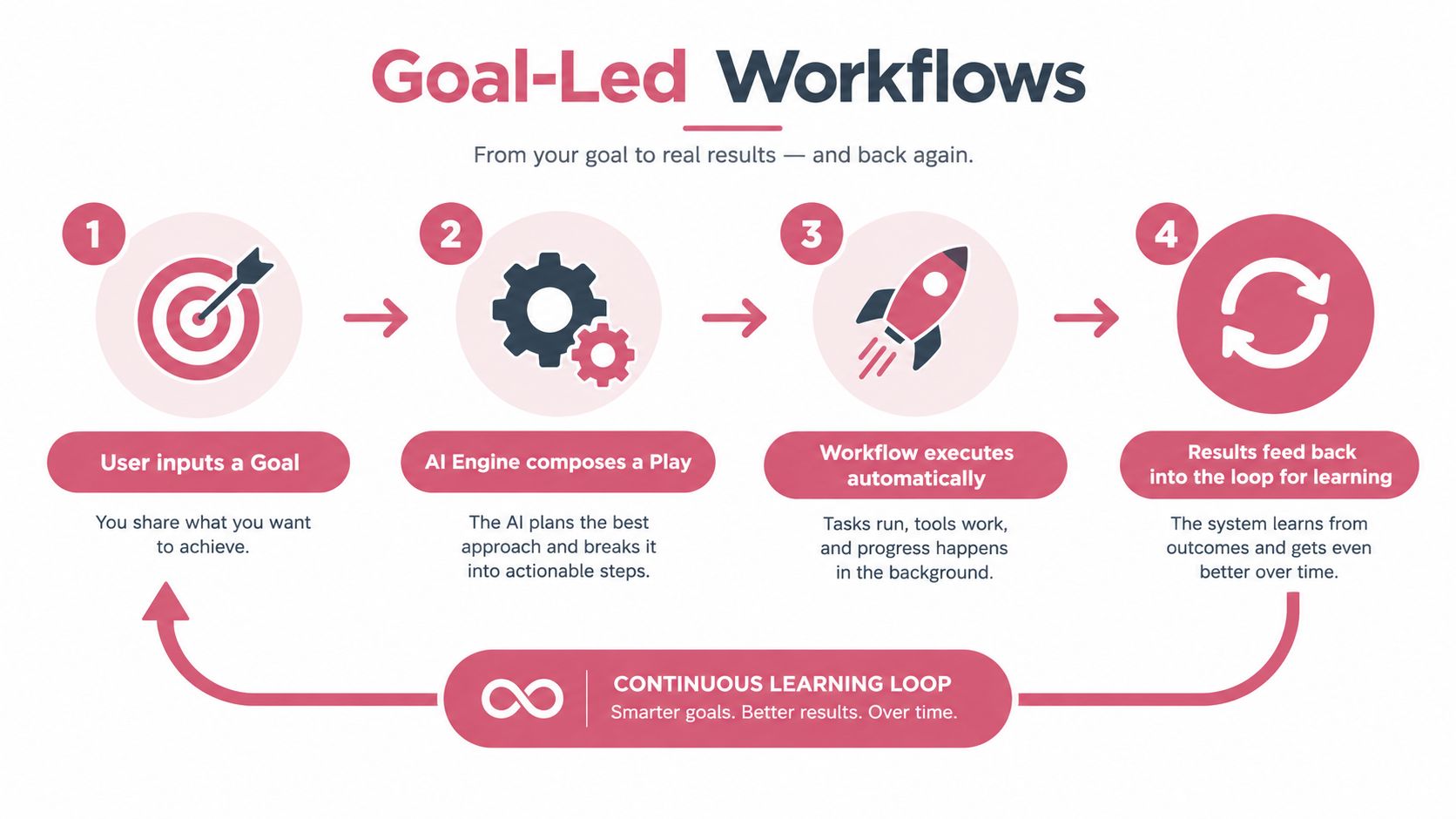
A unified GTM engine connects four practical layers. Its purpose is not to add more autonomous agents. It is to preserve context, enforce controls, and measure whether each play deserves to continue.
The execution layer
Research, enrichment, account selection, qualification, outbound messaging, CRM updates, and reporting should be callable through one consistent interface. Providers can still differ underneath. The workflow should not require a full rewrite whenever an enrichment source or channel changes.
Teams can compare top content automation tools while keeping content production separate from broader GTM orchestration. A content tool may produce useful assets, but it should not become the system of record for account strategy, permissions, or commercial outcomes.
The knowledge layer
The engine needs durable access to the ICP, positioning, customer language, exclusions, brand voice, data definitions, and tested plays. Without that context, each run starts from a blank prompt. The result may sound plausible while losing strategic continuity between campaigns.
The control layer
Permissions, approval gates, provider credentials, data retention, and audit logs belong outside individual prompts. The workflow should specify which records it can read, which systems it can write to, and which actions require human approval.
The learning layer
Each play needs a hypothesis, baseline, treatment, outcome window, and verdict. That telemetry separates a productive workflow from one that merely creates more records and messages. A successful play can be promoted, while a weak one can be revised or retired.
The AI orchestration architecture explains why these layers must operate together. A unified interface reduces context switching, while knowledge orchestration keeps decisions aligned with the company's market, positioning, and voice.
Point tools still have a role. A specialist may outperform a general system at one task. The operational failure begins when teams manually transfer context between prospecting, enrichment, copywriting, sequencing, CRM maintenance, and reporting. Those transfers break the learning loop, obscure attribution, and make it harder to establish whether a play actually improved GTM performance.
How Goal Led Workflows Turn Hypotheses Into Proven Plays
A goal led workflow begins with an outcome, not a channel. The operator states what needs to improve, identifies the audience and constraints, and lets the engine compose a play from available skills.
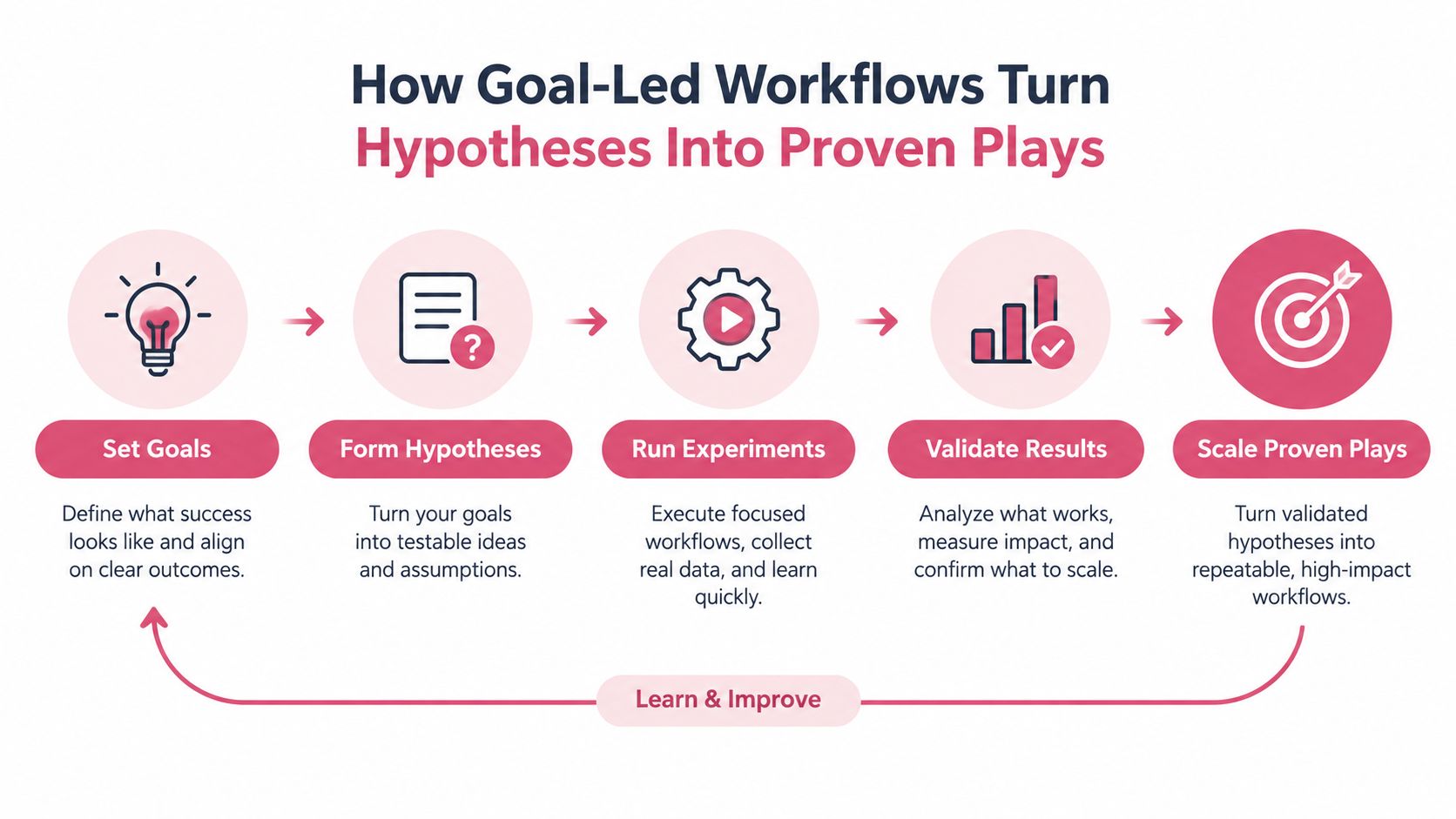
The workflow should move through a controlled sequence.
- Name the goal. Define the commercial result, target segment, time window, and exclusions. “Reach more people” is weak. “Create qualified conversations in a defined account group” gives the system something to optimize.
- Compose the play. The engine selects research, enrichment, scoring, copy, channel, and follow up skills that fit the goal. It should use the current ICP and voice rather than generic assumptions.
- Check the work. Validate records, claims, personalization, consent status, suppression rules, and message quality before anything reaches a prospect.
- Run the motion. Execute the approved workflow across the selected channels and record every meaningful step.
- Score the outcome. Compare results with the success metrics. Activity can be logged, but activity isn't the verdict.
- Update the play state. A new motion starts as a hypothesis. Evidence can move it to validated and then proven. Repeatedly weak results should trigger revision or retirement.
What makes the loop self evaluating
The system needs more than a dashboard. It needs a decision record that explains what changed and why. A useful record includes the goal, audience definition, source data, model output, message version, approval event, delivery result, reply classification, pipeline status, and final verdict.
This structure also prevents a common failure mode. Without retire logic, teams keep running a familiar sequence because it exists in the platform. A self evaluating system can identify that a play creates replies from poor fit accounts, produces low quality meetings, or generates activity without progression. The next run then excludes, revises, or pauses that motion.
The purpose of AI isn't to make every workflow autonomous. It's to make every workflow accountable to evidence.
Holdouts are important when a team wants to claim incremental impact. A portion of an eligible audience can remain outside the automated play, while the team compares quality adjusted outcomes rather than raw engagement. The exact design depends on sales cycle, audience size, channel overlap, and data quality, but the principle is consistent: measure what changed because of the intervention.
This approach also places quality checks before outreach. A system that catches unsupported claims, poor fit, duplicate contacts, or missing approvals before sending protects both performance and reputation. Feedback then becomes operational memory instead of a report that no one uses.
Real GTM Use Cases That Demonstrate the Architecture
The architecture becomes easier to evaluate through concrete GTM motions.
A prospecting workflow can begin with a target account definition, then combine firmographic research, live signals, enrichment, and ICP scoring. The system can produce a ranked account list, explain why each account qualifies, and route uncertain records for review. It doesn't need to write a message until the account and contact data pass the quality gate.
For an outbound motion, the engine can select a play based on the account's situation, apply the approved voice and positioning, and coordinate LinkedIn and email steps. A sales operator can review sensitive messages before sending, while the system handles preparation, scheduling, reply categorization, and CRM updates.
Where the same engine adds value
A visitor pipeline workflow can identify a relevant company, enrich the account, check whether it matches the ICP, and create a sales ready task without forcing an operator to copy data between systems.
A reply handler can classify responses into interest, objection, referral, unsubscribe, or uncertainty. It can draft the next action, but sensitive or ambiguous replies should pause for a person who understands the account context.
Competitive intelligence follows the same pattern. The system gathers changes from selected sources, relates them to positioning and accounts, summarizes the commercial implication, and records the finding in a shared knowledge layer. The output isn't just a document. It becomes input for future plays.
The AI agents for increasing revenue illustrate how prospecting, enrichment, outreach, and reporting can be treated as connected jobs rather than separate departmental projects.
What changes for the operator
The operator spends less time moving information between tools and more time deciding which goals matter, approving consequential actions, and reviewing verdicts. The system handles repetitive preparation, but it doesn't remove the need for judgment.
That distinction keeps the architecture broad. It can support lead qualification, LinkedIn sequencing, CRM synchronization, campaign reporting, content workflows, and market intelligence without pretending that every task has the same risk or measurement standard.
Choosing Compositional Control versus Preconfigured Playbooks
Teams don't need to choose between flexibility and simplicity as permanent product philosophies. They need to choose the right operating surface for each role.
An engineer or GTM platform builder may want compositional control through an MCP in Claude Code. That surface exposes atomic skills, data sources, permissions, and sequencing logic. It suits custom plays, unusual workflows, and teams that want to version and extend their own operating IP.
A sales or marketing operator may prefer a preconfigured playbook in Slack or a web interface. The operator provides the goal and relevant context, reviews the proposed action, and runs a known motion without assembling every component.
The practical comparison
| Operating need | Compositional surface | Preconfigured playbook |
|---|---|---|
| Custom account research | Strong fit | Useful when a standard motion exists |
| Rapid campaign launch | Requires more setup | Strong fit |
| Full control over atomic skills | Strong fit | Limited to exposed controls |
| Consistent execution across operators | Requires governance | Strong fit |
| Experimentation with new motions | Strong fit | Best after the motion is packaged |
| Routine qualification and reporting | Possible | Strong fit |
Both surfaces should use the same GTM API, knowledge layer, data, and accumulated intelligence. Otherwise, the company creates a second form of tool sprawl, with one playbook for technical users and another for everyone else.
Selection rule: Compose when the play itself is the work. Use a preconfigured playbook when speed, consistency, and adoption matter more than custom assembly.
Teams can start with a preconfigured play, inspect its steps and verdicts, then move it into a compositional workflow when the motion needs exceptions. The reverse also works. A custom play that proves useful can be packaged for wider use.
The sales playbook examples provide a useful reference for deciding which motions should become repeatable operating procedures and which should remain experimental.
Trust, Consent, and Human Checkpoints in Automated GTM
Autonomy isn't the correct design target for every GTM action. Trust depends on clear permissions, understandable decisions, and a real ability for an authorized person to change the result.
Deloitte's 2025 US Connected Consumer study found that only 20 percent of respondents said technology providers were very clear about collected data, while 27 percent expressed high or very high confidence that providers protected it. 24 percent reported encountering data privacy issues with generative AI. Marketing specific research also found that 26 percent of organizations cited lack of ownership or governance as a barrier. These findings are available in Deloitte's connected consumer research.

Put judgment at the right boundary
Automate research, enrichment, scoring, drafting, and routine sequencing where the risk is controlled. Pause actions that can materially affect a person or business, such as eligibility decisions, applicant rejection, or communications with significant consequences.
Article 22 of the GDPR limits fully automated decisions with legal or similarly significant effects, except in limited circumstances. Where an exception applies, the affected person must have safeguards that include human intervention, the ability to express a point of view, and the ability to contest the decision. The GDPR Article 22 guidance describes this boundary.
A human checkpoint only works if the reviewer has authority to change the outcome and access to the relevant information. A ceremonial approval button adds delay without adding control.
Make the audit trail reconstructable
The UK Information Commissioner's Office says organizations should keep records of decisions made by AI systems, including requests for human intervention, expressed views, contested decisions, and changes to outcomes. The ICO guidance on individual rights in AI systems also emphasizes that the reviewer needs the authority and capability to change the decision.
A practical log should capture:
- Input data: The records, sources, and fields used.
- System output: The score, recommendation, draft, or classification.
- Final decision: What the organization did.
- Reviewer identity: Who approved, rejected, or changed it.
- Override reason: Why the human decision differed from the system output.
- Permission context: Which access scope allowed the action.
Scoped permissions, provider independent interfaces, provenance for enrichment, retention rules, and approval gates make this architecture safer than relying on a general promise that a human is “in the loop.” The audit trail should let an operations leader reconstruct the complete sequence without asking several teams to search separate systems.
Adoption Checklist and Measurement Rules for GTM Teams
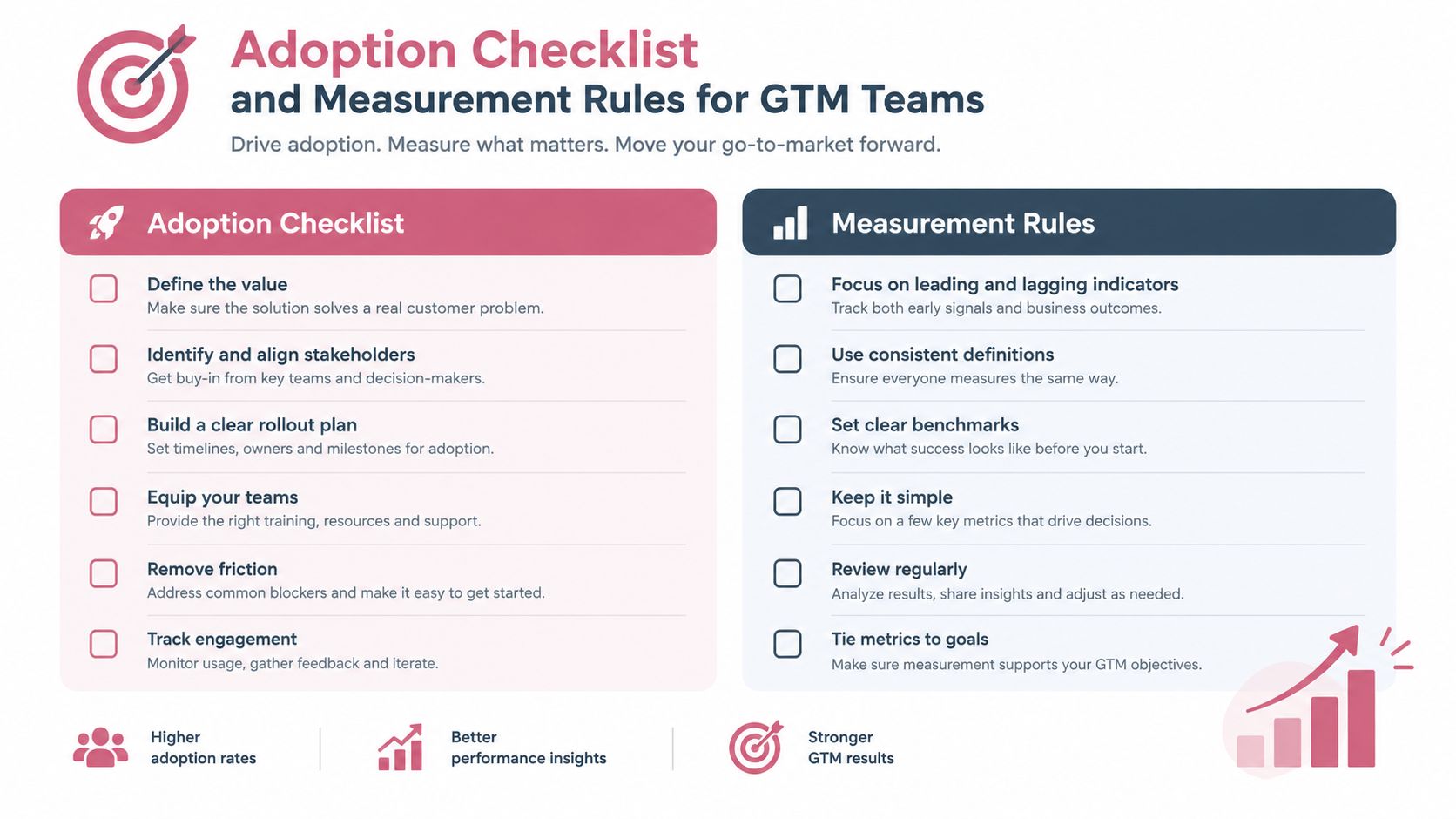
Start with one commercial goal and one workflow. Define the baseline, treatment, outcome window, quality standard, and retirement rule before connecting more channels.
Use this implementation checklist:
- Set the verdict first: Decide what counts as a commercially useful result, not just a completed task.
- Record the hypothesis: Store the audience, message, channel, assumptions, and expected outcome.
- Add quality gates: Check fit, data completeness, consent, duplication, message accuracy, and approval status before execution.
- Use holdouts where practical: Compare automated outcomes with a comparable group that didn't receive the intervention.
- Measure quality adjusted pipeline: Separate qualified progression from raw replies, meetings, or records created.
- Retire weak plays: Stop workflows that repeatedly produce poor fit activity or fail their defined success criteria.
- Review deliverability daily: Track complaints and pause or reduce sending when risk approaches the provider's threshold.
Gmail treats a sender as a bulk sender when it sends close to 5,000 or more messages to personal Gmail accounts within a 24 hour period. Google advises senders to keep the reported spam rate below 0.1 percent and prevent it from reaching 0.3 percent or higher. The Google sender requirements also make clear that authentication, unwanted message controls, and a simple unsubscribe method matter before scaling.
Marketing automation AI should earn its place through verified commercial impact. The winning system isn't the one that launches the most agents. It's the one that knows which plays work, why they work, when they stop working, and who can approve the next move.
Yalc provides a unified GTM API, knowledge orchestration, compositional workflows through an MCP, and preconfigured playbooks through Slack and its web interface. Teams can use it to connect prospecting, enrichment, qualification, outreach, approvals, CRM updates, and self evaluating campaign records, then visit Yalc to explore the operating model.