Outbound Campaign Management: The Operator Playbook for 2026
Outbound teams often blame weak reply rates on bad copy when the larger failure sits upstream. Average B2B cold email reply rates fell from about 8.5% in 2019 to roughly 3.43% in 2026, while top campaigns still exceeded 10.7%, according to the 2026 B2B outbound benchmark. That gap points to a less comfortable conclusion: outbound campaign management is a systems problem, not a subject line contest.
The operators who compound results control the full loop. They define the right accounts, verify the data, protect deliverability, sequence relevant touches, route replies quickly, and grade each campaign with a clear verdict. The teams that only rewrite openers usually keep sending into the same structural problems.
Table of Contents
- Why Most Outbound Programs Lose and a Few Compound
- Locking the ICP, Voice, and Signal Layer First
- Building and Enriching Lists That Actually Convert
- Composing Sequences and Running Them Across Channels
- Reply Triage That Routes the Right Conversation
- Measurement, Verdicts, and the Closed Loop
- A 30 Day Rollout Plan for Outbound Campaign Management
Why Most Outbound Programs Lose and a Few Compound
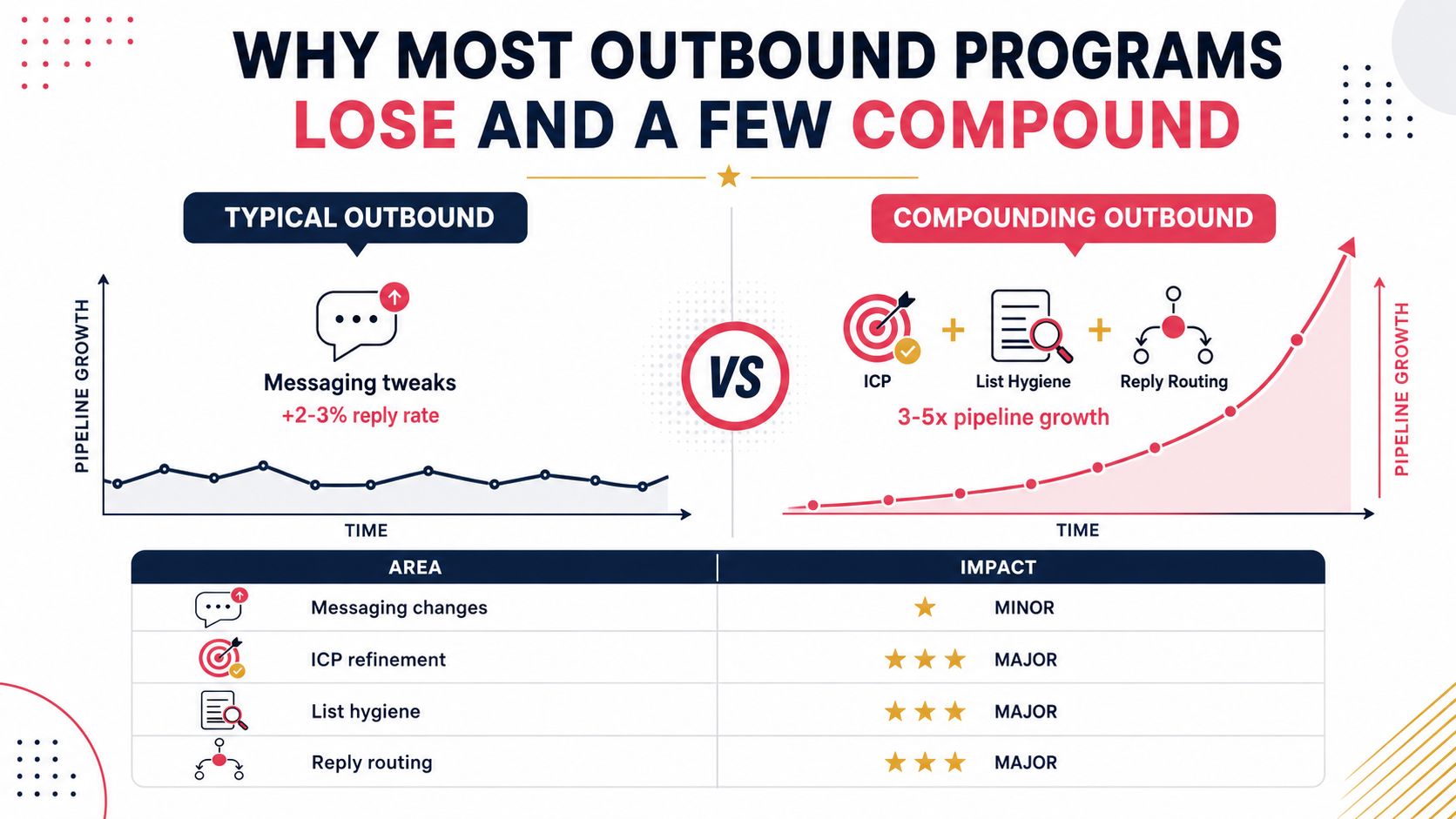
Copy gets too much credit for outbound performance. A new opener can improve a response, but it can't rescue a loose ICP, a stale list, poor sender reputation, or a reply queue nobody owns. Recent benchmark data reports that broad, generic send only motions often produce about 0.3% to 1.5% reply rates, while research and signal based sequencing can reach 3% to 12% or more when the underlying targeting is stronger. The outbound benchmark analysis also puts the average cold email reply rate around 3.43%, with about 95% of cold emails failing to generate a reply.
The usual failure pattern
A weak program tends to follow the same sequence:
- Copy first: The team tests subject lines and opening sentences before validating the target account definition.
- Data ignored: Contacts remain on the sequence while bounce rates climb past 5%, even though the list is no longer trustworthy.
- Volume substituted for fit: Operators keep sending to unverified records because the dashboard rewards activity.
- Replies left unowned: Positive signals sit in a shared inbox while reps debate who should respond.
- No verdict mechanism: Underperforming plays stay live because nobody has to label them as failures.
That operating model creates misleading feedback. A campaign may show engagement from the wrong segment, or appear weak because the right replies were routed late. The team then changes the copy and repeats the error.
What compounding operators score
A stronger model treats every campaign as linked decisions:
- ICP definition determines which accounts qualify.
- List quality determines whether those accounts contain usable contacts.
- Deliverability determines whether messages reach the intended inbox.
- Sequence design determines whether the campaign earns attention over several touches.
- Reply triage determines whether interest becomes a conversation.
- Self graded verdicts determine which plays continue and which ones stop.
The benchmark gap is meaningful. Campaigns using verified lists and three or more personalized follow up touches can reach the 8.5% range, while the broader platform average sits around 3.43%, as reported in the B2B outbound benchmark set. That doesn't prove one cadence works for every market. It does show that orchestration, relevance, and list discipline materially change the outcome.
The working playbook is straightforward: lock the ICP and signal layer, build a verified list, compose a controlled sequence, route replies, then issue a verdict based on business outcomes. Each weekly cycle should promote useful evidence and retire weak assumptions.
Locking the ICP, Voice, and Signal Layer First
The list shouldn't exist until the campaign brief can answer three questions: who qualifies, what should the company sound like, and why should this account hear from the team now?
Start with a hard ICP. Define firmographic boundaries such as industry, geography, company stage, and operating model. Add technographic requirements when the product depends on a particular stack. Then identify trigger events that create a plausible reason to act. A vague persona like “growth leaders at SaaS companies” isn't enough to build a measurable campaign. A usable definition says which companies qualify, which roles matter, and which business condition makes outreach timely.
The negative ICP matters just as much. Explicitly exclude accounts that lack the required infrastructure, serve a different market, sit outside the supported region, or have a role that can't influence the purchase. Negative criteria keep list builders honest when a provider returns attractive but irrelevant contacts. Teams that need a more formal way to document these decisions can use this ICP definition framework as a reference.
Give the team one voice
A positioning one pager should contain:
- Core problem: The operational issue the product solves, stated in the buyer's language.
- Three proof points: Specific capabilities, evidence, or outcomes the team can defend.
- Tone rules: Words to use, words to avoid, and the level of directness expected.
- Call to action: One reasonable next step, not several competing asks.
This document prevents every rep, sequencer, and AI workflow from inventing a different company. It also avoids the opposite problem, a rigid template that makes every message sound copied. The voice should remain consistent while the evidence changes by account.
Build a signal layer
Signals justify a touch. Useful examples include a funding round, a leadership hire, a tool migration, a regulatory shift, or repeated intent around a relevant problem. The signal should connect to the positioning, not decorate the first line. A hiring announcement matters only if the role creates a problem the product can address.
Before launch, the operator should confirm:
- The positive and negative ICP criteria are written down.
- The positioning one pager has three defensible proof points.
- The tone rules work across email, LinkedIn, and human replies.
- Each signal has a source, a date, and a reason it changes priority.
- The campaign brief tells the sequence what to reference and what to ignore.
If the team can't explain why an account belongs in the campaign, personalization will become cosmetic and later performance analysis won't be reliable.
Building and Enriching Lists That Actually Convert
A list is not a CSV file. It's a chain of decisions that begins with account fit and ends with a verified person who can plausibly influence the buying process.
Build the seed list from two inputs: ICP fit and a relevant signal. The seed might contain funded companies in a defined segment, attendees from a specific event, or accounts with a particular technology fingerprint. Starting with a narrow seed makes later analysis possible. A large undifferentiated export only hides bad assumptions under volume.
Use a waterfall, then verify
No single data provider should be treated as authoritative. Push each seed through a waterfall of enrichment sources, keeping the record that meets the verification standard rather than blindly accepting the first result. Teams evaluating their options can compare workflows in this guide to the best lead enrichment tools for 2026.
Verification should cover more than an email field:
- Mailbox checks: Identify invalid, risky, and catch all addresses before they enter a sequence.
- Domain validation: Confirm the company domain is active and associated with the account.
- Profile confirmation: Check that the LinkedIn profile belongs to the person named in the record.
- Role relevance: Score whether the contact owns, influences, or merely observes the problem.
- Recency checks: Remove contacts whose role, company, or business context has changed.
Title selection needs reporting context. A senior title may be irrelevant if the function sits outside the buying committee. A director can be more useful than an executive when the director owns the workflow. Exclude functions that can't evaluate the problem, and add reporting lines so the team knows whether to approach a likely champion, budget owner, or operational user.
Enrich for the sequence, not for decoration
Personalization requires usable evidence. Add recent initiatives, technology changes, hiring patterns, relevant content, market expansion, or leadership changes. Each field needs a defined purpose in the sequence. If the writer can't explain how a field changes the message or priority, the field is probably noise.
Deliverability guardrails begin before sending. Monitor domain health, avoid role accounts where possible, and cap sends by domain when a campaign expands. Validate the list again after enrichment because enrichment providers can return stale or conflicting records. A verified list is a campaign input, not a permanent asset.
Composing Sequences and Running Them Across Channels
A sequence should test a set of variables, not perform a scripted story. The operator needs to know whether the result came from the audience, signal, message, timing, channel mix, or routing. Changing several variables at once makes the campaign harder to learn from.
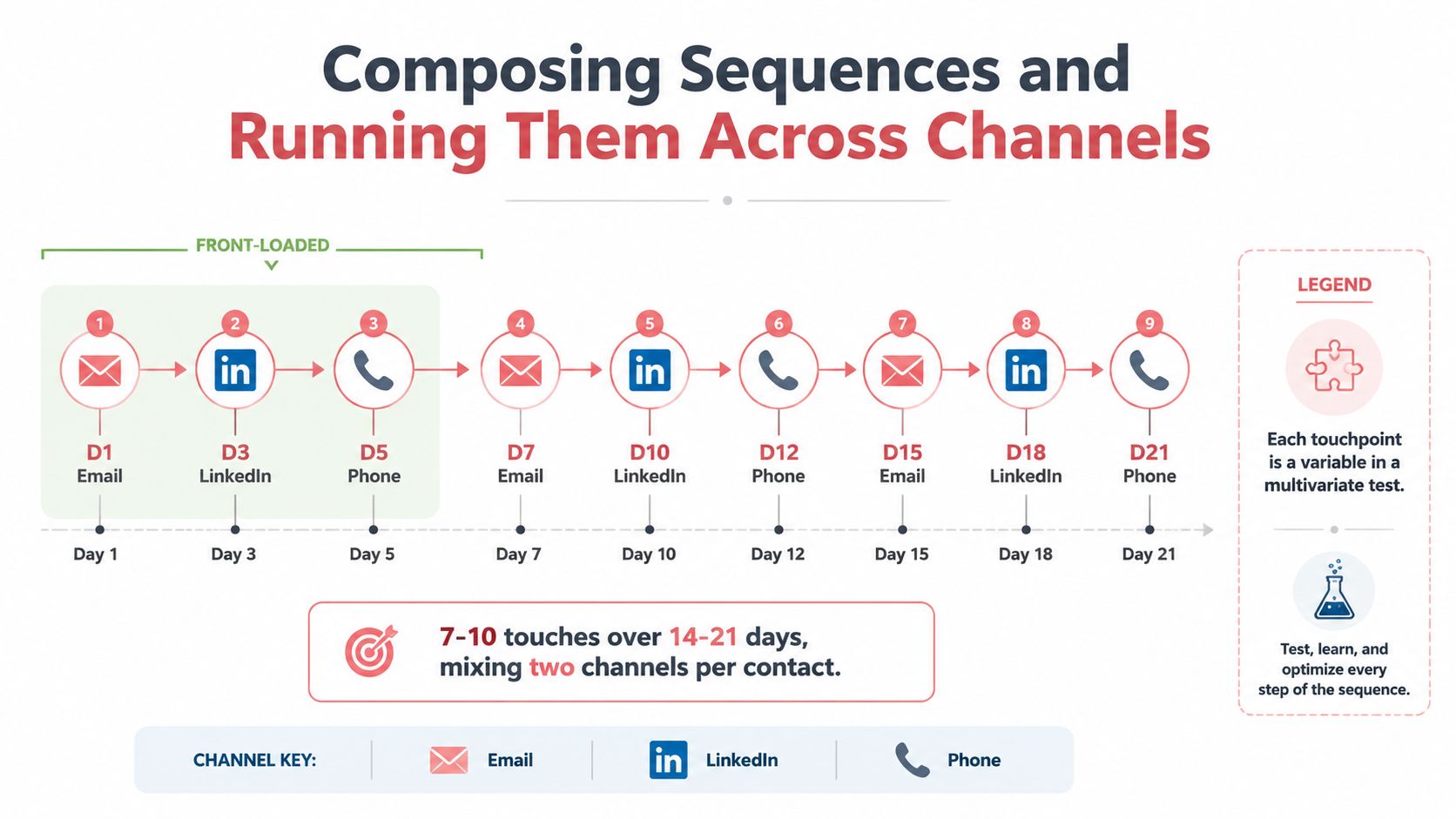
A practical starting structure uses 7 to 10 touches over 14 to 21 days, with two channels per contact. The 2026 outbound benchmark research reinforces the importance of multistep sequences, data hygiene, and personalization in mature outbound markets.
Assign a job to every touch
A sequence might work like this:
- Days 1 and 2: Create awareness through a profile view, relevant comment, or other low pressure interaction.
- Day 3: Send a short opener tied to a verifiable signal.
- Day 5: Add a useful observation, benchmark, resource, or operational suggestion.
- Day 7: Switch channels and test whether the contact responds better outside email.
- Days 10 to 14: Close the loop with a direct but respectful final message.
Each touch needs a single hypothesis. One email might test a signal based opener. Another might test whether a different channel earns a response. The sequence should stop when the contact replies, opts out, becomes irrelevant, or reaches the final touch.
Keep the copy constrained. Subject lines should stay under 6 words, the body under 90 words, and each email should contain one ask. The first line should reference something verifiable, not a generic compliment. A message that claims to have researched the account but cites no concrete evidence damages trust.
Protect the sending system
Email sends should be distributed across business hours rather than released in batches. Teams setting up a new sending environment should understand how to warm up an SMTP server before increasing activity. Deliverability is an operating constraint, so the sequence can't be judged independently from inbox placement.
LinkedIn connection requests should stay within 20 to 25 per day per representative, with a 60% acceptance floor before the operator pauses and investigates the audience or message. Chat should trigger only after a positive signal, such as a reply, meaningful engagement, or an explicit request. It shouldn't become a second cold channel layered onto an already weak campaign.
Fallback logic keeps the sequence adaptive. If a LinkedIn invite remains pending for 5 days, email becomes primary and LinkedIn moves to a view only role. Teams that want to reduce manual coordination can review outbound sales automation workflows and map each channel transition to a clear event.
Reply Triage That Routes the Right Conversation
Reply volume is not the same as buying intent. A message like “send me more info” may be a polite brush off, while “we use competitor X, talk in Q2” contains a real timing and competitive signal. Reply triage turns that distinction into an operating process.
Every reply should receive a label within 60 minutes. The label determines the owner, the next action, and the service level. Vague responses still need a verdict because unlabeled replies clog the queue and distort campaign reporting.
Four labels are enough to start
| Intent Label | Example Reply | Route To | SLA |
|---|---|---|---|
| Positive Intent | “We use competitor X, talk in Q2.” | Human AE | Within the hour |
| Objection | “We already handle this internally.” | Nurture track and battlecard response | Same business day |
| Wrong Person | “I don't own this, speak with operations.” | Referral request | Same business day |
| Out of Office or Unsubscribe | “Back after my leave,” or an opt out request | Snooze sequence or suppression list | Immediate handling |
Positive Intent should reach a human AE quickly, with the original signal and message visible. The AE shouldn't make the prospect repeat context. Objections belong in a nurture path supported by approved battlecard language, but the response should still address the stated concern rather than send a generic follow up.
Wrong Person replies are valuable when handled respectfully. Ask who owns the problem and make the referral easy. A contact who provides the right name has become an internal guide, not a failed prospect.
OOO replies should use the stated return date when one exists. Unsubscribe requests should suppress future outreach immediately. No automated workflow should treat an opt out as a follow up opportunity.
Routing rule: No reply should remain older than 24 hours without an intent label.
The operator should audit misclassifications each week. If “send more info” repeatedly becomes a meeting after a clarifying question, the label definition needs refinement. If positive replies are routed to nurture, the problem is operational, not creative.
Measurement, Verdicts, and the Closed Loop
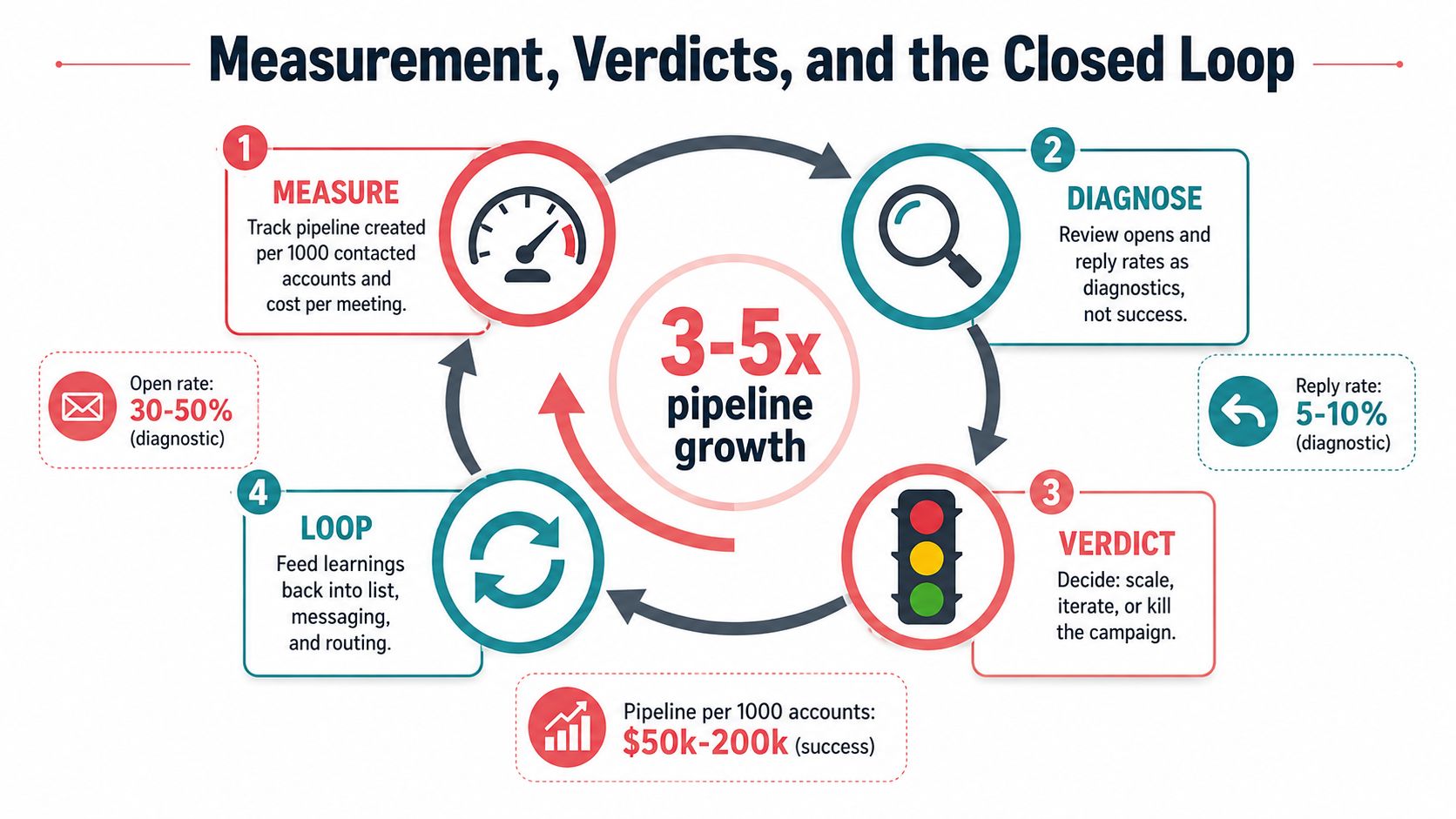
Outbound campaign management is a scoring system, not a copywriting contest. Open and reply rates help diagnose movement, but the scorecard must connect activity to commercial output. Track pipeline created per 1,000 contacted accounts, cost per qualified meeting, and reply to meeting conversion by segment. These measures show whether a play creates useful conversations, not merely attention.
Deliverability belongs in the same operating view. Strong outbound infrastructure is generally benchmarked at 90% or higher primary inbox placement, bounce rate under 1% per inbox per day, spam complaints under 0.05%, and passing SPF, DKIM, and DMARC checks, according to the 2026 deliverability benchmark guidance. If inbox placement falls below roughly 78%, investigate infrastructure and sender reputation before changing the message. A weak inbox position can make a sound offer look ineffective.
Give every play a verdict
After each campaign cycle, assign one outcome:
- Win: The play beats the rolling baseline on positive reply rate and meeting rate for two consecutive cycles. Promote it into the master playbook and test it carefully in adjacent segments.
- Iterate: The result is borderline. Change one defined variable, such as the opener, daypart, or channel mix, then run the test again.
- Retire: The play underperforms across at least 500 sends. Archive it with a reason code so it stops consuming list capacity and sender reputation.
Calculate the baseline using the same segment, channel, and contact definition whenever possible. A senior-buyer campaign cannot be judged fairly against a broad title list. The minimum sample requirement also limits overreaction to random replies.
Diagnose before changing copy
If replies fall, inspect the system in order:
- Inbox placement: Did the messages reach the primary inbox?
- List quality: Were the addresses valid and the roles relevant?
- Signal strength: Did the account have a timely reason to engage?
- Sequence behavior: Did the campaign earn enough exposure without overcontacting?
- Reply routing: Did interested contacts receive a timely human response?
If every play retires, the ICP, list, or delivery layer is probably failing. Rewriting copy first only hides the fault. Promote winning plays only after they hold their verdict, and stop losing plays before they continue damaging sender reputation. Each verdict should feed the next cycle's ICP filters, list rules, deliverability checks, sequence design, and test plan.
A 30 Day Rollout Plan for Outbound Campaign Management
A single operator can establish the loop in 30 days by sequencing the work rather than trying to automate everything at once.
Week 1 creates the decision layer
Put the positive ICP, negative ICP, positioning, proof points, tone rules, and signal definitions on one page. Get sales agreement before list building begins. The sign off matters because later verdicts are only useful when the team agrees on what a qualified account and a meaningful reply look like.
Create the campaign fields at the same time. Store account fit, signal type, signal date, role relevance, source, sequence version, reply label, and verdict reason. If those fields don't exist at launch, the team will reconstruct them from memory after the campaign has already run.
Week 2 builds the verified seed
Use the approved criteria to build a focused seed list. Run enrichment through more than one provider, verify the contact records, remove risky addresses, confirm role relevance, and add the evidence required for personalization. Send a small verified batch only after the operator has checked list quality and sending health.
Don't expand because the first batch feels exciting. Expand when the data is clean and the routing process works.
Week 3 tests two controlled sequences
Launch two parallel sequences across email and LinkedIn. Keep the ICP and core signal constant while changing one meaningful variable, such as the opener or channel order. Wire the four reply labels into the CRM and assign an owner for each route before the first reply arrives.
Review replies daily. A sequence that creates interest but loses the response queue isn't a successful sequence.
Week 4 turns on verdicts
Run the first promotion and retirement pass. Record whether each play won, needs iteration, or should be archived. Write the reason code in plain language, such as weak signal, irrelevant role, poor inbox placement, unclear ask, or slow routing.
Use four guardrails to keep the loop honest:
- Sample thresholds: Don't issue a strong verdict before the campaign reaches its defined minimum sample.
- Holdout cohorts: Keep a comparable group untouched so the team can separate campaign impact from market noise.
- Channel mix caps: Prevent one channel from dominating the result when the test is meant to compare a sequence.
- Rotation rules: Retire weak plays and rotate approved winners without changing several variables at once.
The clearest compounding metric is weekly qualified meetings per 1,000 verified contacts, segmented by verdict class. It shows whether the system is improving because the team is finding better accounts, protecting delivery, routing conversations faster, or sending more.
Yalc connects contact sourcing, enrichment, sequencing, reply handling, and campaign verdicts through a unified GTM workflow, with playbooks available through its interface or Slack and composed workflows available through Claude Code. Visit Yalc to see how its AI GTM operating system can turn outbound campaign management into a scored, auditable loop.