8 Prospecting Best Practices for GTM Teams
Prospecting volume doesn't repair weak targeting, incomplete data, poor prioritization, or inconsistent follow up. Inbound speed makes the point. An analysis of more than 55 million sales activities across 5.7 million inbound leads found that contacting a lead within 5 minutes produced conversion rates about 8 times higher than waiting from 5 minutes to 24 hours, yet only 0.1% of inbound leads were contacted that quickly. The same analysis found that 57.1% of first call attempts happened more than a week after lead arrival. (Lead generation research)
The practical answer isn't another disconnected outreach tip. Strong teams treat prospecting as a controlled operating system. They define the account and buyer first, enrich only useful records, score fit and intent, coordinate channels, protect list quality, respond quickly, test messaging, and measure outcomes. Each layer affects the next, so a larger send volume only magnifies whatever the system already gets wrong.
Yalc can serve as an example of a unified system for ICP storage, enrichment, scoring, sequencing, reply handling, and campaign evaluation. The operating principle matters more than the tool: establish decision rules before execution, keep humans involved in sensitive actions, and make every campaign produce a clear learning outcome.
Table of Contents
- 1. Build Your Ideal Customer Profile Before Outreach
- 2. Use Multi Channel Outreach Instead of Single Channel Sequences
- 3. Personalize at Scale Through Prospect Research and Data Layering
- 4. Measure Every Campaign Against Clear Success Metrics and Win Criteria
- 5. Qualify Leads Before Handing to Sales to Reduce Wasted Follow Up
- 6. Respond to Inbound Replies and Questions Within Hours, Not Days
- 7. Test and Iterate on Messaging Based on Reply Patterns and Objections
- 8. Maintain List Hygiene and Remove Unresponsive Contacts to Preserve Reputation
- 8-Point Prospecting Best Practices Comparison
- Turn the Eight Practices Into One Operating Loop
1. Build Your Ideal Customer Profile Before Outreach
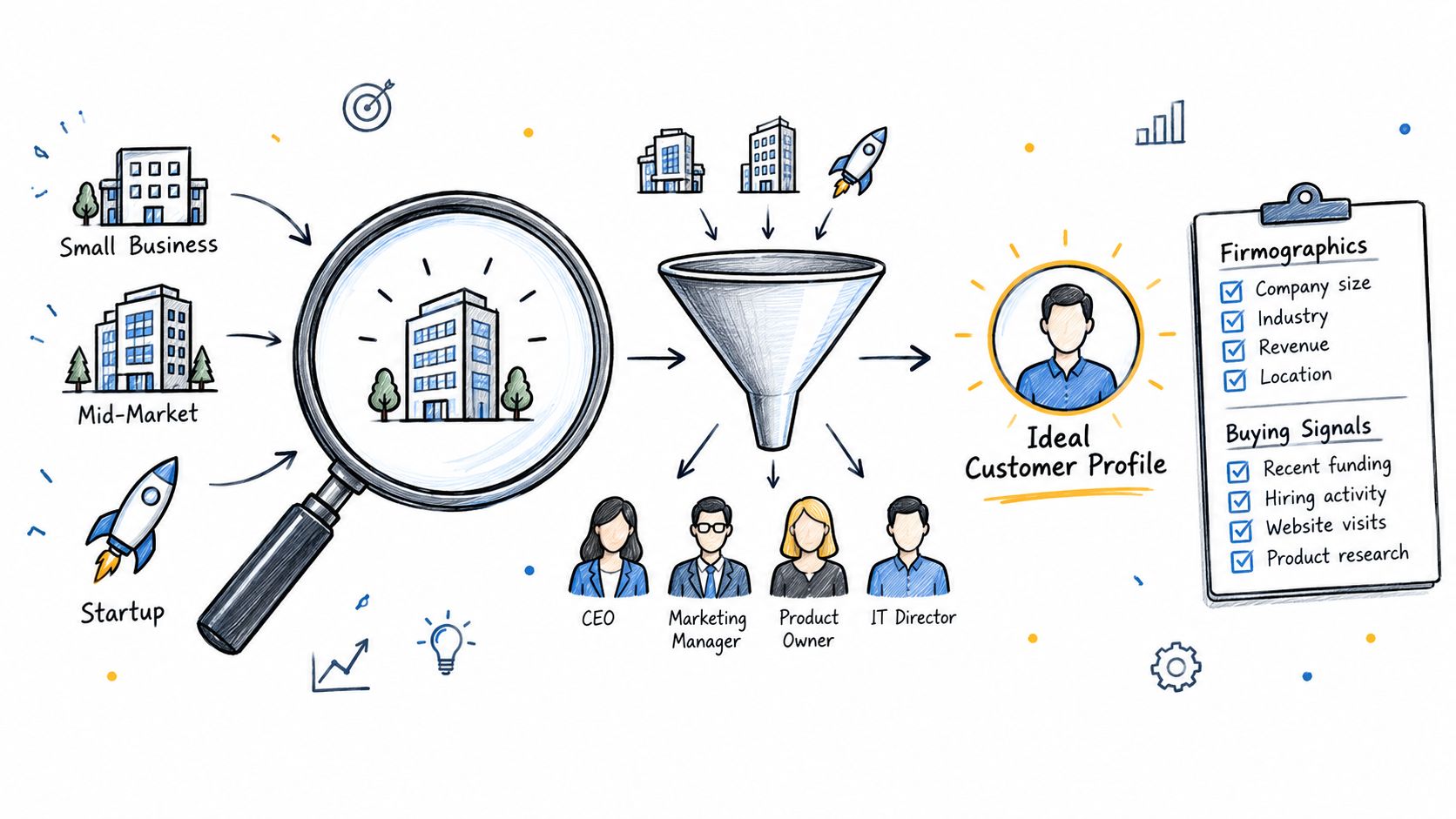
A useful ICP is specific enough to reject attractive but unsuitable accounts. It should describe company characteristics, buyer personas, firmographics, relevant technologies, buying signals, and disqualifiers. If the team can't explain why an account belongs on the list, the list isn't ready.
Start with the customers who already create the strongest commercial evidence. Review the CRM for industry, company size, sales cycle, deal size, retention, expansion, and the person who signed the contract. Interview the 10 best customers to identify recurring conditions, internal problems, and events that preceded their purchase. Then turn those observations into criteria that a researcher or scoring system can apply consistently.
A B2B SaaS company might discover that its best audience is mid market companies with recent fundraising activity, rather than enterprise accounts. A sales operations platform might find that CRM or HRIS upgrades are stronger buying signals than job title alone. An agency should maintain a separate ICP for each client product instead of forcing every campaign through one generic definition.
Practical rule: Score every prospect against the ICP before outreach. A polished sequence sent to the wrong account is still wasted work.
The ICP should live in a shared, editable system, not in one seller's notes. Teams can document what an ICP is and why it matters and use the resulting criteria across list building, messaging, scoring, and handoff. A practical ICP definition should include:
- Company fit: Industry, geography, operating model, size, and relevant business complexity.
- Person fit: Role, seniority, likely influence, and proximity to the problem.
- Buying context: Funding, leadership changes, technology changes, hiring, or a stated initiative.
- Disqualifiers: Customer segments, use cases, or conditions that make a conversation unlikely to succeed.
Review the profile whenever new deals close and on a regular operating cadence. The best ICP is a living filter grounded in actual wins, not a static marketing exercise.
2. Use Multi Channel Outreach Instead of Single Channel Sequences
A prospecting sequence should give the right account several relevant ways to respond. Coordinate email, LinkedIn, phone, or an approved chat channel around one commercial idea, then adapt the message to each channel's format and timing. Repeating identical copy across every touch adds volume without adding context.
Start with two channels, usually email and LinkedIn. A connection request can establish recognition, while email carries the problem, relevance, and proposed next step. Add a third channel only when the account has a legitimate reason to be there, such as an existing community relationship or active Slack use. Private workspaces require particular care because unsolicited contact can feel invasive. Confirm that the channel is appropriate before using it.
Broad B2B cold email usually produces modest reply rates, while highly targeted outreach performs better when a strong intent signal supports the message. Orchestrated multichannel cadences can outperform pure email in some benchmark sets, but benchmark ranges are planning inputs, not guarantees. Use them to justify testing channel design, not to promise a result.
Design the sequence around context
Space touches by at least 2 to 3 days where possible. Keep the central message consistent, while making each execution native to its channel:
- LinkedIn: Send a short connection note or concise follow up.
- Email: Explain the problem, account relevance, and next step with enough context.
- Chat: Write briefly, and use it only when the relationship or workspace makes contact appropriate.
Assign ownership for every channel before launch. Record each touch in the same account timeline so reps can see what was sent, what the prospect answered, and which action comes next. The sequence should stop when a contact opts out, replies, books a meeting, or clearly falls outside the target account.
A coordinated LinkedIn outreach strategy can define channel roles, ownership, timing, and exit rules. Review replies by channel after each campaign, then adjust the sequence rather than increasing touch volume.
3. Personalize at Scale Through Prospect Research and Data Layering
Personalization earns attention when it reflects a current business situation. A first name in a template does not. Use evidence such as a company announcement, leadership change, new role, technology decision, or problem suggested by the prospect's responsibilities. Skip compliments that could apply to any account.
Build the research layer before drafting copy. Combine firmographic data, technographics, company news, role information, and intent signals. Check the company website and LinkedIn page for recent developments, including new hires, promotions, team expansion, and product launches. Technology data can support segment selection, but it should not appear as a decorative detail.
Separate research from writing. Enrich records in batches, store evidence in structured fields, and let templates select a message branch. FullEnrich and ZeroBounce can support contact enrichment and email verification. Crustdata can add company and technology context. For teams using chat-based outreach, the Double My Leads WhatsApp business resource offers a related personalization reference. The operator still decides which fields are reliable and which signals change priority or messaging.
A personalization field is useful only when it changes the message, the priority, or the next action.
Create 2 to 3 core templates with conditional branches. A recently funded company might receive a message about scaling a process. A company hiring for a relevant function might receive one about operational capacity. An account using a familiar technology may need a migration or integration angle, provided that use is verified.
Document source requirements, field ownership, and review rules in the lead enrichment workflow. A research template can capture company news, job changes, and technology usage before writing starts. Compare a researched segment with a control segment, then keep only the personalization that improves reply quality or lead qualification. This creates a repeatable data layer, rather than asking each rep to improvise research for every contact.
4. Measure Every Campaign Against Clear Success Metrics and Win Criteria
A campaign needs a success rule before launch. Without one, teams default to opens and clicks because those figures are easy to report, even when the commercial question is whether suitable buyers respond and book meetings.
Set one leading indicator, such as positive replies, and one business outcome, such as qualified meetings or opportunities. Reply rate helps diagnose targeting and copy, but it cannot stand in for pipeline quality. Polite curiosity from unsuitable accounts is activity, not a win.
Use benchmark ranges as context, not as the verdict. Broad campaigns may fall within the 1% to 4% reply range, while tightly targeted outreach can perform better when the list, offer, and timing align. Set an internal target according to audience, offer, channel, and sales capacity, then record those assumptions beside the campaign.
Turn measurement into a decision
Run campaigns in controlled batches. The plan can include 500 or more emails before a final verdict when early results are not clearly poor. Review early replies anyway for targeting, deliverability, or positioning failures. Review performance weekly, and record the next action beside each key metric.
- Continue: Audience fit, message quality, and reply quality justify another batch.
- Pivot: A repeatable pattern points to a change in audience, offer, CTA, or channel.
- Stop: The campaign produces poor-fit responses, compliance risk, or too little commercial evidence.
Track meetings and qualified opportunities alongside activity metrics. Show cost per acquisition and cost per opportunity when financial decisions depend on them. Separate channel performance from sales execution, since weak results may come from poor follow-up rather than the initial message.
Record why each campaign won or lost, including the segment, offer, test variable, and decision owner. A dashboard earns its place when it produces a verdict, assigns responsibility, and states the next test. That record connects campaign results to the next layer of the prospecting system instead of leaving each team to interpret performance from scratch.
5. Qualify Leads Before Handing to Sales to Reduce Wasted Follow Up
Sales should receive a reason to believe the lead is worth time. That reason can come from account fit, person fit, a relevant problem, a buying signal, or a combination of these. Without a qualification gate, sellers spend follow up capacity on contacts who were never plausible buyers.
Define the minimum criteria with sales leadership. At a minimum, the process should establish whether the contact works at a suitable company, holds the right role or influence, faces a problem the product solves, and has a plausible path to budget. The exact evidence will vary by market, but the rule must be visible to both prospecting and sales.
Use separate scores for company fit and person fit. Add intent or engagement only after the team trusts the underlying data. A senior contact at the wrong type of company shouldn't outrank a suitable account just because the person opened an email. Automated scoring can help with consistency, but human review remains useful for strategic accounts and ambiguous signals.
A practical qualification record should answer:
- Why this account: Which ICP criteria does it meet?
- Why this person: What makes the contact relevant to the buying process?
- Why now: Which signal or stated problem creates timing?
- Why handoff: What did the prospect say or do that justifies sales involvement?
Inbound routing needs the same discipline. A demo request from a suitable account can move quickly, while a low fit inquiry can enter a lighter nurture or disqualification path. Remove genuine non fits from active sequences so the system doesn't keep treating them as open opportunities.
Sales feedback should arrive soon after handoff. Review qualified and disqualified patterns with sales regularly, record the reason for rejection, and update the rule when the evidence changes. Qualification isn't a wall between teams. It's the contract that tells sales what the prospecting function means by ready.
6. Respond to Inbound Replies and Questions Within Hours, Not Days
Speed to lead is an operating rule. Research summarized by lead response time guidance reports that contacting an inbound lead within 5 minutes makes a rep 21 times more likely to qualify it than waiting 30 minutes. The same guidance reports that contact odds are about 100 times higher in the first 5 minutes than after 30 minutes.
Another analysis found conversion rates about 8 times higher when contact happens within 5 minutes rather than later. (Response time research) Build the workflow around three actions: acknowledge the inquiry, route it to an owner, and start qualified human follow up quickly.
For high intent actions such as demo requests or pricing inquiries, industry guidance recommends an automated response in under 1 minute, followed by human contact within 5 minutes. (Inbound lead response guidance) The automated message should confirm receipt and explain what happens next. It should support the human response, not imitate one.
Build the response path before launch
Assign ownership by territory, account tier, availability, or product line. Send real time notifications through Slack, Teams, or email so reps do not have to search several systems for new replies. A queue without a named owner creates delayed follow up.
One industry benchmark reports that the average B2B company takes 42 hours to respond to a lead, while high performing teams aim for under 5 minutes for qualified inbound leads. (B2B response time benchmark) Set a written SLA, define escalation rules, and name a backup owner for absences or overloaded queues.
Prepare response patterns for common cases, including strong interest with poor timing, an existing competitor, pricing requests, and technical questions. Templates should reduce drafting time while preserving the prospect's context. AI can triage replies and surface urgent requests, but a human should review sensitive, complex, or high value messages before sending. Track response time and routing failures alongside reply outcomes, because a fast response from the wrong owner still breaks the operating system.
7. Test and Iterate on Messaging Based on Reply Patterns and Objections
Treat every campaign as a hypothesis about the audience, problem, offer, and timing. The first version is not a verdict on the market. It is a controlled attempt to learn which premise creates a useful conversation.
Test the most uncertain variable first. That might be the opening line, the problem statement, the offer, the CTA, or the segment itself. Change one major variable at a time, record replies verbatim, and classify the reasons behind positive, negative, unclear, and deferred responses.
A repeated objection is evidence. If prospects keep asking about implementation, price, integration, authority, or timing, the message may be missing an important answer. The pattern may also indicate that the team is targeting the wrong role or presenting the right product in the wrong context.
Don't optimize for the easiest metric to move. Optimize for the reply pattern that predicts a qualified conversation.
Use test batches of 100 to 200 contacts per variant when the audience supports it, and wait for at least 30 replies per variant before trusting a pattern. These are operating safeguards, not guarantees of statistical certainty. Small samples can produce persuasive but unstable results.
Store winning and losing angles in a shared playbook. A subject line that earns attention but poor quality replies shouldn't become the default. A less exciting opening that attracts relevant buyers may be commercially stronger. Share objections with sales and marketing so the learning changes discovery questions, positioning, content, and follow up, not just one email sequence.
8. Maintain List Hygiene and Remove Unresponsive Contacts to Preserve Reputation
List hygiene is part of prospecting quality, not an administrative afterthought. Invalid addresses, hard bounces, repeated opt outs, and chronically unresponsive contacts consume sending capacity and can damage the reputation of the domain. A larger list is not an asset if the team can't trust its records.
Validate new addresses before they enter an active campaign. Remove hard bounces after each send, honor unsubscribe requests across future campaigns, and keep source, verification date, role, and account ownership visible. FullEnrich and ZeroBounce are examples of tools teams can use for verification, but no provider eliminates the need for ongoing review.
The operating thresholds should be explicit. One benchmark recommends aiming for a bounce rate under 2% on each send and keeping spam complaints under 0.3%. (Email response and deliverability guidance) Treat a threshold breach as a stop signal for investigation, not as a reason to send harder.
Give every contact an exit path
Use engagement segments to control contact frequency. A prospect who replies should leave the automated sequence immediately. A prospect who opts out should be removed from future sends. A prospect who receives 3 to 5 campaign touches without engagement should be reviewed rather than recycled indefinitely.
Check SPF, DKIM, and DMARC configuration, monitor provider feedback, and separate questionable imports from trusted records. Purchased or scraped data needs particular caution because titles and addresses can change quickly. Re verify important fields on a schedule and rerun source queries when the campaign depends on current company conditions.
List hygiene protects more than inbox placement. It keeps reporting honest. If the team repeatedly contacts dead or unsuitable records, reply rates hide the quality of the underlying market and make every later experiment harder to interpret.
8-Point Prospecting Best Practices Comparison
| Strategy | 🔄 Implementation Complexity | ⚡ Resource Requirements | ⭐ Expected Outcomes | 💡 Ideal Use Cases | 📊 Key Advantages |
|---|---|---|---|---|---|
| Build Your Ideal Customer Profile Before Outreach | Medium–High, requires data analysis, validation and cross‑team alignment | Medium, CRM, analytics, customer interviews, periodic validation | ⭐⭐⭐⭐⭐, sharper conversion, lower CPA, consistent targeting | New GTM motion, scaling outbound, aligning sales & marketing | Reduces wasted outreach; enables precise list building and personalized messaging |
| Use Multi-Channel Outreach Instead of Single-Channel Sequences | High, orchestration across channels and cadence design | High, LinkedIn, email, chat integrations, automation, tracking | ⭐⭐⭐⭐, typically 30–50% lift in replies vs single channel | When prospects span channels or email deliverability is unreliable | Higher reply rates, channel redundancy, better recall and attribution |
| Personalize at Scale Through Prospect Research and Data Layering | High, builds enrichment pipelines and conditional templates | High, enrichment providers, template systems, research time | ⭐⭐⭐⭐, 3–5x better opens/replies when data‑driven | Account‑based programs, enterprise outreach, high‑value targets | Scales personalization efficiently; yields higher quality replies |
| Measure Every Campaign Against Clear Success Metrics and Win Criteria | Medium, define KPIs, reporting cadence and decision rules | Medium, analytics tools, tracking, regular review process | ⭐⭐⭐⭐, faster learning; less wasted spend; improved ROI | Any campaign activity where outcomes must be proven and iterated | Data‑driven decisions; stop or scale campaigns based on results |
| Qualify Leads Before Handing to Sales to Reduce Wasted Follow Up | Medium, create scoring and automated routing rules | Medium, lead scoring, forms, workflows, sales alignment | ⭐⭐⭐⭐, higher sales productivity and close rates | High inbound volume, poor lead quality, misaligned SDR/AE handoff | Increases conversion; reduces rep time spent on unfit leads |
| Respond to Inbound Replies and Questions Within Hours, Not Days | Medium, SLA, routing, and coverage policies needed | Medium–High, on‑call coverage, routing automation, templates/AI | ⭐⭐⭐⭐, significant lift in meeting bookings and momentum | High‑intent inbound, competitive verticals, time‑sensitive leads | Preserves prospect interest; competitive advantage via speed |
| Test and Iterate on Messaging Based on Reply Patterns and Objections | Medium, disciplined A/B testing and feedback capture | Medium, testing framework, sample batches, reply analysis tools | ⭐⭐⭐⭐, continuous improvement; better positioning over time | New messaging, uncertain value props, segmented audiences | Identifies winning angles early; reduces large‑scale waste |
| Maintain List Hygiene and Remove Unresponsive Contacts to Preserve Reputation | Low–Medium, repeatable cleaning processes and rules | Medium, validation tools, unsubscribe handling, monitoring | ⭐⭐⭐⭐, sustained deliverability and lower bounce/complaint rates | Large email programs, long‑term deliverability maintenance | Protects sender reputation; reduces bounces and ISP penalties |
Turn the Eight Practices Into One Operating Loop
The eight practices work best as one sequence of decisions. First lock the ICP and qualification rules. Define the accounts, people, buying signals, and disqualifiers that belong in the motion. Then enrich only the records that can change a decision, such as whether an account fits, whether a contact is current, or whether a timely trigger exists.
Next, score the account and contact separately. Prioritize fit before engagement, then use intent and context to determine order and channel. Validate email addresses, remove opt outs and hard bounces, check the source of important data, and confirm that every active contact has an owner.
Launch a small multichannel test. Keep the message aligned across channels, but adapt the format. Set the success metrics before sending, define the conditions for continuing or stopping, and make sure replies route to a real person. Qualified inbound leads need rapid handling. The evidence is clear: contacting an inbound lead within 5 minutes can materially improve qualification and contact odds compared with waiting. (Lead response research)
The review stage should produce more than a dashboard. It should answer four questions:
- Was the audience right: Did the accounts and contacts match the ICP?
- Was the data reliable: Were titles, emails, triggers, and technology signals current?
- Was the message useful: Which objections, questions, and reply patterns appeared?
- What happens next: Continue, change the audience, revise the message, adjust routing, or retire the play?
A unified system can reduce the operational cost of connecting these stages. Yalc is one optional example. Its unified GTM API can connect enrichment, scoring, sequencing, reply handling, and campaign reporting across tools, while its knowledge layer stores the ICP, voice, positioning, and prior results. Its play library includes Prospecting, Lead Qualifier, Email Enricher, ICP Scorer, Campaign Builder, Sequence Runner, Personalizer, Reply Handler, and Campaign Reporter.
Yalc can be composed through its MCP in Claude Code or run through preconfigured playbooks in Slack and its UI. It also records agent activity, supports scoped permissions, and keeps human approval for sensitive actions. Its campaign learning model treats each run as a hypothesis, records a verdict, and distinguishes intelligence that is a hypothesis, validated, or proven. Teams considering an outbound sales strategy playbook should apply the same principle regardless of their stack: automate repeatable preparation and follow through, but keep humans responsible for strategy, judgment, and approval.
The strongest prospecting system isn't the one that sends the most messages. It's the one that improves its targeting, data, timing, execution, and learning with every controlled cycle.
Yalc connects prospect sourcing, enrichment, ICP scoring, multichannel execution, reply handling, and campaign evaluation through one GTM operating system. Visit Yalc to see how your team can run prospecting plays with your own data, keys, approvals, and accumulated GTM knowledge.