Sales Data Integration Guide for GTM Teams
The CRM says the account is active. The marketing warehouse shows a different owner. An SDR has just enrolled a churned customer in a sequence, while finance needs a board ready pipeline number before the day ends. None of these failures starts with a broken API. They start with records that moved successfully, but carried the wrong identity, stale attributes, or conflicting definitions.
Sales data integration works only when connected systems can agree on what a record means, how reliable it is, and whether downstream teams should act on it. Connectivity is necessary, but it isn't the operating objective. The objective is trusted movement of data across the systems that run revenue.
That distinction matters as CRM adoption becomes mainstream. Industry CRM reporting says 91% of companies with more than 10 employees use CRM software, while 87% of CRM systems are cloud based and 70% of businesses use mobile CRM. These figures are reported in the CRM adoption and usage benchmark collection from SuperOffice. Once sales, marketing, service, finance, and field teams depend on the same records, integration quality becomes an operating advantage rather than a technical convenience.
Table of Contents
- What Sales Data Integration Actually Means for GTM Teams
- The Four Core Patterns Behind Every Integration Stack
- Batch Versus Streaming and When Each One Pays Off
- Enrichment, Dedupe, and Schema Mapping as One Quality System
- Security, Compliance, and Observability as Operating Practices
- How a Unified GTM API Simplifies Orchestration and Downstream Automation
- Why More Integrations Can Worsen Decisions and What to Do About It
What Sales Data Integration Actually Means for GTM Teams
Sales data integration is the governed movement, normalization, and reconciliation of contact, account, activity, and opportunity records across a CRM, marketing automation platform, product systems, billing tools, warehouses, and third party sources. A useful integration doesn't merely copy a lead from one application to another. It decides whether that lead is the same person already in the CRM, whether the account is active, which source should win when fields conflict, and what evidence supports the result.
That makes integration a grading problem first and a connectivity problem second.
Start with trust, not connectors
A practical operating model asks four questions for every record:
- Is the identity correct? The person, company, domain, account, and opportunity must resolve to the right entities.
- Is the field complete? Routing, ownership, consent, lifecycle, and revenue fields need separate checks because their failure costs differ.
- Is the field current? A valid email from an old record isn't necessarily usable for today's outreach.
- Should the system act? Low confidence data should be held, flagged, or enriched again rather than pushed into automation.
Teams often treat CRM quality as one score, but operational benchmarks separate completeness, accuracy, consistency, timeliness, and uniqueness. Healthy CRM governance often lands around 75% to 85% contact completeness, while a composite score above 85 is typically considered strong, according to field level CRM data quality benchmarks. Those thresholds are useful starting points, not universal targets. A consent field may need a stricter rule than an optional industry field.
A team evaluating external company and contact sources may also need a reliable way to collect public data before enrichment and reconciliation. A practical choose a scraping API service resource can help operators compare extraction approaches without treating raw scraped output as verified CRM truth.
Operator rule: A record shouldn't enter an automated sales motion merely because a connector delivered it. It should enter because the integration can explain its identity, freshness, source, and confidence.
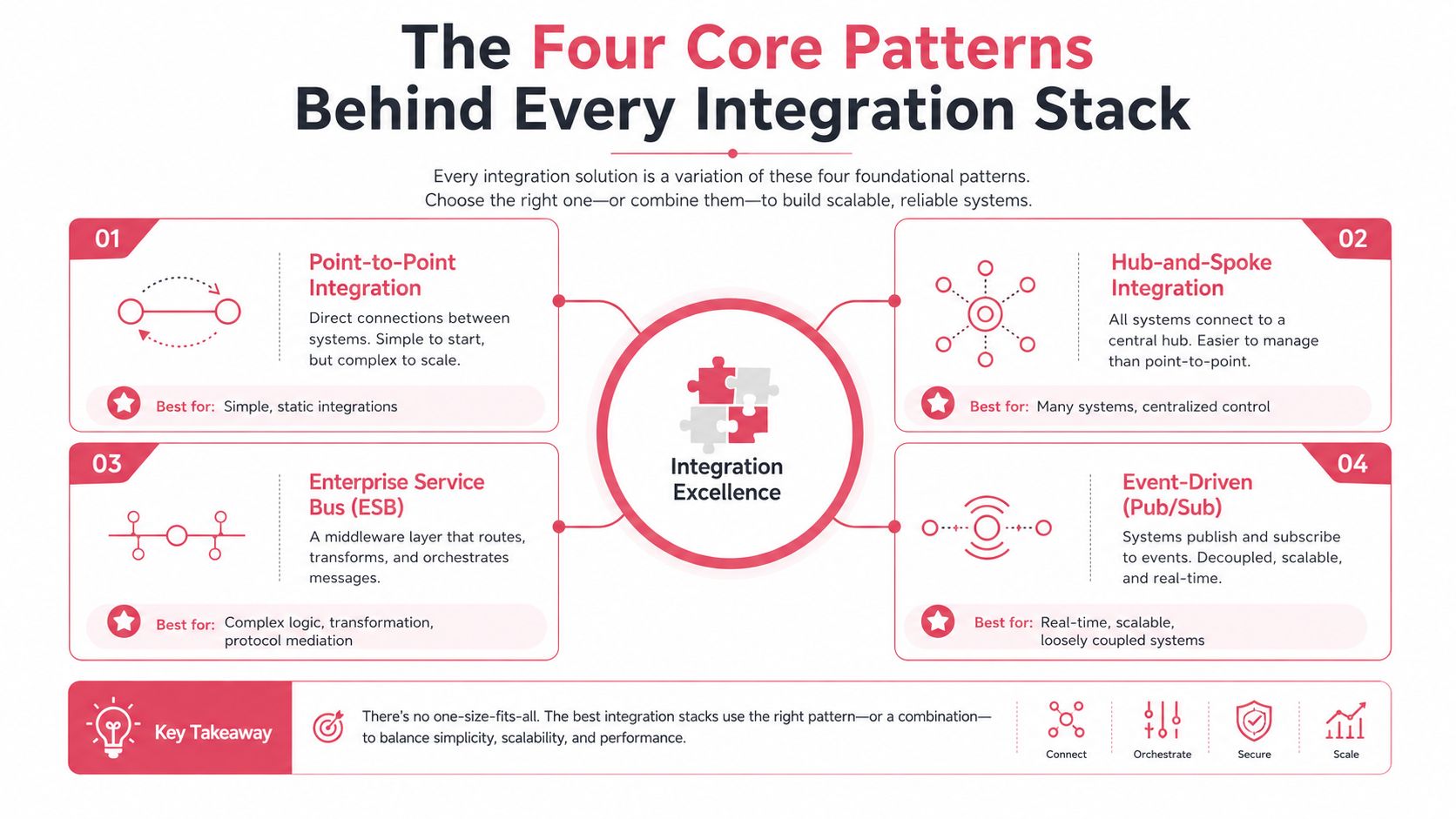
The four patterns below, batch sync, streaming, enrichment, and deduplication with schema mapping, provide the mechanics. A unified API can then give those mechanics one contract, but only if the quality rules remain visible and enforceable.
The Four Core Patterns Behind Every Integration Stack
A sales alert fired from unverified data can route the wrong account, while a delayed signal can miss the buying moment. Integration architecture therefore starts with data quality and decision risk, then chooses the movement pattern that fits the job. Freshness, volume, trigger sensitivity, and confidence determine the trade-off.
Batch sync
Batch sync moves records on a schedule or through a controlled bulk run. It suits CRM to warehouse reporting, historical backfills, billing reconciliation, territory rebuilds, and recovery after a failed pipeline. If sales leadership reviews pipeline each morning and a later refresh is acceptable, batch is usually easier to operate, audit, and replay than a continuous event system.
Batch creates a different risk when teams apply it to urgent workflows. A nightly export cannot reliably trigger a timely response to product activation or a high intent form submission. One malformed file or schema change can also affect a broad run, so validation before load and a clear rerun process matter.
Streaming
Streaming moves events as changes occur. It earns its operating cost when seconds affect routing, prioritization, or customer experience, such as a product usage signal creating a task or a high intent web action notifying a rep. Streaming still needs retry handling, ordering decisions, idempotency, queue capacity, and an owner for unavailable consumers.
A small team with modest volume rarely needs a streaming platform for every object. Keep the event path narrow for urgent changes, then use batch to reconcile the complete dataset.
Enrichment
Enrichment fills missing attributes from third party providers. Common inputs include firmographics, technographics, intent, hiring signals, contact details, and company identifiers. It pays off when missing fields affect routing, segmentation, account selection, or personalization. It wastes budget when providers repeatedly overwrite trusted internal values without changing a decision.
Treat provenance as part of the field, not as an afterthought. Retain the source, retrieval time, and confidence for each enriched value. A unified GTM API can apply the same contract across providers, while confidence scoring lets downstream workflows accept, review, or hold records without forcing the team into one enrichment vendor.
Dedupe and schema mapping
Dedupe collapses multiple representations of the same account, contact, lead, or opportunity. Schema mapping translates different field names and values into a canonical model. The two tasks belong together because a mapped record remains unsafe if three systems represent one company as three accounts.
A deterministic domain match may fit an account, while a contact may require email, name, employer, and other evidence. Probabilistic matching should send uncertain cases to review rather than merge them automatically. Confidence scores make that decision explicit and preserve a grading trail for operators.
| Pattern | Use it when | It is overkill when |
|---|---|---|
| Batch sync | Reporting, backfills, reconciliation, and bulk correction can tolerate scheduled movement | A rep must act on a signal immediately |
| Streaming | Event timing changes routing, engagement, or product response | The workflow only needs a periodic snapshot |
| Enrichment | Missing attributes change prioritization or segmentation | A provider adds fields without improving a decision |
| Dedupe and schema mapping | Multiple systems use different identities or field definitions | One controlled source already owns the record model |
Integrated systems have been tied to measurable commercial impact in industry reporting. One 2026 compilation reports that organizations can generate more than $5 million in incremental revenue over three years after data integration efforts, with sales revenue rising 21% to 30% on average after implementation. A separate 2026 benchmark reports 35% annual recurring revenue growth for businesses using integrated systems versus 19% for businesses using CRM alone. Those figures appear in the Salesforce integration ROI figures compilation. The practical lesson is narrower: connected workflows can produce value when identity, freshness, and confidence are controlled. Adding another connector without those controls can spread bad decisions faster.
Batch Versus Streaming and When Each One Pays Off
Batch and streaming solve different operational problems. Batch optimizes for controlled movement, repeatability, and efficient bulk work. Streaming optimizes for freshness, but it introduces a larger reliability surface.
A nightly CRM to warehouse load is a sensible batch job when reporting doesn't require live opportunity changes. The same pattern works for historical rebuilds and billing reconciliation, where completeness and replayability matter more than immediate delivery. Streaming is better for a product usage trigger, a high intent web event, or chat to rep routing where waiting for the next scheduled run could change the outcome.
| Dimension | Batch | Streaming |
|---|---|---|
| Freshness | Scheduled and predictable | Near immediate when the event path is healthy |
| Cost per record | Efficient for bulk movement | Efficient for narrow, high value events |
| Failure mode | A run can fail across a large data set | Retries, ordering, and consumer failures require active handling |
| Replayability | Straightforward reruns and backfills | Requires durable events, offsets, and idempotency |
| Downstream impact | Consumers process a defined snapshot | Consumers must tolerate partial arrival and change order |
| Best fit | Warehousing, reconciliation, and historical correction | Routing, alerts, triggers, and event driven automation |
The strongest architecture is often hybrid. Batch handles the full account and opportunity population, while streaming carries only the changes that need immediate action. A later batch pass reconciles missed events, repairs drift, and confirms that the operational systems match the warehouse.
The hidden cost of immediacy
Streaming budgets must include more than connector fees. Webhook retries can create duplicates. Events can arrive out of order. A consumer may process the same event twice after a timeout. Queues can build pressure when a downstream API throttles requests.
Every event should carry an idempotency key, and each consumer should record whether that key has already been applied. Teams also need a dead letter path for events that can't be processed, plus a replay procedure that doesn't require manual database surgery.
Streaming is justified when delayed data changes the action. If the action remains the same tomorrow, batch is usually the more disciplined choice.
For a deeper comparison of operational cost, replay behavior, and latency trade offs, teams can use this batch processing trade offs guide. The decision should be made per workflow, not per company. A revenue team can need streaming for one trigger and batch for most of its reporting surface.
Enrichment, Dedupe, and Schema Mapping as One Quality System
Enrichment, deduplication, and schema mapping should be operated as one record quality system. Enrichment adds evidence. Dedupe resolves identity. Schema mapping gives downstream consumers a consistent shape. If the sequence is wrong, the team can enrich the wrong person, merge the wrong account, and then distribute the error across every connected tool.
Grade fields, not just records
A record level score is useful for routing, but field level decisions are safer. Each important field needs a confidence threshold, a freshness window, and a conflict rule. A company domain may be deterministic, while a hiring signal may be probabilistic and time sensitive.
The following model gives RevOps a practical starting point. Thresholds should be adjusted to the cost of a wrong action, and the source system should retain the raw value alongside the normalized value.
| Field | Confidence Threshold | Freshness Window | Conflict Rule |
|---|---|---|---|
| Company domain | Deterministic match required | Recheck when the account identity changes | Verified domain wins over inferred domain |
| Company name | Strong source agreement | Refresh during account review | Longest tenured trusted source wins unless a legal name is verified |
| Contact email | Above the team's accepted validation threshold | Validate before an outbound action | A current verified address wins over an older address |
| Employee count | Provider confidence above the routing threshold | Refresh when segmentation changes | Prefer the source with the clearest retrieval date |
| Intent or hiring signal | Signal confidence above the action threshold | Expire after the defined signal window | Newer corroborated signal wins |
| Account owner | Exact CRM relationship | Update on territory change | CRM assignment remains authoritative |
Enrichment output should flow into the dedupe key before schema mapping. For example, a provider may return a domain that allows the system to connect a prospect to an existing account. The system can then normalize the account, preserve the provider evidence, and prevent three downstream applications from creating competing identities.
Teams comparing enrichment approaches can use this guide to evaluate lead enrichment tools, but vendor coverage isn't a substitute for field governance. A provider with broad coverage can still produce values that are stale, inferred, or inconsistent with internal records.
Make quality reusable
Once the canonical record carries identity, source, timestamp, and confidence, pipeline reporting can consume it directly. Lead routing can filter on the fields it needs. AI prompts can receive only approved attributes rather than raw, contradictory payloads. The team shouldn't have to clean the same record again for every consumer.
Security, Compliance, and Observability as Operating Practices
Security and observability must run with the integration, not sit in a document that nobody revisits. Sales data moves through providers, queues, logs, warehouses, and AI workflows, so each handoff needs a clear owner and a controlled permission boundary.
Control access at the integration level
Use a separate, scoped API key for each provider and give it only the permissions required for that workflow. RevOps administrators may manage mappings and approve changes, while downstream consumers should receive only the fields and actions they need. Rotate credentials on a defined schedule, remove unused access, and record every permission change.
PII requires a deliberate boundary. Mask sensitive fields before they reach logs, debugging tools, or AI prompts unless the workflow has a documented reason to use them. A CRM export that includes an email address may be operationally necessary. The same address rarely belongs in an unrestricted error log.
SOC 2 and GDPR controls become practical when translated into system behavior. Teams need to choose where data is stored, document the lawful basis for enrichment, define retention windows, and propagate a right to be forgotten request through CRM, warehouse, enrichment, messaging, and backup processes. A delete in one application isn't complete if a downstream system can restore the record on its next sync.
Observe the path, not just the endpoint
Good observability shows whether records are arriving, changing, and remaining trustworthy. Track sync latency against an agreed service objective, preserve source attribution on every field, alert on schema drift, and route failed events into a replayable dead letter queue. A green connector status doesn't prove that a field mapped correctly or that a provider returned current data.
A quarterly RevOps audit should answer:
- Access: Which keys and service accounts can read or write sales data?
- Lineage: Can the team identify the source and retrieval time for every critical field?
- Drift: Did any provider change a field type, enum, or required value?
- Failures: Are failed events replayable without creating duplicates?
- Privacy: Were deletion, retention, and consent requests propagated downstream?
- Quality: Did accuracy, completeness, freshness, and uniqueness remain within their field level thresholds?
That operating discipline matters because only 35% of sales professionals fully trust the accuracy of their sales data, according to the Salesforce State of Sales report for 2026. More connectivity won't repair a trust deficit unless the team can see how data was produced and decide when it is safe to use.
How a Unified GTM API Simplifies Orchestration and Downstream Automation
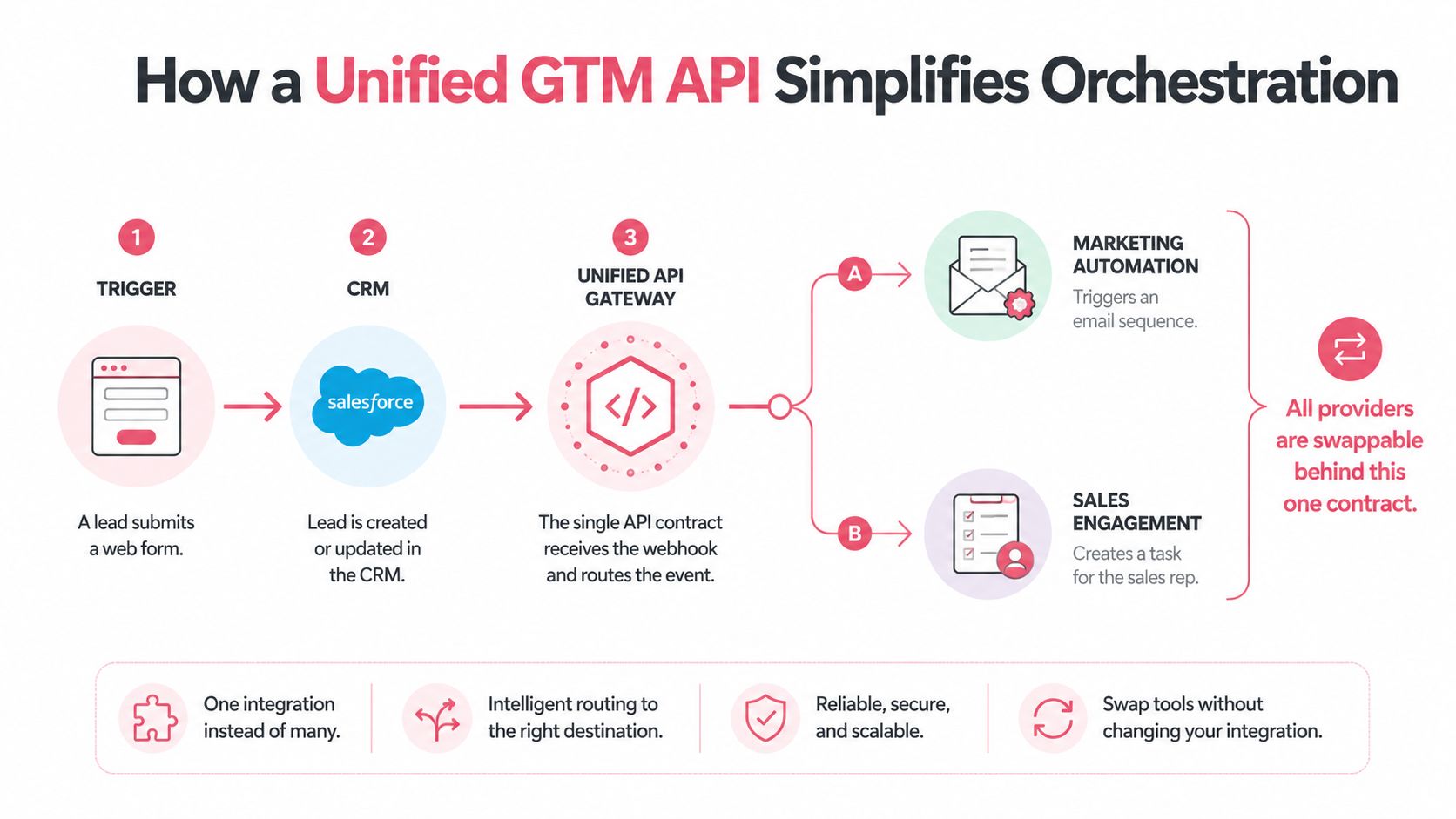
A unified GTM API reduces connector sprawl by giving internal workflows one contract while keeping providers behind it replaceable. It doesn't remove the need for provider specific behavior. It contains that behavior in an orchestration layer instead of forcing every downstream consumer to understand every vendor's schema, rate limit, retry model, and failure response.
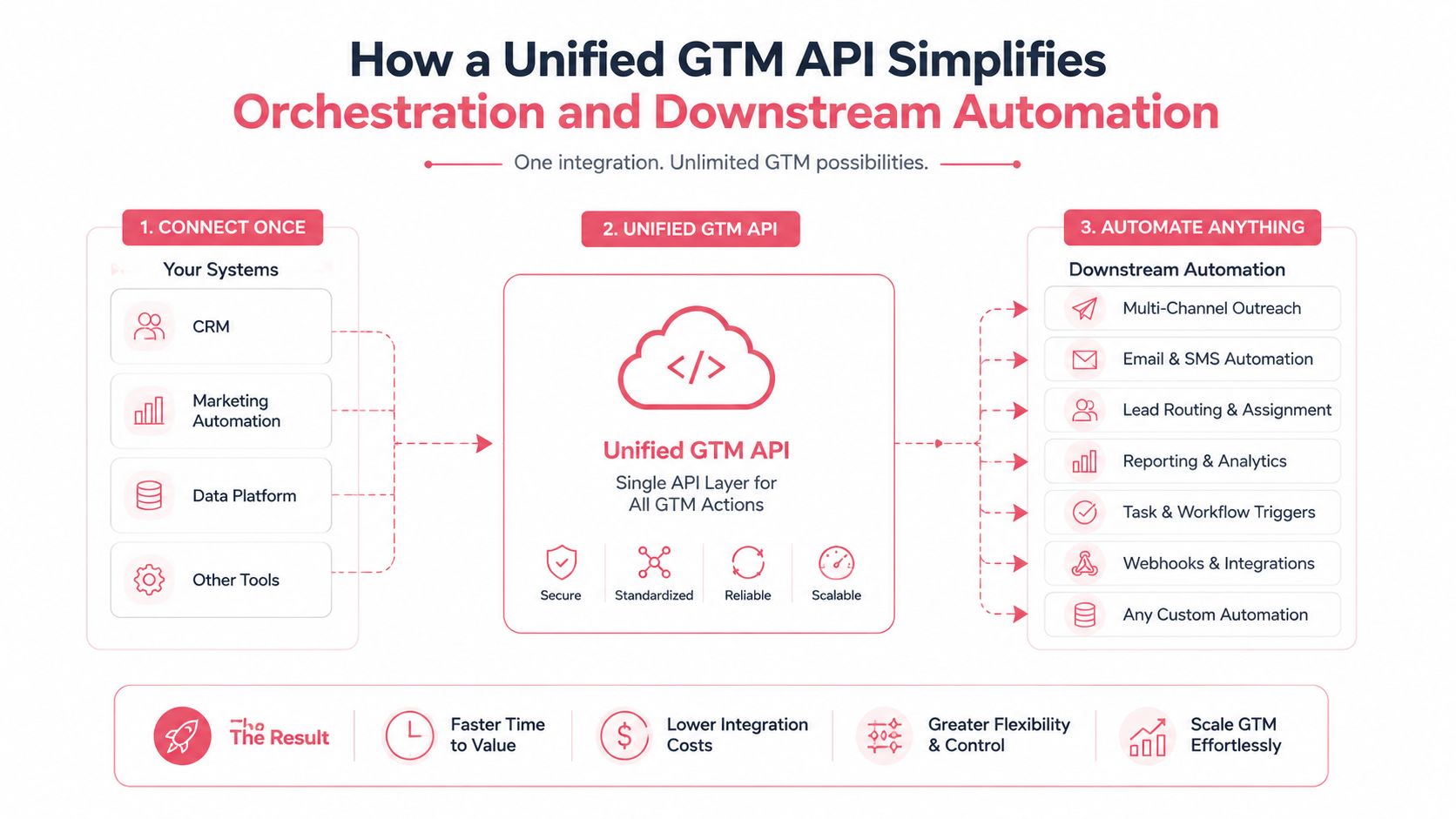
Consider a lead that lands in the CRM. The API receives the event, assigns an idempotency key, and calls available enrichment providers in parallel. It then applies the field thresholds, resolves the account identity, deduplicates the contact, normalizes the output, and writes one graded record back to the CRM.
The sequence matters:
- Receive and identify: Capture the source event, provider context, event time, and idempotency key.
- Enrich selectively: Query the sources needed for the missing or decision critical fields instead of enriching every record indiscriminately.
- Grade evidence: Store confidence, freshness, and source attribution at field level.
- Resolve identity: Match the contact and account before downstream tools receive the record.
- Normalize the contract: Return stable field names, value types, and status values.
- Fan out safely: Send approved outputs to sequencing, scoring, reporting, or human review.
Provider fallback is part of the design. If one enrichment source is degraded, the orchestration layer can use an approved alternative or return a partial result with a lower confidence state. Rate limit handling belongs in the same layer, with backoff, queue controls, and clear behavior for records that can't be completed.
Downstream automation should code against the normalized contract, not against three different provider payloads. That lets a sequence runner, lead scorer, CRM sync, and AI agent reuse the same graded identity. Teams evaluating list validation and cleanup can also review CleanMyList integration options as part of a broader provider comparison, while keeping the normalized contract under internal control.
A unified contract can still create lock in if it hides raw evidence or makes exports difficult. Keep raw provider passthroughs, preserve original identifiers, version the schema, and support portable exports. Teams that want to combine provider choice with a bring your own key model can review unified GTM API enrichment patterns. The interface should simplify operations without taking ownership of the team's data, credentials, or playbooks.
Why More Integrations Can Worsen Decisions and What to Do About It
More integrations can lower decision quality when they add conflicting claims faster than the team can grade them. A CRM may hold one employee count, an enrichment provider another, and a warehouse snapshot a third. If all three values flow into forecasting and AI prompts, the system has more data but less usable certainty.
Common failure modes
Source collisions are the most visible problem. Two providers may disagree about headcount, industry, company name, or account status. Without a survival rule, the last write wins, even when the last write came from a less reliable source.
Propagated errors are harder to find. A bad domain match can attach a contact to the wrong account. That account then receives enrichment, routing, campaign membership, and reporting history. Every downstream system appears to work, but all of them now operate on the same wrong identity.
Contradictory fields also create poor AI inputs. An agent asked to prioritize accounts may treat conflicting values as equally credible. It can produce a confident recommendation based on a record that no human would approve after inspecting the sources.
The operational fix is a confidence scoring layer. Grade each record and each critical field, suppress values below a configurable action threshold, and send disagreements to a human review queue before they reach the CRM or an outbound workflow. The score should explain its inputs, not act as an opaque badge.
A unified GTM API can centralize this grading while leaving providers swappable. The team can change an enrichment source without rewriting routing, scoring, reporting, or AI consumers, provided the normalized contract and evidence model remain stable.
Audit the stack with five questions
- Identity: Can every active account and contact be tied to a defensible canonical identity?
- Provenance: Does each critical value show its source and retrieval time?
- Conflicts: What happens when two sources disagree, and who reviews the exception?
- Suppression: Can low confidence records stay out of sequences, forecasts, and AI prompts?
- Recovery: Can the team replay failed work without duplicating CRM updates?
Forecasting suffers when pipeline stages, ownership, activity, and account context don't share the same quality rules. Teams reviewing those dependencies can use this practical guide to improve sales forecast accuracy. The central test remains simple: can a revenue leader understand not only what the system says, but why it believes the record?
Yalc connects CRM, enrichment, outreach, messaging, and reporting workflows through a unified GTM API with provider specific logic behind one contract. Visit Yalc to see how its confidence scored automation, scoped execution, and portable playbooks can help your team move sales data without sending ungraded records into the motion.