Sales Lead Automation: A Practical Operator's Guide
A lead that waits 30 minutes instead of 5 minutes is associated with approximately 100 times lower odds of contact and approximately 21 times lower odds of qualification, according to a lead response study covering more than 15,000 web form leads and over 100,000 call attempts across six companies over three years. The figures don't promise closed revenue, but they establish the operating problem clearly: sales lead automation must reduce the time between buyer intent and accountable sales action. (Plura's summary of the lead response study)
The strongest systems aren't built to send more messages. They're built to decide what should happen next, execute that action consistently, stop when the evidence says to stop, and preserve enough context for an operator to explain the decision later. That makes sales lead automation a governed control plane for pipeline, not a volume machine.
Table of Contents
- What Sales Lead Automation Actually Does
- The Six Stages of the Lead Lifecycle
- Lead Scoring That Prioritizes the Right Accounts
- Sequencing, Reply Handling, and Channel Coordination
- Governance and the Audit Trail Every Automation Needs
- When the System Should Stop Pursuing a Lead
- Reporting and the Metrics That Actually Matter
What Sales Lead Automation Actually Does
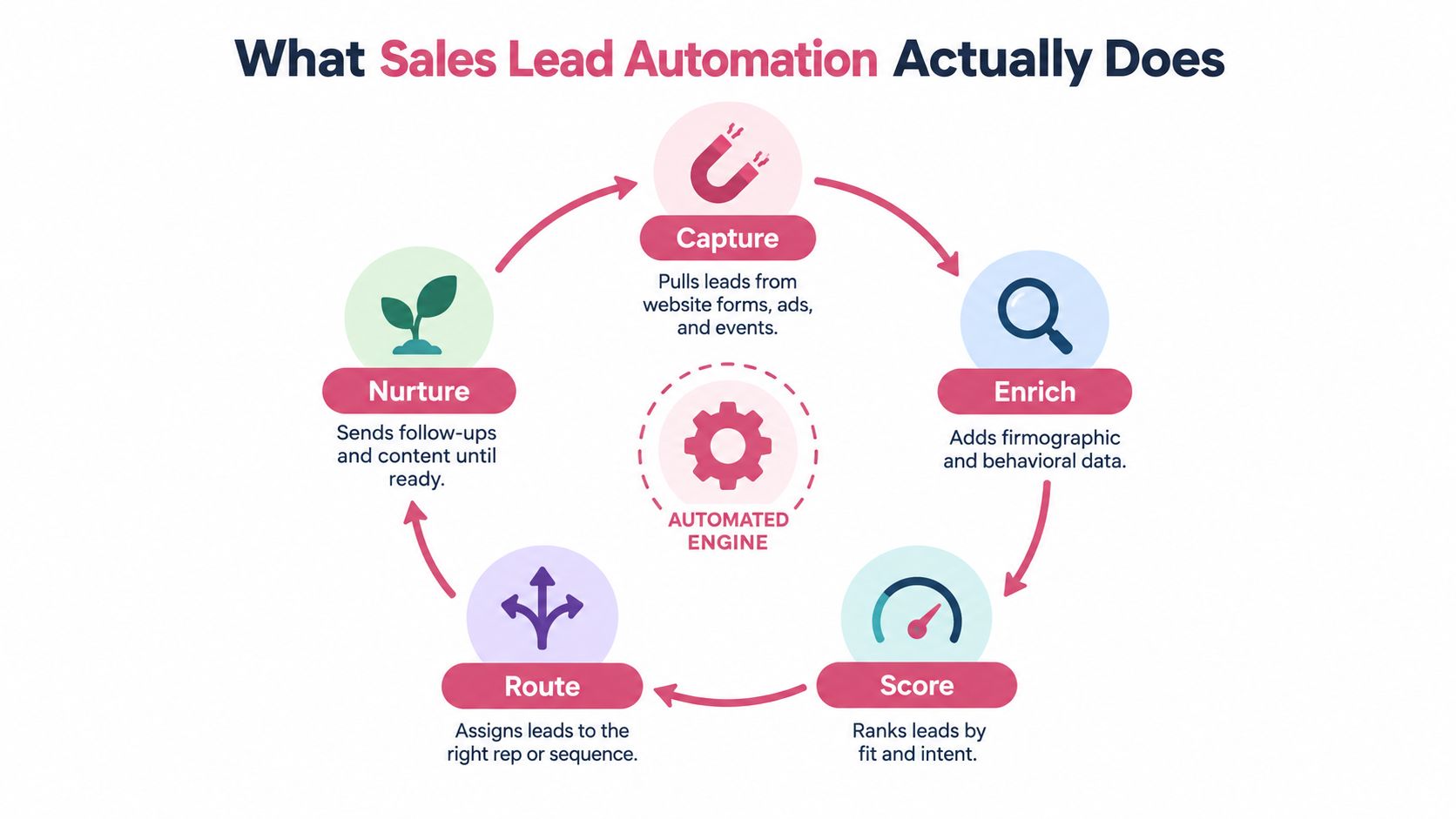
Sales lead automation connects the full journey from signal to outcome. A website form, event registration, advertisement response, or high intent page visit creates an input. The system then enriches the record, evaluates fit and intent, assigns ownership, starts the appropriate motion, handles replies, and records what happened.
Treating these tasks as separate tools creates hidden failure points. A reliable enrichment provider can't compensate for a routing rule that sends a lead to an unmonitored queue. A carefully written sequence can't recover a record that lost its source, consent status, or account owner. Reporting becomes misleading when reply outcomes aren't written back to the same record that triggered the campaign.
Draw the lifecycle before choosing tools
A useful whiteboard model has five connected actions:
- Capture the lead and preserve the original event, source, timestamp, and consent context.
- Enrich the record with the firmographic, role, behavioral, and account information needed for a decision.
- Score the account or person against fit, intent, pipeline context, and known exclusions.
- Route the record to a representative, queue, nurture path, watch list, or disqualification flow.
- Nurture the lead with controlled follow up until a buying signal, reply, suppression event, or exit condition appears.
The loop matters because nurture activity creates new behavior, and new behavior can change the score or route. A system that only pushes records forward isn't intelligent enough for complex B2B motions. It must also support pauses, reversals, requalification, and global suppression.
Speed is useful only when ownership is clear
Historical research cited by the Harvard Business Review found that 37% of companies responded to an online lead within one hour, while 23% never responded. Among companies that did respond within 30 days, the average response time was approximately 42 hours. The same research associated a response within one hour with leads being nearly 7 times more likely to qualify than leads answered later, and more than 60 times more likely than leads answered after at least 24 hours. (Ainora's summary of the lead response research)
Automation removes repeated work, but it doesn't create accountability by itself. Founders, GTM leaders, RevOps teams, and agencies still need a named owner for every route, a backup path when that owner is unavailable, and a record of the decision that moved the lead. Teams comparing the tooling layer can also see HarvestMyData's recommended tools, then map each product to a specific lifecycle stage rather than assembling another disconnected stack.
Practical rule: Automate the handoff, not the responsibility. Every lead should have a next action, an owner, and an exit condition.
The Six Stages of the Lead Lifecycle
A complete system handles six jobs. The first five move and manage the lead. The sixth proves whether the motion deserves to continue.
The six jobs
List building creates a usable set of accounts or people from inbound events, approved prospecting sources, intent signals, or existing CRM records. Its output is a deduplicated record with provenance, not merely a name in a spreadsheet. The failure it prevents is wasted research on incomplete or duplicated targets.
Enrichment adds the context needed to act. That can include company details, role information, technology signals, account relationships, and recent activity. The system should preserve the provider and timestamp for each important field, because stale enrichment can look like a bad lead when the actual problem is bad data.
Scoring ranks records by expected value and readiness. Static fit rules still have a place as safeguards, but the score should also reflect behavior, pipeline state, historical outcomes, and exclusions. Its output should include a reason that a representative can inspect.
Sequencing turns a decision into an approved series of actions across email, LinkedIn, calls, or other permitted channels. The sequence needs entry rules, timing rules, personalization boundaries, and stop conditions. A useful reference for planning the message architecture is Mailadept's guide to cold email sequence structure.
Reply handling interprets inbound responses and changes the record. A positive reply should create a human task or meeting path. A request to stop should suppress future marketing. An ambiguous message should pause automation instead of forcing a confident classification.
Reporting connects each action to a measurable outcome. It should show where records entered, what the system changed, how quickly it acted, which playbook ran, and whether the resulting conversation became qualified pipeline.
| Stage | Primary Input | Primary Output | Working Metric |
|---|---|---|---|
| List building | Approved sources and buying signals | Clean target records | Valid records accepted |
| Enrichment | Email, domain, account, or event data | Contextual lead profile | Match quality and completeness |
| Scoring | Fit, behavior, pipeline, and history | Ranked priority with reasons | Precision at team capacity |
| Sequencing | Approved segment and playbook | Timed actions | Qualified reply rate |
| Reply handling | Email, call, or social response | Intent, owner, and next action | Correct routing |
| Reporting | Events and outcomes | Stage and revenue view | Pipeline created and conversion |
The table is useful only when ownership is explicit. A person can own the scoring policy while a workflow applies it. RevOps can own data quality while sales owns the response. Marketing can own nurture content while a compliance owner controls suppression logic. The system should never leave a stage between teams without a defined handoff.
Lead Scoring That Prioritizes the Right Accounts
A lead score should answer a scarce capacity question: which records deserve attention first? A binary qualified or unqualified label hides too much information. Ranking lets the team spend limited representative time on the accounts with the strongest combination of fit, intent, and expected value.
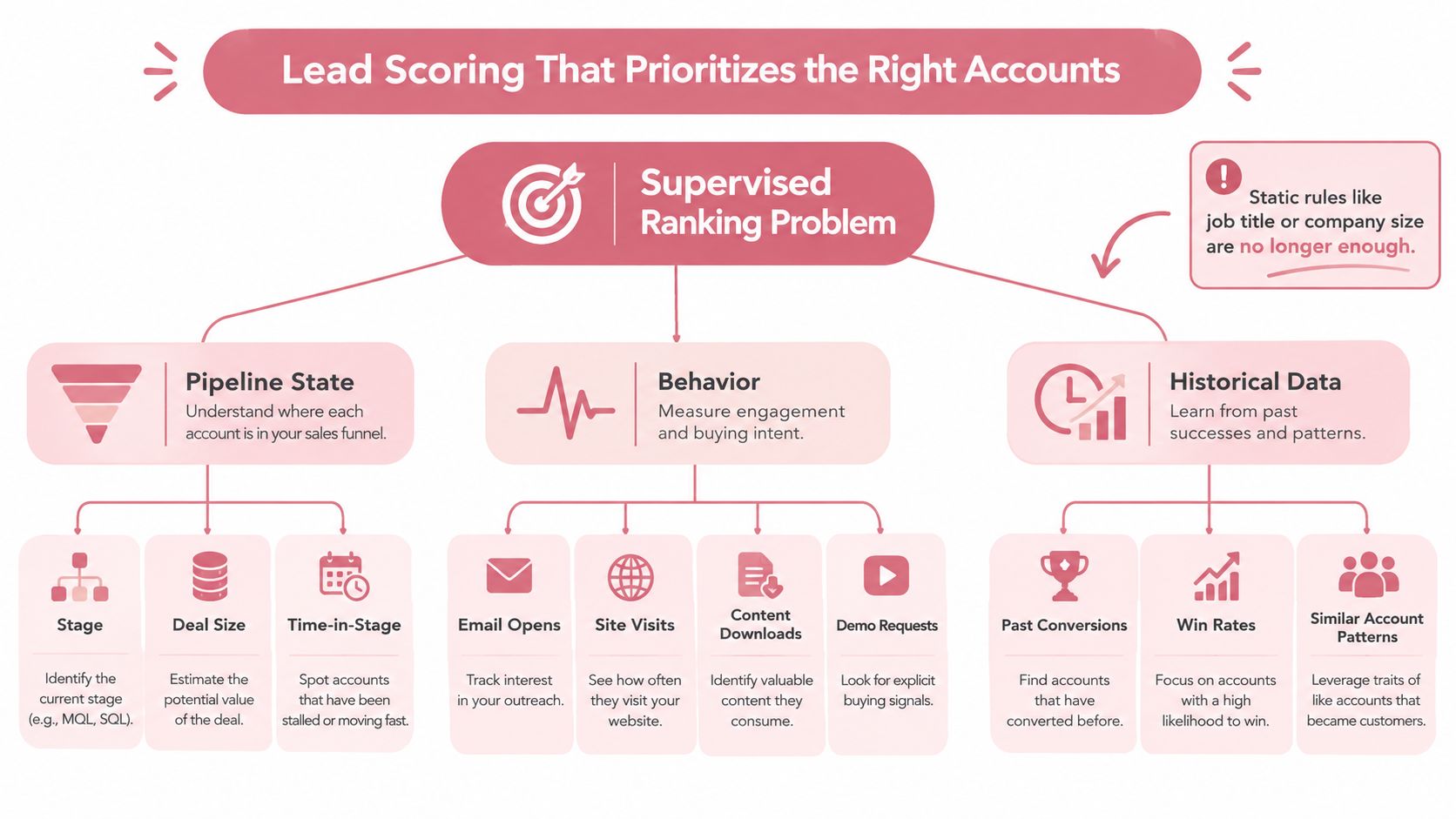
Static rules such as job title or company size can filter obvious mismatches, but they don't explain timing or account momentum. A prospect at an ideal company who has shown no relevant activity may deserve less immediate attention than a less obvious account returning to a product or pricing page while an opportunity is already progressing.
Separate fit from behavior
A practical scoring layer evaluates three different evidence groups:
- Fit signals describe the account and person, such as industry, role, geography, or relationship to the target customer profile.
- Behavior signals describe current interest, such as replies, return visits, content activity, meeting requests, or meaningful product research.
- Pipeline signals describe commercial context, such as opportunity stage, time in stage, opportunity size, and prior interactions.
The output shouldn't be a mysterious number. It should contain a calibrated conversion probability or rank, the features that influenced the result, the source and freshness of those features, and the recommended next action. A representative can then challenge the score when the record contains information the model can't see.
A 2025 study using more than 78,000 B2B opportunity records and 17 variables compared several models. XGBoost achieved 95.57% accuracy, 98.3% precision, 95.9% recall, and a 0.993 AUC on the evaluated dataset. The strongest reported predictors included sales velocity, qualification board score, and opportunity size. (The RIT study on B2B opportunity prediction)
Optimize for the queue the team can actually work
Aggregate accuracy can conceal operational failure. If representatives can contact only the highest ranked part of the queue, the useful test is precision at that capacity limit, such as the top 100 records the team can address in a day. The score should also be reviewed by segment, territory, source, and account type because a model can perform well overall while failing for a strategically important group.
Teams building the operating model can use this lead scoring guide for RevOps teams as a planning reference, then document their own thresholds and review rules. A deeper explanation of the underlying concept is available in Yalc's guide to lead scoring.
Retraining matters when pricing, territories, channels, or the target customer profile changes. Human approval should remain mandatory for irreversible actions, high impact decisions, sensitive industries, and borderline records. A score is a prioritization instrument, not permission to remove judgment from the process.
Sequencing, Reply Handling, and Channel Coordination
A sequence earns the right to continue only when each new action responds to the latest signal. Sending the next message because a timer expired is weaker than checking whether the person replied, changed role, opted out, entered another motion, or became an active opportunity.
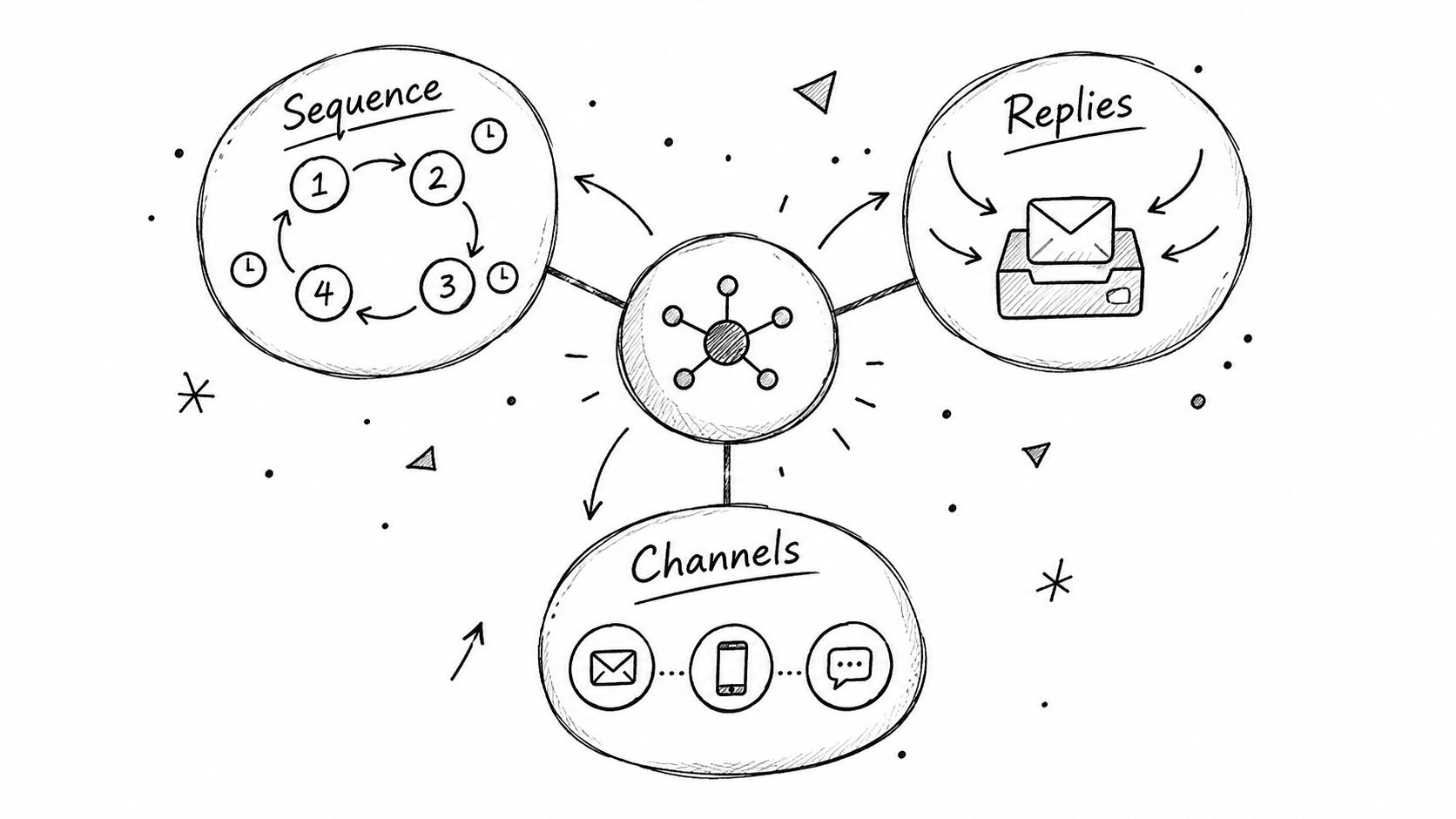
Consider a simple outbound motion for a target account. The system starts with an approved account and a verified contact, sends an email that reflects the account's problem, adds a LinkedIn touch when the channel is appropriate, follows with a useful proof point, then creates a human task for a relevant reply. The sequence is not a fixed broadcast. It is a state machine that changes when the record changes.
Define reply intents before launch
A reply classifier can route messages into a small set of operational categories:
- Positive intent: pause all automated outreach, assign the record to a representative, and create a next action with the original message attached.
- Question or evaluation: pause the sequence and route to someone able to answer. Don't let a generic continuation email ignore the question.
- Not now: record the timing objection, set a permitted review condition, and avoid repeated pursuit before that condition is met.
- Negative intent: record the disqualification reason and suppress the relevant motion.
- Opt out: apply global suppression across every marketing workflow and channel that uses the record.
- Unclear intent: send the message to a human review queue instead of guessing.
Channel coordination isn't channel stacking. Email, LinkedIn, calling, and chat should share one status, one suppression state, and one owner. If a person responds by email, the system must stop the LinkedIn action as well. A single inbox or synchronized activity layer prevents representatives from seeing only one part of the conversation.
Protect the system from its own persistence
Frequency caps, quiet hours, duplicate checks, and account level exclusions are operational controls. They protect deliverability and buyer experience while preventing two representatives or two campaigns from contacting the same person with conflicting messages.
The LinkedIn outreach automation guide is useful when designing the channel layer, but the implementation still needs clear permission boundaries and stop rules. Every send should write an event back to the lead record, including the playbook version, channel, timestamp, approval state, and resulting classification.
The system should treat replies as new evidence. A positive reply can raise priority. A clear rejection should lower it or suppress the account. A role change may invalidate the contact entirely. The sequence becomes safer and more useful when every response changes the next decision.
Governance and the Audit Trail Every Automation Needs
The hard part of sales lead automation isn't making the system act. It's proving why it acted, whether it had permission to act, and what changed afterward. IBM's 2025 to 2026 State of Salesforce research found that only 33% of surveyed organizations' AI initiatives were meeting ROI targets, while just 21% strongly agreed that they had the governance needed for AI. (HubSpot's summary of the sales AI research)
That gap makes governance an operating requirement rather than a legal appendix.
Build a control plane around each action
A useful control plane has four layers:
- Scoped permissions: Give each agent access only to the records, channels, and actions it needs. A scoring worker shouldn't have permission to send outbound messages.
- Approval thresholds: Require human review for sensitive segments, uncertain classifications, irreversible changes, and messages that fall outside an approved playbook.
- Step telemetry: Record the trigger, input fields, enrichment sources, rule or model version, score, action, delivery result, and response.
- Rollback and retirement: Make it possible to disable a play, restore a previous version, and retire a weak hypothesis without deleting the evidence that it ran.
A decision record should distinguish a bad lead from a bad workflow. If an enriched company size is stale, the problem is data freshness. If the right data entered but the route failed, the problem is logic. If the route worked but the message created negative replies, the problem is positioning or playbook design.
Trust is built by proving why the system did what it did.
Treat human review as real intervention
UK GDPR Article 22 restricts decisions made solely through automated processing when they have legal or similarly significant effects on an individual. Where automated decision making is permitted, safeguards include human intervention, the ability to express a point of view, and the ability to contest the decision. The UK Information Commissioner's Office says the reviewer needs enough authority and capability to change the result, not merely approve it. (UK GDPR Article 22)
Organizations using AI to evaluate people should retain the input data, score, decision, reviewer, review time, challenge, and final outcome. UK data protection guidance also recommends regular checks that automated systems work as intended. (UK ICO guidance on individual rights in AI systems)
A weekly governance check should ask:
- Can the team reconstruct the decision? The record contains inputs, versions, and outputs.
- Can the team stop the motion? A play can be disabled without destroying historical evidence.
- Can a person change the result? Reviewers have authority, context, and a documented override path.
- Can the team detect drift? Performance is checked by segment and source.
- Can the team explain confidence? Each play is marked as a hypothesis, validated play, or proven play.
When the System Should Stop Pursuing a Lead
A system that never stops is not persistent. It's uncontrolled. Sales lead automation should treat restraint as a designed outcome, with clear signals that pause a sequence, disqualify a record, or suppress an account across the entire system.
Silence alone doesn't always mean rejection. It may mean the account isn't in market, the role changed, the message missed the problem, or the contact prefers independent research. The system should preserve that uncertainty instead of endlessly optimizing copy against an account that isn't ready to engage.
Define negative intent operationally
Useful stop signals include:
- An explicit opt out: Record the request and propagate suppression across every relevant campaign.
- A clear negative reply: Store the reason, stop the current motion, and prevent near duplicate outreach.
- A role or company change: Recheck identity and ownership before sending another message.
- Repeated silence: Pause after the approved touch policy and move the record to a review or low frequency nurture state.
- Conflicting activity: Stop one sequence when another campaign, opportunity, or representative already owns the account.
- Unresolved ambiguity: Escalate messages that the classifier can't interpret confidently.
For commercial email in the United States, CAN SPAM guidance requires accurate sender information, nondeceptive subject lines, clear identification of the message as an advertisement, and a clear opt out mechanism. The opt out process must handle requests for at least 30 days after the message is sent, and the sender must honor a request within 10 business days. (Federal Trade Commission CAN SPAM compliance guide)
Suppression must be global. Removing a person from one sequence isn't enough if another workflow can import the same record tomorrow. The suppression state should travel with the person and account across email, social, nurture, retargeting, and representative task creation.
Every automated action needs both an entry condition and an exit condition.
Disqualification is also useful training data. Capture why the account stopped, whether the data was wrong, whether the timing was poor, and whether the message was irrelevant. Those outcomes help separate a bad lead from a bad play and improve future ranking.
Reporting and the Metrics That Actually Matter
A useful report follows the lifecycle, not the tool menu. It shows whether the system captured valid demand, enriched it sufficiently, ranked it sensibly, routed it quickly, earned replies, and created commercial outcomes.
Read the report by stage
Leading indicators reveal operational health:
- Capture: accepted records, duplicate rate, and source completeness.
- Enrichment: match rate, field freshness, and unresolved records.
- Scoring: ranking quality at representative capacity and override rate.
- Routing: median and 95th percentile response latency by source, geography, business hours, and lead score. (Retell's speed to lead analysis)
- Sequencing: qualified replies, stop events, and messages that required human review.
- Reporting: pipeline created, conversion by playbook, and tooling cost against outcomes.
The lagging view should connect meetings to opportunities, wins, and revenue without claiming that automation caused every downstream result. Segment every metric by source, account type, geography, and playbook. A fast average can hide a severe queueing problem, while a strong reply rate can conceal poor qualification.
Leaders setting up the dashboard can use these sales dashboard examples as a reference, then tie every chart to an owner and an action. Retire a play when evidence stays weak, revise it when one stage fails, and promote it only when the result holds across the segments that matter.
FAQ
What should the weekly review cover? Start with one metric for capture, enrichment, scoring, routing, sequencing, and commercial outcome. Then inspect exceptions and human overrides.
Should teams optimize open rates? Only as a diagnostic. Qualified replies, meetings, pipeline, and suppression outcomes are closer to the decisions the system is meant to improve.
When should a play be retired? Retire it when the intended outcome remains weak after data quality, routing, and compliance checks rule out operational causes.
Yalc connects research, enrichment, scoring, routing, sequencing, reply handling, and reporting through a unified GTM API with scoped permissions, human approvals, and step level telemetry. GTM teams can visit Yalc to explore governed lead automation that records each play's outcome and helps separate validated motions from weak experiments.