Sales Playbook Software: The Operator's Guide
The popular advice is to build a better sales playbook. That advice is incomplete. There is not a documentation problem. There is an execution problem. Reps can't consistently apply guidance they have to search for, interpret, remember, and self report while managing live opportunities.
A useful sales playbook system has to do more than store messaging. It must place the right action inside the seller's workflow, enforce the conditions for moving a deal forward, record what happened, and connect execution to outcomes. The central buying question, therefore, isn't which platform has the best content library. It's which platform can close the distance between what the team designed and what sellers do.
Table of Contents
- Why Most Sales Playbooks Fail at Execution
- What Sales Playbook Software Actually Does
- Traditional Platforms Versus AI Native Architectures
- How to Choose the Right Platform for Your Team
- Real Playbook Examples That Drive Pipeline
- Implementation Checklist for the First 30 Days
- Measuring ROI and Proving Impact
Why Most Sales Playbooks Fail at Execution
More content rarely fixes weak sales execution. Teams often add battle cards, discovery scripts, objection libraries, and stage guides to Notion or Google Drive, then assume sellers will find and use them at the right moment. In practice, the documents become optional references. Reps rely on memory, personal templates, manager preferences, or whatever appeared most recently in Slack.
That gap is now a recognized enablement problem. Reporting from Supered's State of Sales Enablement identifies adoption and behavior change as a top pain point for 28% of respondents, while proving impact and ROI accounts for 25%. Those figures point to a practical failure: teams spend energy producing guidance, but struggle to change behavior and demonstrate that the guidance affected revenue.
Practical rule: If a playbook can be ignored without changing the workflow, it's a reference library, not an operating mechanism.
The document repository problem
A static playbook usually describes what a rep should do. It doesn't know whether the rep reached the right stage, completed the required action, used the approved message, or achieved the intended result. Usage data is often limited to page views or self reported completion, which tells managers that someone opened a file, not that a play was executed well.
The problem becomes more serious when ownership is unclear. Messaging changes, competitors move, products evolve, and qualification standards shift. Without version control and a named owner, sellers quickly lose confidence in the material. Once trust drops, the team returns to private workarounds.
Enforcement has to sit in the workflow
Operational playbooks define entry criteria, exit criteria, service level agreements, best next actions, and required fields. When those rules live inside the CRM, the system can route work, create tasks, surface templates, and expose missing information before a deal advances. Pedowitz Group's guidance on shared playbooks describes this model as embedding playbook logic in the system of record so execution becomes measurable and handoffs become more consistent.
That distinction changes the implementation target. The team shouldn't ask, “How do we write a complete playbook?” It should ask, “What must happen at this stage, who owns it, what evidence proves completion, and what outcome determines whether the play remains active?”
What Sales Playbook Software Actually Does
Sales playbook software packages a sales motion into reusable guidance for outreach, calls, proposals, qualification, and deal progression. Its job is to make the next appropriate action easier to find and harder to skip. That can include a discovery question set, an objection response, a proposal checklist, a follow up template, or a task sequence tied to a specific buyer situation.
The important distinction is operational context. HubSpot describes playbooks as interactive cards inside sales software, while the product description from Highspot's sales playbook software page emphasizes stage specific guidance for activities such as prospecting, nurturing, and pitching a product. A rep should encounter guidance inside the work, not open a separate folder and interpret a long document.
The mechanics behind an operational play
A functioning play has a trigger, a defined action, and a way to judge completion. For example, a qualification play might activate when a lead reaches a defined score. It can then require an assigned owner, a discovery task, specified CRM fields, an SLA for follow up, and an exit condition such as a qualified opportunity or a documented disqualification.
That structure matters because sales playbook software isn't content storage. Industry analysis of sales playbook software describes the category as a way to package sales motions into reusable guidance while reducing scattered content, inconsistent messaging, and weak visibility into usage and outcomes.
What separates software from a shared drive
A shared drive answers, “Where is the file?” A playbook system answers, “What should happen now, based on this account, stage, persona, and result?” The difference usually appears in five capabilities:
- Context: Guidance is mapped to a stage, persona, trigger, or account condition.
- Workflow: The system creates tasks, routes ownership, and identifies missing inputs.
- Governance: Owners manage versions, approvals, and review cycles.
- Measurement: Managers can connect execution to conversion, win rate, and deal movement.
- Feedback: The system captures results so weak plays can be revised or retired.
The software category has also become commercially meaningful. One independent estimate places the sales playbook management software market at USD 2.5 billion in 2024, with a projection of USD 8.3 billion by 2033 and a 16.2% compound annual growth rate, as reported by Guideflow's market analysis. The underlying operational need is straightforward: teams want repeatable selling motions that can be deployed, monitored, and improved across markets.
Traditional Platforms Versus AI Native Architectures
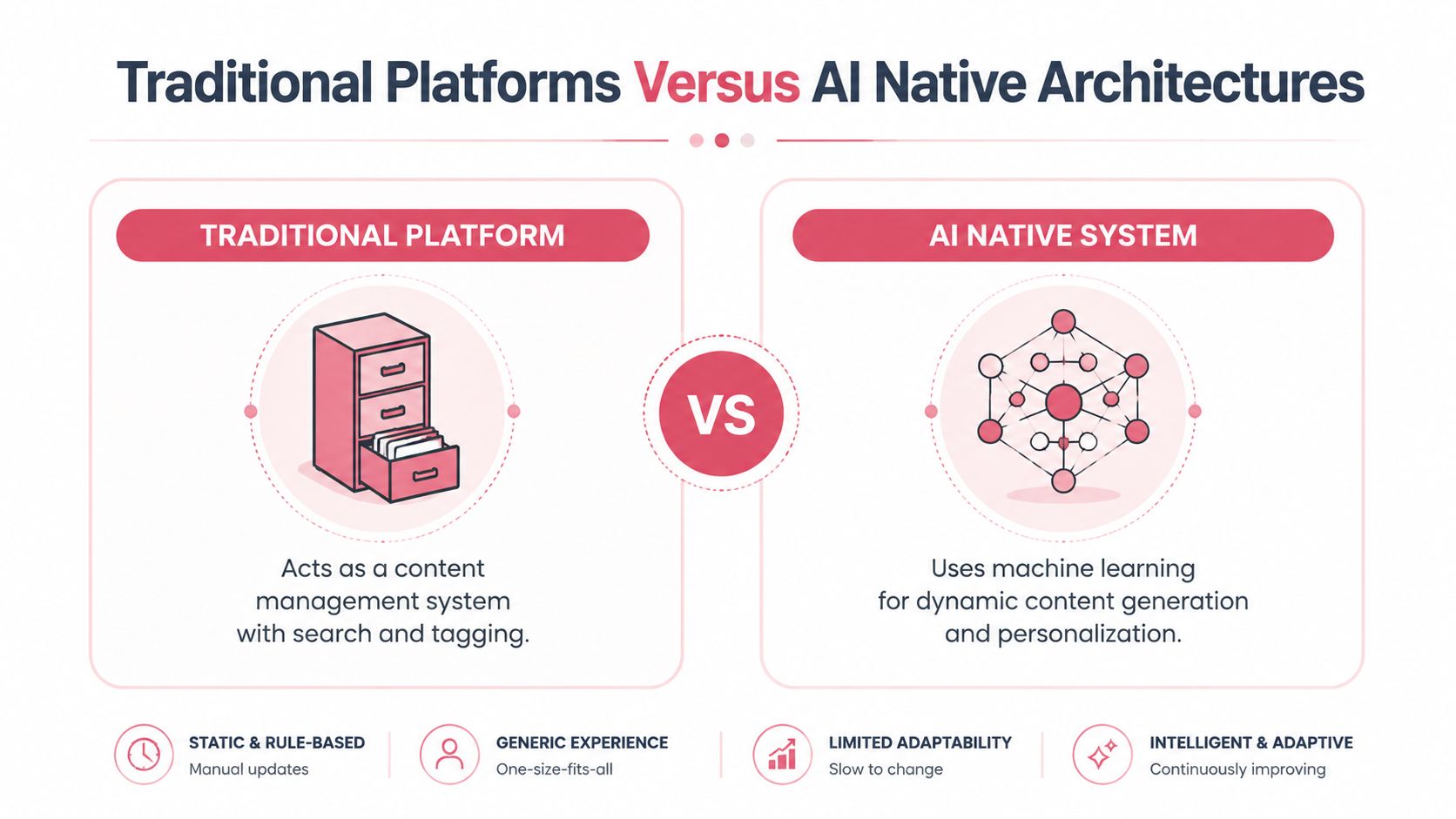
Traditional platforms are built around a content management model. They centralize files, apply tags, provide search, and sometimes surface recommendations. That approach can work for teams whose primary problem is finding approved content. It becomes less effective when the challenge is coordinating actions across systems and determining whether a play worked.
AI native architecture treats the play as executable logic. It can compose a sequence from smaller skills, use live context, call connected systems, pause for approval, and grade the result against a defined objective. The difference isn't that one platform has artificial intelligence and the other doesn't. The difference is where intelligence sits in the operating model.
Architecture Comparison
| Dimension | Traditional Platforms | AI Native Systems |
|---|---|---|
| Primary function | Store and retrieve approved content | Compose and execute goal led plays |
| Seller interaction | Search, read, and self apply guidance | Receive actions and guidance in the workflow |
| Integrations | Connect content to selected tools | Coordinate data and actions across a unified interface |
| Quality control | Manager review and seller reporting | Logged execution, scoring, and approval controls |
| Learning model | Periodic content updates | Confidence moves plays from hypothesis to validated to proven |
| Portability | Content often tied to the platform | Skills and play definitions can remain portable |
A traditional system can be the right choice when the team needs controlled collateral distribution, version management, and a reliable source for talk tracks. It's also easier to explain and often simpler to launch. The trade off is that sellers still carry much of the execution burden.
An AI native system is more suitable when the team needs orchestration across prospect data, enrichment, outbound channels, CRM records, and reporting. It should be evaluated carefully, though. A clever demo doesn't prove that the system can handle permissions, exceptions, audit trails, or poor data quality in production.
Architecture test: Ask the vendor to run a failed play, not just a successful one. The platform should show what it logged, where it paused, who approved the next action, and how the failure affects future recommendations.
Goal led composition and portable IP
The strongest architecture starts with an outcome rather than a document. A team might define a qualified pipeline objective, then compose the necessary research, scoring, personalization, sequencing, and reporting skills around it. Play definitions stored in plain Markdown and YAML can also make the operating knowledge easier to version, fork, and inspect than proprietary configurations.
A unified GTM API provides another important distinction. Instead of rewriting the motion whenever the team changes a data provider or channel, the orchestration layer can preserve the play while swapping the underlying service. More background on this operating model appears in Yalc's guide to sales automation with AI.
How to Choose the Right Platform for Your Team
Choose the platform based on the work that must be enforced, not the number of features shown in the demo. A small team with a simple sales motion may need interactive CRM guidance. A technically mature revenue organization may need composable orchestration, portable play definitions, and controls for autonomous actions.
Start with the operating model
Teams with fewer than 10 reps should usually avoid buying a broad system that requires a dedicated administrator and a long content migration. A focused playbook tool can be enough if it places stage guidance in the CRM and provides useful adoption data.
Teams scaling past 50 reps face a different problem. They need governance, permissions, manager workflows, quality scoring, and integration depth because informal coaching no longer scales. A repository may still be part of the stack, but it shouldn't be the enforcement layer.
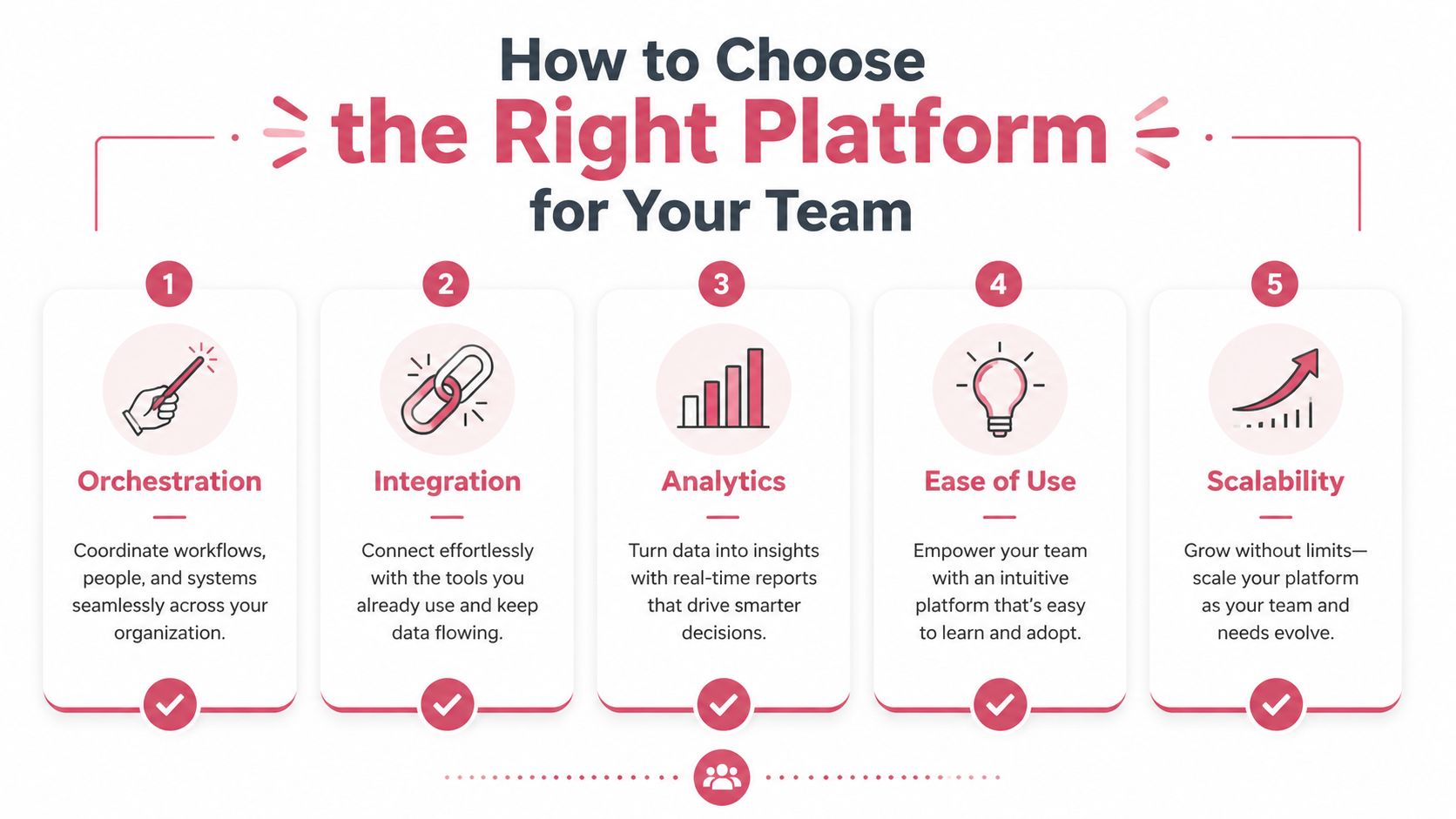
Evaluate the platform across five criteria:
- Orchestration: Can it sequence research, enrichment, messaging, CRM updates, and reporting as one play?
- Integration: Does it connect to the CRM, communication channels, data providers, and warehouse without fragile manual exports?
- Enforcement: Can it require fields, create tasks, apply SLAs, and pause sensitive actions for approval?
- Measurement: Can it distinguish access from actual play execution and connect execution to stage conversion or wins?
- Ownership: Can the team control versions, permissions, data, credentials, and the underlying play definitions?
Run a serious vendor evaluation
Ask vendors to show a play triggered by a real stage condition. Request the full audit trail, including the input data, selected action, human approval, failure handling, and outcome record. Then ask how a manager changes one step, tests the revision, and compares it with the previous version.
Red flags include analytics limited to page views, integrations that depend on manual exports, unclear data ownership, and no way to retire a play without deleting its history. Another warning sign is a platform that requires every user to work in the same interface. Engineers may want to compose through MCP, while sellers may prefer ready playbooks in Slack or the CRM.
For adjacent workflow decisions, teams that rely heavily on outbound email should also review independent guidance on the best email deliverability platforms of 2026. The right deliverability layer won't repair a weak play, but it can prevent execution quality from being confused with infrastructure failure.
A broader comparison of enablement options is available in the 10 best sales enablement tools for 2026. The selection principle remains the same: buy for the behavior and measurement requirements your team can support.
Real Playbook Examples That Drive Pipeline
A useful playbook can be described in operational terms: trigger, inputs, atomic skills, actions, approval points, and success metrics. That structure makes it possible to inspect execution instead of arguing about whether the content feels adequate in scope.
Prospecting play
A prospecting play can begin with an ICP definition and an account condition. The system identifies suitable companies, enriches contact data, checks the relevant persona, and prepares a sequence across approved channels. Atomic skills might include an ICP scorer, LinkedIn scraper, email enricher, personalizer, sequence runner, and reply handler.
The play shouldn't send immediately by default. A manager or operator may approve the account list, message logic, or first batch. Once launched, the system records which accounts matched the criteria, which steps ran, which replies arrived, and whether responses progressed into qualified opportunities.
A weak version only measures activity. A stronger version grades fit, message compliance, reply classification, meeting quality, and downstream stage movement. If the play produces attention without qualified pipeline, the operator changes the hypothesis rather than increasing volume.
For additional patterns, these sales playbook examples show how teams can translate recurring revenue tasks into reusable plays.
Qualification play
Qualification needs explicit entry and exit rules. Entry might be a lead meeting the team's fit criteria and receiving an owner. The play then assigns an SLA, prepares discovery prompts, requires key fields, and recommends a next action based on the buyer's stated problem and buying process.
The exit condition should be observable. It could be a qualified opportunity with confirmed pain, authority, timing, and next step, or a documented disqualification with a reason. That gives managers a concrete basis for coaching. “Ask better questions” becomes “capture the business problem, decision process, and agreed next action before advancing the stage.”
Deal progression play
A deal progression play works from signals already present in the opportunity. Competitive intelligence can prepare an account specific response. Sentiment analysis can flag a change in buyer tone. Reply handling can classify a new objection and route the opportunity to the right owner.
The system should record the outcome of each intervention. Did the buyer accept the next meeting? Did the opportunity progress? Did the seller complete the required multi stakeholder action? The play earns confidence only when repeated execution produces the intended result.
Teams can use pre configured plays from a shared interface when speed matters, or compose custom plays from atomic skills when technical operators need control. The essential requirement is the same in both cases, every action must be observable and every outcome must influence what happens next.
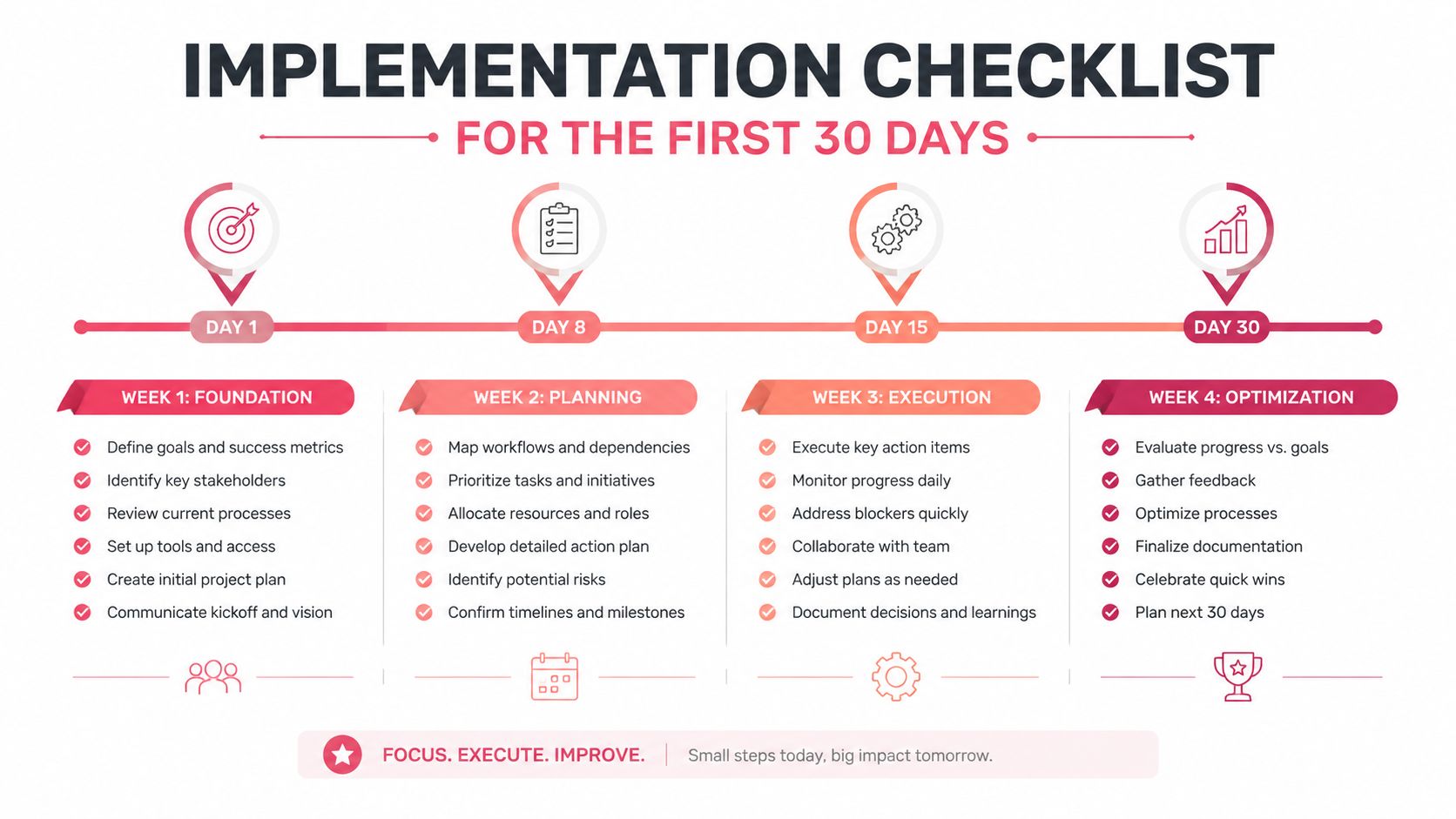
Implementation Checklist for the First 30 Days
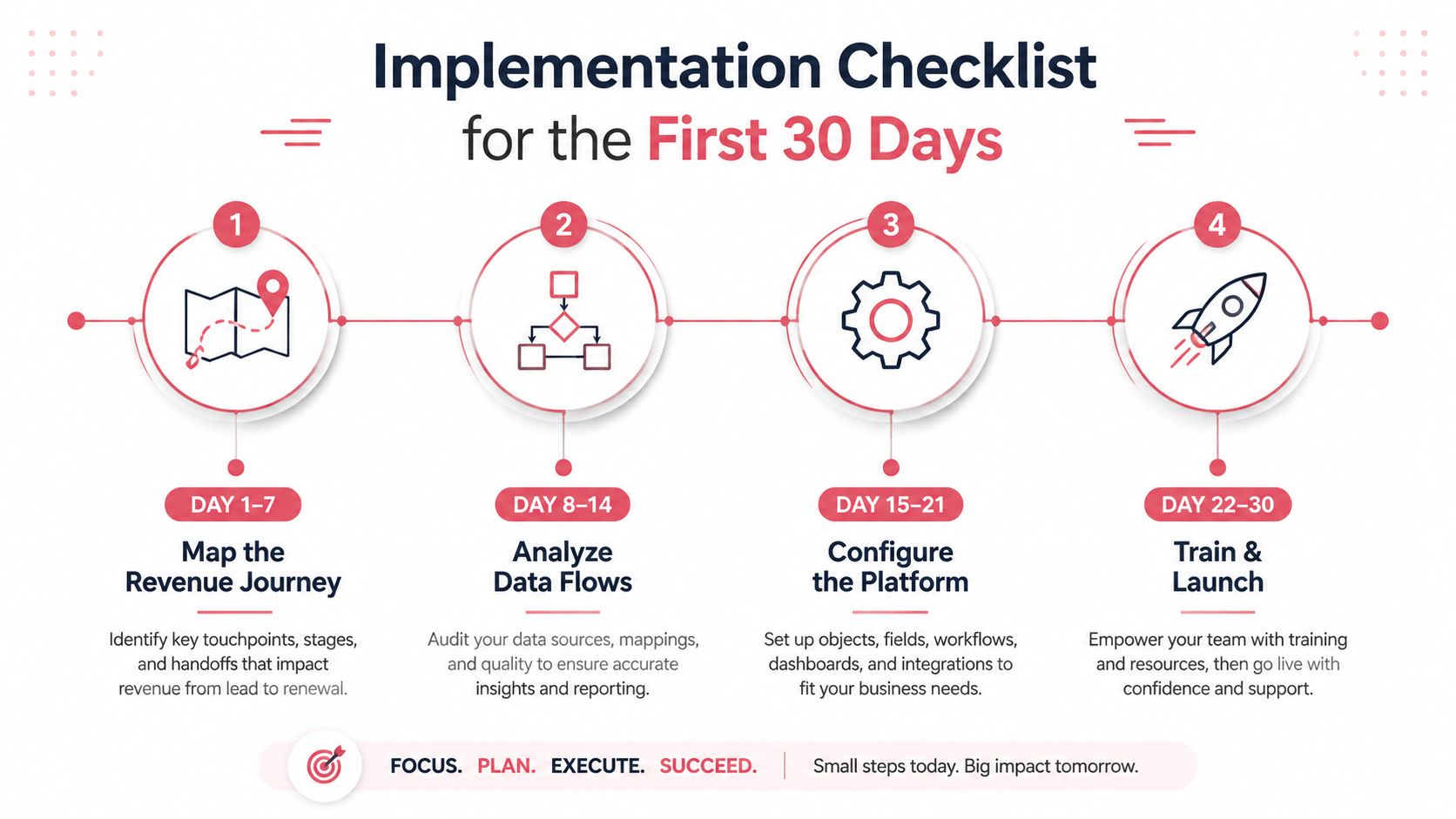
The first month should establish the revenue journey, data contracts, operating controls, and one measurable play. Don't begin by migrating every asset. Begin with the workflow where inconsistent execution creates the clearest business risk.
Days 1 through 7, map the journey
Map the lifecycle from anonymous visitor to lead, opportunity, customer, and advocate. Pedowitz Group's RevOps integration sequence recommends beginning with this revenue journey and its data flows, then prioritizing integrations by business impact and risk.
Name the owner, system of record, required fields, and handoff condition for each object. Document where the playbook should read data and where it may write data. This prevents the platform from becoming another disconnected layer.
Days 8 through 14, inspect the data flows
Trace the inputs for one priority play. Check account data, contact data, CRM stages, channel permissions, enrichment results, and reporting destinations. Define a data contract for every object, including field ownership and acceptable values.
Build failure handling before launch. If enrichment is incomplete, the play should pause or route the record for review. If a message contains a sensitive claim, require human approval. A workflow that only works with clean inputs will fail as soon as it meets live data.
Days 15 through 21, configure and govern
Load the ICP, voice, approved messaging, play definitions, permissions, and success criteria. Add version control and name an owner who can approve changes. Centralize the library and map each play to the relevant persona and stage, following the governance guidance in this playbook software framework.
Wire telemetry so every agent action, human approval, data access, and exception appears in an audit trail. Use health checks and drift monitoring to identify broken integrations or changing field behavior.
Days 22 through 30, train and launch
Walk the team through one complete run, including a normal path and a failure path. Give managers a coaching view that shows whether sellers followed the play and where the process stalled. Launch with a narrow scope, collect feedback, and schedule the first review before adding more plays.
Measuring ROI and Proving Impact
ROI starts with instrumentation, not a presentation prepared after launch. Each play needs a hypothesis, an execution standard, and outcome measures tied to the revenue motion. Without them, usage reports may show activity while business impact remains unproven.
Measure behavior and results together. Track active usage, play execution, conversion by stage, win rate, and average deal size. Industry analyses have associated playbook adoption with larger deals, stronger lead acceptance, and shorter sales cycles, as discussed in Aberdeen's sales playbook analysis. Treat those findings as directional, not as a promise for every team. Their practical lesson is clear: adoption matters only when it can be compared with commercial outcomes.
A static repository can report downloads and views. It cannot prove that sellers followed the play in a live opportunity, or that the play improved the result. AI-native systems can connect execution data with outcomes and grade whether a play is working, giving RevOps a basis for revision rather than relying on content popularity.
Build a closed loop
A practical scoring cycle has four stages:
- Hypothesis: Define the buyer condition, seller action, and expected result.
- Execution: Run the play and log steps, exceptions, approvals, and seller changes.
- Verdict: Compare execution quality and commercial outcome with the success criteria.
- Learning: Mark the play validated or proven, revise it, or retire it.
This keeps familiar but weak plays from surviving by habit. It also stops managers from promoting a play because several sellers liked it. The system should reward repeatable outcomes, not internal enthusiasm.
Show leadership the operating evidence
A credible ROI review connects three layers. First, show whether intended users activated and executed the play. Next, show whether execution met the required standard. Finally, compare similar opportunities that used the play with those that did not, then review progression, conversion, and closed revenue.
Governance matters as much as analytics. A named owner should review the library on a recurring cadence, promote strong plays, retire weak ones, and record the reason for each change. That turns sales playbook software into a controlled operating system for revenue execution, rather than a document repository filled with outdated content.
Yalc provides executable GTM playbooks that coordinate research, enrichment, messaging, CRM work, and reporting through a unified API, with logged actions, approval controls, and outcome scoring. Visit Yalc to assess whether its pre configured Slack and UI workflows or composable MCP approach fits your team's operating model.