How to Scrape LinkedIn Data the Compliant Way in 2026
The team already has the pressure from leadership. More pipeline. Better target accounts. Cleaner prospect data. Someone on ops spins up a scraper, someone in growth buys a browser extension, and sales starts asking when the CSV will hit the CRM.
That approach breaks fast.
The problem isn't whether someone can scrape LinkedIn data. The problem is whether the data can survive contact with reality. Teams end up with records they can't trust, a workflow they can't repeat, and account risk they can't explain to legal or security. The useful frame in 2026 is provenance and durability. Where did this record come from, how stale is it, and can the team refresh it without burning the source?
Table of Contents
- Why Most LinkedIn Scraping Playbooks Fail Before They Start
- How LinkedIn Detects and Blocks Automated Access
- The Four Real Ways to Get LinkedIn Data in 2026
- Building a Compliant LinkedIn Data Pipeline Step by Step
- Legal and Compliance Boundaries You Cannot Ignore
- Wiring LinkedIn Data Into Your GTM Stack Safely
- Operator Checklist for a LinkedIn Data Motion That Lasts
Why Most LinkedIn Scraping Playbooks Fail Before They Start
Most LinkedIn scraping guides get the sequence wrong. They jump from legal caveats to a script. The operational failures arrive first.
A scraping motion usually dies for one of three reasons. Access gets restricted. The data decays before sales uses it. Or the team saves money on tooling and spends it back in operator time, cleanup, and retries. That's why the question isn't “can this be scraped.” It's “can this dataset be maintained.”
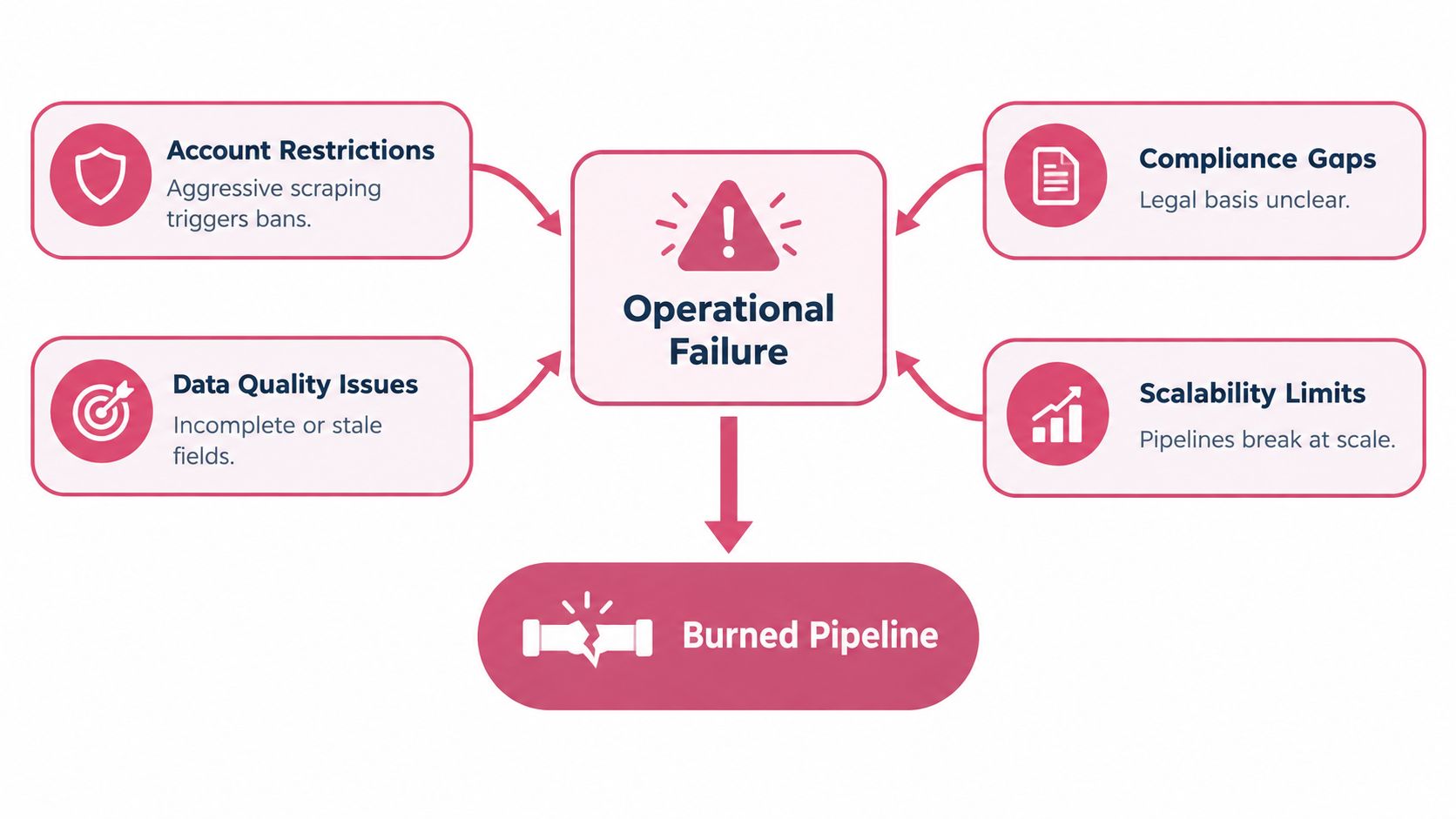
The first failure is access, not code
LinkedIn is commercially valuable because of its scale. A 2026 LinkedIn stats roundup says the platform had more than 1.3 billion registered members worldwide by January 2026, with roughly 310 million monthly active users, including about 257 million users in the United States, 161.5 million in India, and 83.2 million in Brazil. It also describes LinkedIn as spanning 200+ countries and regions and remaining the largest professional social network globally (LinkedIn stats roundup).
That scale is exactly why every team wants to scrape LinkedIn data. It's also why the platform invests heavily in stopping automated collection. Scraping isn't competing with a static directory. It's pushing against one of the most defended professional data surfaces on the internet.
The second failure is stale data
Even when collection works, the snapshot starts aging immediately. Titles change. Employers change. Profile descriptions get rewritten. A CSV from last week can already be wrong for active outbound.
Practical rule: Every LinkedIn record should carry three tags before it reaches sales. Source, collection time, and refresh path.
If a team can't answer those three questions, it doesn't have a pipeline. It has a temporary export.
The false economy is usually obvious in hindsight
Free or cheap scrapers look efficient until someone has to clean broken fields, rerun failed jobs, and reconcile duplicates in the CRM. Then the economics flip. What looked like a growth shortcut turns into a maintenance burden.
A stronger operating model treats each record like inventory with a shelf life. That changes the workflow:
- Tag provenance early: Keep the origin of each field, not just the row.
- Design for refresh: Only collect data that can be checked again without drama.
- Separate usable from collectible: Just because a field can be extracted doesn't mean it belongs in production.
- Price reactivation cost: If the source breaks, estimate what it takes to restore it before relying on it.
Teams that adopt that frame stop obsessing over scripts. They start building pipelines that can be defended, refreshed, and audited.
How LinkedIn Detects and Blocks Automated Access
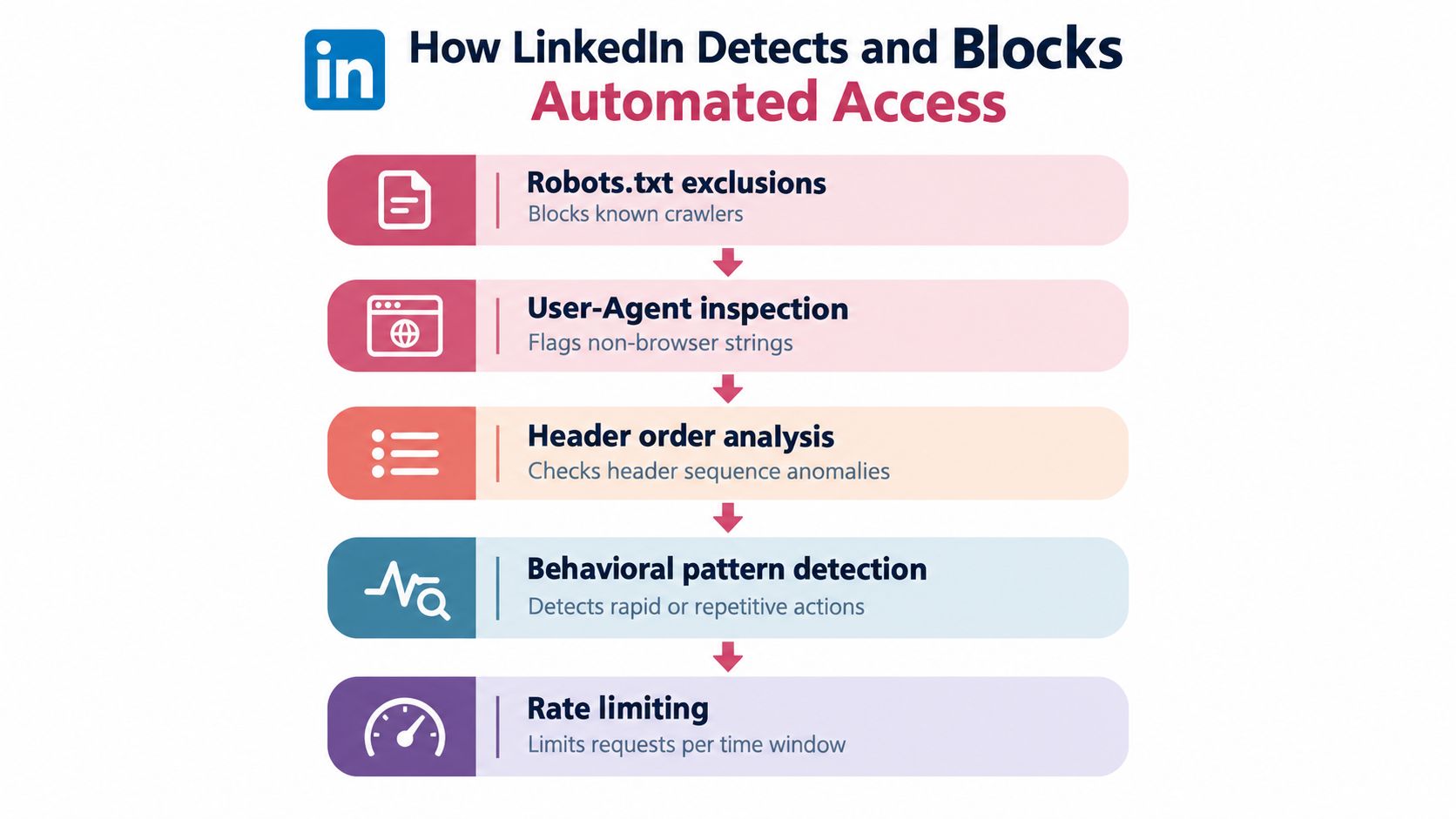
LinkedIn doesn't rely on one defense. It uses layers. Anyone trying to scrape LinkedIn data at scale needs to assume the platform is checking policy signals, browser signals, and behavior signals at the same time.
Policy signals are the first warning
LinkedIn's own robots.txt policy states that the use of robots or other automated means to access LinkedIn without express permission is strictly prohibited. Its crawling terms also say automated crawling and indexing without express permission is strictly prohibited, and they require use of a true IP address and user agent.
That matters because it gives LinkedIn a plain policy basis for restriction before anyone gets into technical arguments. A team may think it's just making requests. LinkedIn sees unapproved automation.
Browser and session fingerprints give scrapers away
Off the shelf scraping tools often leak the same patterns. Strange user agents. Predictable request sequences. Reused cookies. Identical browser behavior across many sessions.
Logged in automation is where teams get reckless. They run browser bots on employee accounts, paginate aggressively through search results, and parallelize tasks because the first batches worked. Then access gets throttled or flagged. Anyone planning automated workflows on top of LinkedIn should understand the practical boundaries covered in LinkedIn automation limits and rules.
Behavior gets scored faster than most teams expect
A bot doesn't need to run for weeks to get noticed. Repetitive actions within one session can be enough. Search loops, rapid profile visits, and synchronized account activity all create patterns that don't look human.
Detection is a budget. Every request spends part of it.
That's why throughput shouldn't be the main optimization goal. One 2026 industry comparison found that one provider returned an average of 39 fields per post, while another achieved a 70% success rate with request latency averaging 12 seconds. For GTM workflows, that's a reminder to validate both completeness and latency before scaling collection (LinkedIn scraper comparison).
What experienced operators do differently
They don't try to “win” against the detection stack. They reduce exposure.
- Prefer approved sources first: Use official access paths where possible.
- Keep scraping narrow: Public pages only, limited fields, clear purpose.
- Avoid logged in scraping: It raises the blast radius immediately.
- Measure survivability: A slower workflow that keeps running is worth more than a fast one that gets shut down.
The teams that last treat LinkedIn access as a scarce resource, not an unlimited endpoint.
The Four Real Ways to Get LinkedIn Data in 2026
There are only four practical routes to LinkedIn data. Every GTM team should choose based on durability first, compliance risk second, and velocity third. If that order feels backwards, it isn't. Data that can't be refreshed or defended becomes dead weight inside the CRM.
Official platform access
The cleanest route is LinkedIn's official developer surfaces and related approved access paths. This route is contract backed and stable, but narrow by design. Teams won't get every field they want, and they won't get the freedom a scraper promises.
That's a feature, not a bug. Official access is built for workflows that need to survive procurement, security review, and repeated use.
Partner and provider ecosystems
The second route is partner data providers and certified vendors. These tools don't all expose the same collection method, but they usually package firmographic and identity data in a way an ops team can use.
For account selection and prospect research, many teams also start from LinkedIn Sales Navigator workflows and then move downstream into a provider that can support enrichment and sync.
Enrichment vendors and reverse lookup tools
This path works well when the team already has partial identifiers such as name, domain, or email and needs a practical way to fill missing fields. The tradeoff is freshness. Some enrichment outputs are useful. Some are guessed, inferred, or lagging behind current profile reality.
If a vendor can't explain where a field came from, that field shouldn't overwrite anything trusted.
Direct collection and scraping
This is the route people mean when they say they want to scrape LinkedIn data. It ranges from narrow collection of public fields to aggressive account based automation that crosses policy and contractual boundaries.
A 2024 academic review found that scraping remains the most effective way to obtain LinkedIn data compared with direct cooperation, purchased data, or APIs, while also highlighting legal, ethical, and technical hurdles across the workflow (academic review of LinkedIn data collection).
That's the right way to read scraping in 2026. It offers breadth. It doesn't offer safety, stability, or repeatability by default.
Four paths to LinkedIn data in 2026
| Approach | Cost Anchor | Durability | Compliance Risk |
|---|---|---|---|
| Official API and approved platform access | Contracted and usage based | High | Low to moderate |
| Partner data providers | Per record, per seat, or contracted vendor pricing | Medium to high | Moderate |
| Enrichment vendors | Per lookup or per seat | Medium | Moderate |
| Direct scraping and automation | Looks cheap at first, expensive to maintain | Low to medium | High |
A blunt recommendation helps. Use official access for fields tied to identity and employment where possible. Use providers when speed matters and provenance is documented. Use scraping only as a fallback for narrow public data collection that the team is willing to quarantine, validate, and refresh carefully.
Building a Compliant LinkedIn Data Pipeline Step by Step
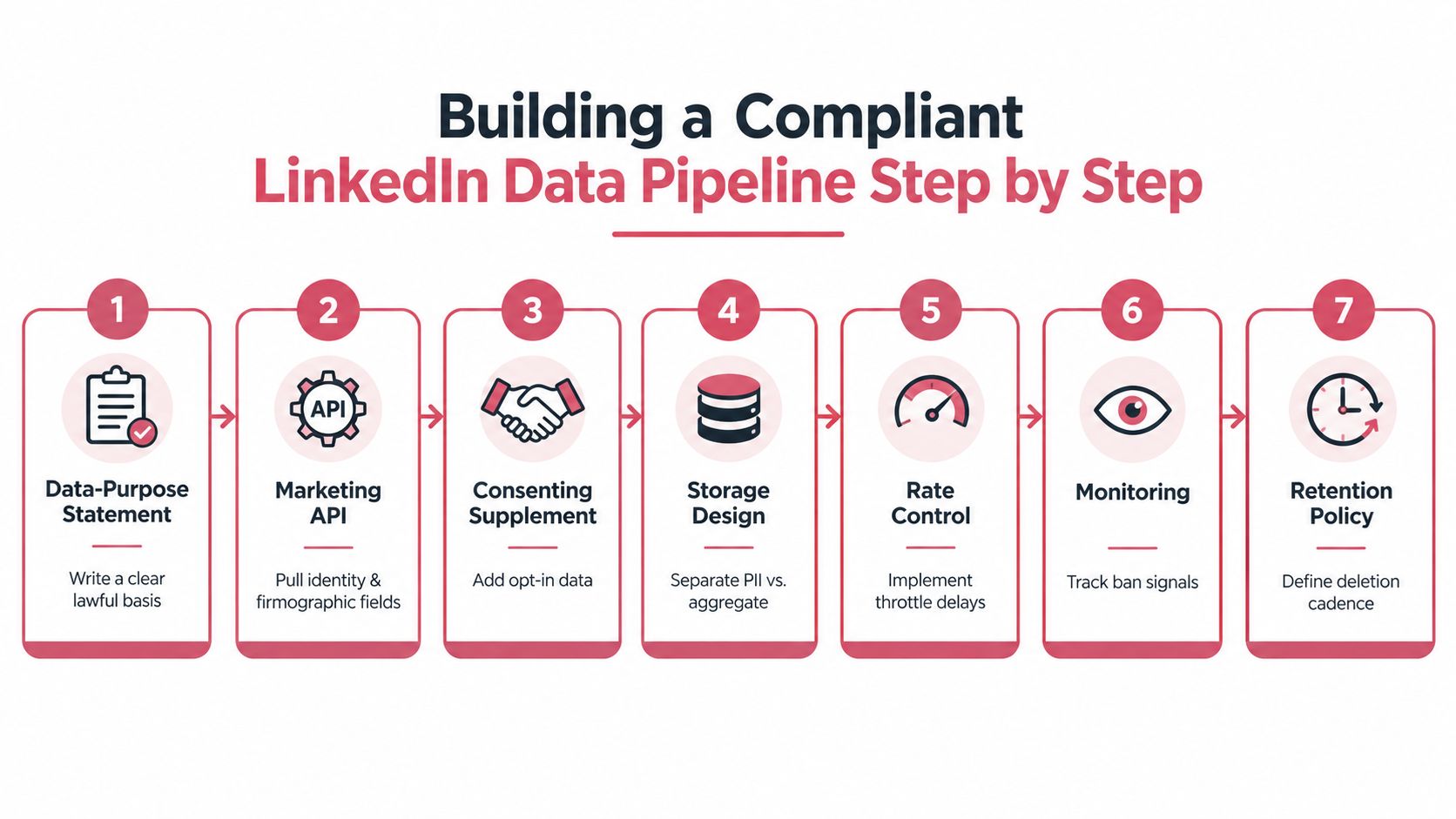
A compliant pipeline starts with field decisions, not with tooling. Teams that get this right know exactly why each field exists, where it came from, and what happens if it goes stale.
Start with purpose and allowed fields
Write a short data purpose statement before any collection begins. It should say what the team is collecting, why it needs the data, which systems will receive it, and who can approve exceptions.
Then define field classes:
- Identity fields such as name and profile URL
- Employment fields such as current company and title
- Firmographic fields tied to accounts rather than people
- Derived fields such as fit scores or routing labels
This avoids the usual mess where every scraped field gets dumped into the CRM because it happened to be available.
Build API first, then enrich, then use scraping sparingly
A practical sequence looks like this:
- Pull stable account and person data from approved sources first. Use official access where available.
- Supplement with enrichment vendors that can document provenance and contractual terms.
- Reserve scraping for public URLs and narrow public fields only. Current public title or visible company page data can be useful when the team has no cleaner source.
- Block login bypass and authenticated scraping. That's where policy and contract risk rises sharply.
- Run validation before sync. Check duplicate records, required fields, and freshness thresholds.
- Tag every row. Source, timestamp, consent state, and confidence should travel with the record.
- Quarantine failures. Bad or conflicting records should land in a review table, not in production.
Treat data quality as an ingestion gate
Most teams validate emails more carefully than job titles. That's backwards. A bad title can break routing, personalization, and account scoring.
Use a freshness gate before records sync into sales tools:
- Keep records when the field came from an approved source or a public source with a clear timestamp.
- Review records when the field conflicts with an existing verified field.
- Discard records when the source is unclear, the collection path required logged in automation, or the data can't be refreshed safely.
Operator note: Provenance should exist at the field level when possible. A row level source tag isn't enough once multiple vendors and collection methods are involved.
Design the runtime for control
Schedule batch jobs during fixed windows so monitoring is predictable. Trigger change handling through webhooks or similar event based methods where available. Keep a quarantine table for records that fail validation or violate policy rules.
One option in this category is Yalc, which provides a unified GTM API, audit trail, and human approval flow for sensitive actions. That structure is useful when a team needs LinkedIn related data to move into outreach and CRM systems without losing provenance along the way.
The best pipeline is usually boring. It refreshes cleanly, fails visibly, and doesn't need heroics from ops every time the source shifts.
Legal and Compliance Boundaries You Cannot Ignore
The legal mistake teams make is treating public visibility as blanket permission. That isn't how the risk works.
The core U.S. precedent still runs through the hiQ dispute. LinkedIn sent a cease and desist letter in May 2017, hiQ obtained a preliminary injunction on August 14, 2017, the Ninth Circuit reaffirmed that injunction again in April 2022, and the dispute later ended with a settlement agreement filed on December 6, 2022. That settlement included a $500,000 judgment against hiQ, findings of liability under California common law trespass to chattels and misappropriation, and injunctive relief that effectively blocked future scraping of LinkedIn by hiQ (Morgan Lewis summary of LinkedIn v. hiQ).
Public access is not the end of the analysis
A separate report on the appellate phase noted that questions remained around whether LinkedIn could use the Computer Fraud and Abuse Act against scraping of publicly posted data. Later reporting says the fight ended with a permanent injunction requiring hiQ to stop scraping and destroy code, data, and algorithms created from LinkedIn member profile data (Bloomberg Law coverage of the hiQ dispute).
That's the distinction operators need to understand. Public access arguments may help in one narrow area. They don't erase contract claims, platform terms, injunction risk, or state law claims.
Personal data rules still attach to ordinary profile fields
Names, job titles, employers, and contact details can all fall under GDPR style personal data rules. A 2026 compliance guide points out that while the narrow U.S. view after hiQ is that scraping publicly visible data is generally not a CFAA crime, the same activity can still violate platform terms, privacy law, or contract obligations. It also notes that GDPR and UK style rules can apply to ordinary profile fields such as names, titles, employers, and contact details (LinkedIn automation and scraping compliance guide).
Regional compliance posture for LinkedIn data
| Region | Public Scraping Posture | Personal Data Rules | Key Risk |
|---|---|---|---|
| United States | Narrower CFAA risk view for public data in the hiQ line of cases | Sectoral and state based obligations still matter | Contract, injunction, and misuse claims |
| European Union | Public visibility does not remove data protection duties | GDPR applies to personal data processing | Lawful basis, minimization, and documentation failures |
| United Kingdom | Similar practical posture to EU style analysis | UK GDPR applies to personal data processing | Legitimate interest and records of processing |
| California | Public data arguments exist, but state claims survived in the hiQ dispute | Privacy and unfair practice concerns can still arise | Trespass, misappropriation, and contractual exposure |
The safest line is simpler than most teams want
Don't log in with employee credentials to collect profile data automatically. Don't bypass technical controls. Don't collect broad personal data first and ask legal to sort it out later.
A practical nuance also matters. Some summaries note that scraping treatment may vary by LinkedIn surface, with a distinction between company pages and individual profile pages in how robots comments and access restrictions are understood (analysis of LinkedIn scraping boundaries by page type). Operators should treat targets, access paths, and page types as different risk categories, not one pooled source.
Wiring LinkedIn Data Into Your GTM Stack Safely
The CRM should never be the first place LinkedIn sourced data lands. It should be the last approved destination.
Start with a source schema that preserves provenance. Each incoming record should include fields such as source_api, vendor, scraped_url, consent_flag, collected_at, and refresh_method. Without those fields, downstream teams can't tell whether a title came from an approved provider, a public page scrape, or a stale browser export.
Map fields conservatively
Don't let enrichment overwrite trusted CRM values by default. Use a merge policy:
- Verified CRM field stays primary unless a fresher approved source conflicts and passes review.
- Public scrape fields enter as candidate values rather than production values.
- Derived scores stay separate from factual profile attributes.
This matters most for title, current employer, and profile URL. Those fields drive routing, personalization, and account ownership, so they need stricter rules than generic notes.
Gate actions based on provenance
Outbound systems should read provenance before they act. If a record came from a weak source, the system should limit what happens next. Sensitive actions such as enrichment on executive titles, contact discovery, or social sequence triggers should pause for approval.
Teams designing a modern revenue system should also think about orchestration, permissions, and auditability across tools. The cleanest reference point is a documented GTM stack architecture that treats data movement and action control as part of the same operating model.
Bad sourcing decisions spread faster in automation than they ever did in manual prospecting.
Watch the system, not just the output
Set dashboards for source errors, schema drift, record decay, and accounts flagged for review. If API failures rise or refresh jobs start missing expected fields, the team should know before sales notices broken personalization.
A safe LinkedIn data motion is less about one clever extraction trick and more about disciplined ingestion, approval, and monitoring.
Operator Checklist for a LinkedIn Data Motion That Lasts
A durable LinkedIn motion is boring in the right places. It uses fewer collection tricks, more controls, and cleaner handoffs into the GTM stack.
Run this checklist before anyone adds another scraper.
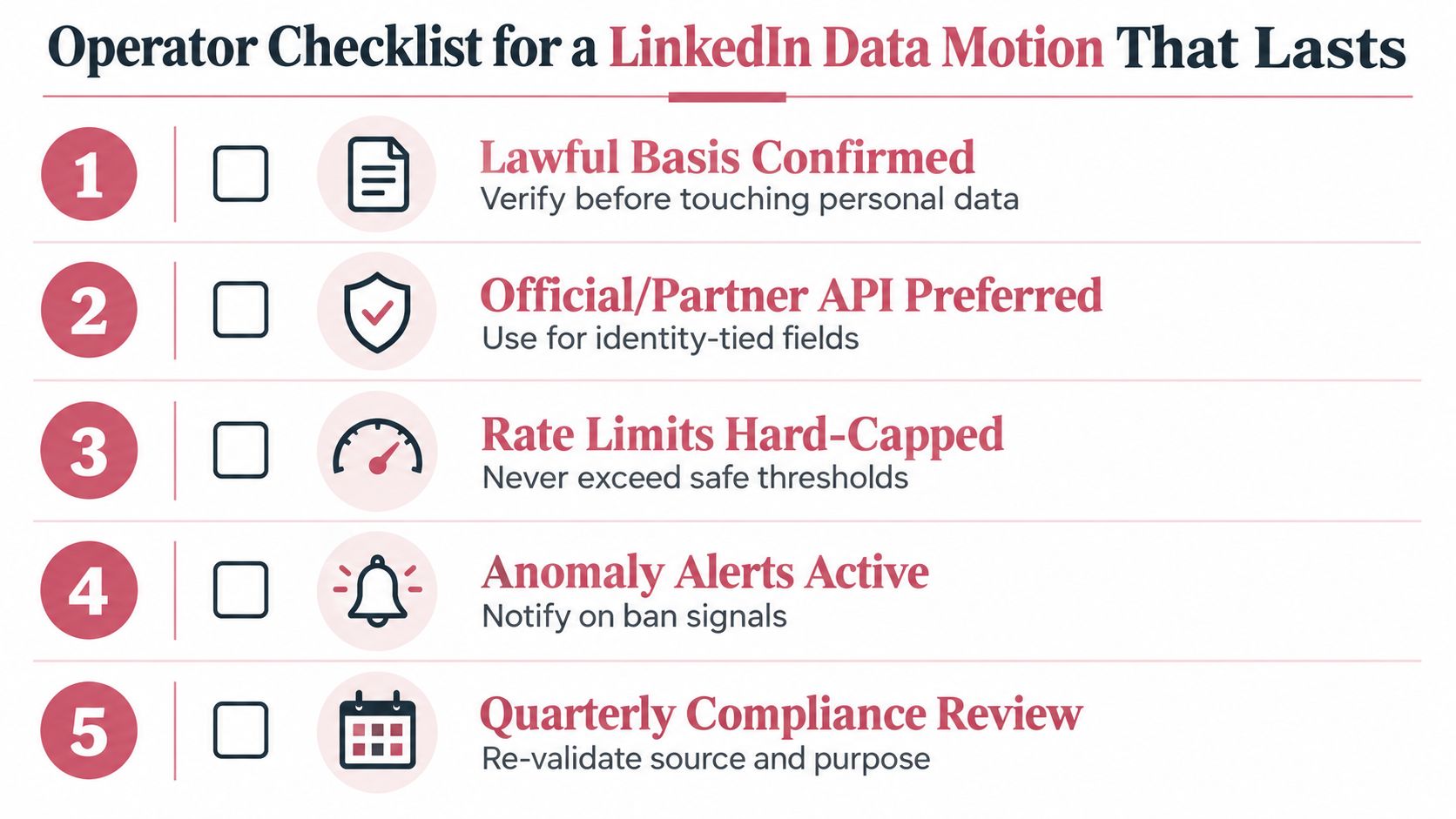
Monday morning checklist
Confirm lawful basis first. If the team is touching personal data, the reason for collection should be written down before collection starts.
Prefer official or partner sources for identity tied fields. Names, employers, and employment history deserve the most defensible collection path available.
Route enrichment through vendors with auditable terms. If a provider can't explain provenance or contractual posture, don't let it into production.
Never run headless logged in sessions against profile pages. That's where account risk and policy risk spike.
Store provenance on every record. Source, timestamp, and consent state shouldn't be optional metadata.
The tie breaker rule
When durability, compliance, and velocity conflict, compliance wins on day one. Velocity gets recovered later through better system design, better source selection, and tighter refresh logic.
A 2026 industry view worth taking seriously is that scraping strategy is shifting away from raw extraction volume and toward reliability and survivability. Higher risk behaviors include authenticated automation, fake accounts, proxy based evasion, and CAPTCHA or rate limit bypass. More durable approaches lean on first party exports, approved APIs, public data providers with clear provenance, and human reviewed enrichment (2026 operator guidance on LinkedIn scraping strategy).
That's the operating posture that lasts. Teams don't need the biggest scrape. They need the cleanest path from source to action.
Yalc gives GTM teams a way to run this kind of motion with one unified GTM API, provenance aware workflows, approval gates for sensitive actions, and audit logs that stay attached to the work. If the goal is to use LinkedIn related data without turning the pipeline into a compliance or account risk problem, it's worth seeing how Yalc structures collection, enrichment, sync, and human review in one system.