Single Agent vs Multi Agent in AI for GTM Teams
Most GTM teams shouldn't start with a multi agent system. They should start with one agent, strong tools, shared memory, and strict approvals, then add orchestration only when the workflow produces enough parallel work to repay its cost. The popular advice says complexity deserves more agents. Production experience points to a harder question: when does the orchestration tax become smaller than the benefit of specialization?
That choice affects more than model design. It shapes latency, token use, reliability, debugging, auditability, and how quickly a revenue operation can move from prototype to production. A single agent can often handle prospect research, enrichment, qualification, and CRM updates through one continuous reasoning chain. A multi agent system can improve throughput when those tasks split cleanly across independent research or specialist roles, but every handoff creates another place for state, permissions, and decisions to go wrong.
The practical framework is simple. Keep the system single agent when the workflow is sequential, approval heavy, and context dependent. Consider multiple agents when work can run in parallel, requires distinct expertise, exceeds one context window, or benefits from deliberately independent validation. Teams that want a deeper grounding in the orchestration layer can also review this practical guide to AI orchestration.
Table of Contents
- Introduction Why the Architecture Choice Matters Now
- What Single Agent and Multi Agent Architectures Actually Mean
- Detailed Comparison Across Coordination Reliability Latency and Composability
- What Benchmarks Show When Compute Is Held Constant
- GTM Use Cases Where Each Architecture Wins
- How to Choose and Implement Without Overengineering
- Recommendation for GTM Teams Starting Today
Introduction Why the Architecture Choice Matters Now
The architecture debate has become more concrete because research now evaluates agent systems as systems, not just as isolated model responses. A foundational 2025 research line describes multi agent systems as useful for decomposing complex work, while also identifying coordination overhead, runtime cost, and communication complexity compared with a single agent. Google Research's 2026 summary defines the single agent pattern as one agent executing all reasoning and actions through a unified memory stream, which explains why many teams sensibly begin there. The underlying scaling research treats the choice as an engineering question rather than a matter of architectural fashion.
For GTM operators, the decision appears in familiar workflows:
- Lead qualification: Read account data, check fit, apply scoring rules, request approval, and update the CRM.
- Outbound preparation: Find prospects, enrich records, draft messages, and queue sequences.
- Competitive intelligence: Search several sources, compare findings, challenge weak evidence, and produce a report.
- Campaign operations: Monitor replies, classify intent, route exceptions, and record outcomes.
The first workflow usually benefits from one agent with tools. The third may justify several specialized agents. The difference isn't whether the workflow sounds complex. It's whether the work contains independent units that can proceed without repeatedly sharing unfinished context.
Operator rule: Complexity in the business process doesn't automatically justify complexity in the agent architecture.
A single agent wins when coherence and control matter more than specialization. It keeps one decision path, one state model, and one primary trace. A multi agent design earns its keep only when the additional throughput, expertise, or failure isolation exceeds the engineering and governance burden introduced by coordination.
This is especially important for B2B teams, where workflows often touch customer records, outbound channels, approval queues, and compliance sensitive data. The most impressive demo may be the wrong production design if operators can't explain why an agent took an action, reproduce the decision, or stop an unsafe handoff.
What Single Agent and Multi Agent Architectures Actually Mean
A single agent uses one reasoning chain to complete a task from beginning to end. It can call tools, query a database, search a knowledge base, update a CRM, or ask for human approval. Those actions don't make it multi agent. The defining feature is that one agent owns the task and maintains the working context.
A multi agent system divides work between two or more agents. The agents may communicate, hand work to one another, or run in parallel under a coordinator. Each agent might have a narrower role, such as researcher, verifier, copywriter, or CRM operator. The architecture introduces extra steps because the system must decide which agent acts, what information gets passed, and whether the receiving agent interprets that information correctly.
A simple GTM mental model
Consider a prospecting workflow:
- Identify accounts that match the ICP.
- Enrich company and contact data.
- Score fit and buying signals.
- Draft an outreach message.
- Request approval.
- Write the approved action to the CRM.
With a single agent, one process manages that sequence. It calls enrichment and CRM tools while preserving the same account context. If the score conflicts with an industry exclusion, the agent can pause and ask for a decision without reconstructing the whole case from messages between separate workers.
With multiple agents, a prospecting agent might find accounts, an enrichment agent might gather data, a scoring agent might classify fit, and a messaging agent might draft outreach. An orchestrator passes records between them and decides what happens after each result. That can work well when the subtasks are independent, but it also adds handoffs, shared state, retries, and additional traces.
The distinction matters for anyone evaluating an AI agent developer, because the build challenge isn't limited to prompting each agent. The team must design the coordination contract, define permissions, preserve provenance, and test the behavior of the system as a whole.
A single agent's main risk is concentration. If it makes a poor decision, the whole flow may stop or continue in the wrong direction. A multi agent system can isolate some failures, but errors can also travel from one agent to the next and become harder to trace.
One agent is a workflow owner. Multiple agents are a distributed team with a communication protocol.
Detailed Comparison Across Coordination Reliability Latency and Composability
The architecture choice becomes clearer when evaluated against the operating constraints GTM leaders manage.
Coordination and state
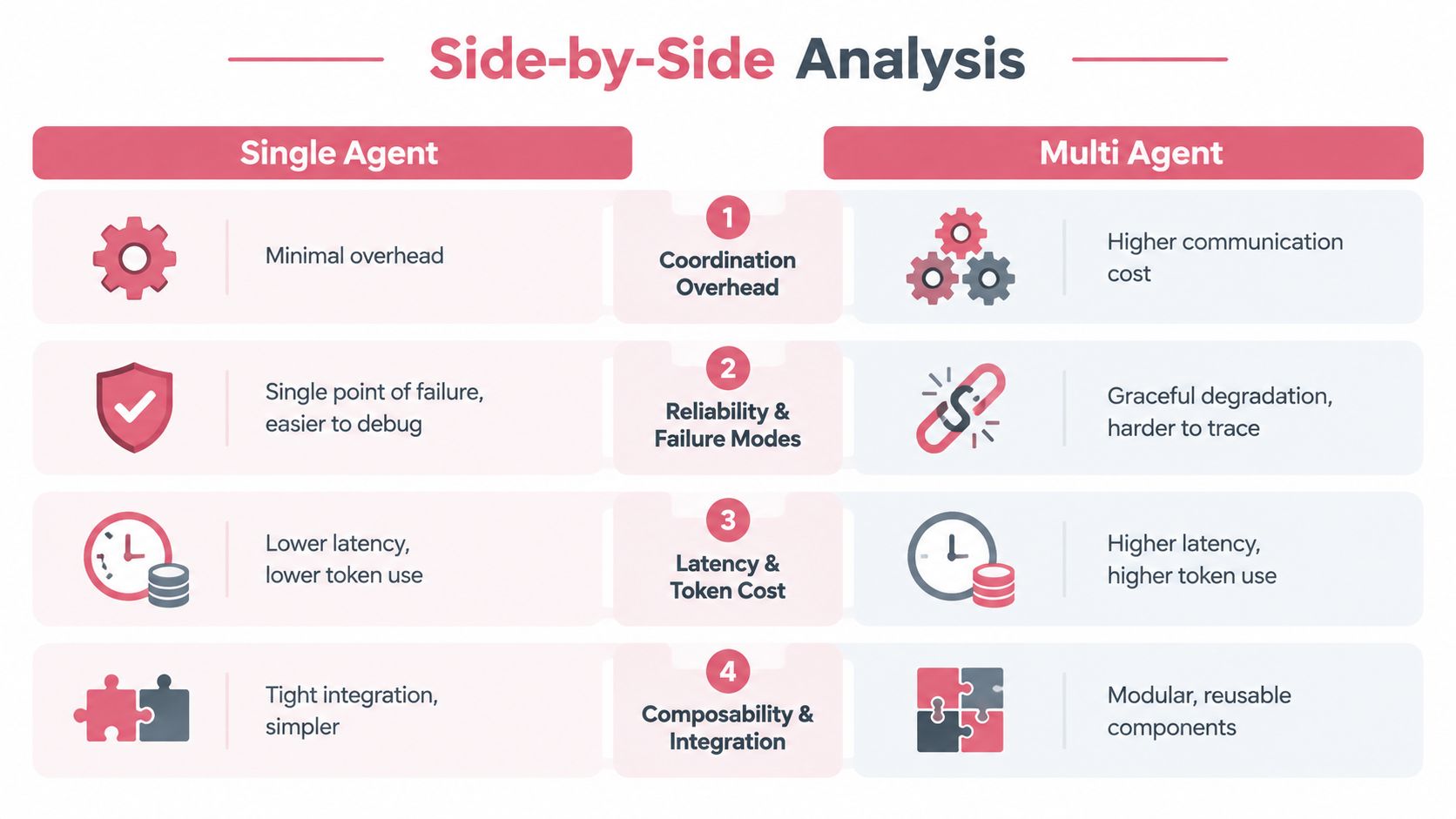
Single agent systems have minimal coordination overhead. The agent selects tools and actions within one trace. Multi agent systems add routing, message passing, role boundaries, and shared state. Those additions are useful when agents can work independently, but wasteful when each step depends on the exact reasoning produced by the previous step.
Verdict: Single agent for sequential work. Multi agent for parallel work.
Reliability and debugging
A single agent creates a concentrated failure surface. That sounds negative, but it makes investigation easier because the team can inspect one decision path, one tool sequence, and one source of state. Multi agent systems may contain failures inside separate modules, yet the overall trace becomes harder to follow. A wrong enrichment result can affect scoring, messaging, and CRM updates before an operator sees the original error.
Latency and token use
Multi agent systems generally use more communication and reasoning steps than a single agent. A Frontiers comparison in a simulated Mars rover decision support benchmark measured the difference directly. In the GPT 4o run, single agent orchestration averaged 2.32 seconds and 458 tokens per evaluation, while the multi agent setup averaged 11.83 seconds and 2,273 tokens. In the GPT 5.5 run, the corresponding figures were 6.06 seconds and 548 tokens for single agent orchestration, versus 35.59 seconds and 3,160 tokens for multi agent orchestration. These results come from a specific benchmark, not a universal GTM forecast, but they show why every additional reasoning path needs a business case. The full Frontiers study provides the benchmark context.
Cost test: A second agent should either remove a bottleneck or improve a decision enough to justify its extra calls.
Composability and reuse
Multi agent designs can make roles reusable. A research agent might support prospecting, competitive intelligence, and account planning. A single agent can also reuse tools and playbooks, often with less integration work because the same process controls the entire flow. Modularity isn't exclusive to multi agent systems. Teams can achieve substantial reuse through clear tool contracts, shared schemas, versioned prompts, and durable knowledge.
Governance and auditability
Governance becomes more demanding as the number of agents and handoffs grows. Singapore's IMDA framework recommends testing agents individually and testing the complete multi agent system to catch emergent risks, including competitive behavior or one agent affecting another. It also recommends continuous monitoring, logging, failsafe mechanisms, and evaluation methods suited to both structured tool calls and unstructured reasoning. The IMDA governance framework is particularly relevant to GTM workflows that can alter records or contact prospects.
| Criterion | Single Agent | Multi Agent |
|---|---|---|
| Coordination | One reasoning path and direct tool calls | Handoffs, routing, shared state, and communication |
| Reliability | Easier to isolate and debug, with a concentrated failure point | Potential module isolation, but harder cross agent tracing |
| Latency and token use | Usually lower for sequential tasks | Higher when agents communicate or repeat context |
| Composability | Reuses tools and workflows through one controller | Reuses specialized roles across different workflows |
| Governance | Simpler permissions and audit trail | Requires individual and system level testing |
| Best fit | Linear, context sensitive, approval heavy work | Parallel, specialist, or adversarial workflows |
What Benchmarks Show When Compute Is Held Constant
Benchmarks do not show a universal multi agent advantage. Results depend on the workload, coordination pattern, and total computation allocated to each system. For GTM teams, the practical decision is an orchestration tax: add agent handoffs only when the extra coordination produces enough quality, coverage, or throughput to justify its cost.
MultiAgentBench evaluates collaboration and competition across interactive scenarios. Its design measures more than task completion, including coordination, negotiation, competition, and resource management. The focus shifts from whether one response is correct to whether several agents work effectively as a system. A later summary describes six interactive scenarios and milestone based KPIs, giving teams a structured way to assess system level collaboration. The MultiAgentBench paper treats coordination as an outcome to measure rather than an assumption. For a GTM-specific view of agent model tradeoffs, see this agent model benchmark.
Google Research compared one single agent with four multi agent variants across Finance Agent, BrowseComp Plus, PlanCraft, and Workbench. The evaluation separated independent, centralized, decentralized, and hybrid topologies. That distinction matters because multi agent is not one architecture. Parallel research can fail through inconsistent outputs or synchronization gaps, while a centralized manager can become a routing bottleneck.
The compute question
Budget controlled experiments across FRAMES and MuSiQue compared single agent systems with five multi agent designs: Sequential, Debate, Ensemble, Parallel roles, and Subtask parallel. With the same thinking token budget, single agent systems matched or outperformed multi agent systems across Qwen3, DeepSeek, and Gemini model families. The budget controlled comparison indicates that apparent multi agent gains may result from giving the system more total computation, rather than from coordination itself.
GTM leaders should separate output quality from the cost of producing it. A multi agent workflow that performs better only after consuming more reasoning, tool calls, monitoring, and maintenance has to earn that operational overhead through measurable business value.
A useful benchmark plan records:
- Quality: Does the output meet business acceptance criteria?
- Resource use: How many model and tool calls does each architecture require?
- Time: How long does the full workflow take, including retries?
- Traceability: Can an operator identify the source of a bad decision?
- Operational burden: How much testing and intervention does each run require?
For a tightly bounded qualification flow, equal compute often favors one coherent agent. Parallel account research may justify several agents when the work divides cleanly into independent tasks. Multi agent pays off when that parallelism or specialization outweighs the orchestration tax. Otherwise, a single agent with well chosen tools is the simpler system to ship and maintain.
GTM Use Cases Where Each Architecture Wins
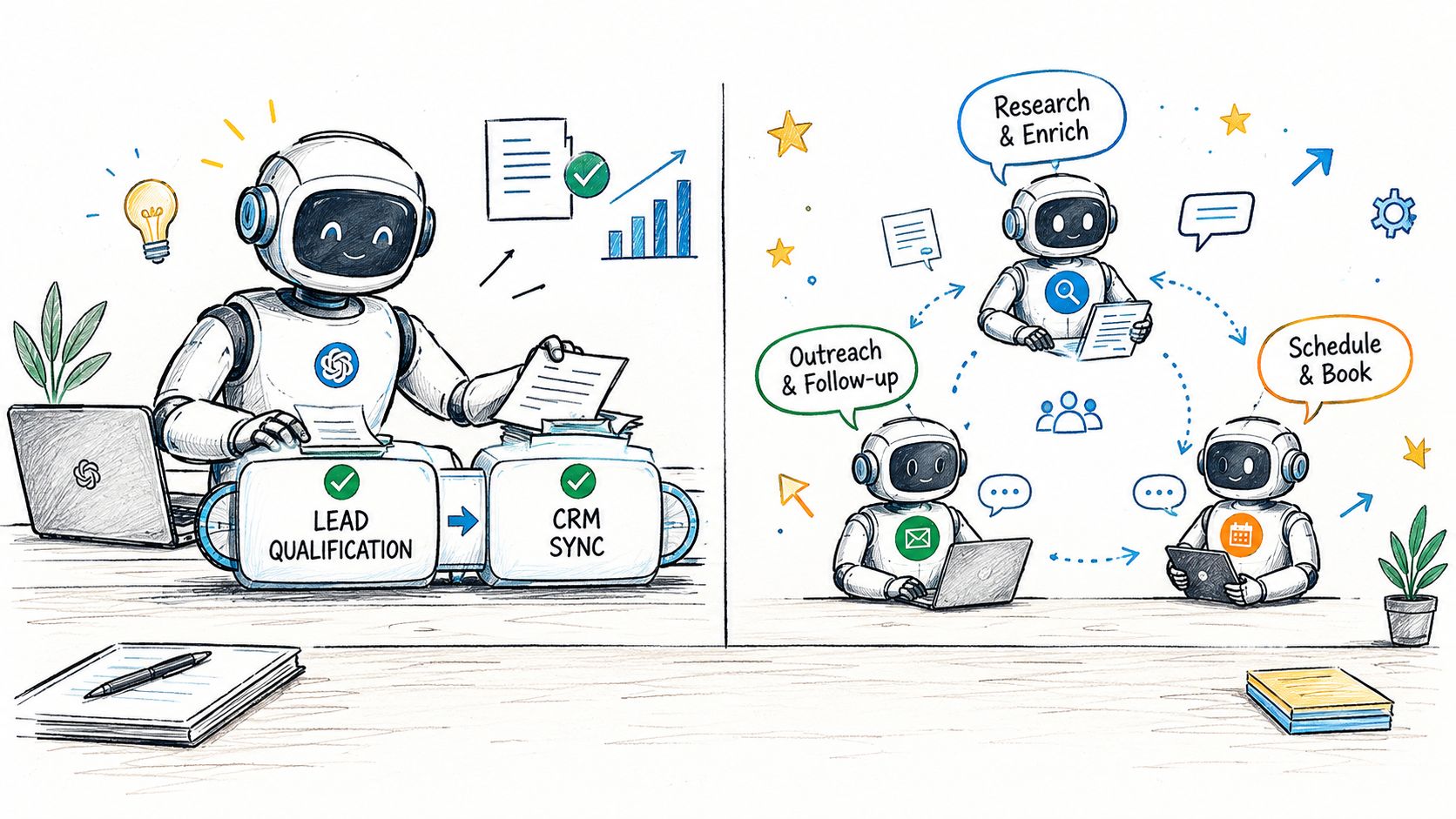
Lead qualification usually belongs to a single agent. The workflow is sequential, context sensitive, and often approval heavy. The agent reads firmographic data, checks the ICP, evaluates role and intent signals, applies exclusion rules, and writes a reasoned result to the CRM. Splitting those steps across agents can make the handoffs more complicated than the decision itself.
CRM synchronization has the same shape. One agent can validate fields, identify missing values, apply routing rules, request approval for sensitive changes, and update the record. A unified trace makes it easier for RevOps to answer why a field changed and which source supported the change.
Where one agent plus tools works
A single agent becomes more capable when it can use the right systems directly. For example, a GTM agent might query Crustdata for firmographics, use FullEnrich for contact details, check Notion for account context, draft an email, and send the proposed action to Slack for approval. The workflow stays under one reasoning owner even though it touches several tools.
This pattern works when the steps depend on one another. The next decision uses the previous result, and preserving the full context improves consistency. It also reduces the number of permission boundaries and makes rollback easier when a record fails validation.
Where multiple agents can pay off
Competitive intelligence is a stronger candidate for multi agent design. One agent can monitor competitor pages, another can inspect product announcements, and another can compare positioning against the team's ICP. Those tasks can run independently before a synthesizer evaluates conflicts and produces a report.
Multi source enrichment can also benefit when each source requires a different access method or expertise. The system might assign separate agents to company data, contact data, news, and technology signals, then pass normalized findings to a scoring agent. The design is defensible only if those research tasks can proceed without constant back and forth.
The rover benchmark provides a useful expectation check. Its measured single agent and multi agent differences show that orchestration can add substantial time and token use even when the final task looks manageable. GTM teams should test the complete path, including retries and approval waits, rather than judging architecture from response quality alone.
Multi agent workflows also require system level testing. The IMDA guidance recommends checking agents separately and then testing how they behave together, with monitoring, logs, and failsafes after deployment. For outbound, that means scoping sending permissions, requiring human approval for new messaging, and recording which agent supplied each claim.
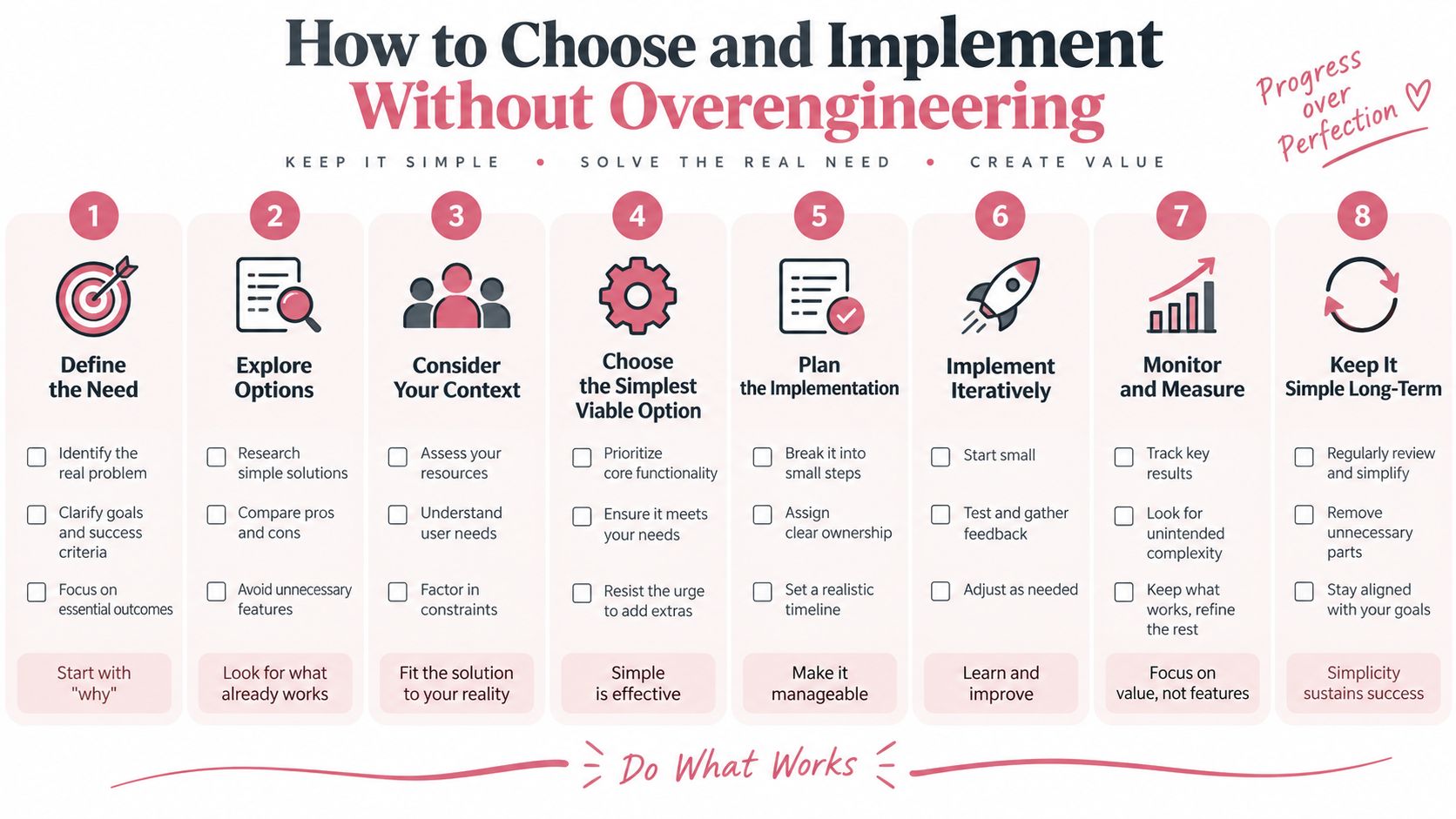
How to Choose and Implement Without Overengineering
Start with the workflow, not the architecture. Map every step, input, output, tool call, approval, and failure condition. Then ask whether the steps are sequential or independent.
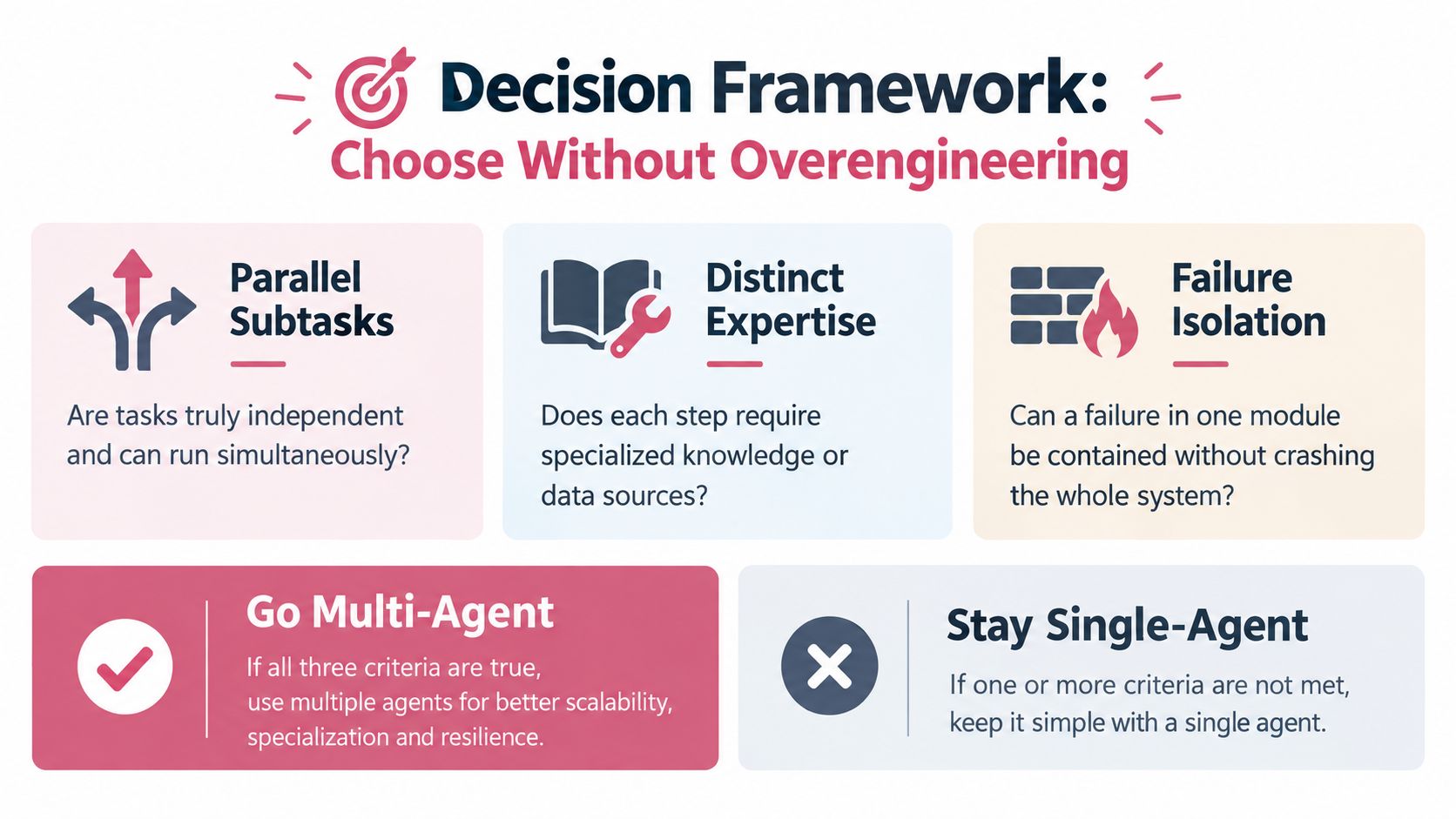
Three signals support a multi agent design:
- Parallel subtasks: Several units of work can run simultaneously without waiting for shared intermediate reasoning.
- Distinct expertise: Different steps require separate data sources, policies, or evaluation styles that one agent handles poorly.
- Context limits: The task contains more information than one coherent reasoning process can reliably manage.
Three signals support staying with one agent:
- Sequential dependency: Each action depends on the exact result of the previous action.
- Audit sensitivity: Operators need one clear trace for every decision and external action.
- Small exception volume: The workflow doesn't create enough independent work to offset coordination overhead.
A practical rollout path
Build one agent behind a stable GTM interface. Give it access to the necessary CRM, enrichment, messaging, and knowledge tools, but keep permissions narrow. Define the acceptance criteria before launch, including what requires approval and what the system must never change automatically.
Next, measure the bounded workflow in production like an operator would. Track completion quality, retries, latency, failed tool calls, approval rates, and the effort required to investigate exceptions. A multi agent design becomes justified only when its measured throughput or reliability improvement exceeds the cost of coordination and additional testing.
When the signal is clear, extract one specialist role instead of rebuilding everything. Keep the original agent as the orchestrator, give the new agent a narrow contract, and pass structured inputs and outputs. Teams evaluating relatable systems for AI agents should focus on state handling, permissions, observability, and recovery behavior, not just role descriptions.
Version every prompt, schema, and routing rule. Test each agent alone, then test the complete system with conflicting inputs, missing data, tool failures, and approval delays. A practical guide to building your own GTM agent can help teams keep the first implementation bounded rather than turning every workflow into a distributed system.
Recommendation for GTM Teams Starting Today
Most B2B startups and scale ups should begin with a single agent plus strong tools, memory, and guardrails. That default fits qualification, enrichment review, CRM synchronization, reply triage, and approval driven outbound because those processes rely on context continuity and predictable control.
A multi agent system makes sense for a proven workflow with independent research streams, separate expert roles, or a context problem that one agent can't handle reliably. It may also suit teams with enough operational maturity to test every agent and the system level behavior together. A 2026 industry report from Halkwinds claims that multi agent architectures can process 6x more tasks per day than comparable single agent systems, but it also reports 6 to 9 months to reach production for multi agent systems versus 3 to 4 months for single agents, due to orchestration engineering, inter agent testing, and failure analysis. The Halkwinds report should be treated as an industry claim, but its central tradeoff is operationally plausible and directly relevant to planning.
The decision matrix is straightforward:
- Small team, sequential workflow, high approval sensitivity: Stay single agent.
- Growing team, several tools, moderate exceptions: Improve the single agent's tool layer and memory first.
- Research heavy workflow with independent streams: Pilot a multi agent topology and measure end to end cost.
- High risk workflow with external actions: Use scoped permissions, human approvals, complete logs, and system level testing before expansion.
Before building, confirm that the task is parallel, define the quality threshold, estimate the coordination burden, and identify who will debug failures. If those answers aren't clear, the architecture is probably too complex.
Yalc provides a unified GTM API and knowledge orchestration layer for workflows spanning prospecting, enrichment, qualification, outreach, and reporting, while keeping approvals, scoped permissions, and execution logs visible to operators. Visit Yalc to evaluate whether a single coordinated agent, or a modular multi agent play, fits the team's actual GTM workflow.