Software Sales Prospecting: The 2026 Operator Playbook
A cold email reply rate of 3.43% is a useful reminder that software sales prospecting isn't mainly a copywriting contest. Benchmark data places many campaigns between 1% and 5%, while top performers reach 8% to 12%. The practical implication is uncomfortable: most prospects stay silent, and small improvements in targeting, timing, deliverability, and message relevance can change pipeline output more than another batch of contacts.
The teams that consistently create qualified conversations don't treat prospecting as a list followed by a send button. They treat every campaign as a hypothesis. The audience, trigger, offer, message, and channel mix either earn promotion, require revision, or get retired.
Table of Contents
- Why Modern Software Sales Prospecting Is a System, Not a Send Button
- Defining the ICP and Building the Source List
- Enrichment and Lead Scoring as the Decision Layer
- Multichannel Outreach and Deliverability as One Motion
- Prospecting Tooling Categories and Where AI GTM Systems Fit
- Workflows That Learn From Every Reply
- Common Misconceptions That Keep Reply Rates Flat
- A 30 Day Operator Checklist for a Working Prospecting Motion
Why Modern Software Sales Prospecting Is a System, Not a Send Button
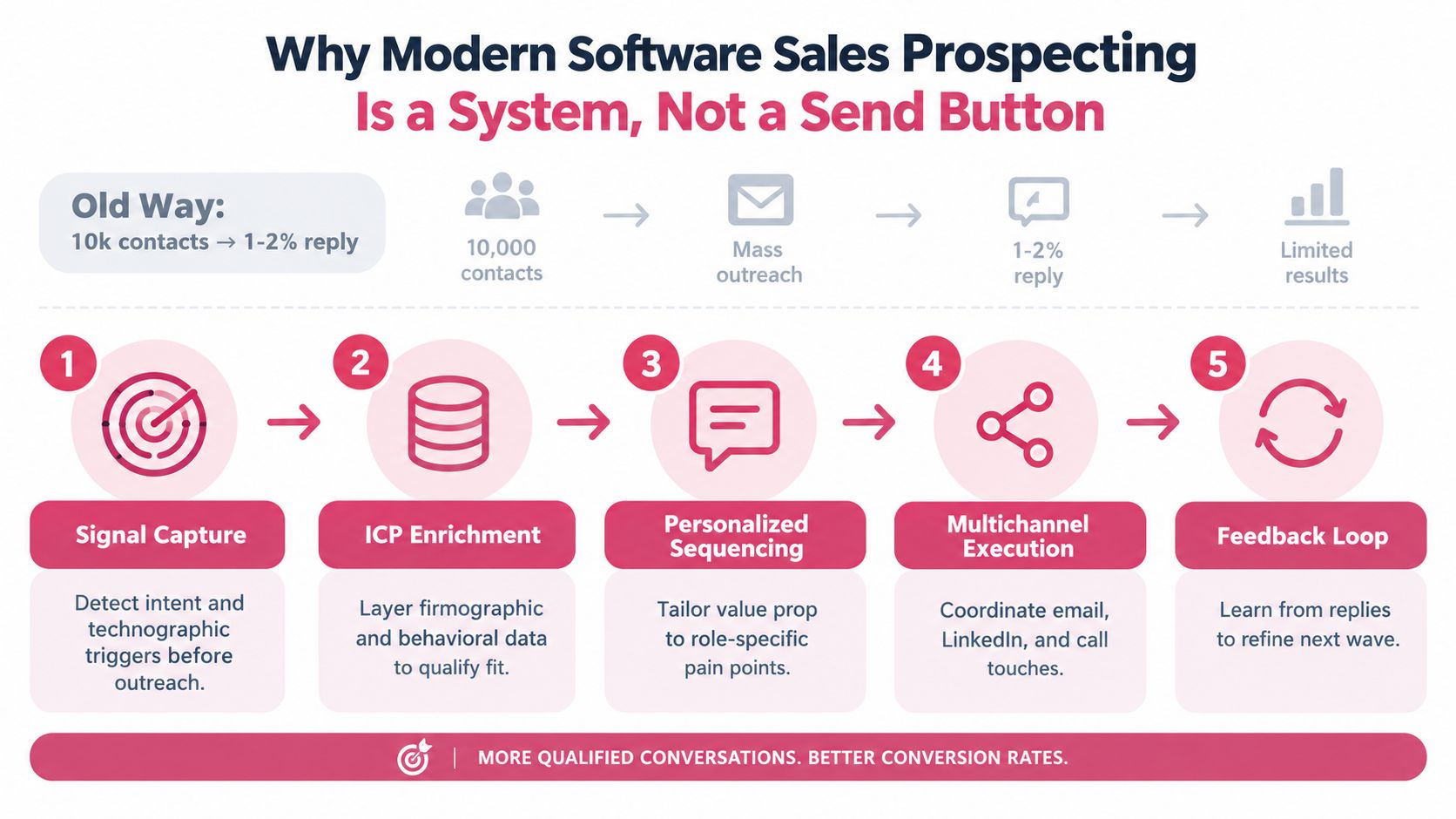
A typical failure pattern starts with a large export. An operator pulls thousands of contacts, applies a generic sequence, and blames the market when replies settle near the bottom of the benchmark range. The list may contain the right job titles, but the companies, buying situations, data quality, and message all remain untested.
Modern software sales prospecting has five connected inputs:
- ICP definition, based on customers that bought.
- Source list quality, including account fit and exclusion rules.
- Enrichment accuracy, so the team knows who and what it's contacting.
- Signal scoring, which separates present relevance from theoretical fit.
- Channel orchestration, so each touch adds context instead of repeating noise.
Campaigns need verdicts
A campaign should have a written hypothesis before launch. For example, a team might believe that software companies hiring sales development representatives and changing their data stack will respond to an offer about reducing manual research. That statement gives the team something to test, rather than a vague ambition to “generate meetings.”
The operating loop is straightforward:
- Capture the inputs: audience, signal, role, offer, channel, and suppression rules.
- Measure the outcome: positive replies, objections, opt outs, meetings, opportunities, and disqualifications.
- Grade the play: determine whether failure came from fit, timing, data, message, or execution.
- Promote or retire: keep validated patterns, revise uncertain ones, and stop spending attention on weak plays.
Practical rule: A reply is not automatically a success. A positive reply from an unqualified account can be a targeting failure disguised as engagement.
This is closer to operating a production service than running a quarterly blast. The team needs clear performance targets, error thresholds, incident reviews, and controlled changes. Outbound sales automation becomes useful when it preserves that discipline and sends learning back into the next list, instead of increasing activity.
Defining the ICP and Building the Source List
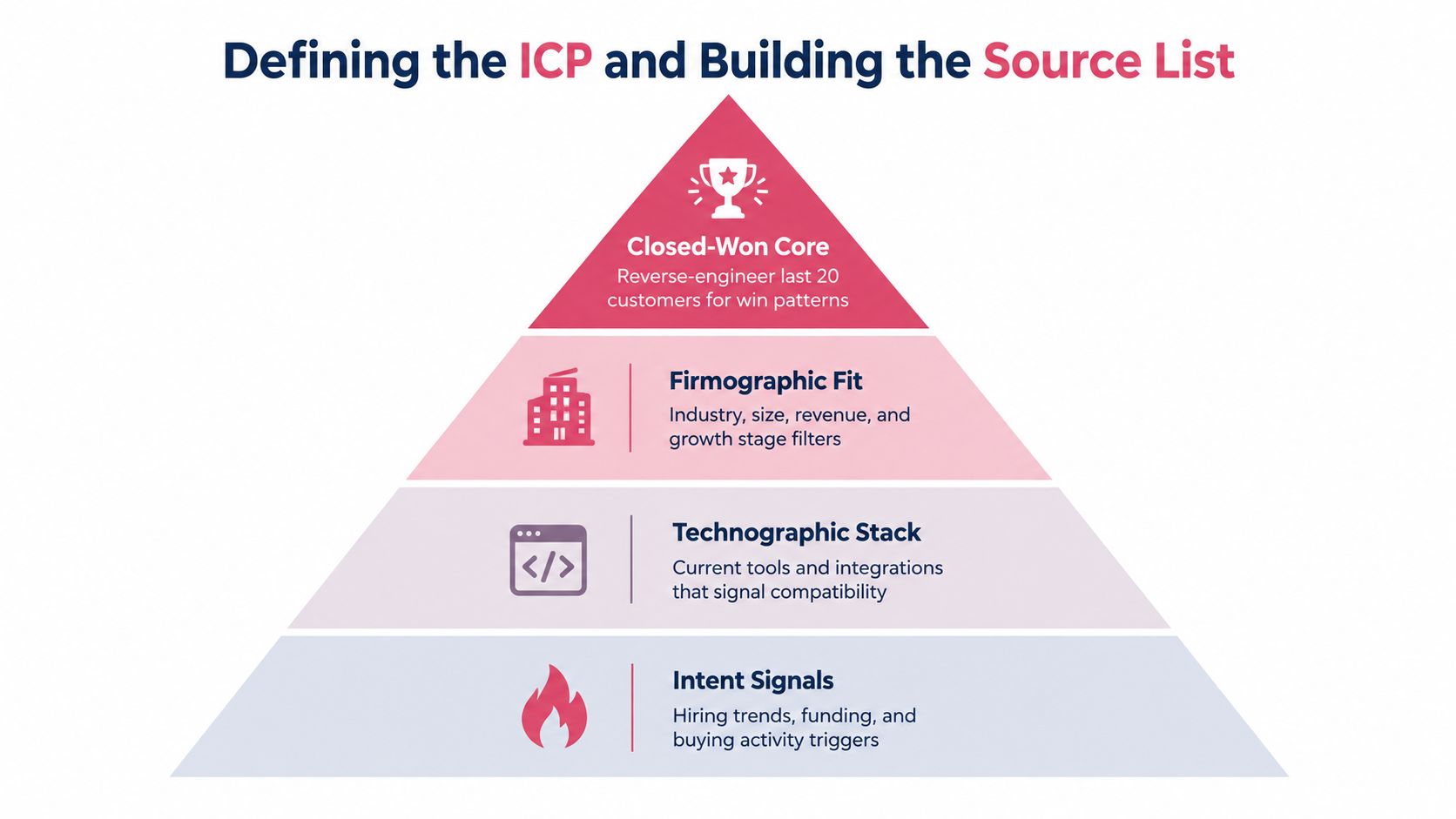
An ideal customer profile should predict closed won, not just opens or downloaded content. A broad total addressable market slide won't tell a sales team which accounts deserve attention this week.
Start with the customers that already converted. Review the last twenty won accounts and record the patterns that appear repeatedly:
- Firmographic fit: industry, company size, geography, growth stage, and operating model.
- Technographic fit: systems, integrations, data infrastructure, and tools that indicate compatibility.
- Buying trigger: hiring, funding, leadership change, expansion, product launch, or an operational transition.
- Time to value: how quickly the customer could reach a meaningful outcome.
- Disqualifiers: missing infrastructure, poor commercial fit, unsupported region, or a problem the product doesn't solve.
The resulting profile should contain hard rules and softer signals. A hard rule might require a particular industry and employee range. A soft signal might increase priority when the account is hiring sales development representatives or replacing a relevant platform.
Build the list in layers
The source list should reflect confidence levels rather than pretending every account is equally attractive.
Primary accounts match the hard rules and resemble proven customers. These accounts deserve the clearest message and the fastest human review.
Adjacent accounts match most of the profile but sit in a neighboring industry, use a different tool, or show only one meaningful trigger. They help the team test whether the current ICP is too narrow.
Experimental accounts challenge an assumption. They might share a buying trigger without matching the usual company profile, or they might operate in a segment the team has never tested. Keep this group visibly separate so an experiment doesn't contaminate the core motion.
Use CRM history, first party product data, public company information, intent providers, and technographic sources together. The list is only the starting point. Niche outbound list building works best when every inclusion has a reason and every exclusion is recorded.
A source list also needs a freshness policy. Remove existing customers from acquisition sequences, suppress active opportunities, account for previous opt outs, and send uncertain records through enrichment before assigning them to a rep. List volume matters less than the proportion of contacts that can support a relevant conversation.
Enrichment and Lead Scoring as the Decision Layer
Raw contact data isn't pipeline. Enrichment turns an account record into a decision about whether the team should act, wait, research further, or exclude it.
A benchmark from Saber's contact data enrichment glossary reports typical leading provider match rates of 75% to 85%. It also places demographic field accuracy at 90% to 95% and firmographic field accuracy at 85% to 90%. Those ranges are strong enough to support automation, but not strong enough to justify blind trust.
Route uncertainty before scoring
An enrichment workflow should distinguish between confirmed, inferred, and missing values. If a provider can't match a professional email or verify a role, the record should move through a fallback path. It shouldn't receive a higher score because the system filled a blank with an assumption.
Useful enrichment fields include:
- Company and domain
- Professional role and seniority
- Industry and company size
- Technology stack
- Recent business trigger
- Existing CRM relationship
- Suppression and consent status
The scoring model should combine fit, intent, and timing. The exact weights should reflect historical conversion rather than internal politics. A team can start with a published model, then recalibrate it after enough comparable campaigns produce outcome data.
| Dimension | Weight | Data Source | Tier A Conversion |
|---|---|---|---|
| Firmographic and ICP fit | Defined by historical analysis | CRM, company data, account research | Report from closed opportunity data |
| Intent and first party behavior | Defined by historical analysis | Product usage, pricing visits, ad engagement | Report from qualified meeting data |
| Timing signals | Defined by historical analysis | Hiring, funding, leadership change, expansion | Report from opportunity data |
Lead scoring should also include a confidence value. A contact with excellent firmographic fit but no verified trigger may belong in a research queue, while an account with a clear trigger and weak contact data may need enrichment before outreach. Waterfall enrichment workflows help formalize those decisions instead of leaving them to individual rep judgment.
Outbound prospecting commonly converts 5% to 15% of leads into meetings, while lead generation through signed contract rates are generally 2% to 5%, according to Derrick's conversion benchmark. That gap makes prioritization essential. The system shouldn't optimize for the largest contact file. It should optimize for the next account most likely to become a qualified opportunity.
Multichannel Outreach and Deliverability as One Motion
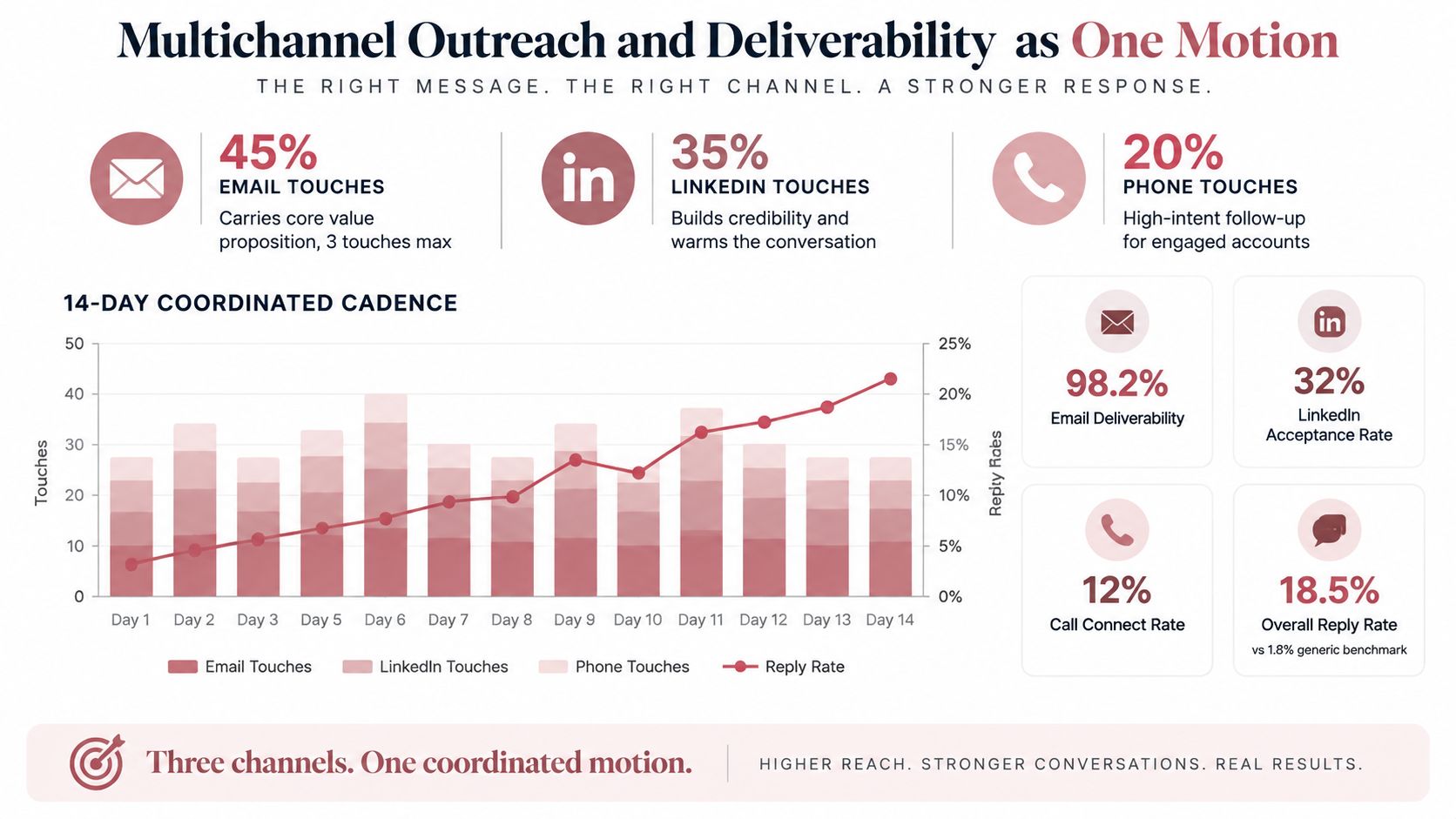
Email, LinkedIn, phone, and chat should operate as one account conversation. A prospect shouldn't receive the same claim in three channels because three separate tools happen to run separate cadences.
Assign each channel a job. Email can carry the central business case, LinkedIn can establish context, and phone or chat can handle urgency after the account shows engagement. The sequence should react to behavior. A reply pauses automation and routes the contact to a human. A click without a reply may justify research or a different channel, but it doesn't automatically justify aggressive follow up.
Coordinate the account, not just the touches
Before launch, define the account level rules:
- Message ownership: decide which channel introduces the idea and which channel reinforces it.
- Touch limits: set limits by channel and stop when the prospect responds or opts out.
- Context sharing: expose prior messages, CRM notes, signals, and objections to every channel.
- Human routing: move replies, sensitive questions, and high intent accounts to a rep.
- Measurement: track positive replies, meetings, opt outs, qualified opportunities, and outcomes per account.
Independent benchmark collections report about one meeting per 120 to 150 prospects for email only, about one per 80 to 100 when LinkedIn is added, and about one per 60 to 80 when email, LinkedIn, and retargeting are combined. The multichannel outbound benchmarks support a practical conclusion: channel diversity can matter more than adding more touches to one channel.
Deliverability remains a causal input. Healthy delivery is generally around 95% to 98% or higher, and a bounce rate below 2% is considered strong. A bounce rate between 2% and 5% signals list quality problems that can damage sender reputation and reduce the visibility of otherwise relevant messages, as outlined in Arrow's deliverability benchmarks.
Authenticate sending domains, maintain stable volume, verify lists, suppress bounced and disengaged contacts, and honor opt outs quickly. GDPR doesn't make every B2B cold email illegal. A justified interest can support outreach when the purpose, necessity, and balancing tests are satisfied, according to GDPR Info's email marketing guidance. Teams should document the assessment, limit data to relevant business fields, and provide a genuine opt out that is honored immediately or within 24 hours, as described in Enrich CRM's prospecting guide.
For teams designing the sequence itself, this Voicedial.ai sales cadence guide provides useful context on coordinating outreach methods without turning a cadence into repetitive noise. AI can assist with research, timing, and next actions inside approved rules. It shouldn't invent facts, impersonate people, or bypass platform limits.
Prospecting Tooling Categories and Where AI GTM Systems Fit
A prospecting stack works better when each tool has one clear responsibility. The common failure isn't a lack of features. It's the handoff between tools, where context disappears and duplicate records multiply.
| Category | Primary job | Typical strength | Main trade off |
|---|---|---|---|
| Source providers | Find target companies and contacts | Broad discovery and filtering | Coverage can exceed accuracy |
| Enrichment and intent tools | Add fit, technology, and behavior data | Better prioritization inputs | Provider match gaps require fallback paths |
| CRM and customer data systems | Establish account truth | History, ownership, and reporting | Data becomes stale without operating rules |
| Engagement platforms | Execute sequences across channels | Workflow control and repeatability | Operators still need to build and inspect plays |
| AI GTM systems | Connect research, scoring, execution, and learning | Faster hypothesis testing and less administration | Governance, integrations, and explainability need review |
Traditional sales engagement platforms are effective when the motion is highly standardized. They provide control over sequence steps, ownership, permissions, and reporting. They still often require operators to define segments, research accounts, write plays, inspect replies, and decide which insights deserve promotion.
An AI GTM operating system such as Yalc connects those stages. It can translate ICP criteria into lists, enrich records, score fit and behavior, recommend next actions, draft channel specific outreach, and feed reply outcomes into future prioritization. That doesn't remove the need for human review. It moves human attention toward claims, exceptions, qualification, and strategy.
Evaluate output, not feature count
A practical evaluation compares one baseline workflow before changing multiple tools. Measure time from signal to first touch, enrichment coverage, false positive rate, accepted meetings, qualified pipeline, rep adoption, and cost per sourced opportunity.
Teams that need a broader view of enablement workflows can also review top sales enablement platforms before selecting a category. The right choice depends on operating constraints. Point tools can be the sensible option for one narrow capability, while an integrated system can reduce repeated research and inconsistent context across the motion.
No platform repairs a weak ICP or an irrelevant offer. The useful platform is the one that makes a sound decision repeatable, visible, and easier to improve.
Workflows That Learn From Every Reply
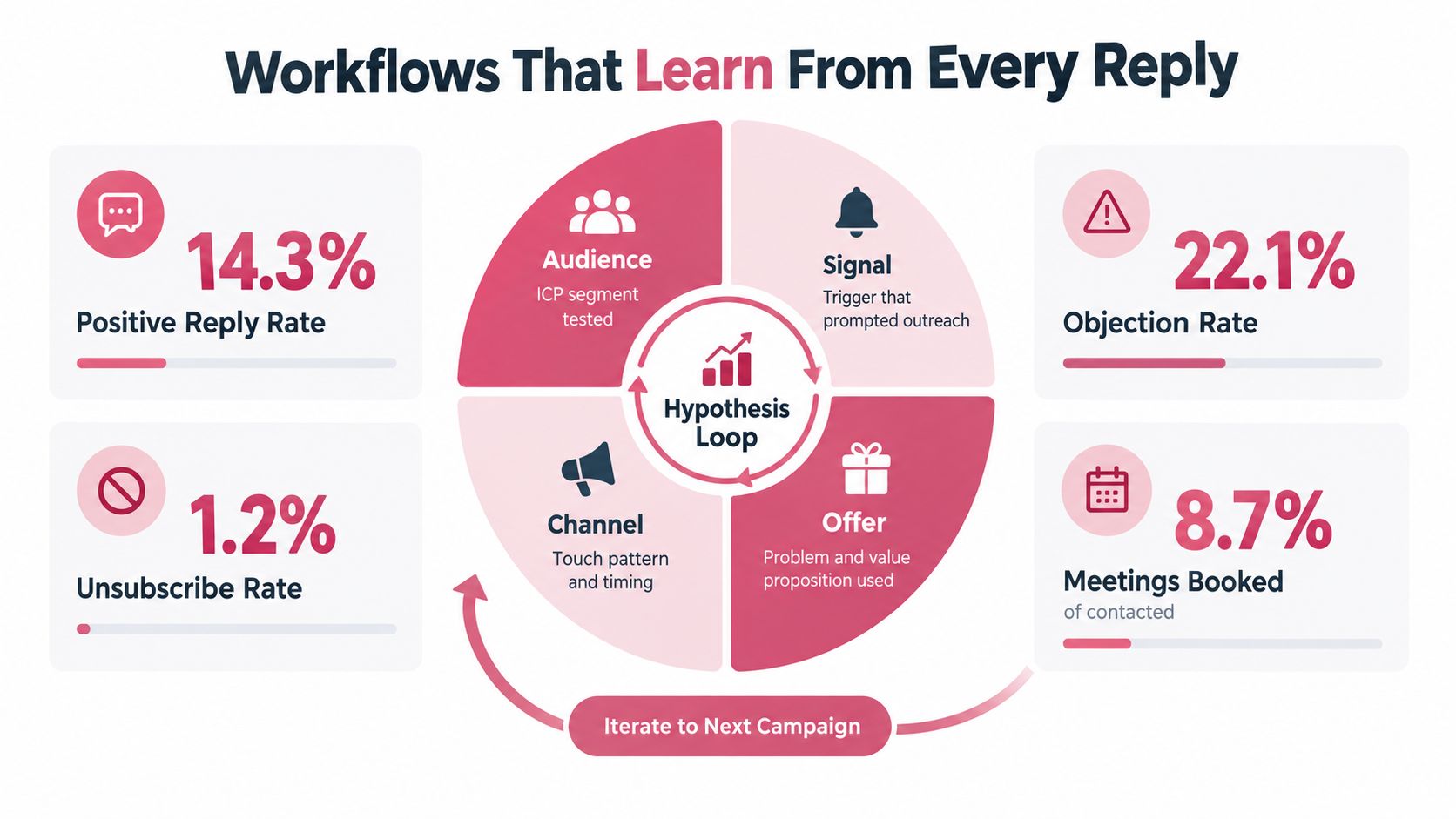
A campaign should state its hypothesis in operational terms: a specific audience, signal, problem, offer, and channel combination expected to create qualified conversations. The result must be graded on business intent, not on activity metrics that make weak outreach look productive.
Every response needs a structured outcome. Tag positive replies, objections, referrals, opt outs, and disqualifications, then classify the reason:
- Timing
- Lack of authority
- No current problem
- Poor targeting
- Weak message
- Wrong channel
- Inaccurate data
Consider two replies. “We use a competitor but re evaluate in November” points to a timing play and a future follow up. “Not interested” may indicate poor fit, weak positioning, or the wrong channel. Treating both as the same negative outcome destroys useful information.
Keep a campaign ledger
The ledger should capture:
- Hypothesis: what the team expected to happen.
- Audience: ICP segment and exclusions.
- Signal: the trigger that justified contact.
- Offer: the problem and value proposition.
- Channel mix: touch pattern and timing.
- Outcome: replies, meetings, opportunities, and disqualifications.
- Grade: promote, revise, observe, or retire.
Promotion rules should require accepted meetings and qualified opportunities across comparable cohorts. A single enthusiastic reply isn't enough to make a play evergreen. Conversely, a weak result shouldn't trigger random changes to every element at once.
The useful loop is observe, classify, score, recommend, execute, measure, and improve. Human reps own claims, qualification, and edge cases. Automation can enrich the prospect, select the next action, draft from approved data, update account scores, and record the result.
The system should reduce interpretation work without hiding the evidence behind an opaque score.
That distinction creates compounding intelligence. A future account benefits from the reasons previous prospects replied, objected, deferred, referred, or opted out. Weak plays lose priority, while validated patterns become easier to deploy with the same brand voice, privacy controls, and approval rules.
Common Misconceptions That Keep Reply Rates Flat
More volume solves weak performance. It doesn't. More messages amplify poor targeting, bad timing, weak offers, and list defects. They can also increase bounces and put the sending domain under unnecessary pressure. The useful lever is better signal density per account.
Personalization means mentioning a company announcement. A funding reference or product launch is not automatically relevant. Buyers respond to the operational consequence of a trigger, such as a changed hiring plan, a new system requirement, or a transition that creates work. Surface level personalization can feel more automated than a concise, accurate observation.
AI writing is the main bottleneck. AI can't manufacture demand when the accounts don't resemble past buyers, enrichment is unreliable, or the product doesn't address a priority. A 2025 survey found that 54% of teams use AI for personalized outbound emails, while 43% run a hybrid inbound and outbound model, according to Outreach's 2025 prospecting report. Adoption doesn't prove that generated copy is the constraint.
The stronger evidence points to hooks and signals. Timeline based hooks produced a 10.01% reply rate, compared with 4.39% for problem based hooks, a 2.3 times difference, in Digital Bloom's cold outbound benchmark research. The lesson isn't to abandon problem messaging. It's to connect the problem to a credible reason that action matters now.
Multichannel outreach has the same trap. Repeating one pitch across email, LinkedIn, and phone is frequency, not orchestration. Winning plays also aren't permanent assets. Measure positive replies, qualified meetings, conversion by signal, and revenue, then promote, revise, or retire each hypothesis based on evidence.
A 30 Day Operator Checklist for a Working Prospecting Motion
A working motion can be built in a month if the team keeps the scope narrow and measures outcomes from the first launch.
Days 1 through 7
Define the ICP from won customers. Record company size, industry, buying trigger, relevant technology, and disqualifiers. Choose one primary persona and two adjacent roles so the team can test buying committee coverage without making the first segment vague.
Build the source list with hard firmographic filters and observable signals. Include hiring, funding, stack changes, leadership moves, expansion, and product launches where those events relate to the product. Exclude existing customers, active opportunities, obvious mismatches, previous opt outs, and contacts with unstable work emails.
Days 8 through 18
Enrich the list, verify contact data, and score each account on fit, timing, reachability, and source quality. Test the provider against a random sample. The operational target in this checklist is at least 95% correct emails and 90% accurate firmographic or technographic fields, but the team should treat those as validation thresholds, not assumed facts.
Don't let a model invent a trigger. Missing evidence should lower confidence and send the record to review.
Launch two message hypotheses for one segment. Coordinate email, LinkedIn, and selective calling or chat. Protect authentication, cap volume, monitor bounces and complaints, and pause follow up after replies or opt outs.
Days 19 through 30
Grade every reply and inspect objections. Route positive intent to sales, preserve referrals, and assign timing based on the prospect's stated window. Record positive reply rate, qualified meeting rate, show rate, opportunity conversion, and source level performance.
Document consent, legitimate interest assessments, opt outs, data fields, retention rules, and regional requirements before the list expands. At the end of the period, promote one play, revise one, and retire one. The deliverable isn't activity. It's a measured motion with a clear next experiment.
Yalc connects prospect sourcing, enrichment, scoring, sequencing, reply handling, and campaign verdicts through a unified GTM operating system that can run from Claude Code, Slack, or its interface. Visit Yalc to see how a controlled feedback loop can replace disconnected prospecting tasks with a motion your team can audit, improve, and run on its own infrastructure.