What Are Key Accounts and Who Qualifies

A key account is a strategically important customer or prospect served with dedicated, coordinated resources, not just the customer with the largest contract. It qualifies because the supplier has a defensible reason to invest beyond standard sales coverage.
Ranking customers by revenue and calling the biggest ones strategic skips the harder decision: whether extra attention will produce enough value to justify its cost. A stronger approach evaluates the organization's economics, buying group, growth potential, and ability to remain a healthy customer when people or budgets change.
Table of Contents
- What a Key Account Really Is
- The Score That Decides Who Qualifies
- Key Accounts Versus Volume Motions
- How to Staff a Key Account Team
- KPIs That Justify the Extra Cost
- Accounts That Earn or Lose the Label
- When to Move an Account In or Out
What a Key Account Really Is
Strategic importance, not contract size, defines a key account. Before assigning dedicated coverage, ask whether winning or losing the organization would materially change revenue concentration, market credibility, product direction, or access to a target segment.
The Springer chapter on key account management distinguishes strategically important customers receiving additional resources, dedicated personnel, coordinated support, or customized commercial programs from customers managed through standard sales coverage. That distinction makes the label a resource allocation decision, not a reward for a successful sale.
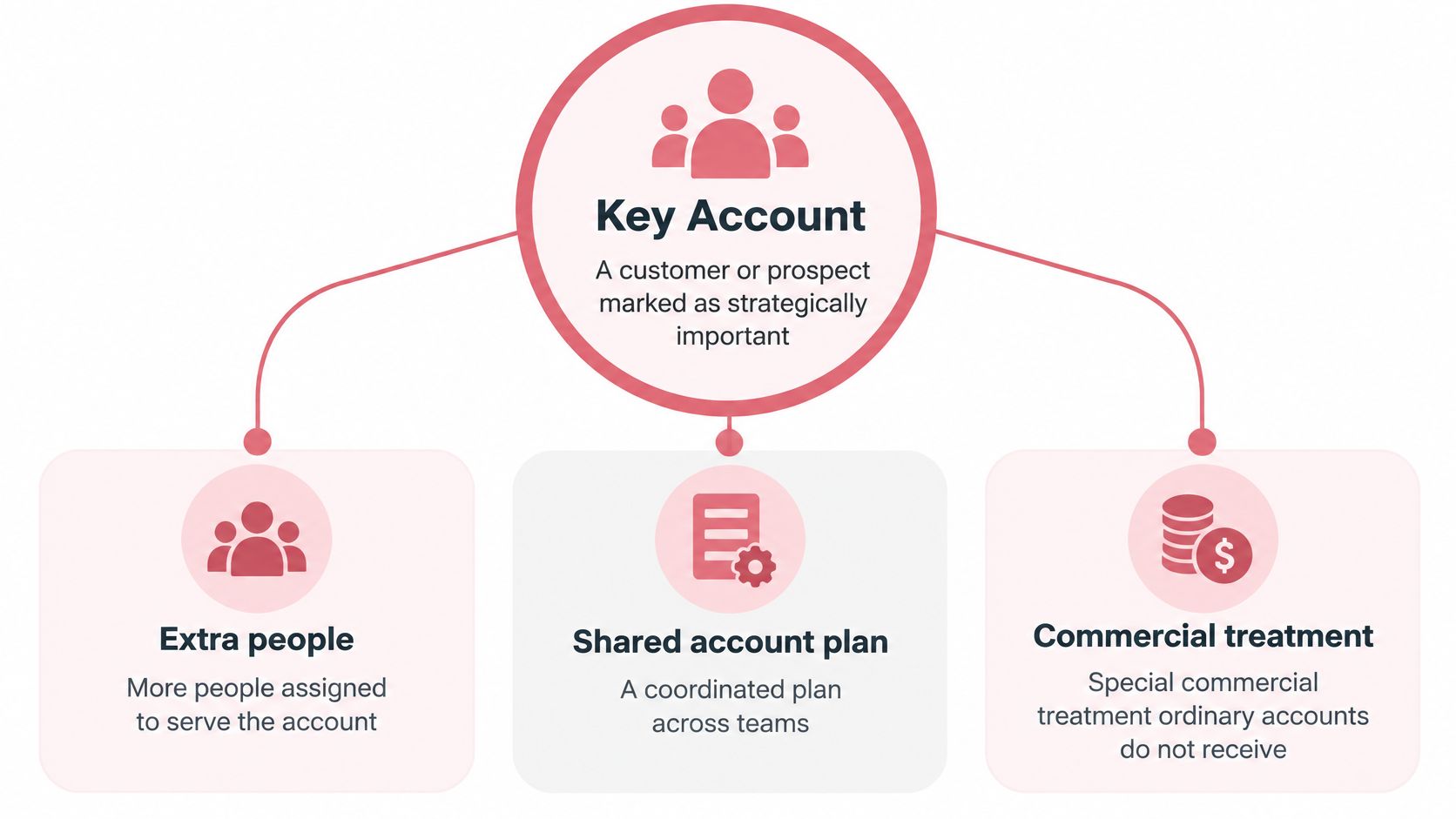
Strategic importance needs an operating consequence
A customer might deserve consideration because its deployment provides access to a new segment. Another might enable valuable technical collaboration or create substantial exposure if it leaves. Neither case automatically justifies discounts, custom development, or unlimited executive attention.
The account owner must explain what the supplier expects in return for the additional investment. That could be profitable expansion, a defensible reference, strategic learning, or protection of an economically important relationship.
Practical rule: If the team can't name what dedicated coverage should change, the account isn't ready for dedicated coverage.
A large contract with thin margin and a fragile relationship can be a weak candidate. A smaller customer with a credible route into a target market can be stronger, provided the supplier can support that route.
Coverage must be meaningfully different
Dedicated coverage should produce observable differences:
- Named accountability: An account lead coordinates decisions rather than leaving each department to pursue its own priorities.
- Shared planning: Sales, customer success, product, and finance work from the same commercial objectives and commitments.
- Deliberate treatment: Executive involvement, service arrangements, and commercial exceptions have explicit purposes and boundaries.
Standard coverage remains appropriate when a seller or agent can address the need through a repeatable offer and light customization. It isn't inferior service. It is the right operating model for customers whose needs don't require exceptional coordination.
For leaders asking what are key accounts, the useful answer is therefore operational: organizations important enough to justify a different way of working, with evidence that the difference is worth funding.
The Score That Decides Who Qualifies
Set an economic floor before scoring strategic attractiveness. Finance should establish the minimum current gross profit or credible future opportunity that can justify dedicated coverage. Prospects need an opportunity based route through the floor because they don't yet generate recurring revenue.
Then assess economic weight, growth path, ICP and product fit, buying complexity, market influence, and durability. Treat the following scoring method as a proposed internal policy, not an industry benchmark: rate each gate from 0 to 5, require growth and fit to reach 4, and require durability to reach at least 3 before promotion.
The multidimensional approach follows the EBSCO overview of key account management, which includes profitability, growth potential, reference value, market access, and other strategic considerations rather than current revenue alone. Its discussion of declining margins among some preferred accounts explains why bookings shouldn't dominate the decision.
Key account qualification scorecard
| Gate | What to measure | Pass signal | Fail signal |
|---|---|---|---|
| Economic weight | Gross margin or ARR, not bookings alone | Margin holds after service cost | Large logo with thin or falling margin |
| Growth path | Additional teams, regions, products, and funded use cases | A dated expansion path with a buyer | Flat usage and no next use case |
| ICP and product fit | Match to the ideal customer and the ability to serve it | Fit is strong and delivery is realistic | High ARR outside the ICP |
| Buying complexity | Roles, sites, and approval steps that must align | Several stakeholders need a shared plan | One buyer and a standard package |
| Market influence | Reference value and access to a segment or technology | The logo opens a market the supplier wants | No reference, no segment access |
| Durability | Sponsor redundancy, integration depth, renewal risk | Several sponsors and real product use | One champion or one budget owner |
Require evidence before awarding points
Economic weight needs a finance approved calculation that includes implementation work, support demand, and exceptional concessions. ARR is useful for comparison, but it doesn't reveal whether the supplier earns enough after servicing the account.
Growth needs a named buyer, an identifiable next use case, and a decision date. An account manager's belief that other departments could adopt isn't an expansion plan.
Fit is a hard gate. No aggregate score should override an inability to deliver the required product, security posture, implementation support, or commercial model. Complexity also needs careful interpretation: complicated procurement creates work, but it doesn't create strategic value by itself.
Market influence requires an actionable route to value. Check whether reference rights are available and whether the supplier intends to pursue the segment. Durability requires evidence of adoption and sponsorship beyond the original contact.
Keep scores auditable
Store the evidence, assessment date, owner, and confidence beside each rating. Missing information should remain an explicit gap rather than becoming an optimistic score.
An account score also serves a different purpose from lead scoring: it decides where coordinated investment belongs, not just which individual deserves a sales response. Recompute it quarterly and after material events such as a sponsor departure or a major change in scope.
Don't promote solely on a total. A strong reference case can't cancel an unserviceable product requirement.
Key Accounts Versus Volume Motions
Volume coverage solves for speed across similar buying needs. Key account coverage solves for coordination within strategically important organizations. Applying both independently to the same organization creates conflicting messages, duplicate work, and unclear ownership.
Volume coverage works when the offer is repeatable and sellers can move buyers through a familiar process. Dedicated coverage makes sense when departments, sites, or approval groups require deliberate alignment around a broader commercial plan.
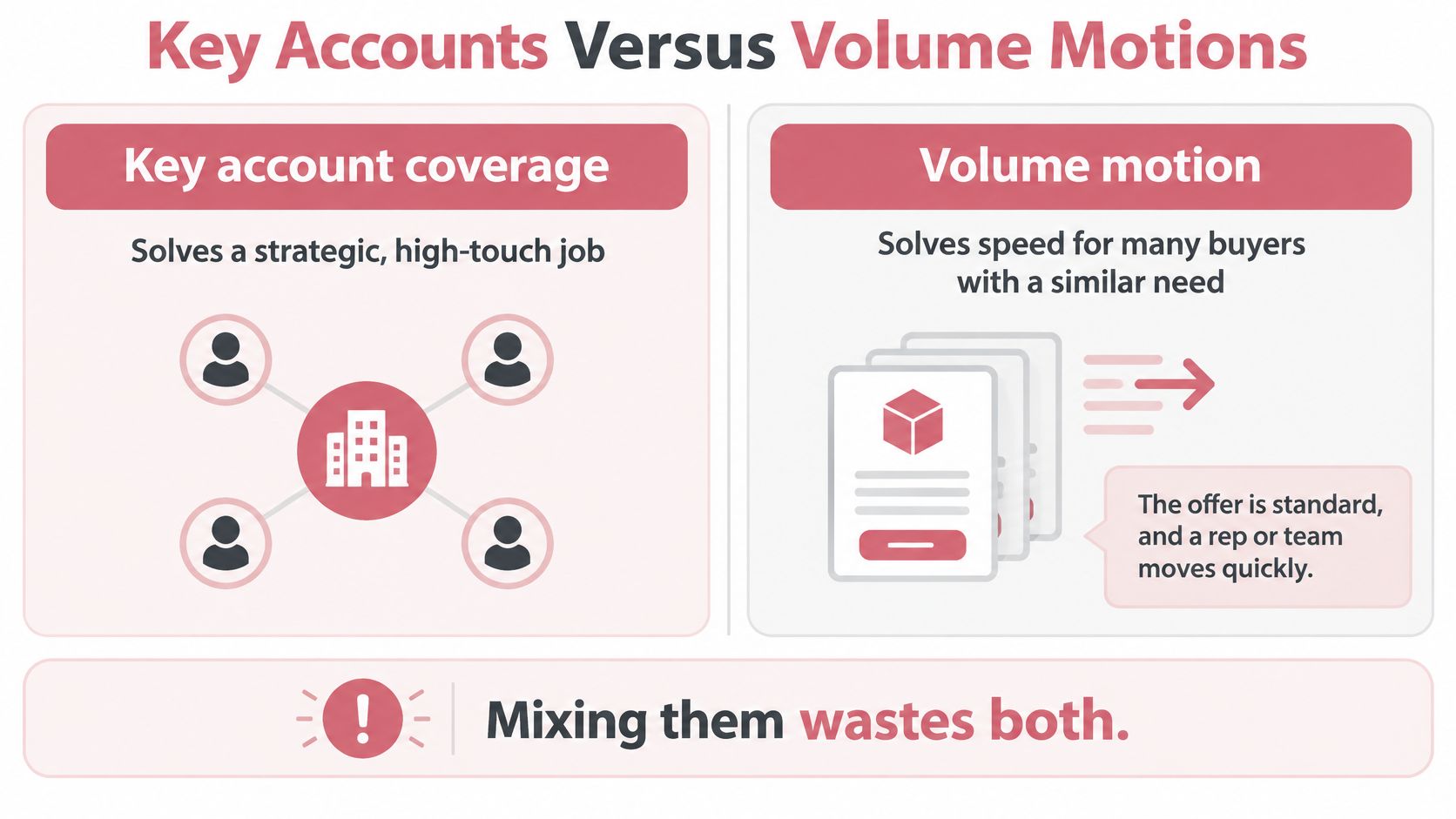
Key account motion versus volume motions
| Motion | Buyer shape | Coverage model | Success metric | Typical book |
|---|---|---|---|---|
| Key account | Many roles, sites, and a long cycle | Named owner plus an executive sponsor | Margin, retention, and expansion | Limited by the capacity needed for each account plan |
| Mid market volume | A repeatable need and a few roles | Pooled reps or agents on a shared sequence | Meetings and pipeline per person | Dozens of accounts in an illustrative staffing model |
| SMB | One buyer and a standard offer | High velocity coverage | Volume and payback speed | A large book supported by repeatable processes |
These are coverage designs, not company size rules. An enterprise logo buying a standard package through a single economic owner may belong in volume coverage. A smaller organization with coordinated purchasing and conflicting site requirements may need a shared account plan.
Size the book from the work
Don't adopt an account count because another company uses it. Estimate the work required for discovery, technical validation, adoption reviews, procurement, executive involvement, and internal coordination. Assign time to each role, including specialists shared across teams.
A pod has capacity only when those commitments fit alongside existing customer obligations. If every account needs frequent product involvement, the constraint may be solutions capacity rather than the number of sellers.
A dedicated account list without dedicated capacity is a naming exercise.
For example, a seller may have room for additional relationships while the implementation team can't support another rollout. Promoting an account under those conditions creates promises the supplier can't keep.
Keep routing explicit. General campaigns should exclude accounts under dedicated ownership unless the account lead approves the audience and message. Marketing can still support those accounts, but its activity should reinforce the account plan rather than compete with it.
The reverse mistake is just as expensive: assigning executive sponsors and bespoke planning to buyers who need a quick quote. Extra coordination can slow a straightforward purchase without improving the outcome.
How to Staff a Key Account Team
Assign an account lead, executive sponsor, solutions or product partner, customer success owner, and finance or revenue operations partner. These are responsibilities, not necessarily separate full time hires. Give them a shared account record before asking them to increase engagement.
The account lead owns the plan and weekly priorities. The executive sponsor handles moments that require senior authority, while the solutions or product partner confirms what the supplier can deliver. Customer success owns adoption and renewal readiness; finance or revenue operations checks economics, terms, and exposure.
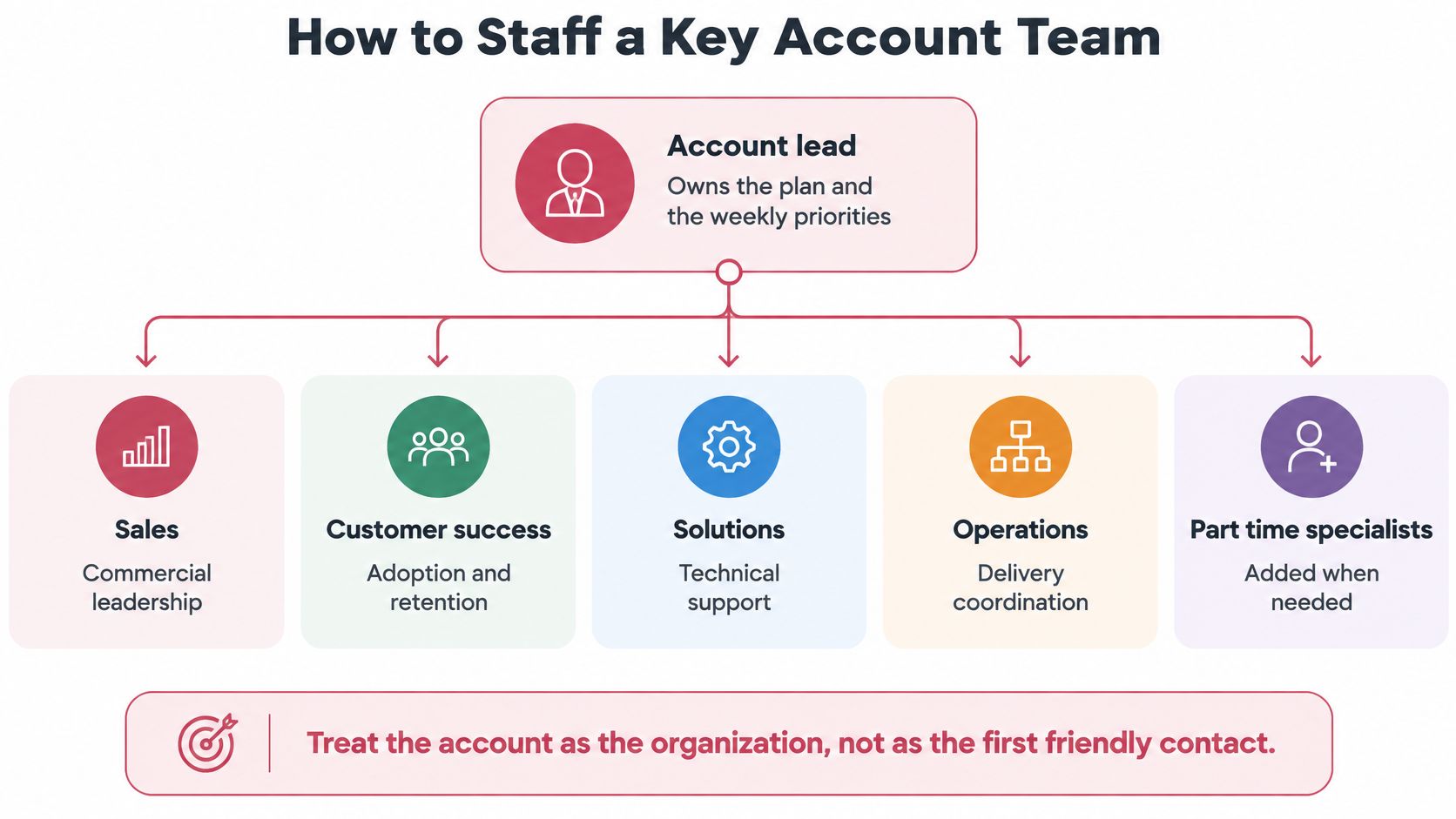
Map responsibilities on both sides
The customer map should identify the economic owner, daily users, technical approvers, procurement, legal or security, and internal champion. Record who influences whom, whose approval blocks progress, and which priorities conflict.
A LUT University thesis on key account management describes the distinctive requirements, coordinated purchasing, complex decisions, and special services associated with these accounts. The staffing implication is practical: relationship ownership alone isn't enough when delivery and buying decisions span departments.
- Account lead: Resolves competing internal priorities and keeps commitments current.
- Executive sponsor: Establishes senior alignment without becoming the default escalation route for routine work.
- Solutions or product partner: Separates supported capabilities from requests requiring development decisions.
- Customer success: Connects the commercial plan to actual adoption and customer outcomes.
- Finance or operations: Checks service cost, payment terms, approval controls, and reporting consistency.
When hiring for the lead role, evaluate coordination and commercial judgment rather than relationship skills alone. GENTY recruitment's key account manager recruitment resource can support role scoping when a team needs a dedicated owner rather than another general sales hire.
Make the record usable by the whole team
The shared record should connect the parent company, subsidiaries, sites, buying committee, competitors, opportunities, contracts, and meaningful interactions. A CRM such as Salesforce or HubSpot can hold the core record, with linked account plans where necessary.
Every research or outreach action should read the current record, then write back evidence, the responsible owner, the next step, and confidence. Label inferred relationships separately from confirmed ones. Pause sensitive outreach for human approval, particularly executive messages, commercial concessions, and communications around unresolved service issues.
sales operations should define required fields, permissions, routing, and handoffs. A private spreadsheet held by a heroic seller leaves the rest of the team unable to distinguish a healthy account from a friendly contact.
KPIs That Justify the Extra Cost
Track stakeholder coverage, gross margin, expansion, retention risk, and pipeline quality together. The account earns continued investment when the results justify the people and exceptions assigned to it, not when the team produces more activity.
A 2023 systematic literature review examined 104 papers published between 1990 and 2022 and discusses longitudinal evidence that key accounts can initially perform as well as or better than other accounts, then become less satisfied, less profitable, and less beneficial for growth. That is the reason bookings alone are an inadequate control.
Key account KPIs and warning signs
| KPI | What it tests | Healthy read | Warning |
|---|---|---|---|
| Stakeholder coverage | Whether the buying group is actually engaged | Economic owner, users, technical, procurement, and an executive are covered | Almost all activity sits on one contact |
| Gross margin | Whether revenue survives the cost to serve | Margin holds or improves | Sales rise while operating margin falls |
| Expansion | Whether the growth bet is real | New teams or products land in the plan window | Usage is flat after a year |
| Retention risk | Whether the relationship can survive a change | Renewal is likely and sponsors are redundant | One budget owner or one site carries the account |
| Pipeline quality | Whether the plan creates revenue | Opportunities advance with more than one thread | Meetings with no economic next step |
The warning conditions are review triggers, not universal performance thresholds. A deliberately narrow deployment may be appropriate, for example, if the account plan explicitly funds a limited validation phase.
Read the economics without hiding delivery costs
Finance should distinguish gross margin from the broader contribution remaining after dedicated coverage. Gross margin can look acceptable while executive time, specialist support, custom planning, and commercial exceptions make the relationship unattractive.
Keep those costs visible rather than burying them in general overhead. Compare the outcome with the investment approved for the account, and explain any variance.
Pipeline quality needs similar discipline. A meeting becomes useful evidence when the buyer confirms a business problem, an approval path, and a concrete next decision. Repeated conversations without movement shouldn't count as strategic progress.
Use the dashboard to make a decision
A useful dashboard combines current values, trends, ownership, and the action required when a warning appears. These sales dashboard examples provide a starting point for presenting those measures without reducing the review to activity totals.
Customer feedback should accompany the numbers. Falling satisfaction can reveal that bespoke promises have exceeded delivery capacity before renewal risk becomes obvious.
Review trigger: Rising sales alongside declining profitability and customer satisfaction calls for a revised plan, not a larger outreach target.
Repair the economics, narrow the commitments, or reduce coverage. Don't treat additional activity as proof that the original investment decision remains sound.
Accounts That Earn or Lose the Label
A regional bank can look strategic and still fail qualification. Consider a hypothetical bank generating $400,000 in ARR through a single business unit. Its champion is responsive, but integration is shallow and procurement hasn't participated in any expansion discussion.
The bank's name attracts internal attention, yet the current evidence doesn't justify dedicated growth coverage. Keep it in standard coverage while the owner validates another sponsor and a funded next use case. Maintain appropriate renewal support without confusing an important contract with a qualified expansion program.
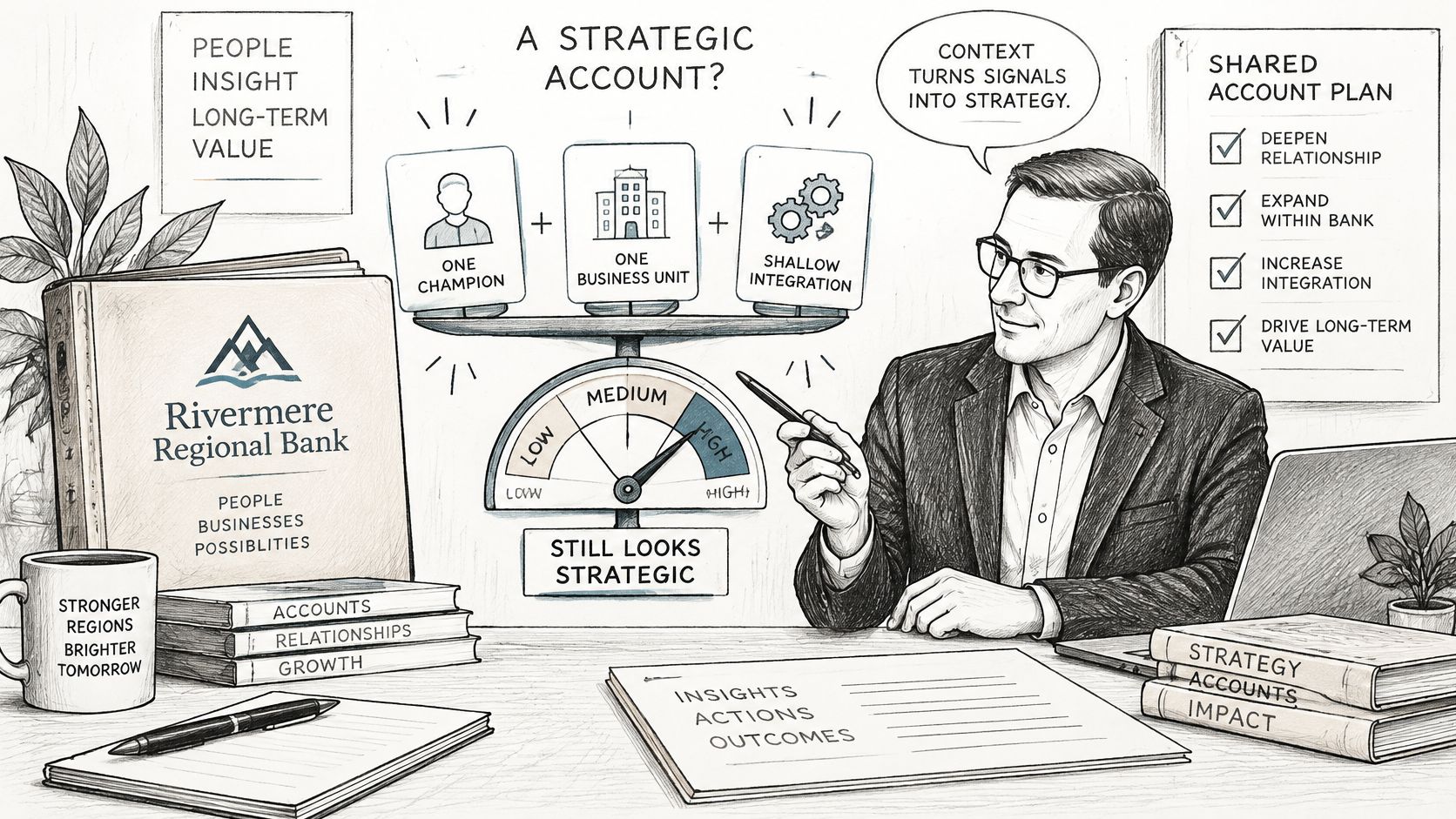
A smaller account with an executable path
Now consider a hypothetical logistics firm generating $180,000 in ARR. Several business units have relevant use cases, security and procurement are already involved, and the supplier wants a reference in that vertical.
This account deserves promotion if delivery capacity and sponsor depth are confirmed. Its case rests on an executable adoption path, not the assumption that every logistics company will buy once the logo appears on a website.
The owner should secure permission for the proposed reference activity and identify the buyer responsible for the next rollout. Without those commitments, influence and growth remain possibilities rather than evidence.
An enterprise account that no longer qualifies
A longstanding enterprise customer presents a different decision. Its original champion has left, usage is confined to a narrow team, and renewal depends on an isolated budget.
Move it out of dedicated growth coverage and establish a bounded retention plan. Demotion doesn't mean abandoning contractual obligations or ignoring customer problems. It means stopping an expansion investment that the available evidence no longer supports.
The decisions differ for concrete reasons:
- Bank: Attractive revenue, but insufficient buying coverage and durability.
- Logistics firm: Smaller current economics, with a credible route to broader adoption.
- Fading enterprise: Historical importance without a current basis for the same resource allocation.
The Demandbase State of the B2B Buyer Report reports that 72% of B2B purchases involve complex buying groups and cites Gartner findings that 74% of buyer teams experience unhealthy conflict. The same report cites Gartner findings that consensus based groups are 2.5 times more likely to report a high quality deal, while content designed for the whole group improves consensus by 20% and messaging optimized for an individual can reduce it by 59%.
The operating response is to help buyers resolve competing priorities, not just give the friendliest contact more personalized material.
When to Move an Account In or Out
Make a quarterly decision to promote, keep, or move out. Treat the label as a current investment judgment, not a permanent entitlement earned by a past contract.
The review should distinguish an attractive opportunity from an account the supplier must carefully protect. Concentration can justify additional risk management even when the case for expansion has weakened.
Run the review in order
Refresh the evidence. Rescore the qualification gates using current commercial, adoption, and relationship information. Date the evidence and identify gaps rather than carrying forward an unsupported rating.
Confirm fit and capacity. Check that delivery remains realistic and the assigned team can cover the buying group. A large renewal doesn't establish an expansion case, and an attractive opportunity doesn't create specialist capacity.
Apply exit triggers. Investigate falling margin despite stable sales, a departed sponsor without a replacement, shrinking usage, or an expansion case blocked by an unresolved approval. Choose a corrective action with an owner and deadline, or reduce the coverage commitment.
Test concentration and resilience. Examples in an SEC customer concentration disclosure include individual customer concentrations of roughly 11% to 20%. Those examples aren't a general benchmark, but they illustrate why a supplier should test how an account's contraction would affect the business.
Record the decision. Write the verdict, supporting evidence, resource change, and accountable owner into the account record that day. Include the condition that would justify reconsideration.
Separate demotion from neglect
Keep dedicated coverage when broad engagement, sound economics, and a dated expansion or retention objective still justify its cost. Where the purpose is retention, state that explicitly so the team isn't measured against an imaginary growth plan.
Moving an account out should trigger a managed handoff, not an unexplained drop in service. Preserve contractual commitments, tell internal teams who now owns the relationship, and remove outdated exceptions.
Finish the review by recording the verdict and its evidence in the shared account record, where the next operator can act on it.
Yalc offers account research, enrichment, ICP scoring, CRM synchronization, and reporting workflows that can support evidence based account prioritization. Visit Yalc to explore how those workflows can prepare account reviews, keep records current, and retain human approval for sensitive actions.