What Are the Use Cases for Yalc? 8 GTM Examples

75% of organizations globally now use sales automation in some form, and 61% of B2B firms had adopted sales automation by 2025. Yalc is most useful for automating and learning from qualification, outbound, intent capture, content engagement, pipeline intelligence, campaign optimization, and custom GTM workflows.
That adoption matters because modern sales automation isn't just email drafting. A 2025 survey cited by Cirrus Insight's sales automation research found that 78% of B2B companies use AI across at least one business function, up from 68% in 2024. The practical shift is from isolated assistants to connected workflows that enrich records, route leads, run sequences, handle replies, sync CRM data, and report what worked.
Yalc fits that operating model as one GTM engine with two operating surfaces. Revenue teams can run preconfigured playbooks from Slack or the Yalc UI when speed matters. Technical operators can bring the Yalc MCP into Claude Code and compose custom plays with direct control over logic, providers, approvals, and versioning. Both surfaces use the same unified GTM API, data, and accumulated GTM knowledge.
Every use case should pass the same practical test:
Goal → Play selection → Execution → Measurement → Learning
The sections below assess the operating problem, relevant plays and integrations, measurable outcomes, the right implementation surface, and the points where a person should approve or challenge the automation. Yalc can also support adjacent workflows such as account servicing with AI security, but the strongest advantage appears when linked GTM steps operate as one motion.
Table of Contents
- 1. Automated Lead Qualification and Scoring at Scale
- 2. Multi Channel Outbound Campaign Orchestration
- 3. Visitor Pipeline Conversion from Website Traffic
- 4. Campaign Performance Measurement and Automated Optimization
- 5. Intent Based Account Targeting and Competitive Intelligence
- 6. Personalized Content Delivery and Social Engagement
- 7. Pipeline Intelligence and Forecast Accuracy
- 8. Custom GTM Motion Composition and Experimentation
- 8 Use Cases Comparison
- Choose the Right Yalc Entry Point
1. Automated Lead Qualification and Scoring at Scale
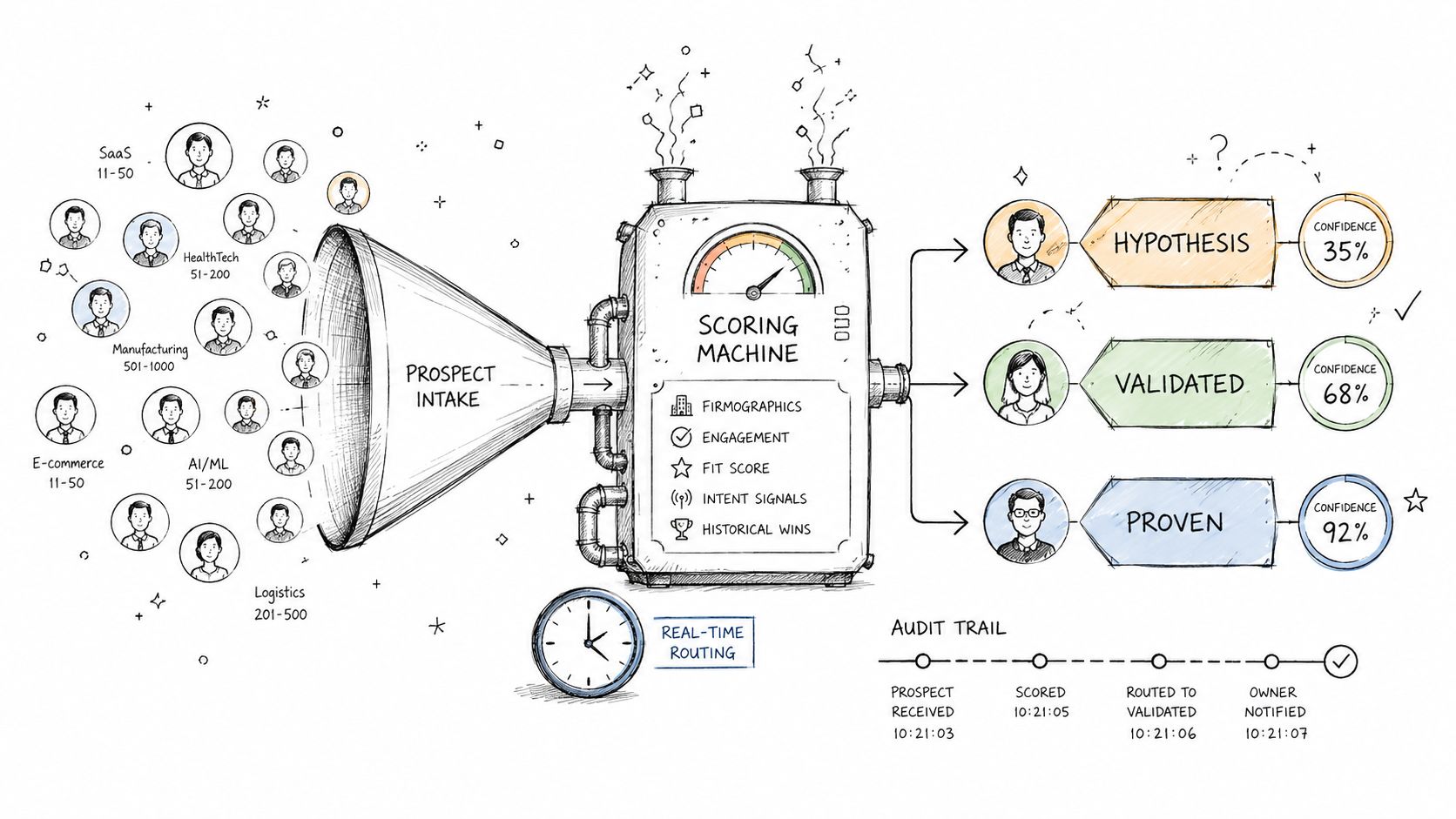
Lead qualification works best when the team turns its actual ICP into explicit decision logic. Yalc's ICP Scorer and Lead Qualifier plays can evaluate company characteristics, buyer roles, technology signals, and engagement context, then return a confidence scored verdict such as hypothesis, validated, or proven.
That structure replaces inconsistent review with a repeatable route. A prospect that fits the ICP and shows meaningful engagement can enter an outbound sequence. A record with weak fit can move to nurture or leave active outreach. The system can also write the reasoning and result back to the CRM through the unified GTM API, so sales and operations work from the same qualification state.
Teams shouldn't begin by scoring every possible signal. They should define the fields that reflect real buying history, test the logic against existing customers, and inspect false positives before allowing automated outreach. The guide to lead scoring is useful for separating fit, behavior, and qualification criteria instead of collapsing them into one vague score.
What to measure and where judgment stays
Useful metrics include qualified lead acceptance, meeting conversion, disqualification reasons, and the proportion of scored records that need manual correction. The key outcome isn't a larger database score. It's a cleaner route from fit and intent to the right sales action.
A practical workflow looks like this:
- Define the ICP: Specify company profile, industry, revenue context, technology, buyer title, and relevant behavioral signals.
- Validate against known accounts: Run the scorer on existing customers and closed opportunities before activating it on new leads.
- Route by confidence: Send high confidence records to a sequence, uncertain records to review, and poor fits to nurture or suppression.
- Review drift: Revisit rejected and accepted records regularly because the ICP changes as the product and market change.
Practical rule: Automate classification before automating contact. A questionable score should create a review task, not an unwanted message.
A preconfigured playbook is the best starting point for a familiar qualification motion. The MCP becomes more useful when qualification depends on custom account lists, proprietary data, or different rules by segment.
2. Multi Channel Outbound Campaign Orchestration
Outbound breaks when the team treats each channel as a separate project. LinkedIn activity sits in one tool, email sequencing in another, follow ups in spreadsheets, and replies in individual inboxes. Yalc's Campaign Builder, Sequence Runner, and Reply Handler can coordinate those steps through one play definition.
The practical benefit is consistency. A campaign can select a defined audience, enrich records through FullEnrich, personalize messages with account context, execute LinkedIn or email steps through connected providers, pause when a prospect replies, and log the interaction in Notion or the team's CRM. Yalc's AI orchestration guide explains the difference between running a single task and coordinating linked actions.
A campaign shouldn't start with every available channel. Begin with email and LinkedIn, establish the approval and reply rules, then consider SMS, Slack, Telegram, Discord, Microsoft Teams, or other supported channels only when the audience and consent model justify them.
A workable outbound design
The sequence needs explicit conditions. A positive buying reply should route to a seller. A pricing question may generate a draft for approval. An unsubscribe or objection should suppress future contact. A vague response should go to a human queue rather than trigger an improvised answer.
Teams should monitor:
- Reply classification: Separate interest, referral, objection, request for information, and opt out.
- Sequence health: Watch delivery, reply, meeting, and suppression outcomes by channel.
- Approval points: Require review for first sends, sensitive claims, unusual personalization, and replies that could affect a deal.
- Channel fit: Use different message angles across channels instead of copying one email into every surface.
The system can execute repetitive follow through, but it can't decide whether a message is appropriate for a relationship, market, or regulatory context without adequate instructions. For a known motion, the preconfigured Campaign Builder and Sequence Runner playbooks reduce deployment time. For complex branching, the MCP lets an operator compose channel rules and reply actions as a versioned workflow.
3. Visitor Pipeline Conversion from Website Traffic
Website traffic becomes useful when the team connects a visit to an account, a buying signal, and a next action. Yalc's Visitor Pipeline play can identify known or anonymous company activity, match it to relevant records where the data supports that match, score the account against the ICP, and route the result into nurture, sales review, or a contextual sequence.
The operating problem isn't a lack of visitor data. It's the gap between collection and action. A target account that repeatedly views product or integration pages may deserve account team attention. A single visit from an unqualified company probably shouldn't create an immediate sales task.

The website visitor outbound workflow provides a useful model for connecting visitor intent to outreach without treating every page view as permission to contact someone. The workflow should also respect consent, privacy, and the limits of identity resolution.
Turn behavior into a controlled route
A strong setup maps page groups to buying context. Product pages can indicate evaluation, implementation pages can suggest technical review, and educational content can remain in nurture until stronger behavior appears. The account owner should receive the context, not just an alert saying that someone visited.
A practical implementation includes:
- Target account filtering: Start with named accounts to reduce noise.
- Behavior mapping: Associate page groups and visit patterns with stages or intent categories.
- Escalation rules: Require repeated or meaningful activity before creating a manual sales task.
- Contextual routing: Include account, page, timing, and known engagement history in the task.
- Suppression checks: Avoid re engaging people who recently received outreach or opted out.
The preconfigured Visitor Pipeline play is suitable when the team already knows its target account logic. The MCP is better when visitor behavior needs to combine with product usage, job changes, content engagement, or custom account scoring before routing.
4. Campaign Performance Measurement and Automated Optimization
A campaign should be treated as a testable commercial hypothesis, not a batch of messages. Yalc's Campaign Reporter play can define the intended outcome, capture campaign events, compare results against the selected metrics, and record a verdict that informs future runs.
The useful distinction is between activity and learning. A team may send messages and receive replies, but still fail to understand which audience, offer, timing, or channel created qualified pipeline. Yalc's confidence model can move a play from hypothesis to validated to proven when the team's evidence supports that progression. Weak plays can be revised or retired instead of becoming permanent templates.
Measure fewer things, better
Teams should choose two or three primary metrics for each campaign. A reply campaign may prioritize qualified response and meetings. An account based motion may prioritize pipeline influence. A nurture campaign may focus on progression to a defined buying action.
The operating loop should include:
- A clear hypothesis: State the audience, problem, message angle, and expected action.
- A controlled variant: Change one meaningful part of the motion so the result can be interpreted.
- A verdict: Record whether the play missed, showed promise, or met the standard.
- A promotion rule: Require enough relevant evidence before making a play a default.
- A review step: Check whether the result came from the play or from an outside factor.
A preconfigured Campaign Reporter is appropriate for standard reporting. The MCP is useful when the team needs custom attribution, special data sources, or a scoring model that combines campaign results with CRM outcomes.
A campaign that isn't connected to a verdict is only producing activity. It isn't building GTM knowledge.
Human review remains necessary when results are ambiguous. A high response rate can still represent poor fit, negative sentiment, or accidental targeting. The system should surface those distinctions rather than promote every active campaign.
5. Intent Based Account Targeting and Competitive Intelligence
Good account targeting starts before a prospect fills out a form. Yalc's Competitive Intel and Trending Radar plays can monitor changes such as relevant job moves, company developments, technology signals, funding announcements, and competitive events, then connect those signals to an account action.
The important design choice is signal priority. Teams often create too many alerts and then ignore all of them. Job changes within a defined ICP may be more actionable than broad industry news because they identify a person, an account, and a reason to revisit the relationship. A competitor event may matter when it changes the customer's risk, budget, or internal team structure.
Build trigger specific playbooks
Each trigger needs its own message logic. A new executive may justify a relevance based introduction. A funding event may support a growth or infrastructure conversation. A competitor announcement may require careful positioning and should never lead to unsupported claims.
Teams can improve signal quality by:
- Starting narrow: Monitor one high value trigger type before expanding.
- Adding account rules: Filter for target industries, company maturity, existing relationship, and territory.
- Checking contact history: Suppress accounts contacted recently unless the new signal materially changes the context.
- Routing with evidence: Give the seller the trigger, date, account, source context, and recommended next action.
- Reviewing noise: Track false positives qualitatively and adjust the logic.
The preconfigured intelligence plays work well for repeatable signals and standard routing. Custom composition through the MCP is valuable when an operator wants to combine external events, CRM history, product usage, and territory ownership before creating a task.
The human role is judgment about timing and relevance. A signal is a reason to investigate, not proof that an account is ready to buy. Yalc can prepare the context and proposed action, while the account owner decides whether the relationship can support contact.
6. Personalized Content Delivery and Social Engagement
Personalization only helps when it adds useful context. Yalc's Thread Writer and Comment Agent can draft messages, posts, articles, and discussion replies using the account's firmographics, public events, technology context, positioning, voice, and engagement history stored in the GTM knowledge layer.
The system is strongest at preparation. It can assemble relevant evidence and produce a first draft for email or LinkedIn. It shouldn't publish outbound content blindly, especially when the message refers to a sensitive event, a customer, a competitor, or an assumption about the buyer's priorities.
Scale the research, not the performance
A practical content workflow starts with a narrow audience and a defined voice. The operator supplies the point of view, claims the company can support, topics to avoid, and the desired action. The agent then drafts against those constraints. A seller or marketer checks accuracy, relevance, tone, and whether the message sounds like a real person who understands the account.
Useful controls include:
- Evidence requirements: Ask the draft to use only approved account facts and supplied positioning.
- Human approval: Review every outbound draft before sending or publishing.
- Channel limits: Use Comment Agent only where the ICP participates.
- Voice maintenance: Update examples, terminology, and positioning as the market changes.
- Simple variants: Test whether a shorter, clearer message performs better than heavy customization.
The preconfigured Thread Writer and Comment Agent plays suit teams that want fast, repeatable drafting. The MCP supports custom content rules, account specific research, approval routing, and provider changes.
Personalization should make a message more relevant, not make an unsupported assumption sound confident.
Human review is mandatory for public social engagement and high consequence claims. The automation can find the conversation and prepare a response. The operator remains responsible for whether the company should join it.
7. Pipeline Intelligence and Forecast Accuracy
Stage alone doesn't tell a sales leader whether a deal is moving. Yalc's Pipeline play can combine CRM records, enrichment, engagement activity, and account signals to show momentum, stalled activity, missing stakeholders, and changes that deserve attention.
A healthy pipeline workflow distinguishes between administrative completeness and commercial evidence. A deal can have a recent close date, a populated amount, and a late stage while showing little buyer engagement. Conversely, a deal with active interaction across several stakeholders may deserve more attention even if the CRM stage has not changed.
Make deal health explainable
The scoring model should reflect the team's buying process. Required signals may include a confirmed problem, active stakeholder involvement, next meeting, technical validation, procurement movement, or a documented mutual action. The system should show which signals are present and missing, rather than returning an unexplained probability.
Sales leaders can use the play to:
- Surface stalled deals: Flag records with no meaningful movement or engagement.
- Prepare reviews: Summarize recent activity, open risks, and missing next steps.
- Separate stage from health: Use signal scoring to challenge a stage, not erase the seller's context.
- Route interventions: Ask the owner for context, involve an executive, or change the forecast category.
- Improve CRM quality: Sync meaningful interactions and decisions without asking sellers to reconstruct every detail manually.
The preconfigured Pipeline play works when the CRM fields and stages are reasonably consistent. MCP composition makes sense when the forecast depends on custom warehouse data, product activity, account hierarchies, or different rules by segment.
Human judgment remains central because buyers don't follow a perfectly measurable path. The system can identify risk and missing evidence. The sales leader still decides whether a unique deal deserves an exception.
8. Custom GTM Motion Composition and Experimentation
Preconfigured playbooks handle familiar motions quickly. Unique markets need something else. A developer focused startup may need to combine GitHub activity, profile research, enrichment, qualification, and Slack outreach. An agency may need one reusable play that changes ICP rules and messaging for each client.
The Yalc MCP in Claude Code gives GTM operators a way to compose those motions from atomic skills and agents. A custom play can connect the LinkedIn Scraper, Email Enricher, ICP Scorer, Personalizer, and Sequence Runner in one workflow. Operators can keep the logic in plain Markdown and YAML, version changes, fork a play for a segment, and compare variants without rebuilding the entire system.
Use custom composition when the operating logic is the differentiator
The MCP is the better entry point when the workflow needs custom branching, provider changes, versioned IP, or experimentation beyond the standard play library. The unified GTM API allows providers such as Unipile, FullEnrich, lemlist, Crustdata, Notion, Claude, and team communication platforms to sit behind a common interface. That makes a provider change an implementation decision rather than a full motion rewrite.
A safe build sequence is:
- Start from a working play: Fork a preconfigured motion instead of starting with an empty file.
- Name the outcome: Define the business result and the evidence required to call the play successful.
- Compose narrowly: Add one new data source or decision rule at a time.
- Version every change: Record what changed, why it changed, and which audience received it.
- Use approval gates: Pause before sending, publishing, updating sensitive records, or taking an irreversible action.
- Promote carefully: Move a custom experiment into the play library only after the result and operating conditions are understood.
The preconfigured surface is faster for standard work. The MCP gives technical operators control when the play itself becomes valuable GTM intellectual property.
8 Use Cases Comparison
| Play | Implementation complexity 🔄 | Resource requirements ⚡ | Expected outcomes ⭐📊 | Ideal use cases 💡 | Key advantages |
|---|---|---|---|---|---|
| Automated Lead Qualification and Scoring at Scale | Medium–High: define ICP, integrate enrichment and routing logic | Data enrichment, engineering for real‑time scoring, ongoing maintenance | ⭐ Higher pipeline quality; 📊 frees ~3–5 h/SDR weekly; fewer false positives | High inbound volume B2B SaaS, large databases, SDR efficiency drives | Standardizes qualification, real‑time routing, audit trail |
| Multi Channel Outbound Campaign Orchestration | Medium: configure cross‑channel sequences and reply triage | Integrations (LinkedIn, email, SMS, chat), personalization data, ops | ⭐ Coordinated outreach; 📊 improved response and capture of replies | Outbound sales scaling, agencies managing multi‑audience campaigns | Eliminates channel switching, auto‑triage, unified logs |
| Visitor Pipeline Conversion from Website Traffic | Medium: tracking pixel, account/contact matching, privacy controls | Website tracking, company matching database, enrichment, AE routing | ⭐ Converts anonymous visitors to opportunities; 📊 faster time‑to‑contact | Companies with meaningful web traffic and ABM focus | Captures intent signals, contextual outreach to matched accounts |
| Campaign Performance Measurement and Automated Optimization | Medium: instrument campaigns, define metrics and thresholds | Analytics instrumentation, consistent campaign volume, reporting tooling | ⭐ Data‑driven playbook evolution; 📊 promotes winning plays and retires losers | Growth teams running many experiments and campaign variants | Automated verdicts, confidence scoring, continuous learning loop |
| Intent Based Account Targeting and Competitive Intelligence | Medium: ingest signals, define triggers, tune alerting | Continuous data feeds (job moves, funding, tech signals), tuning effort | ⭐ Detects buying intent early; 📊 higher conversion on triggered accounts | ABM, targeting high‑value accounts, competitive hunting | Timely trigger alerts, competitive context, triggerable playbooks |
| Personalized Content Delivery and Social Engagement | Low–Medium: set up generation models and review workflows | Content generation models, editorial review, social monitoring | ⭐ Scales personalization; 📊 improves engagement and response rates | Thought leadership, social prospecting, high‑touch outbound | Scales personalized content, consistent voice, real‑time comment opportunities |
| Pipeline Intelligence and Forecast Accuracy | High: deep CRM sync, signal mapping, scoring models | CRM hygiene, enrichment, analytics/engineering resources | ⭐ More accurate forecasts; 📊 early risk detection and deal health signals | Sales leaders managing complex/enterprise pipelines | Signal‑based scoring, momentum alerts, reduced forecast guesswork |
| Custom GTM Motion Composition and Experimentation | High: compose plays in Markdown/YAML, test and version | Technical operators/engineers, staging/testing infra, version control | ⭐ Flexible, repeatable GTM motions; 📊 accelerates experimentation and scale | Engineering‑led GTM, unique markets, agencies building bespoke playbooks | Full control, versioning/forking, portable play IP and safe composition |
Choose the Right Yalc Entry Point
Choose a preconfigured playbook in Slack or the Yalc UI when the motion is familiar and the team needs speed. Qualification, visitor routing, campaign reporting, standard outbound, and basic pipeline monitoring should usually begin there. The team gets a ready workflow without assembling every step, and operators can focus on defining the ICP, approving sensitive actions, and reviewing outcomes.
Choose the Yalc MCP in Claude Code when the motion needs custom logic, versioned plays, provider changes, or deeper experimentation. This is the right surface for workflows that combine unusual data sources, segment specific qualification, custom branching, or proprietary operating knowledge. It also gives technical teams a way to treat plays as portable IP that can be forked, reviewed, and extended.
The two surfaces aren't competing products. They use the same engine, unified GTM API, data, and GTM knowledge orchestration. That shared foundation matters because the team shouldn't lose its ICP, voice, winning plays, or measured outcomes when it changes how a workflow is run.
A practical rollout sequence is:
- Define the outcome and ICP: State the commercial result, target account, buyer, and disqualifying conditions.
- Select one play: Start with the closest preconfigured workflow, or compose a focused MCP variant if the motion is custom.
- Connect the data sources: Use the unified GTM API and the team's own keys to connect CRM, enrichment, engagement, and communication systems.
- Set two or three success metrics: Choose measures that reflect quality and business movement, not activity alone.
- Add approval gates: Require human review for outbound sends, public content, sensitive data changes, uncertain classifications, and high risk replies.
- Run a small cohort: Limit the first execution so operators can inspect records, messages, routes, and exceptions.
- Review the audit trail and verdict: Check the inputs, rules or model version, approval decisions, actions, and outcomes before changing the play.
- Promote or revise: Keep a successful play, revise a weak one, or retire it when the evidence doesn't support continued use.
A defensible workflow audit trail should preserve the original inputs, model version or rule set, human review, decision, and resulting action, as described in guidance on automated workflow audit trails. That record lets operators reconstruct what happened instead of relying on memory or a partial CRM note.
Human review works best when the system handles low risk checks and routes uncertain or high risk cases to people. Human in the loop workflow guidance recommends deterministic checks for policy, style, and PII leakage, followed by a review queue with explicit service expectations and retry handling.
Consent records also need durable identifiers and versioning. A useful event record can include an event ID, subject identifier or pseudonym, consent version, lawful basis, granted purposes, timestamp with timezone, source channel, enforcement scope, retention status, revocation status, and a cryptographic hash of the consent text, following consent audit trail guidance.
The durable advantage isn't automated activity by itself. It comes from measured learning, portable GTM knowledge, controlled execution, and a clear record of why each action occurred. Yalc is one relevant option for teams that want preconfigured speed and custom composition on the same operating foundation.
Yalc offers preconfigured GTM playbooks through Slack and its UI, plus the Yalc MCP for composing custom workflows in Claude Code with your own data, keys, approvals, and versioned logic. Visit Yalc to choose one GTM use case, connect the required sources, and turn the first measured workflow into a repeatable operating play.