What Is an Outreach Programme for B2B GTM
An outreach programme is a structured intervention that extends a GTM motion beyond inbound channels to target specific populations through measurable, repeatable sequences. Intensive outreach has been associated with a 29% higher likelihood of higher education entry and a 19% higher likelihood of attending a high tariff institution among matched participants, showing why sustained intervention matters more than isolated contact. HEPI's 2026 policy note
The popular advice is to “send more messages.” That advice produces activity, not necessarily a programme. A serious B2B outreach programme defines who should be reached, why the intervention exists, which channels and sequences fit the audience, what the system should do after each signal, and how operators will judge whether the motion created commercial value.
For revenue leaders, the useful definition is simple: outreach is an engineered system for creating access where inbound demand is limited or uneven. AI orchestration and unified APIs make that system repeatable, but they don't remove the need for clear objectives, controlled execution, and human judgment.
Table of Contents
- Defining the Modern Outreach Programme
- Core Components of a GTM Outreach System
- Measuring Process Execution and Real Impact
- Orchestrating Plays with a Unified GTM API
- Real World B2B Outreach Play Examples
- Maintaining Quality Control and Compliance
- Transitioning to an Engineered GTM Motion
Defining the Modern Outreach Programme
A generic marketing activity broadcasts information. An outreach programme changes the operating conditions around a defined audience. It identifies people who may benefit from a service, reaches them through channels they already use, and creates a path toward a measurable outcome.
The formal definition is broader than cold email. Outreach is a structured intervention that extends services beyond a provider's normal site to populations with limited access. Evaluation should compare results with predefined objectives and use both quantitative and qualitative indicators, because attendance or contact volume alone doesn't prove impact. The University of Northampton's evaluation research
The B2B equivalent extends the sales motion beyond people who fill out a form, request a demo, or actively search for a solution. A revenue team selects a population, such as finance leaders at companies with a particular operating model, then builds a repeatable intervention around relevant signals, useful context, and controlled follow up.
Practical rule: If the team can't state the target population, intended outcome, sequence logic, and evaluation method, it has a campaign, not an outreach programme.
From disconnected messages to sustained contact
Many outbound teams still operate as a collection of disconnected email blasts, LinkedIn messages, spreadsheets, and CRM updates. Each tool may work in isolation, but the motion breaks when a prospect changes roles, replies with a question, visits a pricing page, or asks not to be contacted.
A programme treats those events as state changes. A positive reply can route the account to a human. A missing email can trigger enrichment. A clear disqualification reason can prevent future contact. No response after a defined sequence can move the account into a different nurture or research path.
The distinction matters because outreach depends on recurring contact and sustained relationships, not just initial awareness. Imperial College London launched its first outreach programme in 1975, a student mentoring scheme believed to be the first of its kind in the UK. Over the following 50 years, its outreach activity reached approximately 200,000 young people, developed into a 30 strong outreach team, and delivered more than 2,000 hours of activity with over 3,000 school pupils every year. Imperial's account of outreach at 50 illustrates how a small initiative becomes an institutional function through repeatable delivery and measurement.
The GTM definition
A modern GTM outreach programme has five properties:
- A defined audience: The team chooses a population with a shared commercial context, not a random contact list.
- A reason to engage: The message connects a relevant problem, trigger, or opportunity to the recipient's situation.
- A repeatable intervention: The system applies rules across research, enrichment, messaging, routing, and follow up.
- A measurable destination: The programme aims for a business outcome such as a qualified conversation, opportunity, or service adoption.
- A learning loop: Results change the next version of the play.
Teams looking for the difference between an outbound task and a broader operating motion can compare their process with this guide to outbound lead generation. The point isn't to automate every interaction. The point is to design a motion that remains coherent when the number of accounts, channels, and signals increases.
Core Components of a GTM Outreach System
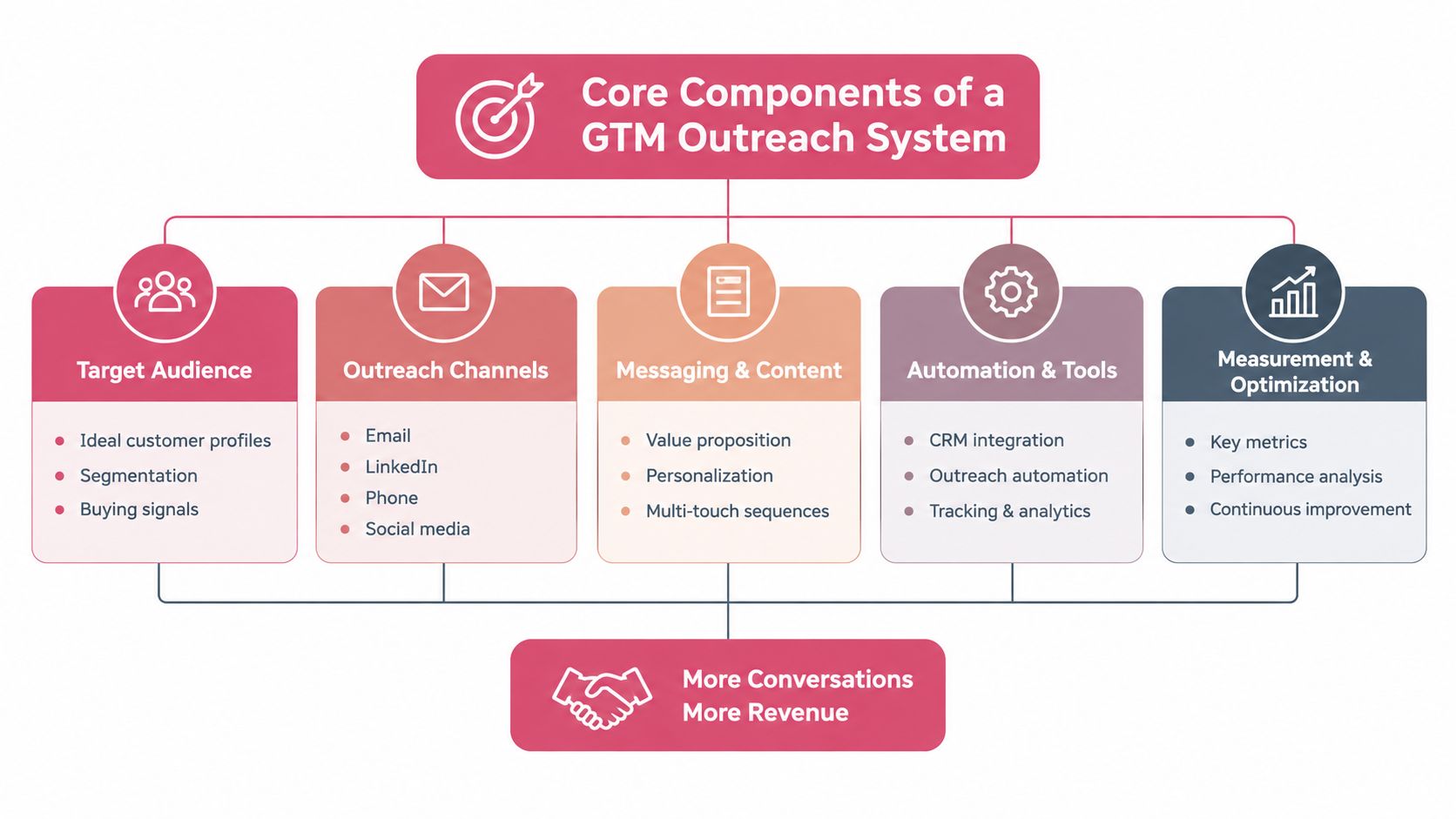
A reliable programme starts with system design, not copywriting. The operator must decide who qualifies, what evidence supports the targeting decision, which channel fits the audience, and how the system should react to each outcome.
Start with the ICP and the access problem
An Ideal Customer Profile should describe more than industry and company size. It should identify the operating conditions that make the problem urgent, the role that feels the pain, the likely buying committee, and the evidence available to the team.
A practical ICP record can include:
- Firmographic fit: Industry, geography, business model, and organizational structure.
- Operational fit: The workflow or constraint that the product can address.
- Trigger fit: Events such as hiring, expansion, a new executive, a technology change, or a visible strategic initiative.
- Role fit: The person who owns the problem, influences the decision, or controls access.
- Exclusion rules: Conditions that make outreach wasteful or inappropriate.
The programme should also ask what prevents the audience from entering through inbound channels. The barrier may be low awareness, limited time, unclear ownership, procurement friction, or distrust of the category. That diagnosis determines the intervention.
Choose channels based on context
Email, LinkedIn, phone, community participation, partner introductions, and content can all play different roles. Channel choice should follow how the audience works, not the team's preferred tool.
A finance leader may respond to a concise operational email, while a technical buyer may need a useful implementation discussion before accepting a meeting. A partner led motion can be more credible in a low trust market, while a direct sequence may work better when a clear trigger creates urgency.
The programme needs channel rules. For example, a researched email may precede a LinkedIn interaction, while a reply or account visit may pause automated contact and create a human task. Persistence is useful only while the contact remains relevant and respectful.
Build cadence and routing logic
A cadence defines timing, channel order, message purpose, and exit conditions. It shouldn't force every prospect through the same path.
A positive response needs a fast human handoff. A request for information should route to the right asset or owner. A negative response should update suppression logic. Silence should not be treated as interest, and a failed enrichment step shouldn't produce a message based on guessed information.
Teams that need to reduce repetitive work across research, sequencing, and follow up can review outbound sales automation as part of an operating model audit. Where internal capacity is limited, a practical resource on the best place to hire SDRs can help leaders evaluate whether prospecting should remain internal, use external support, or combine people with automation.
Personalize the decision, not just the sentence
Adding a first name or company name isn't meaningful personalization. The system should explain why this account belongs in the programme and why the message fits its current context.
The best message may reference a public initiative, a role specific responsibility, or a problem implied by the account's operating model. If the evidence isn't strong enough, the correct action is to research further or hold the account, not invent relevance.
Measuring Process Execution and Real Impact
A programme can generate substantial activity and still fail commercially. Operators need two measurement layers, process evaluation and impact evaluation, with different questions and different corrective actions.
Process evaluation asks whether the motion ran as designed. Impact evaluation asks whether it achieved the objective. EPA guidance on outreach evaluation separates these questions clearly. Execution quality and business effect are related, but they aren't interchangeable.
Define the hypothesis before launch
Every play should begin with a written hypothesis:
A defined audience, reached through a specific intervention, will produce a measurable business outcome.
The hypothesis should state the target population, inclusion and exclusion logic, message angle, channels, owner, and success criteria. It should also name the period or batch being evaluated, so operators don't change the rules after seeing early results.
Useful process indicators include:
- Delivery health: Whether messages were accepted and reached valid destinations.
- Sequence execution: Whether each approved step ran, paused, or exited correctly.
- Reply classification: Whether replies were categorized as positive, neutral, negative, referral, objection, or opt out.
- Data completeness: Whether the record contains enough evidence for the message sent.
- Human handoff: Whether qualified responses reached an owner without delay.
- Suppression accuracy: Whether people who shouldn't receive more contact were removed.
The European Union Drugs Agency's indicator manual defines indicators as quantifiable data elements measured over time to track resource use and performance. That principle applies directly to GTM operations. Each metric should answer a management question, not merely fill a dashboard.
Measure the outcome that matters
Impact metrics depend on the programme's purpose. A demand creation play may aim to create qualified conversations. An expansion play may aim to surface new use cases. A partner programme may aim to generate referred opportunities.
Possible outcome measures include qualified meetings, accepted opportunities, pipeline created, conversion between stages, win rate, revenue influence, repeat engagement, and the quality of accounts entering the funnel. The team should also inspect qualitative evidence, such as whether replies show genuine problem recognition or only polite dismissal.
Volume has a place, but it should remain subordinate to the objective. Massachusetts engagement evaluation guidance distinguishes outreach from engagement and recommends tracking concrete activity counts alongside responses. That prevents a team from treating distribution as participation.
Clear operating records make this easier. Leaders can use process documentation examples for 2026 to structure ownership, decision rules, and evidence across the programme. The result should be a reviewable record of what ran, what happened, and what the team will change.
Orchestrating Plays with a Unified GTM API
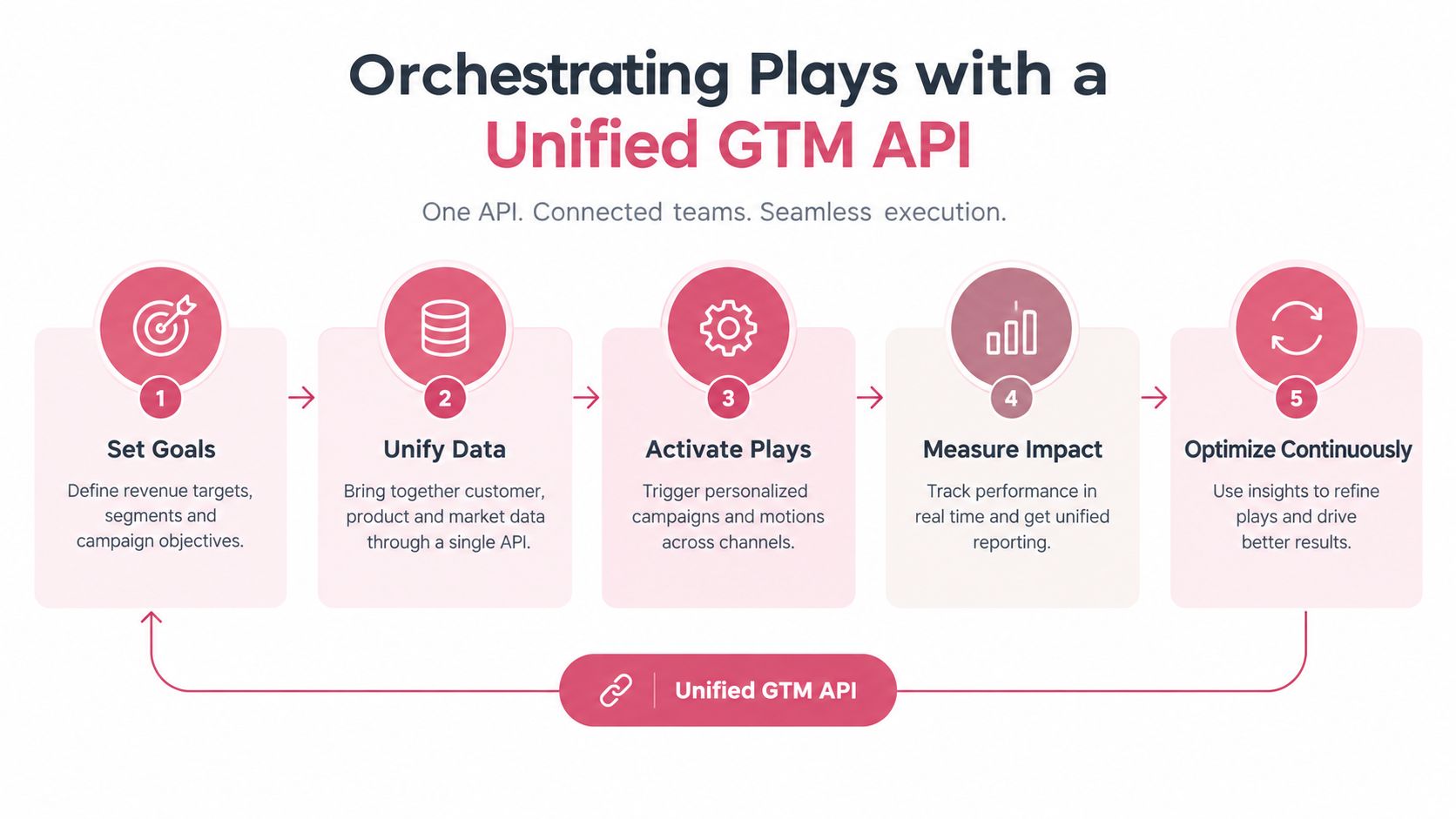
Tool sprawl creates more than inconvenience. It creates competing records of truth. Research sits in one platform, enrichment in another, campaign activity in a third, replies in an inbox, and reporting in a spreadsheet. Each handoff introduces delay, missing context, and inconsistent decisions.
A unified GTM API provides one interface for those operations. The architecture can connect profile and firmographic data, enrichment providers, communication channels, reasoning models, CRM records, and reporting without forcing operators to copy information between systems.
Use reusable skills and governed playbooks
A play should be composed from clear actions rather than hidden automation. Typical atomic skills include:
- Find accounts: Gather candidates from approved sources.
- Enrich records: Add contact details, roles, and firmographic context.
- Score fit: Apply the ICP and exclusion rules.
- Research relevance: Identify a defensible reason for contact.
- Draft and review: Create channel appropriate messaging.
- Send or route: Execute approved actions or assign a human task.
- Classify replies: Interpret the response and select the next state.
- Report results: Compare the run with the predefined objective.
A preconfigured playbook makes these steps accessible to operators who don't want to assemble the workflow. An engineering surface, such as an MCP connected to a coding environment, gives technical teams control over custom logic, branching, and versioning. Both approaches should use the same underlying data and knowledge layer.
Put GTM knowledge in the execution path
The system should read the ICP, voice, positioning, exclusions, approved claims, and previous play outcomes on every run. Otherwise, an AI agent starts from a blank prompt and may produce locally plausible work that conflicts with the company's actual strategy.
This layer also makes provider changes less disruptive. A team can replace an enrichment source or communication channel without rewriting the entire motion, provided the interface preserves the required inputs and outputs.
Grade the play, then change its status
Self evaluation is the important architectural shift. A campaign shouldn't be judged only by a post hoc report. The system can score data quality, targeting fit, message compliance, routing accuracy, and outcome signals as the play runs.
The result should be a verdict such as hypothesis, validated, or proven, with the evidence attached. Winning variants can become defaults. Weak variants can be retired or sent back for review. Bias checks matter because a system can appear efficient while consistently excluding accounts that lack clean data or conventional signals.
The aim isn't autonomous sending at any cost. It's a controlled learning loop in which machines handle repetition and humans approve strategy, exceptions, and sensitive communication.
Real World B2B Outreach Play Examples
A prospecting play begins with a problem, not a list. Suppose a company wants to reach operations leaders at firms showing a particular expansion signal. The play gathers matching accounts, enriches likely contacts, scores fit, researches the trigger, and routes qualified records into a channel sequence.
The important control point comes before sending. If the account lacks a credible trigger or the contact doesn't own the problem, the system records the reason and holds the record. That is better than forcing every name into a sequence because the list has already been purchased or assembled.
Prospecting pipeline
A practical prospecting pipeline can follow this path:
- Candidate discovery: Collect accounts from approved data sources or a defined market segment.
- Record enrichment: Resolve role, company context, and reachable contact details.
- ICP scoring: Apply positive signals and hard exclusions.
- Message selection: Choose the relevant problem angle and channel.
- Sequence execution: Send approved steps and stop when the recipient responds or opts out.
- Outcome capture: Record response type, meeting quality, opportunity status, and operator feedback.
The pipeline isn't successful because it sends quickly. It succeeds when the team can identify which combination of audience, evidence, message, and channel creates qualified commercial conversations.
Visitor pipeline
A visitor pipeline addresses a different access problem. An organization may see account level interest on its website without knowing which visitor deserves a sales action. The play identifies available company context, checks whether the account fits the ICP, enriches likely contacts, and routes a personalized task or sequence.
This play carries a stricter evidence standard. A visit alone isn't proof that a person wants a sales conversation. The system should combine the visit with account fit, relevant content behavior, or another approved signal, then use a restrained message that offers a useful next step rather than claiming to know private intent.
Content engagement play
A content play can monitor relevant public discussions, identify where the company has a legitimate contribution, draft a response in the approved voice, and require review before posting. The objective is not to turn every comment into a pitch. It is to build familiarity and create a path to a conversation when the topic genuinely matches the company's expertise.
Each play should produce a verdict. The system records whether targeting was accurate, whether the message earned meaningful engagement, whether replies progressed, and whether the effort consumed more human review than its value justified. Over time, that record lets the team promote useful plays and retire weak ones without relying on memory or opinion.
Maintaining Quality Control and Compliance
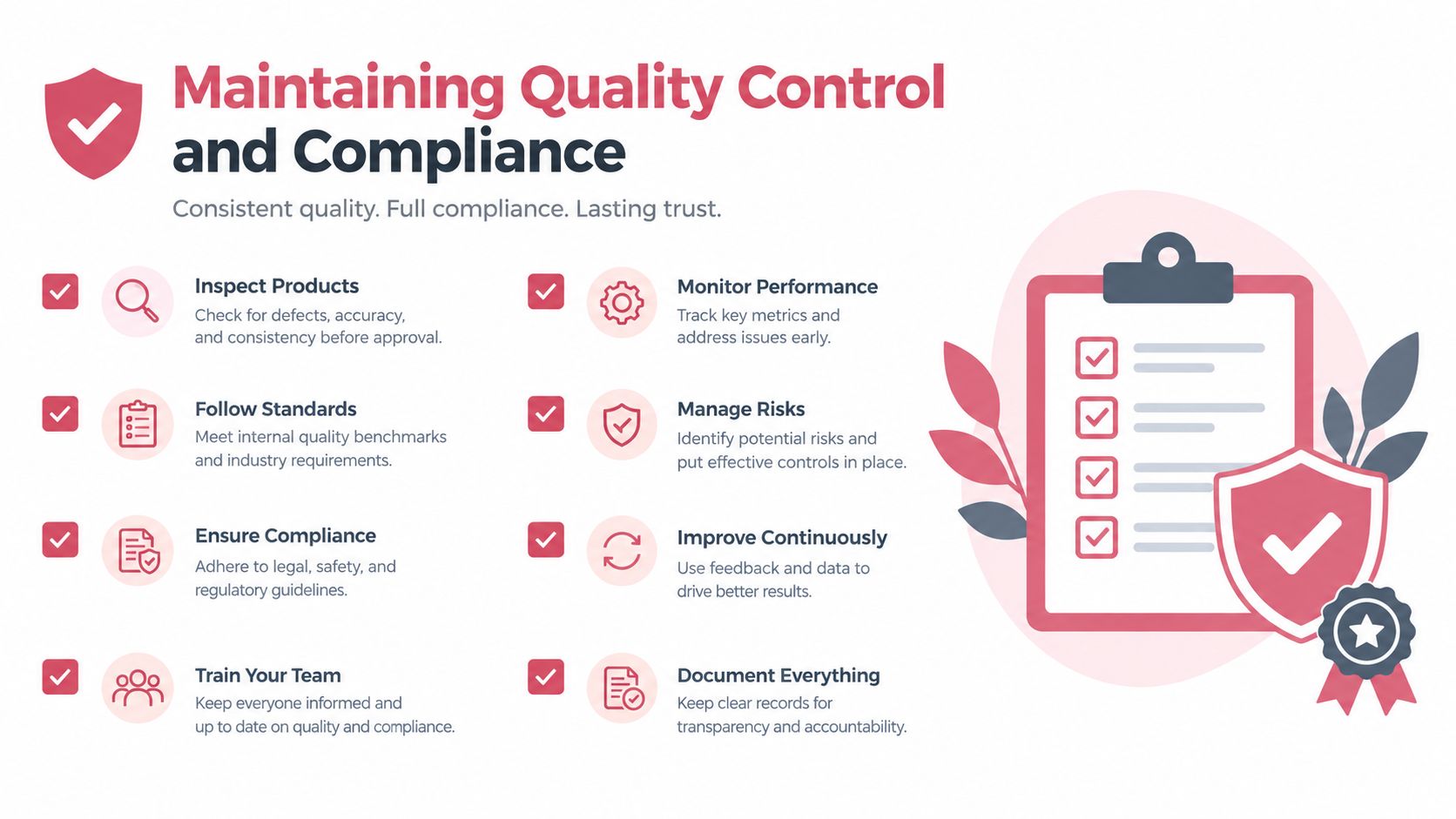
Automation without controls turns a repeatable process into a repeatable liability. A high volume motion can damage sender reputation, expose personal data, send incorrect claims, or contact accounts that should have been excluded.
The operating principle is straightforward: machines can prepare and execute approved work, but humans retain authority over sensitive decisions.
Build an audit trail into every action
Every agent action should produce a step by step record. The log should show the source of a data point, the rule that qualified the account, the message version selected, the approval state, the channel used, and the resulting response classification.
Sensitive actions should pause for approval. Examples include outreach to strategic accounts, messages containing regulated or legal claims, unusual personalization, public comments, escalation after an objection, and any action where the system has low confidence.
Permissions should follow least access. An enrichment agent doesn't need unrestricted CRM deletion rights. A message drafting agent doesn't need permission to publish. A reporting agent doesn't need access to credentials. This separation limits the impact of an error and makes investigations practical.
Protect quality before delivery
Teams should review message rendering, factual support, opt out handling, duplicate suppression, and channel consistency before activation. A spam word checker can support copy review, but it shouldn't replace domain health monitoring, audience judgment, or compliance review.
The same discipline applies to social selling. LinkedIn outreach automation should pause when a response requires interpretation, rather than treating every interaction as permission for another automated message.
The conversation itself should be the audit trail. If an operator can't reconstruct why a prospect received a message, the programme isn't ready to scale.
Data control is part of quality control. Keeping data and credentials on infrastructure the team controls improves auditability and reduces unnecessary exposure. Portable play definitions also help leaders inspect, version, test, and roll back changes instead of depending on opaque automation.
Transitioning to an Engineered GTM Motion
The transition starts with an activity audit. Revenue leaders should record where SDR, sales, marketing, and operations hours go across list building, research, enrichment, scoring, copy preparation, sending, reply triage, CRM updates, and reporting.
The objective isn't to remove people from the motion. It's to move people toward judgment, conversation, account strategy, and exception handling.
Find the work that compresses cleanly
Repetitive tasks with clear inputs and outputs are the strongest candidates for automation. These include finding records, enriching fields, applying deterministic exclusions, preparing variants, syncing status, classifying straightforward replies, and producing campaign reports.
Tasks that depend on trust, ambiguity, negotiation, or material brand risk should remain human controlled. The team can automate preparation and routing while preserving approvals for the final action.
Install the operating foundation
A practical rollout follows this order:
- Define the commercial objective: Choose the outcome the programme must influence.
- Document the ICP: Record fit criteria, triggers, exclusions, roles, and evidence standards.
- Map the data: Identify sources, ownership, freshness requirements, and permitted use.
- Choose the interface: Use a unified API, a ready playbook, or a composed engineering workflow.
- Create one narrow play: Start with a clearly bounded audience and a single hypothesis.
- Add controls: Configure approvals, permissions, suppression rules, and complete telemetry.
- Run a controlled test: Review process execution and impact separately.
- Version the result: Promote what works, revise uncertain plays, and retire weak ones.
Portable plays written in plain Markdown or YAML can become reusable company IP. They can be forked for a new segment, reviewed in version control, and improved as the market changes. That makes the GTM motion less dependent on individual SDR habits and more resilient as channels, providers, and messaging evolve.
The best definition of an outreach programme is therefore operational. It's a measurable intervention that extends access to a defined audience, executes through repeatable paths, learns from outcomes, and keeps humans accountable for the moments that require judgment.
Yalc provides an AI GTM operating system with a unified API for research, enrichment, scoring, sequencing, reply handling, reporting, and related plays. Teams can compose custom workflows through its MCP or run preconfigured playbooks from Slack and the Yalc interface, with their data, keys, approvals, and audit trails under their control. Visit Yalc to evaluate how an engineered outreach motion could fit the team's current GTM stack.