What Is Competitive Intelligence: A GTM Operator's Guide
Competitive intelligence usually fails for the same reason many revenue programs fail. Teams collect information, package it into a report, and stop before anyone changes a decision. Yet the competitive environment is getting harder to manage. By 2020, businesses reported an average of 29 competitors, up 16% from 2019, according to Hootsuite's overview of competitive intelligence. The practical implication is counterintuitive: more research doesn't necessarily create more advantage. The advantage comes from turning verified signals into the next GTM action.
Table of Contents
- Why GTM Teams Are Rethinking Competitive Intelligence
- The Working Definition of Competitive Intelligence
- The Four Source Families Behind Modern CI
- A CI Workflow That Produces Plays, Not Reports
- Turning CI Signals into Sales and Marketing Plays
- What Separates CI Theater from CI That Wins Deals
- Ethics, Legal Lines, and the Tooling That Closes the Loop
Why GTM Teams Are Rethinking Competitive Intelligence
Competitive intelligence shouldn't be treated as a quarterly slide deck or a collection of battle cards. It works better as a continuous decision support pipeline that feeds sales, marketing, product, and operations while a decision is still changeable.
The familiar failure pattern is easy to recognize. An analyst produces a polished competitor report, sends it to a shared drive, and waits for adoption. Reps ignore it because the content isn't connected to a live opportunity. Marketing doesn't know which message to change. Product sees a long list of features without evidence of buyer impact. Meanwhile, a competitor wins deals the team never knew were at risk.
An operator builds a different system. Signals arrive from pricing pages, hiring activity, community discussions, product usage, customer reviews, and closed deal feedback. The team scores those signals against active opportunities and turns them into a recommended action, such as changing an objection response, routing an account to a specialist, or updating an outbound message.
Practical rule: If a CI finding doesn't change a rep's next action, a marketer's next message, or a product decision, it isn't finished.
A sound program gives leaders four capabilities:
- A defensible definition: Everyone understands what qualifies as intelligence and what remains unverified noise.
- A source family map: The team knows which inputs reveal public behavior, sentiment, product behavior, and deal causation.
- A play producing cadence: Research follows a repeatable path from trigger to validated action.
- Automated orchestration: Signals reach the systems where GTM work happens instead of waiting in a report repository.
The broader discipline is commonly defined as the legal and ethical collection and analysis of information about competitors' capabilities, vulnerabilities, and intentions. That definition is useful, but incomplete for revenue teams. The working question is more demanding: what should the business do next, who owns that action, and how will the team know whether it worked?
The Working Definition of Competitive Intelligence
Competitive intelligence is the systematic gathering, analysis, and dissemination of external information with strategic value, covering competitors, customers, markets, and products. The San José State University definition of competitive intelligence frames the discipline as decision support for threats and opportunities. SCIP's ethics guidance adds the boundary that makes the practice legitimate: information must be collected and used lawfully and with integrity.
For a GTM team, the process has four operational stages.
Planning starts with a decision
Planning isn't a request to “monitor competitors.” It starts with a business question tied to an active motion:
- Why are opportunities in a target segment stalling against a particular alternative?
- Has a pricing change altered the economics of a live deal?
- Is a new product launch creating an objection in outbound conversations?
- Does a recurring support issue justify a roadmap change?
The question sets the scope, the sources, and the owner. Without it, analysts collect whatever appears interesting and call the result intelligence.
Gathering requires source discipline
Gathering means collecting evidence from relevant external and internal inputs. Public web pages, customer reviews, job postings, product signals, win and loss notes, and sales calls can all contribute. The quality of the final recommendation depends on the quality and relevance of those inputs.
The competitive intelligence process described in the Journal of Business Economics and Management emphasizes planning, ethical collection, processing, analysis, and dissemination. In practice, that means a single unverified claim shouldn't become a sales talking point. A useful signal should be traced to its source, dated, and compared with another relevant input.
Analysis creates meaning
Analysis is where raw evidence becomes a competitive moment. The team should ask what changed, how confident it is, which accounts or segments are affected, and what action follows.
A pricing page change may matter to a late stage opportunity but not to every account. A customer complaint may indicate a broad product weakness or an isolated implementation issue. The analyst's job isn't to maximize the number of observations. It's to rank them by decision impact and confidence.
Dissemination must reach the workflow
A shared drive isn't dissemination. Sales needs an updated objection response in the enablement system. Marketing may need a positioning adjustment or landing page revision. Product needs a structured roadmap request. Revenue operations may need a routing rule or account alert.
The operator grade definition is therefore simple:
Competitive intelligence is verified knowledge of competitor behavior that changes a rep's next action, a marketer's next message, or a product roadmap decision this quarter.
CI isn't the same as market research. Market research looks outward at markets, buyers, category conditions, and demand. Business intelligence looks inward at company performance, such as pipeline, conversion, retention, and revenue. CI connects external competitive behavior to internal decisions.
| Discipline | Primary Question | Owner | Cadence | Output |
|---|---|---|---|---|
| Competitive intelligence | What competitor or market signal should change our next GTM action? | CI, revenue operations, product marketing | Continuous, with scheduled reviews | Verified signal, recommendation, and play |
| Market research | How large is the market, who buys, and how is demand changing? | Strategy, research, marketing | Project based or periodic | Market assessment and strategic context |
| Business intelligence | What is happening inside our business and why? | Revenue operations, finance, analytics | Continuous reporting | Dashboards, performance analysis, and forecasts |
The Four Source Families Behind Modern CI
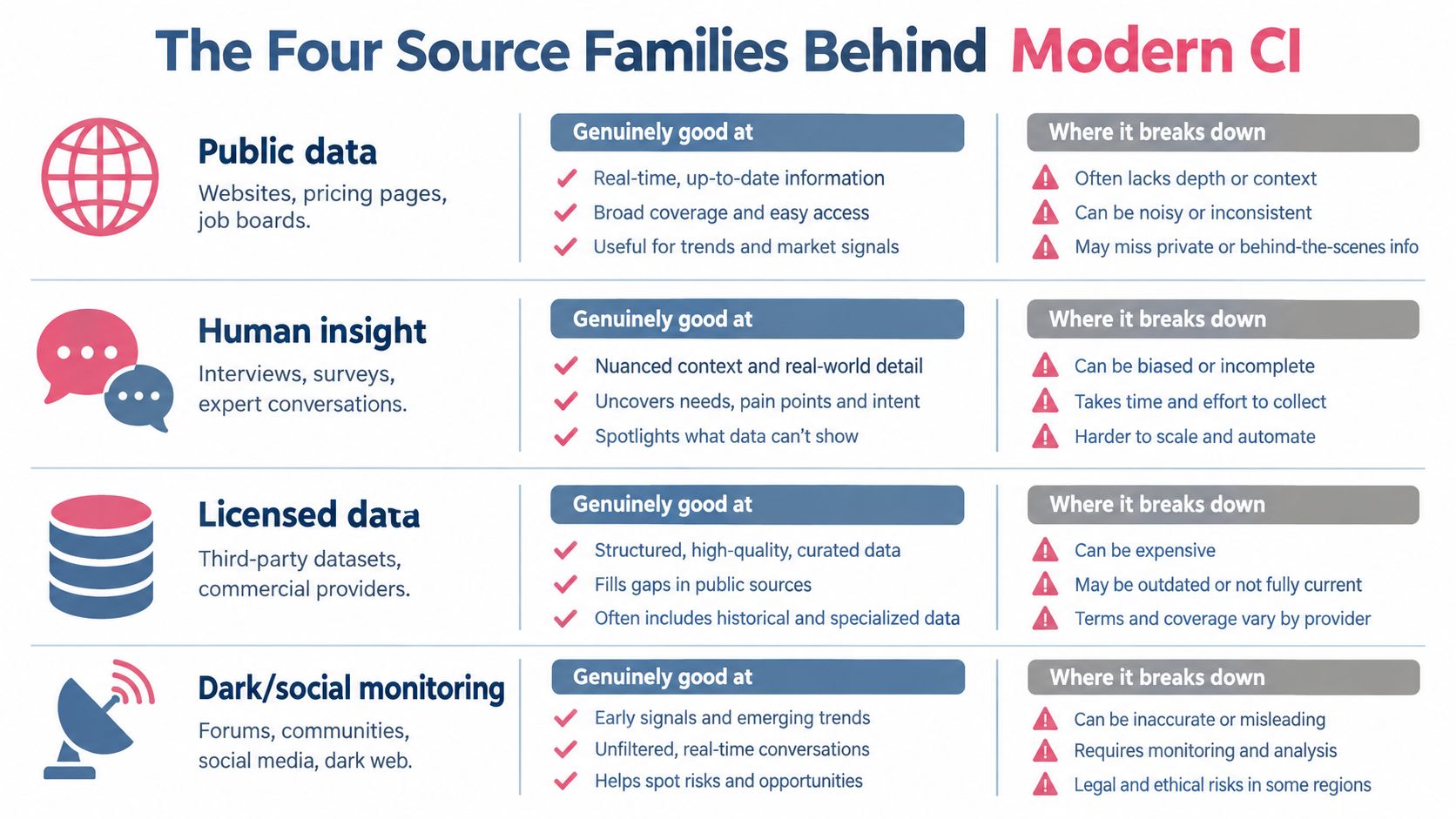
No single source family explains competitive reality. Public information shows what a competitor chooses to disclose. Social listening reveals conversation and sentiment. Product telemetry shows behavior inside your own funnel. Win and loss data explains how buyers describe their decisions.
Public data gives breadth
Competitor websites, pricing pages, job postings, SEC filings, patents, press releases, product announcements, and review sites are accessible and relatively structured. They help teams identify positioning changes, hiring priorities, packaging changes, partnerships, and publicly stated product direction.
The limitation is timing and intent. Public information often reflects what a company wants the market to see, not necessarily what customers experience or what sales teams say in private conversations. Job postings can indicate an investment area, but they don't prove a launch is imminent. A pricing page can reveal packaging, but not the discounting behavior applied to a particular account.
Social listening surfaces weak signals
Reddit, LinkedIn, X, niche communities, and influencer commentary can reveal sentiment shifts, implementation complaints, product rumors, and language buyers use when comparing vendors. This source family is particularly useful for finding questions that formal research hasn't yet captured.
Noise is the trade off. A loud post may represent one frustrated user, not a market trend. Automated monitoring needs filters for relevance, source quality, repetition, and corroboration. Teams exploring the mechanics can use Sift AI's guide to competitive monitoring as a reference point for how monitoring can be organized.
Product telemetry shows behavior
Anonymized product telemetry can reveal where prospects compare tools during trials, which features correlate with churn, and where users encounter friction against a competing product. It is often the strongest behavioral signal because it reflects what people do rather than what they say.
Telemetry has a clear boundary. It only covers the part of the market that reaches your product, trial, or funnel. It won't explain why an account never considered you, or what a competitor is doing with buyers outside your visibility. Teams that use intent data and buying signals can connect observed behavior to account prioritization, but they still need human validation.
Win and loss data explains causation
Post decision interviews, CRM opportunity notes, and Gong or Chorus call capture can show why a buyer selected or rejected a vendor. This source family is closest to deal level causation. It can expose objections around onboarding, procurement, security, product gaps, or executive confidence.
The bias is participation. Buyers who agree to an interview aren't necessarily representative, and CRM notes vary by rep. A reliable program compares interview findings with call evidence, opportunity context, and other source families. Automated GTM orchestration can then tag the evidence, score confidence, and route the resulting signal to a battle card, account owner, campaign, or product queue.
A CI Workflow That Produces Plays, Not Reports
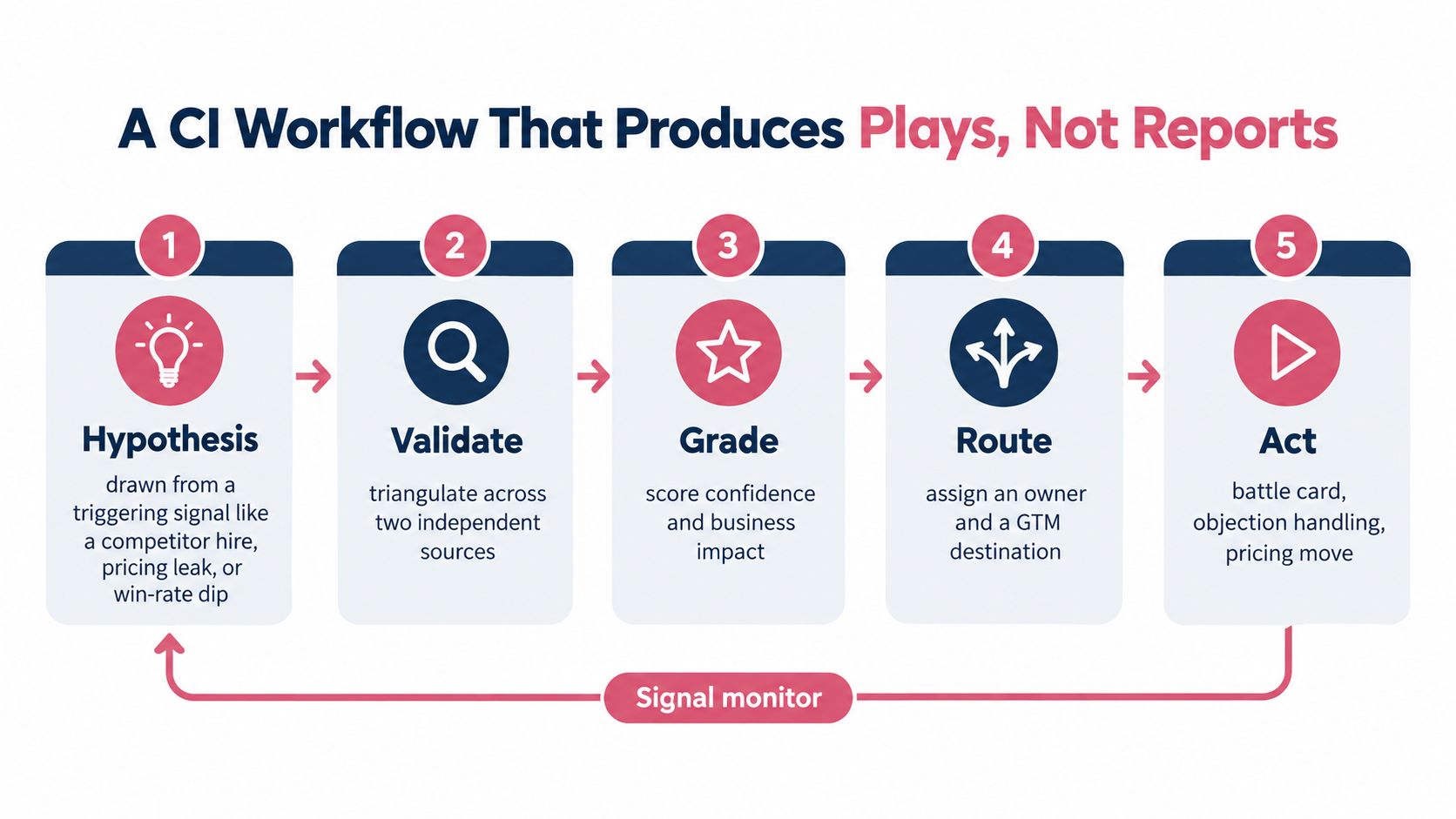
A useful CI workflow begins with a trigger and a named owner, not a blank research request. The trigger might be a competitor hire, a pricing leak, a decline in win rate, a new entrant launch, a repeated lost deal pattern, or a product gap appearing in support tickets.
Start with a scoped hypothesis
The owner writes a testable question. “Competitor pricing changed” is an observation. “The competitor's new packaging is causing procurement objections in mid market opportunities” is a hypothesis that can guide research.
The owner also identifies the affected motion, such as outbound, product led growth, lifecycle, account based marketing, or enterprise sales. That context determines which evidence matters and where the output should go.
Validate across source families
The team should capture evidence from at least two independent source families. For a pricing hypothesis, that could mean a public pricing page plus recent opportunity notes. For a product gap, it could mean product telemetry plus support tickets or customer interviews.
The evidence needs pressure testing. Sales reps can explain whether an objection is appearing in live conversations. Customer facing teams can distinguish a recurring issue from an isolated complaint. Product marketing can check whether the competitor claim is relevant to the target segment.
Grade the signal
Every proposed play receives two grades:
- Confidence: How strong and corroborated is the evidence?
- Impact: How much could the signal affect pipeline, deal progression, positioning, or product priorities?
A high confidence, high impact finding should move quickly. A low confidence, high impact finding may deserve more research, but it shouldn't become a claim in front of a prospect.
Route the action
The output should have a destination and an owner. Possible artifacts include an insight card, battle card update, talk track delta, campaign change, routing rule, or disqualification criteria change.
A report can document context, but it isn't the endpoint. The action might tell a rep to ask a new discovery question, give marketing a new comparison angle, or tell product to investigate a recurring capability gap.
Use a fixed operating cadence
A practical cadence keeps the system moving without turning every signal into an emergency:
- Weekly intake: Capture triggers, assign owners, and reject signals without a decision attached.
- Biweekly grading: Review evidence, confidence, impact, and proposed destination.
- Monthly leadership review: Bring sales, marketing, product, and operations together to approve changes.
- Quarterly market reset: Reassess tracked competitors, source quality, assumptions, and active hypotheses.
For teams working on search visibility and category monitoring, the SemDash AI Overview visibility guide provides useful context for connecting competitive observation to changing discovery behavior.
The workflow terminates in a published action, not a memo. The next review checks whether the play was used, whether the target behavior changed, and whether the intelligence should be promoted, revised, or retired.
Turning CI Signals into Sales and Marketing Plays
A product signal becomes valuable when a team can name the action it will change this week.
Scenario one, a missing feature in a product led motion
A B2B SaaS team sees repeated trial behavior around a feature that a competitor offers and the team doesn't. Prospects compare the feature during evaluation, then raise it in sales conversations. The product marketing manager owns the hypothesis, while product analytics and sales development provide the evidence.
The output isn't a generic competitor update. It includes a revised battle card, a new sales talk track, and a landing page rewrite that explains the current product boundary and the recommended workaround. The affected motions are product led growth, lifecycle email, and outbound.
The team watches trial progression, feature related objections, demo conversion, and the rate at which reps use the revised talk track. Those measures don't prove that the competitor signal caused every outcome, but they show whether the play is reaching the relevant buyer moment.
Teams that formalize this kind of motion can use signal based selling to connect observed account behavior with a specific sales action instead of sending broad outreach.
Scenario two, onboarding time becomes the objection
Win and loss interviews reveal that buyers repeatedly associate a competing platform with faster onboarding. The revenue operations lead owns validation, sales enablement reviews call recordings, and customer success checks whether the objection reflects actual implementation experience.
The resulting package includes an onboarding comparison card, an objection handling script, a competitor displacement email sequence, and a product roadmap request. The sequence targets accounts already evaluating alternatives, while the roadmap request gives product a documented pattern rather than an anecdotal complaint.
The affected motions are account based marketing, outbound, and sales enablement. The team watches objection frequency, progression from evaluation to proposal, reply quality from the displacement sequence, and the number of opportunities where onboarding becomes a blocker.
Neither scenario requires a grand report. Each requires a trigger, an owner, evidence, an artifact, and a defined observation window. That is the difference between intelligence as information and intelligence as a time bound GTM play.
What Separates CI Theater from CI That Wins Deals
CI theater produces artifacts. CI that wins deals produces actions that survive contact with buyers.
The theater version includes research dumps, battle cards updated without an owner, claims with no confidence grading, and glossy competitor matrices that don't tell a rep what to say. It can look active because the team is publishing. It remains disconnected because nobody can trace the work to a live opportunity or a closed outcome.
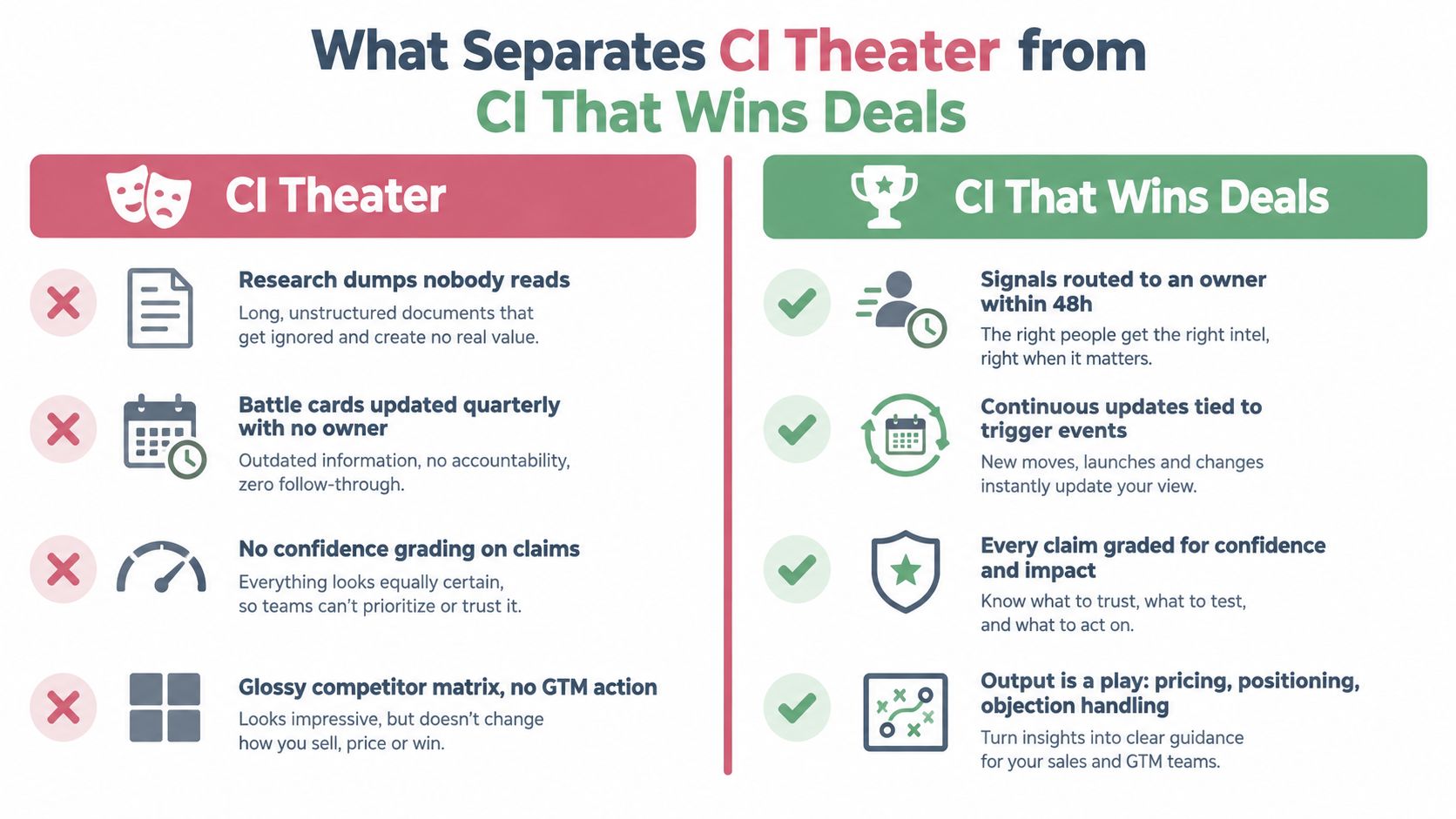
The operator version has fewer outputs, but each output has a clear destination. A signal goes to an owner. Evidence is graded. The play is published where the team works. Closed deal feedback determines whether the claim remains useful.
A GTM leader can diagnose the difference with a short set of questions:
- Ownership: Who owns the last update on each competitor?
- Field exposure: When did each battle card last face a live deal?
- Evidence: Which claims trace to a source that another team member can verify?
- Outcome linkage: What share of CI artifacts connects to a closed won or closed lost outcome?
- Retirement: Which outdated claims or plays have been removed?
If nobody can answer, the program is operating as a content function. That doesn't make the research worthless, but it means the team hasn't built a revenue feedback loop.
The measure of CI isn't how many competitor pages the team has cataloged. It's whether verified intelligence changes decisions and improves the quality of deal execution.
Grading is the missing control in many programs. Without confidence and impact scores, every signal appears equally urgent. Without feedback from closed deals, the team can't distinguish a persuasive play from a plausible story.
Ethics, Legal Lines, and the Tooling That Closes the Loop
Ethical CI begins with transparency. SCIP expects practitioners to follow applicable laws, identify themselves and their organization accurately during interviews, avoid conflicts of interest, and make honest, realistic recommendations. Its professional ethics framework is a guideline, not a substitute for company policy or legal review.
The operator translation is straightforward:
- Transparency: Say who you are and why you're asking.
- Source attribution: Record where the information came from.
- Confidentiality: Don't circulate non public information.
- Rumor control: Don't present speculation, stolen data, or unverified claims as intelligence.
Legal review matters at the edges. Teams should assess terms of service before automated extraction, avoid NDA protected information, respect employee non solicit obligations, and involve counsel when competitive exchanges create antitrust concerns. Public availability doesn't automatically make every collection method or use appropriate.
Choose tools by the handoff they remove
A lightweight stack might combine Klue or Crayon for competitor tracking, spreadsheets for evidence logs, and Gong or Chorus for call capture. Those tools can work when a human owns review and distribution. The weakness appears when signals remain in separate systems and someone must manually copy them into enablement, CRM, campaign, or routing workflows.
Automated GTM orchestration closes that handoff. It can ingest a trigger, compare it with stored context, request human approval for sensitive actions, and route the approved result into a sequence, battle card, account queue, or reporting layer. The system still needs source rules and human judgment. Automation should reduce delay, not remove verification.
Yalc is one option for this operating model. Its competitive intel capability can collect competitor pricing, positioning, recent changes, and customer stories, while its wider GTM system can connect intelligence to play execution, outcome grading, and audit logs. Teams comparing the category with adjacent revenue disciplines can also review sales intelligence fundamentals.
A practical implementation checklist is short:
- Assign an owner: Give CI one accountable operator, even when several teams contribute.
- Codify source rules: Define permitted sources, evidence standards, retention, and escalation.
- Set the cadence: Run intake, grading, leadership review, and refreshes on schedule.
- Log every play: Record the trigger, evidence, owner, destination, and decision.
- Grade outcomes: Mark each play as a hypothesis, validated, or proven, then retire weak work.
The teams that operationalize competitive intelligence don't try to know everything about every competitor. They build a controlled loop that finds relevant signals, tests them, and puts verified decisions into the hands of people who can act.
Yalc helps GTM teams connect competitive signals to research, enrichment, outreach, routing, and reporting through a unified operating layer. Visit Yalc to explore how its competitive intelligence and play orchestration capabilities can turn external evidence into measurable GTM actions.