What Is GTM Engineering and How Modern Teams Build It
The popular advice says GTM engineering means adding an AI SDR, connecting it to a data provider, and letting it send more outbound. That framing is too narrow. A team can automate prospect research, sequence creation, and CRM updates while still targeting the wrong accounts, sending weak messages, and learning nothing from the results.
GTM engineering is better understood as feedback controlled revenue infrastructure. It turns a commercial hypothesis into a repeatable system with data inputs, decision rules, approved actions, and measurable outcomes. The work can include AI, APIs, enrichment, and outbound, but none of those define the discipline. The defining feature is a system that can be tested, audited, improved, and stopped when it fails.
Table of Contents
- A Working Definition for Operators
- The Building Blocks of a GTM Engineering System
- How GTM Engineering Differs From RevOps SDR and Sales Engineering
- Three Plays a GTM Engineer Owns End to End
- The Productivity Case and the Failure Modes
- Team Shape Tooling and Data Prerequisites
- A 30 Day Adoption Checklist for a Small Team
A Working Definition for Operators
A practical answer to what is GTM engineering starts with the operating model, not the tool category. GTM engineering applies engineering discipline to the full go to market system, from segmentation and positioning through marketing, sales, customer success, and measurement. The work converts strategy into connected data sources, qualification logic, workflow automation, CRM synchronization, execution scripts, and feedback loops.
The distinction matters because automation can increase activity without improving pipeline. A GTM engineer is accountable for whether a play produces qualified pipeline, useful learning, or better operator productivity. Activity volume is an input, not a commercial result.
The underlying GTM concept has a long business foundation. Wiley describes go to market as the mechanism for delivering a selected product to a market, beginning with segmentation and target market selection, then shaping the marketing mix for that segment. The GTM engineer builds the operating infrastructure that makes those strategic decisions executable and measurable. Wiley's reference on go to market strategy provides the strategic foundation, while the engineering layer handles the repeatable execution.
The boundary between machines and people
Machines are well suited to repetitive preparation and controlled execution. They can resolve identities, enrich records, detect signals, apply eligibility rules, draft research summaries, route work, and write outcomes back to a system of record.
People must retain responsibility for the decisions that change the commercial system. That includes changing the ideal customer profile, approving positioning, reviewing sensitive outreach, handling exceptions, checking compliance, and deciding whether a failed play deserves another iteration.
Practical rule: Automate the work around judgment before automating judgment itself.
A GTM engineer therefore designs the boundary. The role defines where an agent can act independently, where it must ask for approval, and what evidence is required before a play receives broader permission. Teams assessing GTM engineering hiring should look for people who can explain both the technical workflow and the commercial decision it supports.
The economic case supports this focus on repeatable, judgment rich work. McKinsey estimates that approximately one third of sales and sales operations tasks can be easily automated with currently available technology. Its research also reports that early sales automation adopters achieved 10% to 15% efficiency improvements and potential sales uplift of up to 10%. McKinsey's sales automation research shows why the opportunity is real, but it doesn't justify removing humans from the loop.
The Building Blocks of a GTM Engineering System
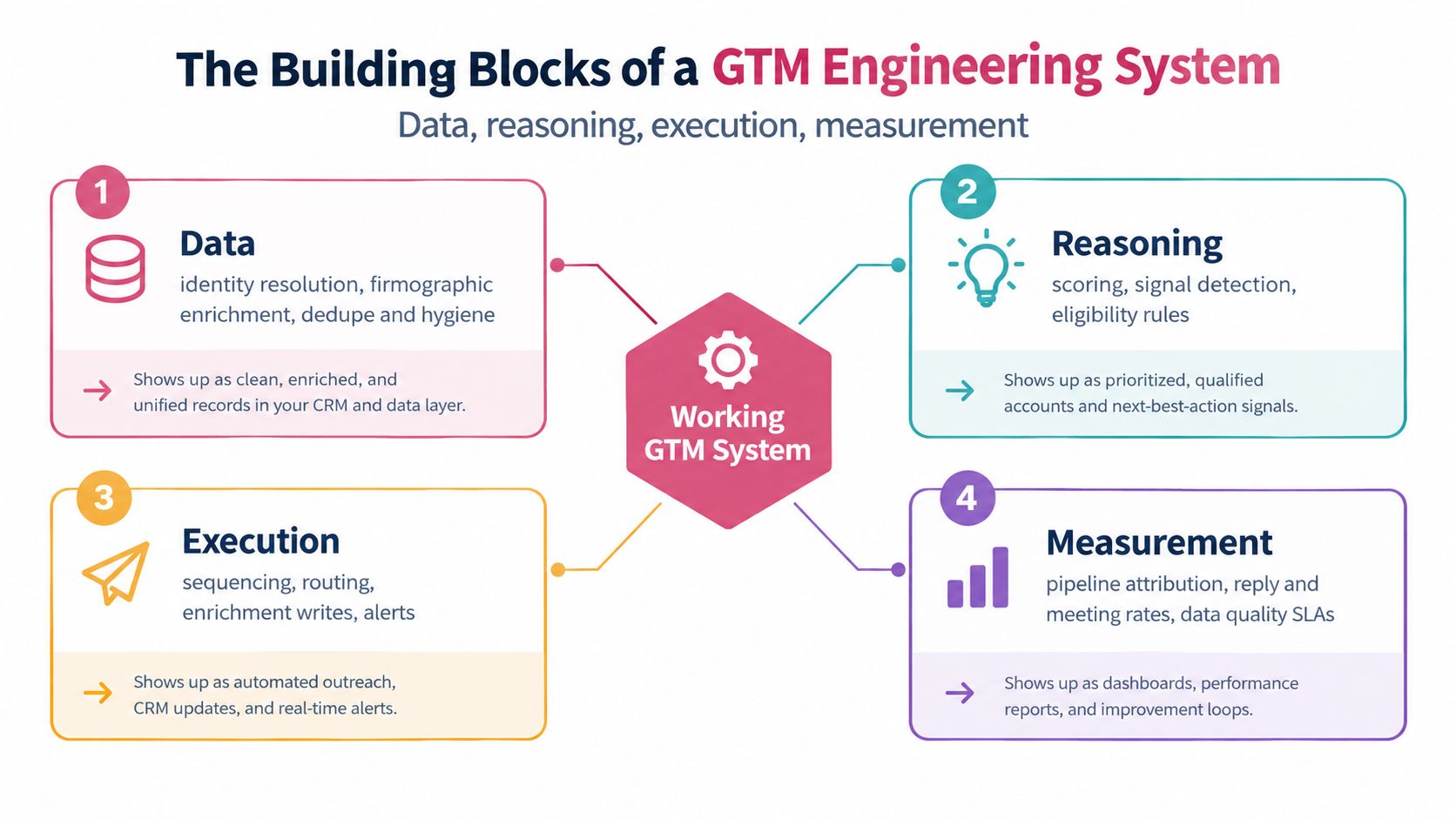
A working system has four connected layers: data, reasoning, execution, and measurement. If one layer is weak, the next layer amplifies the weakness. A polished message cannot rescue an incorrect account record, and a detailed dashboard cannot repair a workflow that never writes reliable outcomes.
Start with data
The data layer establishes what the system believes about an account, contact, opportunity, and event. It should resolve identity across sources, maintain firmographic attributes, capture buying signals, remove duplicates, and preserve CRM hygiene.
Treat those definitions as versioned assets rather than invisible spreadsheet knowledge. A change to industry classification, territory, employee count, or contact role can change who qualifies for a play. The workflow should record which data was used and when it was refreshed.
Data quality is a control requirement for AI enabled GTM workflows. Salesforce reports that 84% of data and analytics leaders agree that AI outputs are only as good as their data inputs. Salesforce's sales statistics support a simple rule: every automated action needs data prerequisites and a failure path.
Express reasoning as testable logic
Reasoning turns raw records into decisions. This layer can include scoring models, prompts, signal detection, eligibility rules, qualification criteria, and confidence levels. The important point is that the logic should be explicit enough to inspect, test, and revert.
A score should explain why an account was prioritized. A classifier should identify the fields that led it to label a reply as interested, unclear, or unsuitable. If a team can't inspect the reasoning, it can't distinguish a targeting problem from a message problem.
Connect execution to the system of record
Execution moves approved decisions into action. It can route a lead to an owner, create a task, trigger an email sequence, update a CRM field, send an alert, or request a human review. Integrations across email, LinkedIn, calendaring, product telemetry, and CRM systems should use stable interfaces and idempotent writes where possible.
The system shouldn't depend on an operator copying rows between tools. That handoff introduces delay, duplicate activity, and missing outcomes. A useful GTM stack architecture exposes each action as a composable step while keeping the commercial context available at execution time.
Close the loop with measurement
Measurement records both operational and commercial telemetry. Operational data includes tool calls, latency, failures, lineage, and human overrides. Commercial data includes delivery, positive replies, qualified meetings, opportunities, and revenue rates.
Each play should have an input population, eligibility constraints, intervention, approval policy, and outcome definition. The team can then compare a new version with a baseline, isolate weak enrichment from poor messaging, and retire logic that consistently fails.
McKinsey reports that 19% of B2B decision makers were already implementing generative AI use cases for buying and selling, while 23% were in the process of doing so. In one example, a generative AI tool reduced the time needed to assess competitors' capabilities by 60% to 80%. McKinsey's research on profitable B2B growth through generative AI illustrates the right evaluation pattern: define the task, record the baseline, automate repeatable work, and check output against a quality threshold.
How GTM Engineering Differs From RevOps SDR and Sales Engineering
The roles overlap around revenue, but they don't own the same work. Confusion usually starts when a company gives an SDR a few automations and calls the result GTM engineering.
RevOps governs the revenue system. RevOps maintains the CRM model, reporting definitions, forecasting process, permissions, routing standards, and operational controls. A GTM engineer builds new plays inside that environment and takes responsibility for whether those plays work.
An SDR executes conversations. The GTM engineer designs the workflow that determines which accounts enter the queue, what information the SDR receives, how activity is routed, and how the outcome returns to the system.
A sales engineer supports a deal. Sales engineering brings technical expertise into discovery, solution design, demonstrations, and procurement. GTM engineering works behind the deal cycle by building the infrastructure that identifies, qualifies, routes, and learns from commercial opportunities.
Growth marketing runs demand programs. GTM engineering can extend those programs into account selection, lifecycle triggers, outbound routing, and customer expansion workflows. It doesn't replace campaign strategy or creative judgment.
| Role | Primary Output | Decision Rights | Tooling Ownership |
|---|---|---|---|
| GTM Engineering | Governed revenue plays, integrations, scoring logic, and feedback loops | Defines workflow logic, approval gates, test design, and play retirement | Builds and connects the tools used by each play |
| RevOps | Reliable systems, reporting, forecasting, and process governance | Owns data definitions, operating standards, permissions, and system health | Maintains the established revenue stack |
| SDR | Human prospect conversations and qualified handoffs | Decides how to engage within the approved playbook and escalates exceptions | Uses the assigned prospecting and engagement tools |
| Sales Engineering | Technical support for active opportunities | Advises on technical fit, solution design, and implementation risk | Owns technical deal assets and demonstration environments |
The practical difference is the output. RevOps optimizes the machine already in use. GTM engineering constructs new revenue infrastructure. A useful comparison of GTM engineering and SDR team responsibilities helps clarify why one person can be responsible for the play while another remains responsible for the conversation.
A small team may combine these roles, but it shouldn't combine their decision rights by accident. The person who builds a classifier shouldn't be the only person deciding what a qualified lead means. The person who owns a forecast shouldn't change the inputs without documenting the change.
Three Plays a GTM Engineer Owns End to End
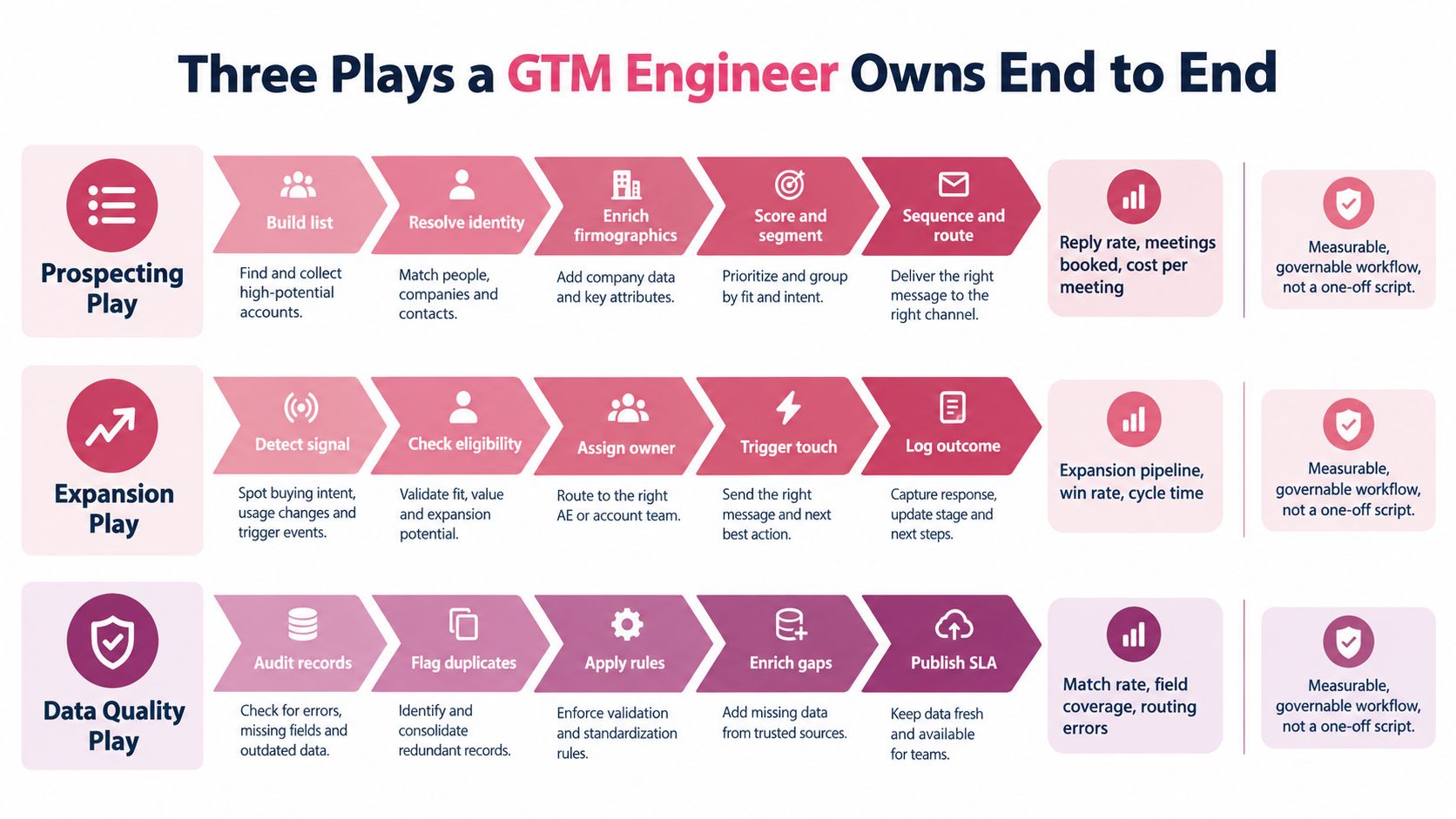
A GTM engineer doesn't ship a one off script and move on. The engineer defines the input, builds the workflow, sets approval boundaries, measures the outcome, and maintains the play after launch.
The prospecting play
The prospecting workflow begins with a specific target, not a broad request for more leads. The builder combines firmographic criteria with relevant intent signals, resolves account and contact identity, enriches required fields, removes duplicates, checks record freshness, and scores the result against the approved ICP.
Only eligible records should enter the SDR queue. The workflow should preserve the source of each signal, the reason for the score, and the date of the last verification. A daily export can be useful, but it should include a quality sample that the engineer audits regularly.
The play's outcome isn't the number of records created. The useful measures are qualified pipeline generated per experiment, reply quality, meetings booked, routing errors, and the time an SDR spends reviewing each record.
The expansion play
Expansion starts with a customer or account signal. The signal might indicate a new team, a product adoption event, a relevant business change, or another condition defined by the customer team. The workflow checks eligibility, confirms ownership, selects an approved touch, and logs the result.
The customer success or account owner remains responsible for context. The system can surface the signal and prepare the action, but it shouldn't invent a commercial relationship or send an unreviewed message to a strategic account.
A useful expansion play records whether the signal was valid, whether the owner accepted the recommendation, whether the customer engaged, and whether the resulting opportunity progressed. This creates a feedback loop without turning customer relationships into blind automation.
The reply triage play
Reply triage uses classification and routing rules to sort inbound responses by intent, urgency, and objection type. An interested reply can move quickly to a human owner. An out of office response can be parked until the appropriate date. A pricing objection can be routed to the person who owns the relevant response.
The classifier should be tested against a human reviewed sample before it receives broad authority. Unclear replies should remain visible rather than being forced into a confident category. Tagged replies should also return to the messaging experiment that produced them, so the team can identify which angle creates useful conversations.
Teams looking for broader practical sales automation advice should apply the same discipline to every automated action: define the decision, preserve the context, route uncertainty, and review the result.
A play isn't production ready because it runs without errors. It's production ready when the team knows what it did, why it did it, and what happened next.
The Productivity Case and the Failure Modes
The productivity case is strongest where operators lose time to repeated preparation. List building, enrichment, CRM updates, routing, reporting, and research can move through a common operating layer instead of passing between disconnected tools.
McKinsey found that non selling activities consume about two thirds of the average sales team's time. Its research also reports that leading companies using shared services and automation improved sales productivity by as much as 30%. In one technology company example, robotic process automation reduced order entry from three hours to three minutes, creating 30% more customer facing time and a potential 20% lift in sales. McKinsey's sales productivity research shows that the value comes from removing repetitive handoffs, not from collecting more applications.
| Outcome | Productivity Gain | Failure Mode That Cancels It |
|---|---|---|
| Faster account preparation | Operators spend less time finding and reconciling records | Weak identity resolution creates duplicate or irrelevant accounts |
| More frequent experiments | Teams can ship and compare play versions faster | Prompt drift quietly reduces message quality |
| Cleaner CRM updates | Workflow writes preserve consistent fields and ownership | Unclear write rules corrupt the system of record |
| Better response handling | Routing sends urgent replies to the right person | Removing human review lets poor classifications reach buyers |
| Lower manual workload | Repeated enrichment and reporting run automatically | Unbounded enrichment creates unnecessary provider costs |
The most common failure isn't a broken API. It's a team scaling a flawed premise. If the ICP is too broad, automation industrializes bad targeting. If the signal is weak, more enrichment only gives the wrong decision more detail. If the message doesn't fit the market, more sequence volume increases the amount of rejection.
McKinsey reports that data driven decision making produces a 2% to 5% increase in sales, while cross functional coordination and teaming produce a 5% to 10% increase. The same research found that eight in ten fast growing B2B companies cluster data science, engineering, workflow integration, and related capabilities in a centralized hub. McKinsey's research on sales growth outperformance supports an operating model where infrastructure is shared, while commercial judgment remains distributed to the people closest to customers.
Team Shape Tooling and Data Prerequisites
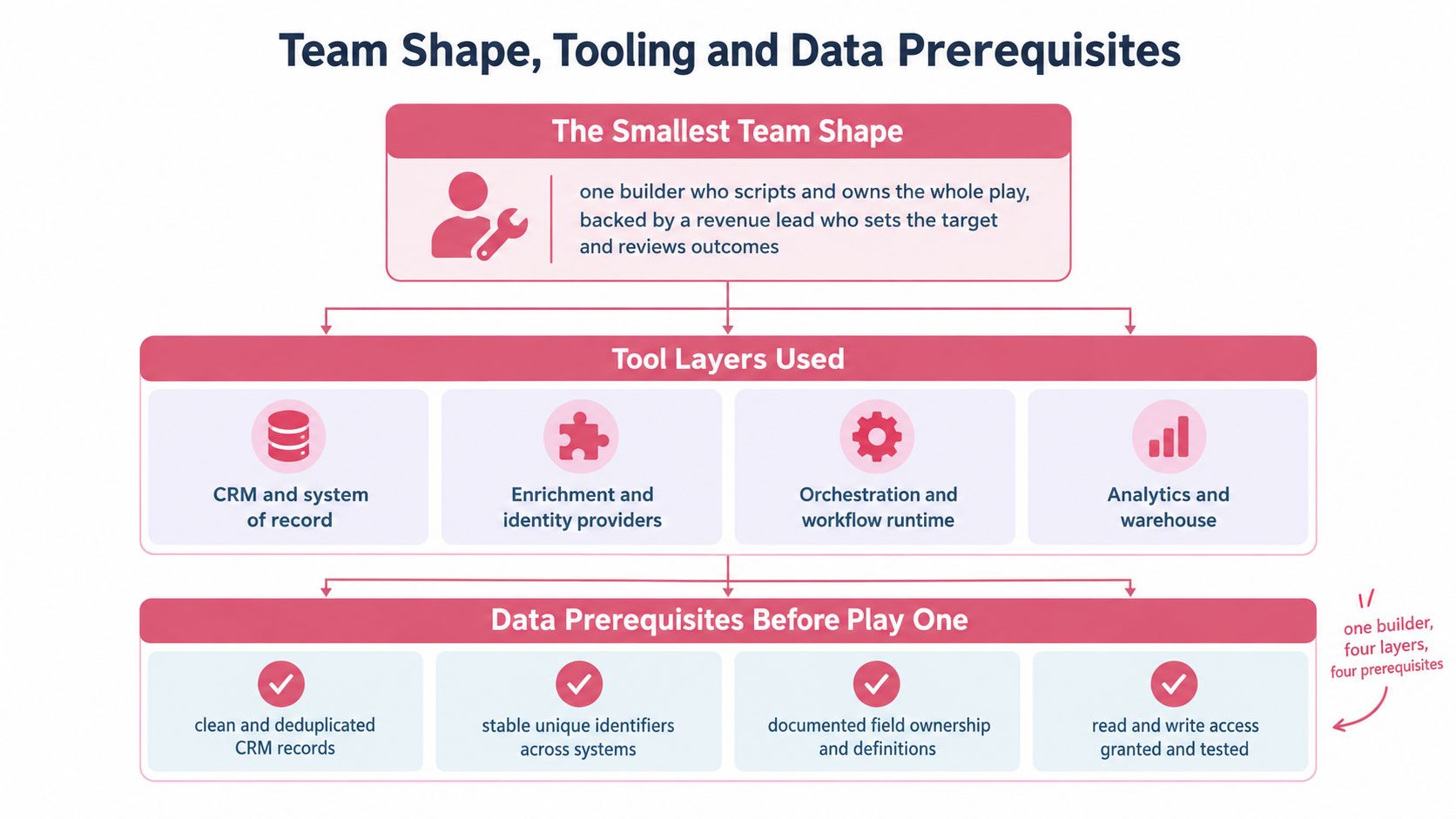
A small team doesn't need a large department to start. It needs clear ownership. The smallest workable shape has one builder, one approver, and one operator.
The builder scripts and maintains the workflow. The approver reviews copy, eligibility rules, permissions, routing, and launch conditions. The operator owns the playbook, handles downstream follow up, and reports whether the workflow is useful in practice.
One person can hold more than one role, but the approval step shouldn't disappear. Separating build from approval creates a basic control against silent errors and makes responsibility visible.
Keep the stack narrow
A practical stack has four layers:
- Enrichment and identity: Supplies firmographic, contact, and signal data while preserving source and freshness.
- Data store: Holds the canonical account, contact, activity, and outcome records.
- Orchestration: Runs triggers, transformations, approvals, routing, and writes across systems.
- Measurement: Tracks play inputs, quality checks, operator review, and commercial outcomes.
One suitable tool per layer is often easier to govern than a broad collection of overlapping applications. The right choice depends on the existing CRM, warehouse, APIs, permissions, and operator habits. Tool count isn't a maturity metric.
Make the data contract explicit
Before the first play runs, the team should confirm:
- A deduplicated account and contact model.
- Stable identifiers across the systems the workflow touches.
- A documented ICP with named fields and definitions.
- A tagged corpus of replies if classification is required.
- Explicit CRM fields that the play can read and write.
- Ownership for data quality, approvals, and exception handling.
The system should verify required fields before scoring an account. Before outreach, it should check suppression status, duplicate activity, message ownership, and record freshness. Failed checks should pause the action for review, not produce a low quality score that looks authoritative.
The team should also decide where credentials live, which actions require approval, and what the audit record must retain. Least privilege, rate limits, deduplication, and idempotent writes reduce the damage caused by bad data or a faulty rule.
A 30 Day Adoption Checklist for a Small Team
A small team can establish the discipline in 30 days without trying to automate the full revenue motion. The sequence matters because measurement must exist before the first play, and governance must exist before the second.
Week 1 builds the measurement foundation
Confirm the CRM source of truth. Identify the fields that represent account, contact, owner, activity, reply, meeting, opportunity, and outcome. Capture reply and meeting events consistently, then choose the single pipeline metric the team will defend during the first experiment.
Document who owns data definitions and who approves external communication. If the team can't agree on the metric or the source of truth, it isn't ready to add autonomous actions.
Week 2 ships one narrow play
Choose one play with a clear input and a limited action. Inbound lead enrichment is a useful starting point because it can improve preparation without immediately sending external communication.
Define the eligibility rule, baseline measurement, data checks, human approval gate, and stop condition. Run the workflow on a controlled sample, compare its recommendations with human decisions, and record false positives and missing records.
Week 3 adds triage and routing
Extend the system to reply triage or another workflow that helps operators act faster. Document the escalation rule for urgent, interested, sensitive, and unclear replies. Review a quality sample of 50 cases weekly and compare the classifier's decision with the human decision.
Don't optimize for the number of replies processed. Optimize for correct routing, response quality, and the time required for an operator to reach a sound decision.
Week 4 governs what survives
Retire any workflow that doesn't move the selected metric or produce useful learning. Document the surviving playbook, including inputs, rules, permissions, approvals, failure paths, and ownership for build, data, review, and follow up.
The first 30 days for a GTM engineer should establish a repeatable operating rhythm, not a showcase of disconnected automations.
Before adding a second play, ask three questions:
- Did the first play produce a measurable commercial or productivity result?
- Can the team explain where it failed and who owns the fix?
- Can the same workflow run again without creating hidden data, compliance, or reputation risk?
If the answer to any question is no, stabilize the first loop. Stacking automation on an unmeasured system only makes diagnosis harder.
Yalc provides a unified GTM API, reusable playbooks, knowledge orchestration, telemetry, scoped permissions, and human approval gates for teams building measurable revenue workflows. Teams can compose plays through Claude Code or run prepared workflows from Slack and the Yalc interface, then visit Yalc to evaluate whether it fits their operating model.