What Is Lead Qualification and How to Automate It
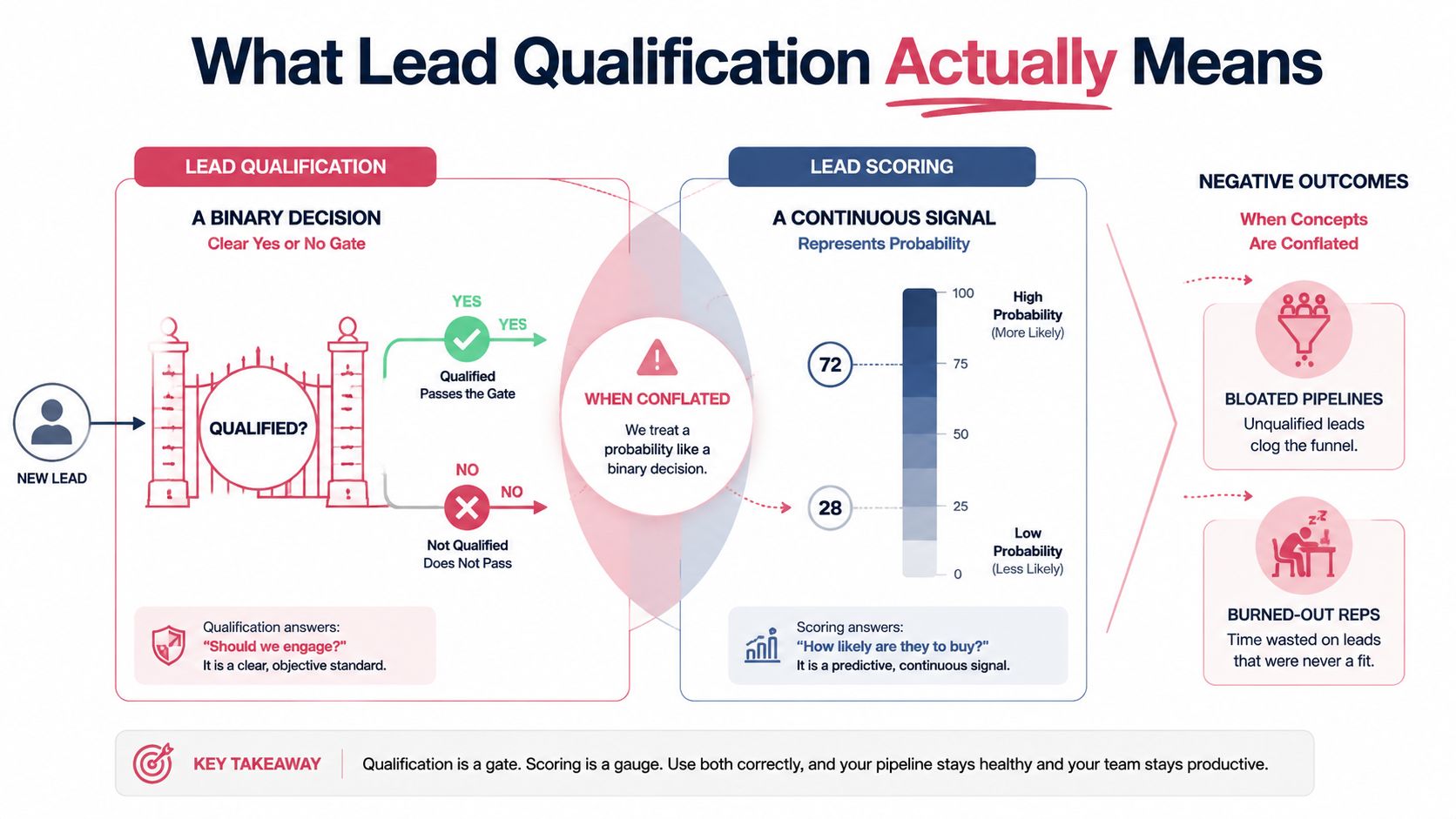
Lead qualification is the binary routing decision that evaluates fit, intent, capacity to buy, and timing to decide whether a prospect deserves immediate human time. Lead scoring is different, a continuously updated numeric signal that helps rank demand before that routing decision.
The popular advice is to “qualify every lead” with a checklist or discovery call. That approach fails when buyer intent changes faster than a rep can review a queue. Inbound teams need qualification to work as a latency sensitive control system, where data, thresholds, routing speed, and human judgment protect both pipeline quality and rep capacity.
Table of Contents
- What Lead Qualification Means in a Modern GTM Motion
- The Leakage at the Qualification Boundary: Why Systems Design Beats Coaching
- Choosing the Right Qualification Framework for Your Deal Motion
- Scoring Thresholds and Handoff Rules That Protect Rep Time
- A Practical Inbound Qualification Workflow From Capture to Route
- How Yalc Automates Qualification Across the GTM Stack
- Metrics and Pitfalls That Separate Mature Systems From Fragile Ones
What Lead Qualification Means in a Modern GTM Motion
The most common cause of poor qualification is the blending of two distinct decisions: scoring and routing. A system can rank demand accurately and still waste rep time if it routes records too slowly or sends them to the wrong owner.
Lead scoring produces a numeric priority signal. It can change when a prospect visits a pricing page, submits a form, matches a target company profile, or goes quiet. Lead qualification applies defined criteria and creates a state change, such as routing to sales, routing to an SDR, or placing the record in nurture. Highspot's explanation of lead qualification frames the operating distinction clearly: scoring ranks demand, while qualification determines whether the prospect is ready for immediate human attention.
A score can show that two prospects deserve different levels of urgency. Qualification still has to answer a binary question: does this record meet the criteria for the next human action? Keeping those decisions separate prevents every engaged contact from being treated as pipeline and keeps active buyers distinct from casual researchers.
The four inputs behind the gate
A useful qualification system evaluates four dimensions together:
- Fit: Does the company match the ideal customer profile, including industry, size, geography, and technology environment?
- Intent: Is the prospect showing behavior associated with an active buying process rather than general interest?
- Capacity: Can the organization fund the purchase, and does the contact have authority or access to someone who does?
- Timing: Is there a realistic project horizon, triggering event, or business priority?
A strong fit with weak intent belongs in nurture. Strong intent from a poor fit should not automatically reach an AE. The decision logic must evaluate the combination instead of rewarding engagement in isolation.
Practical rule: A qualification outcome should tell the next person exactly what to do, not merely report how interested the lead appears.
Qualification therefore functions as a routing control, not a checklist reserved for a discovery call. The system should capture available data, enrich missing context, assess fit and intent, and route the record while interest remains active. Human discovery still matters for complex or high value opportunities, but obvious mismatches should be filtered before a rep spends time on them.
For conversational qualification, teams can start using SkipCalls screening scripts to give SDRs consistent questions without turning every interaction into an interrogation. The script should support the routing policy, not replace it.
The Leakage at the Qualification Boundary: Why Systems Design Beats Coaching
Qualification quality depends on the operating system around the rep. Shared inputs, decision rules, enrichment, ownership, and disposition data determine whether a lead becomes a useful conversation or disappears in a queue. Without those controls, leadership cannot separate weak traffic from incomplete data, slow routing, or inconsistent execution.
The qualification boundary is where pipeline leakage becomes measurable. Benchmark data across B2B sources places average lead to MQL conversion around 31%, while MQL to SQL conversion is commonly cited near 13% to 15%. A large share of apparent demand is therefore lost after marketing identifies interest, making the handoff a systems design problem. Landbase's lead qualification statistics also reports qualified leads converting at 40% versus 11% for unqualified prospects.
Latency is another control variable. The same benchmark source reports follow up within one hour converting at 53%, compared with 17% after 24 hours. A qualified record sitting in an unowned queue is not being qualified effectively. Thresholds, routing speed, and AI orchestration must work together while buyer intent is still active.
Where manual processes fail
Manual qualification produces three recurring defects:
- Inconsistent thresholds: Reps interpret fit, urgency, and authority differently.
- Hidden prioritization: High intent records can sit behind older tasks, territory exceptions, or incomplete assignments.
- No audit trail: Operations cannot reconstruct which data or rule caused a lead to be accepted, rejected, or ignored.
The commercial cost extends beyond wasted meetings. A false positive consumes seller attention that could have gone to a genuine buyer. A false negative vanishes without showing that a viable prospect never received a response.
AI can reduce this delay when it applies the same policy to every record, enriches missing fields, identifies routing conditions, and escalates exceptions. It still needs clear thresholds and human review for ambiguous or high value opportunities. Automation without governance only makes an unclear process run faster.
The table below provides a control model for those errors. Its rates and lead counts are scenario inputs, not external benchmarks. The figures marked as estimated pipeline impact cannot be calculated from the available verified data, so replace them with internal opportunity values rather than guessed totals.
The hidden cost of manual qualification errors
| Error Type | Rate | Monthly Leads Affected | Rep Hours Consumed or Lost | Estimated Pipeline Impact |
|---|---|---|---|---|
| False positive | 15% | 300 out of 2,000 | Roughly 150 rep hours in the stated scenario | Calculate from internal meeting and opportunity value |
| False negative | 10% | 200 out of 2,000 | Lost human coverage for qualified prospects | Calculate from internal qualified lead and pipeline value |
A mature model defines its inputs, applies consistent logic, routes by ownership and segment, and sends rejection reasons back to RevOps. It also measures response latency. A correct decision made too late can produce the same commercial outcome as a missed decision.
Choosing the Right Qualification Framework for Your Deal Motion
No qualification framework works equally well across every sales motion. BANT is useful when the buying process is simple and budget is a practical gate. It becomes awkward when a buyer hasn't created a budget yet, the problem needs to be shaped, or several stakeholders influence the decision.
The framework should match the work a seller must do next. A transactional inbound motion needs a compact filter. An enterprise opportunity needs evidence about decision criteria, process, economic ownership, pain, and internal support.
The framework trade offs
BANT covers Budget, Authority, Need, and Timeline. It suits transactional SMB deals with shorter cycles, especially when the product has a clear commercial model and budget confirmation is meaningful early. Its weakness is sequencing. Asking about budget before establishing the business problem can make a legitimate evaluation feel premature.
CHAMP starts with Challenges, then examines Authority, Money, and Prioritization. It fits SDR led outbound and mid market discovery where the prospect may recognize a problem before formalizing funding. The strength is problem first conversation. The weakness is that it can leave commercial qualification vague unless the rep converts the challenge into a business case.
MEDDIC covers Metrics, Economic Buyer, Decision Criteria, Decision Process, Identify Pain, and Champion. It belongs in complex enterprise deals with multiple stakeholders and procurement steps. It gives managers a clearer view of deal health, but it requires more discovery discipline than a high volume SMB motion can support.
GPCT, Goals, Plans, Challenges, and Timeline, works well in consultative mid market sales where the seller acts as an advisor. It helps connect the prospect's desired outcome to the plan and obstacles. Its limitation is that budget and authority may remain underdeveloped unless the team adds those checks explicitly.
Qualification framework decision matrix
| Framework | Best Deal Motion | Avg Deal Size | Sales Cycle | Key Strength | Key Weakness |
|---|---|---|---|---|---|
| BANT | Transactional SMB inbound | Smaller, defined purchase | Shorter | Fast, easy to teach | Budget can be premature |
| CHAMP | SDR led outbound and mid market | Mid market purchase | Moderate | Leads with the customer challenge | Commercial readiness may stay unclear |
| MEDDIC | Complex enterprise | Larger, strategic purchase | Longer | Exposes stakeholder and decision risk | Too heavy for high volume motions |
| GPCT | Consultative mid market | Mid market purchase | Moderate | Connects goals, plans, and obstacles | Needs added authority and budget checks |
The matrix should guide conversation design, not become a mandatory form with every acronym represented. Teams often get better results by using a small automated gate for obvious fit and intent, then applying the appropriate human framework after a seller has earned the right to ask deeper questions.
Scoring Thresholds and Handoff Rules That Protect Rep Time
A score has no operational value until it triggers a defined action. Teams should publish point bands, owners, response expectations, escalation conditions, and fallback handling before turning on automation.
A commonly published B2B model uses 0 to 49 points for cold leads, 50 to 79 points for MQLs, and 80 to 100 points for SQLs. Cleverly's B2B lead scoring model describes MQLs as warm enough for SDR review and SQLs as requiring immediate outreach. The bands aren't universal. They're a starting structure that must be calibrated against accepted leads, opportunities, and closed outcomes.
A practical tier model
- Cold, 0 to 49: Keep the lead in marketing automation. Don't create an active seller task unless a new signal changes the state.
- Warm, 50 to 79: Send the record to an SDR queue with a defined review and outreach expectation. The SDR verifies need, authority, and timing.
- Sales ready, 80 to 100: Route to the appropriate AE or sales queue immediately, with the score breakdown and relevant activity attached.
A strong model separates fit points from intent points. Industry, company size, and technology alignment should establish whether the account belongs in the ICP. Pricing visits, demo requests, and recent repeat activity can raise urgency. Recency matters because old engagement should not keep a dormant record at the top of the queue.
Lead scoring tiers and routing rules
| Score Band | Point Range | Route To | Response SLA | Escalation Trigger |
|---|---|---|---|---|
| Cold | 0 to 49 | Marketing nurture | No active sales response | New high intent activity |
| Warm | 50 to 79 | SDR review and nurture | Within 24 hours | Second high intent action |
| Sales ready | 80 to 100 | AE or assigned sales queue | Immediate routing | No owner or missed response |
Use score decay for inactivity so old behavior doesn't clog current queues. The decay period should be agreed by RevOps and validated against the buying cycle, rather than copied blindly from another company.
For teams separating numeric priority from the qualification decision, Yalc's lead scoring guide provides useful context on how scoring supports prioritization without replacing the underlying routing criteria. A threshold should never override a hard disqualifier, and a borderline score should have a human review path instead of disappearing.
A Practical Inbound Qualification Workflow From Capture to Route
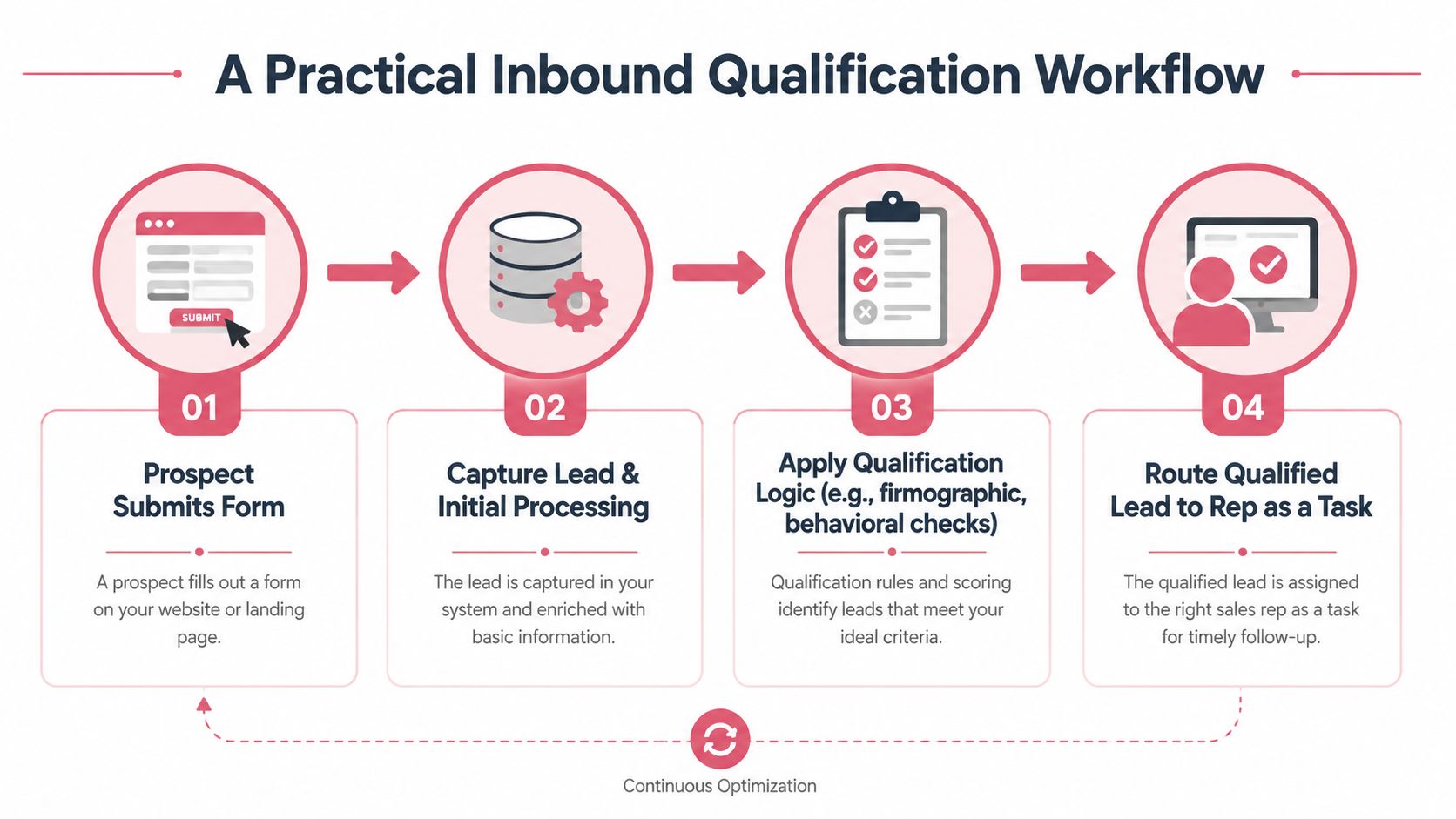
The workflow should begin before a rep sees the lead. A form submission creates a record, enrichment adds context, the decision engine applies rules, and the next owner receives a task with enough information to act.
Five operating steps
Capture only useful fields. Ask for the business email, company name, and one qualification field that supports routing. Extra questions should earn their place by improving decision quality.
Enrich the record. Append firmographic and technographic information from tools such as Clearbit or Apollo. If the data is missing, send the record to a fallback path instead of treating the absence of data as proof of poor fit.
Apply fit and intent logic. Evaluate ICP alignment, behavioral signals, existing CRM ownership, and current activity. A high score should identify urgency, while the qualification gate confirms that the account belongs in the sales motion.
Route the next action. A sales ready lead can create a CRM task, notify the assigned rep in Slack, and trigger a personalized email. A warm lead belongs in an SDR cadence. A poor fit should receive a relevant nurture or self serve destination, with the reason logged.
Record the decision. Store the score breakdown, rule outcome, owner, timestamp, and disposition in the CRM. Without that history, the team can't distinguish a bad rule from a missed SLA.
Design for speed and exceptions
The operating rule from Sendspark's inbound lead qualification workflow recommends responding within 5 minutes for top tier leads. That should be implemented as automation, not left as a reminder in a sales playbook. The workflow needs an owner lookup, territory fallback, duplicate handling, and after hours coverage.
A warm lead shouldn't sit idle because it didn't book a meeting immediately. Ways to qualify leads faster outlines the broader operational problem: speed depends on connected capture, enrichment, scoring, and routing rather than a single faster rep.
The workflow should also distinguish a bad lead from an incomplete record. Missing enrichment can justify an SDR review, but it shouldn't automatically create a disqualification. That exception path protects against false negatives without sending every unknown record directly to an AE.
How Yalc Automates Qualification Across the GTM Stack
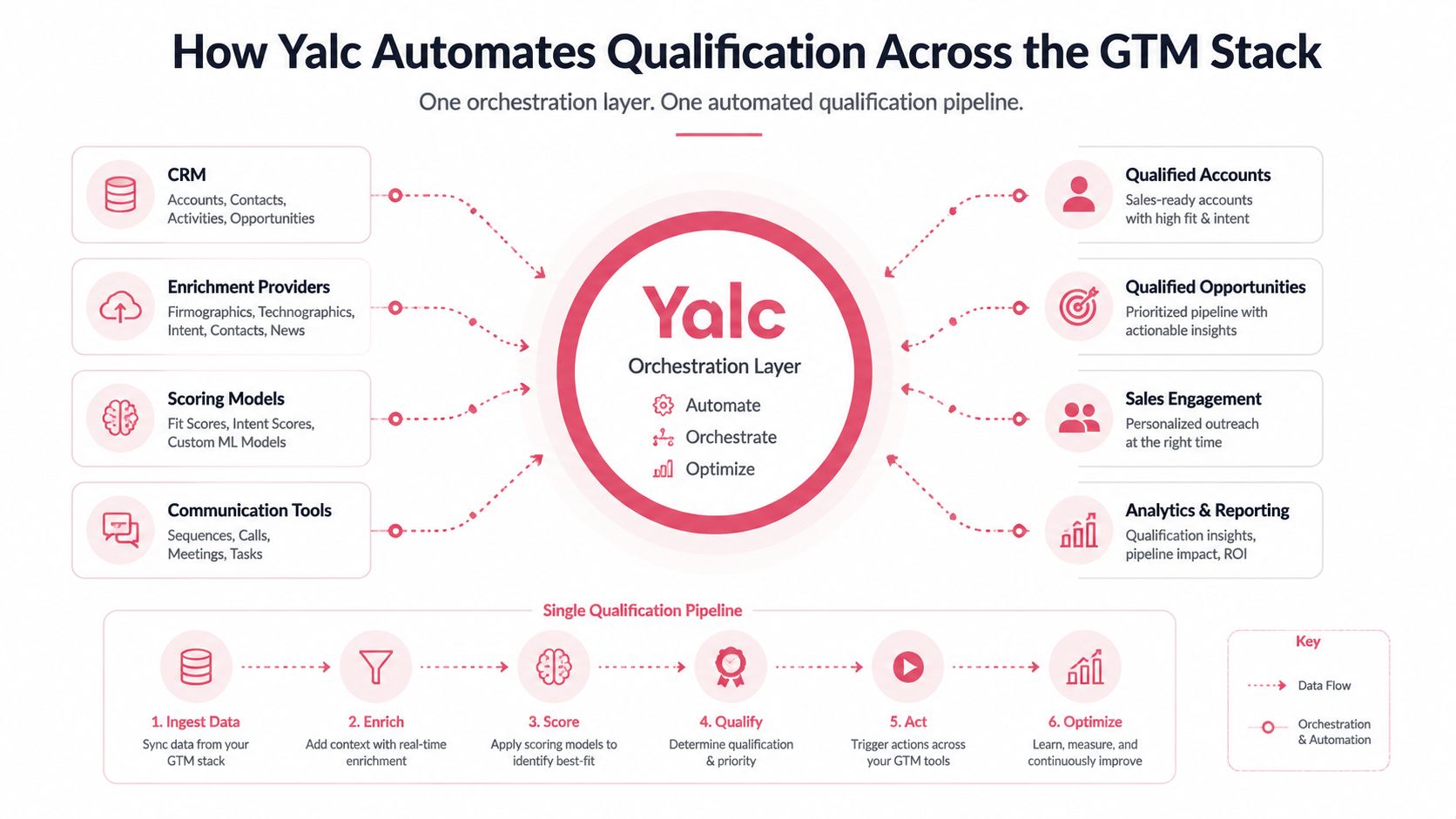
Qualification becomes easier to govern when one orchestration layer connects the systems that hold account data, behavioral activity, scoring logic, ownership, and communication. Without that layer, teams often distribute the process across CRM workflows, enrichment jobs, Slack alerts, and manual spreadsheet checks. Each handoff introduces another place for latency, duplication, or an unexplained decision.
Yalc can operate as that orchestration layer across the GTM stack. It can connect CRM data, enrichment providers, scoring models, and communication tools, then route a qualified record with its context attached. The useful design principle isn't automation for its own sake. It's that the system should preserve the reasoning behind each route while leaving high value judgment with the appropriate human.
Orchestration, feedback, and auditability
A connected qualification layer should handle more than score calculation:
- Context assembly: Add company size, ICP attributes, intent signals, ownership, and recommended talking points to the task.
- Decision logging: Record the inputs, score breakdown, threshold applied, timestamp, and final route.
- Feedback capture: Store why an AE or SDR rejected a lead so RevOps can identify patterns in fit, intent, or enrichment quality.
- Exception handling: Detect duplicates, respect account ownership, apply territory rules, and send after hours demand to an on call queue.
Yalc's broader approach to AI supported sales workflows is described in its sales automation AI resource. The relevant point for qualification is the separation between orchestration and judgment. Automation can gather evidence, apply stable rules, and surface exceptions. A human should still decide how to handle strategic accounts, ambiguous buying committees, or a prospect whose situation doesn't fit the model.
AI driven scoring deserves the same caution. A 2025 industry roundup cited AI driven scoring improving accuracy by 40%, 67% of B2B companies using AI to analyze behavior and predict buying intent, and predictive analytics raising qualified leads by 25%. Those claims are reported in Amplitude's qualified lead guide, but they shouldn't be treated as a reason to remove governance. The score can prioritize. The rules determine eligibility, and human escalation handles exceptions.
Metrics and Pitfalls That Separate Mature Systems From Fragile Ones
A qualification system is working when it improves the quality and speed of the next action, not when it produces a larger MQL number. RevOps should monitor speed to lead, SDR to AE acceptance, qualified to pipeline conversion, and time in stage before disqualification. These metrics show whether the gate is protecting seller time while preserving viable demand.
Three failure modes deserve regular attention:
- Threshold drift: The ICP changes, but the scoring bands remain fixed. Review fit and intent weights weekly against current acceptance and opportunity data.
- Routing bottlenecks: A qualified lead reaches an overloaded territory queue or an absent owner. Use ownership checks, fallback queues, and escalation alerts.
- Feedback loop failure: AEs reject records without structured reasons, so the scoring model never learns which signal misfired. Require a disposition code for every rejection.
Mature versus fragile qualification systems
| Dimension | Fragile System | Mature System |
|---|---|---|
| Decision logic | Personal rep judgment | Shared criteria and explicit thresholds |
| Routing | Manual queues and unclear ownership | Automated ownership, territory, and fallback rules |
| Speed | Response depends on task inspection | SLA is measured from submission to action |
| Feedback | Rejection reasons stay in conversations | Disposition codes return to RevOps |
| Governance | Rules remain unchanged | Weekly audits and quarterly recalibration |
| Exceptions | Unknown data is rejected | Gray zones receive human review |
A quarterly review should compare fit and intent signals with closed won outcomes, while weekly monitoring should catch threshold drift and routing failures sooner. Every misroute is a system data point, not automatically a rep performance issue. Teams that treat those records as evidence can refine the gate without making it harder for sellers to act.
Yalc connects qualification logic, enrichment, CRM routing, and GTM execution into an auditable workflow that keeps humans involved where judgment matters. Visit Yalc to evaluate how its orchestration layer can turn your qualification rules into a faster, more consistent operating system.