What Is Marketing Orchestration
Most advice about marketing orchestration starts in the wrong place. It tells teams to connect more channels, add more automation, or personalize more messages. That approach can increase activity without improving the buyer's experience or the quality of pipeline.
Marketing orchestration is a closed learning loop. A team forms a hypothesis about a market, account, message, or action. The system executes the play, measures the outcome, assigns a verdict, and uses the result to shape the next decision. Automation may send the sequence, but orchestration decides whether that sequence should exist, who should receive it, what should happen after a response, and whether the play deserves to run again.
Table of Contents
- What Marketing Orchestration Actually Means
- Automation Versus Orchestration
- The Four Components of a Mature Orchestration System
- Why Orchestration Drives Measurable Growth
- A Real B2B Scenario From Signal to Handoff
- Three Scopes of Marketing Orchestration
- How to Implement Orchestration for B2B GTM Teams
- How to Judge Whether Your Stack Is Orchestrating
What Marketing Orchestration Actually Means
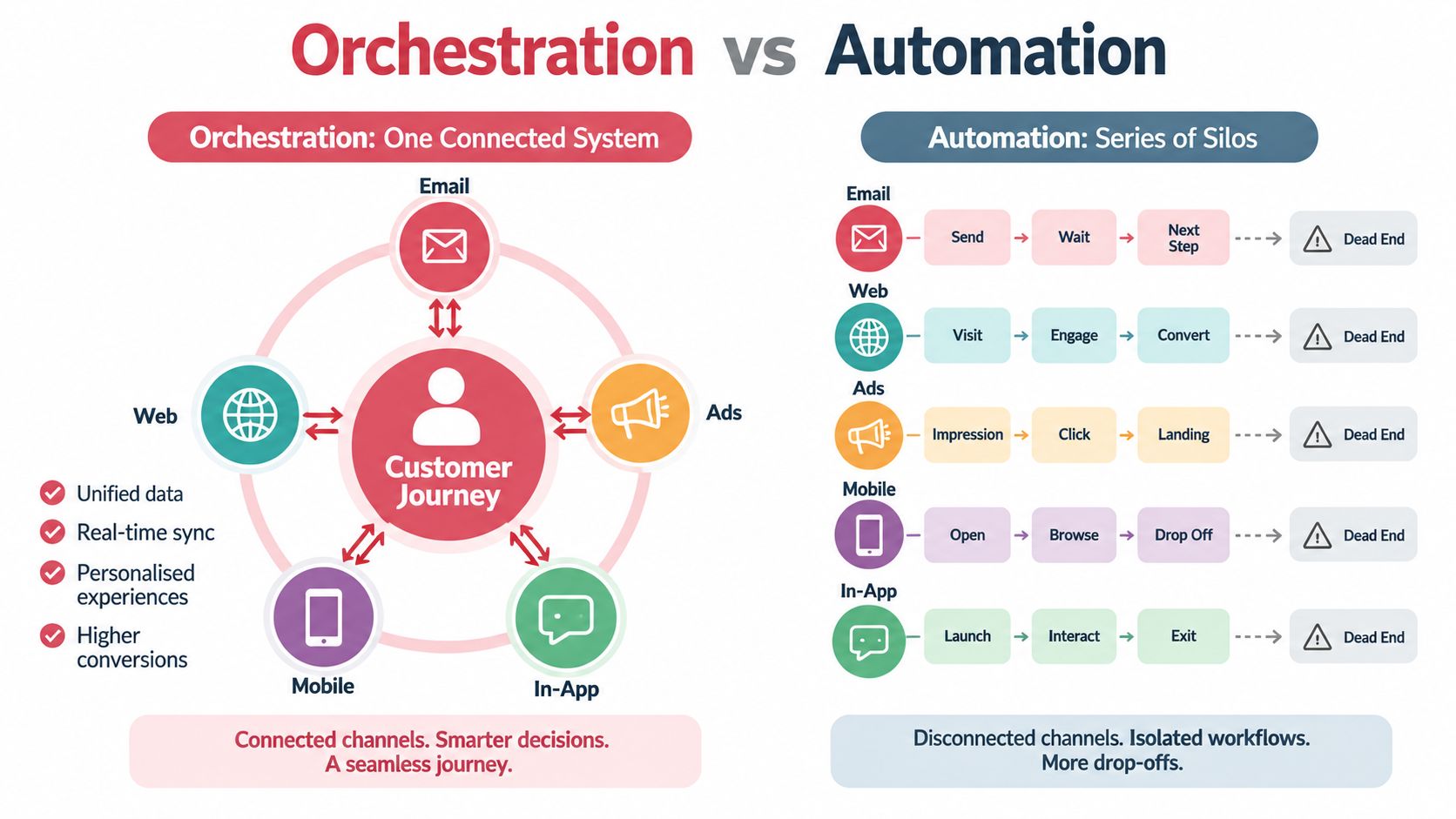
Marketing orchestration isn't multi channel automation with a better name. It treats the customer journey as one connected system, where a prospect's action in one place changes what happens elsewhere.
A website visit, an email reply, a sales call, and an account level buying signal shouldn't remain isolated events. They should update a shared customer state. That state determines eligibility, message, channel, timing, suppression rules, and the next internal handoff.
The practical loop has five parts:
- Observe signals: Capture firmographic context, content engagement, replies, sales activity, and other relevant events.
- Select an action: Decide what should happen next, rather than just following the next step in a fixed sequence.
- Execute: Deliver the action through email, the website, paid media, social, sales, or another appropriate channel.
- Measure: Track whether the action produced a useful outcome, not just whether it was completed.
- Learn: Record a verdict and update future play selection.
This structure prevents common failures, including contradictory offers, repeated questions, duplicate outreach, and generic nurture continuing after a prospect has entered an active sales process. Research reviewing 85 studies found that approximately 72% associated synchronized messaging across at least three channels with a significantly higher likelihood of conversion than single channel or poorly coordinated activity. The research review supports the operational case for treating the journey as the primary unit of work.
The roots of the idea go back to integrated marketing communications. The framework developed in the late 1980s and early 1990s, with Don Schultz, Stanley Tannenbaum, and Robert Lauterborn helping formalize it at Northwestern University's Medill School. The American Association of Advertising Agencies' 1993 definition focused on combining the strategic roles of advertising, direct response, sales promotion, and public relations for clarity and consistency. This overview of integrated marketing communications provides the historical context.
For B2B teams, the modern interpretation is straightforward. Research, targeting, content, outbound messaging, qualification, CRM updates, and follow up should reflect the same ICP and positioning. Teams that also care about how their brand appears in AI discovery can use Get Cited by the AI as a resource for understanding citation visibility, while keeping that signal connected to the broader journey. A useful companion concept is AI orchestration, where intelligence and action are coordinated rather than treated as separate functions.
Automation Versus Orchestration
Automation executes predefined steps. Orchestration adds a decision layer.
An automated system can send an email after a form submission, create a task in a CRM, or add a contact to a social audience. Those actions are useful, but they don't prove that the system understands what the prospect needs next. It may continue sending the same sequence after a reply, a sales conversation, or a change in account status.
Orchestration reads shared context before selecting the next action. If a prospect replies positively to an email, the system can suppress the scheduled social sequence, update qualification, route the account to sales, and attach the relevant engagement history to the CRM record. The point isn't to add more actions. The point is to prevent the wrong action from happening.
Practical test: If the system only launches predefined sequences and records completion, it is automation. If it suppresses conflicts, adapts after new signals, and records whether the play worked, it is orchestration.
The distinction becomes clearer when teams compare the operating questions:
| Automation asks | Orchestration asks |
|---|---|
| What task should run after this trigger? | What outcome is the team trying to produce? |
| Which email comes next? | Which channel and message fit the current state? |
| Was the step completed? | Did the play improve the journey or pipeline? |
| Can the workflow run without a person? | Where should the system pause for judgment? |
Automation remains an important layer. Email platforms, CRM workflows, sequencing tools, and lead scoring systems can all execute parts of an orchestrated motion. The failure comes from assuming that connecting those tools automatically creates a shared decision model.
Teams evaluating their stack should document what happens after a positive reply, a pricing page visit, a meeting booking, a sales accepted lead, and an opportunity creation event. If each channel continues its own workflow without checking the others, the stack is coordinated only on paper.
Simple integrations can still help. For example, teams that need to connect Slack and Zapier can reduce manual notification work, but a notification workflow alone isn't orchestration. It becomes part of orchestration only when the event changes eligibility, routing, execution, or measurement. The distinction also helps separate orchestration from sales automation, which typically focuses on repeatable sales tasks rather than the full decision system.
The Four Components of a Mature Orchestration System
A mature system needs four architectural components. Without them, teams usually get faster execution of fragmented workflows.
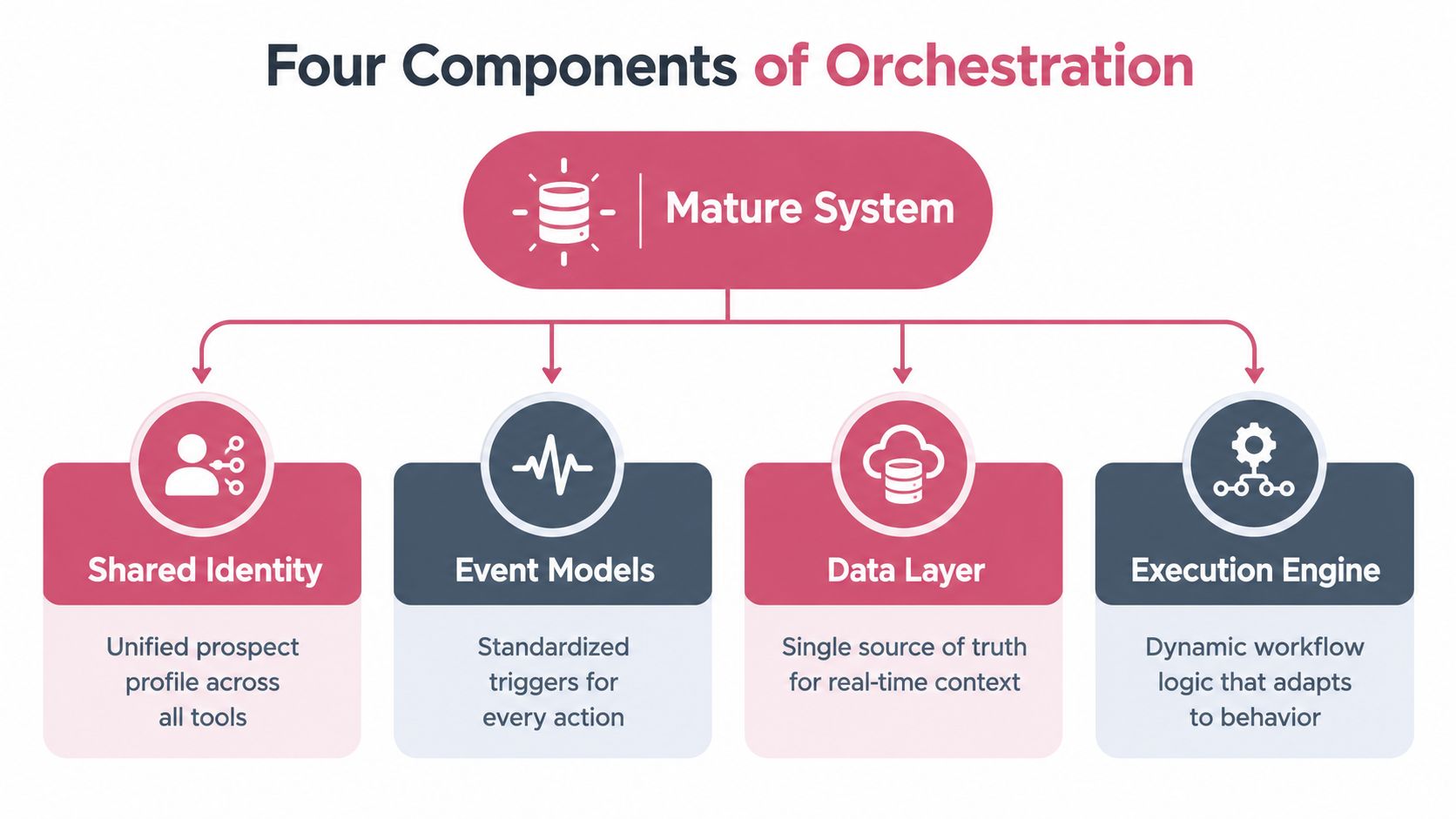
Shared identity
Every system needs a reliable way to understand that the person who visited the website is connected to the CRM record, the account, the sales activity, and the relevant campaign. The identity model should support both individual contacts and buying groups, because a single lead rarely represents the complete B2B journey.
A shared identity also needs clear ownership and permission rules. The system should know which records can receive marketing, which accounts are in active sales conversations, and which actions require approval.
Event models
An event model turns scattered activity into standardized signals. “Visited pricing page,” “replied positively,” “meeting booked,” and “opportunity created” should have defined meaning, required fields, and a known effect on customer state.
The model should also distinguish meaningful events from noise. A single page visit may warrant observation. A combination of repeated product research, a technical asset download, and a direct reply may warrant qualification and routing.
Data layer
The data layer keeps current context available to the decision engine. It should preserve the timeline of interactions, connect marketing and sales outcomes, and make the source of each event auditable.
API work is often where this architecture succeeds or fails. Teams planning integrations can use CRM API implementation tips to think through authentication, field mapping, error handling, and synchronization requirements before building decision rules.
Execution engine
The execution engine applies eligibility rules, chooses an action, and sends it through the right system. It also needs cross channel suppression. A person in an active sales conversation should not receive a generic nurture email while a separate outbound sequence continues.
A closed loop adds the final control. The system records the action, the result, the confidence of the conclusion, and the next disposition. Cross channel attribution modeling explains why last touch reporting alone hides the sequence that influenced a conversion. A mature system uses telemetry and outcome data to decide whether a play should be repeated, revised, or retired.
Why Orchestration Drives Measurable Growth
The business case for orchestration is not that coordinated campaigns look cleaner. It is that integrated operating models connect insight to action more effectively.
McKinsey identified a group of marketing “integrators” that combined data and creativity in their operating model. These companies grew revenue by at least 10% annually, compared with approximately 5% for the S&P 500 average, a rate roughly twice as high. Seventy two percent of integrators used advanced analytics for consumer insights, compared with 40% of average growth companies. These figures come from McKinsey's research on integrating data and creativity.
The useful interpretation is not that orchestration guarantees a particular growth rate. The evidence shows why integration belongs in the operating model. Teams gain an advantage when customer data informs targeting, creative stays consistent across touchpoints, sales receives context, and performance results influence the next decision.
A campaign dashboard can tell a team that a message received engagement. An orchestration system asks a harder question: did the message move the right account toward a qualified conversation, and should the team use the same play again?
That distinction changes how teams allocate effort:
- Research becomes input: Buyer and market signals shape audience selection and positioning.
- Execution becomes a controlled test: Each play has a defined audience, action, and expected outcome.
- Measurement becomes operational: Results change routing, suppression, timing, or future play selection.
- Knowledge compounds: Proven decisions remain available instead of disappearing into an old campaign report.
Poor orchestration creates the opposite effect. It increases the number of messages, tasks, and reports while leaving the underlying decisions unchanged. A team can automate every channel and still fail to answer which play created pipeline, which segment responded for the wrong reason, or which sequence should be retired.
The strongest operating model treats a campaign as a hypothesis, not a permanent asset. A team states what it expects to happen, runs the play within defined permissions, measures downstream results, and records what it learned. That is how orchestration becomes a growth capability rather than a campaign management layer.
A Real B2B Scenario From Signal to Handoff
A prospect visits a pricing page, downloads a technical whitepaper, and replies “yes” to an email. An automation system may register three separate events and continue the default nurture sequence.
An orchestrated system combines the events into one state change. The prospect has shown a pattern that warrants a different action, so the system evaluates the account, updates qualification, suppresses generic outreach, routes the opportunity to an appropriate sales owner, and writes the context into the CRM before the handoff.
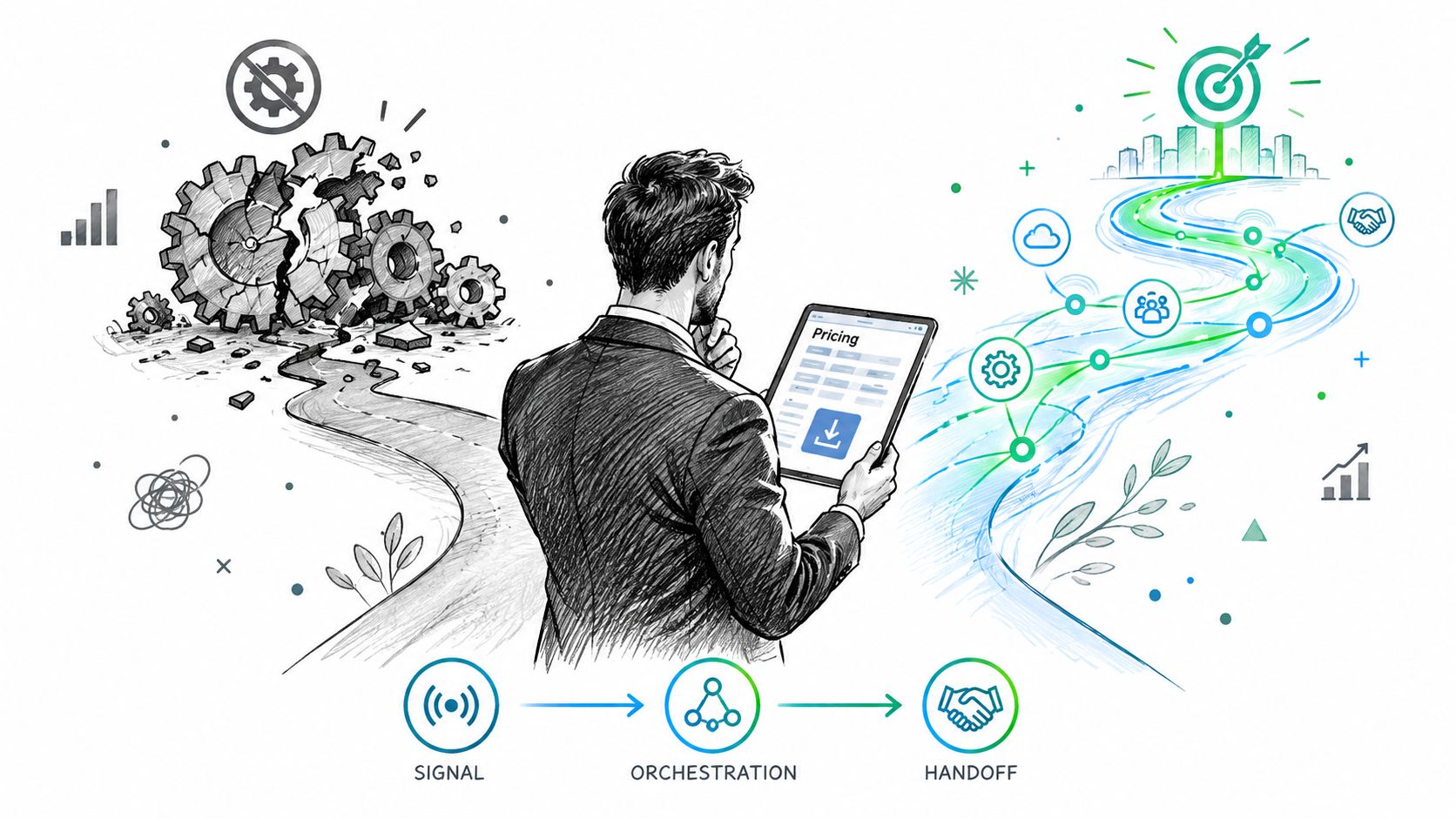
The workflow should be explicit:
- Capture the events: Record the pricing visit, technical download, and reply with timestamps and source context.
- Resolve the account: Associate the contact with the correct company, account tier, and existing CRM activity.
- Evaluate intent: Apply the agreed qualification logic instead of relying on one isolated action.
- Suppress conflicts: Remove the prospect from generic nurture and unrelated outbound activity.
- Route with context: Assign the account to sales with the content viewed, message received, and reply history attached.
- Measure the handoff: Track time to response, meeting outcome, and eventual opportunity progression.
The sales representative shouldn't open with a generic introduction. The CRM should show why the prospect was routed and which question the prospect may be trying to answer. Marketing should also stop treating the contact as an anonymous nurture record.
This scenario illustrates the difference between an event driven workflow and a sequence of independent triggers. The automation system executes tasks accurately but lacks the shared state required to choose a coherent next step. The orchestration system uses the same tools, but it coordinates their decisions around the buyer.
B2B teams also need to track the account rather than only the individual. One benchmark reports a median of 27 touchpoints for a closed B2B deal, while another cited benchmark reports an average journey lasting 211 days, with 76 tracked touchpoints, 6.8 stakeholders, and 3.7 channels. The B2B attribution benchmark supports evaluating contribution across the buying group and opportunity timeline rather than assigning all credit to a form submission or final sales call.
Three Scopes of Marketing Orchestration
Marketing orchestration operates at three different scopes. Confusing them leads teams to solve a narrow coordination problem while missing the commercial one.
Customer journey orchestration
This scope manages the experience of an individual across email, web, social, advertising, sales, and other touchpoints. It determines what the person should see next, when to suppress a message, and how a new behavior changes the journey.
Marketing operations orchestration
This scope coordinates the internal work required to produce and launch campaigns. It covers approvals, content production, audience preparation, tracking conventions, handoffs, and reporting. It can reduce operational friction, but a well organized launch process doesn't necessarily create a better buyer journey.
B2B GTM orchestration
This scope coordinates account level plays across marketing, sales, revenue operations, and customer facing teams. It connects multiple stakeholders, account priorities, qualification rules, sales activity, messaging, and commercial outcomes.
For most B2B leaders, the third scope deserves priority. An individual journey matters, but account decisions determine whether marketing should create demand, support an active opportunity, expand within an account, or suppress generic activity.
| Scope | Primary unit | Main decision |
|---|---|---|
| Customer journey | Individual | What should this person receive next? |
| Marketing operations | Internal process | What must the team approve, produce, or launch? |
| B2B GTM | Account and opportunity | Which coordinated play should move this account forward? |
The scopes should connect, but they shouldn't be treated as interchangeable. A sales accepted lead can change the individual journey, trigger an internal notification, and move the account into a different GTM play. The decision model must preserve those relationships.
Account-level orchestration also makes suppression more useful. If one stakeholder enters an active sales conversation, marketing may need to adjust messaging for the entire account, rather than just removing one contact from a mailing list.
How to Implement Orchestration for B2B GTM Teams
Implementation should start with decisions, not software. A team that buys a platform before defining state changes, outcomes, and approval boundaries usually ends up automating existing confusion.
Define success before execution
Choose the measures that determine whether a play worked. Useful metrics include qualified meeting rate, positive reply rate, pipeline created, time to response, unsubscribe rate, and cost per opportunity. These measures are more useful for orchestration than reporting only the final interaction before conversion.
Attribution rules must be documented before launch. A first touch model emphasizes the interaction that introduced the buyer. A last touch model emphasizes the interaction nearest conversion. A full path model distributes credit across the journey and can give additional weight to milestone events. Adobe's B2B measurement guidance explains why teams should connect the chosen rule to pipeline, revenue, win rate, and cycle time.
Map the state changes
List the events that matter for the ICP. Mark which events only add context and which events change eligibility, routing, or messaging.
A useful map includes:
- Research signals: Content views, search behavior, technical questions, or account activity.
- Intent signals: Pricing engagement, reply sentiment, meeting requests, or product interest.
- Process signals: Qualification changes, sales acceptance, opportunity creation, or stalled activity.
- Outcome signals: Meeting results, opportunity progression, closed business, or disqualification.
Build a verdict loop
Every play should begin as a hypothesis. After execution, the system should assign a verdict such as hypothesis, validated, or proven only when the result clears predefined thresholds across comparable cohorts.
This protects teams from promoting a play because it generated more activity. The system should also monitor bias from segment mix, channel availability, and sample size before treating an outcome as reliable.
Add governance before autonomy
Sensitive actions need human approval. That includes sending high volume outbound messages, changing account status, making claims that require legal review, and taking actions involving sensitive customer data.
Use scoped permissions so each workflow can access only what it needs. Keep immutable run telemetry, record approvals, version playbooks, and make it possible to reconstruct why the system selected an action. Teams evaluating GTM orchestration tools with AI should treat these controls as core requirements, not optional administration features.
Start with one high value journey, such as inbound qualification or a focused outbound motion. Stabilize the identity model, event definitions, suppression logic, and measurement before expanding to more channels.
How to Judge Whether Your Stack Is Orchestrating
The simplest evaluation is behavioral. Ask what the stack does when a prospect changes direction.
Can it suppress conflicting outreach after a positive reply? Can it change the next step after a high intent action? Can it route the account with the relevant context? Can it show whether the play improved pipeline instead of merely increasing sends, clicks, or completed tasks?
A stack that cannot answer those questions is probably automating channels rather than orchestrating a journey.
Use this practical audit:
- State awareness: Does every important tool receive a consistent view of the contact and account state?
- Decision logic: Can the system choose among actions, or does it only advance a fixed sequence?
- Suppression: Does a sales handoff stop irrelevant marketing and outbound activity?
- Outcome tracking: Does the play connect to qualified meetings, pipeline, opportunity outcomes, and response time?
- Learning: Does the team promote successful plays, revise uncertain ones, and retire weak ones?
- Governance: Are sensitive actions paused for approval and recorded in an audit trail?
Multi touch attribution and marketing mix modeling answer different questions. Multi touch attribution assigns fractional credit to tracked individual interactions. Marketing mix modeling uses aggregated time series data, commonly spend and revenue, to estimate the marginal contribution of channels. This comparison of attribution methods explains why mature teams may need both, one for campaign optimization and another for budget allocation when activity is difficult to identify at person level.
The final standard is accountability. Each play should have a hypothesis, a success measure, a verdict, and a decision to repeat, revise, or retire. That is the shift from automation to orchestration, from launching sequences to building a system that learns which decisions move the right accounts forward.
Yalc gives B2B teams a unified GTM API, coordinated playbooks across research, enrichment, qualification, outreach, CRM updates, and reporting, plus telemetry, scoped permissions, and human approval for sensitive actions. Visit Yalc to evaluate how a governed learning loop could fit the team's existing tools and GTM process.