What Is Sentiment Analysis and How GTM Teams Use It
Sentiment analysis is an NLP task that identifies opinions and attitudes in text and classifies them as positive, negative, or neutral, often at sentence or document level. It can turn scattered replies, reviews, surveys, and call notes into a graded signal for pipeline, customer health, and retention decisions.
A revenue team usually feels the problem before it names it. Sales reps add buyer reactions to CRM notes, customer success managers paste renewal concerns into account records, marketing watches comments under a campaign, and support collects a growing queue of open text. The signal is there, but nobody can read every message closely enough to detect the pattern early.
Sentiment analysis helps sort that text by expressed attitude. It doesn't replace judgment, and it doesn't reveal exactly what a buyer will do. Used properly, it gives GTM teams a repeatable way to find conversations that deserve attention, compare feedback across segments, and track whether a message, product change, or service interaction is improving the customer experience.
The useful mental model is a graded intelligence layer, not a positive or negative label. A simple model can classify a sentence. A stronger operating system can connect sentiment to an account, topic, stage, product area, or next action. The difference matters when the question is not “How do people feel?” but “Which account needs intervention, why, and who should act?”
Table of Contents
- Why Sentiment Analysis Matters for Busy GTM Teams
- What Sentiment Analysis Actually Means
- How Sentiment Analysis Works Under the Hood
- Where GTM Teams Apply Sentiment Analysis Every Day
- Choosing the Right Sentiment Approach for Your Data
- Why Sentiment Analysis Fails on Real World Text
- Best Practices to Make Sentiment Analysis Reliable
Why Sentiment Analysis Matters for Busy GTM Teams
A sales leader might open the CRM on Monday and find dozens of call summaries. A marketing manager might have replies across social channels, campaign comments, and community discussions. A customer success leader might know that several accounts sound uneasy, without knowing whether the issue is pricing, implementation, product capability, or a single unresolved ticket.
Sentiment analysis creates an initial sorting layer for that work. The established definition is an NLP task that identifies opinions, attitudes, and sentiments in text, commonly across reviews, surveys, and social media posts, as described in this overview of sentiment analysis as an NLP and machine learning task.
For GTM operators, the value comes from connecting that classification to a workflow:
- Pipeline review: A buyer's note that says the product is “interesting, but difficult to justify internally” should not sit beside an enthusiastic feature comment as if both indicate the same buying position.
- Retention work: Several negative comments about onboarding may deserve a customer success review, even when the account's overall relationship remains positive.
- Campaign decisions: A campaign can attract attention while creating confusion about the product's category or promise. Sentiment helps expose that difference.
- Voice of customer work: Product and marketing teams can group reactions by topic instead of relying on the loudest individual comment.
Practical rule: Sentiment is most useful when it changes who acts, what they investigate, or how they prioritize the queue.
The output alone isn't a decision. A negative label may indicate a serious account risk, a harmless complaint about a minor preference, or a neutral description of a business constraint. GTM teams need the surrounding text, the topic, the account context, and a confidence signal before taking consequential action.
This guide focuses on that operating judgment. It starts with the basic classification model, moves into how systems produce their scores, then applies the idea to feedback, social listening, campaign analysis, and sales conversations. It also sets clear boundaries for automation, because benchmark performance doesn't remove the need for representative data, bias checks, or human review.
What Sentiment Analysis Actually Means
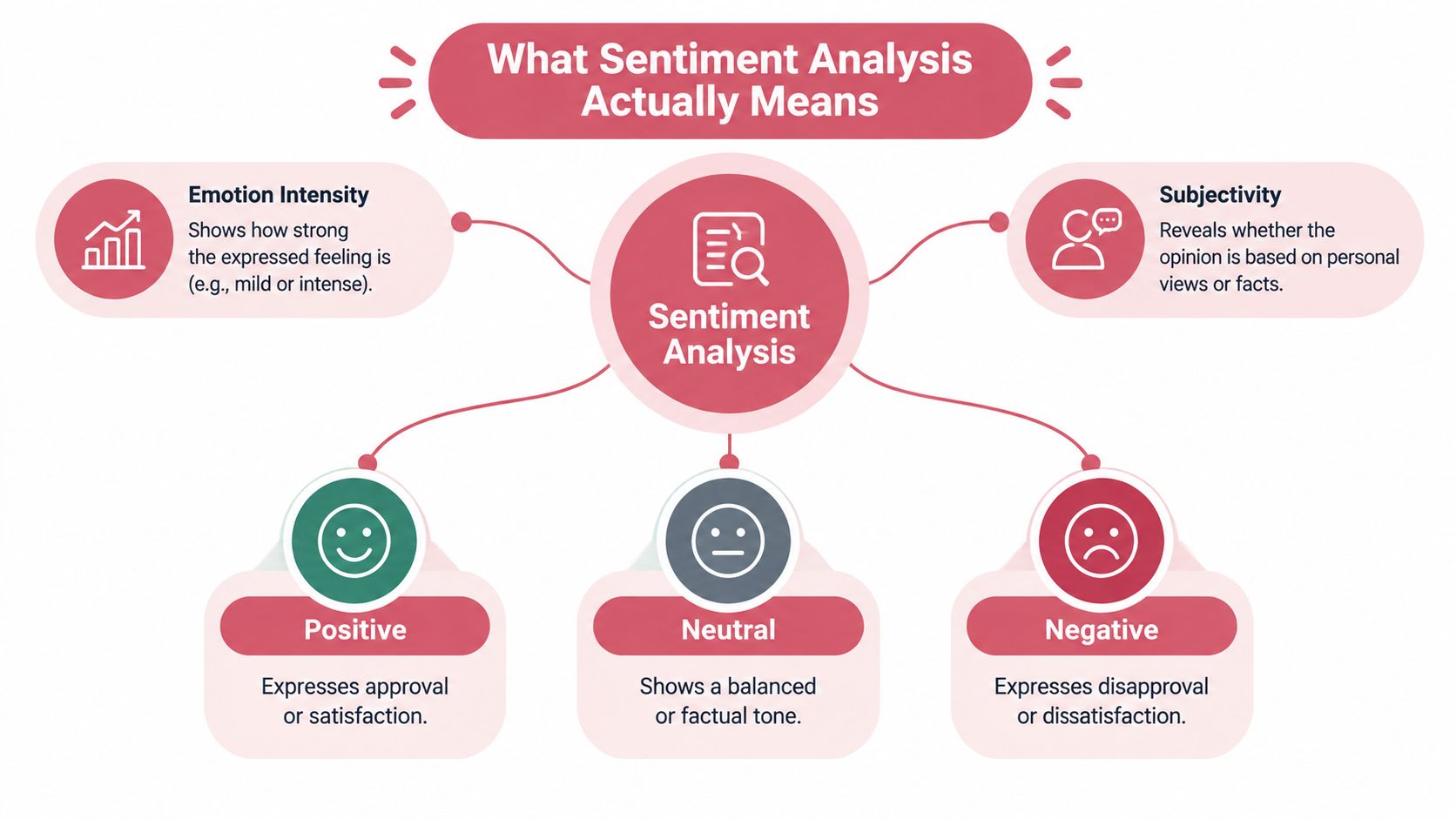
The simplest version answers one question: Does the text express a positive, negative, or neutral attitude? This three way classification is a practical baseline, and sentiment systems can apply it to a sentence or to an entire document, depending on the use case, as described in this technical discussion of sentiment analysis classifications and granularity.
Consider three CRM notes:
- “The implementation team was responsive and helpful.” Positive.
- “The reporting workflow is slowing our weekly review.” Negative.
- “The procurement group is reviewing the security terms.” Neutral.
The model isn't counting pleasant or unpleasant words and stopping there. It is estimating the attitude expressed toward a subject. “Responsive” may be positive when it describes support, while “slow” may be negative when it describes a workflow. The object of the sentiment matters.
Classification has more than one level
A document level score can tell a team that a support thread is broadly negative. A sentence level score can isolate the exact complaint inside a long conversation. Aspect based analysis goes further by linking sentiment to a specific subject, such as onboarding, integrations, pricing, or reporting.
Fine grained systems can also use an intensity scale rather than only three labels. One common approach classifies text as very positive, positive, neutral, negative, or very negative, sometimes using a 1 to 5 star style scale, which gives teams a more precise way to rank feedback and compare changes over time, as outlined in this plain language explanation of fine grained sentiment analysis.
Sentiment analysis is a classification problem with context, not a keyword count.
That distinction prevents a common mistake. A buyer can write, “The new workflow is not bad,” which contains a positive word but communicates qualified approval. Another buyer can write, “Great, another dashboard,” where the literal word is positive but the intended tone may be sarcastic. A useful implementation preserves the original text and shows the evidence behind the label.
Teams evaluating their options can also compare specialized customer feedback analysis models when deciding whether their data needs simple labels, aspect level outputs, or richer customer experience signals.
How Sentiment Analysis Works Under the Hood
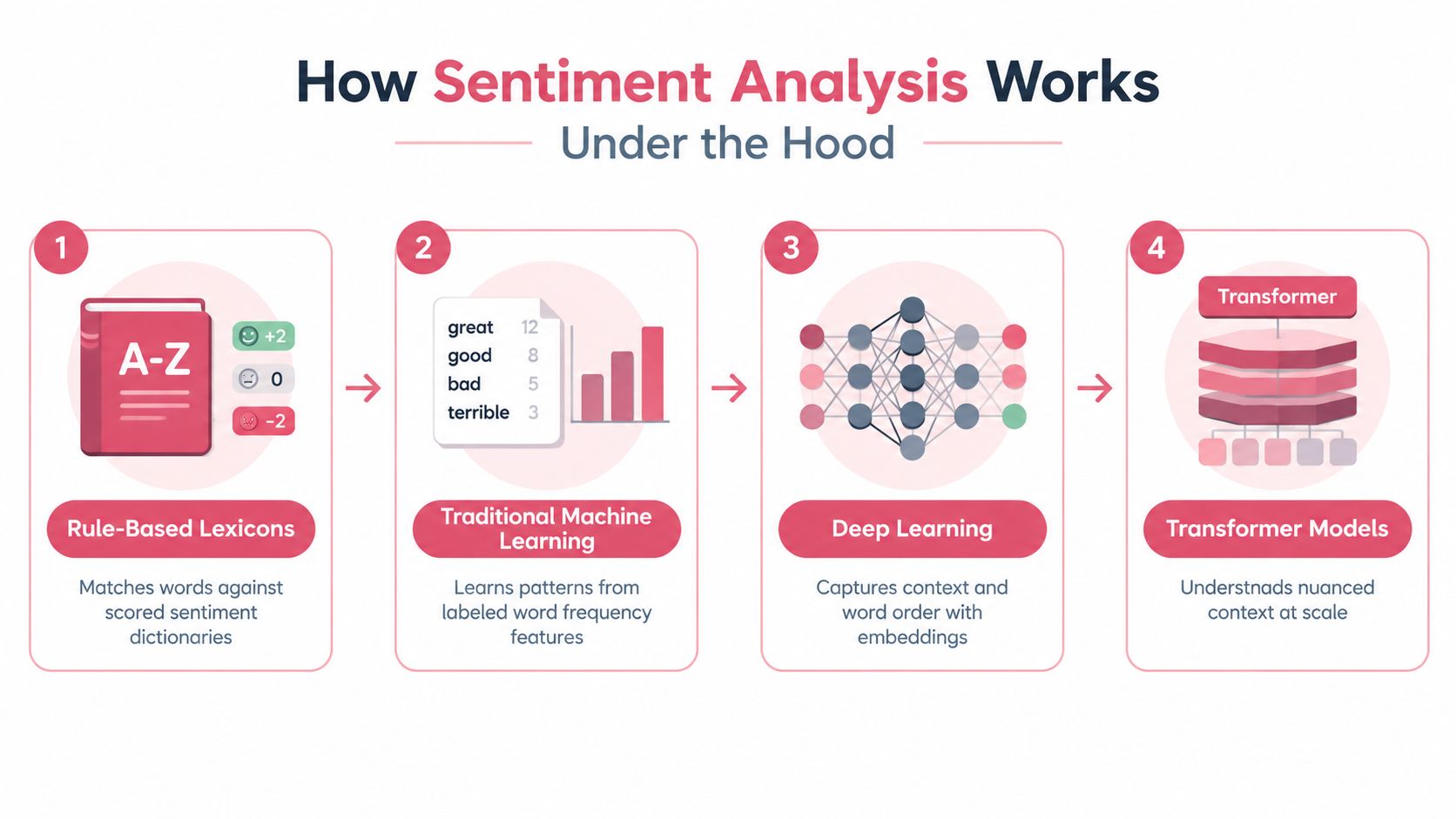
The model family determines what context the system can use, how much labeled data it needs, and how easily an operator can explain a result. A useful progression runs from dictionaries, to traditional machine learning, to neural models, and finally to transformer encoders.
Four common approaches
Rule based lexicons match words or phrases against a sentiment dictionary. “Helpful” may carry a positive score, while “broken” may carry a negative score. This approach is easy to inspect and can work well for a narrow, stable vocabulary, but it struggles with negation, sarcasm, unfamiliar jargon, and sentences where the same word changes meaning by context.
Traditional machine learning learns from labeled examples using features such as word frequency or word sequences. A classifier can learn that certain combinations often appear in negative support messages. It usually offers a practical balance of cost and interpretability, but bag of words features don't represent long range context particularly well.
Deep learning models use embeddings and neural networks to represent words and their relationships. They can account for word order more effectively than simple frequency features, though their behavior can be harder to inspect and their results still depend heavily on the data used for training.
Transformer encoders use self attention to evaluate relationships across a sequence. That helps them handle context and negation more effectively than bag of words features. In one benchmarking study, RoBERTa reached 94.1% mean accuracy and F1, compared with 92.8% for BERT and 92.1% for DistilBERT, with ROC AUC and PR AUC above 0.97 across the models, according to the reported transformer sentiment benchmark.
The output needs useful evidence
A production system should expose more than a label. It should preserve the source text, show the target of the sentiment, provide a confidence value, and identify the topic or aspect that influenced the result. A sentence such as “The product is powerful, but setup is painful” contains both approval and criticism. A single document score hides that split.
The training data shapes every output. If the examples come mostly from polished reviews, the model may perform poorly on abbreviated call notes, fragmented chat messages, or industry language. Teams should ask which channels, languages, customer segments, and sentiment cases the model has seen.
For teams tracking how language about a company changes across public channels, a practical guide to AI brand sentiment tracking can help frame the difference between simple classification and ongoing monitoring. The operating question remains the same: can the result support a specific action, and can a human verify why the system produced it?
Where GTM Teams Apply Sentiment Analysis Every Day
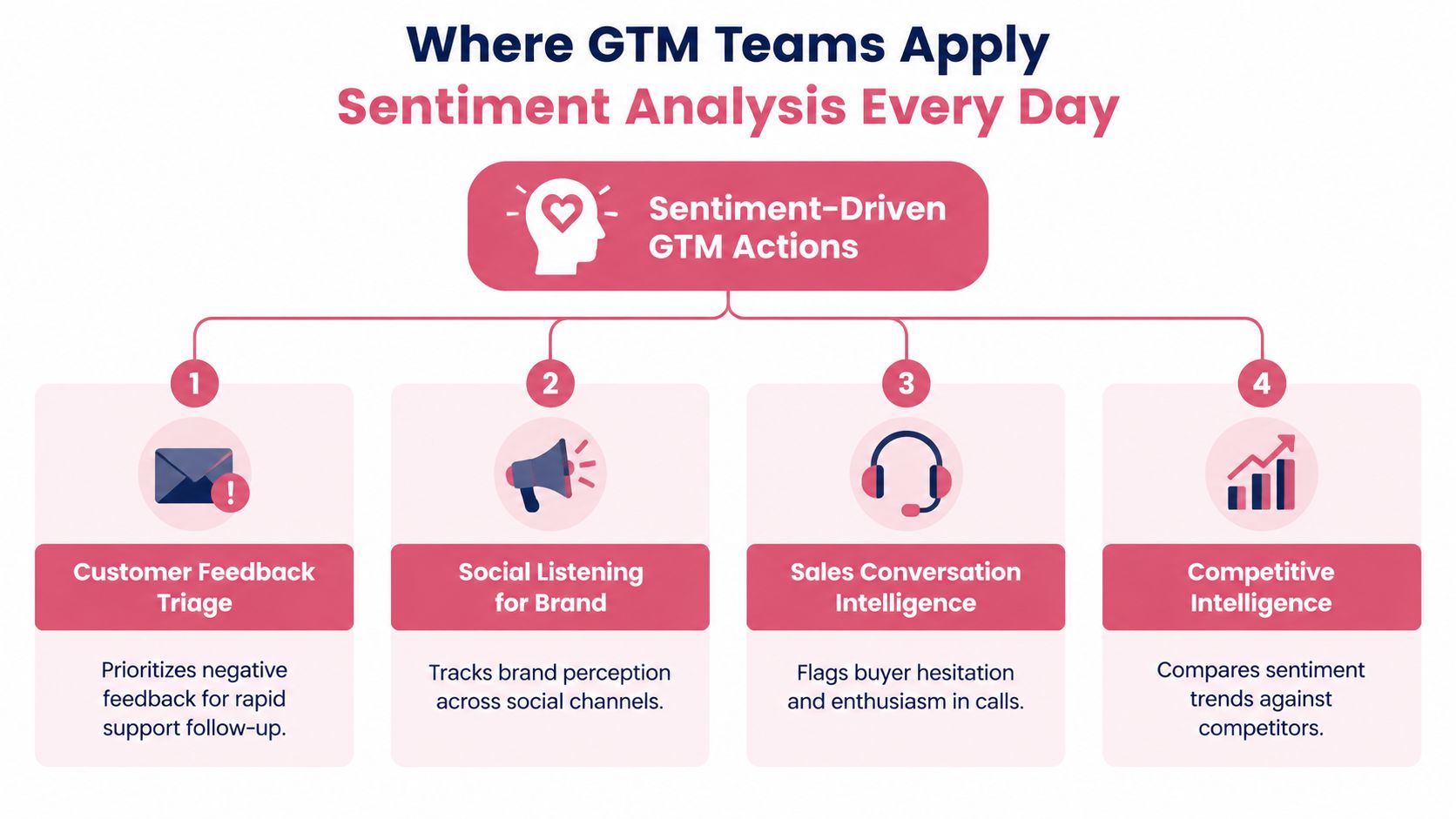
Sentiment becomes commercially useful when it changes a queue, a message, or an account plan. The strongest workflows pair the text with a topic and an owner, then let the team review the evidence before acting.
Customer feedback triage
A customer writes, “The new reporting view looks clean, but exporting data still fails during our weekly close.” A basic system might mark the message as mixed or negative. A more useful workflow attaches the negative signal to data export, routes it to the product or support owner, and keeps the positive comment as context.
The same approach works across support tickets, surveys, review sites, and success notes. Negative feedback can receive earlier review, while neutral feedback can remain available for trend analysis rather than competing for immediate attention.
Social listening and competitive signals
A social post may praise a competitor's onboarding while criticizing its reporting. Another post may mention a company positively but express frustration with its pricing. Sentiment analysis helps separate the company named in the post from the subject of the opinion, which is essential for brand and competitive work.
Teams comparing social listening products can use an Xholic AI tool comparison as a starting point for understanding how monitoring approaches differ. The selection should follow the channel, volume, language mix, and response workflow, not the attractiveness of a dashboard.
Campaign and message decisions
Suppose a campaign receives many reactions that describe the message as clear, but several comments say the offer doesn't apply to the reader's role. Overall sentiment may look acceptable while the campaign still attracts the wrong audience.
The operator should connect sentiment to message theme, audience segment, and conversion behavior. A campaign reporter can then flag which angles generate useful interest, which create confusion, and which draw negative reactions from the intended buyer. Sentiment won't prove campaign ROI on its own, but it can explain why a message is or isn't moving the right people.
Sales conversation intelligence
A call note that says, “The team likes the workflow, but legal won't approve data access,” contains enthusiasm and an obstacle. The next action isn't to label the account positive or negative. It is to assign the data access objection, notify the right stakeholder, and update the opportunity plan.
Conversation systems can score buyer language, detect hesitation, and surface repeated objections across calls. CRM workflows can then send the relevant context to the account owner. Teams building this connection between conversation data and CRM actions can review GTM automation for CRM workflows as one example of the integration problem to solve.
The best implementation treats sentiment as a routing signal. It doesn't make a renewal decision or change an opportunity stage without the account context and a human owner.
Choosing the Right Sentiment Approach for Your Data
The right approach depends less on what is newest and more on what the data needs. A small volume of consistent survey responses may not require a complex model. A multilingual stream of social posts, sales notes, and support messages needs stronger context handling, better evaluation, and a clear review process.
| Approach | Best For | Tradeoff to Expect |
|---|---|---|
| Lexicon rules | Stable vocabulary, transparent first pass, simple surveys | Easy to inspect, but weak on context, sarcasm, and domain language |
| Traditional machine learning | Labeled internal data and repeatable classification | More adaptable than word lists, but dependent on feature design and label quality |
| Transformer models | Context heavy text, negation, varied language, aspect level analysis | Stronger contextual performance, with greater data, evaluation, and governance demands |
| LLM based workflows | Rich explanations, extraction of topics and nuanced feedback | Flexible outputs need strict schemas, cost controls, and human checks |
Document level sentiment is suitable when the team needs a broad view of a review, survey response, or account note. Sentence level analysis works better when long notes contain several opinions. Aspect based sentiment is the better fit when the decision depends on whether the complaint concerns pricing, implementation, integrations, or support.
A practical selection test
Start with the simplest approach that can answer the operational question.
- Use a label only: when the team needs to route an obvious support queue.
- Use intensity: when the team needs to rank urgency or compare feedback over time.
- Use aspect sentiment: when one message can contain praise for one area and concern about another.
- Use human review: when the output could affect renewal handling, account escalation, employee evaluation, or a public response.
Sentiment shouldn't replace a broader qualification framework. Teams that want to connect attitude signals with fit, behavior, and buying readiness can place the model alongside a lead scoring framework, rather than treating sentiment as a complete account score.
Why Sentiment Analysis Fails on Real World Text
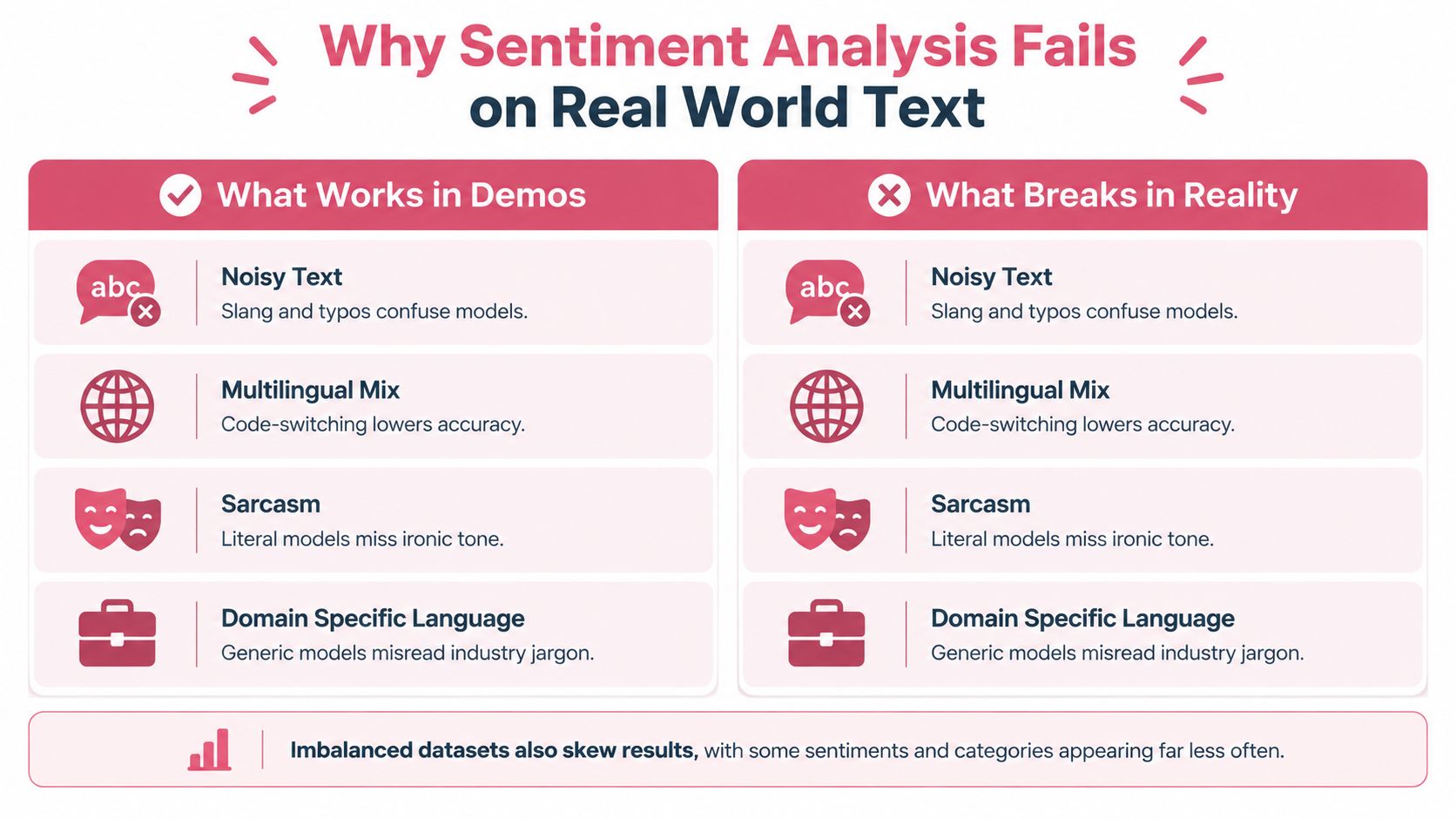
A model can perform well on a benchmark and still fail in a GTM inbox. Real messages contain abbreviations, typos, copied templates, mixed languages, emojis, sarcasm, and industry terms that don't appear in the training examples. Recent reviews identify persistent gaps in sarcasm, irony, multilingual handling, and domain dependence, while social media heavy data can introduce noise, bias, privacy concerns, and weak generalization, as discussed in this review of sentiment analysis limitations and research gaps.
Accuracy can hide the wrong failure
Class imbalance creates another trap. In financial text, neutral statements can dominate, so a model may appear strong while missing the less common positive or negative cases that matter most. The Financial PhraseBank is designed for finance and economic sentiment evaluation, and its use of macro averaged F1 alongside accuracy reflects the need to assess each class rather than let the largest class determine the impression of quality, as explained in this benchmark discussion of financial sentiment evaluation.
A similar issue appears in B2B feedback. If most comments are neutral status updates, overall accuracy won't tell a retention team whether the model can find serious dissatisfaction. Evaluation should reflect the action the team cares about, including recall for urgent negative cases and precision when false alarms create expensive manual work.
A benchmark score describes performance on that benchmark. It doesn't certify the model for a different market, channel, or customer population.
Automation needs a boundary
Human review remains necessary when text is ambiguous, sarcastic, multilingual, or tied to a high consequence action. A 2025 public health evaluation reported 86.12% accuracy for RoBERTa large, with lower scores for TextBlob and VADER, yet broader reviews still emphasize interpretability, resource demands, algorithmic bias, and validity risks when data is imbalanced or unrepresentative, according to this evaluation of sentiment analysis reliability in public health contexts.
For GTM teams, that means confidence thresholds should control routing, not authorize irreversible action. Low confidence cases should enter a review queue. High confidence cases can automate tagging or prioritization when the team has validated the behavior against real examples.
Best Practices to Make Sentiment Analysis Reliable
Reliable sentiment analysis starts with the data, not the model. Teams should sample messages from the actual channels they plan to use, remove duplicated boilerplate, protect sensitive information, and check whether the examples represent their languages, segments, products, and customer stages.
Build an operating checklist
- Define the decision first. Decide whether the output will route support, flag account risk, inform campaign analysis, or support research. A label without an owner usually becomes dashboard decoration.
- Design labels around the work. Positive, negative, and neutral may be enough for triage. Add intensity, topic, or aspect labels only when they change an action.
- Create a reviewed sample. Have people label representative messages, including sarcasm, mixed opinions, short replies, jargon, and neutral business updates. Use the sample as a test set rather than evaluating only on training examples.
- Measure each class. Review precision, recall, and macro averaged F1 when imbalance matters. Compare errors by channel, language, segment, and topic.
- Set human approval points. Require review before changing an account risk status, escalating a renewal, publishing a public response, or taking action based on ambiguous language.
- Monitor drift. Product names, campaigns, competitors, and customer vocabulary change. Recheck examples when the business or channel changes.
- Record the verdict. Log whether the sentiment signal led to a useful action. Retain the original text and the reviewer's correction so the workflow improves.
Sentiment should be treated as a hypothesis about expressed attitude. The team validates it against the message and the downstream outcome, then promotes only the patterns that hold up in its own environment. That discipline fits the broader practice of AI orchestration for coordinated GTM workflows, where agents need clear permissions, observable steps, and human control around sensitive actions.
A sensible pilot uses one feedback stream, one owner, and one decision. For example, a customer success team can classify renewal related notes by sentiment and onboarding topic, review the flagged cases, and compare the results with account outcomes before expanding to social or sales data.
Yalc gives GTM teams a unified operating layer for sentiment, CRM, campaign, and customer workflows, with reusable playbooks, audit trails, scoped permissions, and human approvals for sensitive actions. Visit Yalc to see how an AI native GTM system can turn sentiment signals into controlled, measurable pipeline and retention plays.